
Sedation Complications Urgencies and Emergencies Medical Emergency Kit
- Slides: 26
Sedation Complications, Urgencies and Emergencies
Medical Emergency Kit
Golden Rule In cases of trouble – Always verify adequate respirations of your patient Ventilate Reverse
Sedation Emergencies Nausea/Vomiting Aspiration Paradoxical reactions Oversedation Laryngospasm
Nausea/Vomiting Most commonly associated with – Opioids Patient movement will aggravate – Swallowing blood – Anxiety
Treatment of Nausea and Vomiting… Promethazine (Phenergan) – 25 mg IV, IM, oral or rectal – Additive sedative effect Trimethylbenzamide (Tigan) – 200 -250 mg oral, rectal, IM Questionable efficacy Ondansetron (Zofran) – 4 mg IV or IM
Aspiration Defined – Inhaling of vomit into lungs Causes – Depression of protective reflexes with depressed level of consciousness – Increased N/V associated with opioids – Swallowing of blood
Aspiration Damage: – Particles/fluids Cellular response to lungs (chemical burn) Respiratory lining breakdown Surfactant destroyed Alveoli collapse becoming fluid filled – Large particles Mechanical airway obstruction Atalectasis, asphyxia, death
Aspiration Treatment – Aggressive suctioning – Head down position – Transfer to hospital quickly
Aspiration Prevention – Identify prone patients Anxiety Problems with opioids – NPO solids > 6 hours – NPO clear liquids > 2 hours – Vigilant suctioning of blood – Prophylactics?
Paradoxical Reactions… Benzodiazepines primary culprit – More common in women and children Crying Anger Agitation Combativeness Pruritis Disorientation Dysphoria Tachycardia
Paradoxical Reactions… Benzo’s remove inhibitions in some patients Patients with mental disorders more likely Treatment – Flumazenil
Oversedation… Any level of sedation or anesthesia can be achieved by any route – Inhalational – Orally – Parenteral
Oversedation… Your patient is clearly oversedated when they do not… – Maintain their own patent airway – Breath on their own – Respond to verbal commands
Oversedation… Understand dosing schedules Understand pharmacokinetics of medications used – Drug—Drug interactions – Increased concentrations of midazolam and triazolam Erythromycin Ketoconazole/iatraconazole Grapefruit juice Protease inhibitors Verapamil/diltiazem
Oversedation… Overuse of opioids often results in… – Respiratory depression – Decreased depth, rate and drive – Decreased skeletal muscle tone
Respiratory Depression… In the presence of respiratory depression patients may… – Obstruct Muscle relaxation Tongue position – Hypoventilation to the point of apnea
Oversedation… Does not necessarily define a state of emergency, but you must be able to… – Recognize the situation – Be able to get out of it skillfully – Have the courage to ask for help
Oversedation… Oversedation will generally imply that your patient does not… – Hold his own airway – Breath spontaneously – Both
Oversedation… You absolutely, positively Must be able to distinguish between the two
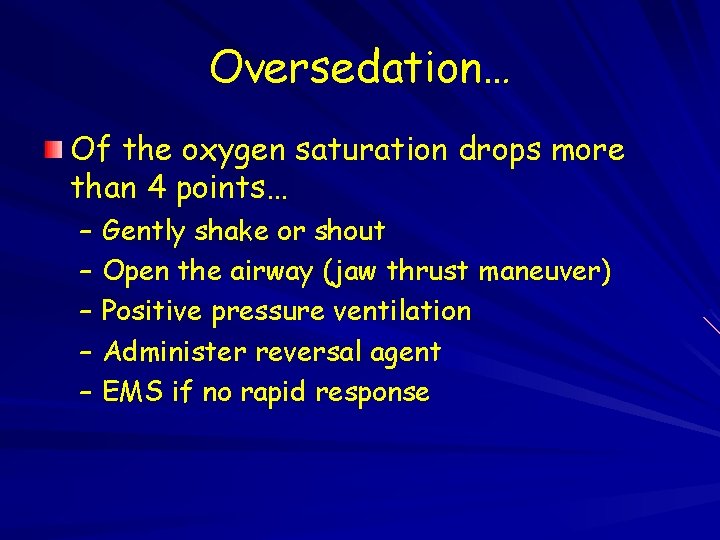
Oversedation… Of the oxygen saturation drops more than 4 points… – Gently shake or shout – Open the airway (jaw thrust maneuver) – Positive pressure ventilation – Administer reversal agent – EMS if no rapid response
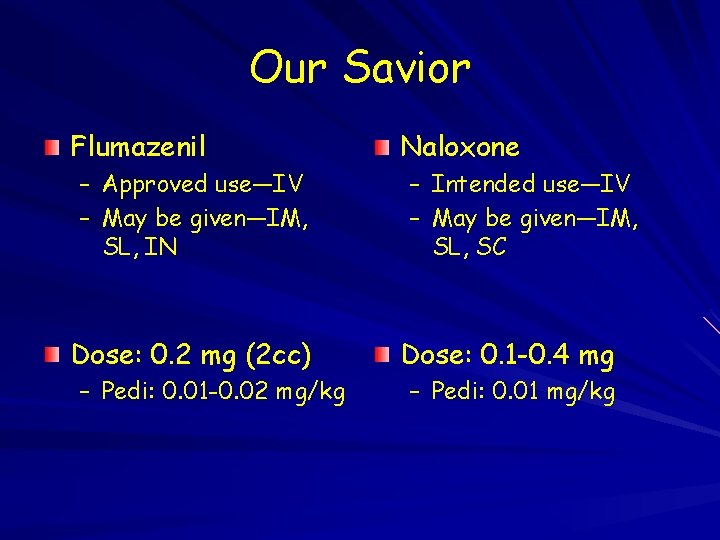
Our Savior Flumazenil Naloxone Dose: 0. 2 mg (2 cc) Dose: 0. 1 -0. 4 mg – Approved use—IV – May be given—IM, SL, IN – Pedi: 0. 01 -0. 02 mg/kg – Intended use—IV – May be given—IM, SL, SC – Pedi: 0. 01 mg/kg
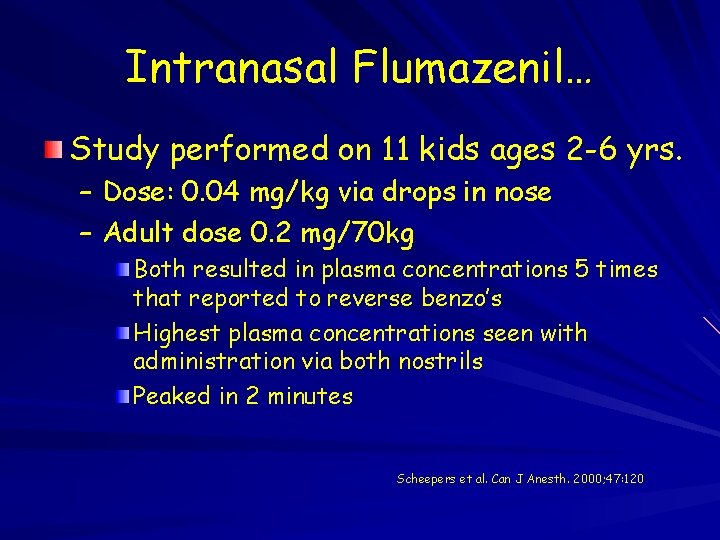
Intranasal Flumazenil… Study performed on 11 kids ages 2 -6 yrs. – Dose: 0. 04 mg/kg via drops in nose – Adult dose 0. 2 mg/70 kg Both resulted in plasma concentrations 5 times that reported to reverse benzo’s Highest plasma concentrations seen with administration via both nostrils Peaked in 2 minutes Scheepers et al. Can J Anesth. 2000; 47: 120
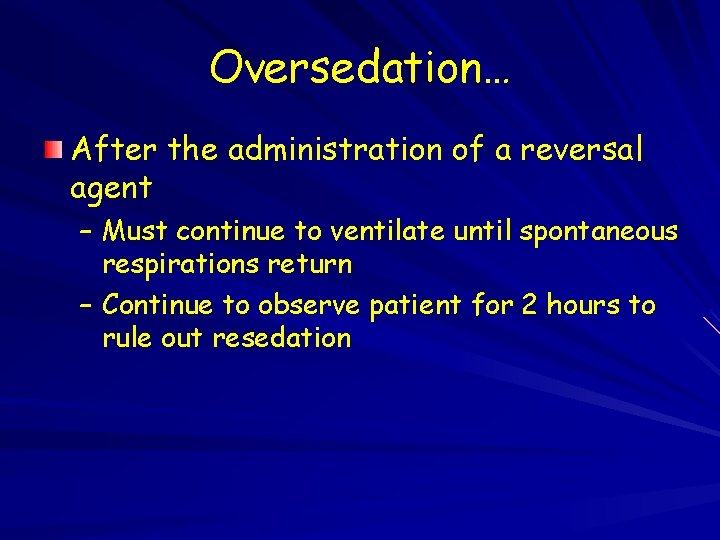
Oversedation… After the administration of a reversal agent – Must continue to ventilate until spontaneous respirations return – Continue to observe patient for 2 hours to rule out resedation
Laryngospasm In the event that you cannot ventilate, you must consider the presence of laryngospasm or foreign body airway obstruction Defined: – Forceful partial or complete adduction of the vocal cords
Laryngospasm Treatment – Remove any obvious foreign material – Ventilate forcefully with oxygen – Reverse the sedative agent