
Sedation and Delirium Management Medical Surgical Nursing II
- Slides: 29
Sedation and Delirium Management Medical Surgical Nursing II Urden Chapter 9
Goals of Sedation and Delirium Management �“The goal is to find a balance between providing compassionate patient care and avoiding the perils of oversedation” (Urden, 2012, p. 95).
Sedation Scales �Scoring systems to assess sedation are strongly recommended. �Why ◦ Individuals do not metabolize sedative medications at the same rate. ◦ Use of a standardized scale can ensure that continuous infusions such as proprofol or lorazepam are titrated to a specific goal. ◦ Use of scales can be used for medications given prn to assess response and patient comfort.
Complications of sedation �“State of unintended patient unresponsiveness in which the patient resides in a state of suspended animation similar to general anesthesia” �Prolonged deep sedation is associated with complications of ◦ Pressure ulcers pneumonia ◦ Thromboemboli ◦ Gastric ileus Nosocomial Delayed weaning from mechanical ventilation
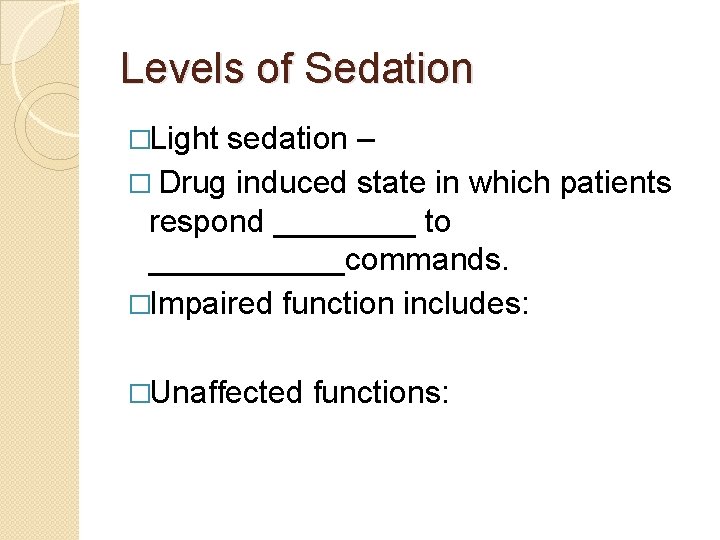
Levels of Sedation �Light sedation – � Drug induced state in which patients respond ____ to ______commands. �Impaired function includes: �Unaffected functions:
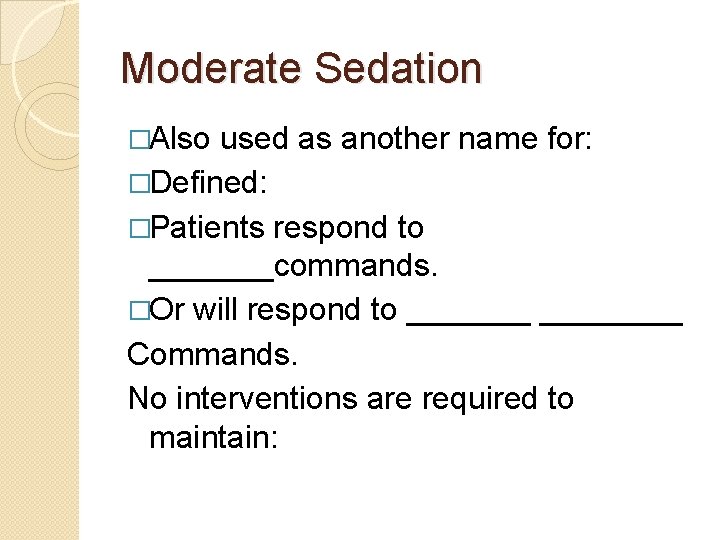
Moderate Sedation �Also used as another name for: �Defined: �Patients respond to _______commands. �Or will respond to ________ Commands. No interventions are required to maintain:
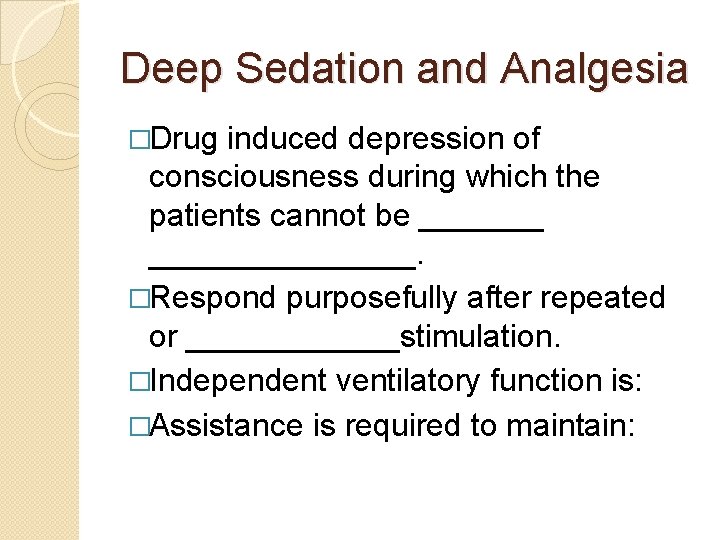
Deep Sedation and Analgesia �Drug induced depression of consciousness during which the patients cannot be ___________. �Respond purposefully after repeated or ______stimulation. �Independent ventilatory function is: �Assistance is required to maintain:
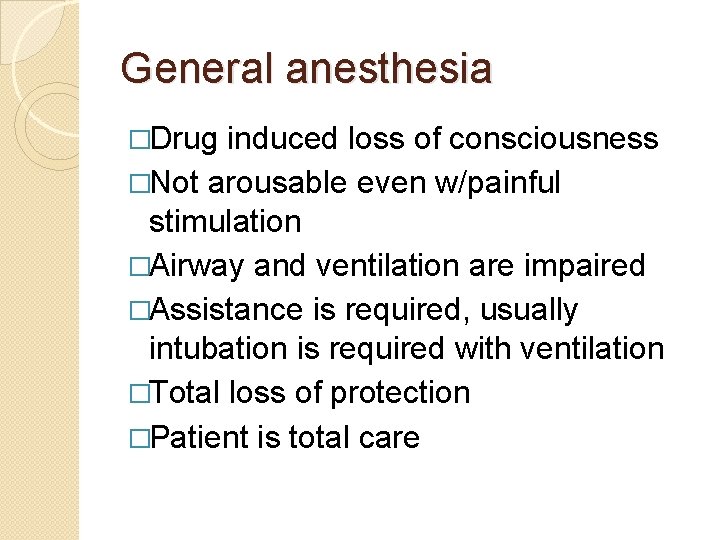
General anesthesia �Drug induced loss of consciousness �Not arousable even w/painful stimulation �Airway and ventilation are impaired �Assistance is required, usually intubation is required with ventilation �Total loss of protection �Patient is total care
Perils of Undersedation �Self extubation with complications of : ◦ Bronchospasm, aspiration, dysrhythmias, bradycardia and death related to the inability to establish a patent airway.
Pharmacological Management with sedation �Sedation must always be preceded or accompanied by analgesia if there is a mechanism of pain or suspicion of pain being experienced.
Benzodiazepines �Powerful amnesic properties �Inhibit reception of new sensory information �Do not give pain relief �Most frequently used are: �Which one is used for acute, short term agitation?
Benzodiazepines �Which drug is used for long term sedation? �Why is it preferred over the other? �What are the major side effects of these medications? �The antidote is: �What must be considered before an antidote is given?
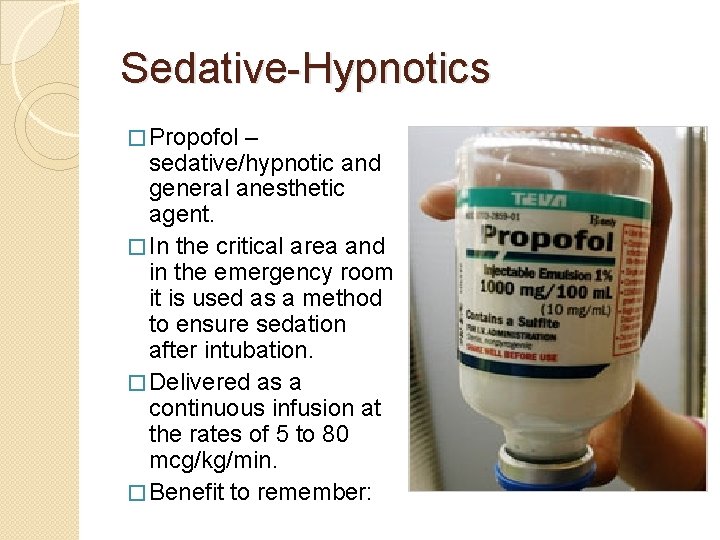
Sedative-Hypnotics � Propofol – sedative/hypnotic and general anesthetic agent. � In the critical area and in the emergency room it is used as a method to ensure sedation after intubation. � Delivered as a continuous infusion at the rates of 5 to 80 mcg/kg/min. � Benefit to remember:
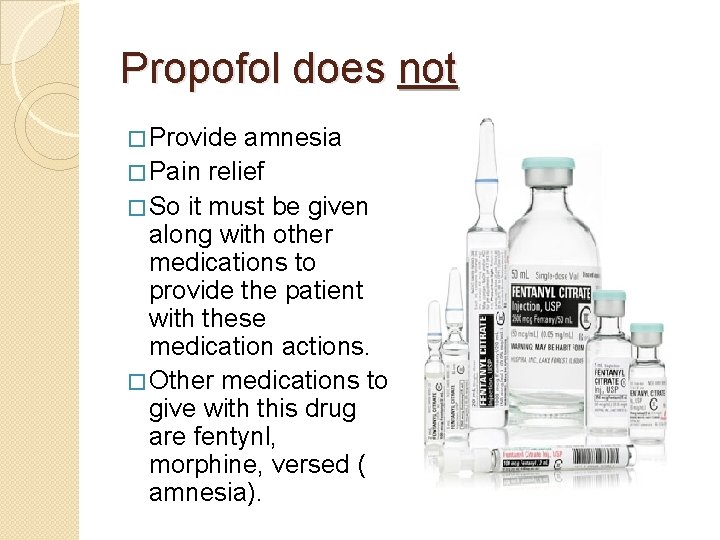
Propofol does not � Provide amnesia � Pain relief � So it must be given along with other medications to provide the patient with these medication actions. � Other medications to give with this drug are fentynl, morphine, versed ( amnesia).
Side effects to manage with Propofol � Hypotension – How would you manage this problem � Hyperlipidemia in long term use � Infection related to high fat content � Pancreatitis � Propofol Related infusion syndrome PRIS ◦ ◦ ◦ Most common in children Metabolic acidosis Rhabodmyolysis Acute kidney failure Dysrhythymias
Propofol Infusion �Things to remember ◦ Dedicated line ◦ Do not mix with other drugs if possible otherwise check compatibility ◦ Certain IV fluids cannot be given with proprofol ◦ Monitor serum triglyceride levels ◦ Calories from propofol are calculated into daily calorie counts.
Central Alpha Agonists �Dexmedetomidine or Precedex �Approved for continuous infusion for less than 24 hours in mechanically ventilated patients. �Confers sedation and analgesic effects without respiratory depression. �Loading dose is 1. 0 mcg/kg over 10 minutes �Continuous infusion is range 0. 2 to 0. 7 mcg/kg/hour.
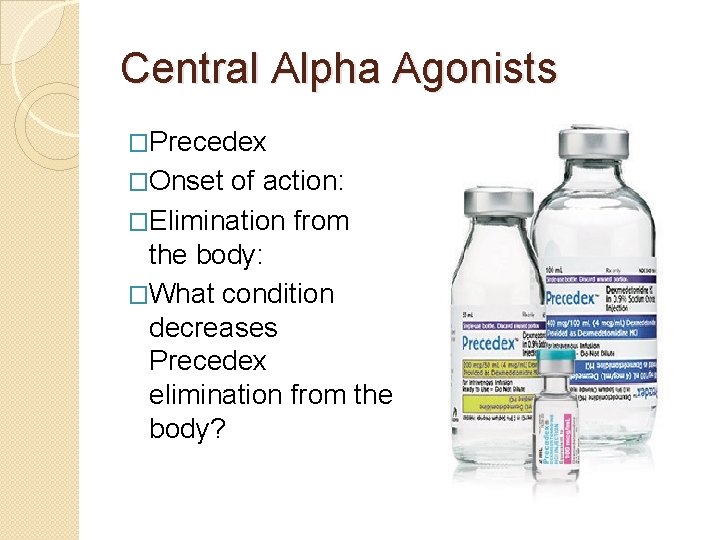
Central Alpha Agonists �Precedex �Onset of action: �Elimination from the body: �What condition decreases Precedex elimination from the body?
Things to Remember �Choice of sedative is highly specific to the patient and the situation �Short term sedation - < 24 hours most frequently used sedatives are _______ & Propofol. �Both drugs should or may be combined with a short-acting opiod analgesic which is ______ or _______.
Things to remember �For long term sedation the recommended agent is? �Precedex �Versed �Lorazepam �Morphine �Fentynl
Preventing sedative dependence and withdrawal �Why this occurs? Critically ill patients are often sedated and mechanically ventilated are seriously ill for weeks or months. �With time physical and psychological dependence occurs. �What are the symptoms of sedative dependence and withdrawal?
Sedation vacation �Strategy to avoid the pitfalls of sedative dependence and withdrawal is a planned strategy to turn off the sedation infusion once a day. �Shortens time to extubation �Back up plan is needed for patients who do not tolerate the procedure. �The goal is to allow the stable patient to regain consciousness for clinical assessment – what would you use?
Nursing Care Responsibility �Ongoing assessment of the patient’s level of consciousness to avert complications. �If the patient is severely agitated, consult with the physician it is vital to consult with the physician and pharmacist to establish and effective treatment plan. �Often the sedation is restarted at 50% of the previous morning dose and
Delirium �Global impairment of cognitive processes �Sudden onset �Coupled with disorientation �Impaired short-term memory �Altered sensory perception(manifests as? ) �Inappropriate behavior
Delirium �Occurs in 60% to 85% among mechanically ventilated patients. �Delirium is often identified in the patient who is agitated and pulling at tubes. �Delirium can occur in patients who are physically calm. �Provision of adequate _____is an essential component of delirium prevention.
Management of Delirium with Medication �Priority – medication selection of drugs that provide sedation without withdrawal associated agitation. �Which drug is discussed by Urden as a plausible choice? �What type of delirium is this medication used for?
Monitoring Requirements �Use of this drug requires _____ monitoring due to the prolongation of the QT interval which increases the risk of ventricular dysrhythmias. �Stabilizes cerebral function by blocking transmission of ______mediated neurotransmitters at the cerebral synapses and in the basal ganglia.
Nonpharmacological interventions to prevent delirium �These methods are similar to those used to relieve pain �Back massage �Music therapy �Noise reduction �Decreasing lights at night �Clustering nursing care interventions �Uninterrupted rest �Speaking in a calm and gentle voice.
AWS & Delirium Tremens �Patients w/alcohol dependency & critically ill are at risk for alcohol withdrawal syndrome and DT’s. �AWS assoc w/increased risk of delirium, hallucinations, seizures, need for mechanical ventilation and death �Delirium Tremens- when hyperactive agitated delirium is caused by alcohol withdrawal