
Security Stability Governance and Business Support for the
Security, Stability, Governance and Business Support for the Internet Paul Twomey President and CEO 1 March 2007 1 Advisory Council
What we want you to do today • Understand the risks to the Internet as we have known it for over 30 years – Security and stability of addressing and routing – Governance and attempts at control/regulation • Become partners in managing these risks • Understand how your interests are affected by ICANN’s policy work • Get involved in creating the policy that sets how the net connects you to your customers • Understand the opportunity the upcoming liberalising of g. TLDs offers the Financial Sector • But first… 2 Advisory Council
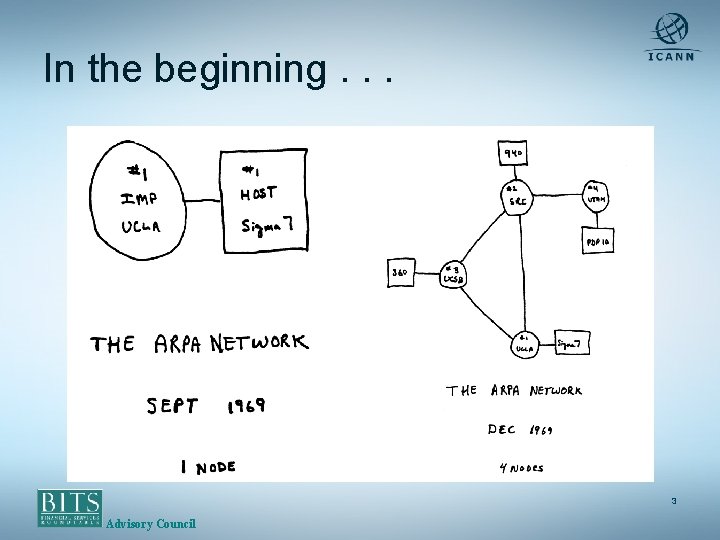
In the beginning. . . 3 Advisory Council
Internet community – a real phenomenon with world changing values • • • Ensuring a single, end-to-end interoperable Internet Bottom-up technical policy-making and decision-making Participation open to all who wish to do so Legitimacy determined by open participation and the value of the contribution to the joint effort Consensus-based decision making, but not full ‘census-based’ consensus Cooperation, coordination and consultation among participants and groups pushing initiatives forward Yet, very spirited and blunt public debate Private agreement or contract approach to creating and managing linkages among and to the network Global efficiency in the allocation of resources, such as Internet Protocol addresses Encouraging innovation, particularly at the fringe of the network 4 Advisory Council
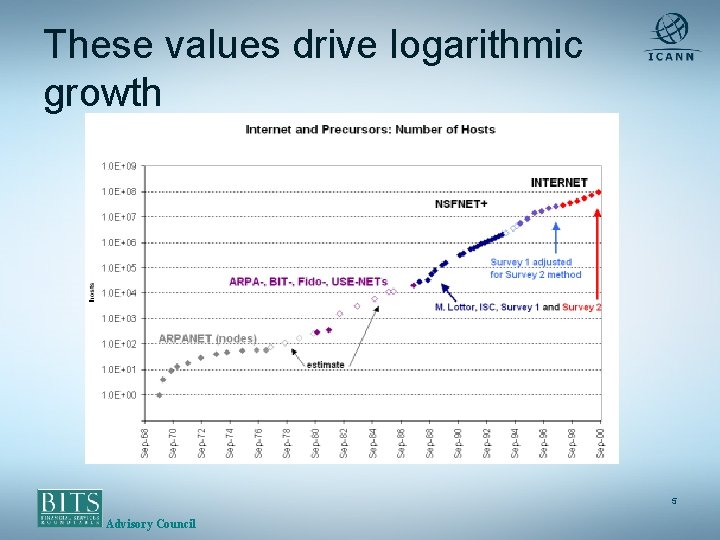
These values drive logarithmic growth 5 Advisory Council
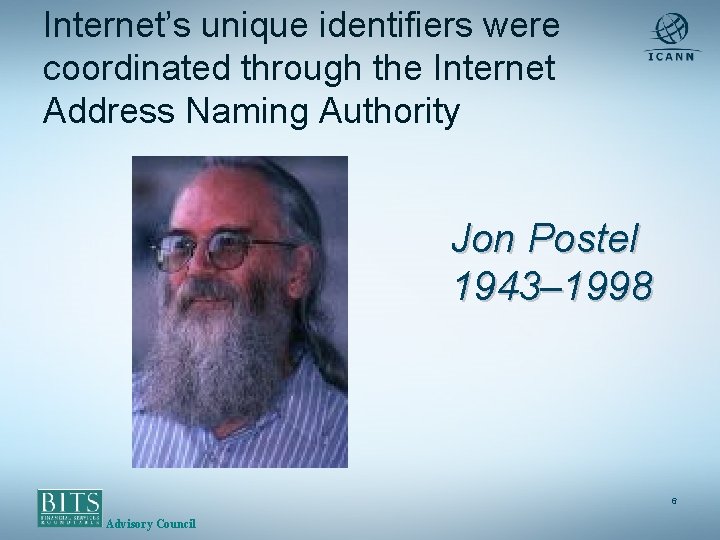
Internet’s unique identifiers were coordinated through the Internet Address Naming Authority Jon Postel 1943– 1998 6 Advisory Council
Need for Change Circa 1996– 97 • Globalisation of Internet • Commercialisation of Internet • Lack of competition in domain name space • Trademark–domain name conflicts • Need for a new model of governance 7 Advisory Council
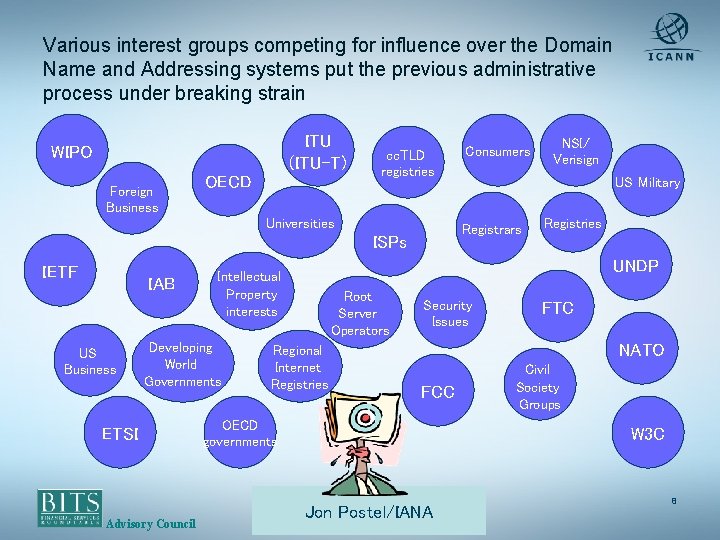
Various interest groups competing for influence over the Domain Name and Addressing systems put the previous administrative process under breaking strain ITU (ITU-T) WIPO Foreign Business OECD cc. TLD registries Universities IAB US Business ETSI Advisory Council Registries UNDP Intellectual Property interests Developing World Governments NSI/ Verisign US Military Registrars ISPs IETF Consumers Root Server Operators Regional Internet Registries Security Issues FTC NATO FCC OECD governments Civil Society Groups W 3 C Jon Postel/IANA 8
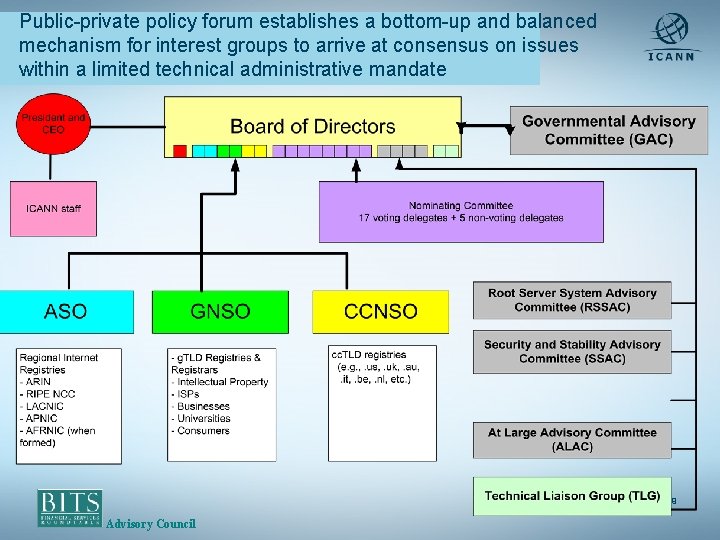
Public-private policy forum establishes a bottom-up and balanced mechanism for interest groups to arrive at consensus on issues within a limited technical administrative mandate 9 Advisory Council
ICANN Mission Statement • To coordinate, overall, the global Internet's system of unique identifiers, and to ensure stable and secure operation of the Internet's unique identifier systems. In particular, ICANN coordinates: 1. Allocation and assignment of the three sets of unique identifiers for the Internet: • Domain names (forming a system called the DNS) • Internet protocol (IP) addresses and autonomous system (AS) numbers • Protocol port and parameter numbers 2. Operation and evolution of the DNS root name server system 3. Policy development reasonably and appropriately related to these technical functions 10 Advisory Council
Principles of operation 1. Contribute to stability and security of the unique identifiers system and root management 2. Promote competition and choice for registrants and other users 3. Forum for multi-stakeholder bottom-up development of related policy 4. Ensuring on a global basis an opportunity for participation by all interested parties 11 Advisory Council
What is it that we stand for? • • • Single interoperable Internet All can express their own language and identity BUT… All can access all others Creativity and offering development is encouraged for the benefit of consumers Security of the network is maintained to ensure confidence in the model Stability of the experience for application development and consumer experience Growth is encouraged Resources are deployed efficiently in support of a global network All relevant stakeholders have a voice and role 12 Advisory Council
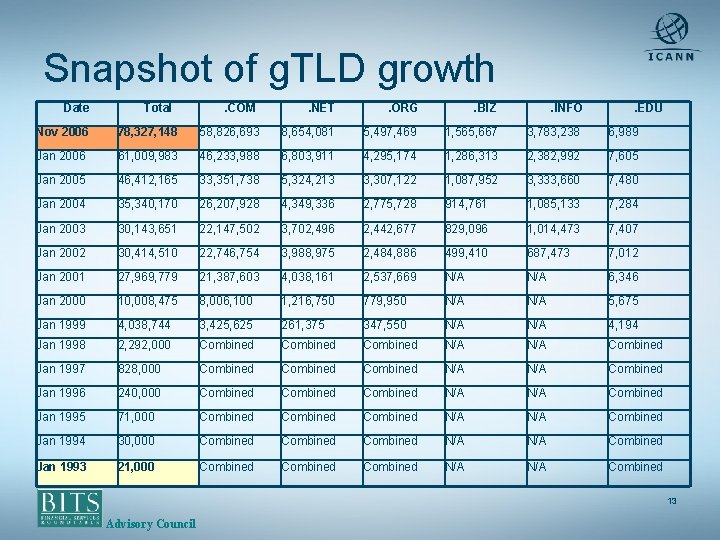
Snapshot of g. TLD growth Date Total . COM . NET . ORG . BIZ . INFO . EDU Nov 2006 78, 327, 148 58, 826, 693 8, 654, 081 5, 497, 469 1, 565, 667 3, 783, 238 6, 989 Jan 2006 61, 009, 983 46, 233, 988 6, 803, 911 4, 295, 174 1, 286, 313 2, 382, 992 7, 605 Jan 2005 46, 412, 165 33, 351, 738 5, 324, 213 3, 307, 122 1, 087, 952 3, 333, 660 7, 480 Jan 2004 35, 340, 170 26, 207, 928 4, 349, 336 2, 775, 728 914, 761 1, 085, 133 7, 284 Jan 2003 30, 143, 651 22, 147, 502 3, 702, 496 2, 442, 677 829, 096 1, 014, 473 7, 407 Jan 2002 30, 414, 510 22, 746, 754 3, 988, 975 2, 484, 886 499, 410 687, 473 7, 012 Jan 2001 27, 969, 779 21, 387, 603 4, 038, 161 2, 537, 669 N/A 6, 346 Jan 2000 10, 008, 475 8, 006, 100 1, 216, 750 779, 950 N/A 5, 675 Jan 1999 4, 038, 744 3, 425, 625 261, 375 347, 550 N/A 4, 194 Jan 1998 2, 292, 000 Combined N/A Combined Jan 1997 828, 000 Combined N/A Combined Jan 1996 240, 000 Combined N/A Combined Jan 1995 71, 000 Combined N/A Combined Jan 1994 30, 000 Combined N/A Combined Jan 1993 21, 000 Combined N/A Combined 13 Advisory Council
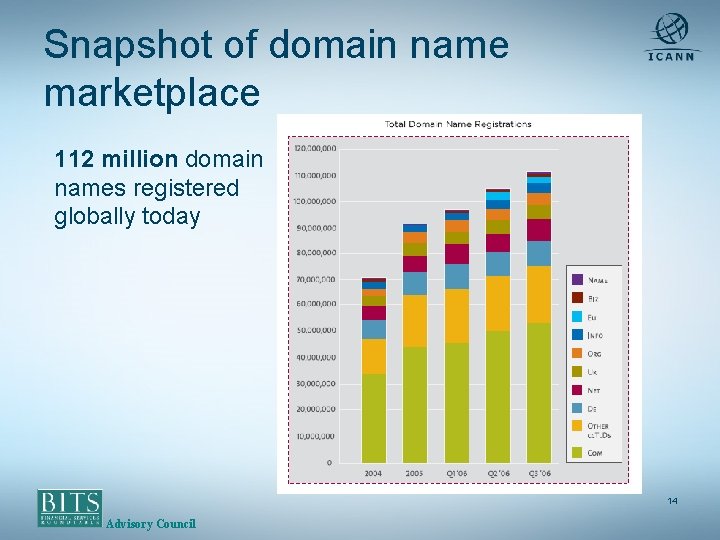
Snapshot of domain name marketplace 112 million domain names registered globally today 14 Advisory Council
Why do we get out of bed in the morning? • The Internet is the most powerful and pervasive means of empowering individuals in human history • Being part of the glue which ensures a rapid unleashing of humanity’s knowledge and possibilities for all persons no matter what age, sex, creed, class, ethnicity and (at least some degree) wealth • Radically reducing transaction costs and barriers to markets across a globalised economy 15 Advisory Council
Agenda • Understand the risks to the Internet as we have known it for over 30 years ü Security and stability of addressing and routing – Governance and attempts at control/regulation • Become partners in managing these risks • Understand how your interests are affected by ICANN’s policy work • Get involved in creating the policy that sets how the net connects you to your customers • Understand the opportunity the upcoming liberalising of g. TLDs offers the Financial Sector 16 Advisory Council
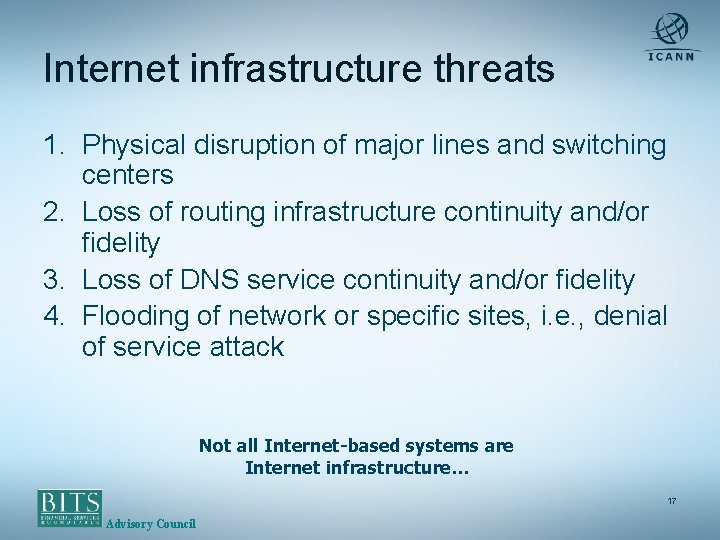
Internet infrastructure threats 1. Physical disruption of major lines and switching centers 2. Loss of routing infrastructure continuity and/or fidelity 3. Loss of DNS service continuity and/or fidelity 4. Flooding of network or specific sites, i. e. , denial of service attack Not all Internet-based systems are Internet infrastructure… 17 Advisory Council
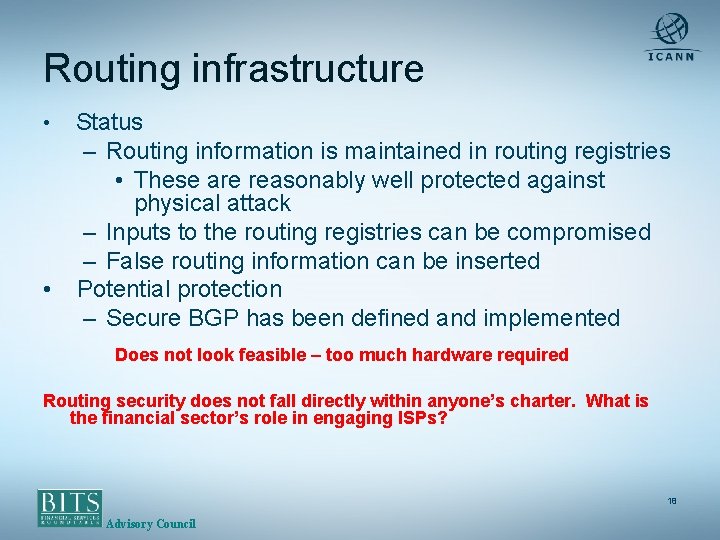
Routing infrastructure Status – Routing information is maintained in routing registries • These are reasonably well protected against physical attack – Inputs to the routing registries can be compromised – False routing information can be inserted • Potential protection – Secure BGP has been defined and implemented • Does not look feasible – too much hardware required Routing security does not fall directly within anyone’s charter. What is the financial sector’s role in engaging ISPs? 18 Advisory Council
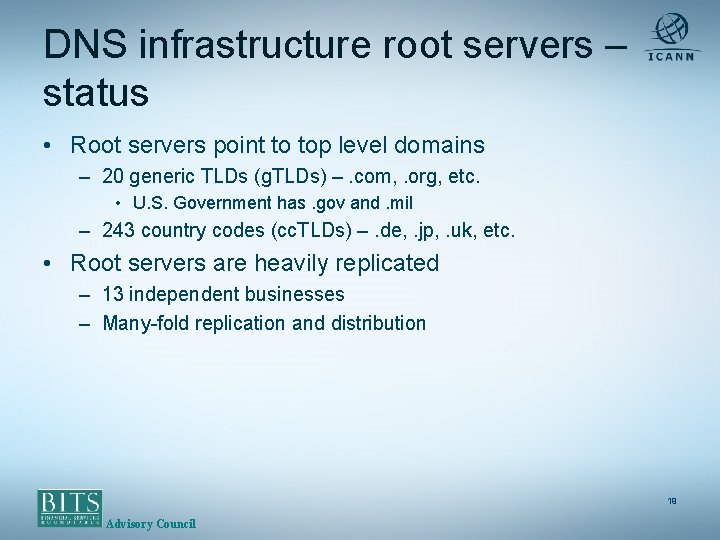
DNS infrastructure root servers – status • Root servers point to top level domains – 20 generic TLDs (g. TLDs) –. com, . org, etc. • U. S. Government has. gov and. mil – 243 country codes (cc. TLDs) –. de, . jp, . uk, etc. • Root servers are heavily replicated – 13 independent businesses – Many-fold replication and distribution 19 Advisory Council
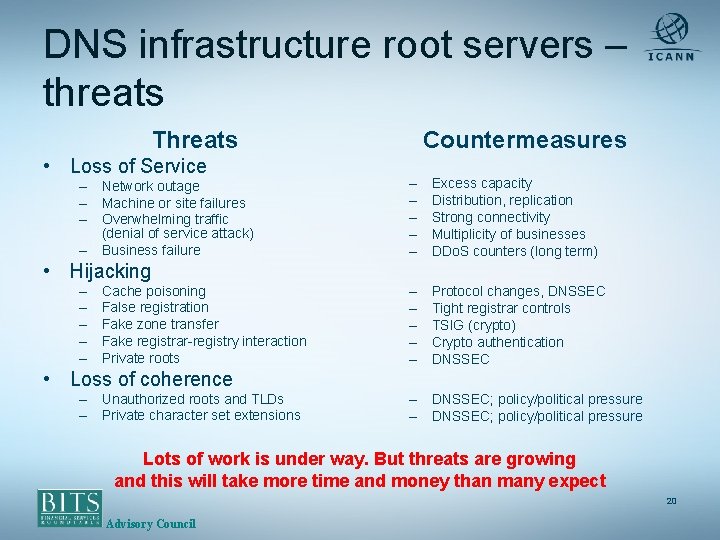
DNS infrastructure root servers – threats Threats • Loss of Service – Network outage – Machine or site failures – Overwhelming traffic (denial of service attack) – Business failure Countermeasures – – – Excess capacity Distribution, replication Strong connectivity Multiplicity of businesses DDo. S counters (long term) – – – Protocol changes, DNSSEC Tight registrar controls TSIG (crypto) Crypto authentication DNSSEC • Hijacking – – – Cache poisoning False registration Fake zone transfer Fake registrar-registry interaction Private roots • Loss of coherence – Unauthorized roots and TLDs – Private character set extensions – DNSSEC; policy/political pressure Lots of work is under way. But threats are growing and this will take more time and money than many expect 20 Advisory Council
System threats • Denial of service attacks target high-value sites – DNS servers are among the obvious targets – These will get more sophisticated – Action is required – see later slides • Domain and address theft is growing – Spammers like to hide their identity – The legal framework doesn’t provide protection Address theft, per se, is not actionable(!) Should the financial sector lobby for this (internationally)? 21 Advisory Council
The denial of service problem • Denial of service attacks are increasing – This will get worse – probably much worse • Law enforcement is important but necessarily at the wrong end of the problem • Technical changes in the Internet would help a lot 22 Advisory Council
Distributed denial of service • On 6 February 2007 – most visible since 2002 attack but not as comprehensive as amplified DDo. S attack on TLDs of 2006 • Six of the 13 root servers that form building blocks of the Internet were affected – two badly • The attack highlighted the effectiveness of Anycast load balancing technology • More analysis is needed before a full report on what happened can be drawn up – reasons behind the attack are unclear – a wake-up call • Root server operators worked together in a fast, effective, and co-ordinated effort • Recent SSAC recommendations for improving the security of the domain name system still need to be followed through – other measures should also be considered • Coordination and preparation were key • Did you notice? 23 Advisory Council
ICANN purview • ICANN strives to achieve coherence, stability and security • Almost all of the operational details are carried out by others, but – The IANA (Internet Assigned Numbers Authority) function is within ICANN – L root • Join us in both dialogue and new funding mechanisms – security foundation/gold star service, etc. 24 Advisory Council
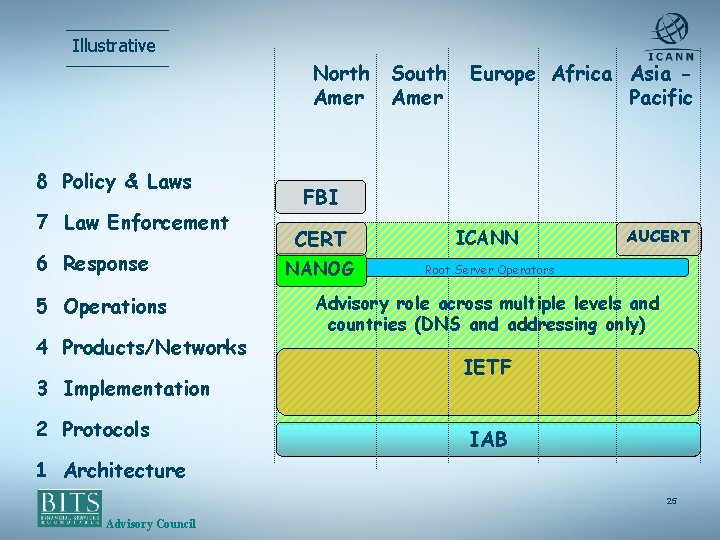
Illustrative North Amer 8 Policy & Laws 7 Law Enforcement 6 Response 5 Operations 4 Products/Networks 3 Implementation 2 Protocols South Amer Europe Africa Asia Pacific FBI CERT ICANN NANOG Root Server Operators AUCERT Advisory role across multiple levels and countries (DNS and addressing only) IETF IAB 1 Architecture 25 Advisory Council
DDo. S – some technical approaches • Identification of sources of traffic – Tighten the routing security • Refashion the protocols to know the identity of senders of traffic • Distinguish between well managed computers on well managed networks vs others – “Well managed” means they aren’t zombies and their configuration is checked regularly • Well managed networks quarantine computers which appear to be infected or misbehaving • Well managed networks report misbehaviors and accept reports of misbehaviors • Traffic among well managed networks gets preference 26 Advisory Council
DDo. S customer approaches • Pressure on the vendor to supply machines that are safe out of the box • Establishment of an ethic that machines should be safe – it’s the vendor’s problem, not the user’s 27 Advisory Council
Some ICANN initiatives • Agreement on formal relationship between Root Server Operators and ICANN • Tightened procedures for distributing changes to the root zone (CRADA report) • DNSSEC deployment analysis and road map • IPv 6 transition road map (re DNS) • DNS service robustness enhancements • Best practices for cc. TLDs 28 Advisory Council
Agenda • Understand the risks to the Internet as we have known it for over 30 years • Security and stability of addressing and routing ü Governance and attempts at control/regulation • Become partners in managing these risks • Understand how your interests are affected by ICANN’s policy work • Get involved in creating the policy that sets how the net connects you to your customers • Understand the opportunity the upcoming liberalising of g. TLDs offers the Financial Sector 29 Advisory Council
Internet community – a real phenomenon with world changing values • • • Ensuring a single, end-to-end interoperable Internet Bottom-up technical policy-making and decision-making Participation open to all who wish to do so Legitimacy determined by open participation and the value of the contribution to the joint effort Consensus-based decision making, but not full ‘census-based’ consensus Cooperation, coordination and consultation among participants and groups pushing initiatives forward Yet, very spirited and blunt public debate Private agreement or contract approach to creating and managing linkages among and to the network Global efficiency in the allocation of resources, such as Internet Protocol addresses Encouraging innovation, particularly at the fringe of the network 30 Advisory Council
Internet growth • Has been coordinated, not managed • Private-sector led, NOT command control • It’s phenomenal growth has led to debates at the U. N. World Summit on the Information Society (WSIS) • These debates have refined international understanding about how best to support Internet growth while maintaining its stability and interoperability • We now have greater clarity about who does what • But the debate rages on 31 Advisory Council
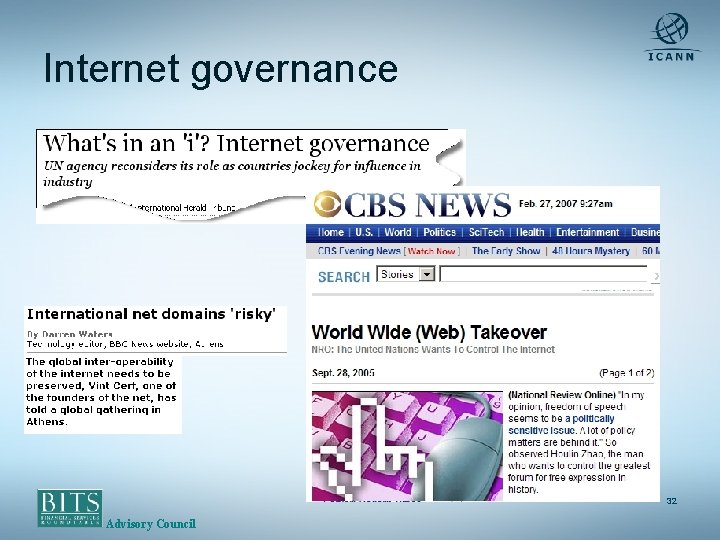
Internet governance 32 Advisory Council
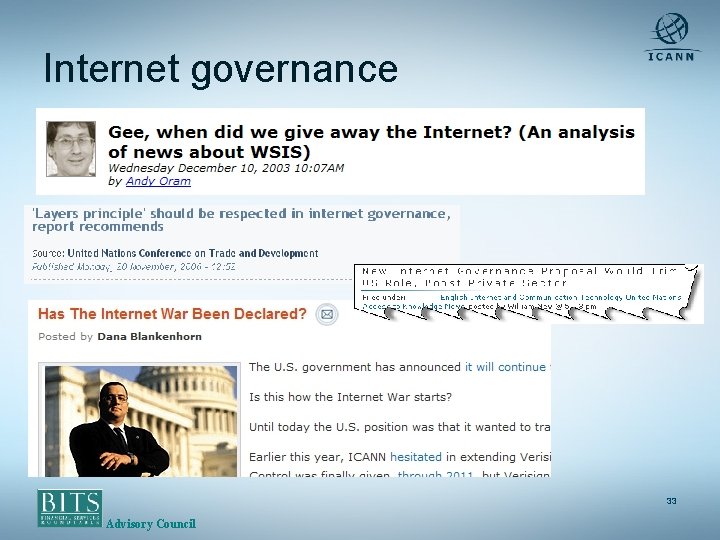
Internet governance 33 Advisory Council
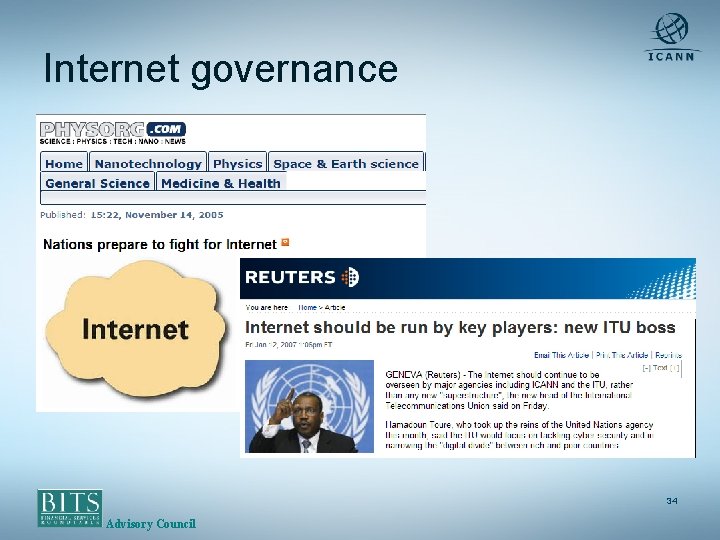
Internet governance 34 Advisory Council
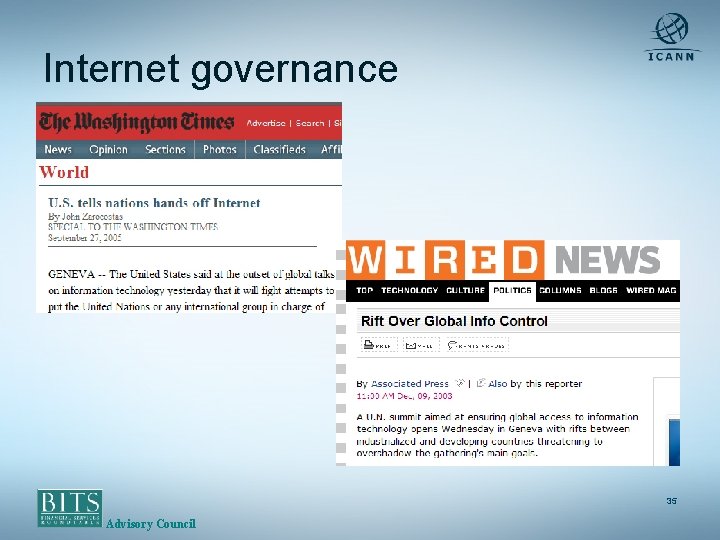
Internet governance 35 Advisory Council
Who’s still running the argument? • Iran and Brazil have made a formal request to return the issue of Internet governance to the table at the next U. N. Secretary General’s Internet Governance Forum in Rio de Janeiro in October 2007 • In particular that a U. N. body should coordinate all Internet activity, including the addressing and routing system 36 Advisory Council
Internet governance • Oversight model – – Too few stakeholders allowed to contribute to or influence Internet infrastructure, capabilities, services – Everyone pays the price of the overseer’s agenda • Private-sector leadership is key – – Has worked since early Internet days – Multiple stakeholders from all Internet communities and constituencies have a say in Internet infrastructure, stability, security, interoperability • Everybody needs a seat at the table 37 Advisory Council
U. S. perspective John Kneuer, Acting Assistant Secretary for Communications and Information, United States Department of Commerce. . . “…the Department continues to be supportive of private sector leadership in the coordination of the technical functions related to the management of the DNS as envisioned in the ICANN model. Furthermore, the Department continues to support the work of ICANN as the coordinator for the technical functions related to the management of the Internet DNS. ” 38 Advisory Council
But this is a global problem • We need your CEOs to understand that this is a global regulatory issue • We need your CEOs to help stand up for some key principles for private sector leadership in Internet governance • We would like you to help us sell this message and coordinate the voice of the private sector beneficiaries of the Internet as we have it now 39 Advisory Council
Get involved – it’s your fight, too! Your Internet needs you 40 Advisory Council
Agenda • Understand the risks to the Internet as we have known it for over 30 years • Security and stability of addressing and routing • Governance and attempts at control/regulation • Become partners in managing these risks ü Understand how your interests are affected by ICANN’s policy work • Get involved in creating the policy that sets how the net connects you to your customers • Understand the opportunity the upcoming liberalising of g. TLDs offers the Financial Sector 41 Advisory Council
Competition in the domain name space – Money makes the world go round… • ICANN introduced competition to the domain name space • Registrars now have a market and a business • Advertising on the Internet linked to domain name sales and per-click revenue generation • Domain name marketplace is even driving how we search – contextually as well as topically – and the scale of sites that can be searched 42 Advisory Council
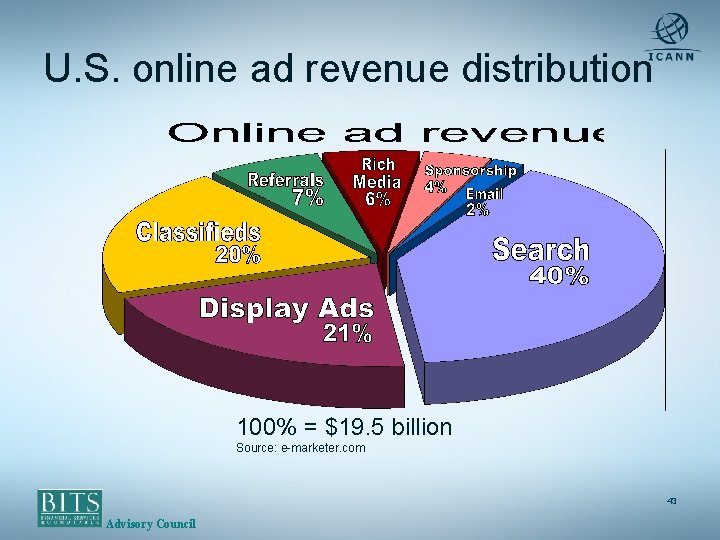
U. S. online ad revenue distribution 100% = $19. 5 billion Source: e-marketer. com 43 Advisory Council
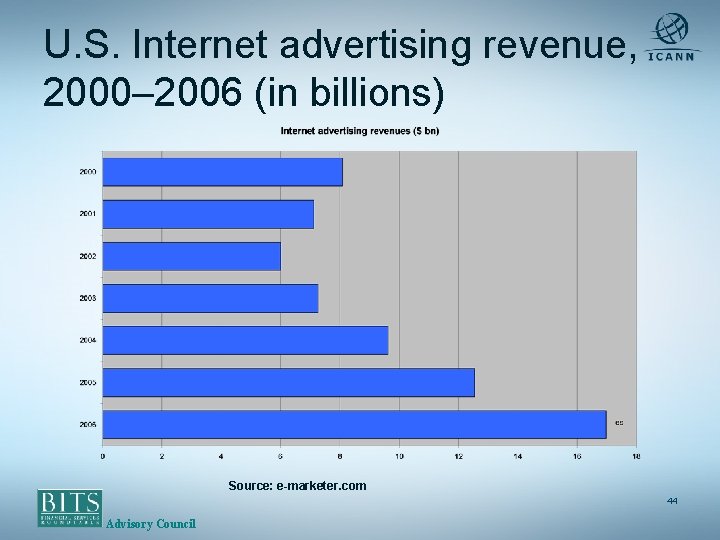
U. S. Internet advertising revenue, 2000– 2006 (in billions) Source: e-marketer. com 44 Advisory Council
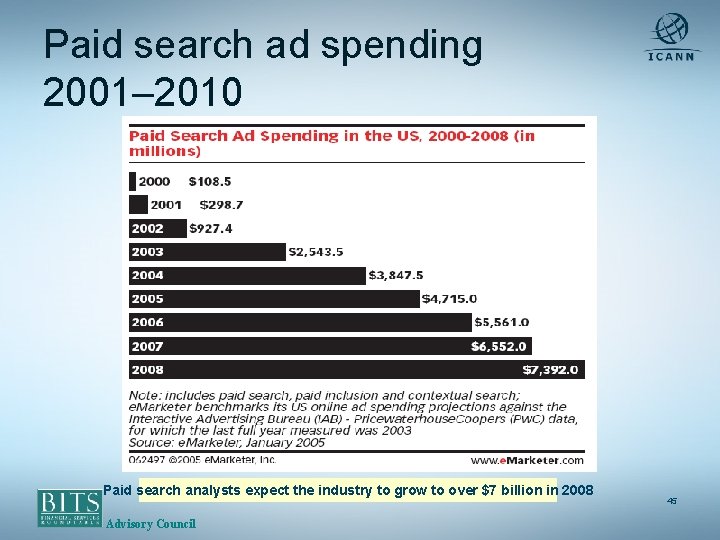
Paid search ad spending 2001– 2010 Paid search analysts expect the industry to grow to over $7 billion in 2008 Advisory Council 45
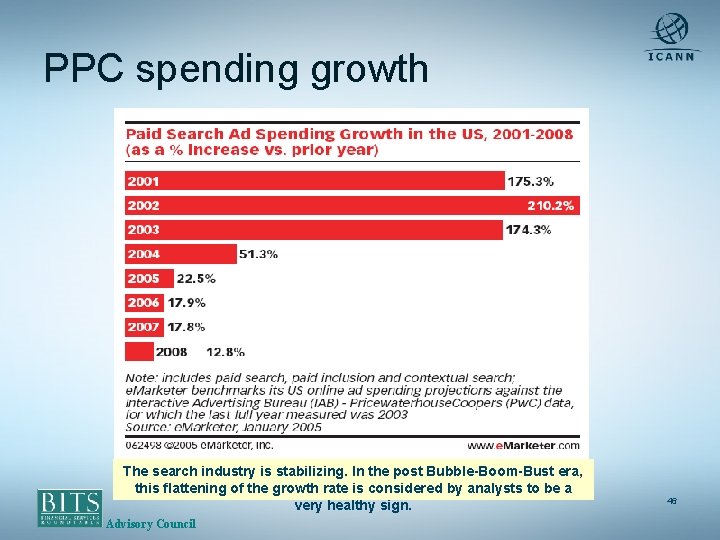
PPC spending growth The search industry is stabilizing. In the post Bubble-Boom-Bust era, this flattening of the growth rate is considered by analysts to be a very healthy sign. Advisory Council 46
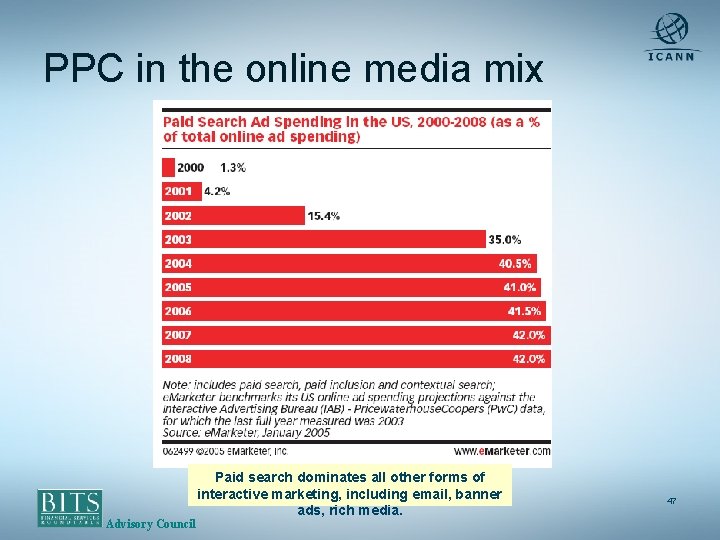
PPC in the online media mix Advisory Council Paid search dominates all other forms of interactive marketing, including email, banner ads, rich media. 47
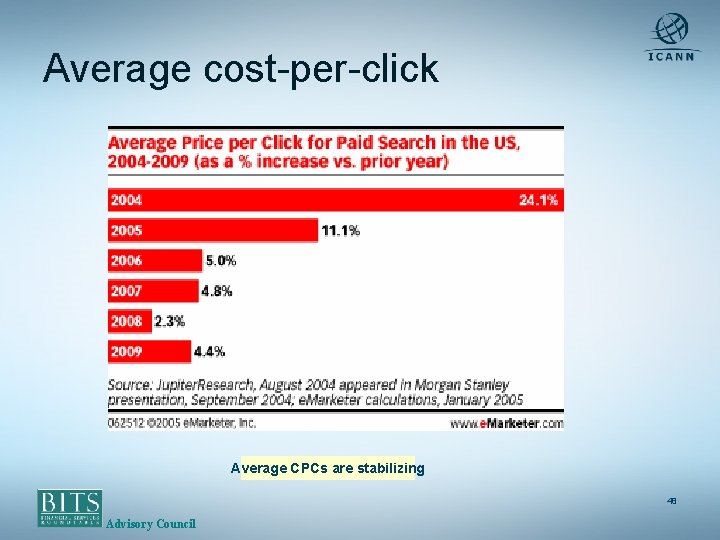
Average cost-per-click + 24. 1% + 11. 1% + 5% + 4. 8 % + 2. 3% + 4. 4% Average CPCs are stabilizing 48 Advisory Council
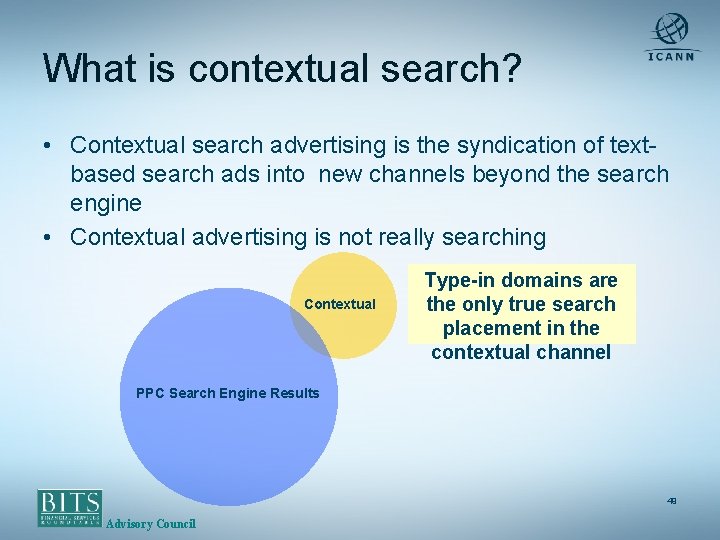
What is contextual search? • Contextual search advertising is the syndication of textbased search ads into new channels beyond the search engine • Contextual advertising is not really searching Contextual Type-in domains are the only true search placement in the contextual channel PPC Search Engine Results 49 Advisory Council
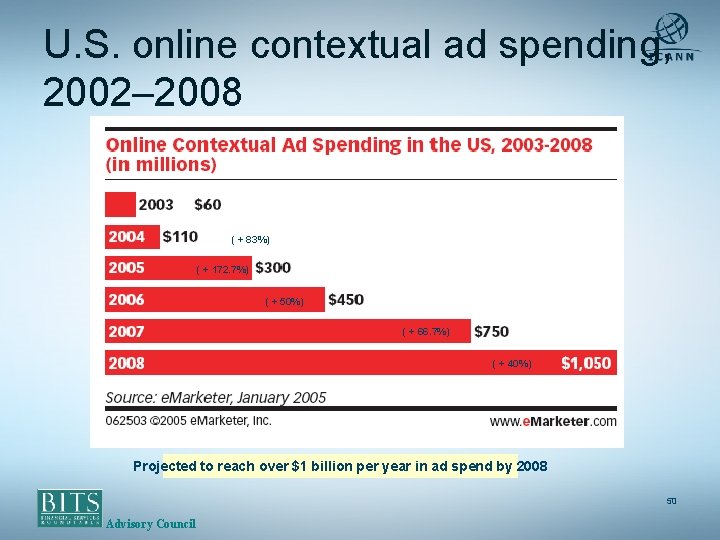
U. S. online contextual ad spending, 2002– 2008 ( + 83%) ( + 172. 7%) ( + 50%) ( + 66. 7%) ( + 40%) Projected to reach over $1 billion per year in ad spend by 2008 50 Advisory Council
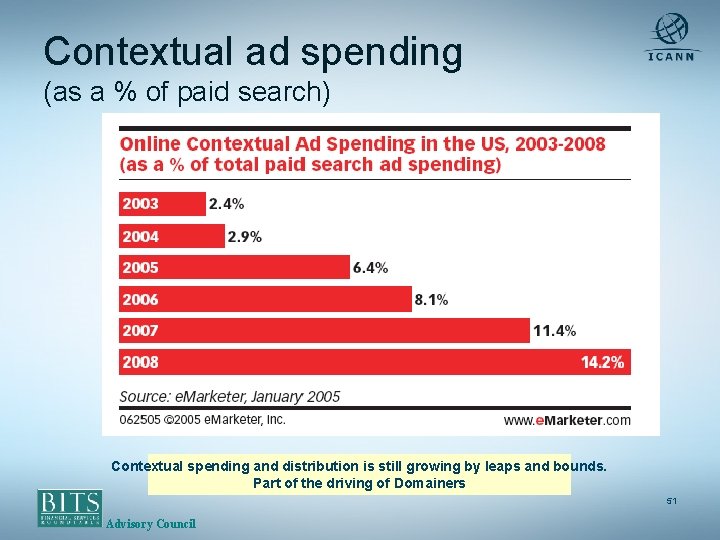
Contextual ad spending (as a % of paid search) Contextual spending and distribution is still growing by leaps and bounds. Part of the driving of Domainers 51 Advisory Council
ICANN’s policy development role • Safeguard an open, fair and equitable policy development process • Be receptive to all stakeholders, public and private • Be responsive to stakeholders who provide input and communicate next steps • Communicate timely and useful information about the issue and the policy process 52 Advisory Council
Whois database • Some businesses see a strong need for unrestricted access to Whois information to – – Identify cybersquatters and domain infringement Investigate online fraud and phishing Manage domain names and intellectual property Conduct e-commerce by researching other online entities • One major hotel chain recorded 100 -plus new domain names registered in its name – or a version thereof – every day – Confusingly similar names led to pay-per-click sites • Full registration data would help legitimate businesses shut down fraudulent domains 53 Advisory Council
Whois policy process • Whois issues are being addressed through the General Names Supporting Organisation’s (GNSO’s) policy – BITS comments development process (PDP) received in April • Numerous opportunities for 2006 and public review and comment January 2007 – Formed part of subsequent Whois Task Force Reports 54 Advisory Council
Recent public comments on Whois • Many support the BITS position – – Businesses and trade organisations – Nonprofits engaged in fighting fraud – Law enforcement agencies • Opposition to Whois from other advocacy organisations, some government agencies, some Internet users 55 Advisory Council
Organisations supporting BITS Whois position • • Walt Disney Company e. Bay, Inc. Electronic Arts, Inc. Coalition Against Unsolicited Commercial E -mail • Recording Industry Association of America and the International Federation of the Phonographic Industry • American Society of Composers, Authors and Publishers Advisory Council • American Intellectual Property Law Association • International Anti. Counterfeiting Coalition • Intercontinental Hotels Group • National Arbitration Forum • American Red Cross • American Heart Association • March of Dimes Birth Defects Foundation 56
Different views of Whois • Privacy commissioners in the European Union • Attention in public comments to restricted access, privacy and accuracy of the data 57 Advisory Council
Enforcement of existing Whois policy • That will remain the case until the Board approves any new policy, if any 58 Advisory Council
Next steps on Whois • ICANN staff is preparing notes for the GNSO Council on the Task Force Recommendations to – – Identify issues for clarification – Identify issues for further discussion – Identify potential implementation issues – Suggest a framework for further development of the proposal 59 Advisory Council
Task force recommendation (1) • Nonbinding recommendation to GNSO Council • Operational Point of Control (OPo. C) proposal – – Registrants could use an OPo. C in place of the current administrative and technical contact details – If there was an issue with the domain name, the OPo. C would contact the registrant 60 Advisory Council
Task force recommendation (2) • OPo. C includes – – Improved procedure for correcting inaccurate Whois data • OPo. C does not include – – Procedure for access by rights-holders, law enforcement – suggests use of best practices for dealing with requests 61 Advisory Council
PDP next steps • GNSO’s Whois Task Force presents Final Task Force Report to GNSO Council March 2007 • Council will send its own recommendations to ICANN Board for consideration and decision. • ICANN Board will review GNSO recommendations, 2 nd/3 rd quarter of 2007 62 Advisory Council
Agenda • Understand the risks to the Internet as we have known it for over 30 years • Security and stability of addressing and routing • Governance and attempts at control/regulation • Become partners in managing these risks • Understand how your interests are affected by ICANN’s policy work ü Get involved in creating the policy that sets how the net connects you to your customers • Understand the opportunity the upcoming liberalising of g. TLDs offers the Financial Sector 63 Advisory Council
Where stakeholders find common ground Increasingly, ICANN finds itself one of the few forums in which these issues can be raised so that solutions can be found within the Internet community 64 Advisory Council
Agenda • Understand the risks to the Internet as we have known it for over 30 years • Security and stability of addressing and routing • Governance and attempts at control/regulation • Become partners in managing these risks • Understand how your interests are affected by ICANN’s policy work • Get involved in creating the policy that sets how the net connects you to your customers ü Understand the opportunity the upcoming liberalising of g. TLDs offers the Financial Sector 65 Advisory Council
New generic top-level domain timetable • Next working group report to Lisbon meeting in late March • Potentially GNSO Policy Development Process may be completed by July meeting in Puerto Rico • Policy may be concluded by the end of the 3 rd Quarter 2007 • Next round of new g. TLDs in early 2008? 66 Advisory Council
Consider the impact of – • • Unique financial services TLD Industry cross-certified DNSSEC Other anti-phishing tools? 67 Advisory Council

To subscribe to our business e-newsletter • Complete the sign-up sheet today, or • Go to http: //www. icann. org/business/ 68 Advisory Council
Thank You www. icann. org 69 Advisory Council
- Slides: 69