
Security Sector Reform and Peace Support Operations 1
- Slides: 28
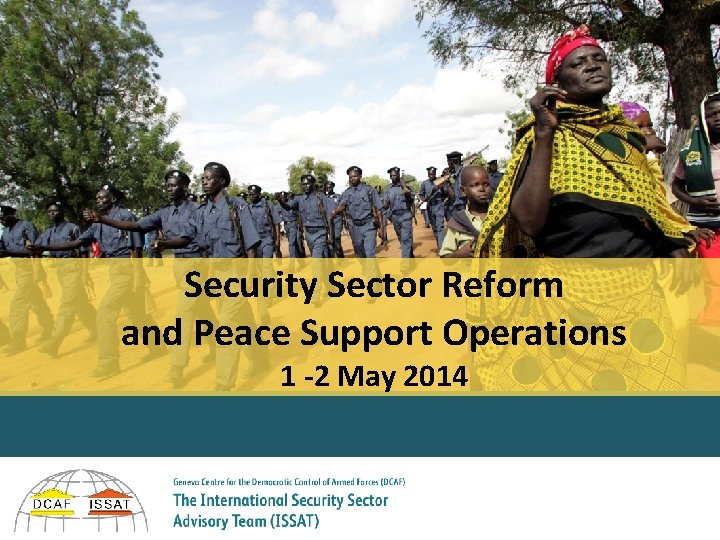
Security Sector Reform and Peace Support Operations 1 -2 May 2014 Session 1 © DCAF/ISSAT
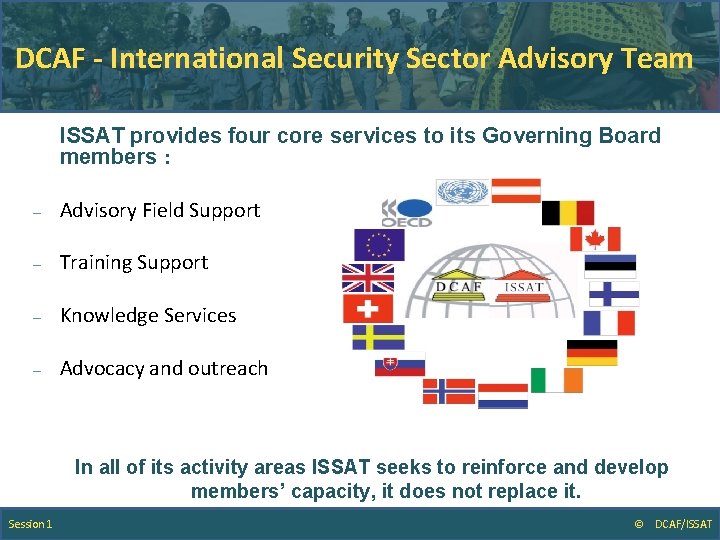
DCAF - International Security Sector Advisory Team ISSAT provides four core services to its Governing Board members : – Advisory Field Support – Training Support – Knowledge Services – Advocacy and outreach In all of its activity areas ISSAT seeks to reinforce and develop members’ capacity, it does not replace it. Session 11 ©© DCAF/ISSAT
Agenda - SSR and PSO THURSDAY: • Introduction to SSR & SSR in post-conflict contexts • PSO/SSR: Stabilisation and creating the conditions for success • Overview of SSR and Governance • DDR - At the heart of a Peace Process • Burundi case study - brief introduction FRIDAY: • Recap Day 1 and Q/A Session • Burundi case study: – Country brief – Exercise: group work; group presentations/discussion in plenary • Concluding session Session 11 ©© DCAF/ISSAT
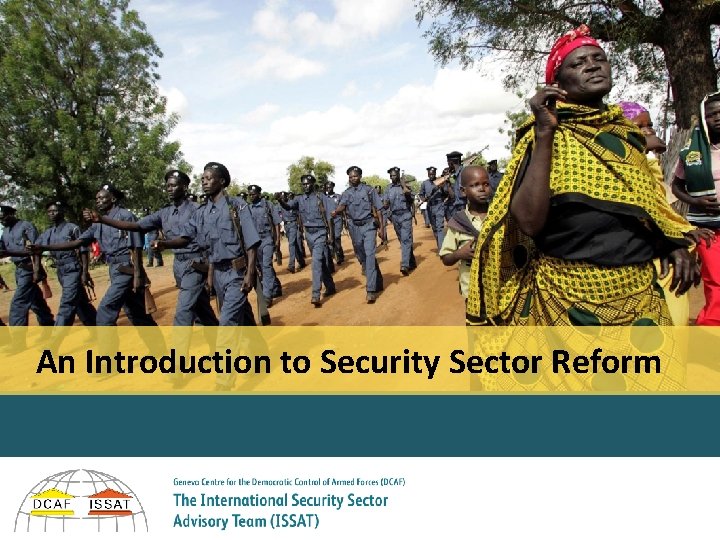
An Introduction to Security Sector Reform Session 1 © DCAF/ISSAT
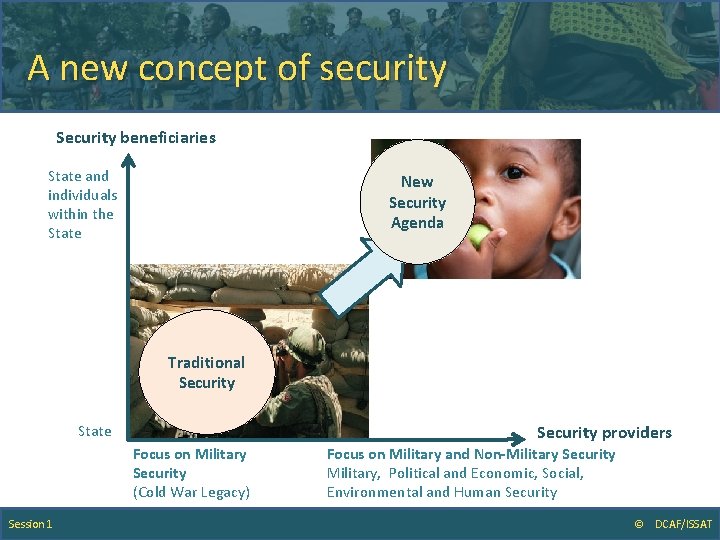
A new concept of security Security beneficiaries State and individuals within the State New Security Agenda Traditional Security providers State Focus on Military Security (Cold War Legacy) Session 11 Focus on Military and Non-Military Security Military, Political and Economic, Social, Environmental and Human Security ©© DCAF/ISSAT
Why is security important? • Security is fundamental to reducing poverty, protecting human rights and supporting sustainable development. • Security and development are inherently linked. • Security for whom? Security of states and security of people are not the same thing but are mutually dependant. • Insecurity in one country can have a significant impact on neighbouring countries and beyond. Session 11 ©© DCAF/ISSAT
Security sector • There is neither one definition nor one standard architecture for the security sector… • …however, various definitions (AU, ECOWAS, EU, OECD, some Member States, the UN…) converge around a similar understanding… Session 11 ©© DCAF/ISSAT
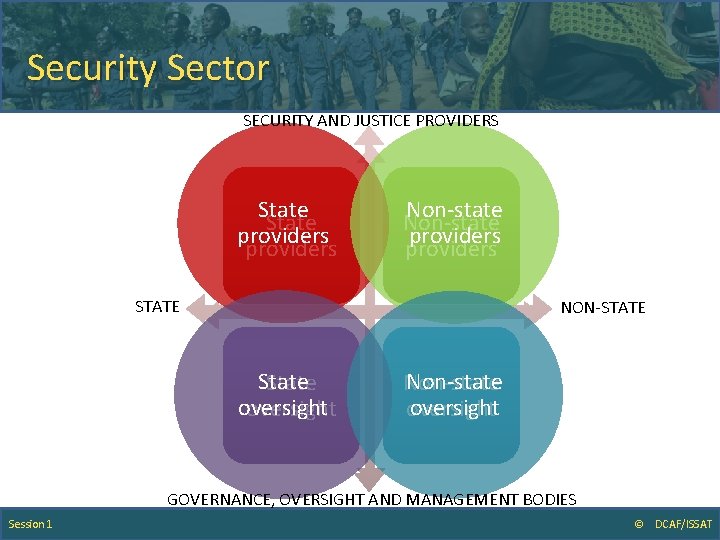
Security Sector SECURITY AND JUSTICE PROVIDERS State providers Non-state providers STATE NON-STATE State oversight Non-state oversight GOVERNANCE, OVERSIGHT AND MANAGEMENT BODIES Session 11 ©© DCAF/ISSAT
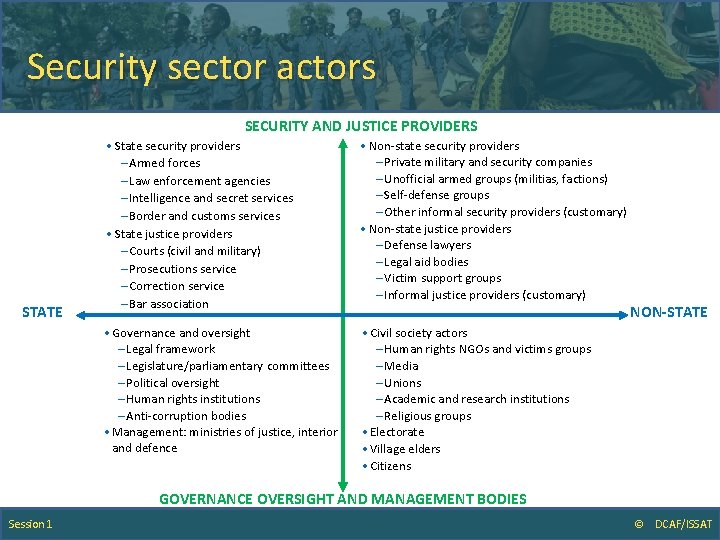
Security sector actors SECURITY AND JUSTICE PROVIDERS STATE • State security providers – Armed forces – Law enforcement agencies – Intelligence and secret services – Border and customs services • State justice providers – Courts (civil and military) – Prosecutions service – Correction service – Bar association • Non-state security providers – Private military and security companies – Unofficial armed groups (militias, factions) – Self-defense groups – Other informal security providers (customary) • Non-state justice providers – Defense lawyers – Legal aid bodies – Victim support groups – Informal justice providers (customary) • Governance and oversight – Legal framework – Legislature/parliamentary committees – Political oversight – Human rights institutions – Anti-corruption bodies • Management: ministries of justice, interior and defence • Civil society actors – Human rights NGOs and victims groups – Media – Unions – Academic and research institutions – Religious groups • Electorate • Village elders • Citizens NON-STATE GOVERNANCE OVERSIGHT AND MANAGEMENT BODIES Session 11 ©© DCAF/ISSAT
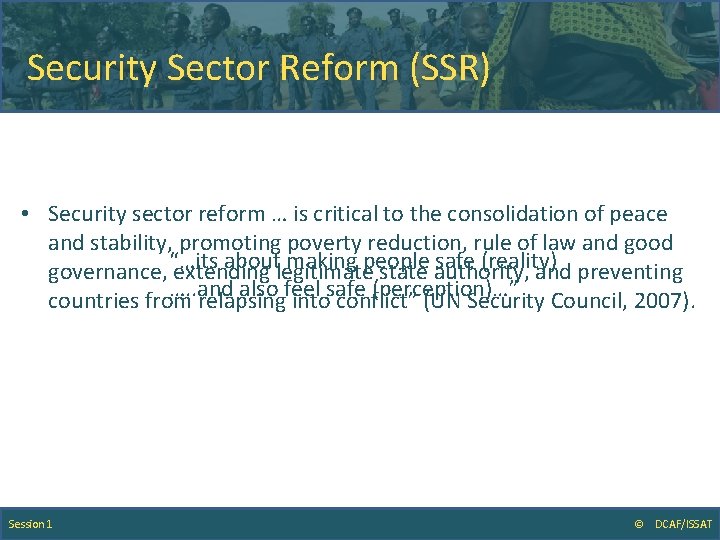
Security Sector Reform (SSR) • Security sector reform … is critical to the consolidation of peace and stability, promoting poverty reduction, rule of law and good aboutlegitimate making people safe (reality) governance, “…its extending state authority, and preventing …. . and also feel (perception)…” countries from relapsing intosafe conflict” (UN Security Council, 2007). Session 11 ©© DCAF/ISSAT
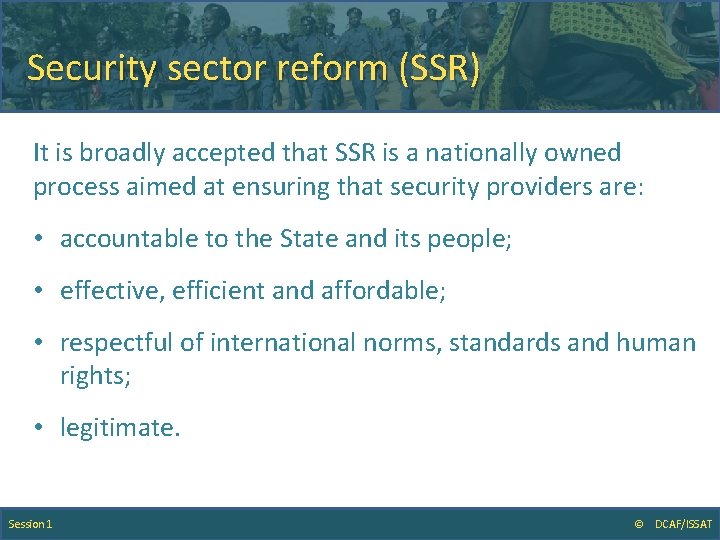
Security sector reform (SSR) It is broadly accepted that SSR is a nationally owned process aimed at ensuring that security providers are: • accountable to the State and its people; • effective, efficient and affordable; • respectful of international norms, standards and human rights; • legitimate. Session 11 ©© DCAF/ISSAT
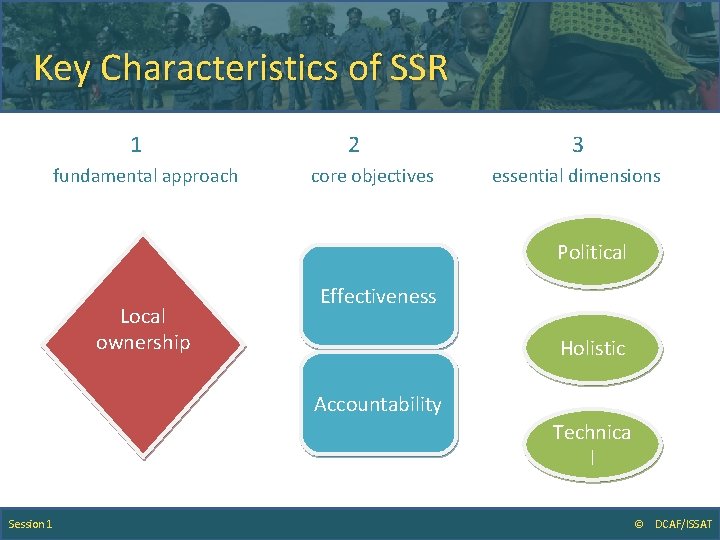
Key Characteristics of SSR 1 fundamental approach 2 core objectives 3 essential dimensions Political Local ownership Effectiveness Holistic Accountability Technica l Session 11 ©© DCAF/ISSAT
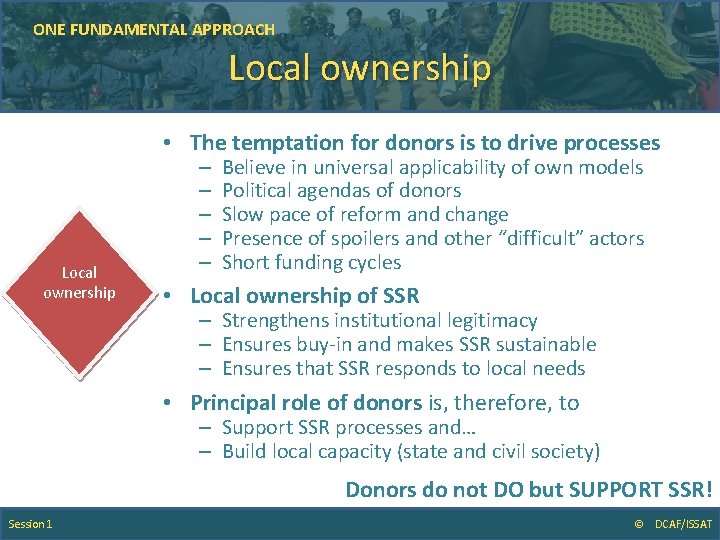
ONE FUNDAMENTAL APPROACH Local ownership • The temptation for donors is to drive processes Local ownership – – – Believe in universal applicability of own models Political agendas of donors Slow pace of reform and change Presence of spoilers and other “difficult” actors Short funding cycles • Local ownership of SSR – Strengthens institutional legitimacy – Ensures buy-in and makes SSR sustainable – Ensures that SSR responds to local needs • Principal role of donors is, therefore, to – Support SSR processes and… – Build local capacity (state and civil society) Donors do not DO but SUPPORT SSR! Session 11 ©© DCAF/ISSAT
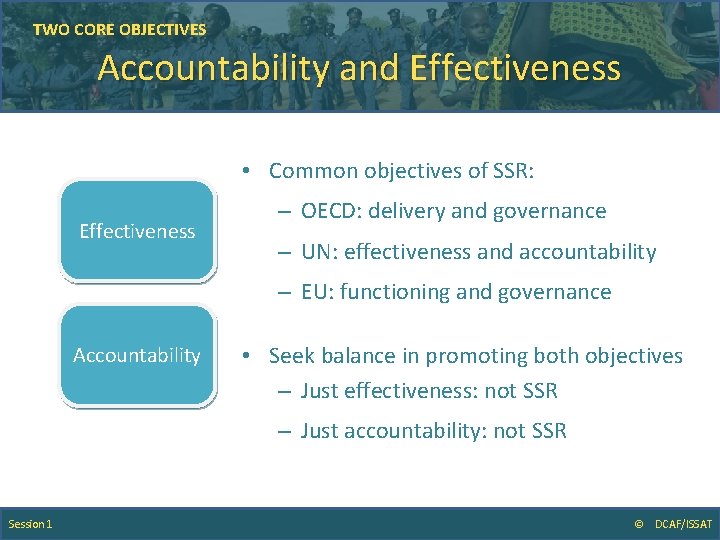
TWO CORE OBJECTIVES Accountability and Effectiveness • Common objectives of SSR: Effectiveness – OECD: delivery and governance – UN: effectiveness and accountability – EU: functioning and governance Accountability • Seek balance in promoting both objectives – Just effectiveness: not SSR – Just accountability: not SSR Session 11 ©© DCAF/ISSAT
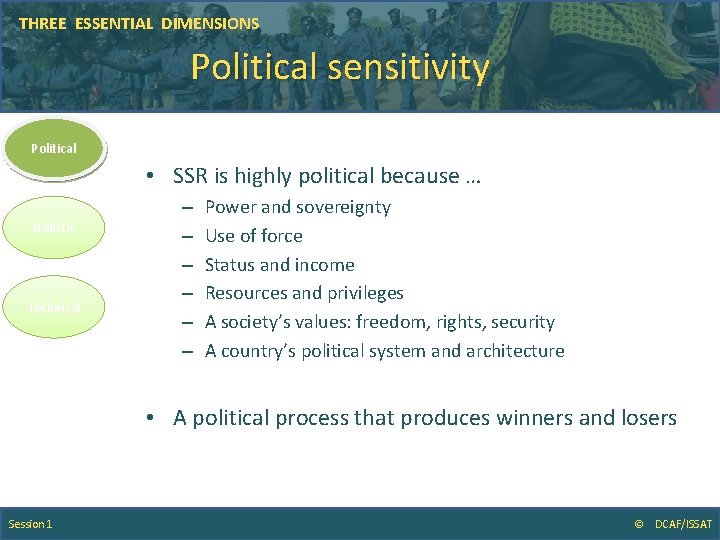
THREE ESSENTIAL DIMENSIONS Political sensitivity Political • SSR is highly political because … Holistic Technical – – – Power and sovereignty Use of force Status and income Resources and privileges A society’s values: freedom, rights, security A country’s political system and architecture • A political process that produces winners and losers Session 11 ©© DCAF/ISSAT
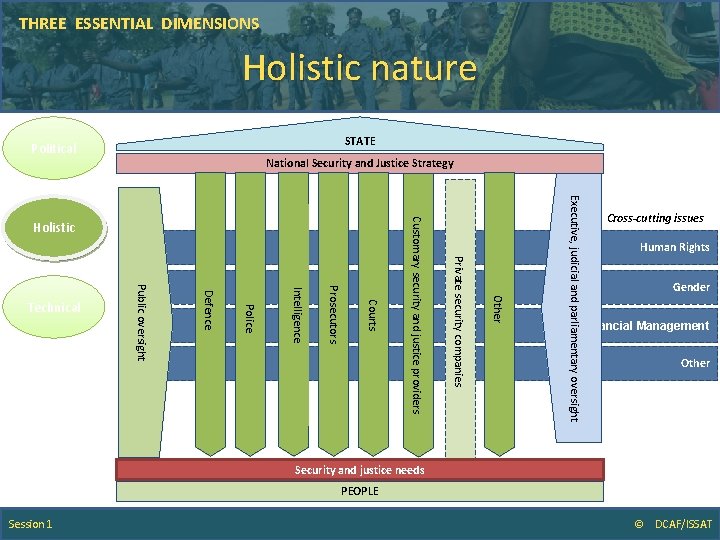
THREE ESSENTIAL DIMENSIONS Holistic nature STATE Political National Security and Justice Strategy Executive, judicial and parliamentary oversight Other Private security companies Courts Prosecutors Intelligence Police Defence Public oversight Technical Customary security and justice providers Holistic Cross-cutting issues Human Rights Gender Financial Management Other Security and justice needs PEOPLE Session 11 ©© DCAF/ISSAT
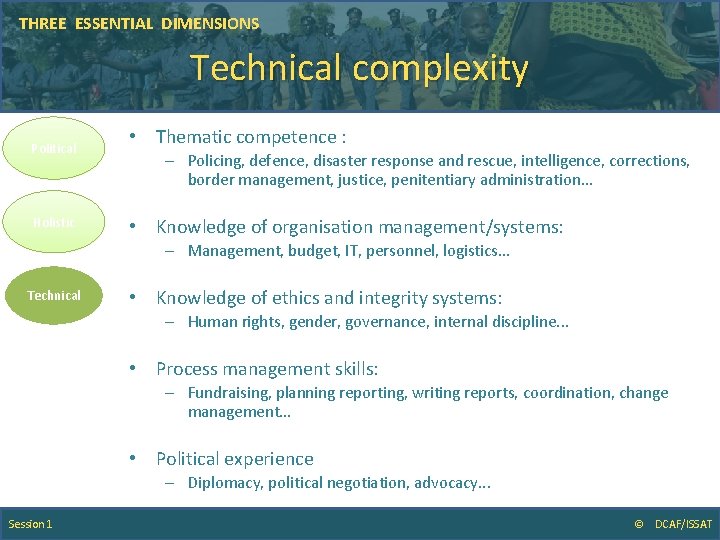
THREE ESSENTIAL DIMENSIONS Technical complexity Political Holistic • Thematic competence : – Policing, defence, disaster response and rescue, intelligence, corrections, border management, justice, penitentiary administration… • Knowledge of organisation management/systems: – Management, budget, IT, personnel, logistics… Technical • Knowledge of ethics and integrity systems: – Human rights, gender, governance, internal discipline. . . • Process management skills: – Fundraising, planning reporting, writing reports, coordination, change management… • Political experience – Diplomacy, political negotiation, advocacy. . . Session 11 ©© DCAF/ISSAT
Remember • Human security is at the heart of SSR • Security and Development are closely linked. No security – no development! • Bottom Line – Security is fundamental to Peoples’ well being • SSR in a Nutshell: 1 – 2 – 3 Session 1 © DCAF/ISSAT
From concept to practice Session 1 © DCAF/ISSAT
SSR is contextual • Every reform context is different, no one-size-fits-all SSR solutions • SSR principles don’t change but other factors do: – – – – Political and legal factors Economic factors Social factors Technology Environment Security Regional • SSR has to be tailored to the needs and opportunities of a specific context Session 11 ©© DCAF/ISSAT
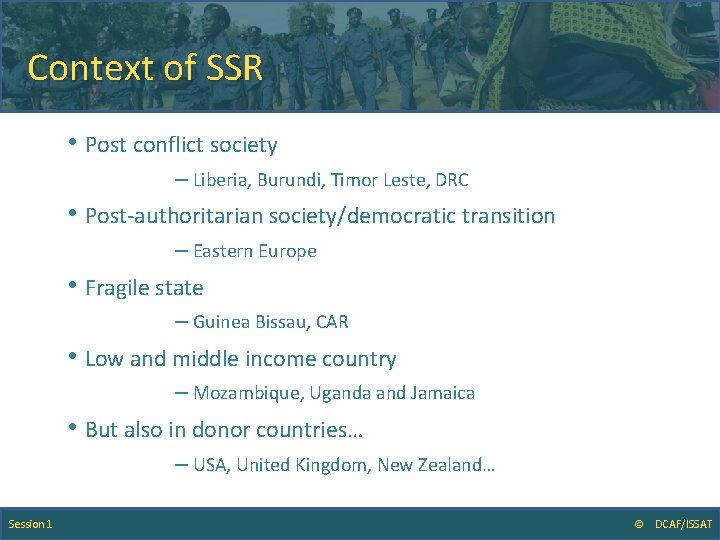
Context of SSR • Post conflict society – Liberia, Burundi, Timor Leste, DRC • Post-authoritarian society/democratic transition – Eastern Europe • Fragile state – Guinea Bissau, CAR • Low and middle income country – Mozambique, Uganda and Jamaica • But also in donor countries… – USA, United Kingdom, New Zealand… Session 11 ©© DCAF/ISSAT
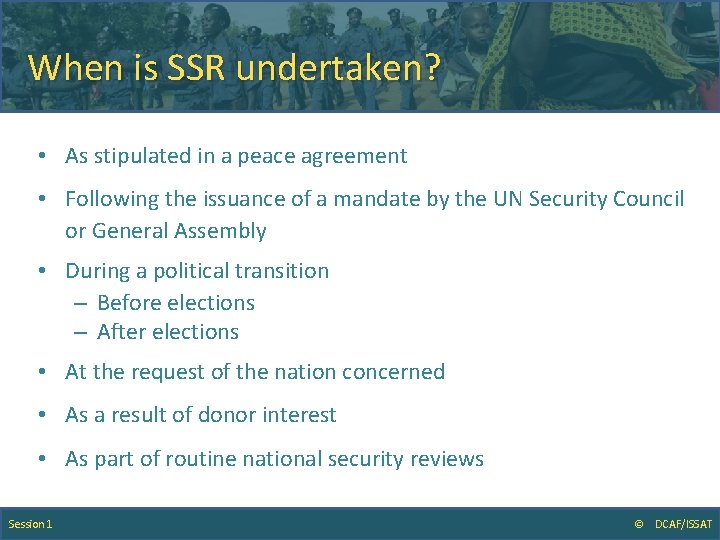
When is SSR undertaken? • As stipulated in a peace agreement • Following the issuance of a mandate by the UN Security Council or General Assembly • During a political transition – Before elections – After elections • At the request of the nation concerned • As a result of donor interest • As part of routine national security reviews Session 11 ©© DCAF/ISSAT
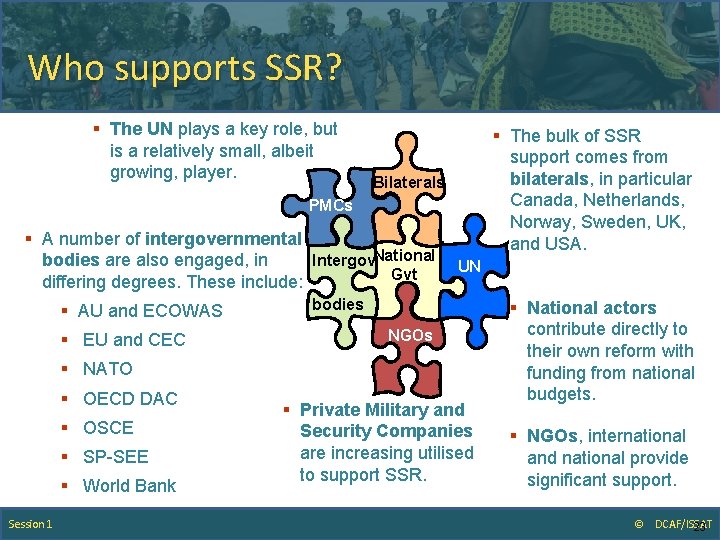
Who supports SSR? § The UN plays a key role, but is a relatively small, albeit growing, player. § The bulk of SSR support comes from bilaterals, in particular Canada, Netherlands, Norway, Sweden, UK, and USA. Bilaterals PMCs UN § A number of intergovernmental bodies are also engaged, in Intergov. National Gvt differing degrees. These include: § AU and ECOWAS § EU and CEC UN bodies NGOs § NATO § OECD DAC § OSCE § SP-SEE § World Bank Session 11 § Private Military and Security Companies are increasing utilised to support SSR. § National actors contribute directly to their own reform with funding from national budgets. § NGOs, international and national provide significant support. ©© DCAF/ISSAT 23
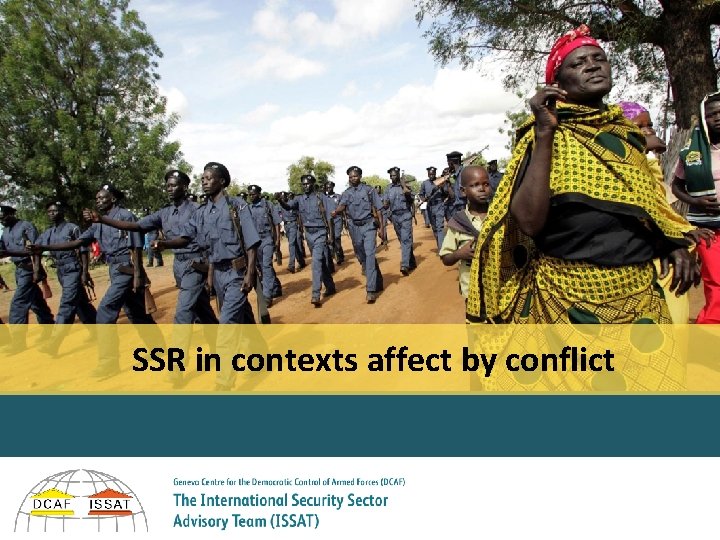
SSR in contexts affect by conflict Session 1 © DCAF/ISSAT
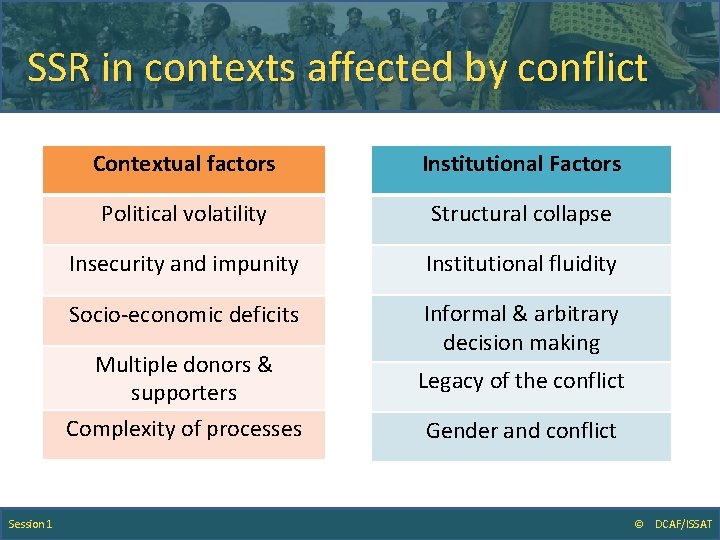
SSR in contexts affected by conflict Contextual factors Institutional Factors Political volatility Structural collapse Insecurity and impunity Institutional fluidity Socio-economic deficits Informal & arbitrary decision making Multiple donors & supporters Complexity of processes Session 11 Legacy of the conflict Gender and conflict ©© DCAF/ISSAT
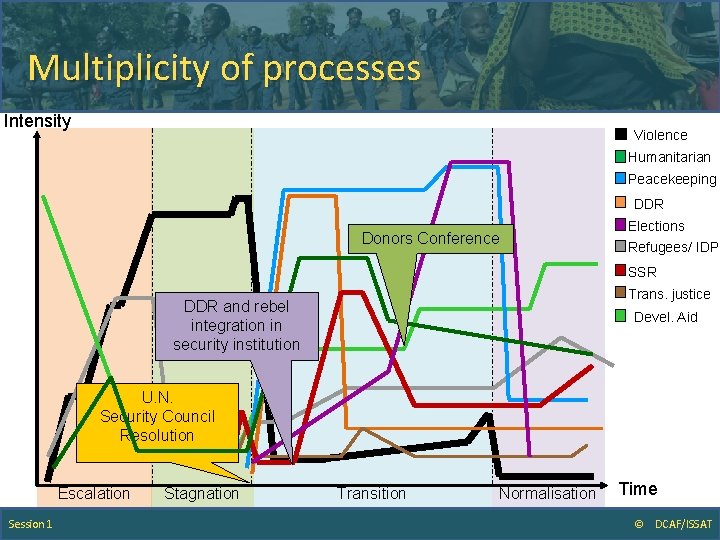
Multiplicity of processes Intensity Violence Humanitarian Peacekeeping DDR Donors Conference Elections Refugees/ IDPs SSR Trans. justice DDR and rebel integration in security institution Devel. Aid U. N. Security Council Resolution Escalation Session 11 Stagnation Transition Normalisation Time ©© DCAF/ISSAT
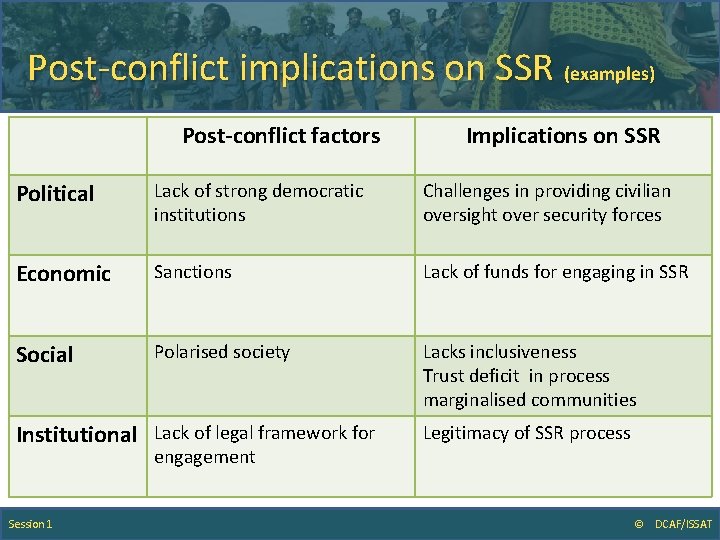
Post-conflict implications on SSR (examples) Post-conflict factors Implications on SSR Political Lack of strong democratic institutions Challenges in providing civilian oversight over security forces Economic Sanctions Lack of funds for engaging in SSR Social Polarised society Lacks inclusiveness Trust deficit in process marginalised communities Institutional Lack of legal framework for engagement Session 11 Legitimacy of SSR process ©© DCAF/ISSAT
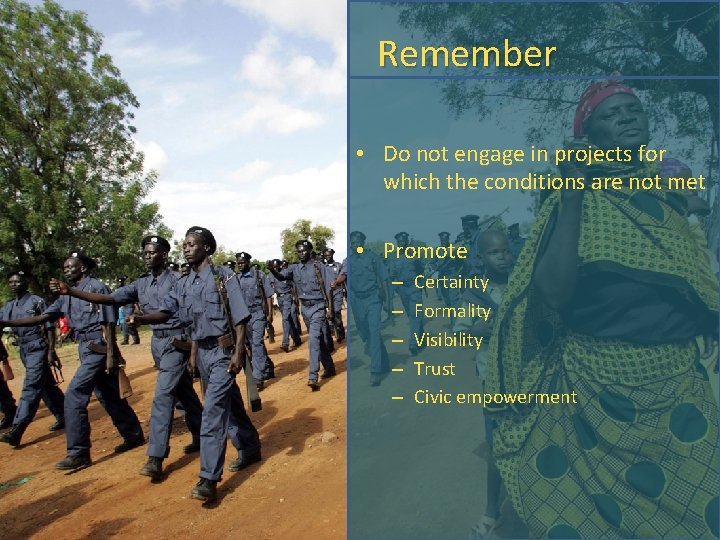
Remember • Do not engage in projects for which the conditions are not met • Promote – – – Session 1 Certainty Formality Visibility Trust Civic empowerment © DCAF/ISSAT