
Security Officer Training Program COMPANY POLICIES AND ORIENTATION
- Slides: 59
Security Officer Training Program COMPANY POLICIES AND ORIENTATION Company Policies July 2004
Security Officer Training Program Every contract security company will provide their employees with basic orientation into policies that will need to be adhered to by each security officer. The process will take approximately 2 -4 hours. Special attention should be given to all the various forms that will need to be read and signed. Company Policies July 2004
Security Officer Training Program Important Note!!! • This module is designed to give you an overview of the types of topics covered in a company orientation • The policies described in this module are samples and are superseded by your own companies actual policies Company Policies July 2004
Security Officer Training Program SECURITY REPORTS AND LOGS The primary purposes of a security log are to: • Provide a primary record of the security officers’ time on and off duty. • Provide a precise and factual record of what duties are performed and when they are performed. • Record unusual events (incidents) and observations. Company Policies July 2004
Security Officer Training Program • Keep a record of equipment and other special items which are entrusted to the care of a security officer. • Provide evidence for clients which may be used to settle disputes or legal proceedings. • Ensure proper notifications are made regarding unusual conditions when a field supervisor or client contact is called. Company Policies July 2004
Security Officer Training Program Items to be recorded when making log entries: § Itemize significant equipment received at the beginning of each shift, especially the number of keys received. § Log each door or gate, found unlocked which is normally locked. § Log any item that is delivered to the security post and any item picked up. § Log all visitors and employees entering or leaving the facility during non-working hours unless a special form is provided for such use. Company Policies July 2004
Security Officer Training Program § Make all entries in ink – preferably black. § Print all entries to make sure they can be read. § Use precise time entries. Do not round off more than to the nearest five minutes. § Log when a paycheck is picked up and the name of the person picking up the check. (Ask for I. D. if you don’t know the individual. ) § Make an entry for every hour, even if nothing significant occurs. (ex. , “Access control at the main security gate #1 – all appears normal, no unusual activity. ”) Company Policies July 2004
Security Officer Training Program § Check and log the condition of all vending machines while on patrol. § Log the time of each patrol (start and finish). § Write things down. Take credit for your good work. It is better to write too much than too little. § Log all phone calls made by you or anyone else. This protects you should a telephone abuse situation occur at the facility. Company Policies July 2004
Security Officer Training Program THINGS NOT TO DO IN A LOG BOOK v Doodle or write anything not security oriented. v Log anything before the time that it actually occurs. v Use abbreviations or ditto marks. v Sign off duty before your relief arrives and is fit to perform his/her duties. v Enter personal opinions or write comments about co-workers, client employees, or your supervisors. v Use “white-out” or erase anything. If you make a mistake, draw a line through it, initial it and write the correct word, time, etc. . Company Policies July 2004
Security Officer Training Program REPORTING PROCESSES/PROCEDURES Some events will most likely require immediate notification of client personnel. 1. HR issues involving employees of the client. 2. Maintenance or mechanical issues. 3. Incidents where the fire department, emergency medical services or law enforcement personnel are en route to the facility. 4. Weather related emergencies 5. Union activity. Company Policies July 2004
Security Officer Training Program Incidents requiring immediate notification of the contract security company include: 1. Call-offs or absences of security personnel. 2. Any type of inappropriate conduct on the part of contract security personnel. 3. Schedule changes or requests for vacation, pay raises, etc. Company Policies July 2004
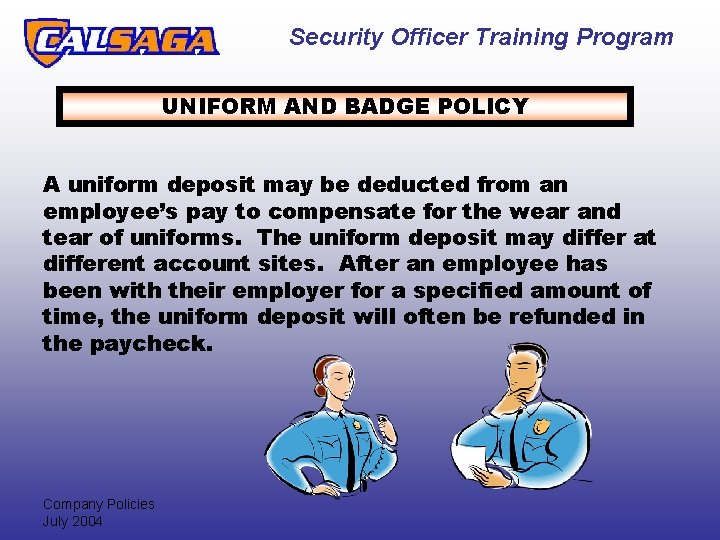
Security Officer Training Program UNIFORM AND BADGE POLICY A uniform deposit may be deducted from an employee’s pay to compensate for the wear and tear of uniforms. The uniform deposit may differ at different account sites. After an employee has been with their employer for a specified amount of time, the uniform deposit will often be refunded in the paycheck. Company Policies July 2004
Security Officer Training Program A proper uniform usually consists of: Ø 2 shirts Ø 2 pairs of pants Ø 1 jacket Ø 1 tie Ø 1 belt * Some accounts require a blazer, hat or cap. Company Policies July 2004
Security Officer Training Program ü At the time of issue, the officer is responsible for trying on the uniforms to ensure proper fit. ü Once at the assigned facility, the supervisor has the right to inspect the fit of uniforms and request a change if necessary. ü After 30 days, more uniform parts may usually be obtained by filling out a uniform request and faxing or delivering it to the office. ü If additional parts are requested an officer has the maximum amount, old parts must be exchanged for new ones. Company Policies July 2004
Security Officer Training Program ü If uniform parts are returned damaged (other than normal wear and tear), a charge will be levied in accordance with the severity of the damage. ü If uniforms are not returned when employment is terminated, the cost of the missing items will be charged to the individual. ü Uniforms will not be issued without a written request form. ü Security uniforms may only be worn during the course of your work assignment. Company Policies July 2004
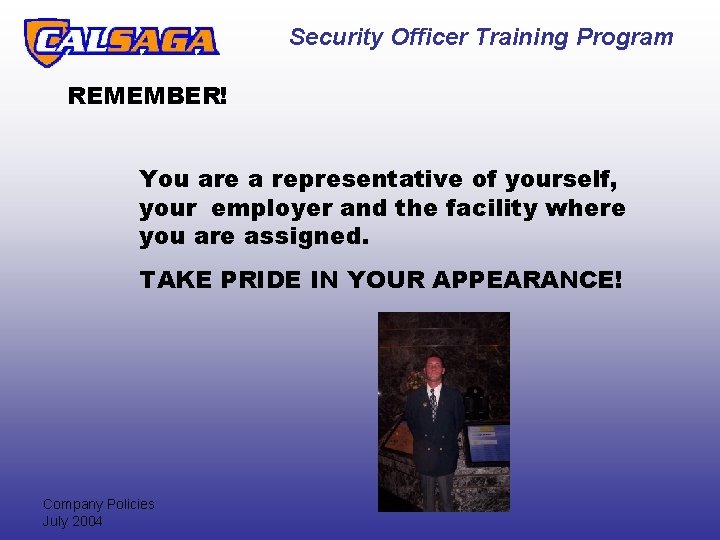
Security Officer Training Program REMEMBER! You are a representative of yourself, your employer and the facility where you are assigned. TAKE PRIDE IN YOUR APPEARANCE! Company Policies July 2004
Security Officer Training Program WORK SCHEDULES 1. The supervisor is responsible for preparing work schedules. 2. It is the responsibility of each officer to check his/her schedule with his/her respective manager. 3. If an officer cannot work the schedule as prepared, he/she should contact their Account Manager or Site Manger immediately. 4. Any officer who has been advised to contact the Human Resources Department for counseling will be removed from the schedule until the outcome of the counseling is decided. Company Policies July 2004
Security Officer Training Program Every officer should contact his/her respective Account Manager for any of the following: 1. Request for time off (must be in writing with TWO WEEKS NOTICE). 2. If because of illness, injury or other such emergency the employee cannot work the prepared schedule. 3. Reporting any other situation which affects the employee’s work schedule. 4. Requesting more work time. Company Policies July 2004
Security Officer Training Program REVIEW OF OVERTIME Contract security personnel are often asked to work overtime. Your company will be as reasonable as possible in these situations but likely appreciate your willingness to do so. Any hours over 8 in a day or 40 in a pay week will be paid at time and a half. Company Policies July 2004
Security Officer Training Program FAMILY AND MEDICAL LEAVE POLICY Employee Family and Medical Leave is covered by California Law. See your employer for details if you have questions. Company Policies July 2004
Security Officer Training Program VACATION POLICY Vacation policies will vary from employer to employer. Review and discuss with the HR Department Company Policies July 2004
Security Officer Training Program ABSENTEEISM POLICY Absenteeism is defined as being absent from work on any scheduled workday. The reason for the absence is NOT a judgmental factor, nor is the absence “legitimized” if the employee has an excuse or if he/she reported the absence. If you’re not at work for any reason, you are absent, and the reason doesn’t matter. Excessive absenteeism and/or tardiness will result in disciplinary action which will be based on the frequency of occurrence. Company Policies July 2004
Security Officer Training Program THE POINTS CONCEPT Absenteeism is documented by using a points system. Points are assessed for an absence of any length. § If you report to work late. § If you leave before the end of your shift WITH permission. § If you miss a day of work by call appropriately (more than one hour before your scheduled shift). Company Policies July 2004
Security Officer Training Program § If you miss 2 days of work consecutively because of illness. If you miss 3 or more days, you may be required to provide a doctor’s excuse. § If you call off for a scheduled mandatory meeting. § If you call off less than 1 hour before your scheduled shift. § If you come to work late after your supervisor called you. § If you (unless totally incapacitated) have a family member or friend call you off work. Company Policies July 2004
Security Officer Training Program § If you call off on a holiday premium shift. § If you call off the day before or the day after a holiday. § If your supervisor calls you after your shift has started, and you say you are not coming in. § If you are absent without calling for a scheduled shift (no call/no show). § If you are absent without calling for 2 days in a row you will considered as voluntarily quitting your job. Company Policies July 2004
Security Officer Training Program ADDITIONAL ABSENTEEISM INFORMATION v If an employee is excessively late, the supervisor shall make the decision to either place the employee on duty, or advise the employee that the shift was filled. v In the event an employee is unable to work (whether for sickness or family emergency) a supervisor must be notified as soon as possible (i. e. , no less than four hours prior to the shift). Company Policies July 2004
Security Officer Training Program v You must notify the appropriate supervisor. Calls from an employee notifying anyone else is unacceptable. You must speak to the appropriate supervisor, depending on where you are assigned. v. You are responsible for knowing your work schedule, and once that schedule is posted, the employer expects 100% availability. Anything less is unacceptable and subject to disciplinary action. Company Policies July 2004
Security Officer Training Program NEW HIRES All new hires are placed on a six week orientation period during which ANY violation of company policy will result in disciplinary action up to and including termination. New employees will receive a “First Written Warning” for absenteeism. EXCEPTIONS Absence due to: funeral leave military obligation jury duty work related injury Company Policies July 2004
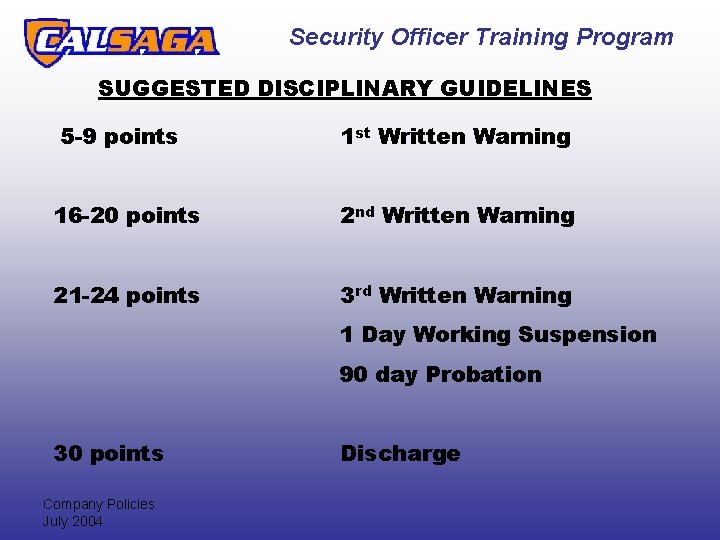
Security Officer Training Program SUGGESTED DISCIPLINARY GUIDELINES 5 -9 points 1 st Written Warning 16 -20 points 2 nd Written Warning 21 -24 points 3 rd Written Warning 1 Day Working Suspension 90 day Probation 30 points Company Policies July 2004 Discharge
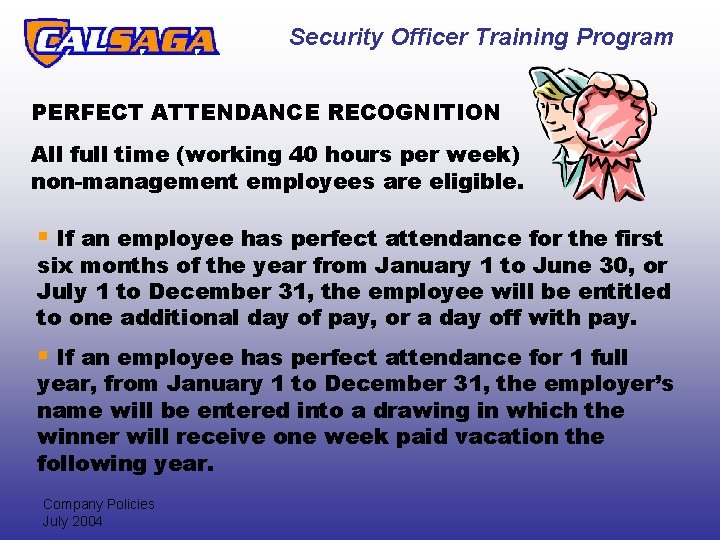
Security Officer Training Program PERFECT ATTENDANCE RECOGNITION All full time (working 40 hours per week) non-management employees are eligible. § If an employee has perfect attendance for the first six months of the year from January 1 to June 30, or July 1 to December 31, the employee will be entitled to one additional day of pay, or a day off with pay. § If an employee has perfect attendance for 1 full year, from January 1 to December 31, the employer’s name will be entered into a drawing in which the winner will receive one week paid vacation the following year. Company Policies July 2004
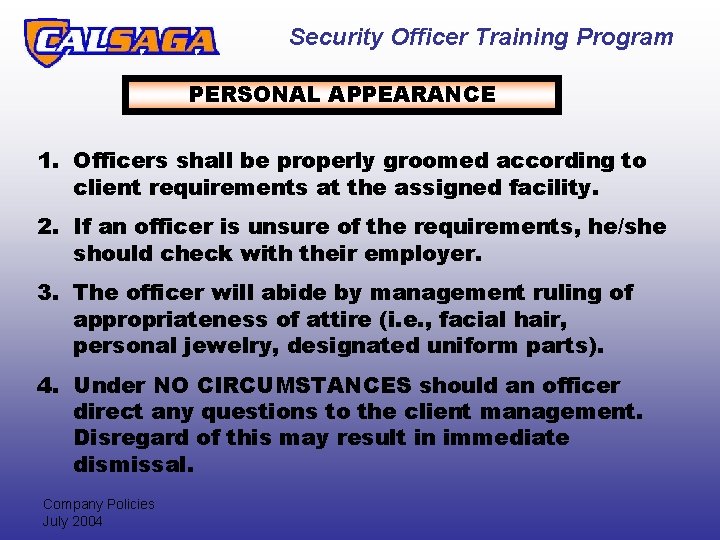
Security Officer Training Program PERSONAL APPEARANCE 1. Officers shall be properly groomed according to client requirements at the assigned facility. 2. If an officer is unsure of the requirements, he/she should check with their employer. 3. The officer will abide by management ruling of appropriateness of attire (i. e. , facial hair, personal jewelry, designated uniform parts). 4. Under NO CIRCUMSTANCES should an officer direct any questions to the client management. Disregard of this may result in immediate dismissal. Company Policies July 2004
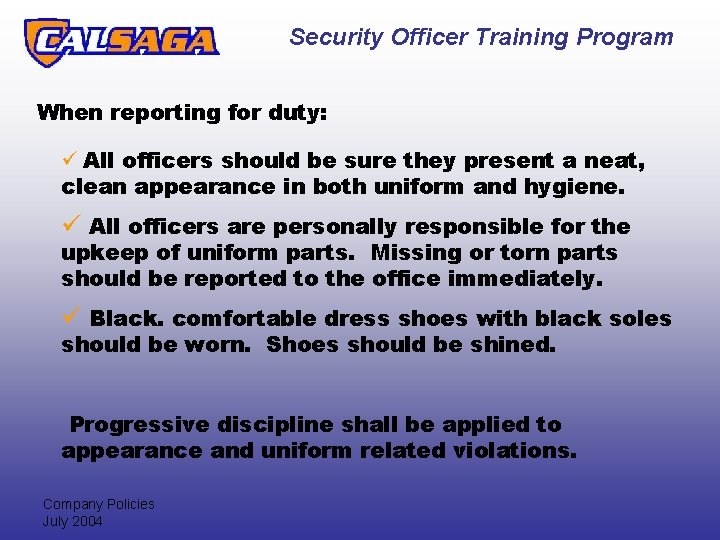
Security Officer Training Program When reporting for duty: ü All officers should be sure they present a neat, clean appearance in both uniform and hygiene. ü All officers are personally responsible for the upkeep of uniform parts. Missing or torn parts should be reported to the office immediately. ü Black. comfortable dress shoes with black soles should be worn. Shoes should be shined. Progressive discipline shall be applied to appearance and uniform related violations. Company Policies July 2004
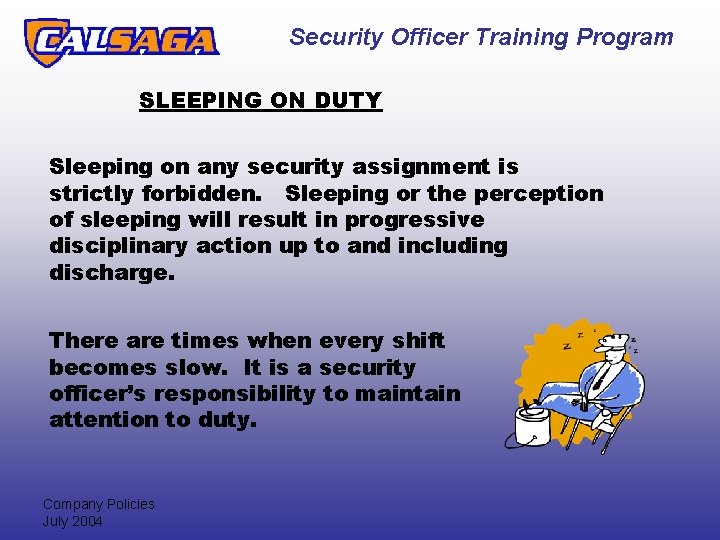
Security Officer Training Program SLEEPING ON DUTY Sleeping on any security assignment is strictly forbidden. Sleeping or the perception of sleeping will result in progressive disciplinary action up to and including discharge. There are times when every shift becomes slow. It is a security officer’s responsibility to maintain attention to duty. Company Policies July 2004
Security Officer Training Program REPORTING FOR DUTY UNDER THE INFLUENCE Any supervisor who suspects an employee may be under the influence of an intoxicating substance, while on duty or reporting for duty should: 1. Whenever possible, ask another supervisor or security officer to witness the dialogue with the employee suspected of being under the influence. 2. Ask the employee who is displaying signs of impairment if they have been drinking or are under the influence in the presence of witnesses. Company Policies July 2004
Security Officer Training Program 3. Regardless of their response, if, in the supervisor’s opinion the person is impaired, he/she should call someone to transport the impaired employee (spouse, friend, parent, etc. ) to the hospital or office for determination. 4. If the impaired employee declines, offer to call him/her a cab. 5. If the employee continues to refuse offers of help and is attempting to leave the property by driving away in his/her vehicle, note the license number and take a brief description of the vehicle and direction in which the employee headed. Company Policies July 2004
Security Officer Training Program 6. Contact the police immediately. 7. Advise the person answering the police telephone, who you are, what has happened, and provide them with the impaired employee’s vehicle description, as well as the direction they departed. 8. The supervisor must ensure he/she obtains the name of the dispatcher or police officer he/she provided the information to and enter the name in the report generated. Company Policies July 2004
Security Officer Training Program 9. The supervisor will make no attempt to physically detain the impaired employee at any time. 10. The supervisor shall NOT leave the property to transport or follow the person in any manner. 11. There shall be no abbreviated manner in which these situations are handled. Company Policies July 2004
Security Officer Training Program POSTS Ø Never leave a post unattended without permission of a supervisor or proper relief. Ø Never leave a post before the end of an assigned work shift even if the relief arrives ahead of time and is willing to take over. Ø Never allow an officer whose appearance and condition indicate that he/she is not fit for duty to relieve you at your post. Notify a supervisor if you suspect a problem. Ø Never leave guarded property without proper relief or permission of a supervisor. Company Policies July 2004
Security Officer Training Program FIREARMS AND OTHER DANGEROUS WEAPONS Possession of any: • firearms • fireworks • explosives • pepper mace • dangerous knives • razors dagger • brass knuckles is strictly prohibited and may result in disciplinary action, up to and including termination. Company Policies July 2004
Security Officer Training Program PUBLIC RELATIONS: PERSONAL ATTITUDE AND RESPONSIBILITY All security officers should: § Maintain a positive attitude and strive to meet and surpass management expectations. § Maintain courteous relations with co-workers, employees, visitors, contactors, salespersons, etc. § Enforce security regulations fairly and impartially. § Realize you are a representative of your employer and the facility to which you are assigned. Company Policies July 2004
Security Officer Training Program INSUBORDINATION A refusal to carry out a lawful order of a supervisor, client, manager, or other authority. INSUBORDINATION WILL NOT BE TOLERATED AND IS GROUNDS FOR DISCHARGE. Company Policies July 2004
Security Officer Training Program The following acts of theft or pilferage will not be permitted: ü Searching any files, desks, cabinets lockers on protected facility property. ü Engaging in deliberate destruction or defacing of protected facility property. ü Allowing unauthorized removal of property from the protected facility. ü Using any protected facility property without advance permission of the management person in charge of the security function. ü Similar acts toward employee and visitor property. Company Policies July 2004
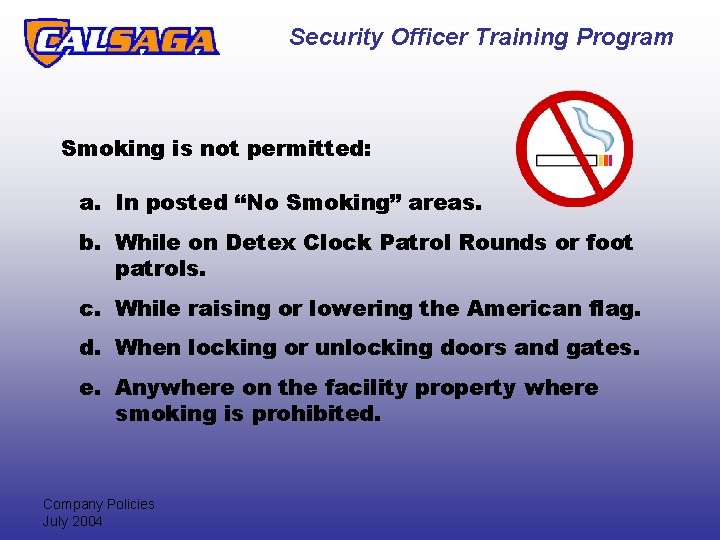
Security Officer Training Program Smoking is not permitted: a. In posted “No Smoking” areas. b. While on Detex Clock Patrol Rounds or foot patrols. c. While raising or lowering the American flag. d. When locking or unlocking doors and gates. e. Anywhere on the facility property where smoking is prohibited. Company Policies July 2004
Security Officer Training Program REQUESTS FOR INFORMATION 1. A security officer should not discuss the affairs of the facility with anyone. 2. A security officer should not answer questions asked by strangers regardless of their identification. 3. All reporters, news media personnel, civil, governmental and consumer representatives, process servers, repossessors, etc. , entering the property for the purpose of obtaining information should be referred to the management representative in charge of the security function or any officially designated person who is responsible for giving out information. Company Policies July 2004
Security Officer Training Program PERSONAL CONDUCT The following examples of personal conduct are strictly forbidden: • Engaging in violence or horseplay. • Use of profane or offensive language or gestures. • False reporting or failure to report any security related incident, observed personally, done personally, or brought to the attention of the security officer by another person. Company Policies July 2004
Security Officer Training Program • Falsifying employment application, time records, incident reports, records or documents. • Accepting gifts or bribes in the line of duty. • Gambling in any form. • Soliciting contributions or selling tickets for any purpose. • Loaning or borrowing money between co-workers or employees of the protected facility. • Damaging, abusing or losing control of any protected facility property assigned to the facility. Company Policies July 2004
Security Officer Training Program • Visiting protected property while not on duty without advance permission of your employer. • Receiving friends, relatives, or pets on protected property. • Immoral or indecent behavior, • Insubordination • Gossiping or spreading false or private information. • Threatening harm to self or others. • Other forms of negative conduct previously noted. Company Policies July 2004
Security Officer Training Program This list is not all inclusive. ANY BEHAVIOR RESULTING IN BREACH OF SECURITY OR CONDUCT DETRIMENTAL TO THE PROTECTED FACILITY OR YOUR EMPLOYER IS NOT PERMITTED AND WILL RESULT IN DISCIPLINE UP TO AND INCLUDING TERMINATION! Company Policies July 2004
Security Officer Training Program 1. All security officers shall execute their duties at all times and shall not participate in any action of sympathy in conducting a work stoppage, picketing, or an action of strike. 2. Intentional interference with the orderly operation of the protected facility will not be tolerated. 3. Posting or distributing any material on protected facility without proper authorization will not be permitted. 4. Missing any scheduled clock rounds without prior permission will not be permitted. Company Policies July 2004
Security Officer Training Program 5. No children, pets or visitors are allowed on protected facility property unless prior permission has been given. When this policy conflicts with the protected facility policy, it does not apply and the facility policy should be followed. 6. Cameras of any sort are not permitted on protected facility property unless prior approval has been given by the security function manager. The manager should be notified immediately of any violation of this policy. 7. Visitors are not permitted on the protected property for the purpose of peddling or selling. Security officers will be advised if there are exceptions to this rule. Company Policies July 2004
Security Officer Training Program 8. All security officers shall maintain their work area in a neat orderly condition. The area should be swept and the trash emptied before going off duty. 9. The use of unnecessary or undue force is strictly prohibited. All visitors, employees or officials of the protected facility should be treated with respect. 10. All duties outlined in the post orders are to be followed without exception. 11. Fraternization with employees or vendors of the protected facility is strictly forbidden. Company Policies July 2004
Security Officer Training Program 12. Fraternization of employees working at different facilities is not encouraged, but is not forbidden as long as the relationship does not interfere with daily operations. 13. Fraternization of employees of any rank working at the same facility is strictly forbidden. 14. A violation of the fraternization policy may result in disciplinary action up to and including discharge. The employer reserves the right to transfer employees to other facilities. 15. It is the employee’s responsibility to obtain adequate transportation to and from work and to stay in communication with their Account Manager about possible schedule changes. Company Policies July 2004
Security Officer Training Program PROTECTED FACILITY EQUIPMENT TELEPHONE POLICY 1. The use of facility telephones to place or receive a personal call is strictly forbidden. 2. Abuse of telephones for personal calls either in frequency and/or length shall be cause for termination. 3. If it becomes necessary to make a personal call, ask permission from the supervisor and log details. 4. Any calls to “ 900” numbers and long distance shall be cause for termination and is prosecutable. 5. Cellular phones should not be carried, worn, or used while on duty. Company Policies July 2004
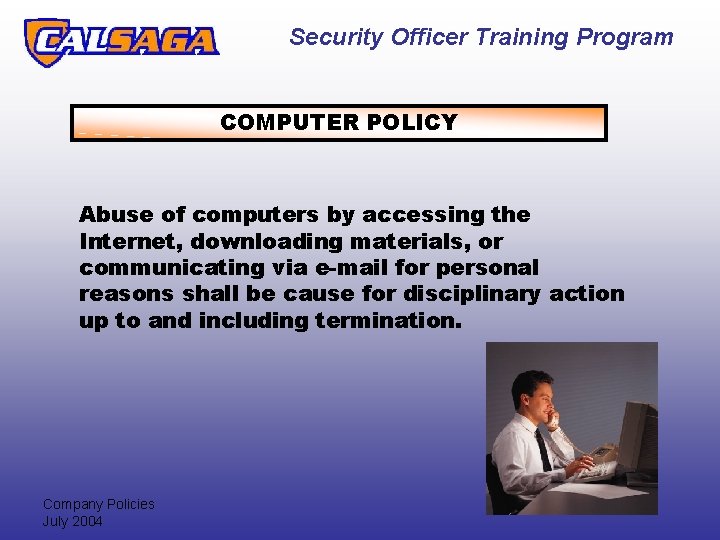
Security Officer Training Program COMPUTER POLICY Abuse of computers by accessing the Internet, downloading materials, or communicating via e-mail for personal reasons shall be cause for disciplinary action up to and including termination. Company Policies July 2004
Security Officer Training Program Employees are strictly forbidden to use electronic media for knowingly transmitting, retrieving, or storing any communication that is: • Discriminatory or harassing • Derogatory to any individual or group • Obscene • Defamatory or threatening • Engaged in for nay purpose that is illegal or contrary to your employer’s policy or business interest. Violation of the computer use policy can lead to discipline, up to and including termination, as well as civil liability and criminal prosecution. Company Policies July 2004
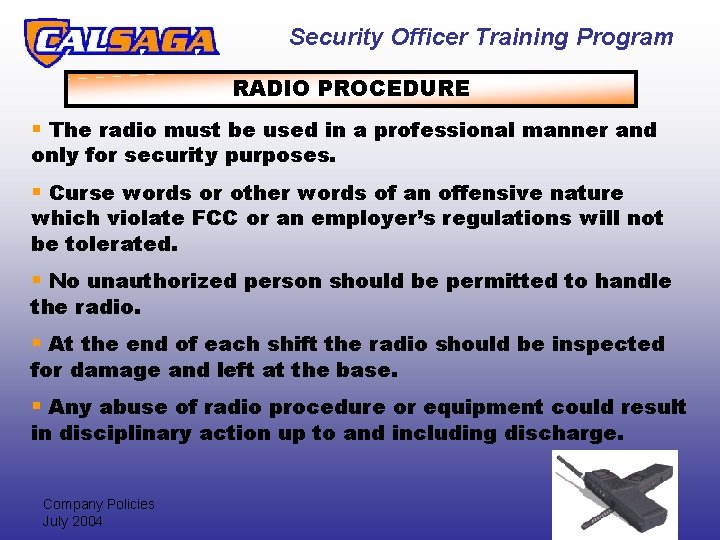
Security Officer Training Program RADIO PROCEDURE § The radio must be used in a professional manner and only for security purposes. § Curse words or other words of an offensive nature which violate FCC or an employer’s regulations will not be tolerated. § No unauthorized person should be permitted to handle the radio. § At the end of each shift the radio should be inspected for damage and left at the base. § Any abuse of radio procedure or equipment could result in disciplinary action up to and including discharge. Company Policies July 2004
Security Officer Training Program VEHICLE SAFETY POLICY New employees or employees being transferred to an account which requires the use of a vehicle will be subject to a driver’s license record report. A job offer for the driving position will be rescinded if: 1. License is currently under suspension. 2. Over four points are accumulated. 3. DWI/DUI conviction in the last three years 4. Any other vehicle/traffic violations as determined by HR Company Policies July 2004
Security Officer Training Program v All employees should notify his/her supervisor or the Director of Human Resources of any traffic violations, including those occurring during nonworking hours on in non-company vehicles. v Any damage to the vehicle which is a result of the employee’s negligence, must be repaired at the employee’s expense. The employee will be responsible for a minimum amount of the insurance deductible, which is dependent on whether the vehicle is owned by your employer or the client. Company Policies July 2004
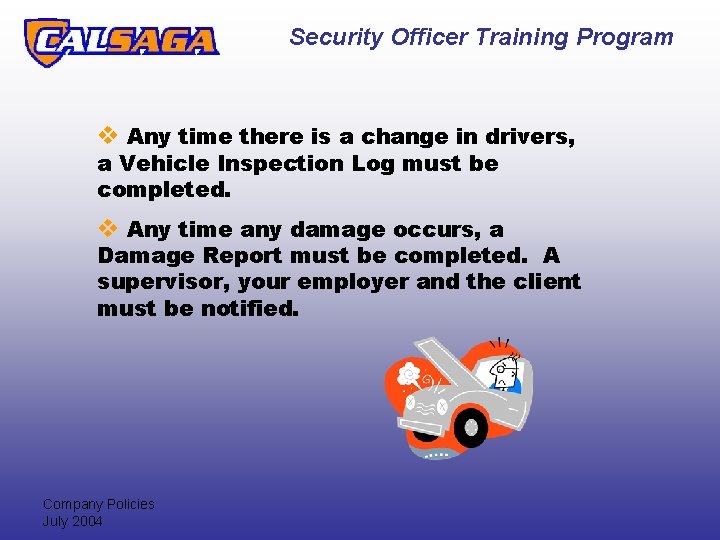
Security Officer Training Program v Any time there is a change in drivers, a Vehicle Inspection Log must be completed. v Any time any damage occurs, a Damage Report must be completed. A supervisor, your employer and the client must be notified. Company Policies July 2004