
Security In The Courthouse Presented by Harold C
Security In The Courthouse Presented by Harold C. Gillens, PSP, CFC, CHS-III South Carolina Clerks of Court and Master of Deeds Annual Conference
Introduction n Security Best Practices indicate that we should transition from being a REACTIVE Society to a PROACTIVE Society n n Are you focused on PREPAREDNESS & PREVENTION? Agenda n Security Standards & Guidelines n Self Assessment / Security Audit n Security & Emergency Planning n The Security Architect/Consultant’s Role n Conclusion
Security Standards & Guidelines
Standard & Guidelines (Security Best Practices) n Administrator’s Office Directives/Order n n Mission – Protecting People, Property, and Information Directive/Order Coverage n n n n Daily Security Procedures to Protect The Pubic & Court Staff Courthouse Staff Security of Judicial Officers Security Equipment Security Planning Courthouse Design/Build & Remodeling Considerations Security Checklist/Assessments
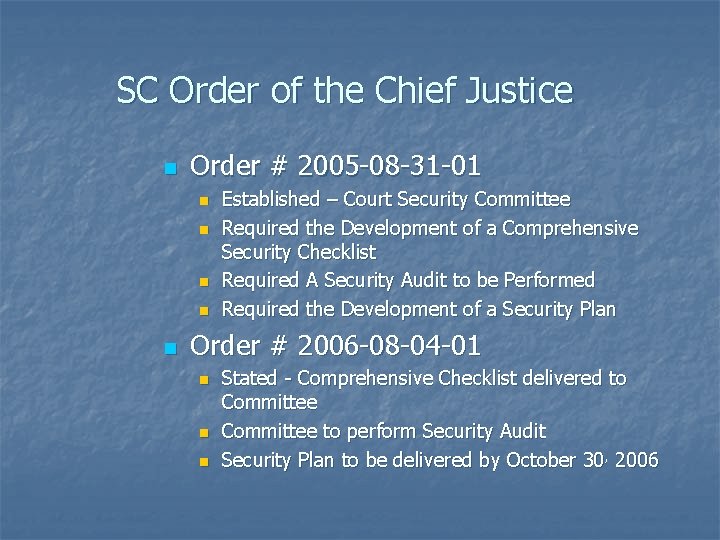
SC Order of the Chief Justice n Order # 2005 -08 -31 -01 n n n Established – Court Security Committee Required the Development of a Comprehensive Security Checklist Required A Security Audit to be Performed Required the Development of a Security Plan Order # 2006 -08 -04 -01 n n n Stated - Comprehensive Checklist delivered to Committee to perform Security Audit Security Plan to be delivered by October 30, 2006
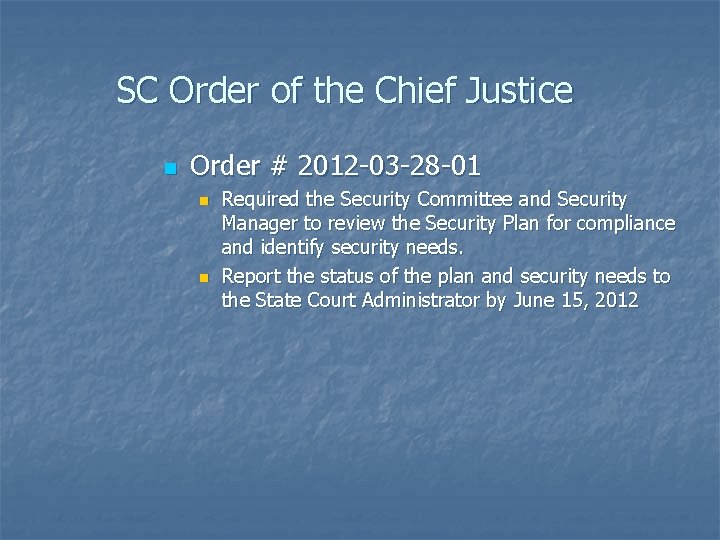
SC Order of the Chief Justice n Order # 2012 -03 -28 -01 n n Required the Security Committee and Security Manager to review the Security Plan for compliance and identify security needs. Report the status of the plan and security needs to the State Court Administrator by June 15, 2012
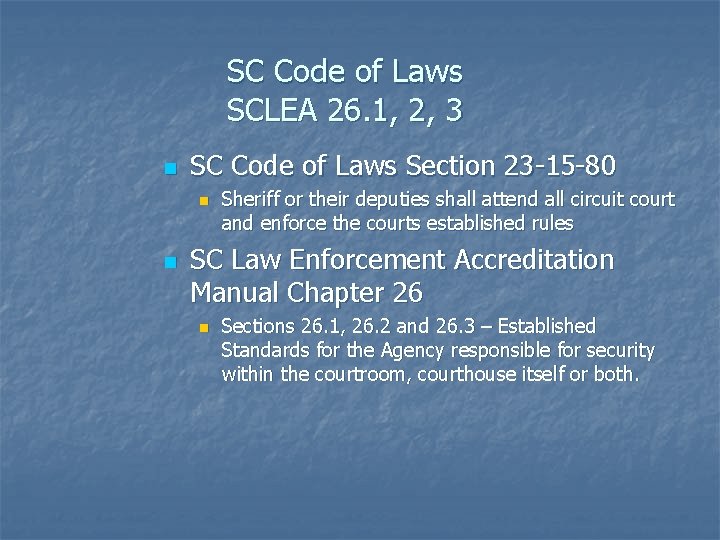
SC Code of Laws SCLEA 26. 1, 2, 3 n SC Code of Laws Section 23 -15 -80 n n Sheriff or their deputies shall attend all circuit court and enforce the courts established rules SC Law Enforcement Accreditation Manual Chapter 26 n Sections 26. 1, 26. 2 and 26. 3 – Established Standards for the Agency responsible for security within the courtroom, courthouse itself or both.
Self Assessment/Security Audit
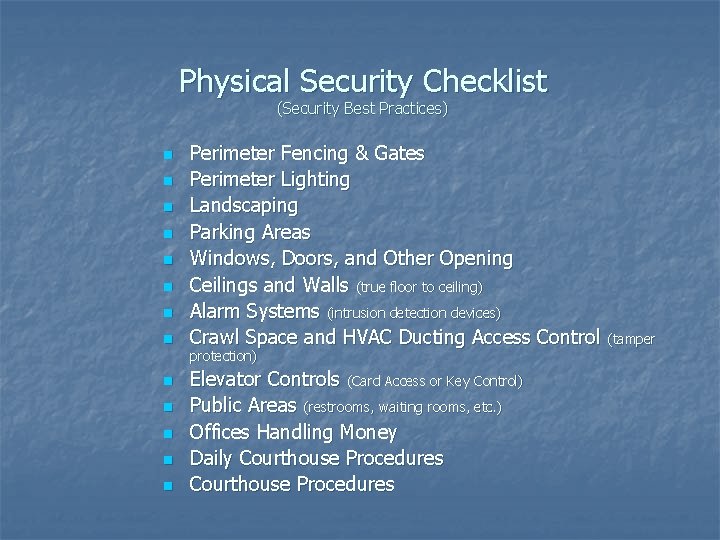
Physical Security Checklist (Security Best Practices) n n n n Perimeter Fencing & Gates Perimeter Lighting Landscaping Parking Areas Windows, Doors, and Other Opening Ceilings and Walls (true floor to ceiling) Alarm Systems (intrusion detection devices) Crawl Space and HVAC Ducting Access Control (tamper protection) Elevator Controls (Card Access or Key Control) Public Areas (restrooms, waiting rooms, etc. ) Offices Handling Money Daily Courthouse Procedures
SAMPLE Comprehensive Checklist n SEE HANDOUTS
Security & Emergency Planning
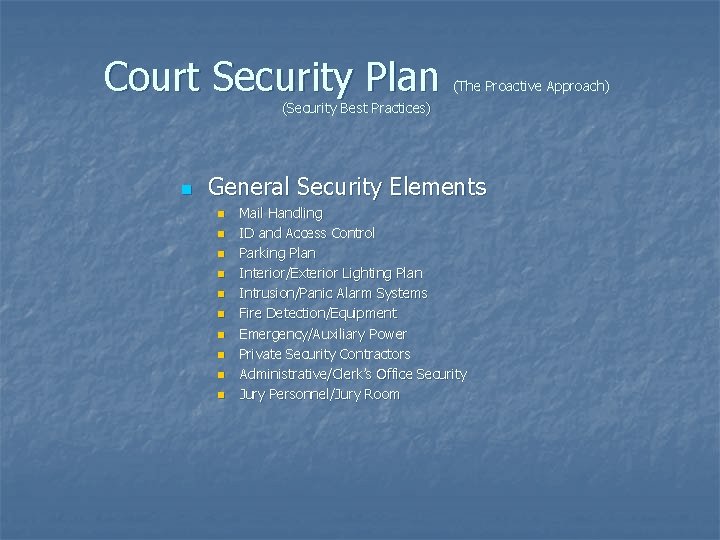
Court Security Plan (The Proactive Approach) (Security Best Practices) n General Security Elements n n n n n Mail Handling ID and Access Control Parking Plan Interior/Exterior Lighting Plan Intrusion/Panic Alarm Systems Fire Detection/Equipment Emergency/Auxiliary Power Private Security Contractors Administrative/Clerk’s Office Security Jury Personnel/Jury Room
Court Security Plan (The Proactive Approach) (Security Best Practices) n General Security Elements (Continues) n n n n Public Demonstrations Vital Records Storage Evacuation Planning After-Hours Operations Custodial Services Computer and Data Security Workplace Violence
Court Security Plan (The Proactive Approach) (Security Best Practices) n Operational Security Elements n n n n Security Personnel and Staffing Perimeter and Entry Screening Prisoner/Inmate Transport Holding Cells Interior and Public Waiting Areas Courtroom Security Jury Trial Procedures High Risk/High Profile Trials Judicial Protection Incident Reporting and Recording Security Personnel/Staff Training Courthouse Communication Bomb Threats
Court Security Plan (The Proactive Approach) (Security Best Practices) n Operational Security Elements (continues) n n n Hostage/Escape/Lockdown/Active Shooter Procedures Firearms Policies and Procedures Restraint of Defendants
The Security Architect / Consultant’s Role
Security Committee Support n n n Are your Security Committee equipped to develop and support every element of your Security Plan? Keep in Mind – This is a Collateral Duty for every member (focus and time management) Here are some elements they may require assistance with: n n Risk and Vulnerability Assessments / Security Audits Electronic Systems Design and Installation Management (Access Control, Intrusion Detection, IP Video Management/CCTV, Parking Control, Mass Notification, and Intercom Systems) n n Workplace Violence Awareness & Training Design Build & Renovation – Security Architect Support
New Courthouse Design/Build & The Security Architect n n n Is a Courthouse in your 3 to 5 year Master Plan? Who is the 1 st person you will hire in your design/build process? How will you address security during your design/build process? n Require your Architect to have a Security Planner on staff? n Hire a Security Planner directly? n Tell the General Contractor to “throw” something in? n Implement your security requirements after the building has been built?
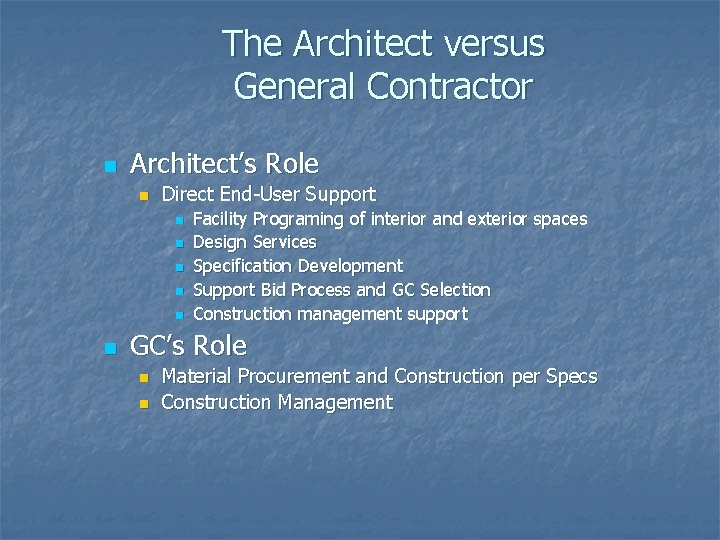
The Architect versus General Contractor n Architect’s Role n Direct End-User Support n n n Facility Programing of interior and exterior spaces Design Services Specification Development Support Bid Process and GC Selection Construction management support GC’s Role n n Material Procurement and Construction per Specs Construction Management
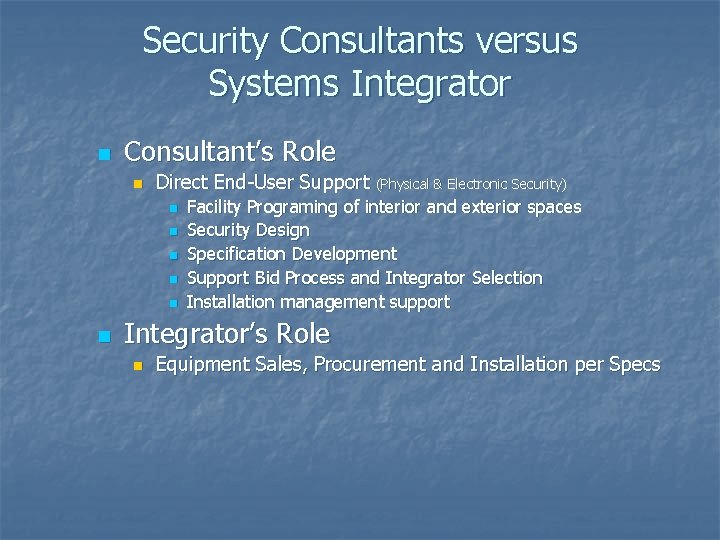
Security Consultants versus Systems Integrator n Consultant’s Role n Direct End-User Support (Physical & Electronic Security) n n n Facility Programing of interior and exterior spaces Security Design Specification Development Support Bid Process and Integrator Selection Installation management support Integrator’s Role n Equipment Sales, Procurement and Installation per Specs
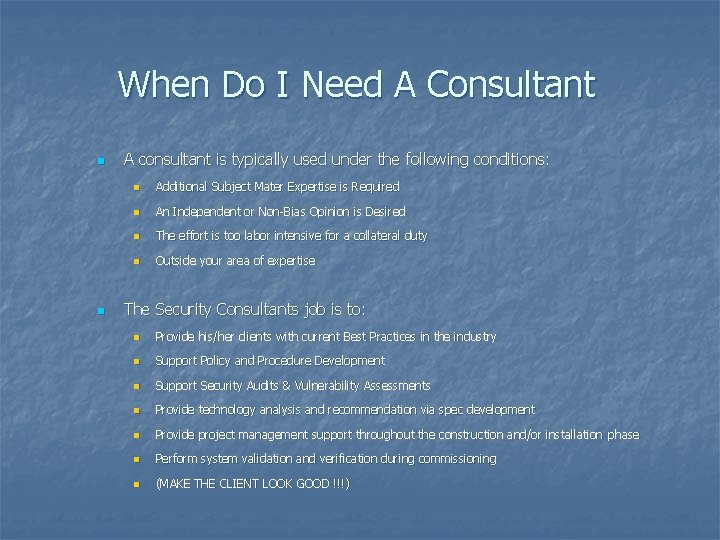
When Do I Need A Consultant n n A consultant is typically used under the following conditions: n Additional Subject Mater Expertise is Required n An Independent or Non-Bias Opinion is Desired n The effort is too labor intensive for a collateral duty n Outside your area of expertise The Security Consultants job is to: n Provide his/her clients with current Best Practices in the industry n Support Policy and Procedure Development n Support Security Audits & Vulnerability Assessments n Provide technology analysis and recommendation via spec development n Provide project management support throughout the construction and/or installation phase n Perform system validation and verification during commissioning n (MAKE THE CLIENT LOOK GOOD !!!)
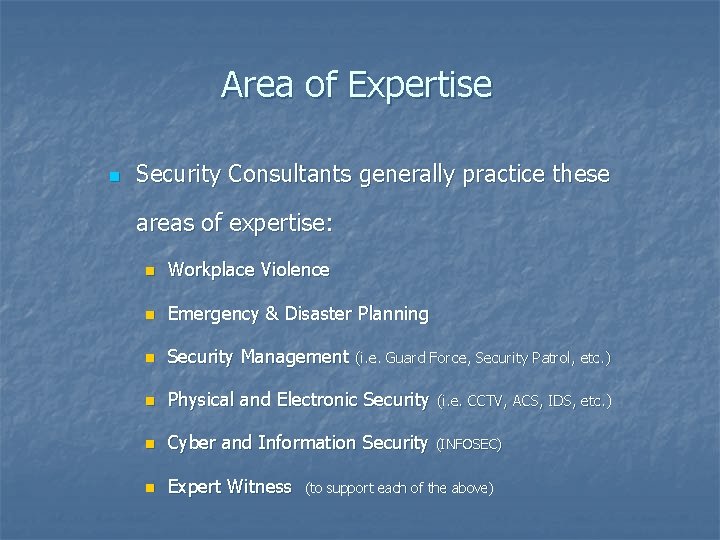
Area of Expertise n Security Consultants generally practice these areas of expertise: n Workplace Violence n Emergency & Disaster Planning n Security Management (i. e. Guard Force, Security Patrol, etc. ) n Physical and Electronic Security (i. e. CCTV, ACS, IDS, etc. ) n Cyber and Information Security (INFOSEC) n Expert Witness (to support each of the above)

Conclusions
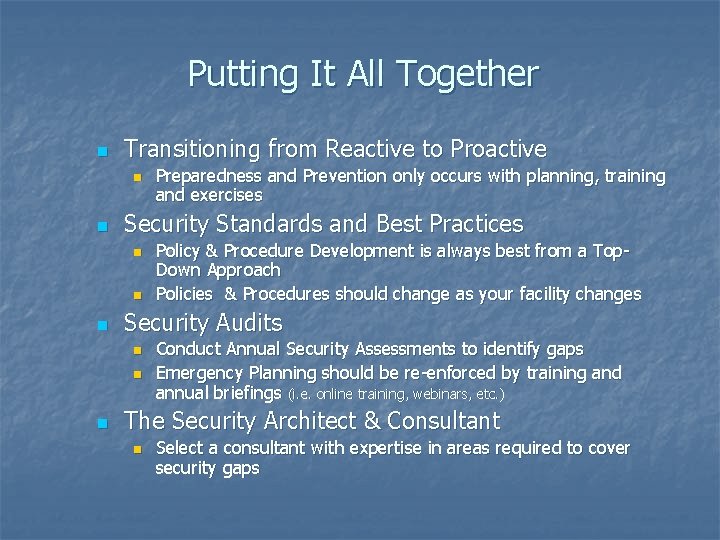
Putting It All Together n Transitioning from Reactive to Proactive n n Security Standards and Best Practices n n n Policy & Procedure Development is always best from a Top. Down Approach Policies & Procedures should change as your facility changes Security Audits n n n Preparedness and Prevention only occurs with planning, training and exercises Conduct Annual Security Assessments to identify gaps Emergency Planning should be re-enforced by training and annual briefings (i. e. online training, webinars, etc. ) The Security Architect & Consultant n Select a consultant with expertise in areas required to cover security gaps

Questions & Discussions
Presented By: Harold C. Gillens, PSP, CFC, CHS-III President / CEO Quintech Security Consultants, Inc. 102 Sangaree Park Court Suite 4 Summerville, SC 29483 v: 843. 695. 0170 c: 843. 364. 0169 www. quintechengineering. com hgillens@quintechengineering. com
- Slides: 26