
Security Deposit Law Benjamin D Horne The Legal

Security Deposit Law Benjamin D. Horne The Legal Aid Society of Columbus February 26, 2020
The law • This presentation will hit the highlights • Included with materials are selected sections from Peter Iskin’s Landlord. Tenant law book that cover in far more detail. . . – Tenant claims against Landlord – Security Deposits – Landlord claims against Tenant 3
The law • The Iskin book often cites unreported municipal court decisions. These are available online at. . . https: //lasclev. org/landlordtenantbook/unpub lished-ohio-landlord-tenant-law-decisions/ 4
The law • Ohio Revised Code 5321. 16. • 5321. 13(A) “No provision of this chapter may be modified or waived by any oral or written agreement. . . ” • E. g. lease term that “Security Deposit is nonrefundable” unenforceable lease term 5
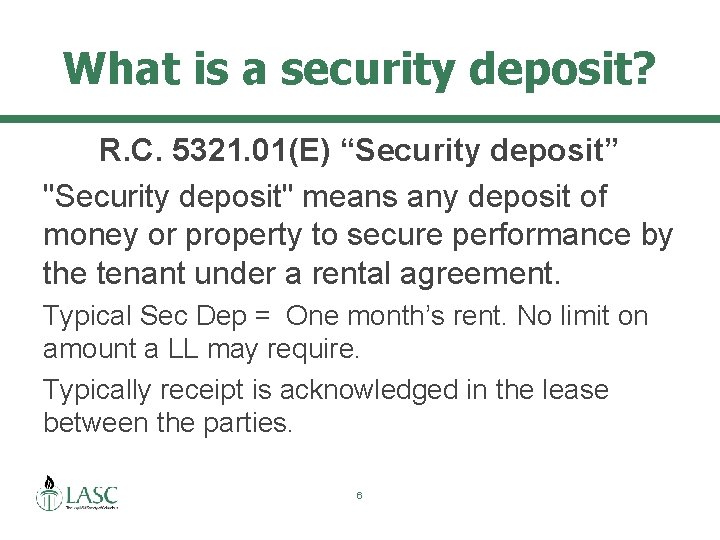
What is a security deposit? R. C. 5321. 01(E) “Security deposit” "Security deposit" means any deposit of money or property to secure performance by the tenant under a rental agreement. Typical Sec Dep = One month’s rent. No limit on amount a LL may require. Typically receipt is acknowledged in the lease between the parties. 6
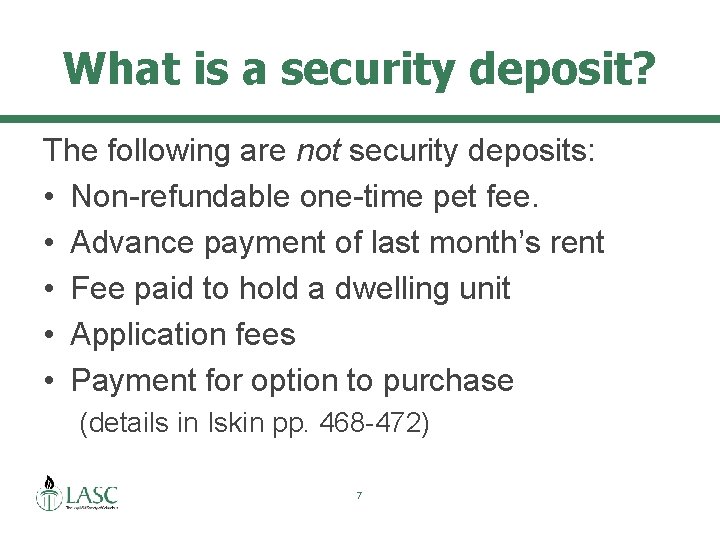
What is a security deposit? The following are not security deposits: • Non-refundable one-time pet fee. • Advance payment of last month’s rent • Fee paid to hold a dwelling unit • Application fees • Payment for option to purchase (details in Iskin pp. 468 -472) 7
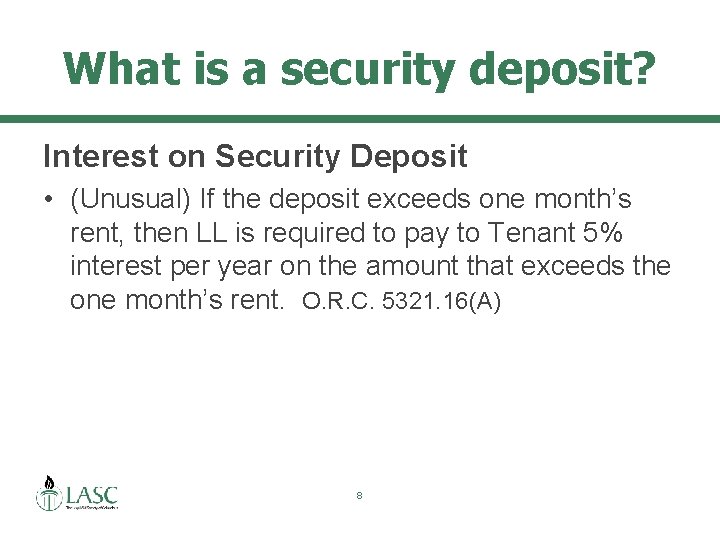
What is a security deposit? Interest on Security Deposit • (Unusual) If the deposit exceeds one month’s rent, then LL is required to pay to Tenant 5% interest per year on the amount that exceeds the one month’s rent. O. R. C. 5321. 16(A) 8
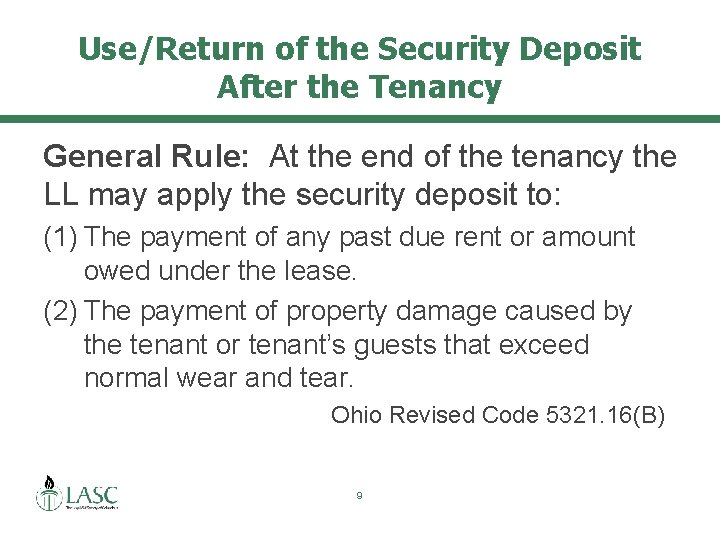
Use/Return of the Security Deposit After the Tenancy General Rule: At the end of the tenancy the LL may apply the security deposit to: (1) The payment of any past due rent or amount owed under the lease. (2) The payment of property damage caused by the tenant or tenant’s guests that exceed normal wear and tear. Ohio Revised Code 5321. 16(B) 9
Use/Return of the Security Deposit After the Tenancy General Rule: • After the landlord gets possession of the property back (returns keys to LL), Landlord has 30 days to return the deposit or explain what was deducted from the deposit. • Explanation must be in writing and all deductions itemized. O. R. C. 5321. 16(B) 10
Use/Return of the Security Deposit After the Tenancy General Rule: • Tenant has to provide the Landlord with a forwarding address or new address where the deposit or notice of deduction can be sent. • If Tenant fails to do this, LL does not have to return deposit or send a notice of deductions. R. C. 5321. 16(B) 11
Use/Return of the Security Deposit After the Tenancy “I didn’t have a forwarding address” = Most common LL excuse for not returning the SD. Tenant should retain proof of delivering written notification of forwarding address • Photocopy of Letter and certificate of mailing • Email that gets a response from LL • Text message that gets response from LL 12
Written Itemization • Purpose of Itemization = Make landlords give reasons to tenants why their SD is being withheld so that tenants may decide whether to pursue an action for recovery of that security deposit. Mc. Neil v. Wasserbauer, 1998 WL 323592 13
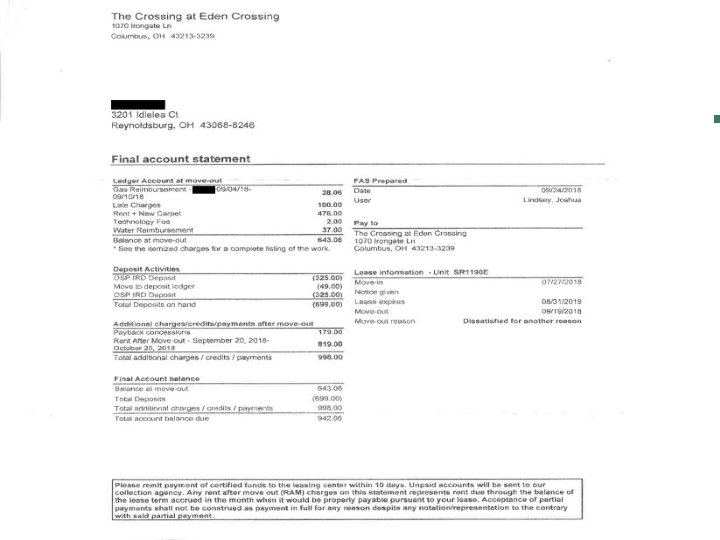
Written Itemization • The written itemization often comes in the form of a “Final Account Statement” or “Final Ledger”, produced by the property manager. • Final ledger lists what the landlord believes is owed and credits the deposit. • If landlord reports money owed, this Final Ledger may also be used to report a debt to a credit reporting agency like FABCO. • Reporting incorrect information can be a violation of the Fair Credit Reporting Act. 14
15
Damage to the property For withholdings for tenant-caused damages to the property, Landlord will have the burden of proving by preponderance of evidence: • Tenant violated lease or tenant duties under R. C. 5321. 05 • Damage is beyond normal wear and tear • Tenant caused the damage Whitestone v. Stittsworth, 2007 WL 155299 (10 th Dist. ) 16
Damage to the property • R. C. 5321. 05 tenant duties include: – Keep the premises safe and sanitary – Dispose of trash in a clean safe manner – Use and operate all electrical and plumbing fixtures properly – Refrain from intentionally or negligently destroying, defacing, damaging, or removing any fixture, appliance, or other part of the premises. 17
Damage to the property Damages to the property beyond normal wear and tear • Damages must be specific • Tenant or tenant guests must have caused damage. • Withheld amount should be the actual cost of repair or a reasonable estimate of cost to remedy damage. 18
Damage to the property • “$40 – cleaning” not specific enough because fails to specify the reason for the cleaning charge. Nolan v. Sutton 97 Ohio App. 3 d 616 • “Wal Mart $112. 59” not specific enough because it does not explain what the landlord bought or why the items were necessary. Schaedler v. Shinkle 2000 WL 1283776 19
Damage to the property • No general rule categorically defines the limits of normal wear and tear. • Normal wear and tear includes “injuries to the building due to gradual deterioration which results from use, lapse of time, and the elements”. 49 Am. Jur. 2 d Landlord and Tenant § 973 at 946. 20
Damage to the property • Landlord should not withhold for anything that the landlord routinely does after a tenant moves out. – Routine cleaning or painting – Replacing or shampooing carpet • Okay to charge for these things only if there is extraordinary damage caused by tenant or guests. Schaedler v. Shinkle, 2000 WL 1283776 21
Damage to the property • Be wary of Landlord withholding for items that broke because they were old or had been poorly repaired in the past. • Landlord has burden to prove it was the tenant’s intentional or negligent acts or improper use of appliance (violations of tenant’s duties under R. C. 5321. 05) that caused the need for the repair. Whitestone v. Stittsworth, 2007 WL 2334795 22
Other landlord claims • Other possible LL claims against tenant beyond damage to property: – Unpaid rent or utilities due under the lease – Late fees owed under the lease – Rent for balance of lease term if – “Early termination charge” in lease – “Cleaning / Painting” fee provision in lease 23
Other landlord claims • Unpaid rent, utilities, or late fees owed under the lease can all be legitimate withholdings. – For utilities, check lease for who is responsible and make sure the bill covers a time period tenant was at the property. – Late fees should have a relation to the landlord’s loss of use of the money for the period it was late. Courts have found per diem late fees ($5. 00 per day until rent paid) unconscionable and unenforceable. e. g. Neubauer v. Patzkowsky 1992 WL 125269 24
Other landlord claims • Rent for balance of lease term. – If Tenant vacates prior to lease termination date, Landlord has claim for rent for the balance of the lease term. However: – Landlord has a duty to mitigate damages by advertising / trying to re-rent the property. – Landlord cannot double dip by re-renting the property and also suing for balance of lease term. Tenant owes only for dates the rental unit stayed empty. 25
Other landlord claims • Example – Tenant in a one-year lease vacates after three months. – Property stays empty for a month, then landlord re-rents. – Landlord cannot claim tenant owes nine months of rent. Landlord has a good claim for one month of rent. 26
Other landlord claims What if Tenant moves out (or never moves in) because of bad conditions issues? – 5321. 07(B)(3) allows tenant to unilaterally terminate the lease if Tenant gave written notice of conditions problems, waited a reasonable amount of time (no more than 30 days), and landlord failed to remedy/repair. – Tenant should not owe for balance of any lease term in these circumstances. 27
Other landlord claims Liquidated Damages Unenforceable • Contradicts R. C. 5321. 16 • Examples: – Early termination fees in lease – Cleaning/painting fee provisions in lease • Also any automatic forfeiture of the deposit or “non-refundable security deposit” language in the lease is unenforceable. KGM Capital, LLC v. Jackson, 2014 WL 2566286 28
Tenant claim for Deposit R. C. 5321. 16(C) – If Landlord fails to return the deposit, or withholds for things it shouldn’t, Tenant may sue to recover • The deposit together with: • Damages in an amount equal to the amount wrongfully withheld, and • Reasonable attorney’s fees. • Court costs 29
Tenant claim for Deposit Example: – Tenant paid $800 deposit. – Landlord withholds $150 for “shampooing carpets” (wrongful withholding). – Tenant has a claim for twice the amount wrongfully withheld ($300) plus attorney’s fees and court costs. 30
Tenant claim for Deposit Example: – Tenant paid $800 deposit. – Tenant vacates at end of lease, provides forwarding address to Landlord. – After two weeks, Landlord sends itemized list withholding entire deposit for “cleaning, painting, and new carpeting”. (timely response, but wrongful withholding) – Tenant has claim for $1600 plus attorney’s fees and court costs. Smith v. Padgett, 32 Ohio St. 3 d 344 31
Tenant claim for Deposit • If Landlord has a right to withhold the whole deposit and fails to send a written itemization, there is no penalty, no claim for Tenant, even though LL violated 30 -day provision in the statute. Vardeman v. Llewellyn (17 Ohio St. 3 d 24); Munsie v. Welkener 1997 WL 374739. 32
Reasonable Attorney’s Fees • If any portion of the security deposit is wrongfully withheld, the LL’s liability for reasonable attorney’s fees under 5321. 16(C) is mandatory. Smith v. Padgett, 32 Ohio St. 3 d 344 • Includes time spent on affirmative claim under 5321. 16(C) and any time spent in defending against a counterclaim for unpaid rent or damage to premises. Whitestone Co. Stittsworth 2007 WL 155299 (10 th Dist. ) 33
Reasonable Attorney’s Fees • The fees can exceed the security deposit award. • E. g. Whitestone Co. Stittsworth 2007 WL 155299 (10 th Dist. ). Award of $700 security deposit, $700 statutory damages, $5, 989. 76 in attorney’s fees. • Schultz v. Wurdlow, 2012 WL 2859914 (10 th Dist. ). Award of $350 security deposit, $350 statutory damages, $14, 782. 50 in attorney’s fees. • Ridenour v. Dunn, 2004 WL 1445270 (10 th Dist. ). Award of $225 security deposit, $225 statutory damages, $1, 000. 00 in attorney’s fees. 34
Burden of Proof • Tenant’s burden to prove: 1. The existence and termination of lease. 2. The amount of the security deposit. 3. The amount of the security deposit not returned. 4. Compliance with forwarding address requirement. Schultz v. Wurdlow, 2012 WL 2859914 (10 th Dist. ) 35
Burden of Proof • Landlord’s burden to prove: 1. The lawfulness of and deductions from the security deposit. Zealler v. F & W Props. , 2000 WL 1015345 36
3 rd party purchaser of premises • If property is sold during tenancy, who is liable to the tenant for the security deposit, original owner or new owner? • Original landlord always remains liable to the tenant for returning the security deposit. • New owner may be responsible if in the purchase of the premises the new owner agreed to assume such liability, or if the lease contains a provision imposing liability on any purchaser. 37
- Slides: 37