
Security and Privacy in Cloud Computing Ragib Hasan
Security and Privacy in Cloud Computing Ragib Hasan Johns Hopkins University en. 600. 412 Spring 2010 Lecture 1 01/25/2010
Welcome to the class Administrative details When? : Monday 3 pm-3. 50 pm Where? : Shaffer 202 Web: http: //www. cs. jhu. edu/~ragib/sp 10/cs 412 Instructor: Ragib Hasan, 324 NEB, rhasan 7@jhu. edu Office hours: Monday 4 pm-5 pm (more TBA) 1/25/2010 en. 600. 412 Spring 2010 2
Goals of the course • Identify the cloud computing security issues • Explore cloud computing security issues • Learn about latest research 1/25/2010 en. 600. 412 Spring 2010 3
Plan Each week, we will – Pick a different cloud computing security topic – Discuss general issues on the topic – Read one or two latest research paper on that topic 1/25/2010 en. 600. 412 Spring 2010 4
Evaluations Based on paper reviews – Students taking the course for credit will have to submit 1 paper review per week – The reviews will be short, 1 page discussion of the paper’s pros and cons (format will be posted on the class webpage) 1/25/2010 en. 600. 412 Spring 2010 5
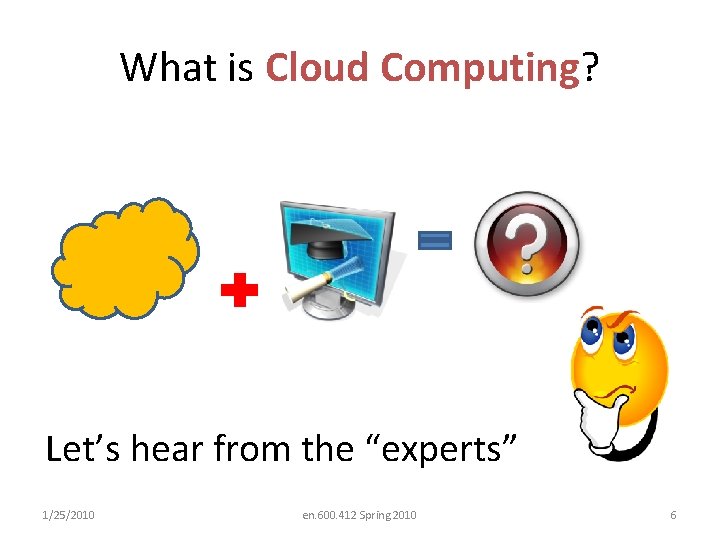
What is Cloud Computing? Let’s hear from the “experts” 1/25/2010 en. 600. 412 Spring 2010 6
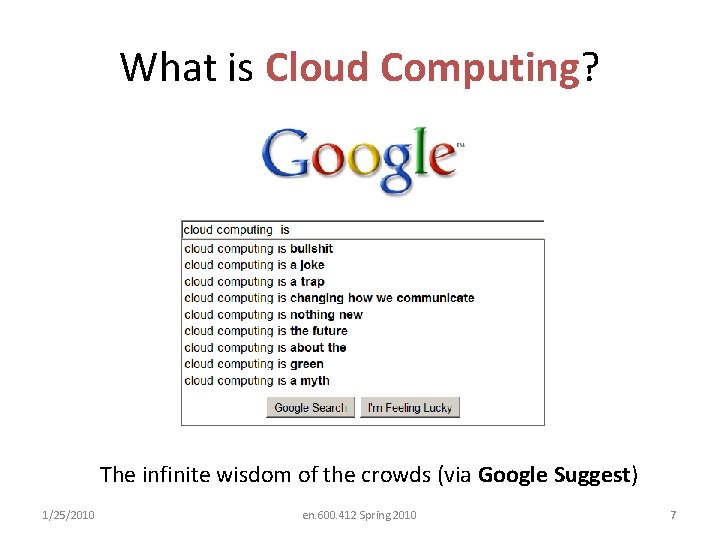
What is Cloud Computing? The infinite wisdom of the crowds (via Google Suggest) 1/25/2010 en. 600. 412 Spring 2010 7
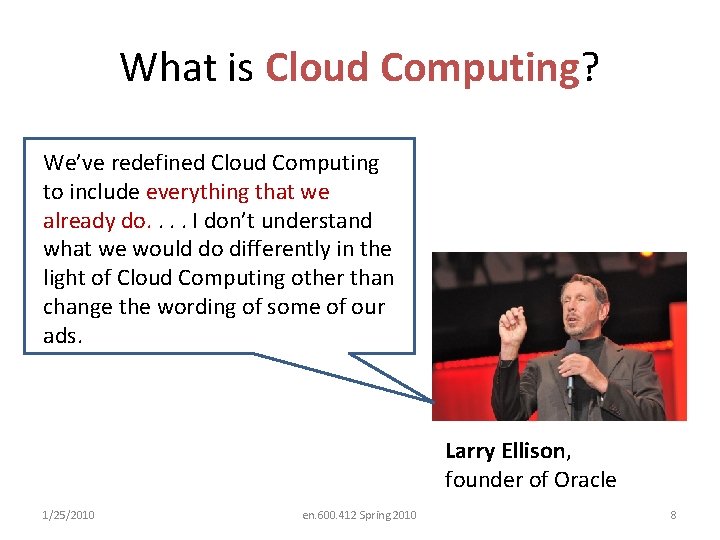
What is Cloud Computing? We’ve redefined Cloud Computing to include everything that we already do. . I don’t understand what we would do differently in the light of Cloud Computing other than change the wording of some of our ads. Larry Ellison, founder of Oracle 1/25/2010 en. 600. 412 Spring 2010 8
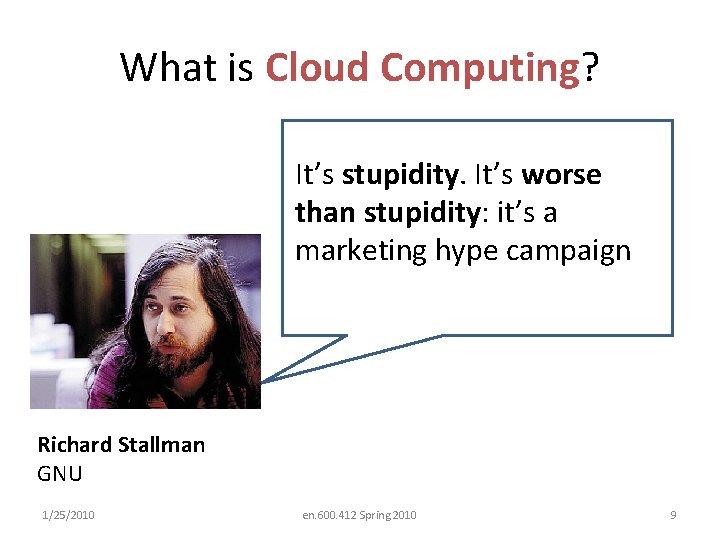
What is Cloud Computing? It’s stupidity. It’s worse than stupidity: it’s a marketing hype campaign Richard Stallman GNU 1/25/2010 en. 600. 412 Spring 2010 9
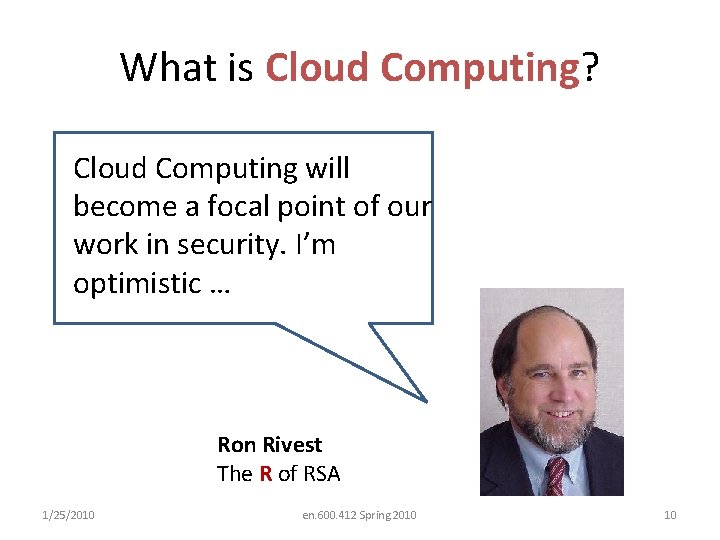
What is Cloud Computing? Cloud Computing will become a focal point of our work in security. I’m optimistic … Ron Rivest The R of RSA 1/25/2010 en. 600. 412 Spring 2010 10
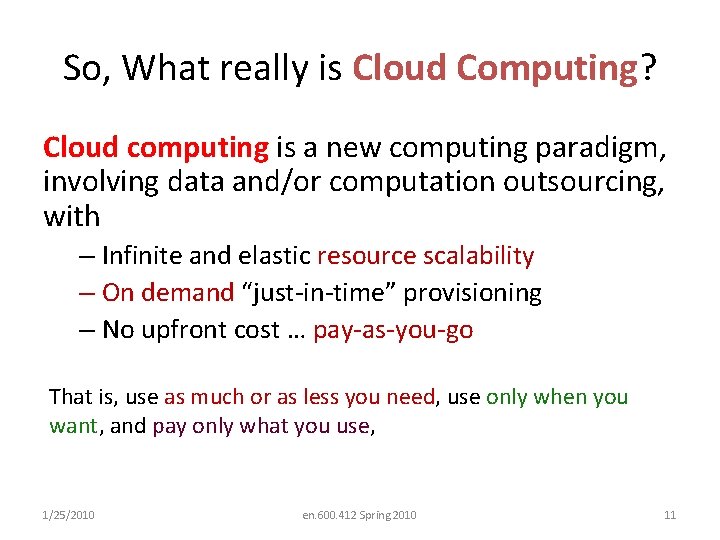
So, What really is Cloud Computing? Cloud computing is a new computing paradigm, involving data and/or computation outsourcing, with – Infinite and elastic resource scalability – On demand “just-in-time” provisioning – No upfront cost … pay-as-you-go That is, use as much or as less you need, use only when you want, and pay only what you use, 1/25/2010 en. 600. 412 Spring 2010 11
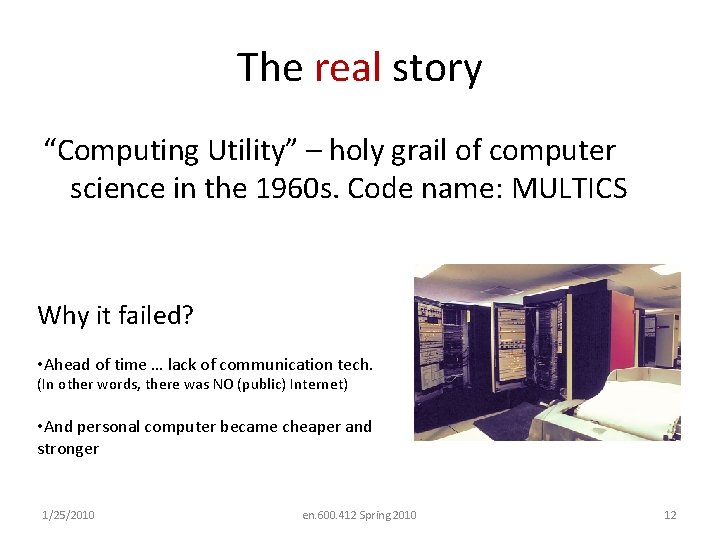
The real story “Computing Utility” – holy grail of computer science in the 1960 s. Code name: MULTICS Why it failed? • Ahead of time … lack of communication tech. (In other words, there was NO (public) Internet) • And personal computer became cheaper and stronger 1/25/2010 en. 600. 412 Spring 2010 12
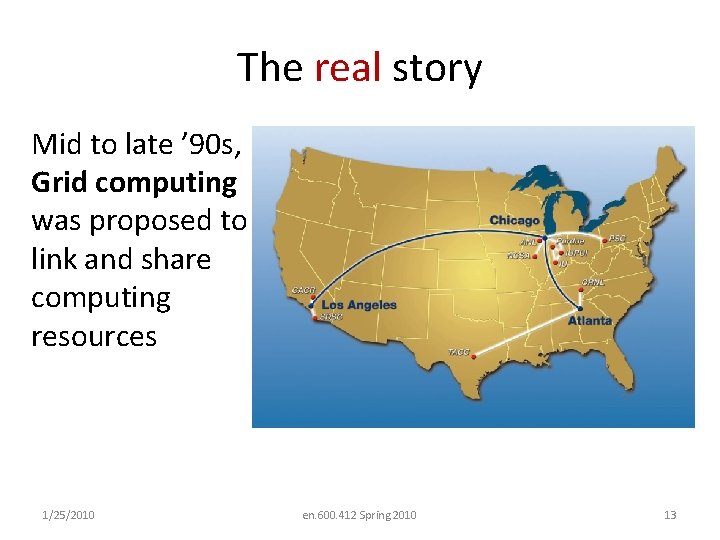
The real story Mid to late ’ 90 s, Grid computing was proposed to link and share computing resources 1/25/2010 en. 600. 412 Spring 2010 13
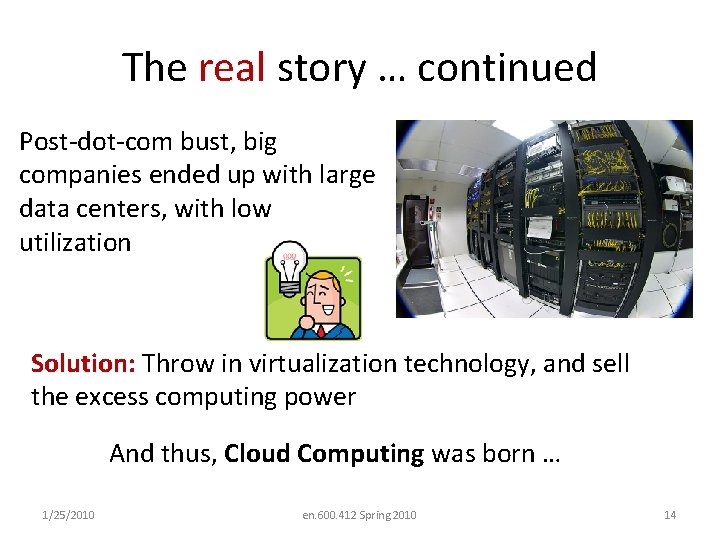
The real story … continued Post-dot-com bust, big companies ended up with large data centers, with low utilization Solution: Throw in virtualization technology, and sell the excess computing power And thus, Cloud Computing was born … 1/25/2010 en. 600. 412 Spring 2010 14
Cloud computing provides numerous economic advantages For clients: – No upfront commitment in buying/leasing hardware – Can scale usage according to demand – Barriers to entry lowered for startups For providers: – Increased utilization of datacenter resources 1/25/2010 en. 600. 412 Spring 2010 15
Cloud computing means selling “X as a service” Iaa. S: Infrastructure as a Service – Selling virtualized hardware Paa. S: Platform as a service – Access to a configurable platform/API Saa. S: Software as a service – Software that runs on top of a cloud 1/25/2010 en. 600. 412 Spring 2010 16
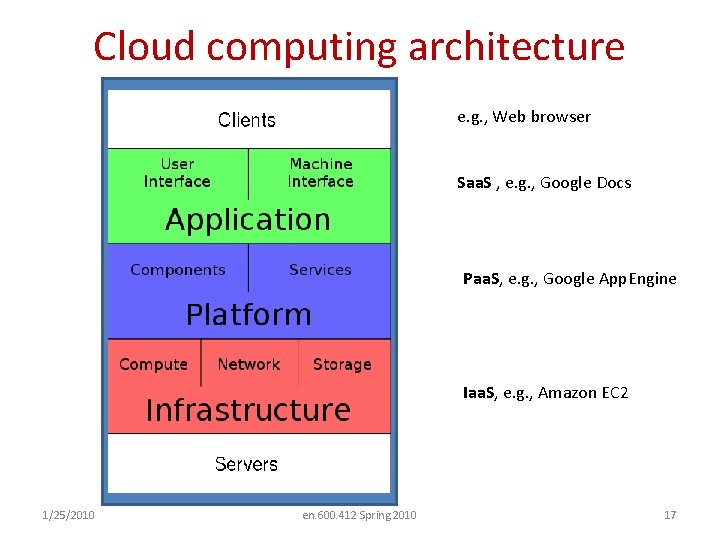
Cloud computing architecture e. g. , Web browser Saa. S , e. g. , Google Docs Paa. S, e. g. , Google App. Engine Iaa. S, e. g. , Amazon EC 2 1/25/2010 en. 600. 412 Spring 2010 17
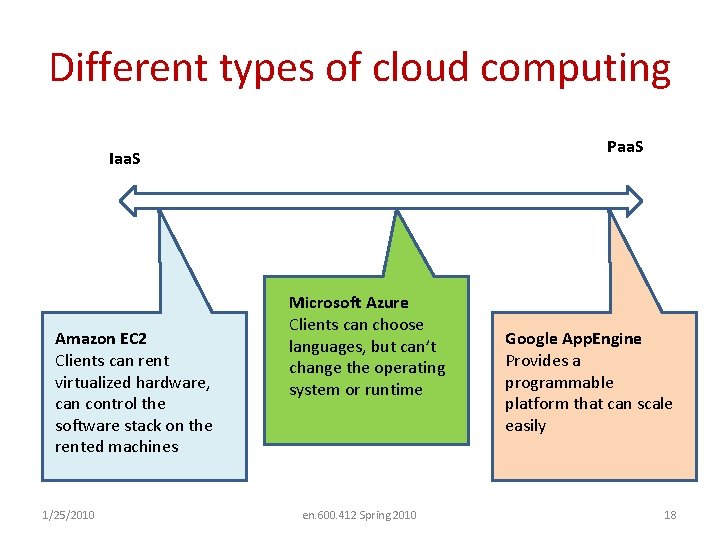
Different types of cloud computing Paa. S Iaa. S Amazon EC 2 Clients can rent virtualized hardware, can control the software stack on the rented machines 1/25/2010 Microsoft Azure Clients can choose languages, but can’t change the operating system or runtime en. 600. 412 Spring 2010 Google App. Engine Provides a programmable platform that can scale easily 18
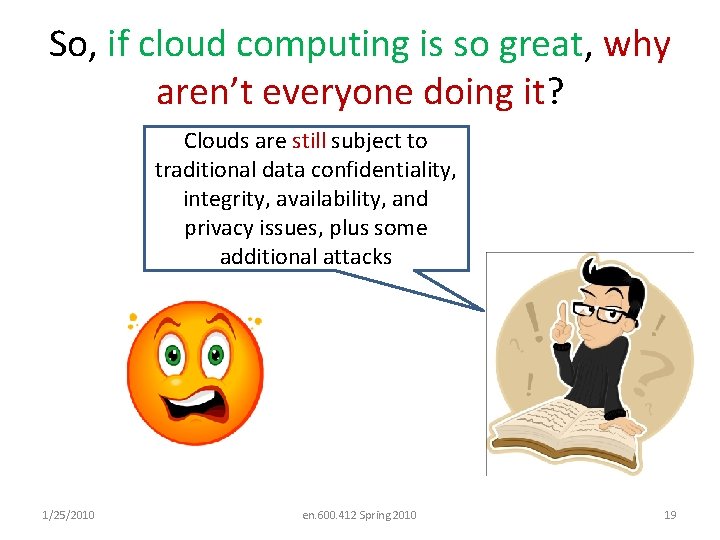
So, if cloud computing is so great, why aren’t everyone doing it? Clouds are still subject to traditional data confidentiality, integrity, availability, and privacy issues, plus some additional attacks 1/25/2010 en. 600. 412 Spring 2010 19
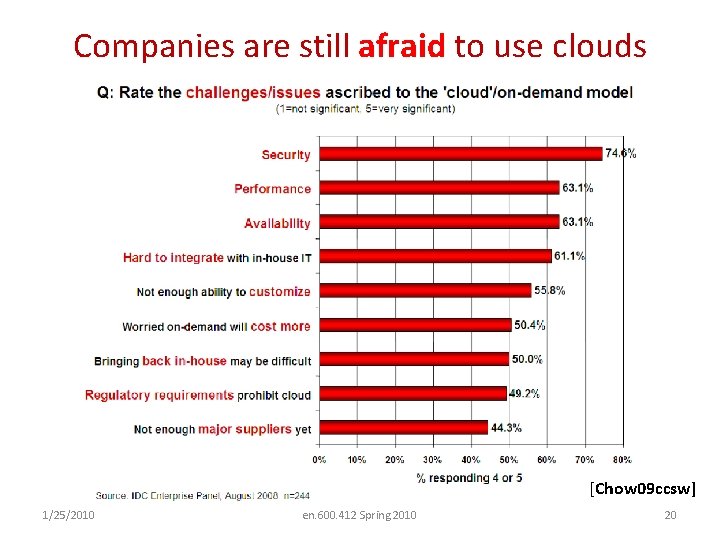
Companies are still afraid to use clouds [Chow 09 ccsw] 1/25/2010 en. 600. 412 Spring 2010 20
Anatomy of fear … Confidentiality – Will the sensitive data stored on a cloud remain confidential? Will cloud compromises leak confidential client data (i. e. , fear of loss of control over data) – Will the cloud provider itself be honest and won’t peek into the data? 1/25/2010 en. 600. 412 Spring 2010 21
Anatomy of fear … Integrity – How do I know that the cloud provider is doing the computations correctly? – How do I ensure that the cloud provider really stored my data without tampering with it? 1/25/2010 en. 600. 412 Spring 2010 22
Anatomy of fear … Availability – Will critical systems go down at the client, if the provider is attacked in a Denial of Service attack? – What happens if cloud provider goes out of business? 1/25/2010 en. 600. 412 Spring 2010 23
Anatomy of fear … Privacy issues raised via massive data mining – Cloud now stores data from a lot of clients, and can run data mining algorithms to get large amounts of information on clients 1/25/2010 en. 600. 412 Spring 2010 24

Anatomy of fear … Increased attack surface – Entity outside the organization now stores and computes data, and so – Attackers can now target the communication link between cloud provider and client – Cloud provider employees can be phished 1/25/2010 en. 600. 412 Spring 2010 25
Anatomy of fear … Auditability and forensics – Difficult to audit data held outside organization in a cloud – Forensics also made difficult since now clients don’t maintain data locally 1/25/2010 en. 600. 412 Spring 2010 26

Anatomy of fear … Legal quagmire and transitive trust issues – Who is responsible for complying with regulations (e. g. , SOX, HIPAA, GLBA)? – If cloud provider subcontracts to third party clouds, will the data still be secure? 1/25/2010 en. 600. 412 Spring 2010 27

What we need is to … • Adapt well known techniques for resolving some cloud security issues • Perform new research and innovate to make clouds secure 1/25/2010 en. 600. 412 Spring 2010 28
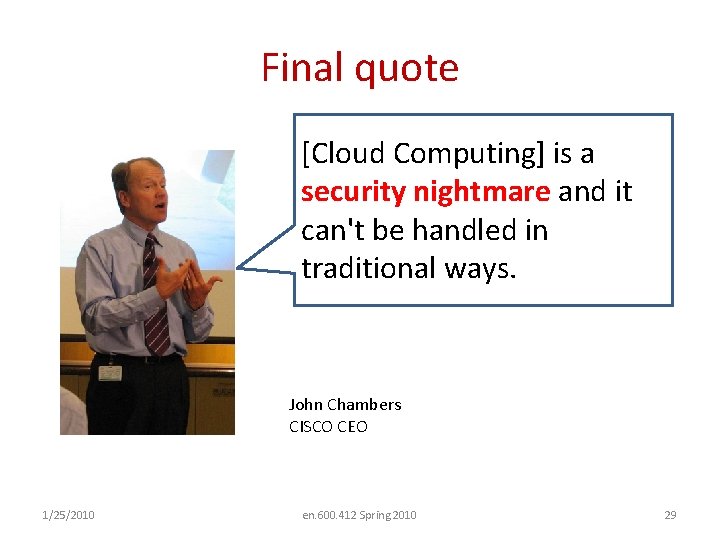
Final quote [Cloud Computing] is a security nightmare and it can't be handled in traditional ways. John Chambers CISCO CEO 1/25/2010 en. 600. 412 Spring 2010 29
Further Reading Armbrust et al. , Above the Clouds: A Berkeley View of Cloud Computing, UC Berkeley Tech Report UCB/EECS-2009 -28, February 2009. Chow et al. , Cloud Computing: Outsourcing Computation without Outsourcing Control, 1 st ACM Cloud Computing Security Workshop, November 2009. 1/25/2010 en. 600. 412 Spring 2010 30
- Slides: 30