
Security and Privacy in Cloud Computing Ragib Hasan

Security and Privacy in Cloud Computing Ragib Hasan Johns Hopkins University en. 600. 412 Spring 2011 Lecture 6 03/14/2011
Securing Computations in a Cloud Goal: Examine the correctness problem of outsourced computations. Review Assignment #5: (Due 3/28) Du et al. , Run. Test: Assuring Integrity of Dataflow Processing in Cloud Computing Infrastructures, Asia. CCS 2010 3/14/2011 en. 600. 412 Spring 2011 Lecture 6 | JHU | Ragib Hasan
Recap: Po. R and HAIL • Strengths? • Weaknesses? • Ideas? 3/14/2011 en. 600. 412 Spring 2011 Lecture 6 | JHU | Ragib Hasan
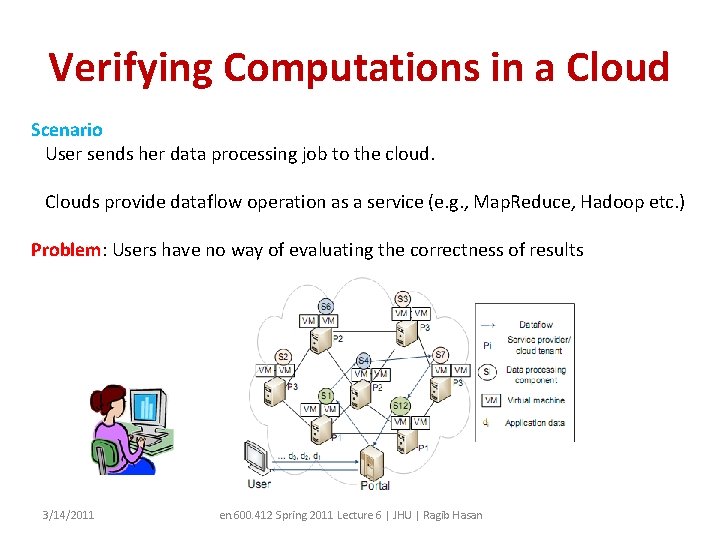
Verifying Computations in a Cloud Scenario User sends her data processing job to the cloud. Clouds provide dataflow operation as a service (e. g. , Map. Reduce, Hadoop etc. ) Problem: Users have no way of evaluating the correctness of results 3/14/2011 en. 600. 412 Spring 2011 Lecture 6 | JHU | Ragib Hasan
Threat Model • Attacker: – Cloud provider itself may be malicious – Even for honest cloud providers, some nodes may be compromised – Malicious nodes can snoop on data and/or tamper results • Assests: – Integrity of results – Confidentiality of inputs and results 3/14/2011 en. 600. 412 Spring 2011 Lecture 6 | JHU | Ragib Hasan

Data. Flow Operations Properties High performance, in-memory data processing Each node performs a particular function Nodes are mostly independent of each other Examples Map. Reduce, Hadoop, System S, Dryad 3/14/2011 en. 600. 412 Spring 2011 Lecture 6 | JHU | Ragib Hasan
How do we ensure Data. Flow operation results are correct? Goals • To determine the malicious nodes in a Data. Flow system • To determine the nature of their malicious action • To evaluate the quality of output data Du et al. , Run. Test: Assuring Integrity of Dataflow Processing in Cloud Computing Infrastructures, Asia. CCS 2010 3/14/2011 en. 600. 412 Spring 2011 Lecture 6 | JHU | Ragib Hasan
Possible Approaches • Re-do the computation • Check memory footprint of code execution • Majority voting • Hardware-based attestation • Run-time attestation 3/14/2011 en. 600. 412 Spring 2011 Lecture 6 | JHU | Ragib Hasan
Run. Test: Randomized Data Attestation Idea – For some data inputs, send it along multiple dataflow paths – Record and match all intermediate results from the matching nodes in the paths – Build an attestation graph using node agreement – Over time, the graph shows which node misbehave (always or time-to-time) 3/14/2011 en. 600. 412 Spring 2011 Lecture 6 | JHU | Ragib Hasan
Attack Model • Data model: – Input deterministic Data. Flow (i. e. , same input to a function will always produce the same output) – Data processing is stateless (e. g. , selection, filtering) • Attacker: – Malicious or compromised cloud nodes – Can produce bad results always or some time – Can collude with other malicious nodes to provide same bad result 3/14/2011 en. 600. 412 Spring 2011 Lecture 6 | JHU | Ragib Hasan
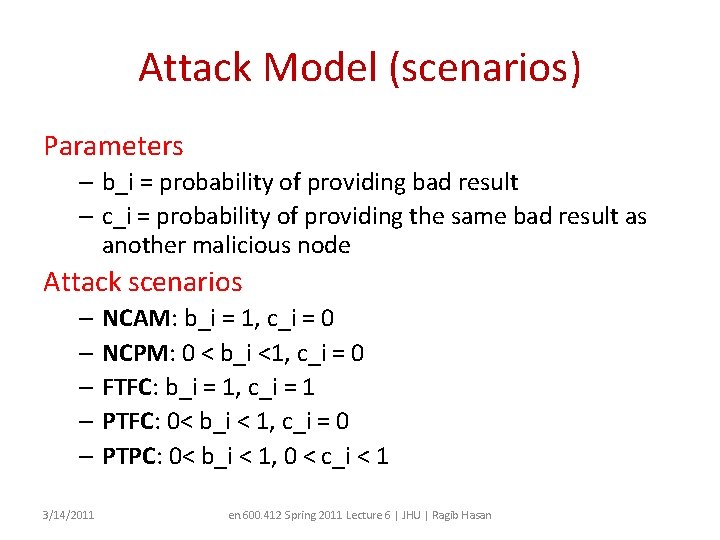
Attack Model (scenarios) Parameters – b_i = probability of providing bad result – c_i = probability of providing the same bad result as another malicious node Attack scenarios – NCAM: b_i = 1, c_i = 0 – NCPM: 0 < b_i <1, c_i = 0 – FTFC: b_i = 1, c_i = 1 – PTFC: 0< b_i < 1, c_i = 0 – PTPC: 0< b_i < 1, 0 < c_i < 1 3/14/2011 en. 600. 412 Spring 2011 Lecture 6 | JHU | Ragib Hasan
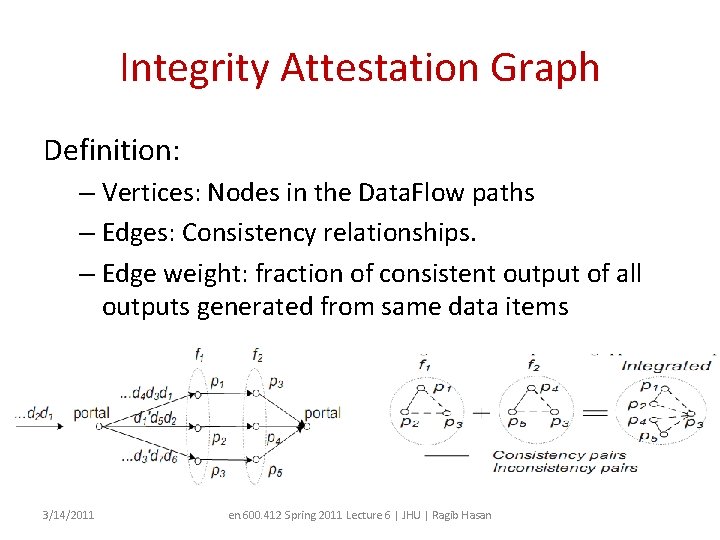
Integrity Attestation Graph Definition: – Vertices: Nodes in the Data. Flow paths – Edges: Consistency relationships. – Edge weight: fraction of consistent output of all outputs generated from same data items 3/14/2011 en. 600. 412 Spring 2011 Lecture 6 | JHU | Ragib Hasan
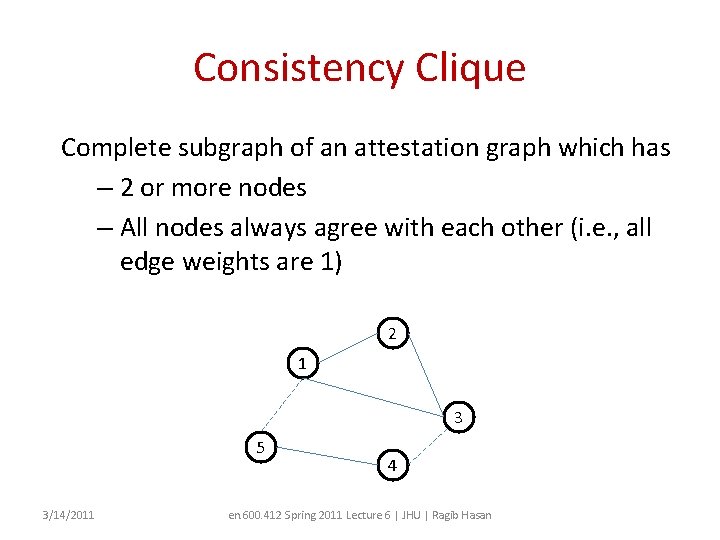
Consistency Clique Complete subgraph of an attestation graph which has – 2 or more nodes – All nodes always agree with each other (i. e. , all edge weights are 1) 2 1 3 5 3/14/2011 4 en. 600. 412 Spring 2011 Lecture 6 | JHU | Ragib Hasan
How to find malicious nodes Intuitions – Honest nodes will always agree with each other to produce the same outputs, given the same data – Number of malicious nodes is less than half of all nodes 3/14/2011 en. 600. 412 Spring 2011 Lecture 6 | JHU | Ragib Hasan
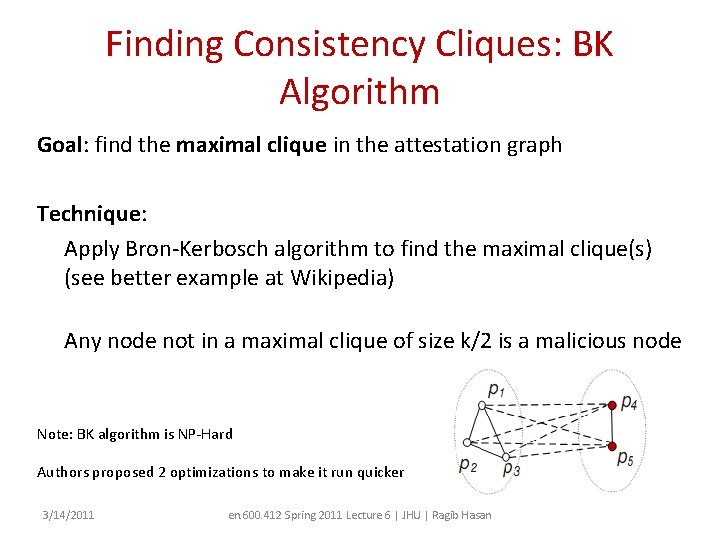
Finding Consistency Cliques: BK Algorithm Goal: find the maximal clique in the attestation graph Technique: Apply Bron-Kerbosch algorithm to find the maximal clique(s) (see better example at Wikipedia) Any node not in a maximal clique of size k/2 is a malicious node Note: BK algorithm is NP-Hard Authors proposed 2 optimizations to make it run quicker 3/14/2011 en. 600. 412 Spring 2011 Lecture 6 | JHU | Ragib Hasan
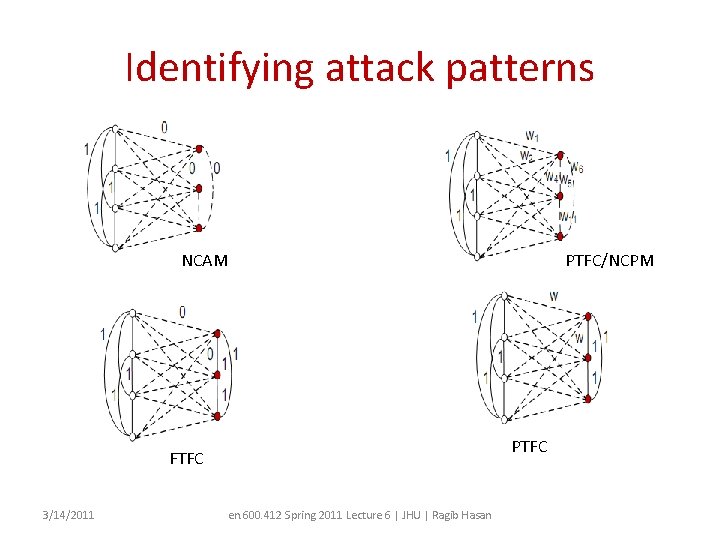
Identifying attack patterns NCAM PTFC FTFC 3/14/2011 PTFC/NCPM en. 600. 412 Spring 2011 Lecture 6 | JHU | Ragib Hasan
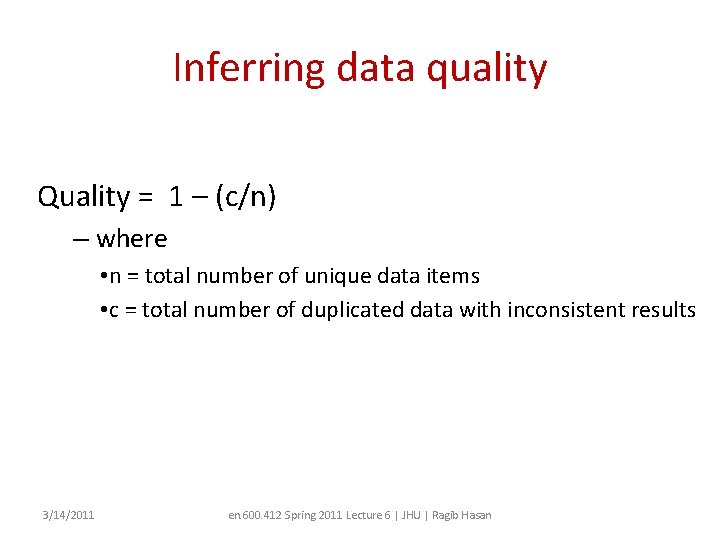
Inferring data quality Quality = 1 – (c/n) – where • n = total number of unique data items • c = total number of duplicated data with inconsistent results 3/14/2011 en. 600. 412 Spring 2011 Lecture 6 | JHU | Ragib Hasan
Evaluation • Extended IBM System S • Experiments: – Detection rate – Sensitivity to parameters – Comparison with majority voting 3/14/2011 en. 600. 412 Spring 2011 Lecture 6 | JHU | Ragib Hasan
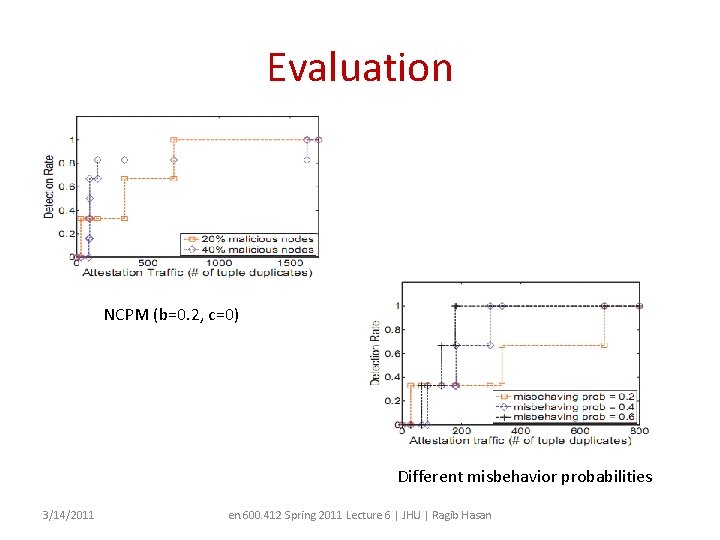
Evaluation NCPM (b=0. 2, c=0) Different misbehavior probabilities 3/14/2011 en. 600. 412 Spring 2011 Lecture 6 | JHU | Ragib Hasan
Discussion • Threat model • High cost of Bron-Kerbosch algorithm (O(3 n/3)) • Results are for building attestation graphs per function • Scalability • Experimental evaluation 3/14/2011 en. 600. 412 Spring 2011 Lecture 6 | JHU | Ragib Hasan
- Slides: 20