
Secured Transactions UCC Article 9 Security Interests in


- Slides: 30
Secured Transactions UCC Article 9 Security Interests in Personal Property
Overview 1. 2. 3. 4. 5. 6. 7. 8. Introduction Type of Credit Attachment Perfection of a Security Interest Did buyer take free of the Security Interest? Priority in the Proceeds Remedies
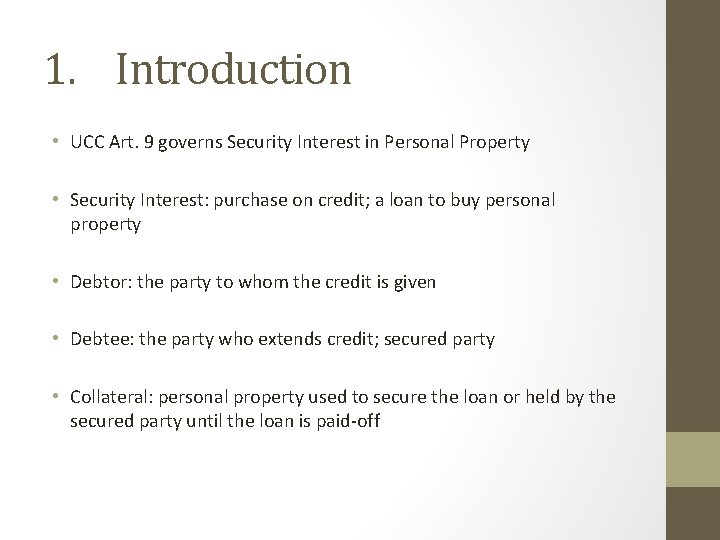
1. Introduction • UCC Art. 9 governs Security Interest in Personal Property • Security Interest: purchase on credit; a loan to buy personal property • Debtor: the party to whom the credit is given • Debtee: the party who extends credit; secured party • Collateral: personal property used to secure the loan or held by the secured party until the loan is paid-off
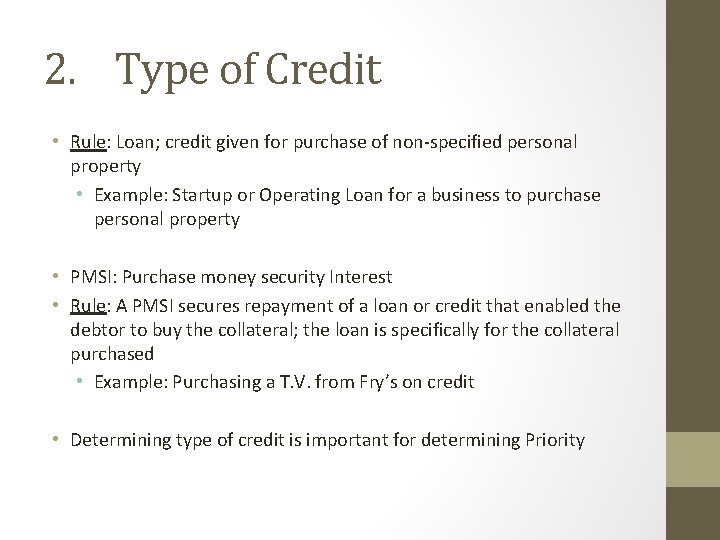
2. Type of Credit • Rule: Loan; credit given for purchase of non-specified personal property • Example: Startup or Operating Loan for a business to purchase personal property • PMSI: Purchase money security Interest • Rule: A PMSI secures repayment of a loan or credit that enabled the debtor to buy the collateral; the loan is specifically for the collateral purchased • Example: Purchasing a T. V. from Fry’s on credit • Determining type of credit is important for determining Priority
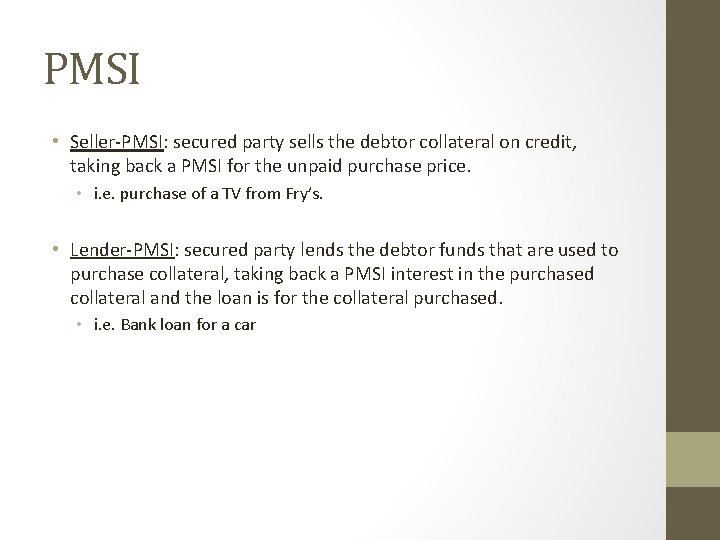
PMSI • Seller-PMSI: secured party sells the debtor collateral on credit, taking back a PMSI for the unpaid purchase price. • i. e. purchase of a TV from Fry’s. • Lender-PMSI: secured party lends the debtor funds that are used to purchase collateral, taking back a PMSI interest in the purchased collateral and the loan is for the collateral purchased. • i. e. Bank loan for a car
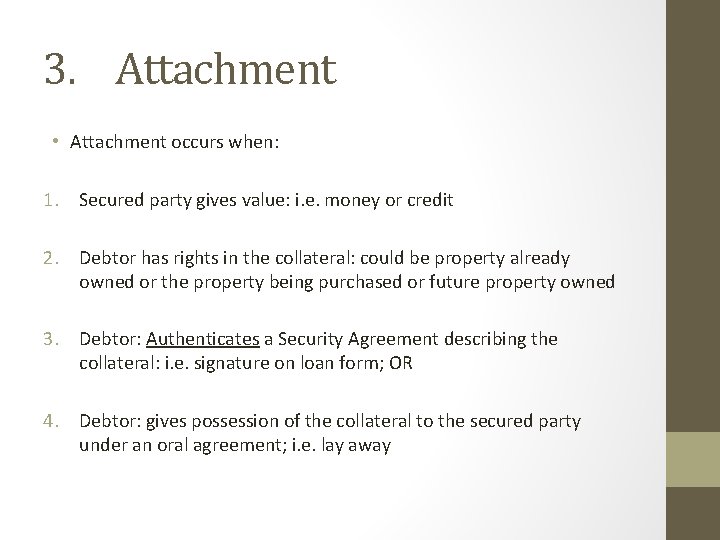
3. Attachment • Attachment occurs when: 1. Secured party gives value: i. e. money or credit 2. Debtor has rights in the collateral: could be property already owned or the property being purchased or future property owned 3. Debtor: Authenticates a Security Agreement describing the collateral: i. e. signature on loan form; OR 4. Debtor: gives possession of the collateral to the secured party under an oral agreement; i. e. lay away
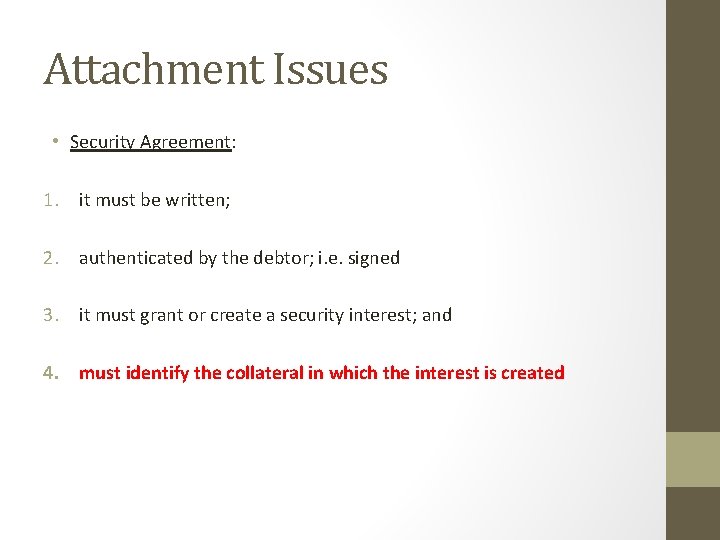
Attachment Issues • Security Agreement: 1. it must be written; 2. authenticated by the debtor; i. e. signed 3. it must grant or create a security interest; and 4. must identify the collateral in which the interest is created
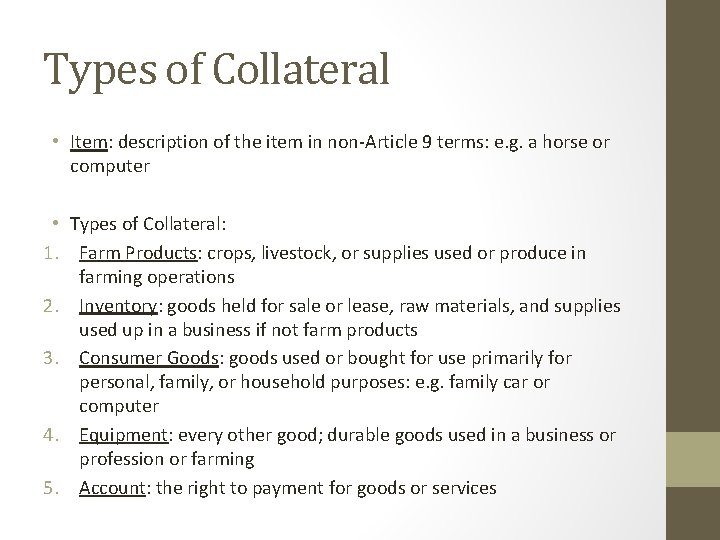
Types of Collateral • Item: description of the item in non-Article 9 terms: e. g. a horse or computer • Types of Collateral: 1. Farm Products: crops, livestock, or supplies used or produce in farming operations 2. Inventory: goods held for sale or lease, raw materials, and supplies used up in a business if not farm products 3. Consumer Goods: goods used or bought for use primarily for personal, family, or household purposes: e. g. family car or computer 4. Equipment: every other good; durable goods used in a business or profession or farming 5. Account: the right to payment for goods or services
Types of Collateral • After-acquired property: Article 9 permits a debtor to grant a security interest in property to be acquired at a later time. • Pledge: only way a secured interest can attach without a writing; secured party has possession of the collateral
4. Perfecting the Security Interest • Rule: a perfected security interest is enforceable against any later claimant, including secured parties, buyers, and lien creditors • Perfection requires attachment plus some form of notice • A secured party can perfect a security interest in tangible collateral by taking it into physical possession (i. e. layaway)
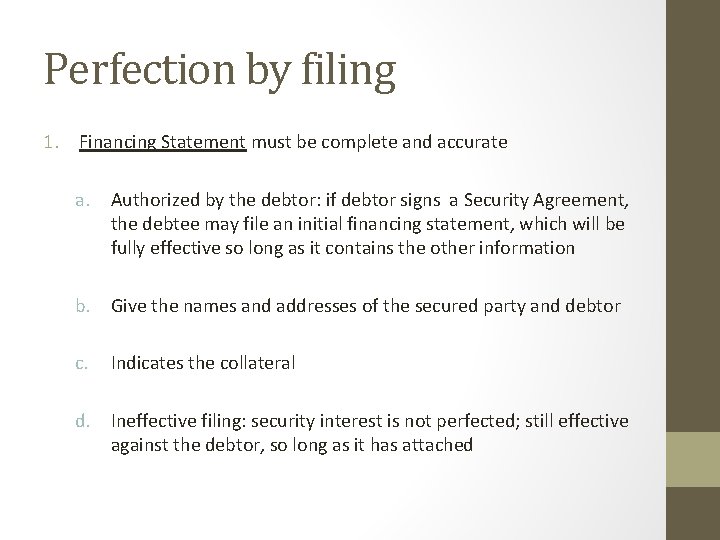
Perfection by filing 1. Financing Statement must be complete and accurate a. Authorized by the debtor: if debtor signs a Security Agreement, the debtee may file an initial financing statement, which will be fully effective so long as it contains the other information b. Give the names and addresses of the secured party and debtor c. Indicates the collateral d. Ineffective filing: security interest is not perfected; still effective against the debtor, so long as it has attached
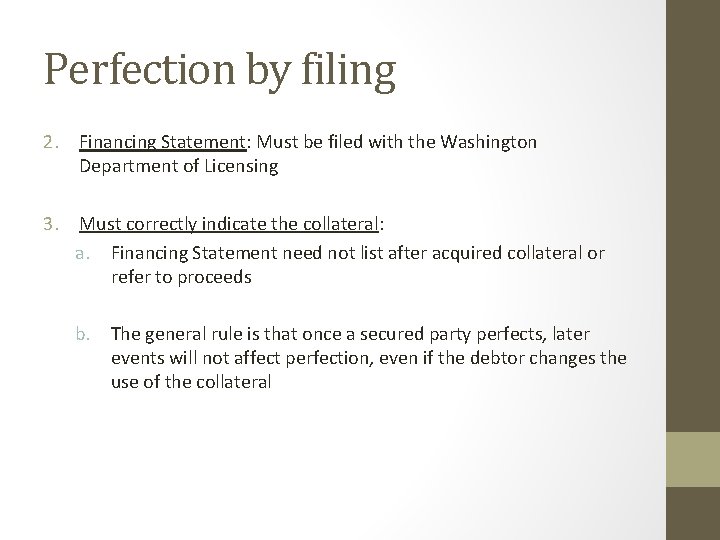
Perfection by filing 2. Financing Statement: Must be filed with the Washington Department of Licensing 3. Must correctly indicate the collateral: a. Financing Statement need not list after acquired collateral or refer to proceeds b. The general rule is that once a secured party perfects, later events will not affect perfection, even if the debtor changes the use of the collateral
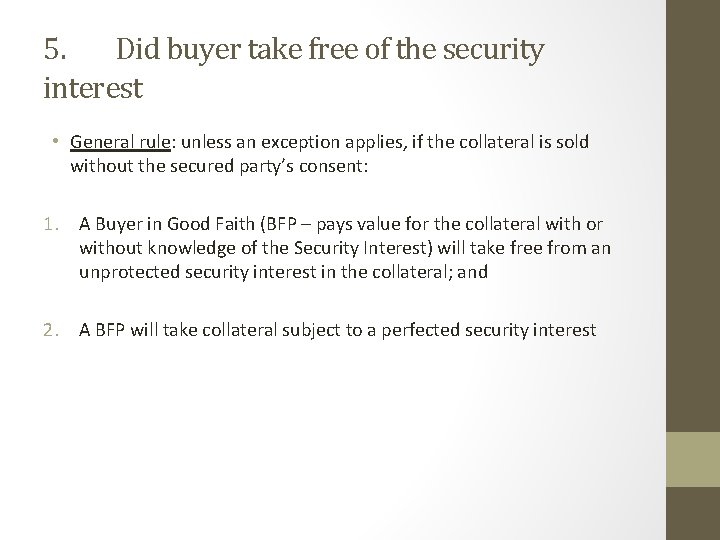
5. Did buyer take free of the security interest • General rule: unless an exception applies, if the collateral is sold without the secured party’s consent: 1. A Buyer in Good Faith (BFP – pays value for the collateral with or without knowledge of the Security Interest) will take free from an unprotected security interest in the collateral; and 2. A BFP will take collateral subject to a perfected security interest
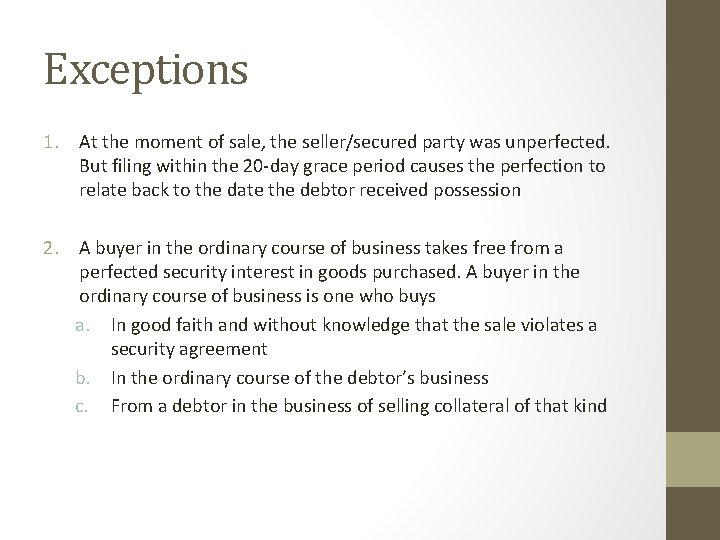
Exceptions 1. At the moment of sale, the seller/secured party was unperfected. But filing within the 20 -day grace period causes the perfection to relate back to the date the debtor received possession 2. A buyer in the ordinary course of business takes free from a perfected security interest in goods purchased. A buyer in the ordinary course of business is one who buys a. In good faith and without knowledge that the sale violates a security agreement b. In the ordinary course of the debtor’s business c. From a debtor in the business of selling collateral of that kind
6. Priority • Unperfected vs. unperfected: first to attach has priority • Perfected vs. unperfected: a perfected security interest has priority over any unperfected security interest • Perfected vs. Perfected: between two perfected secured parties, the first to file or perfect has priority unless the second has a superpriority (PMSI)
Priority • Perfected vs. PMSI: • Super-priority: a secured party with a PMSI in non-inventory will have priority over earlier-filed interest if she perfects before or within 20 days after the debtor receives possession of the collateral • If the collateral is inventory to the debtor, then before the debtor receives possession the PMSI party must give written and signed notice to the secured parties of record describing the collateral and file w/ DOL.
7. Priority in the Proceeds • A security interest that has attached to the collateral sold will automatically attach to the proceeds and will have the same priority • A security interest perfected by filing will remain perfected in cash proceeds for as long as they remain identifiable; until proceeds become untraceable
8. Remedies 1. Upon the debtors’ default, the secured party may repossess the collateral if it can be done without breach of the peace; otherwise it must use judicial repossession (Sheriff’s Department collects the property and has a Sheriff’s Sale or Auction) 2. After repossession, the secured party may sell collateral (privately or at auction), but only if a. b. c. d. e. It gives notice of the sale to the debtor and any secured party of record and If every aspect of the sale is commercially reasonable 10 days is reasonable notice of sale Debtor may redeem the collateral by paying all obligations and expenses to the secured party Secured party is liable in damages to the debtor for any harm caused by failure to observe rules
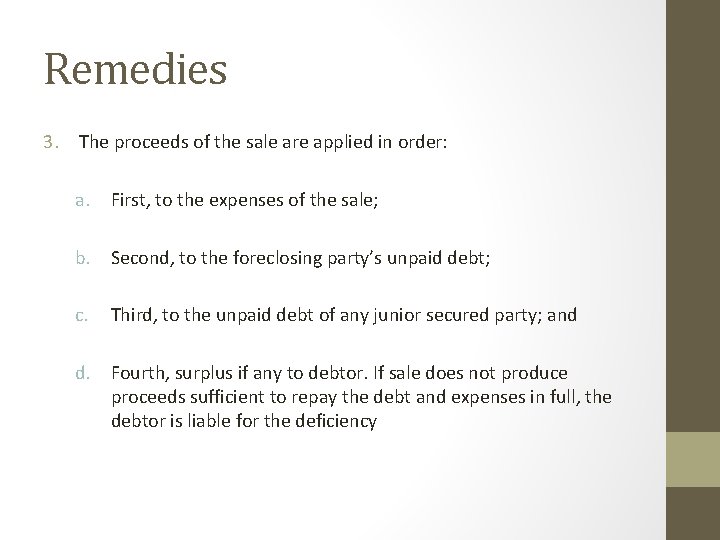
Remedies 3. The proceeds of the sale are applied in order: a. First, to the expenses of the sale; b. Second, to the foreclosing party’s unpaid debt; c. Third, to the unpaid debt of any junior secured party; and d. Fourth, surplus if any to debtor. If sale does not produce proceeds sufficient to repay the debt and expenses in full, the debtor is liable for the deficiency
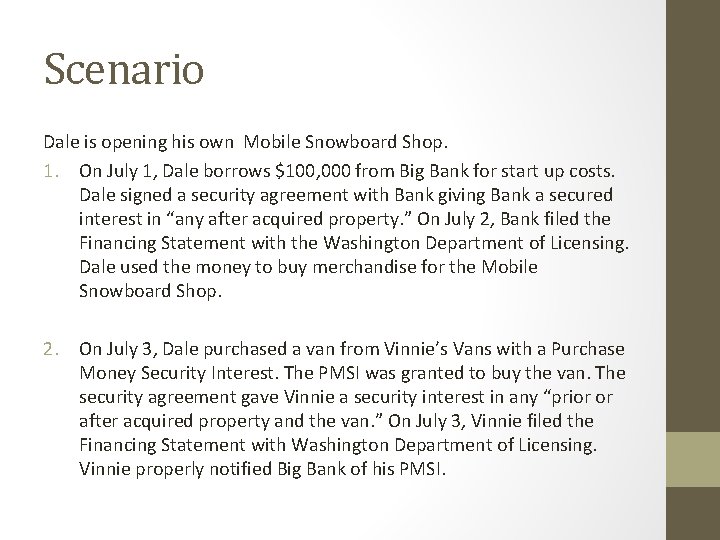
Scenario Dale is opening his own Mobile Snowboard Shop. 1. On July 1, Dale borrows $100, 000 from Big Bank for start up costs. Dale signed a security agreement with Bank giving Bank a secured interest in “any after acquired property. ” On July 2, Bank filed the Financing Statement with the Washington Department of Licensing. Dale used the money to buy merchandise for the Mobile Snowboard Shop. 2. On July 3, Dale purchased a van from Vinnie’s Vans with a Purchase Money Security Interest. The PMSI was granted to buy the van. The security agreement gave Vinnie a security interest in any “prior or after acquired property and the van. ” On July 3, Vinnie filed the Financing Statement with Washington Department of Licensing. Vinnie properly notified Big Bank of his PMSI.
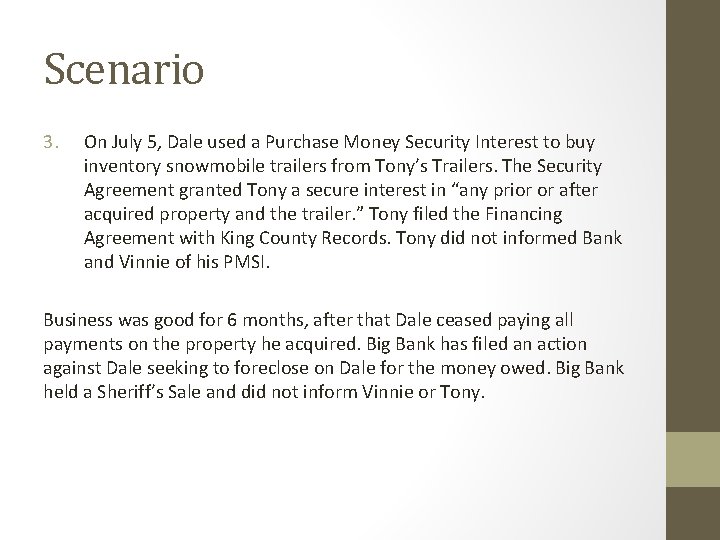
Scenario 3. On July 5, Dale used a Purchase Money Security Interest to buy inventory snowmobile trailers from Tony’s Trailers. The Security Agreement granted Tony a secure interest in “any prior or after acquired property and the trailer. ” Tony filed the Financing Agreement with King County Records. Tony did not informed Bank and Vinnie of his PMSI. Business was good for 6 months, after that Dale ceased paying all payments on the property he acquired. Big Bank has filed an action against Dale seeking to foreclose on Dale for the money owed. Big Bank held a Sheriff’s Sale and did not inform Vinnie or Tony.
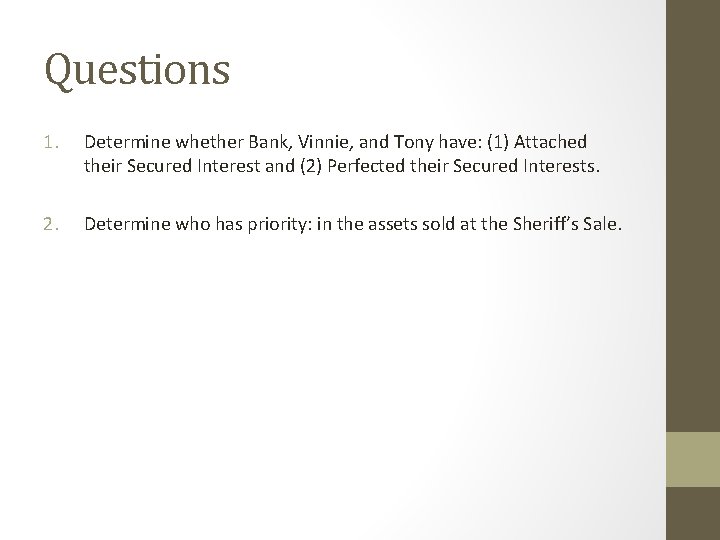
Questions 1. Determine whether Bank, Vinnie, and Tony have: (1) Attached their Secured Interest and (2) Perfected their Secured Interests. 2. Determine who has priority: in the assets sold at the Sheriff’s Sale.
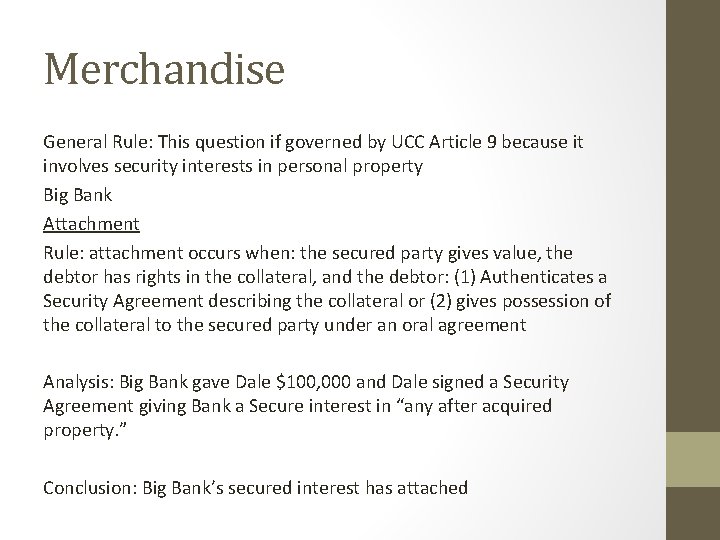
Merchandise General Rule: This question if governed by UCC Article 9 because it involves security interests in personal property Big Bank Attachment Rule: attachment occurs when: the secured party gives value, the debtor has rights in the collateral, and the debtor: (1) Authenticates a Security Agreement describing the collateral or (2) gives possession of the collateral to the secured party under an oral agreement Analysis: Big Bank gave Dale $100, 000 and Dale signed a Security Agreement giving Bank a Secure interest in “any after acquired property. ” Conclusion: Big Bank’s secured interest has attached
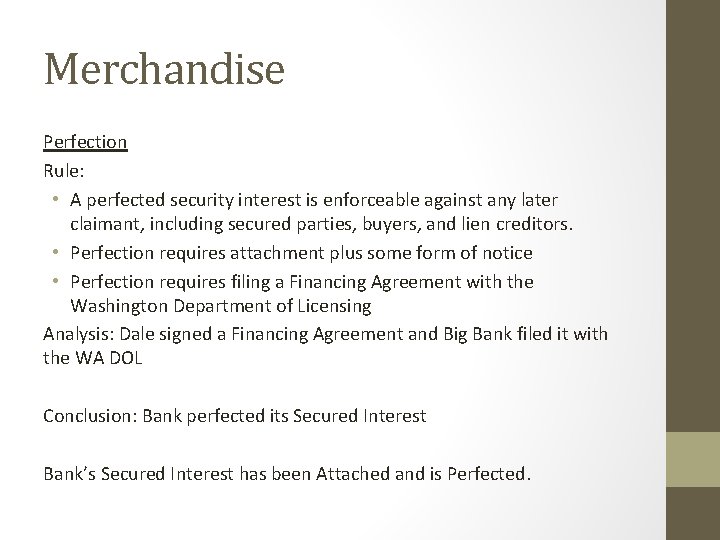
Merchandise Perfection Rule: • A perfected security interest is enforceable against any later claimant, including secured parties, buyers, and lien creditors. • Perfection requires attachment plus some form of notice • Perfection requires filing a Financing Agreement with the Washington Department of Licensing Analysis: Dale signed a Financing Agreement and Big Bank filed it with the WA DOL Conclusion: Bank perfected its Secured Interest Bank’s Secured Interest has been Attached and is Perfected.
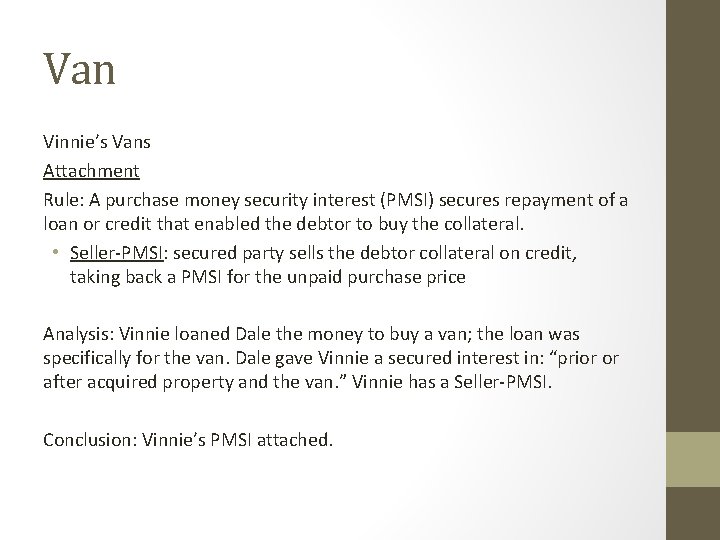
Van Vinnie’s Vans Attachment Rule: A purchase money security interest (PMSI) secures repayment of a loan or credit that enabled the debtor to buy the collateral. • Seller-PMSI: secured party sells the debtor collateral on credit, taking back a PMSI for the unpaid purchase price Analysis: Vinnie loaned Dale the money to buy a van; the loan was specifically for the van. Dale gave Vinnie a secured interest in: “prior or after acquired property and the van. ” Vinnie has a Seller-PMSI. Conclusion: Vinnie’s PMSI attached.
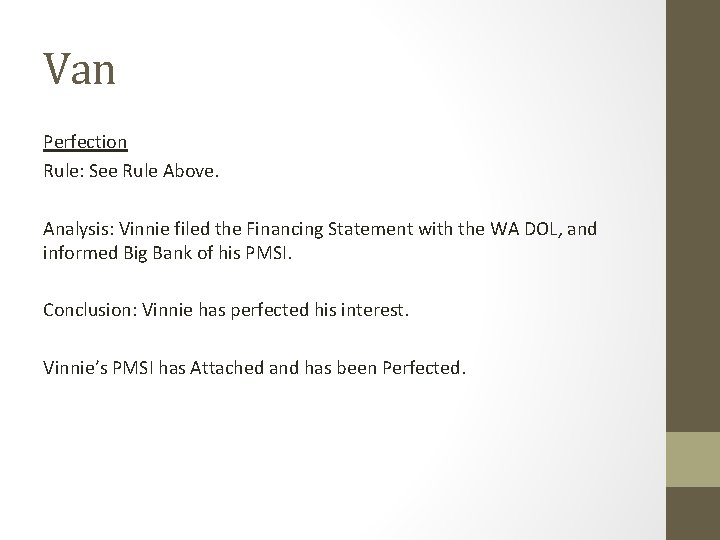
Van Perfection Rule: See Rule Above. Analysis: Vinnie filed the Financing Statement with the WA DOL, and informed Big Bank of his PMSI. Conclusion: Vinnie has perfected his interest. Vinnie’s PMSI has Attached and has been Perfected.
Trailer Tony Attachment Rule: See PMSI above. Analysis: Dale signed a PMSI giving Tony a secured interest in “any prior or after acquired property and the trailer. ” Conclusion: Tony’s secured interest has attached.
Trailer Perfection Rule: See above. If the collateral is inventory to the debtor, then before the debtor receives possession the PMSI party must give written and signed notice to the secured parties of record describing the collateral and file w/ DOL Analysis: Tony filed the Financing Statement with King County Records instead of the DOL and did not inform Bank and Vinnie of his PMSI. Conclusion: Tony’s secured interest is not perfected.
Priority Issue: who has priority in the proceeds of the Sheriff’s Sale? Rule: • Unperfected vs. unperfected: first to attach has priority • Perfected vs. unperfected: a perfected security interest has priority over any unperfected security interest • Perfected vs. Perfected: between two perfected secured parties, the first to file or perfect has priority unless the second has a superpriority (PMSI) • Super-priority: a secured party with a PMSI in non-inventory will have priority over earlier-filed interest if she perfects before or within 20 days after the debtor receives possession of the collateral
Priority Analysis: 1. Bank v. Vinnie: Even though Bank perfected first, Vinnie has a PMSI which has priority over a general loan. 2. Bank v. Tony: Even though Tony has a PMSI, Tony did not perfect his secured interest because he filed incorrectly and did not inform Bank of his interest. 3. Vinnie v. Tony: Vinnie perfected his PMSI, Tony did not. Conclusion: Vinnie has priority over both Bank and Tony. Bank has priority over Tony has priority over no one.