
Secured Embedded Architecture Laboratory SEAL Fault Analysis of
Secured Embedded Architecture Laboratory (SEAL) Fault Analysis of Cryptosystems: Attacks, Countermeasures, and Metrics Debdeep Mukhopadhyay Sikhar Patranabis Department of Computer Science and Engineering IIT Kharagpur debdeep@cse. iitkgp. ernet. in sikhar. patranabis@cse. iitkgp. ernet. in http: //cse. iitkgp. ac. in/resgrp/seal/ 13 -09 -2015 CHES 2015, SAINT MALO, FRANCE 1
Secured Embedded Architecture Laboratory (SEAL) 13 -09 -2015 CHES 2015, SAINT MALO, FRANCE 2
Secured Embedded Architecture Laboratory (SEAL) Fault Tolerance : Context in Cryptography High-throughput requirements of various information disciplines. Cryptographic accelerators are needed ◦ Hardware Designs implemented as ASICs and FPGAs. ◦ Raises concerns regarding their reliability. Faults are catastrophic in context to security algorithms. ◦ AES can be broken with a single well-formed fault! 13 -09 -2015 CHES 2015, SAINT MALO, FRANCE 3
Secured Embedded Architecture Laboratory (SEAL) Types of Fault Attacks Differential Fault Analysis (DFA) ◦ Induce a fault ◦ Observe the Difference of the correct and faulty pairs ◦ Derive equations to obtain the key Differential Fault Intensity Attack (DFIA) ◦ Obtain non-uniform faults (biased faults) through nonexpensive techniques ◦ Perform Side Channel Analysis like power analysis to exploit the bias 13 -09 -2015 CHES 2015, SAINT MALO, FRANCE 4
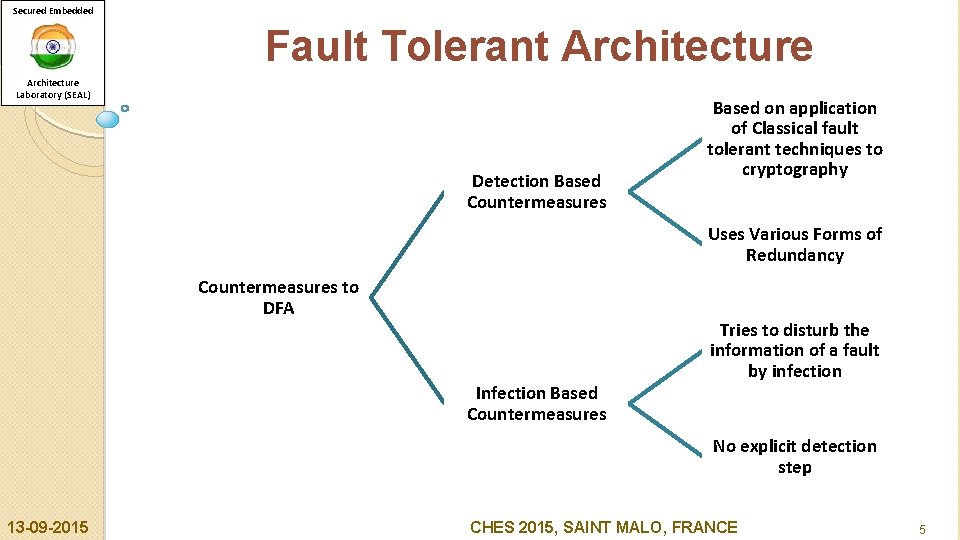
Secured Embedded Fault Tolerant Architecture Laboratory (SEAL) Detection Based Countermeasures Based on application of Classical fault tolerant techniques to cryptography Uses Various Forms of Redundancy Countermeasures to DFA Infection Based Countermeasures Tries to disturb the information of a fault by infection No explicit detection step 13 -09 -2015 CHES 2015, SAINT MALO, FRANCE 5

Secured Embedded OUTLINE Architecture Laboratory (SEAL) Part 1: Brief History of Fault Attacks, Fault Models Part 2: Differential Fault Analysis of Block Ciphers Part 3: Countermeasures versus Biased Faults – Pushing the Limits Part 4 : Fault Tolerance at a Granular Level : Idempotent Instruction Sequences 13 -09 -2015 Part 5: Metrics for Fault Analysis CHES 2015, SAINT MALO, FRANCE
Secured Embedded Architecture Laboratory (SEAL) PART 1 BRIEF HISTORY OF FAULT ATTACKS, FAULT MODELS 13 -09 -2015 CHES 2015, SAINT MALO, FRANCE
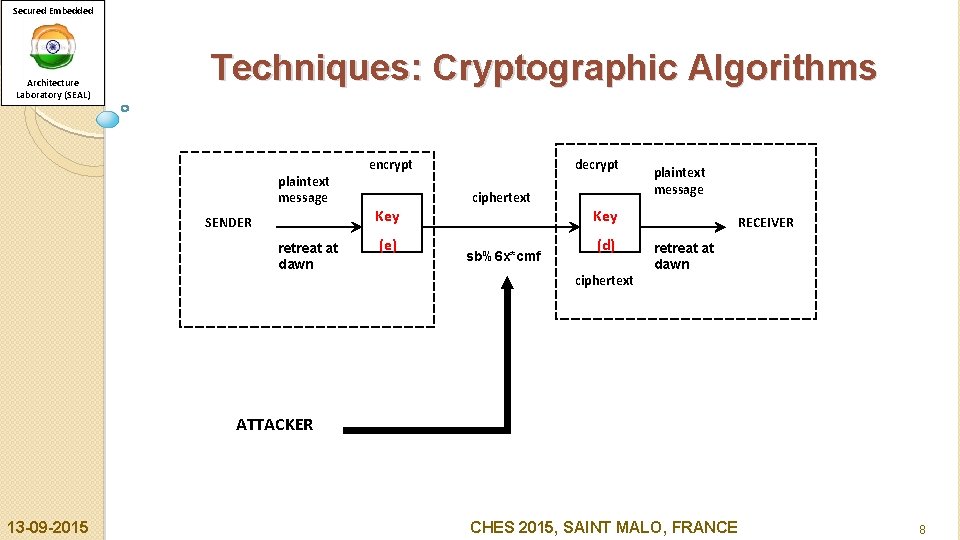
Secured Embedded Architecture Laboratory (SEAL) Techniques: Cryptographic Algorithms plaintext message SENDER retreat at dawn encrypt Key (e) decrypt ciphertext sb%6 x*cmf plaintext message Key (d) ciphertext RECEIVER retreat at dawn ATTACKER 13 -09 -2015 CHES 2015, SAINT MALO, FRANCE 8
Secured Embedded Architecture Laboratory (SEAL) Fault Attacks : A Brief Overview Introduction of faults in the normal execution of cryptographic algorithms and analysis of faulty output to obtain the key First conceived in 1996 by Boneh, Demillo and Lipton E. Biham developed Differential Fault Analysis (DFA) of DES Today there are numerous examples of fault analysis of block ciphers such as AES under a variety of fault models and fault injection techniques Popular Fault Injection Techniques – Clock Glitches, Voltage Glitches, EM and Optical Injection Techniques 13 -09 -2015 CHES 2015, SAINT MALO, FRANCE 9
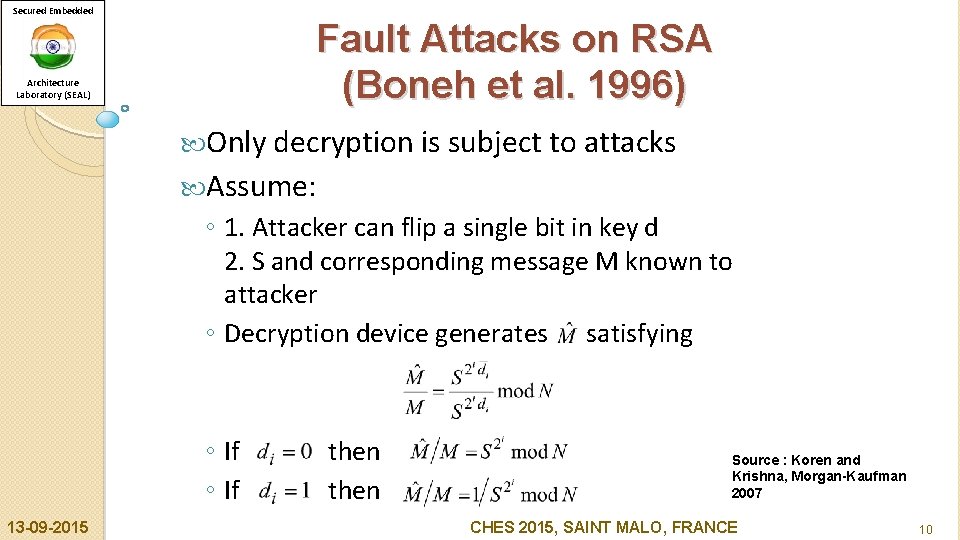
Secured Embedded Architecture Laboratory (SEAL) Fault Attacks on RSA (Boneh et al. 1996) Only decryption is subject to attacks Assume: ◦ 1. Attacker can flip a single bit in key d 2. S and corresponding message M known to attacker ◦ Decryption device generates satisfying ◦ If then 13 -09 -2015 Source : Koren and Krishna, Morgan-Kaufman 2007 CHES 2015, SAINT MALO, FRANCE 10
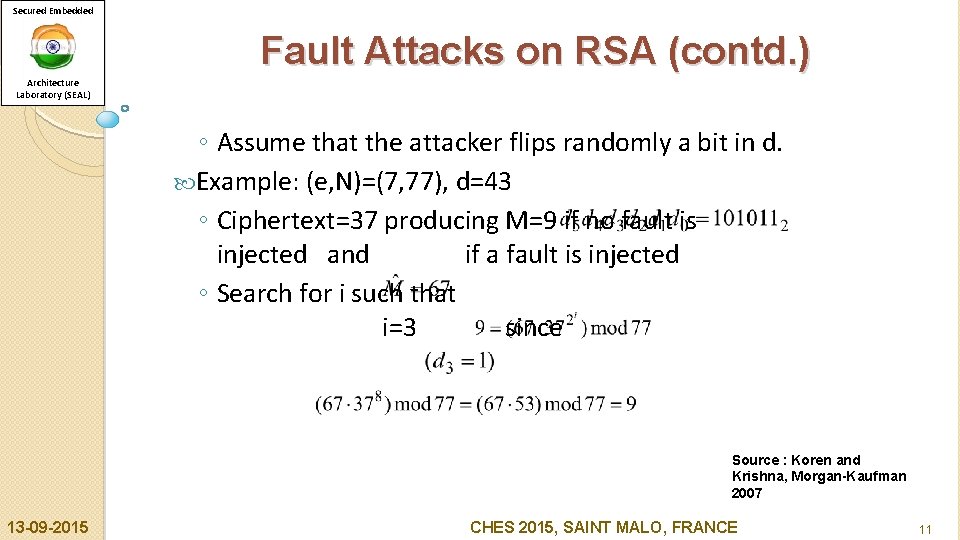
Secured Embedded Fault Attacks on RSA (contd. ) Architecture Laboratory (SEAL) ◦ Assume that the attacker flips randomly a bit in d. Example: (e, N)=(7, 77), d=43 ◦ Ciphertext=37 producing M=9 if no fault is injected and if a fault is injected ◦ Search for i such that i=3 since Source : Koren and Krishna, Morgan-Kaufman 2007 13 -09 -2015 CHES 2015, SAINT MALO, FRANCE 11
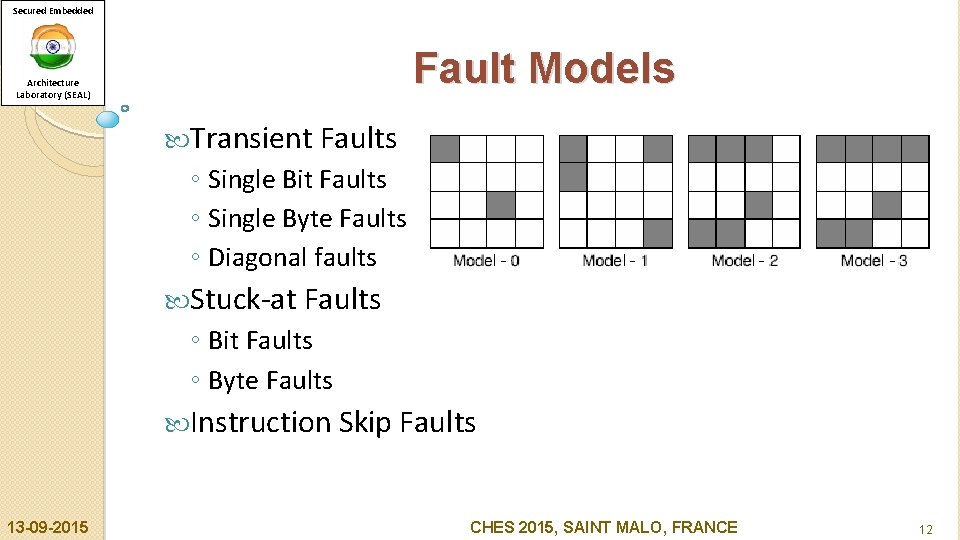
Secured Embedded Fault Models Architecture Laboratory (SEAL) Transient Faults ◦ Single Bit Faults ◦ Single Byte Faults ◦ Diagonal faults Stuck-at Faults ◦ Bit Faults ◦ Byte Faults Instruction Skip Faults 13 -09 -2015 CHES 2015, SAINT MALO, FRANCE 12
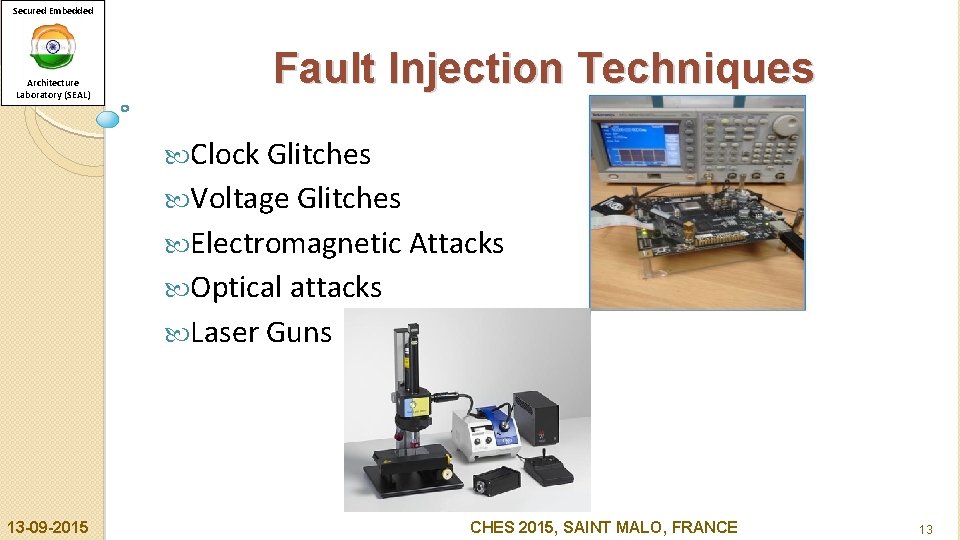
Secured Embedded Architecture Laboratory (SEAL) Fault Injection Techniques Clock Glitches Voltage Glitches Electromagnetic Attacks Optical attacks Laser Guns 13 -09 -2015 CHES 2015, SAINT MALO, FRANCE 13
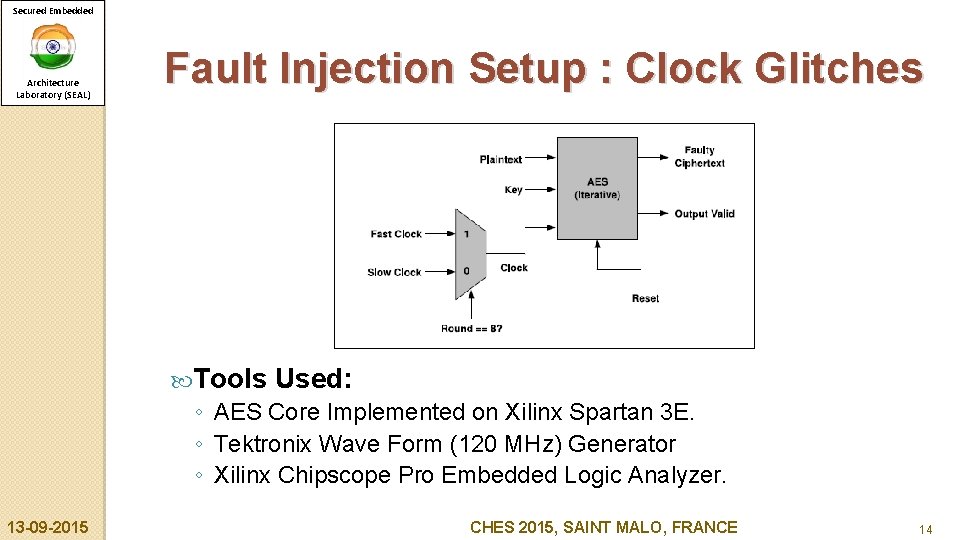
Secured Embedded Architecture Laboratory (SEAL) Fault Injection Setup : Clock Glitches Tools Used: ◦ AES Core Implemented on Xilinx Spartan 3 E. ◦ Tektronix Wave Form (120 MHz) Generator ◦ Xilinx Chipscope Pro Embedded Logic Analyzer. 13 -09 -2015 CHES 2015, SAINT MALO, FRANCE 14
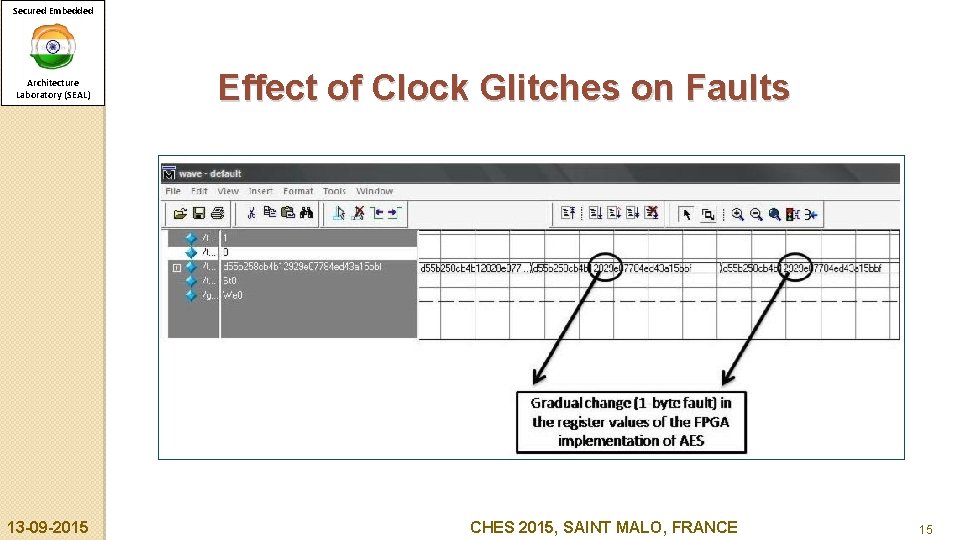
Secured Embedded Architecture Laboratory (SEAL) 13 -09 -2015 Effect of Clock Glitches on Faults CHES 2015, SAINT MALO, FRANCE 15
Secured Embedded Architecture Laboratory (SEAL) When describing a fault attack on any cryptographic primitive, it is important to try and bridge the gap between theoretically and practically achievable fault models 13 -09 -2015 CHES 2015, SAINT MALO, FRANCE
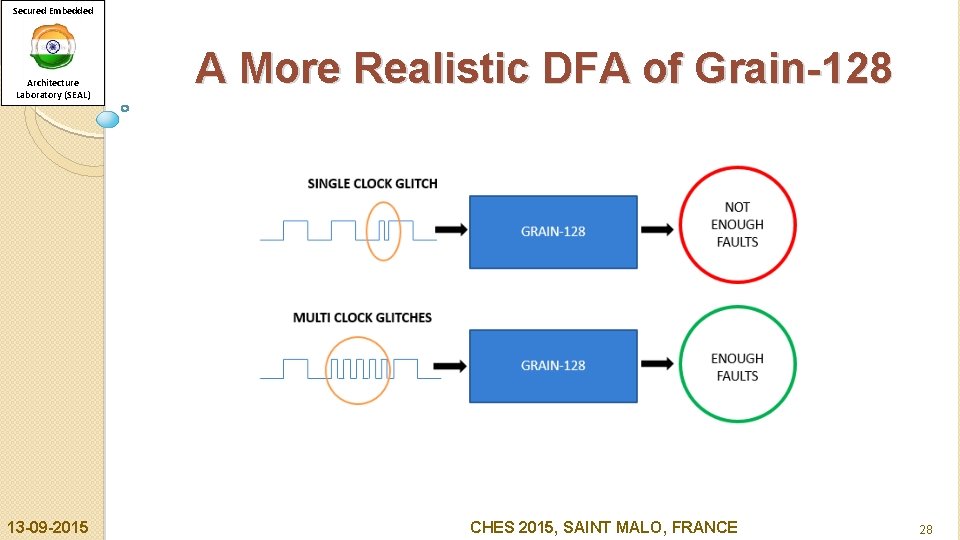
Secured Embedded Architecture Laboratory (SEAL) Fault Attacks on Stream Ciphers Fault Attacks threaten stream ciphers as well A number of DFA attacks have been reported on stream ciphers such as Mickey and GRAIN-128 However, not all of these use realistic or practically achievable fault models The assumption that uniformly random single bit flips can be obtained seems invalid in practical set-ups 13 -09 -2015 CHES 2015, SAINT MALO, FRANCE 17
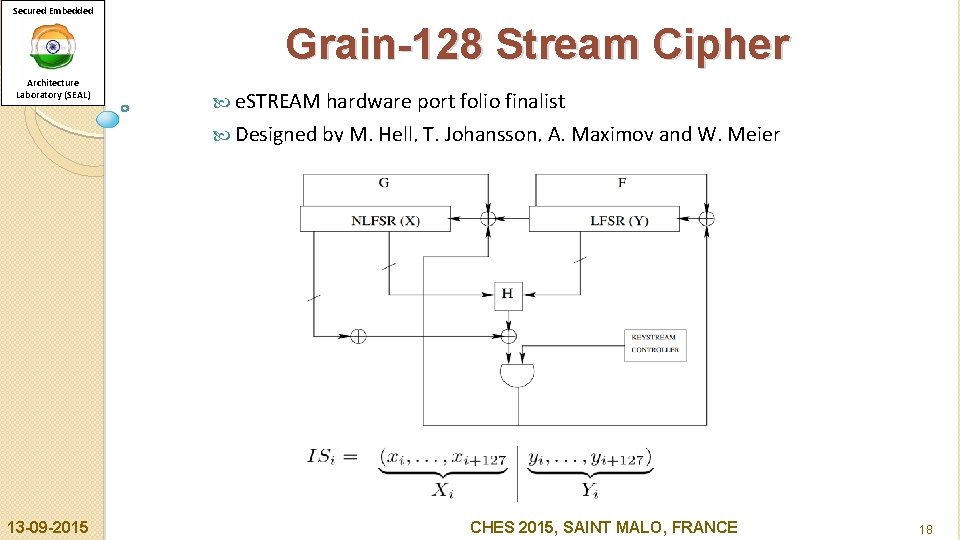
Secured Embedded Grain-128 Stream Cipher Architecture Laboratory (SEAL) e. STREAM hardware port folio finalist Designed by M. Hell, T. Johansson, A. Maximov and W. Meier 13 -09 -2015 CHES 2015, SAINT MALO, FRANCE 18
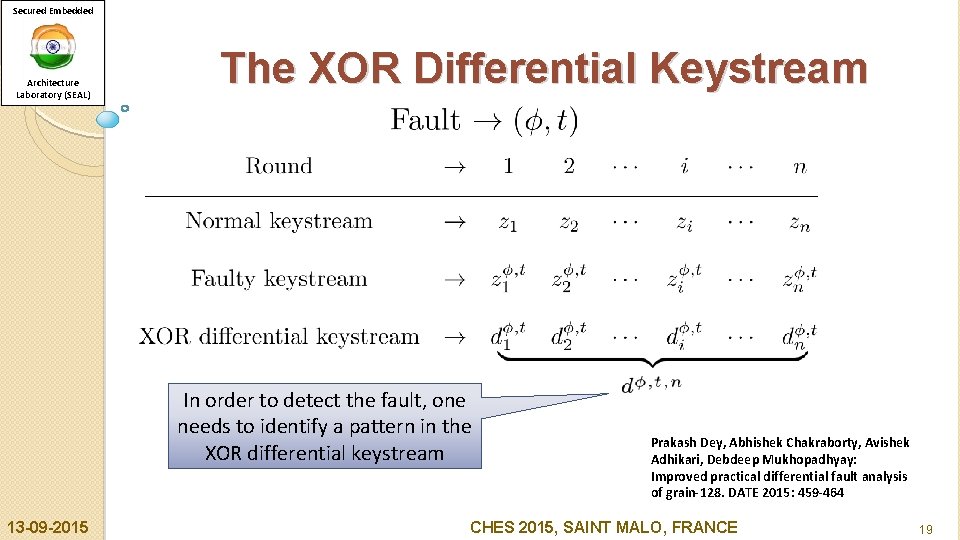
Secured Embedded Architecture Laboratory (SEAL) The XOR Differential Keystream In order to detect the fault, one needs to identify a pattern in the XOR differential keystream 13 -09 -2015 Prakash Dey, Abhishek Chakraborty, Avishek Adhikari, Debdeep Mukhopadhyay: Improved practical differential fault analysis of grain-128. DATE 2015: 459 -464 CHES 2015, SAINT MALO, FRANCE 19
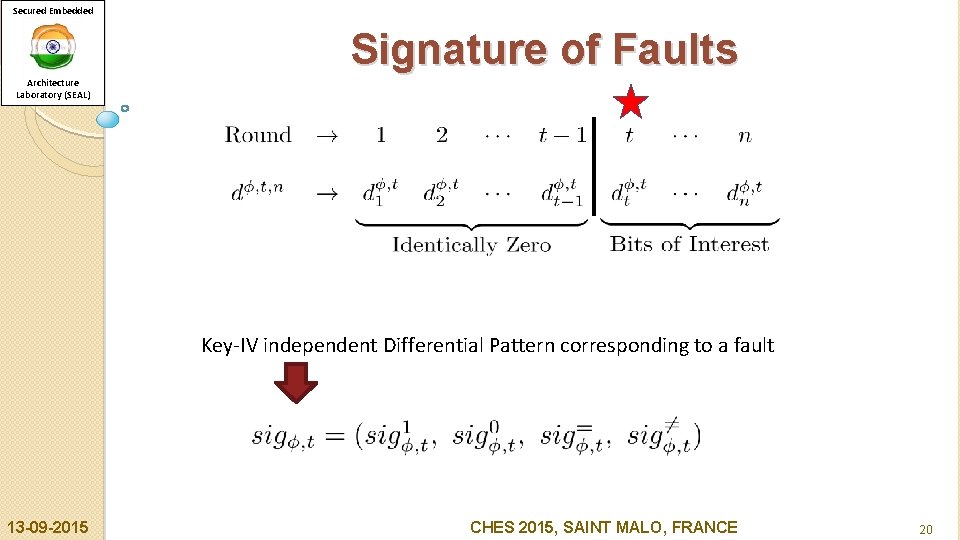
Secured Embedded Signature of Faults Architecture Laboratory (SEAL) Key-IV independent Differential Pattern corresponding to a fault 13 -09 -2015 CHES 2015, SAINT MALO, FRANCE 20
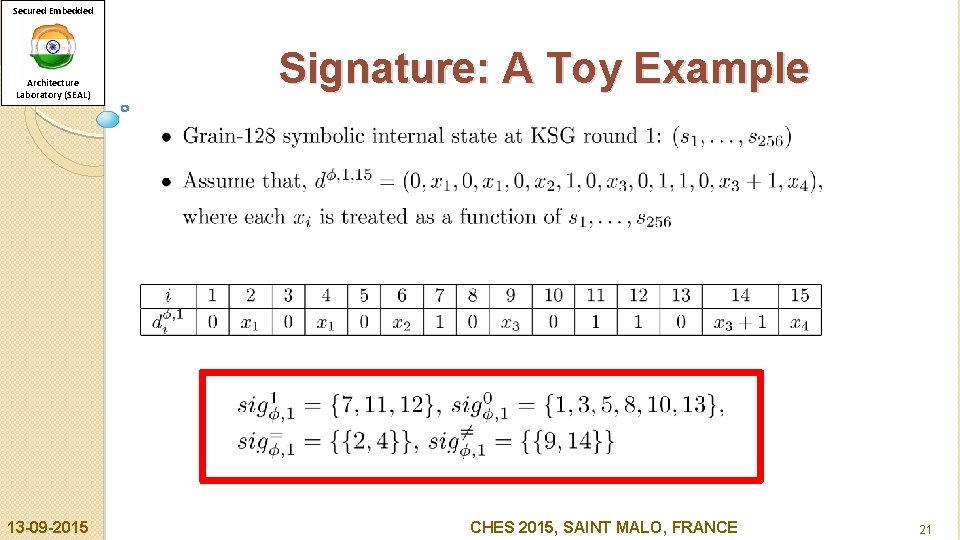
Secured Embedded Architecture Laboratory (SEAL) 13 -09 -2015 Signature: A Toy Example CHES 2015, SAINT MALO, FRANCE 21
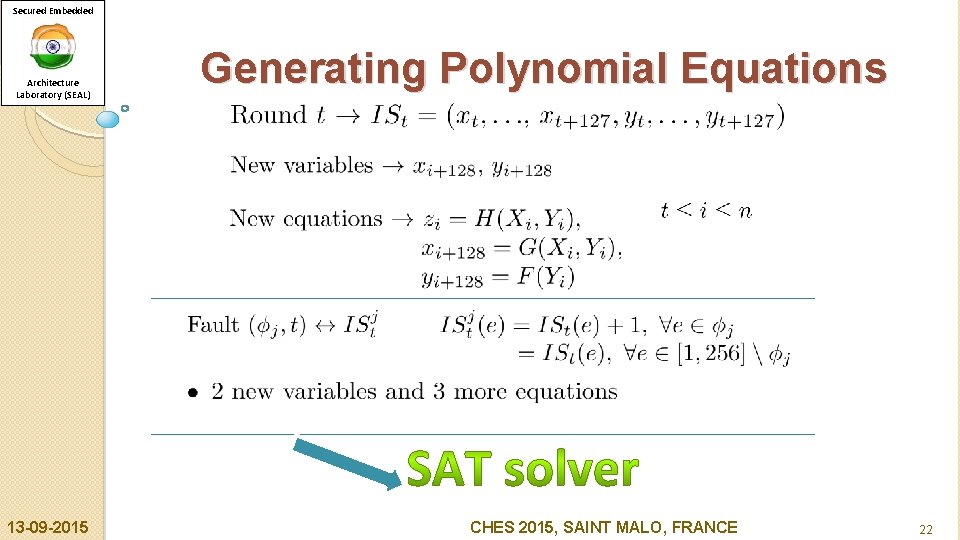
Secured Embedded Architecture Laboratory (SEAL) 13 -09 -2015 Generating Polynomial Equations CHES 2015, SAINT MALO, FRANCE 22
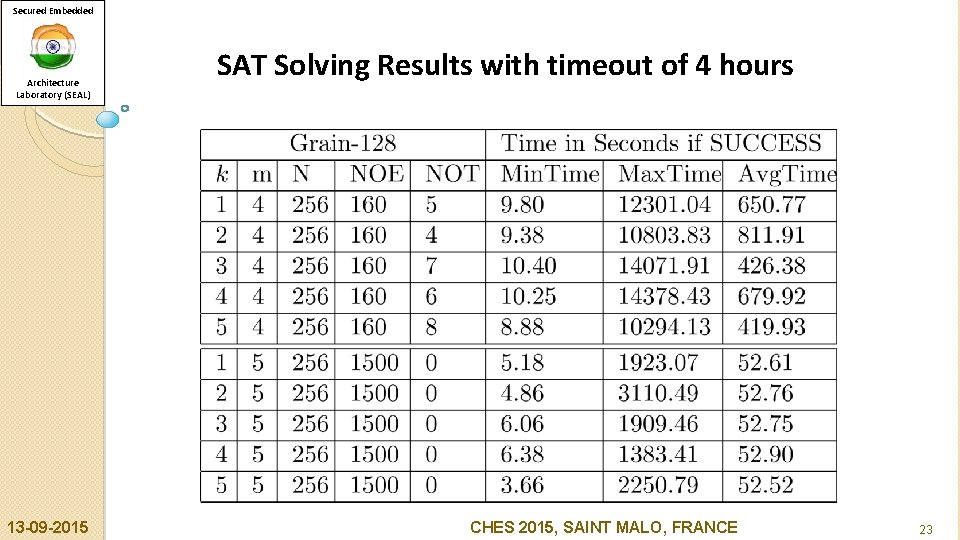
Secured Embedded Architecture Laboratory (SEAL) 13 -09 -2015 SAT Solving Results with timeout of 4 hours CHES 2015, SAINT MALO, FRANCE 23
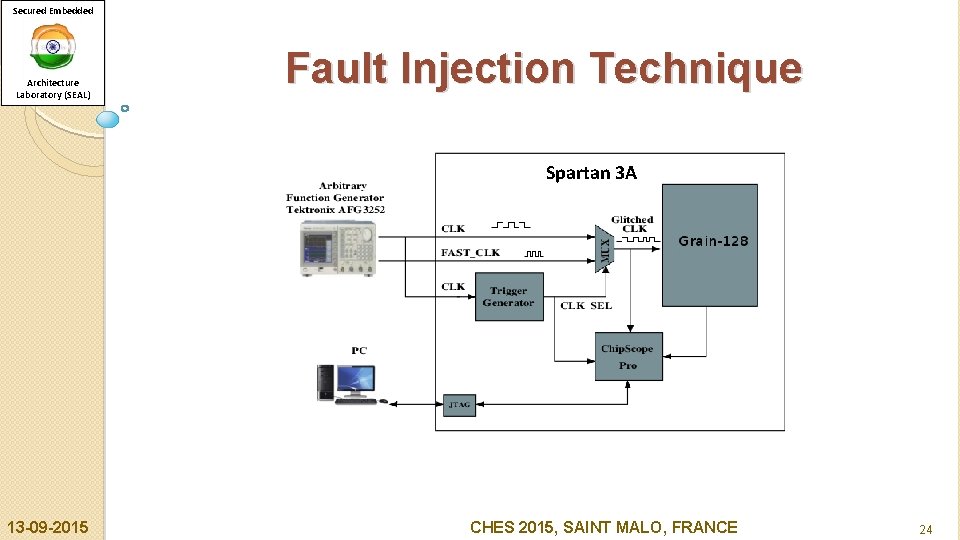
Secured Embedded Architecture Laboratory (SEAL) Fault Injection Technique Spartan 3 A 13 -09 -2015 CHES 2015, SAINT MALO, FRANCE 24
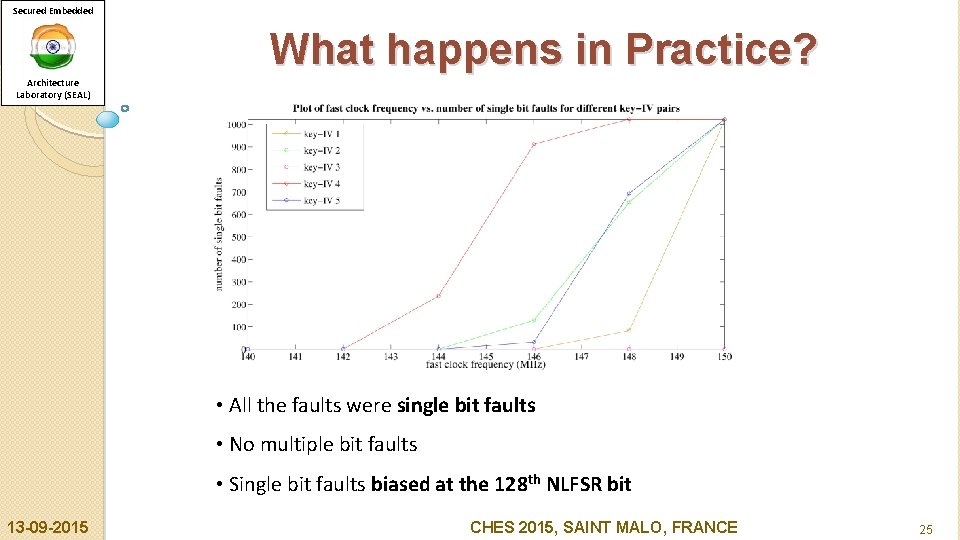
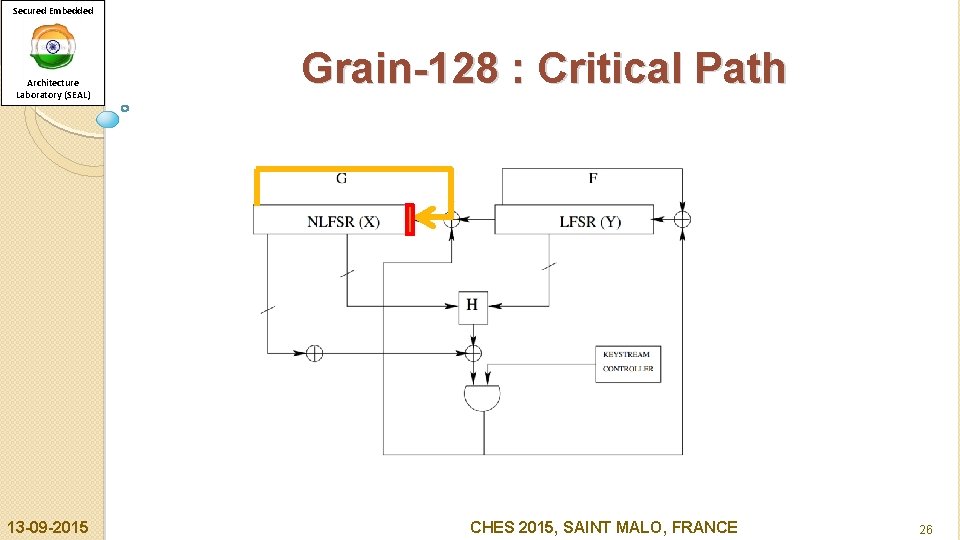
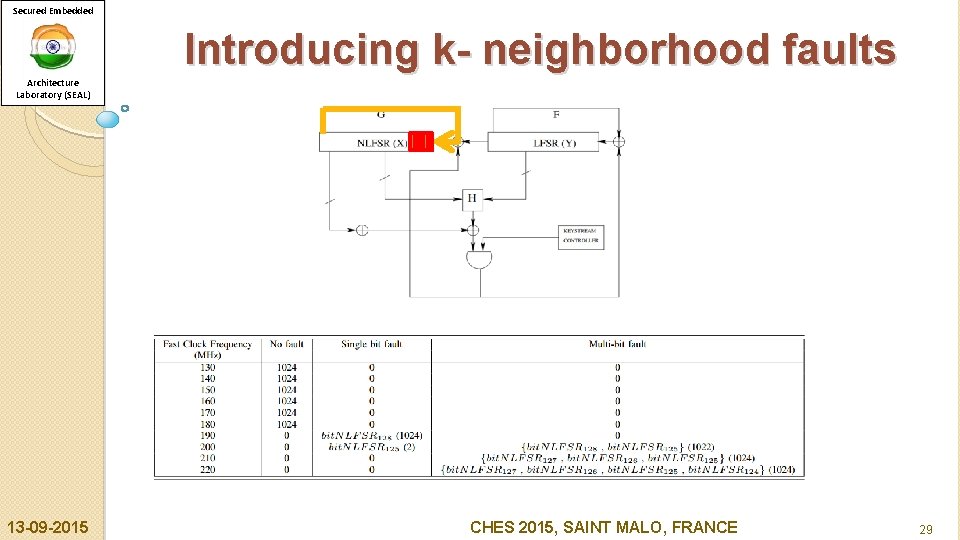
Secured Embedded What happens in Practice? Architecture Laboratory (SEAL) • All the faults were single bit faults • No multiple bit faults • Single bit faults biased at the 128 th NLFSR bit 13 -09 -2015 CHES 2015, SAINT MALO, FRANCE 25
Secured Embedded Architecture Laboratory (SEAL) 13 -09 -2015 Grain-128 : Critical Path CHES 2015, SAINT MALO, FRANCE 26
Secured Embedded Architecture Laboratory (SEAL) Practically Achievable Fault Model Many preceding fault attacks on stream ciphers assume a uniformly random fault distribution However, fault injections using set-up time violations via clock glitches, for example, would lead to a very biased fault distribution since it is the critical path that would be violated each time So it would not be practically feasible to obtain the same fault coverage as claimed under the uniform fault assumption 13 -09 -2015 CHES 2015, SAINT MALO, FRANCE 27
Secured Embedded Architecture Laboratory (SEAL) 13 -09 -2015 A More Realistic DFA of Grain-128 CHES 2015, SAINT MALO, FRANCE 28
Secured Embedded Introducing k- neighborhood faults Architecture Laboratory (SEAL) 13 -09 -2015 CHES 2015, SAINT MALO, FRANCE 29
Secured Embedded Architecture Laboratory (SEAL) Summary of the Attack Actual chip results of clock glitch induced faults on a stream cipher (Grain-128) were discussed Occurrence of biased faults at a single bit Existing single bit fault based DFA on Grain-128 will not be feasible Modified fault injection technique: Combining the effect of the clock glitches and also the shift in the registers Revisiting the DFA algorithm on Grain-128: Relaxed fault model with key recovery possible for k-neighborhood fault 13 -09 -2015 CHES 2015, SAINT MALO, FRANCE 30
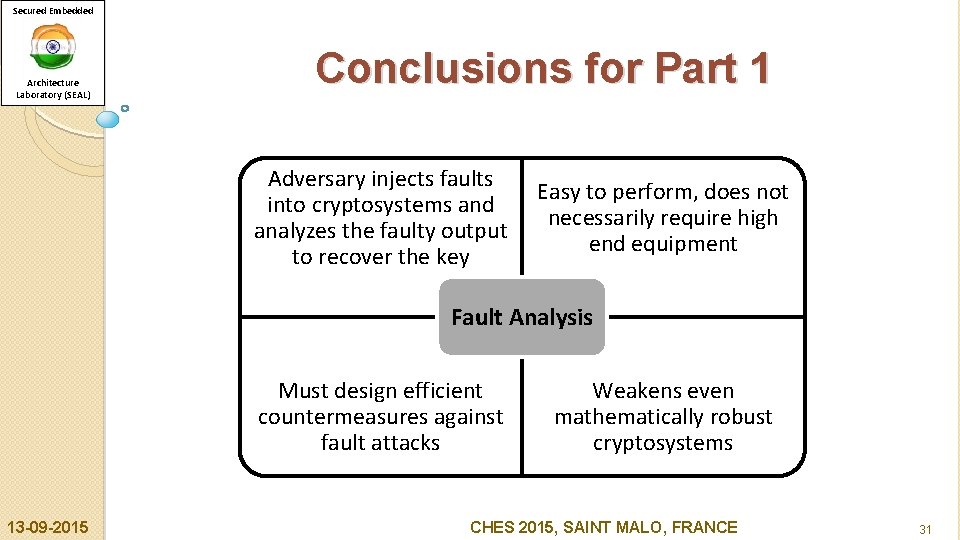
Secured Embedded Architecture Laboratory (SEAL) Conclusions for Part 1 Adversary injects faults into cryptosystems and analyzes the faulty output to recover the key Easy to perform, does not necessarily require high end equipment Fault Analysis Must design efficient countermeasures against fault attacks 13 -09 -2015 Weakens even mathematically robust cryptosystems CHES 2015, SAINT MALO, FRANCE 31
Secured Embedded Architecture Laboratory (SEAL) PART 2 DIFFERENTIAL FAULT ANALYSIS OF BLOCK CIPHERS 13 -09 -2015 CHES 2015, SAINT MALO, FRANCE
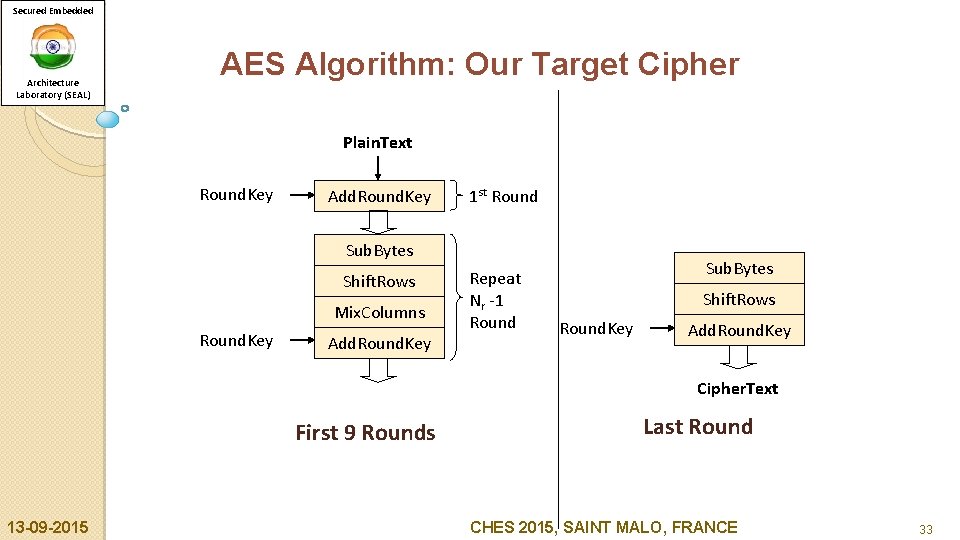
Secured Embedded Architecture Laboratory (SEAL) AES Algorithm: Our Target Cipher Plain. Text Round. Key Add. Round. Key 1 st Round Sub. Bytes Shift. Rows Mix. Columns Round. Key Add. Round. Key Repeat Nr -1 Round Sub. Bytes Shift. Rows Round. Key Add. Round. Key Cipher. Text First 9 Rounds 13 -09 -2015 Last Round CHES 2015, SAINT MALO, FRANCE 33
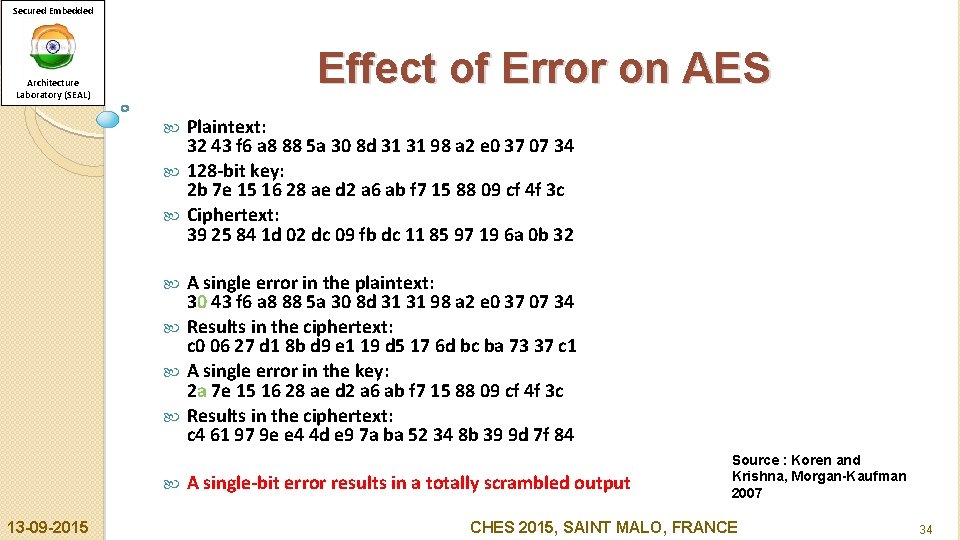
Secured Embedded Effect of Error on AES Architecture Laboratory (SEAL) Plaintext: 32 43 f 6 a 8 88 5 a 30 8 d 31 31 98 a 2 e 0 37 07 34 128 -bit key: 2 b 7 e 15 16 28 ae d 2 a 6 ab f 7 15 88 09 cf 4 f 3 c Ciphertext: 39 25 84 1 d 02 dc 09 fb dc 11 85 97 19 6 a 0 b 32 A single error in the plaintext: 30 43 f 6 a 8 88 5 a 30 8 d 31 31 98 a 2 e 0 37 07 34 Results in the ciphertext: c 0 06 27 d 1 8 b d 9 e 1 19 d 5 17 6 d bc ba 73 37 c 1 A single error in the key: 2 a 7 e 15 16 28 ae d 2 a 6 ab f 7 15 88 09 cf 4 f 3 c Results in the ciphertext: c 4 61 97 9 e e 4 4 d e 9 7 a ba 52 34 8 b 39 9 d 7 f 84 13 -09 -2015 A single-bit error results in a totally scrambled output Source : Koren and Krishna, Morgan-Kaufman 2007 CHES 2015, SAINT MALO, FRANCE 34
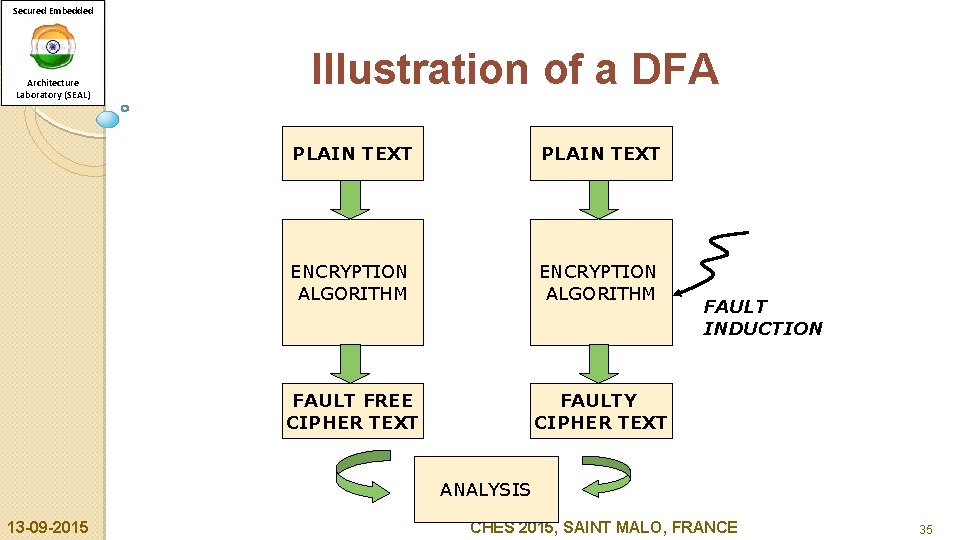
Secured Embedded Architecture Laboratory (SEAL) Illustration of a DFA PLAIN TEXT ENCRYPTION ALGORITHM FAULT FREE CIPHER TEXT FAULTY CIPHER TEXT FAULT INDUCTION ANALYSIS 13 -09 -2015 CHES 2015, SAINT MALO, FRANCE 35
Secured Embedded Types of DFA Architecture Laboratory (SEAL) Attack Location: ◦ Targeting the Data Path: Assume that the fault occurs in the AES data path. ◦ Targeting the AES Key Schedule: Assume that the fault occurs in the AES Key-schedule. Fault Model: ◦ Single Byte ◦ Multiple Byte 13 -09 -2015 CHES 2015, SAINT MALO, FRANCE 36
Secured Embedded Architecture Laboratory (SEAL) Single Byte Faults in known DFAs Single Byte Fault ◦ Attacker induces fault at the input of the 8 th round in a single byte ◦ Fault value should be non-zero but can be arbitrary Relaxing the requirements make the attack more practical ◦ No knowledge required of the fault value ◦ Lesser bytes needed to be faulty ◦ Lesser faulty cipher texts required 13 -09 -2015 CHES 2015, SAINT MALO, FRANCE 37
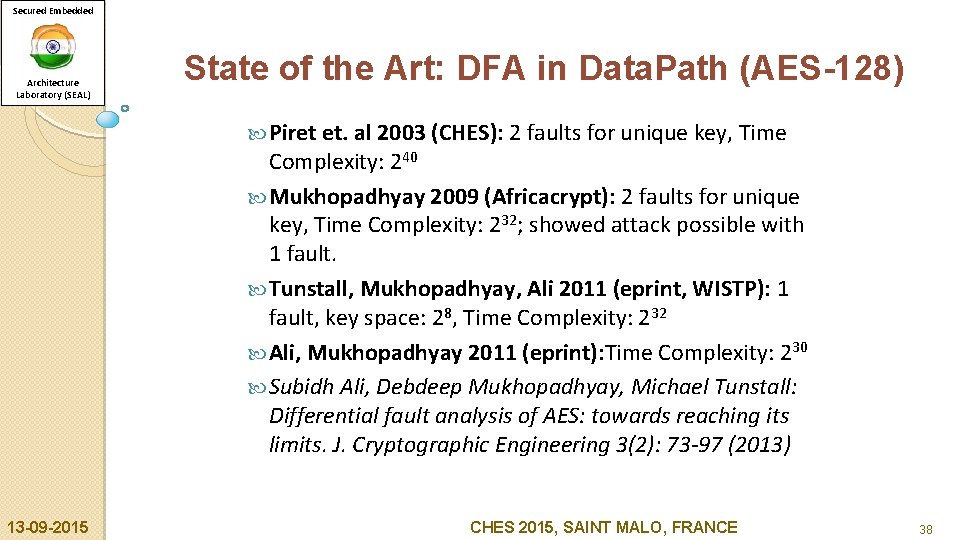
Secured Embedded Architecture Laboratory (SEAL) State of the Art: DFA in Data. Path (AES-128) Piret et. al 2003 (CHES): 2 faults for unique key, Time Complexity: 240 Mukhopadhyay 2009 (Africacrypt): 2 faults for unique key, Time Complexity: 232; showed attack possible with 1 fault. Tunstall, Mukhopadhyay, Ali 2011 (eprint, WISTP): 1 fault, key space: 28, Time Complexity: 232 Ali, Mukhopadhyay 2011 (eprint): Time Complexity: 230 Subidh Ali, Debdeep Mukhopadhyay, Michael Tunstall: Differential fault analysis of AES: towards reaching its limits. J. Cryptographic Engineering 3(2): 73 -97 (2013) 13 -09 -2015 CHES 2015, SAINT MALO, FRANCE 38
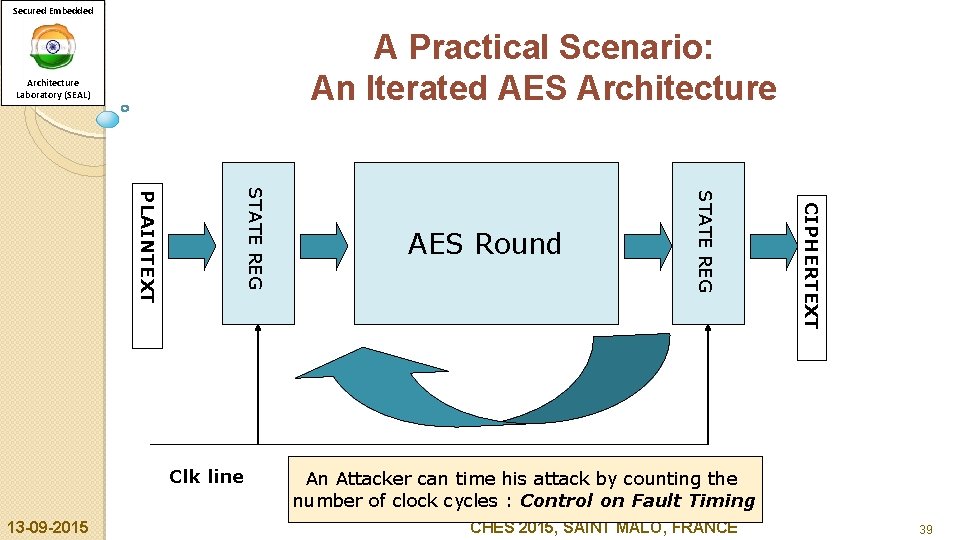
Secured Embedded A Practical Scenario: An Iterated AES Architecture Laboratory (SEAL) CIPHERTEXT 13 -09 -2015 STATE REG PLAINTEXT Clk line AES Round An Attacker can time his attack by counting the number of clock cycles : Control on Fault Timing CHES 2015, SAINT MALO, FRANCE 39
Secured Embedded Principle of the Attack Architecture Laboratory (SEAL) First, consider a single byte arbitrary fault at the input of the 9 th round. ISB : Inverse Sub Byte We develop a filter, which takes as input the faulty and fault free ciphertext. 13 -09 -2015 CHES 2015, SAINT MALO, FRANCE 40
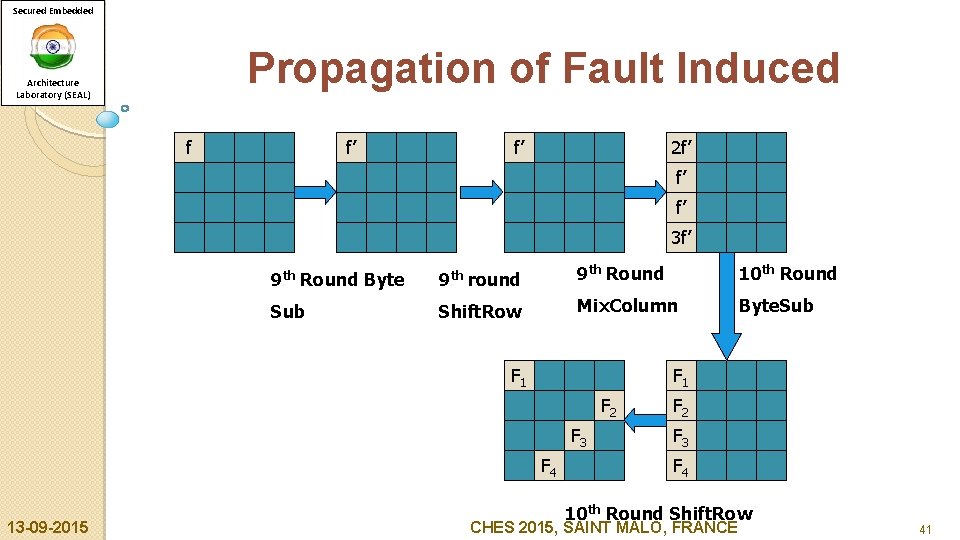
Secured Embedded Propagation of Fault Induced Architecture Laboratory (SEAL) f f’ f’ 2 f’ f’ f’ 3 f’ 9 th Round Byte 9 th round 9 th Round 10 th Round Sub Shift. Row Mix. Column Byte. Sub F 1 F 2 F 3 F 4 13 -09 -2015 F 2 F 3 F 4 10 th Round Shift. Row CHES 2015, SAINT MALO, FRANCE 41
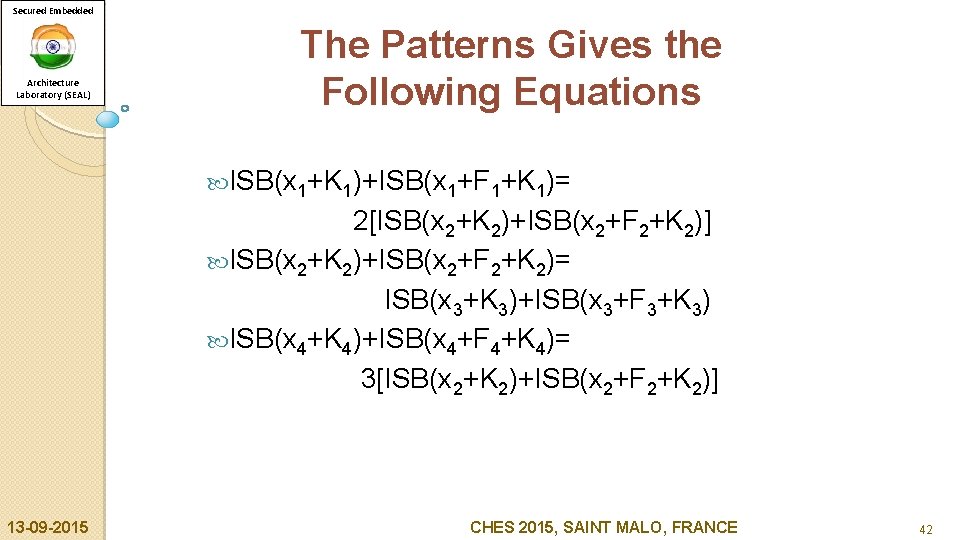
Secured Embedded Architecture Laboratory (SEAL) The Patterns Gives the Following Equations ISB(x 1+K 1)+ISB(x 1+F 1+K 1)= 2[ISB(x 2+K 2)+ISB(x 2+F 2+K 2)] ISB(x 2+K 2)+ISB(x 2+F 2+K 2)= ISB(x 3+K 3)+ISB(x 3+F 3+K 3) ISB(x 4+K 4)+ISB(x 4+F 4+K 4)= 3[ISB(x 2+K 2)+ISB(x 2+F 2+K 2)] 13 -09 -2015 CHES 2015, SAINT MALO, FRANCE 42
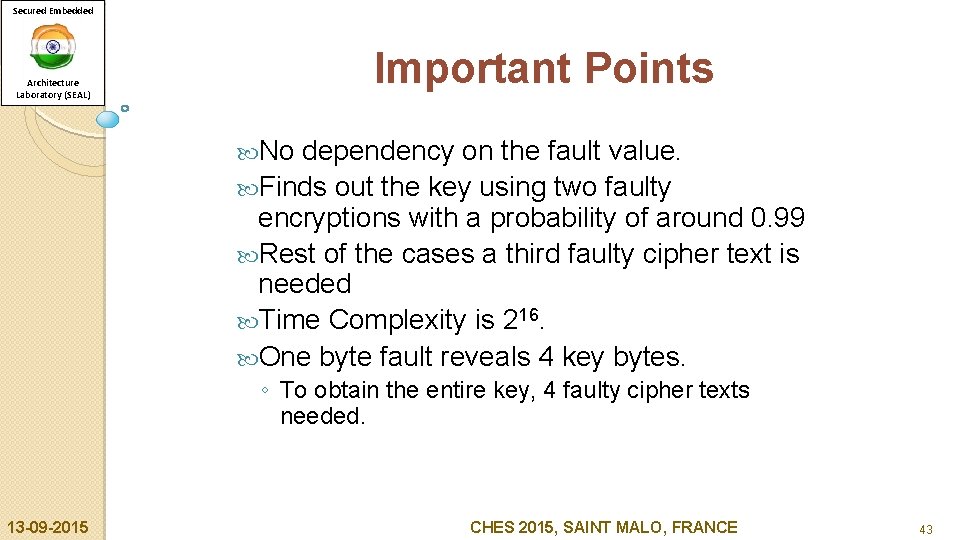
Secured Embedded Important Points Architecture Laboratory (SEAL) No dependency on the fault value. Finds out the key using two faulty encryptions with a probability of around 0. 99 Rest of the cases a third faulty cipher text is needed Time Complexity is 216. One byte fault reveals 4 key bytes. ◦ To obtain the entire key, 4 faulty cipher texts needed. 13 -09 -2015 CHES 2015, SAINT MALO, FRANCE 43
Secured Embedded Architecture Laboratory (SEAL) When the Fault is Induced in the 8 th Round… Fault is induced at the input of 8 th round A one byte disturbance creates a 4 byte fault at the input of the 9 th round Let us trace the disturbance through the last 3 rounds Equations of similar nature… 13 -09 -2015 CHES 2015, SAINT MALO, FRANCE 44
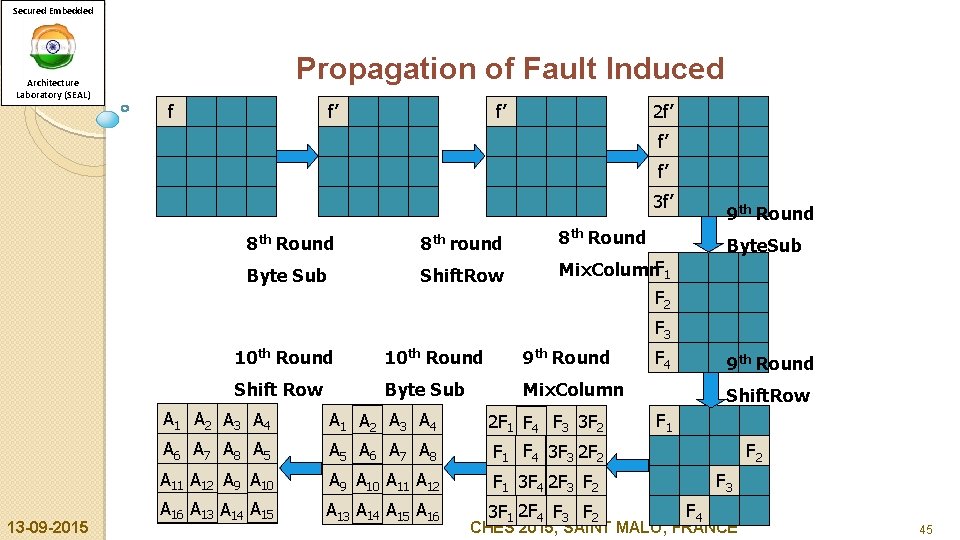
Secured Embedded Architecture Laboratory (SEAL) Propagation of Fault Induced f f’ f’ 2 f’ f’ f’ 3 f’ 8 th Round 8 th round 8 th Round Byte Sub Shift. Row Mix. Column. F 1 9 th Round Byte. Sub F 2 F 3 13 -09 -2015 10 th Round 9 th Round Shift Row Byte Sub Mix. Column A 1 A 2 A 3 A 4 2 F 1 F 4 F 3 3 F 2 A 6 A 7 A 8 A 5 A 6 A 7 A 8 F 1 F 4 3 F 3 2 F 2 A 11 A 12 A 9 A 10 A 11 A 12 F 1 3 F 4 2 F 3 F 2 A 16 A 13 A 14 A 15 A 16 3 F 1 2 F 4 F 3 F 2 F 4 9 th Round Shift. Row F 1 F 2 F 3 F 4 CHES 2015, SAINT MALO, FRANCE 45
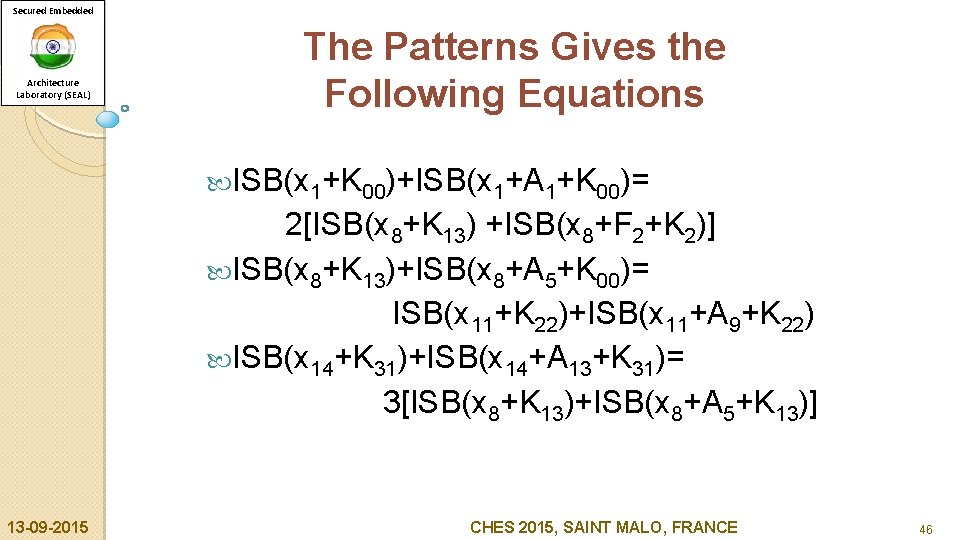
Secured Embedded Architecture Laboratory (SEAL) The Patterns Gives the Following Equations ISB(x 1+K 00)+ISB(x 1+A 1+K 00)= 2[ISB(x 8+K 13) +ISB(x 8+F 2+K 2)] ISB(x 8+K 13)+ISB(x 8+A 5+K 00)= ISB(x 11+K 22)+ISB(x 11+A 9+K 22) ISB(x 14+K 31)+ISB(x 14+A 13+K 31)= 3[ISB(x 8+K 13)+ISB(x 8+A 5+K 13)] 13 -09 -2015 CHES 2015, SAINT MALO, FRANCE 46
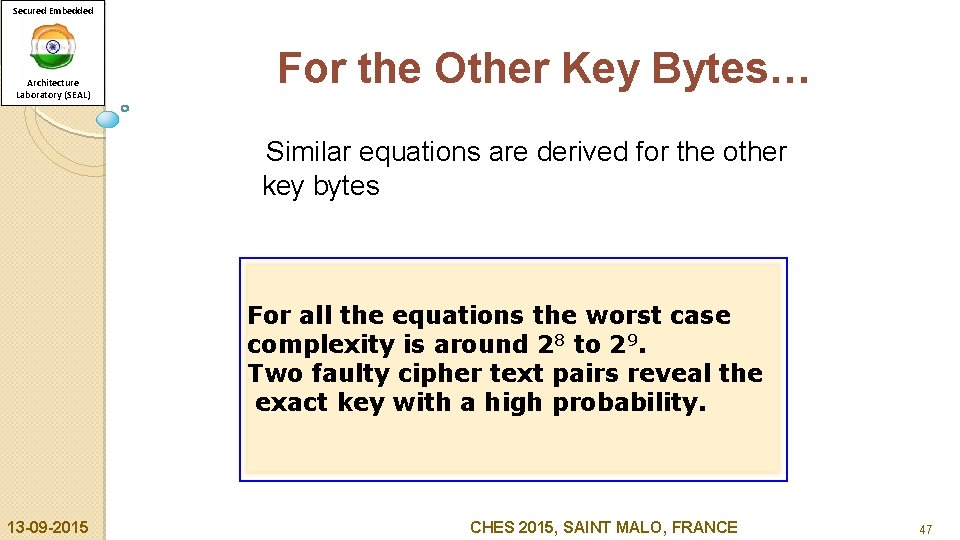
Secured Embedded Architecture Laboratory (SEAL) For the Other Key Bytes… Similar equations are derived for the other key bytes For all the equations the worst case complexity is around 28 to 29. Two faulty cipher text pairs reveal the exact key with a high probability. 13 -09 -2015 CHES 2015, SAINT MALO, FRANCE 47
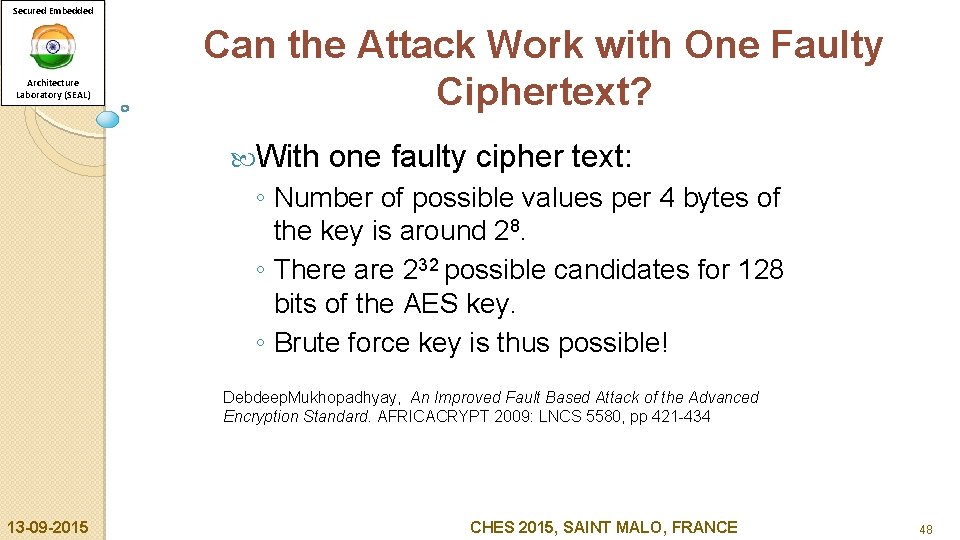
Secured Embedded Architecture Laboratory (SEAL) Can the Attack Work with One Faulty Ciphertext? With one faulty cipher text: ◦ Number of possible values per 4 bytes of the key is around 28. ◦ There are 232 possible candidates for 128 bits of the AES key. ◦ Brute force key is thus possible! Debdeep. Mukhopadhyay, An Improved Fault Based Attack of the Advanced Encryption Standard. AFRICACRYPT 2009: LNCS 5580, pp 421 -434 13 -09 -2015 CHES 2015, SAINT MALO, FRANCE 48
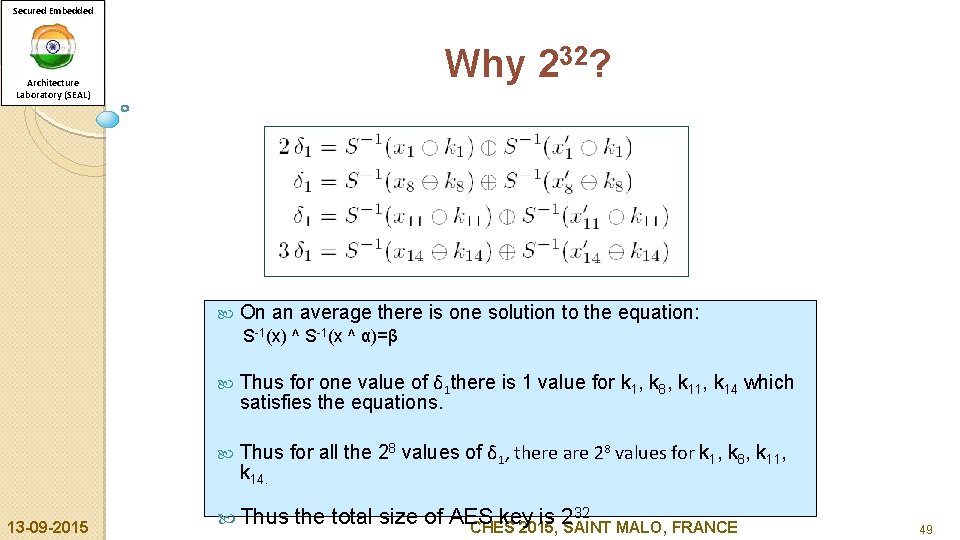
Secured Embedded Why 232? Architecture Laboratory (SEAL) On an average there is one solution to the equation: S-1(x) ^ S-1(x ^ α)=β 13 -09 -2015 Thus for one value of δ 1 there is 1 value for k 1, k 8, k 11, k 14 which satisfies the equations. Thus for all the 28 values of δ 1, there are 28 values for k 1, k 8, k 11, k 14. Thus 32 the total size of AES key is 2 CHES 2015, SAINT MALO, FRANCE 49
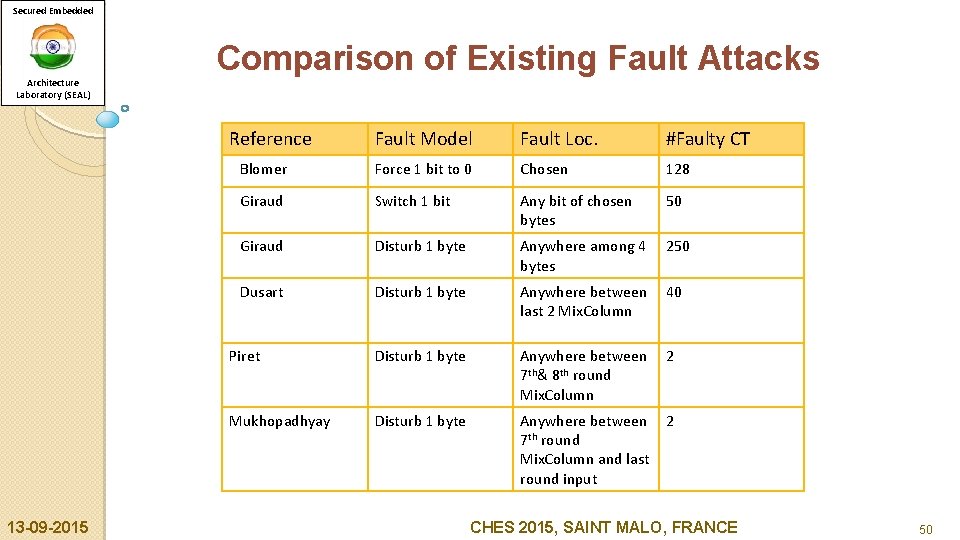
Secured Embedded Architecture Laboratory (SEAL) 13 -09 -2015 Comparison of Existing Fault Attacks Reference Fault Model Fault Loc. #Faulty CT Blomer Force 1 bit to 0 Chosen 128 Giraud Switch 1 bit Any bit of chosen bytes 50 Giraud Disturb 1 byte Anywhere among 4 250 bytes Dusart Disturb 1 byte Anywhere between 40 last 2 Mix. Column Piret Disturb 1 byte Anywhere between 2 7 th& 8 th round Mix. Column Mukhopadhyay Disturb 1 byte Anywhere between 2 7 th round Mix. Column and last round input CHES 2015, SAINT MALO, FRANCE 50
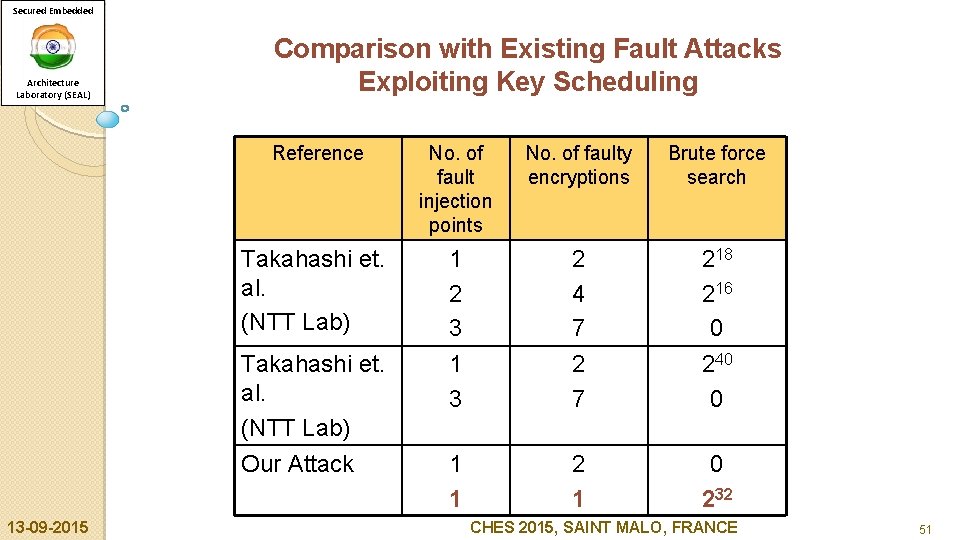
Secured Embedded Architecture Laboratory (SEAL) Comparison with Existing Fault Attacks Exploiting Key Scheduling Reference No. of fault injection points No. of faulty encryptions Brute force search Takahashi et. al. (NTT Lab) 1 2 3 1 3 2 4 7 218 216 0 240 0 1 1 2 1 0 232 Takahashi et. al. (NTT Lab) Our Attack 13 -09 -2015 CHES 2015, SAINT MALO, FRANCE 51
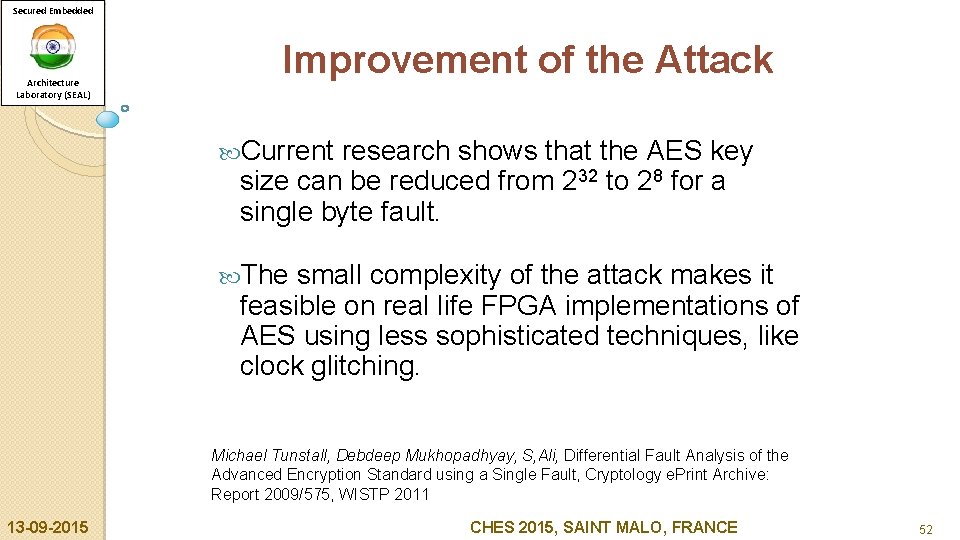
Secured Embedded Architecture Laboratory (SEAL) Improvement of the Attack Current research shows that the AES key size can be reduced from 232 to 28 for a single byte fault. The small complexity of the attack makes it feasible on real life FPGA implementations of AES using less sophisticated techniques, like clock glitching. Michael Tunstall, Debdeep Mukhopadhyay, S, Ali, Differential Fault Analysis of the Advanced Encryption Standard using a Single Fault, Cryptology e. Print Archive: Report 2009/575, WISTP 2011 13 -09 -2015 CHES 2015, SAINT MALO, FRANCE 52
Secured Embedded Architecture Laboratory (SEAL) Drawbacks of Existing DFA Requires 232 brute-force search Time complexity O(232). 13 -09 -2015 CHES 2015, SAINT MALO, FRANCE 53
Secured Embedded Improving The DFA Architecture Laboratory (SEAL) The attack is improved in two ways: Ø Reduce the search space of the attack Ø Reduce the time complexity of the attack 13 -09 -2015 CHES 2015, SAINT MALO, FRANCE 54
Secured Embedded Reducing the Search space Architecture Laboratory (SEAL) Search space reduced in two phases. First phase: ØFind the 232 candidates of 10 th round key. Second phase Ø Deduce four differential equation from differences {2 f’, f’, 3 f’}. Ø Reduce the 232 candidates to 28 using the four differential equation. 13 -09 -2015 CHES 2015, SAINT MALO, FRANCE 55
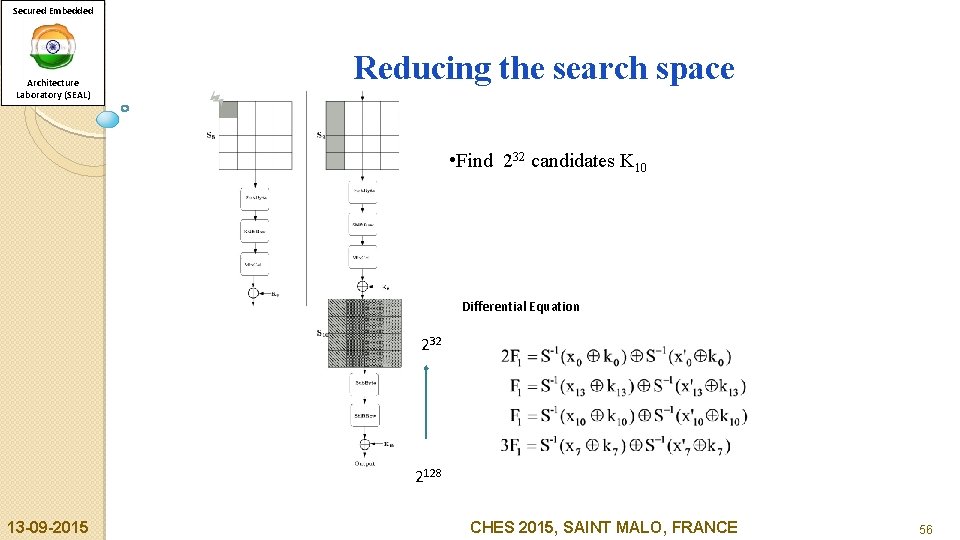
Secured Embedded Architecture Laboratory (SEAL) Reducing the search space • Find 232 candidates K 10 Differential Equation 232 2128 13 -09 -2015 CHES 2015, SAINT MALO, FRANCE 56
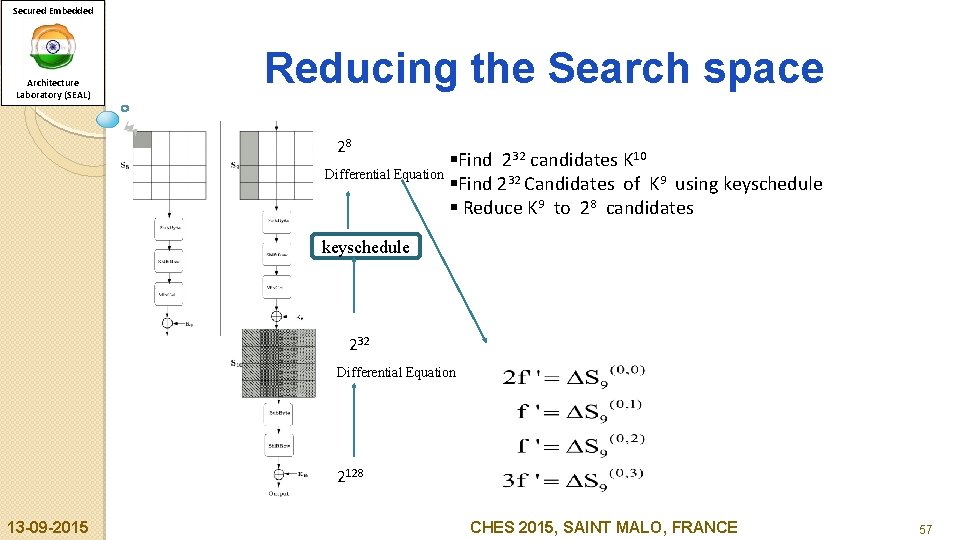
Secured Embedded Architecture Laboratory (SEAL) Reducing the Search space 28 §Find 232 candidates K 10 Differential Equation §Find 232 Candidates of K 9 using keyschedule § Reduce K 9 to 28 candidates keyschedule 232 Differential Equation 2128 13 -09 -2015 CHES 2015, SAINT MALO, FRANCE 57
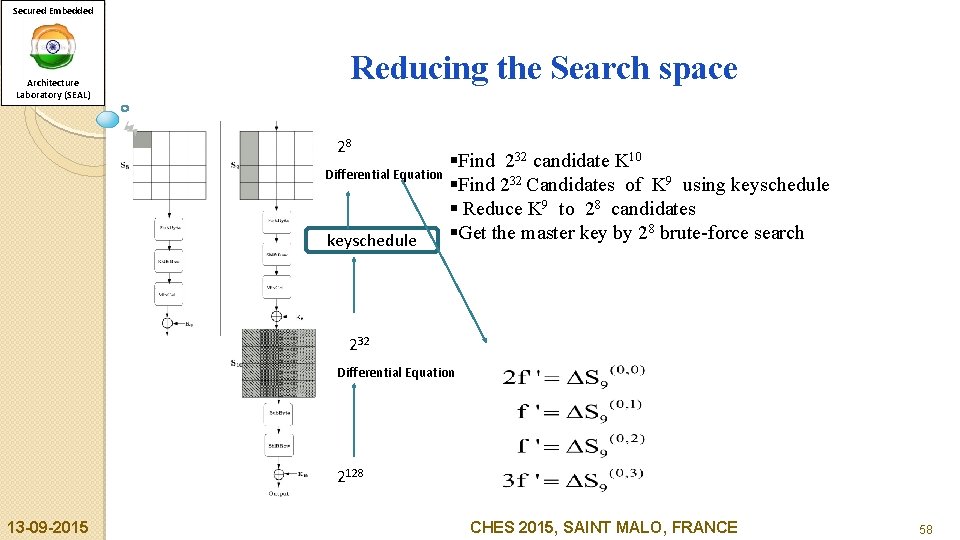
Secured Embedded Architecture Laboratory (SEAL) Reducing the Search space 28 §Find 232 candidate K 10 Differential Equation §Find 232 Candidates of K 9 using keyschedule § Reduce K 9 to 28 candidates §Get the master key by 28 brute-force search keyschedule 232 Differential Equation 2128 13 -09 -2015 CHES 2015, SAINT MALO, FRANCE 58
Secured Embedded Results Architecture Laboratory (SEAL) Requires 28 Time 13 -09 -2015 brute-force search. complexity 232 CHES 2015, SAINT MALO, FRANCE 59
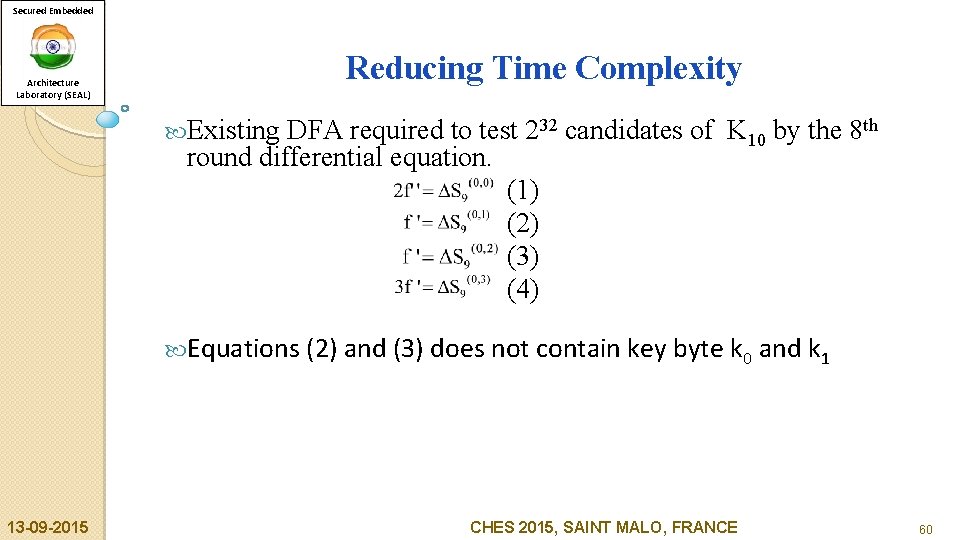
Secured Embedded Reducing Time Complexity Architecture Laboratory (SEAL) Existing DFA required to test 232 candidates of K 10 by the 8 th round differential equation. (1) (2) (3) (4) Equations (2) and (3) does not contain key byte k 0 and k 1 13 -09 -2015 CHES 2015, SAINT MALO, FRANCE 60
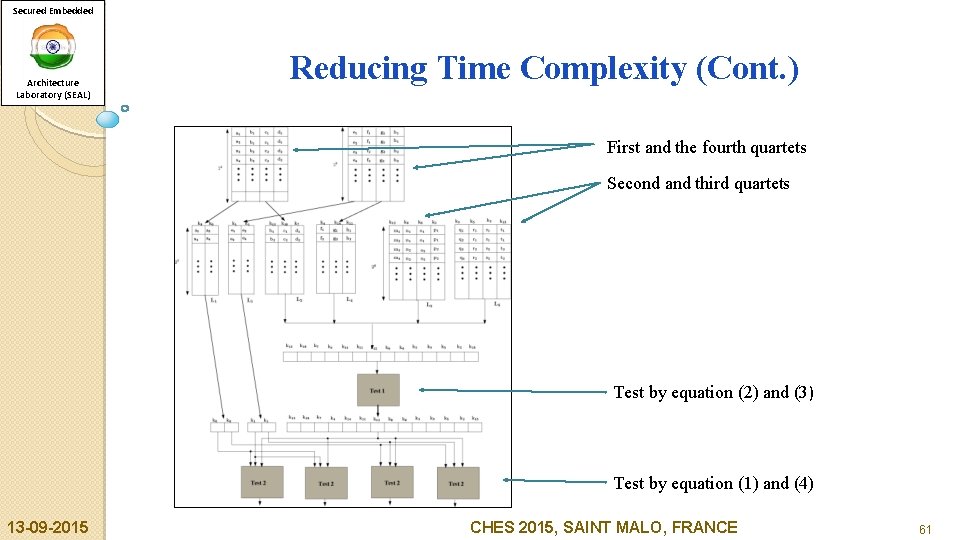
Secured Embedded Architecture Laboratory (SEAL) Reducing Time Complexity (Cont. ) First and the fourth quartets Second and third quartets Test by equation (2) and (3) Test by equation (1) and (4) 13 -09 -2015 CHES 2015, SAINT MALO, FRANCE 61
Secured Embedded Results Architecture Laboratory (SEAL) Time complexity of the attack reduced to 230 from 232 Attack is four times faster. Ali, Mukhopadhyay 2011 (eprint): Time Complexity: 230 13 -09 -2015 CHES 2015, SAINT MALO, FRANCE 62
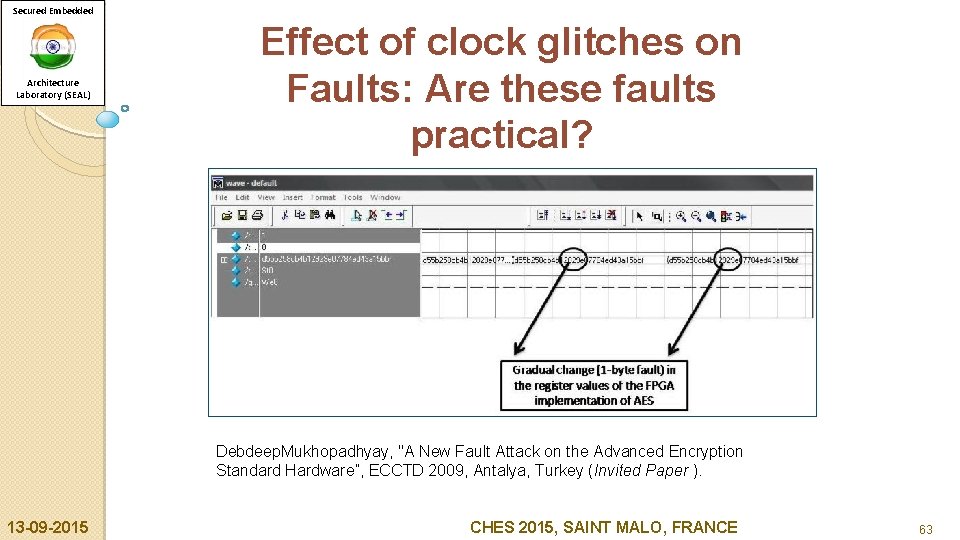
Secured Embedded Architecture Laboratory (SEAL) Effect of clock glitches on Faults: Are these faults practical? Debdeep. Mukhopadhyay, "A New Fault Attack on the Advanced Encryption Standard Hardware”, ECCTD 2009, Antalya, Turkey (Invited Paper ). 13 -09 -2015 CHES 2015, SAINT MALO, FRANCE 63
Secured Embedded Architecture Laboratory (SEAL) MULTI-BYTE FAULT ATTACKS ON AES 13 -09 -2015 CHES 2015, SAINT MALO, FRANCE
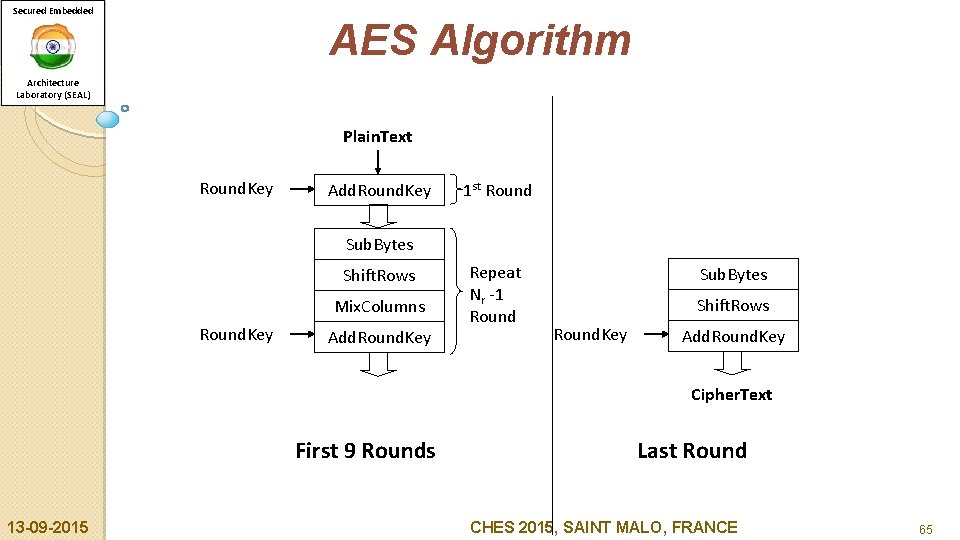
Secured Embedded AES Algorithm Architecture Laboratory (SEAL) Plain. Text Round. Key Add. Round. Key 1 st Round Sub. Bytes Shift. Rows Mix. Columns Round. Key Add. Round. Key Repeat Nr -1 Round Sub. Bytes Shift. Rows Round. Key Add. Round. Key Cipher. Text First 9 Rounds 13 -09 -2015 Last Round CHES 2015, SAINT MALO, FRANCE 65
Secured Embedded Fault Model Used Architecture Laboratory (SEAL) Multi Byte Faults (more practical) ◦ Attacker induces fault at the input of the 8 th round in some bytes ◦ Fault value should be non-zero but can be arbitrary Improves 13 -09 -2015 the fault coverage. CHES 2015, SAINT MALO, FRANCE 66
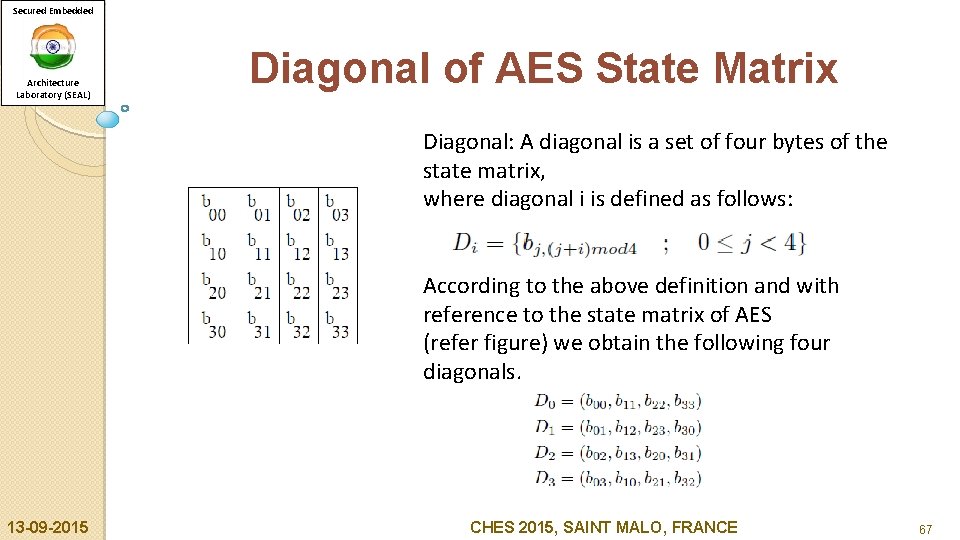
Secured Embedded Architecture Laboratory (SEAL) Diagonal of AES State Matrix Diagonal: A diagonal is a set of four bytes of the state matrix, where diagonal i is defined as follows: According to the above definition and with reference to the state matrix of AES (refer figure) we obtain the following four diagonals. 13 -09 -2015 CHES 2015, SAINT MALO, FRANCE 67
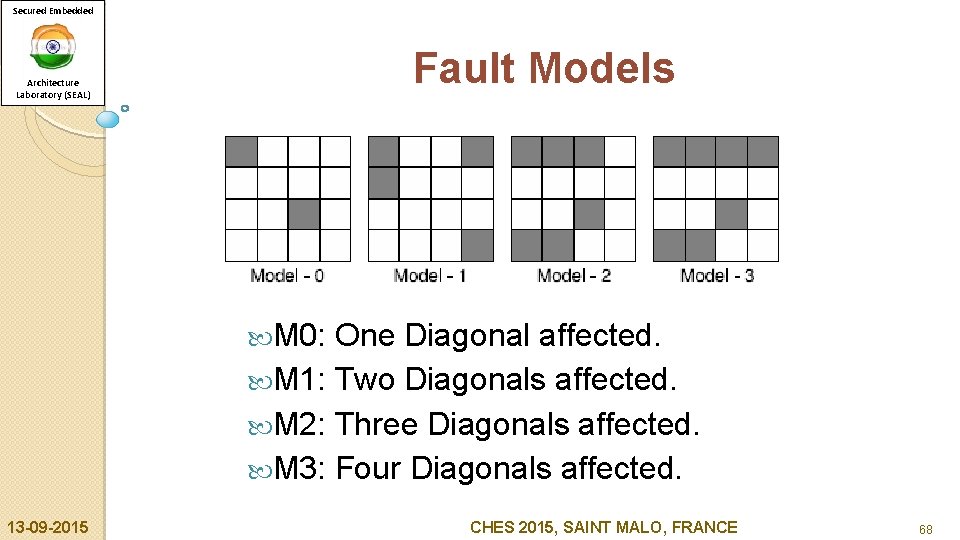
Secured Embedded Fault Models Architecture Laboratory (SEAL) M 0: One Diagonal affected. M 1: Two Diagonals affected. M 2: Three Diagonals affected. M 3: Four Diagonals affected. 13 -09 -2015 CHES 2015, SAINT MALO, FRANCE 68
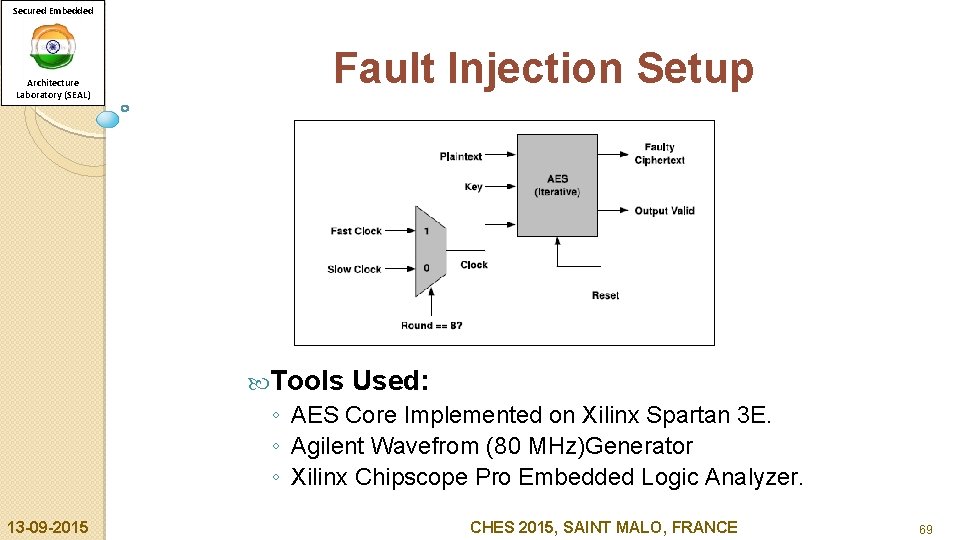
Secured Embedded Architecture Laboratory (SEAL) Fault Injection Setup Tools Used: ◦ AES Core Implemented on Xilinx Spartan 3 E. ◦ Agilent Wavefrom (80 MHz)Generator ◦ Xilinx Chipscope Pro Embedded Logic Analyzer. 13 -09 -2015 CHES 2015, SAINT MALO, FRANCE 69
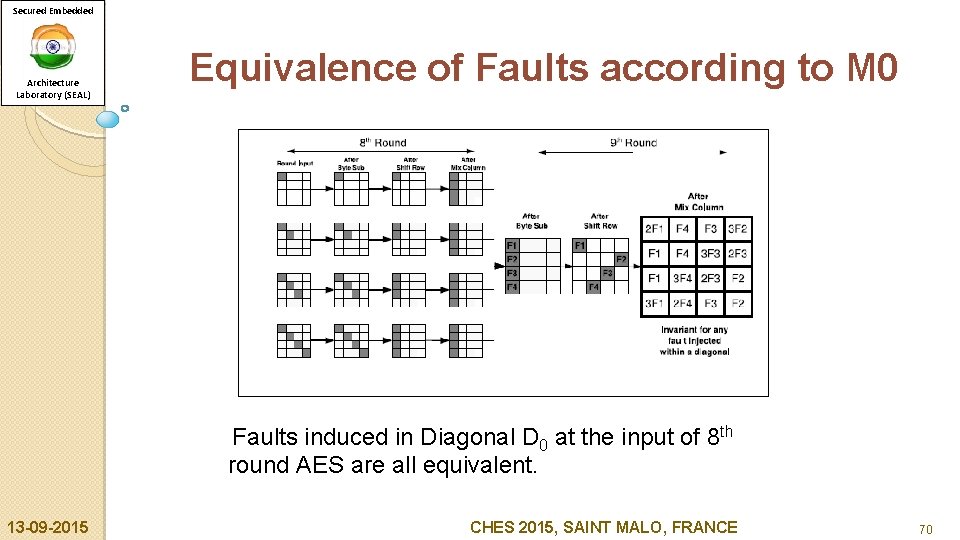
Secured Embedded Architecture Laboratory (SEAL) Equivalence of Faults according to M 0 Faults induced in Diagonal D 0 at the input of 8 th round AES are all equivalent. 13 -09 -2015 CHES 2015, SAINT MALO, FRANCE 70
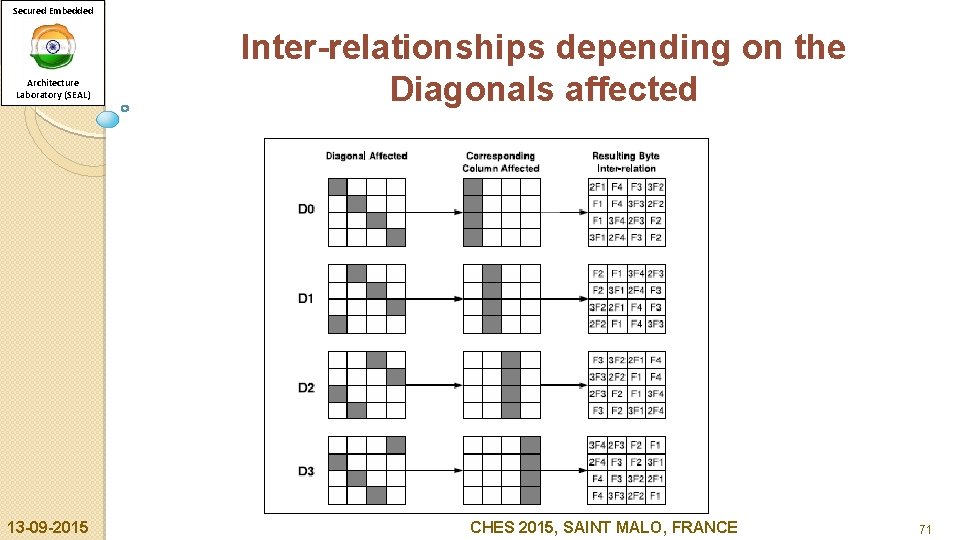
Secured Embedded Architecture Laboratory (SEAL) 13 -09 -2015 Inter-relationships depending on the Diagonals affected CHES 2015, SAINT MALO, FRANCE 71
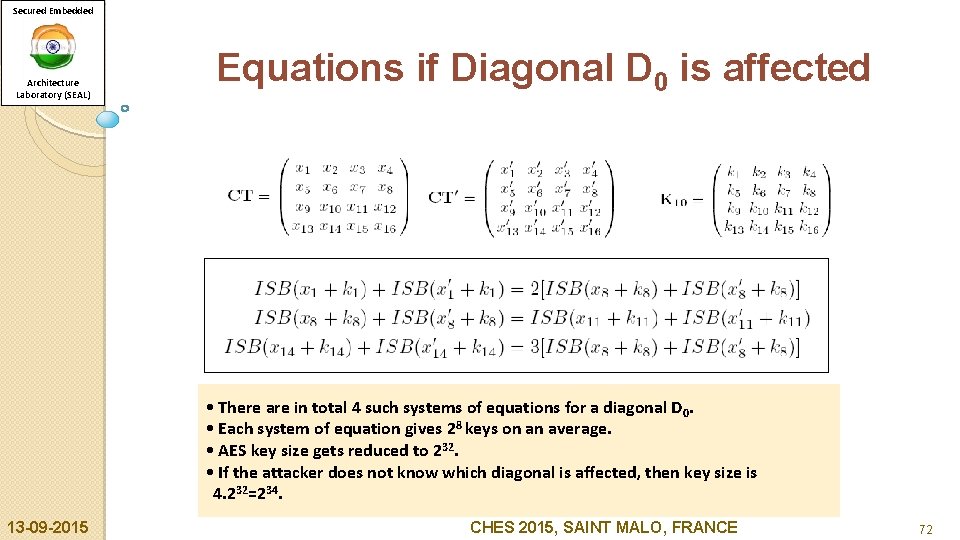
Secured Embedded Architecture Laboratory (SEAL) Equations if Diagonal D 0 is affected • There are in total 4 such systems of equations for a diagonal D 0. • Each system of equation gives 28 keys on an average. • AES key size gets reduced to 232. • If the attacker does not know which diagonal is affected, then key size is 4. 232=234. 13 -09 -2015 CHES 2015, SAINT MALO, FRANCE 72
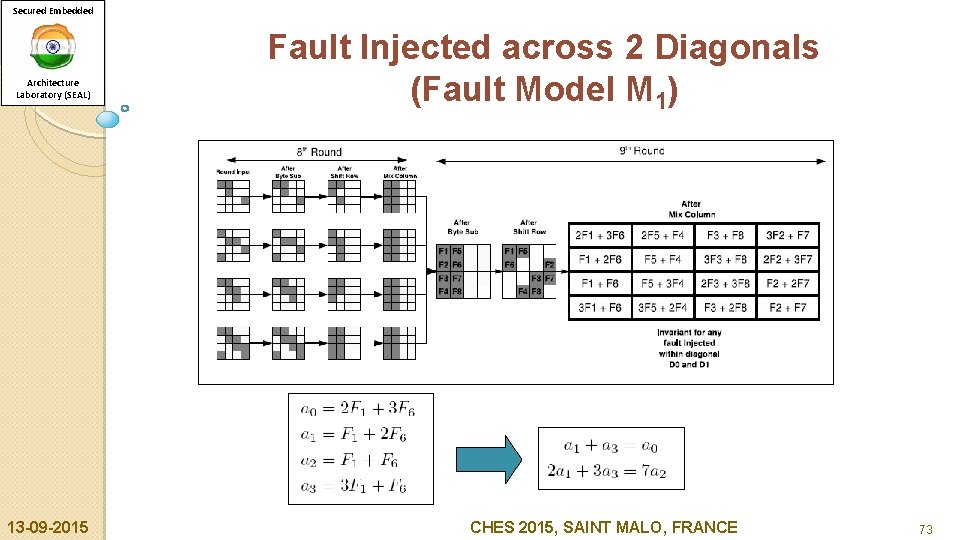
Secured Embedded Architecture Laboratory (SEAL) 13 -09 -2015 Fault Injected across 2 Diagonals (Fault Model M 1) CHES 2015, SAINT MALO, FRANCE 73
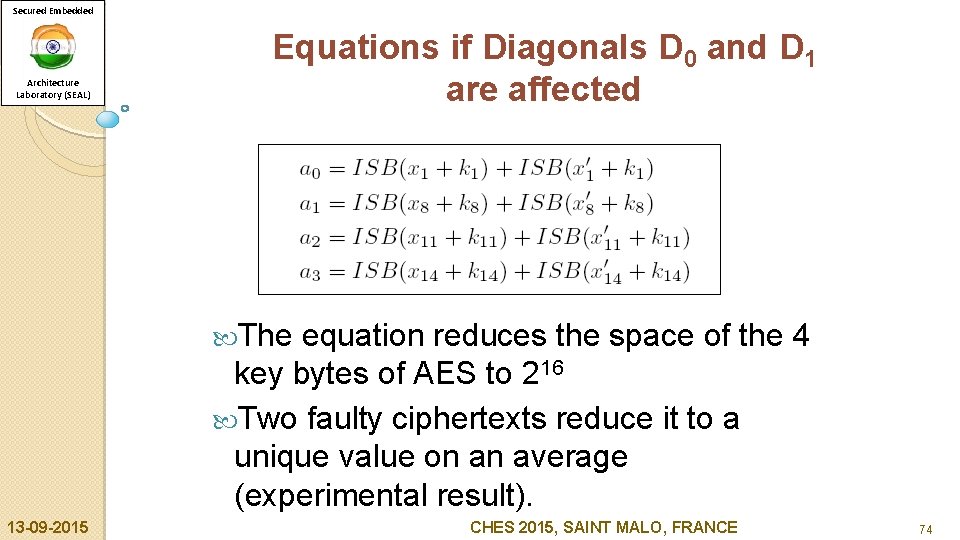
Secured Embedded Architecture Laboratory (SEAL) Equations if Diagonals D 0 and D 1 are affected The equation reduces the space of the 4 key bytes of AES to 216 Two faulty ciphertexts reduce it to a unique value on an average (experimental result). 13 -09 -2015 CHES 2015, SAINT MALO, FRANCE 74
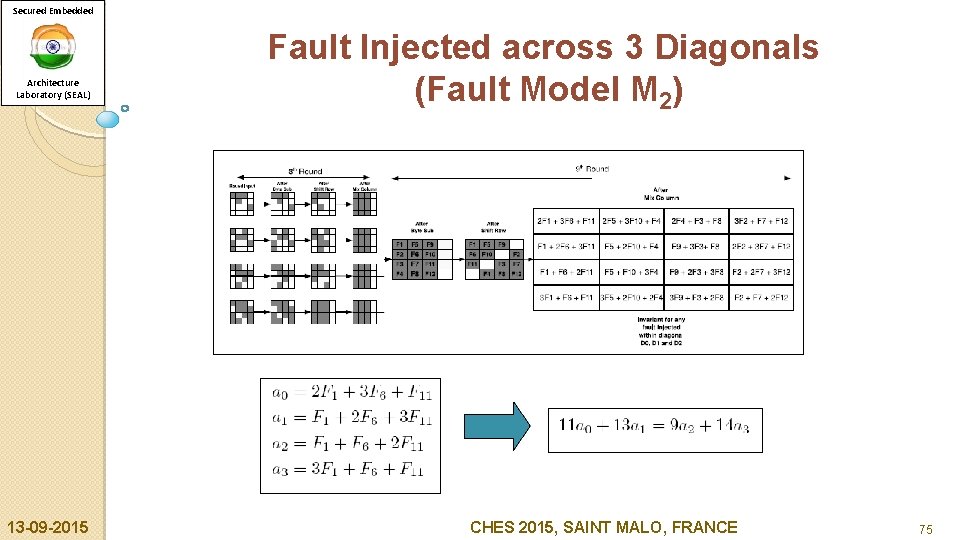
Secured Embedded Architecture Laboratory (SEAL) 13 -09 -2015 Fault Injected across 3 Diagonals (Fault Model M 2) CHES 2015, SAINT MALO, FRANCE 75
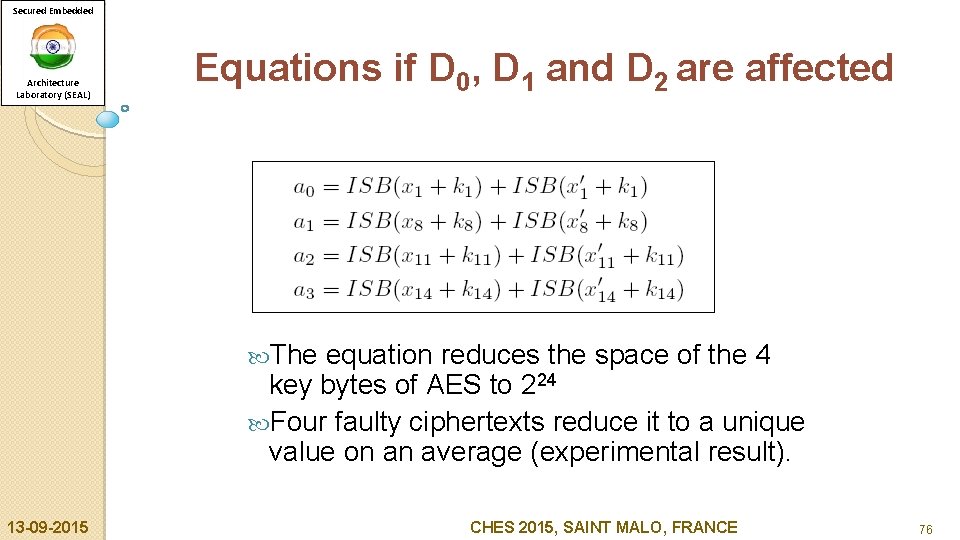
Secured Embedded Architecture Laboratory (SEAL) Equations if D 0, D 1 and D 2 are affected The equation reduces the space of the 4 key bytes of AES to 224 Four faulty ciphertexts reduce it to a unique value on an average (experimental result). 13 -09 -2015 CHES 2015, SAINT MALO, FRANCE 76
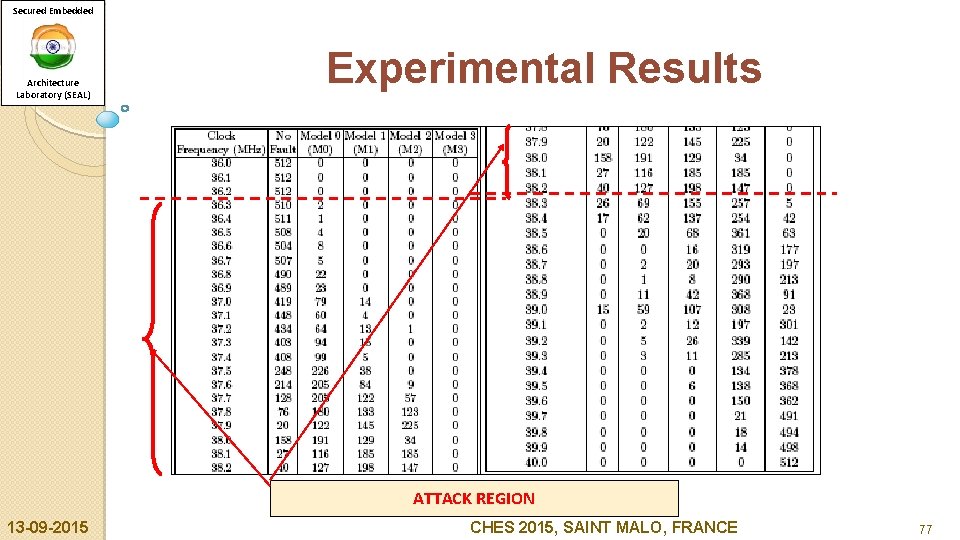
Secured Embedded Architecture Laboratory (SEAL) Experimental Results ATTACK REGION 13 -09 -2015 CHES 2015, SAINT MALO, FRANCE 77
Secured Embedded Architecture Laboratory (SEAL) DFA on AES Key-schedule vs DFA on AES datapath Faults are induced in the Keyschedule. Attacks on Key-Schedule show that a single byte fault, in the AES-128 keyschedule, reduces the AES key size to 28 values: 13 -09 -2015 ◦ This result is analogous to the single byte fault induction in the AES-128 datapath, where also the remaining key size is 232 ◦ However the time complexity in this present attack is 235, while for the CHES 30 2015, SAINT MALO, FRANCE 78
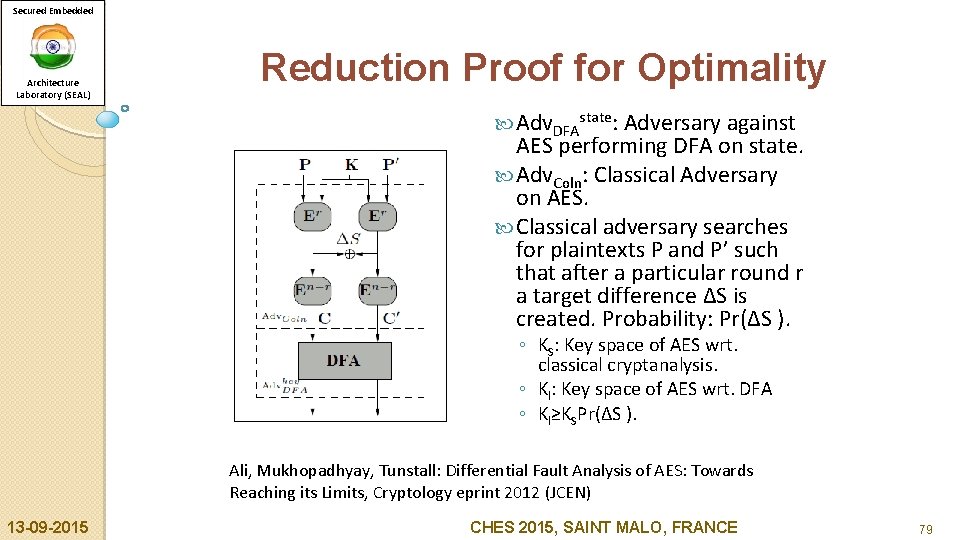
Secured Embedded Architecture Laboratory (SEAL) Reduction Proof for Optimality Adv. DFAstate: Adversary against AES performing DFA on state. Adv. Coln: Classical Adversary on AES. Classical adversary searches for plaintexts P and P’ such that after a particular round r a target difference ΔS is created. Probability: Pr(ΔS ). ◦ KS: Key space of AES wrt. classical cryptanalysis. ◦ Kl: Key space of AES wrt. DFA ◦ Kl≥KSPr(ΔS ). Ali, Mukhopadhyay, Tunstall: Differential Fault Analysis of AES: Towards Reaching its Limits, Cryptology eprint 2012 (JCEN) 13 -09 -2015 CHES 2015, SAINT MALO, FRANCE 79
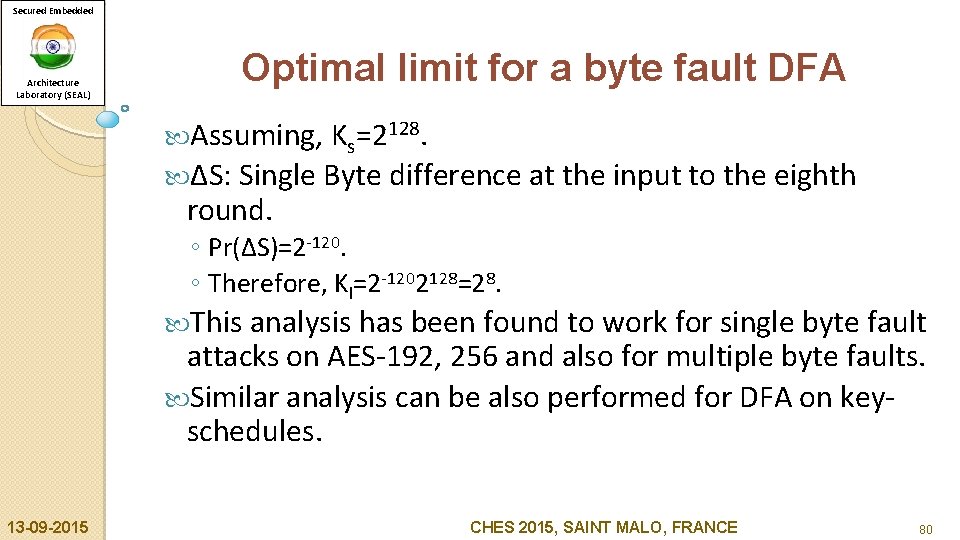
Secured Embedded Architecture Laboratory (SEAL) Optimal limit for a byte fault DFA Assuming, Ks=2128. ΔS: Single Byte difference at the input to the eighth round. ◦ Pr(ΔS)=2 -120. ◦ Therefore, Kl=2 -1202128=28. This analysis has been found to work for single byte fault attacks on AES-192, 256 and also for multiple byte faults. Similar analysis can be also performed for DFA on keyschedules. 13 -09 -2015 CHES 2015, SAINT MALO, FRANCE 80
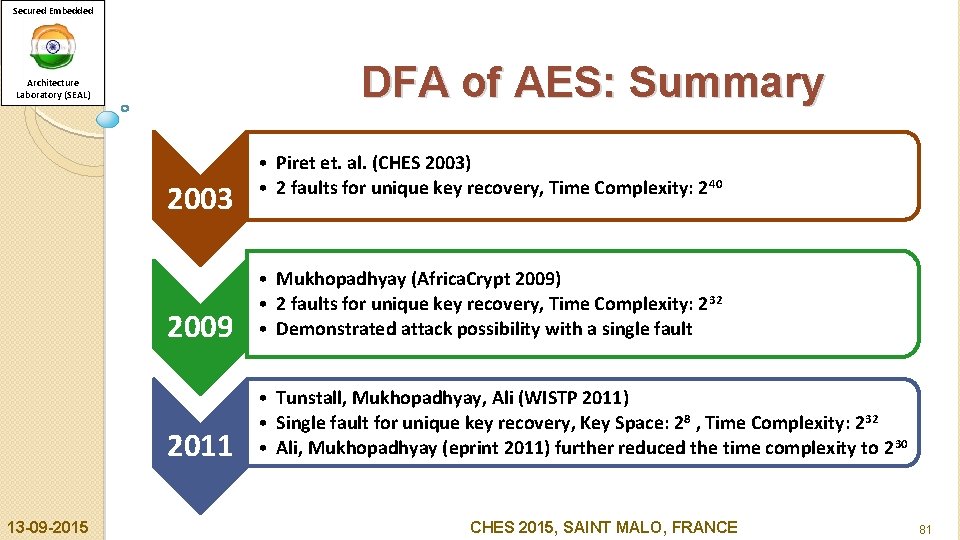
Secured Embedded DFA of AES: Summary Architecture Laboratory (SEAL) 2003 13 -09 -2015 • Piret et. al. (CHES 2003) • 2 faults for unique key recovery, Time Complexity: 240 2009 • Mukhopadhyay (Africa. Crypt 2009) • 2 faults for unique key recovery, Time Complexity: 232 • Demonstrated attack possibility with a single fault 2011 • Tunstall, Mukhopadhyay, Ali (WISTP 2011) • Single fault for unique key recovery, Key Space: 28 , Time Complexity: 232 • Ali, Mukhopadhyay (eprint 2011) further reduced the time complexity to 230 CHES 2015, SAINT MALO, FRANCE 81
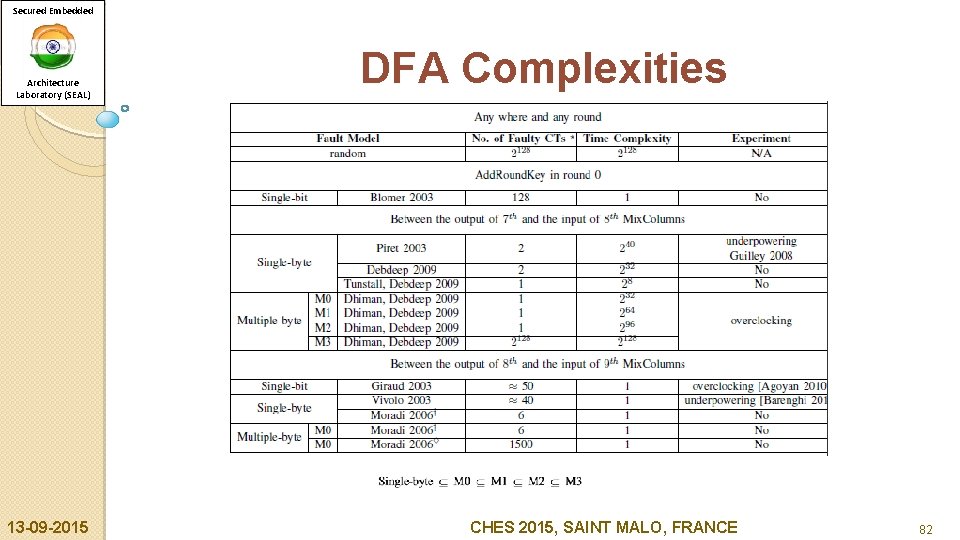
Secured Embedded Architecture Laboratory (SEAL) 13 -09 -2015 DFA Complexities CHES 2015, SAINT MALO, FRANCE 82
Secured Embedded Architecture Laboratory (SEAL) Conclusions for Part 2 Faults can be catastrophic for ciphers. The leakage is so strong that all conventional ciphers are vulnerable against fault attacks. Important to design suitable countermeasures: of particular interest to smart card industry This brings a new spectrum to the design philosophy of ciphers to prevent fault analysis. 13 -09 -2015 CHES 2015, SAINT MALO, FRANCE 83
Secured Embedded Architecture Laboratory (SEAL) PART 3 COUNTERMEASURES VERSUS BIASED FAULTS – PUSHING THE LIMITS 13 -09 -2015 CHES 2015, SAINT MALO, FRANCE
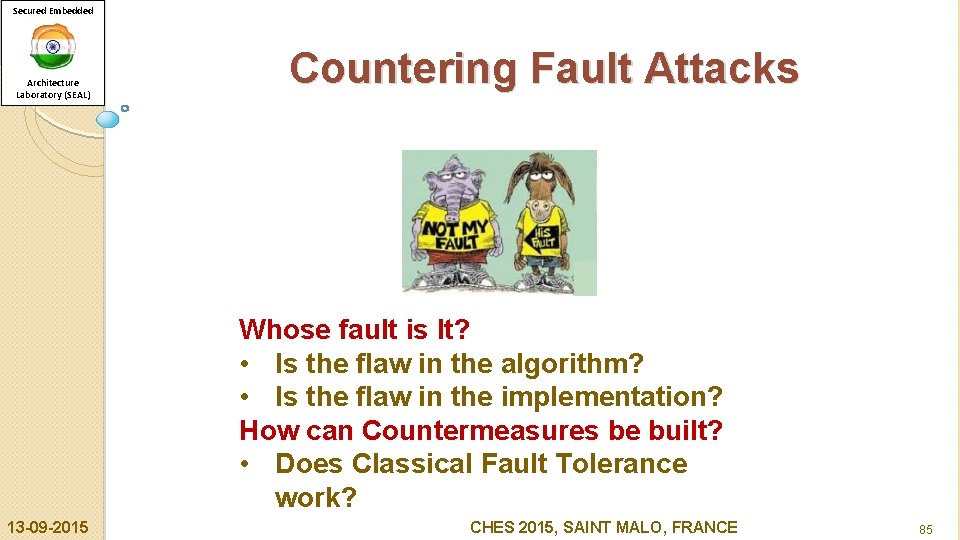
Secured Embedded Architecture Laboratory (SEAL) Countering Fault Attacks Whose fault is It? • Is the flaw in the algorithm? • Is the flaw in the implementation? How can Countermeasures be built? • Does Classical Fault Tolerance work? 13 -09 -2015 CHES 2015, SAINT MALO, FRANCE 85
Secured Embedded Architecture Laboratory (SEAL) Detection Based Countermeasures Also known as Concurrent Error Detection (CED) techniques Use various kinds of redundancy to detect faults Vulnerable to attacks in the comparison step itself Vulnerable to biased fault attacks 13 -09 -2015 CHES 2015, SAINT MALO, FRANCE 86
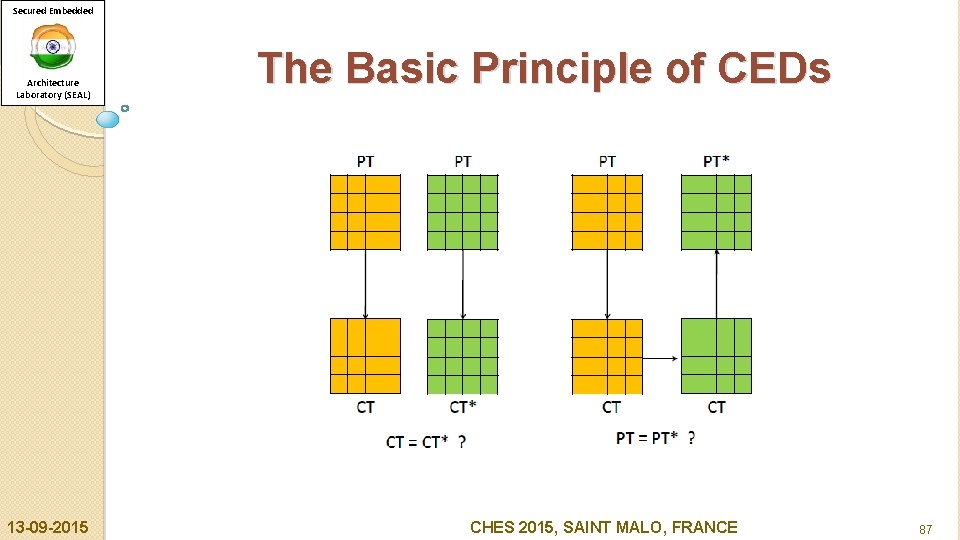
Secured Embedded Architecture Laboratory (SEAL) 13 -09 -2015 The Basic Principle of CEDs CHES 2015, SAINT MALO, FRANCE 87
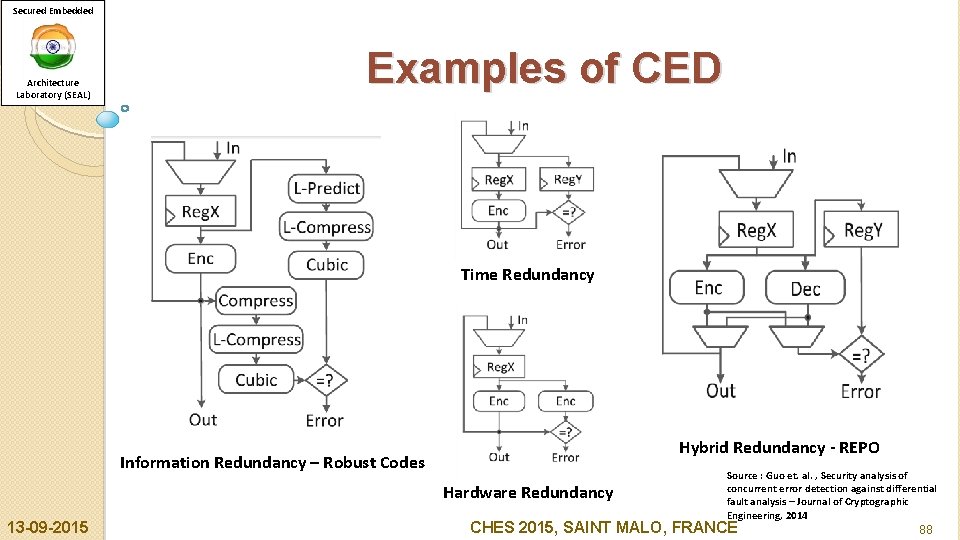
Secured Embedded Architecture Laboratory (SEAL) Examples of CED Time Redundancy Hybrid Redundancy - REPO Information Redundancy – Robust Codes Hardware Redundancy 13 -09 -2015 Source : Guo et. al. , Security analysis of concurrent error detection against differential fault analysis – Journal of Cryptographic Engineering, 2014 CHES 2015, SAINT MALO, FRANCE 88
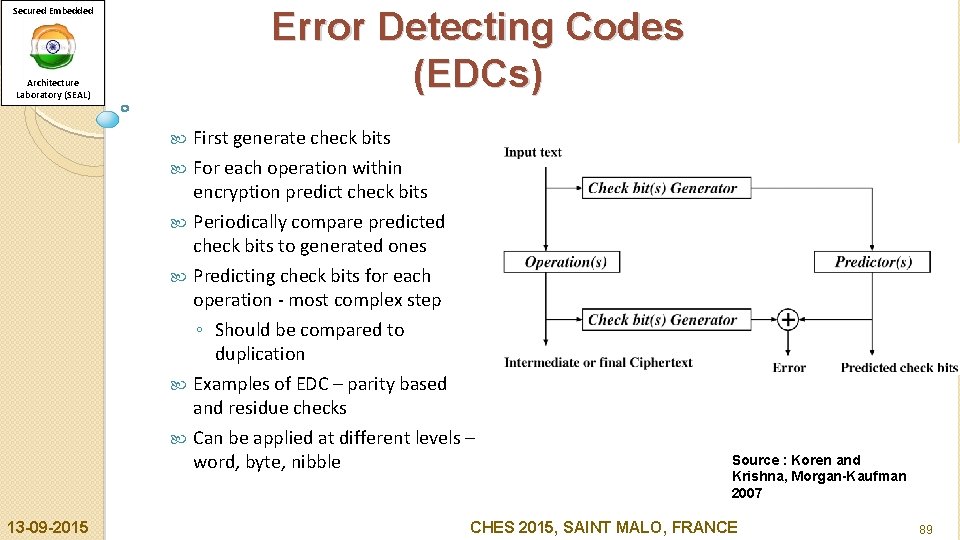
Secured Embedded Error Detecting Codes (EDCs) Architecture Laboratory (SEAL) First generate check bits For each operation within encryption predict check bits Periodically compare predicted check bits to generated ones Predicting check bits for each operation - most complex step ◦ Should be compared to duplication Examples of EDC – parity based and residue checks Can be applied at different levels – word, byte, nibble 13 -09 -2015 Source : Koren and Krishna, Morgan-Kaufman 2007 CHES 2015, SAINT MALO, FRANCE 89
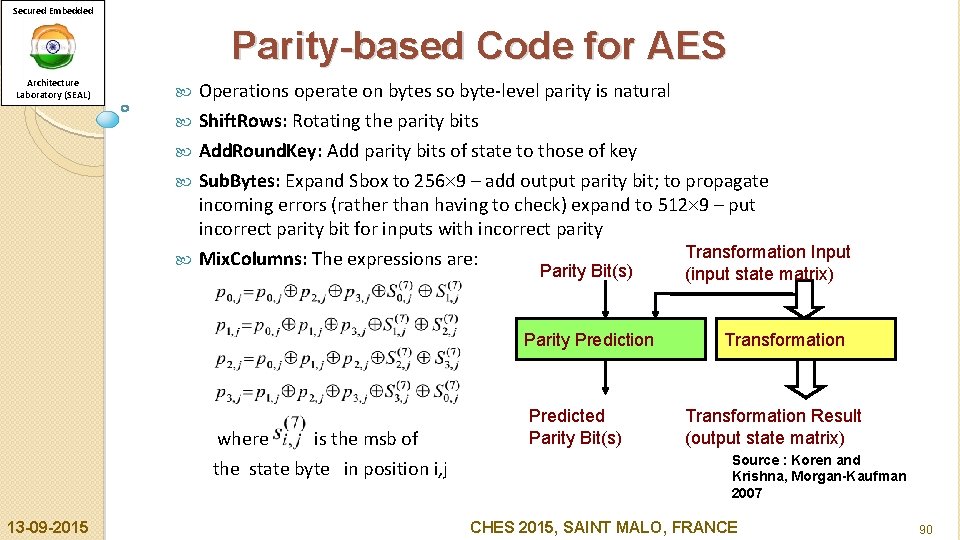
Secured Embedded Parity-based Code for AES Architecture Laboratory (SEAL) Operations operate on bytes so byte-level parity is natural Shift. Rows: Rotating the parity bits Add. Round. Key: Add parity bits of state to those of key Sub. Bytes: Expand Sbox to 256 9 – add output parity bit; to propagate incoming errors (rather than having to check) expand to 512 9 – put incorrect parity bit for inputs with incorrect parity Transformation Input Mix. Columns: The expressions are: Parity Bit(s) (input state matrix) Parity Prediction where is the msb of the state byte in position i, j 13 -09 -2015 Predicted Parity Bit(s) Transformation Result (output state matrix) Source : Koren and Krishna, Morgan-Kaufman 2007 CHES 2015, SAINT MALO, FRANCE 90
Secured Embedded Architecture Laboratory (SEAL) Does Detection Always Guarantee Security? 13 -09 -2015 CHES 2015 91
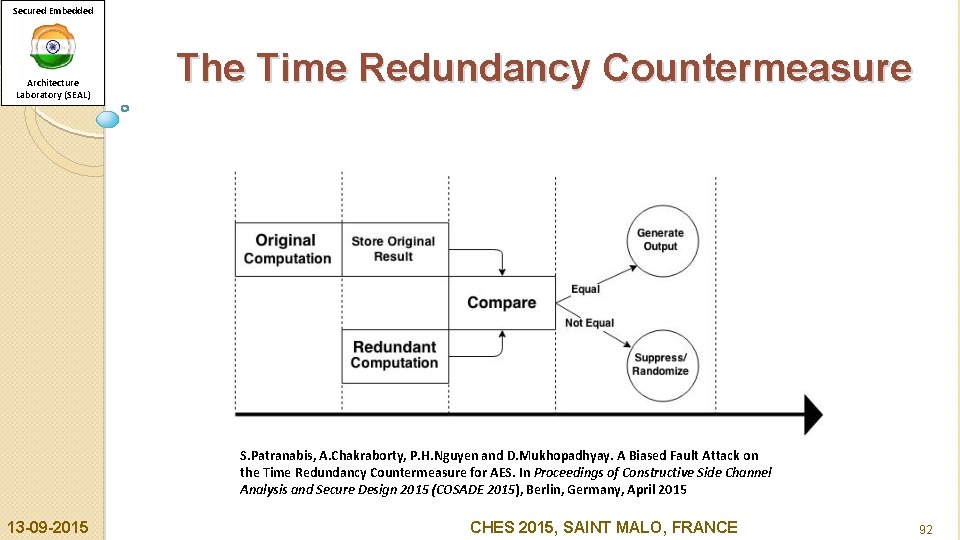
Secured Embedded Architecture Laboratory (SEAL) The Time Redundancy Countermeasure S. Patranabis, A. Chakraborty, P. H. Nguyen and D. Mukhopadhyay. A Biased Fault Attack on the Time Redundancy Countermeasure for AES. In Proceedings of Constructive Side Channel Analysis and Secure Design 2015 (COSADE 2015), Berlin, Germany, April 2015 13 -09 -2015 CHES 2015, SAINT MALO, FRANCE 92
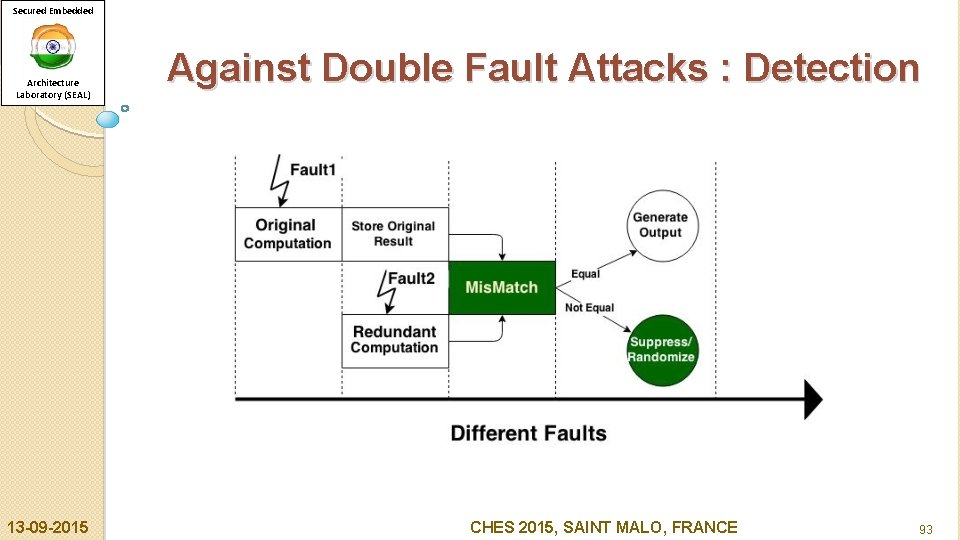
Secured Embedded Architecture Laboratory (SEAL) 13 -09 -2015 Against Double Fault Attacks : Detection CHES 2015, SAINT MALO, FRANCE 93
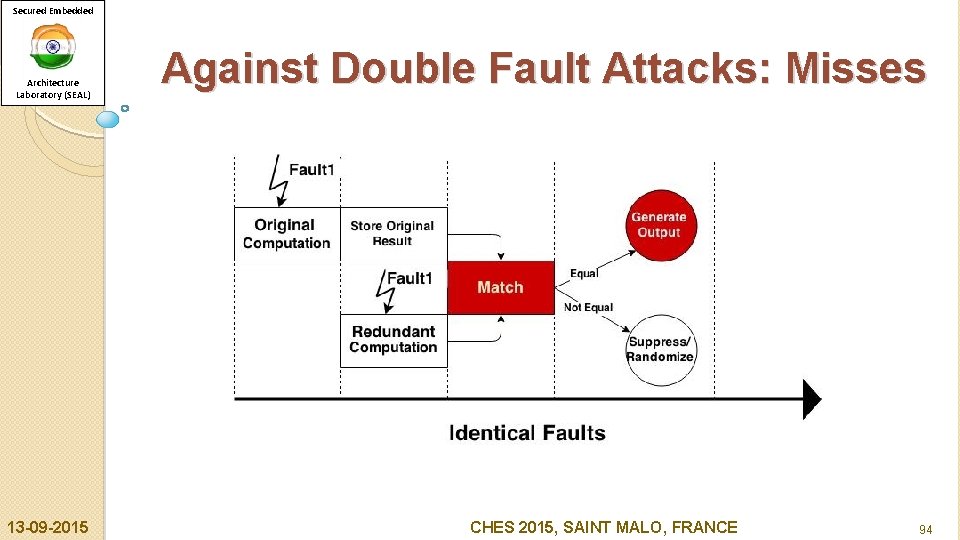
Secured Embedded Architecture Laboratory (SEAL) 13 -09 -2015 Against Double Fault Attacks: Misses CHES 2015, SAINT MALO, FRANCE 94
Secured Embedded Architecture Laboratory (SEAL) Beating The Countermeasure Improving fault collision probability ◦ Enhancing the probability of identical faults in original and redundant rounds Two major aspects ◦ The size of the fault space ◦ The probability distribution of faults in the fault space A smaller fault space enhances the fault collision probability A non-uniform probability distribution of faults in the fault space also enhances the fault collision probability 13 -09 -2015 CHES 2015, SAINT MALO, FRANCE 95
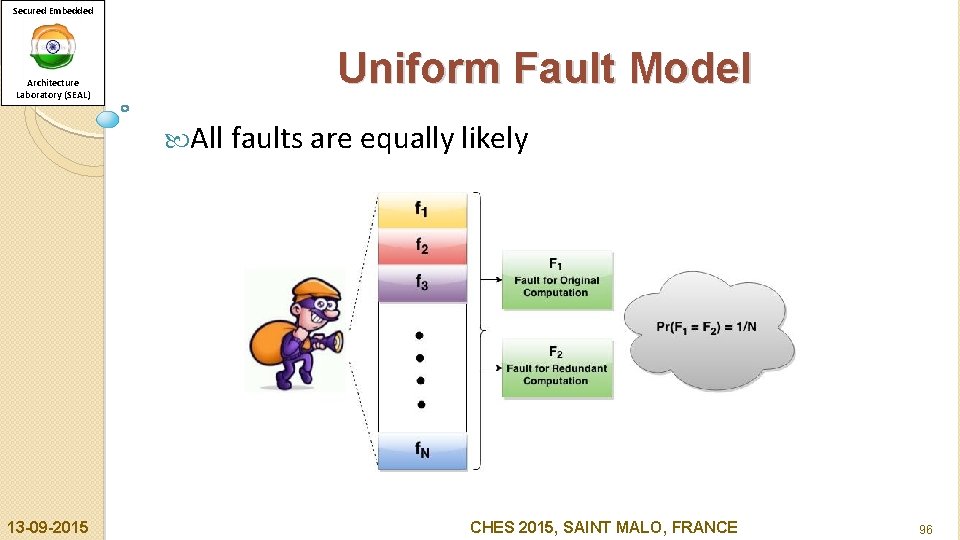
Secured Embedded Architecture Laboratory (SEAL) Uniform Fault Model All faults are equally likely 13 -09 -2015 CHES 2015, SAINT MALO, FRANCE 96
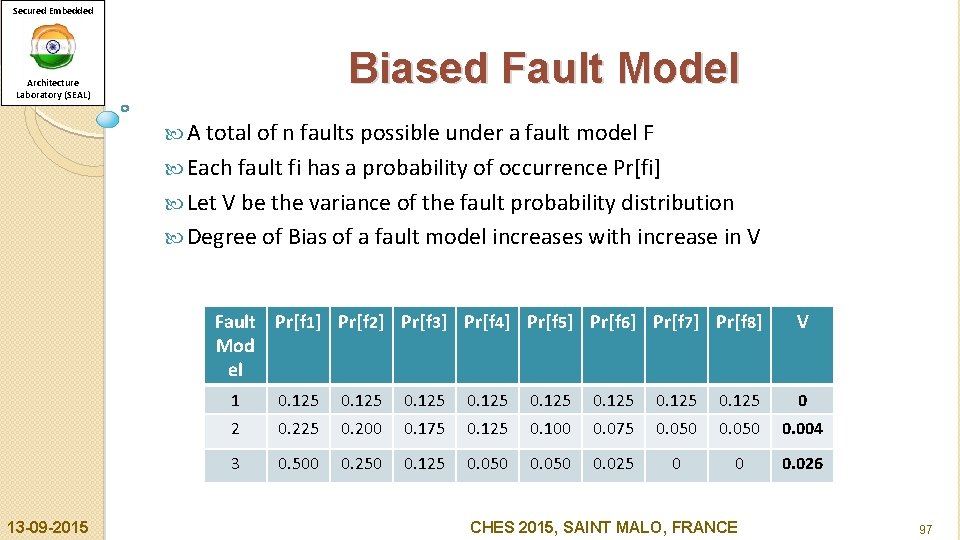
Secured Embedded Biased Fault Model Architecture Laboratory (SEAL) A total of n faults possible under a fault model F Each fault fi has a probability of occurrence Pr[fi] Let V be the variance of the fault probability distribution Degree of Bias of a fault model increases with increase in V Fault Pr[f 1] Pr[f 2] Pr[f 3] Pr[f 4] Pr[f 5] Pr[f 6] Pr[f 7] Pr[f 8] Mod el 13 -09 -2015 V 1 0. 125 0 2 0. 225 0. 200 0. 175 0. 125 0. 100 0. 075 0. 050 0. 004 3 0. 500 0. 250 0. 125 0. 050 0. 025 0 0 0. 026 CHES 2015, SAINT MALO, FRANCE 97
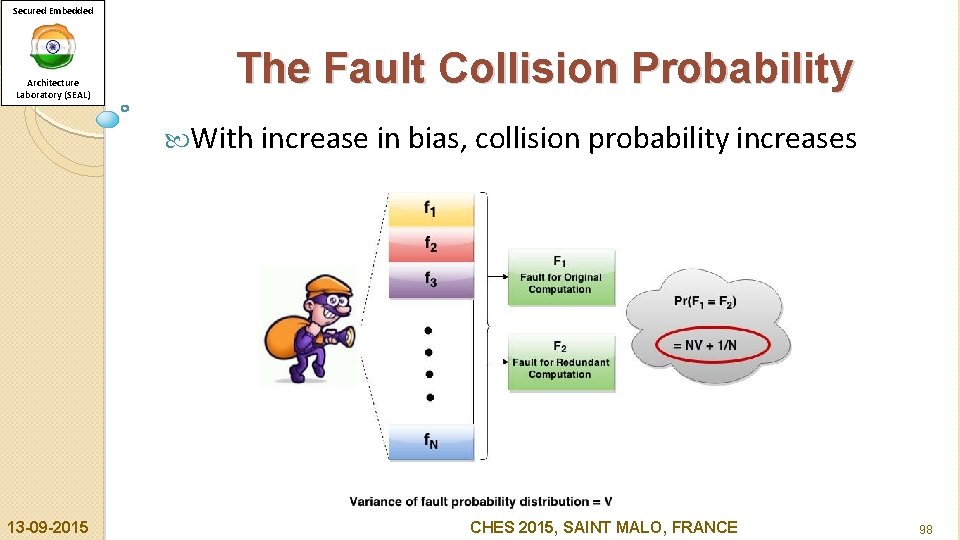
Secured Embedded Architecture Laboratory (SEAL) The Fault Collision Probability With increase in bias, collision probability increases 13 -09 -2015 CHES 2015, SAINT MALO, FRANCE 98
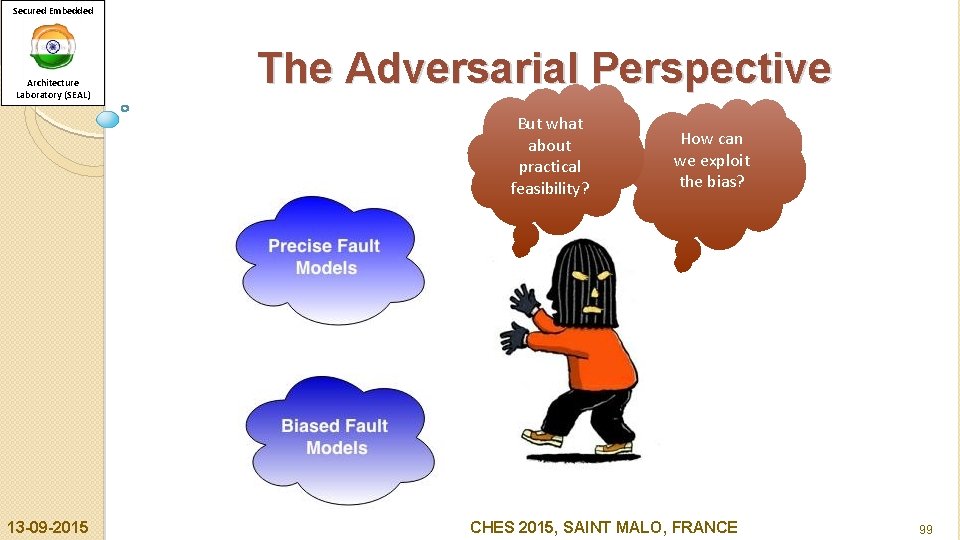
Secured Embedded Architecture Laboratory (SEAL) The Adversarial Perspective But what about practical feasibility? 13 -09 -2015 How can we exploit the bias? CHES 2015, SAINT MALO, FRANCE 99
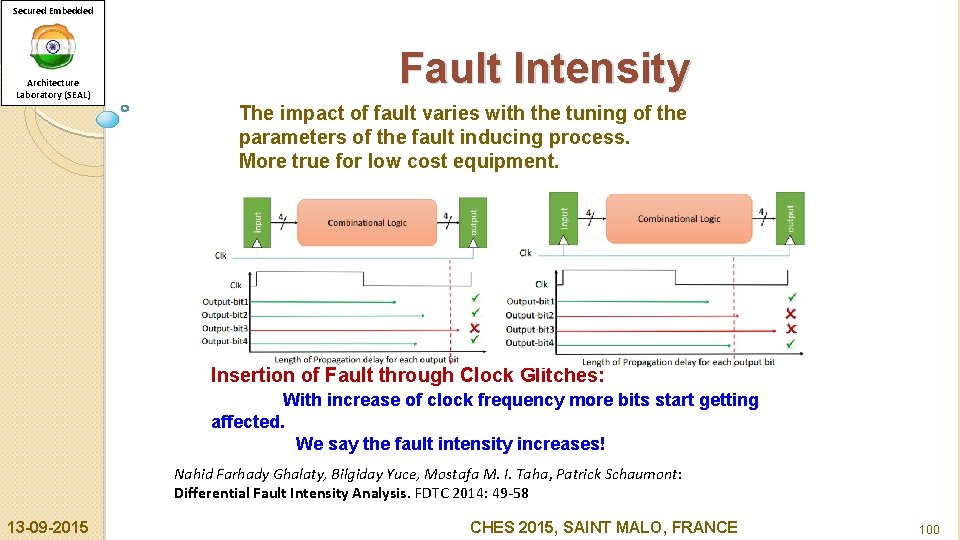
Secured Embedded Architecture Laboratory (SEAL) Fault Intensity The impact of fault varies with the tuning of the parameters of the fault inducing process. More true for low cost equipment. Insertion of Fault through Clock Glitches: With increase of clock frequency more bits start getting affected. We say the fault intensity increases! Nahid Farhady Ghalaty, Bilgiday Yuce, Mostafa M. I. Taha, Patrick Schaumont: Differential Fault Intensity Analysis. FDTC 2014: 49 -58 13 -09 -2015 CHES 2015, SAINT MALO, FRANCE 100
Secured Embedded Architecture Laboratory (SEAL) Differential Fault Intensity Analysis (DFIA) Combines fault injection and DPA principles Induces biased faults by varying the fault intensity Applies a hypothesis test with biased faults Uses biased faults as the source of leakage 13 -09 -2015 CHES 2015, SAINT MALO, FRANCE 101
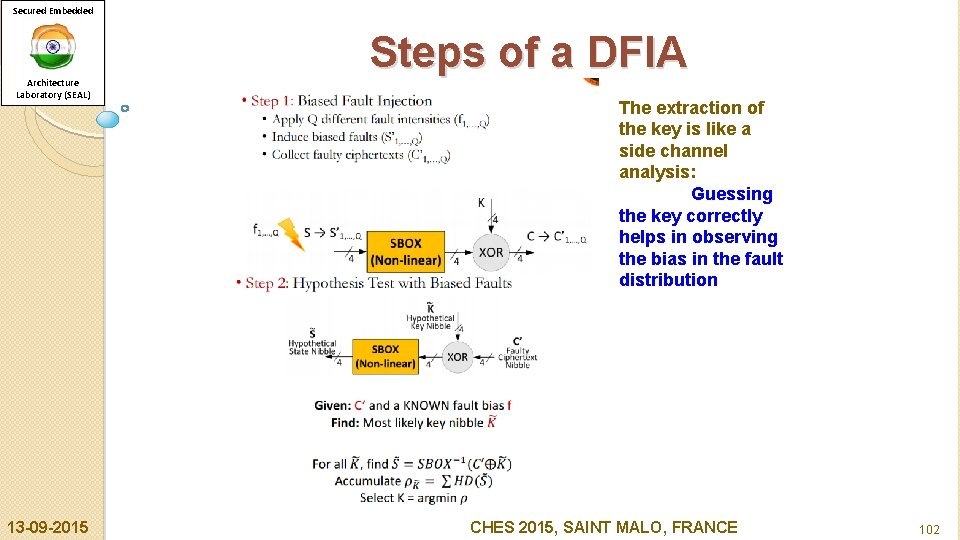
Secured Embedded Architecture Laboratory (SEAL) 13 -09 -2015 Steps of a DFIA The extraction of the key is like a side channel analysis: Guessing the key correctly helps in observing the bias in the fault distribution CHES 2015, SAINT MALO, FRANCE 102
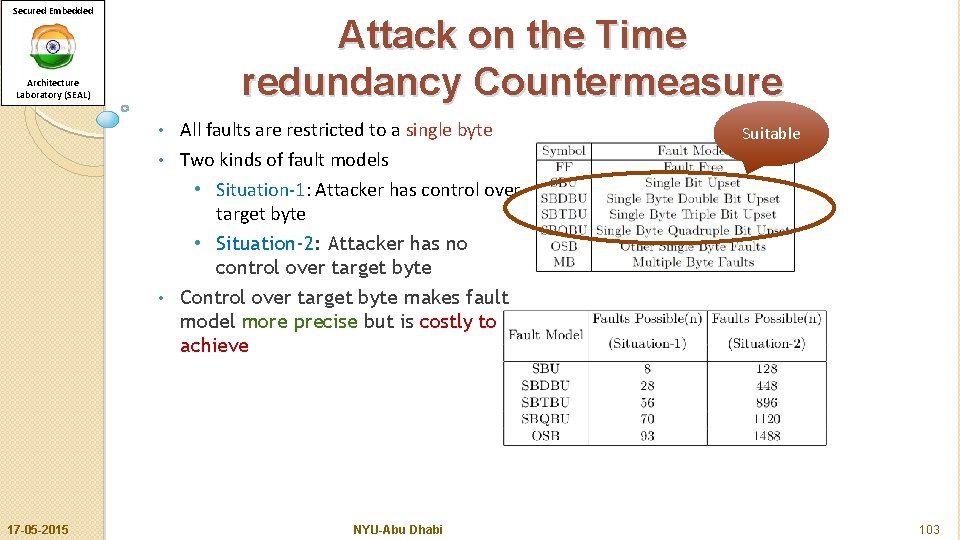
Secured Embedded Attack on the Time redundancy Countermeasure Architecture Laboratory (SEAL) • All faults are restricted to a single byte • Two kinds of fault models • Situation-1: Attacker has control over target byte Suitable • Situation-2: Attacker has no control over target byte • Control over target byte makes fault model more precise but is costly to achieve 17 -05 -2015 NYU-Abu Dhabi 103
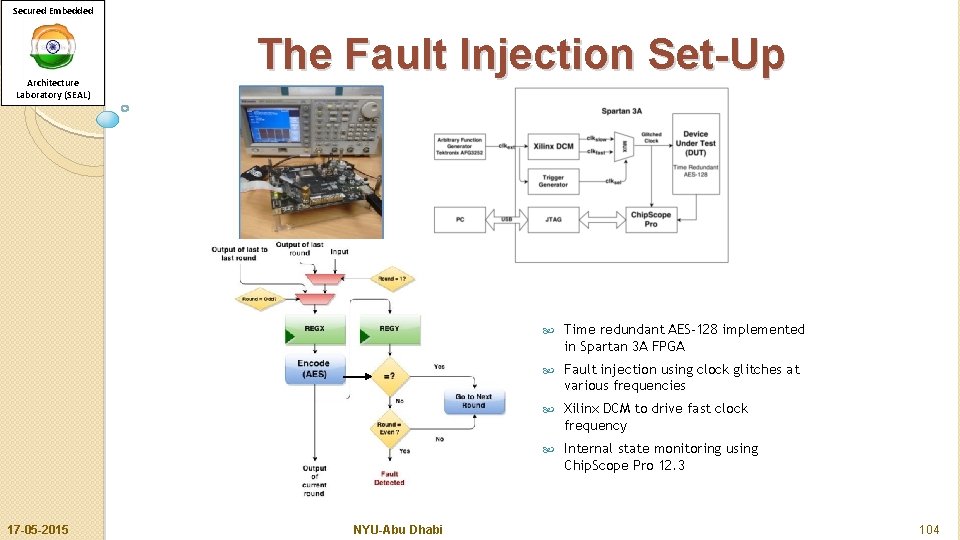
Secured Embedded Architecture Laboratory (SEAL) The Fault Injection Set-Up Time redundant AES-128 implemented in Spartan 3 A FPGA Fault injection using clock glitches at various frequencies Xilinx DCM to drive fast clock frequency Internal state monitoring using Chip. Scope Pro 12. 3 17 -05 -2015 NYU-Abu Dhabi 104
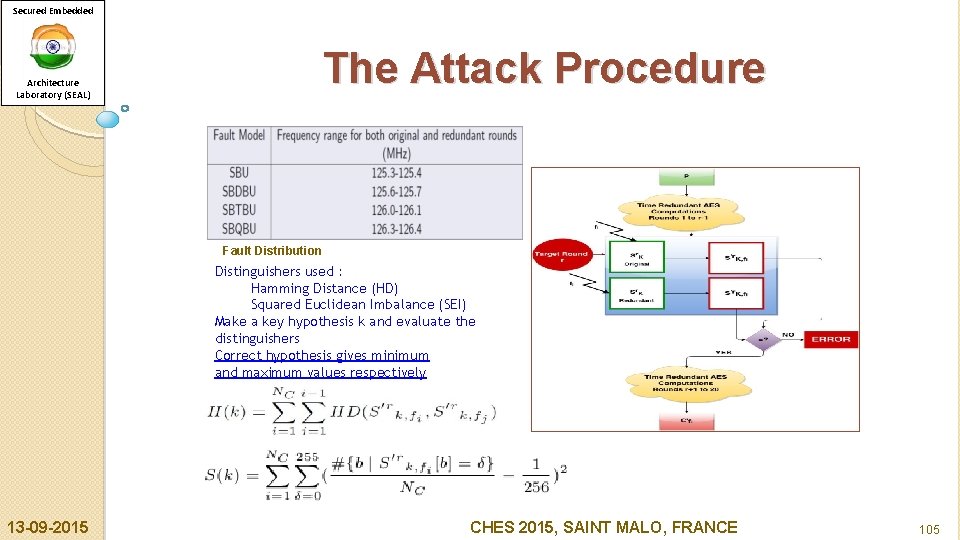
Secured Embedded Architecture Laboratory (SEAL) The Attack Procedure Fault Distribution Distinguishers used : Hamming Distance (HD) Squared Euclidean Imbalance (SEI) Make a key hypothesis k and evaluate the distinguishers Correct hypothesis gives minimum and maximum values respectively 13 -09 -2015 CHES 2015, SAINT MALO, FRANCE 105
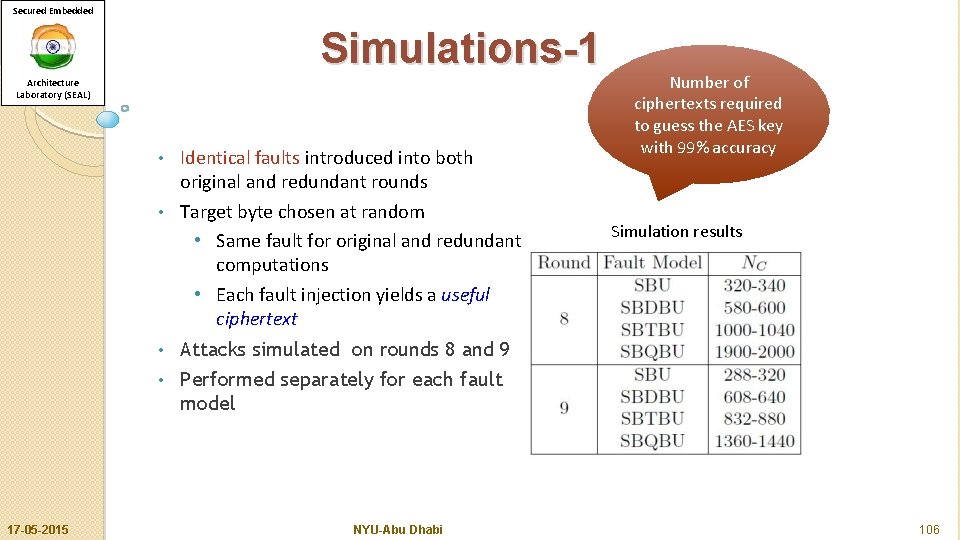
Secured Embedded Simulations-1 Architecture Laboratory (SEAL) Identical faults introduced into both original and redundant rounds • Target byte chosen at random • Same fault for original and redundant computations • Each fault injection yields a useful ciphertext • Number of ciphertexts required to guess the AES key with 99% accuracy Simulation results Attacks simulated on rounds 8 and 9 • Performed separately for each fault model • 17 -05 -2015 NYU-Abu Dhabi 106
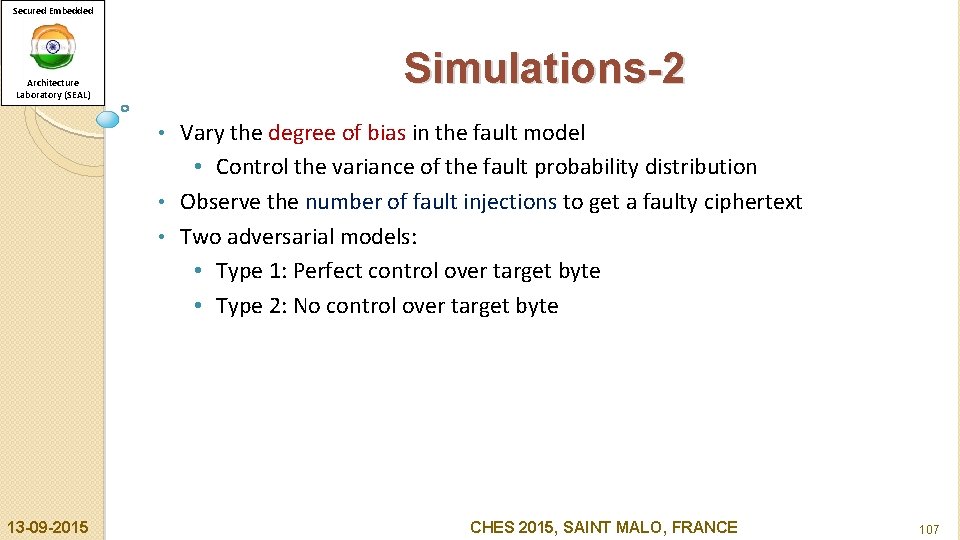
Secured Embedded Simulations-2 Architecture Laboratory (SEAL) Vary the degree of bias in the fault model • Control the variance of the fault probability distribution • Observe the number of fault injections to get a faulty ciphertext • Two adversarial models: • Type 1: Perfect control over target byte • Type 2: No control over target byte • 13 -09 -2015 CHES 2015, SAINT MALO, FRANCE 107
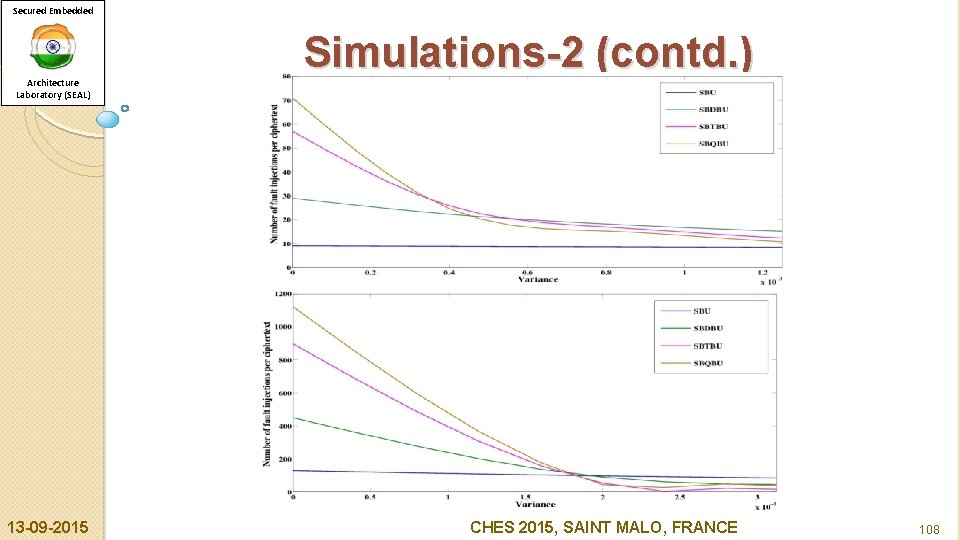
Secured Embedded Architecture Laboratory (SEAL) 13 -09 -2015 Simulations-2 (contd. ) CHES 2015, SAINT MALO, FRANCE 108
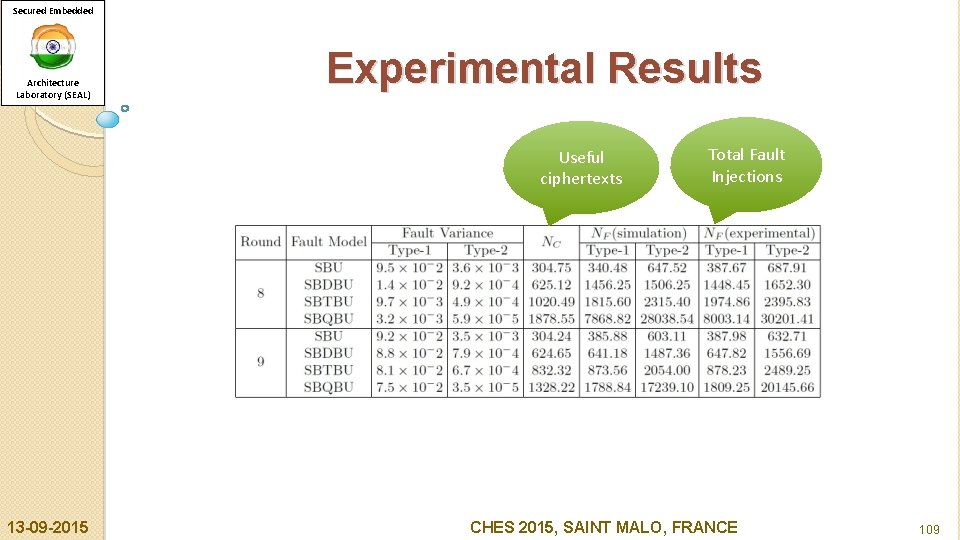
Secured Embedded Architecture Laboratory (SEAL) Experimental Results Useful ciphertexts 13 -09 -2015 Total Fault Injections CHES 2015, SAINT MALO, FRANCE 109
Secured Embedded Architecture Laboratory (SEAL) Comments on Detection Schemes Bias of a fault model can be quantified in terms of the variance of fault probability distribution Detection based countermeasures are vulnerable against biased fault attacks that are practically achievable 13 -09 -2015 CHES 2015, SAINT MALO, FRANCE 110
Secured Embedded Architecture Laboratory (SEAL) Fault Tolerance for DFA needs to be revisited? Cover all of the essential or almost all? ? ? 13 -09 -2015 CHES 2015, SAINT MALO, FRANCE 111
Secured Embedded Architecture Laboratory (SEAL) Countermeasures Must Be Augmented Detection alone does not guarantee security against fault attacks, especially in the wake of biased fault models Need to augment the countermeasure scheme to tackle biased fault attacks Two possible strategies: ◦ Fault Space Transformation ◦ Infective Countermeasures 13 -09 -2015 CHES 2015, SAINT MALO, FRANCE 112
Secured Embedded Architecture Laboratory (SEAL) Fault Space Transformation Ensure that the adversary cannot exploit the biased nature of the fault model Fault spaces for the original and redundant computations are different Adversary cannot ensure the occurrence of equivalent faults in the two different fault spaces at the same time. 13 -09 -2015 CHES 2015, SAINT MALO, FRANCE 113
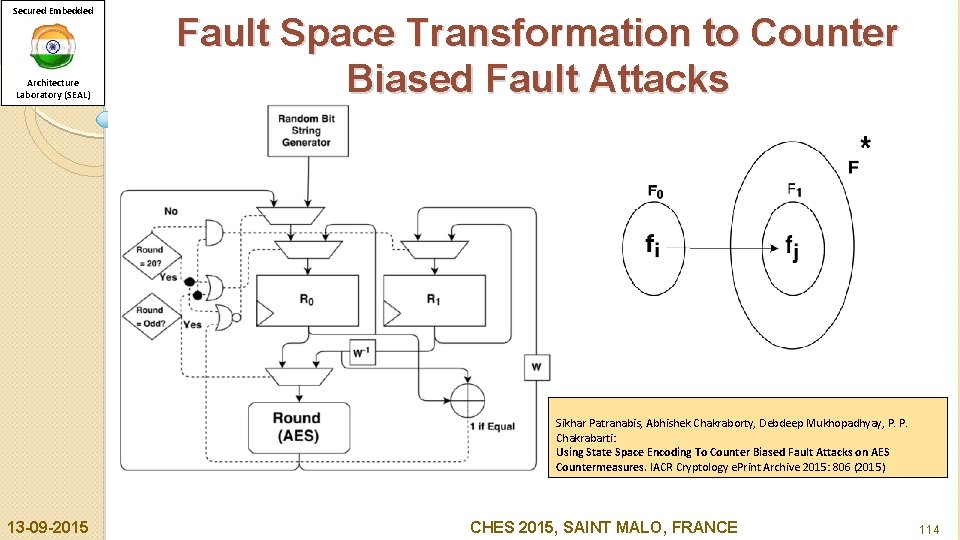
Secured Embedded Architecture Laboratory (SEAL) Fault Space Transformation to Counter Biased Fault Attacks Sikhar Patranabis, Abhishek Chakraborty, Debdeep Mukhopadhyay, P. P. Chakrabarti: Using State Space Encoding To Counter Biased Fault Attacks on AES Countermeasures. IACR Cryptology e. Print Archive 2015: 806 (2015) 13 -09 -2015 CHES 2015, SAINT MALO, FRANCE 114
Secured Embedded Architecture Laboratory (SEAL) The Impact of Transformation Transforming the fault space implies that the adversary cannot beat the countermeasure by merely introducing the same fault twice It is most unlikely that the transformed fault space will have a one-to-one correspondence in terms of bias with the original Mathematically, the expected fault collision probability over all possible transformations is the same as for uniform fault models 13 -09 -2015 CHES 2015, SAINT MALO, FRANCE 115
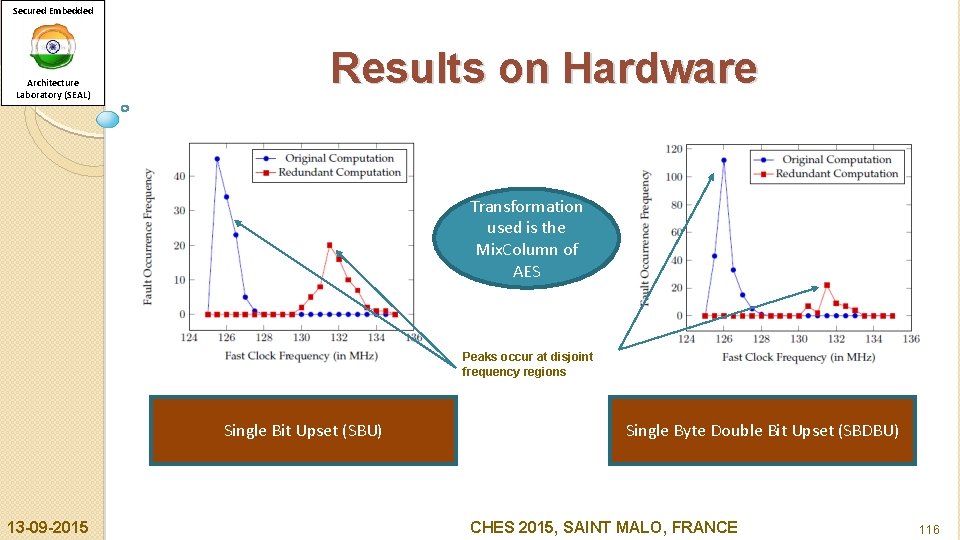
Secured Embedded Architecture Laboratory (SEAL) Results on Hardware Transformation used is the Mix. Column of AES Peaks occur at disjoint frequency regions Single Bit Upset (SBU) 13 -09 -2015 Single Byte Double Bit Upset (SBDBU) CHES 2015, SAINT MALO, FRANCE 116
Secured Embedded Architecture Laboratory (SEAL) Infective Countermeasures The main initial idea behind infective countermeasures was to diffuse the impact of the fault such that even if the adversary were to attack the comparison step, the state would still be affected 13 -09 -2015 CHES 2015, SAINT MALO, FRANCE 117
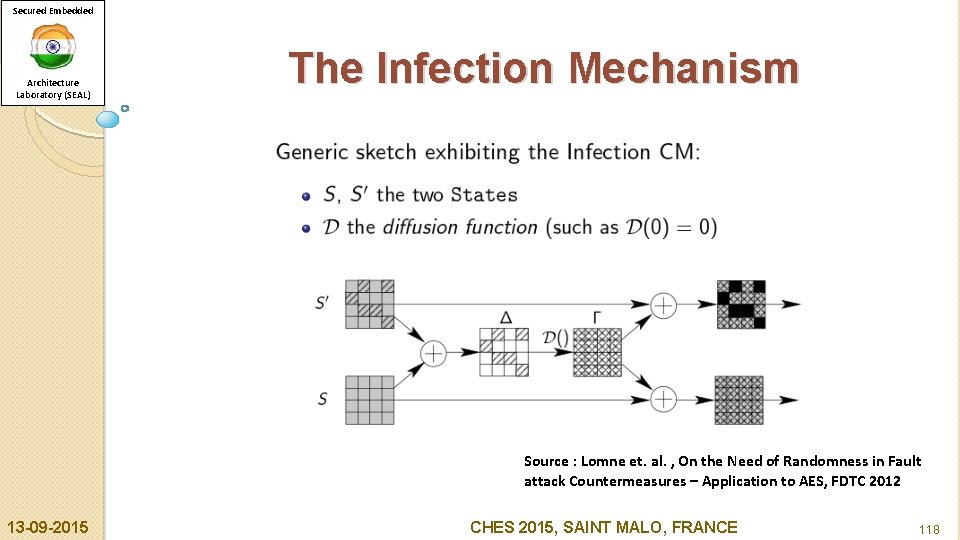
Secured Embedded Architecture Laboratory (SEAL) The Infection Mechanism Source : Lomne et. al. , On the Need of Randomness in Fault attack Countermeasures – Application to AES, FDTC 2012 13 -09 -2015 CHES 2015, SAINT MALO, FRANCE 118
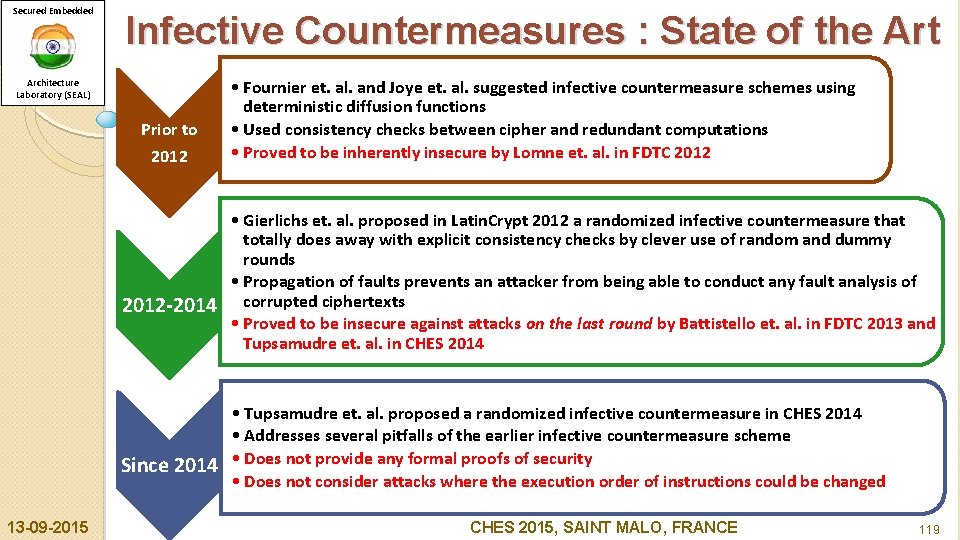
Secured Embedded Infective Countermeasures : State of the Art Architecture Laboratory (SEAL) Prior to 2012 • Fournier et. al. and Joye et. al. suggested infective countermeasure schemes using deterministic diffusion functions • Used consistency checks between cipher and redundant computations • Proved to be inherently insecure by Lomne et. al. in FDTC 2012 • Gierlichs et. al. proposed in Latin. Crypt 2012 a randomized infective countermeasure that totally does away with explicit consistency checks by clever use of random and dummy rounds • Propagation of faults prevents an attacker from being able to conduct any fault analysis of 2012 -2014 corrupted ciphertexts • Proved to be insecure against attacks on the last round by Battistello et. al. in FDTC 2013 and Tupsamudre et. al. in CHES 2014 • Tupsamudre et. al. proposed a randomized infective countermeasure in CHES 2014 • Addresses several pitfalls of the earlier infective countermeasure scheme Since 2014 • Does not provide any formal proofs of security • Does not consider attacks where the execution order of instructions could be changed 13 -09 -2015 CHES 2015, SAINT MALO, FRANCE 119
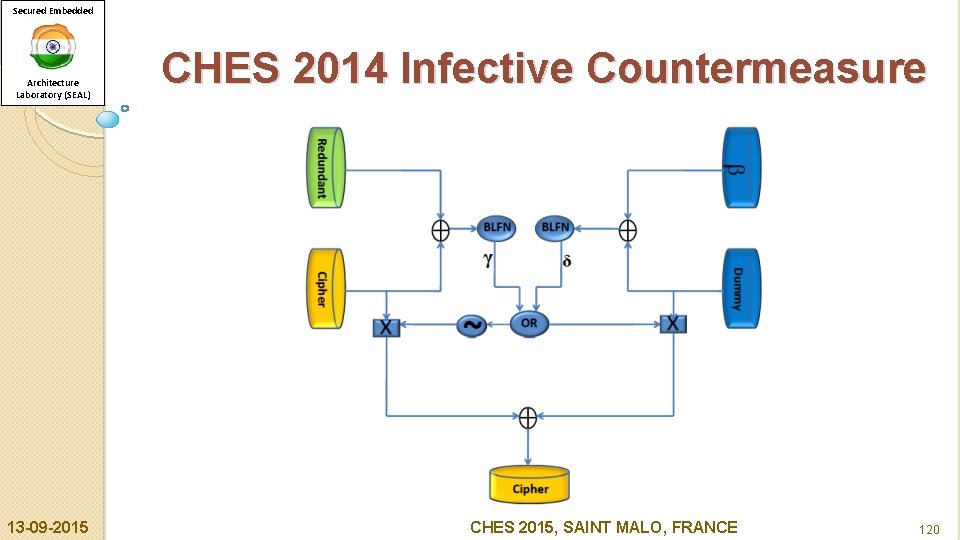
Secured Embedded Architecture Laboratory (SEAL) 13 -09 -2015 CHES 2014 Infective Countermeasure CHES 2015, SAINT MALO, FRANCE 120
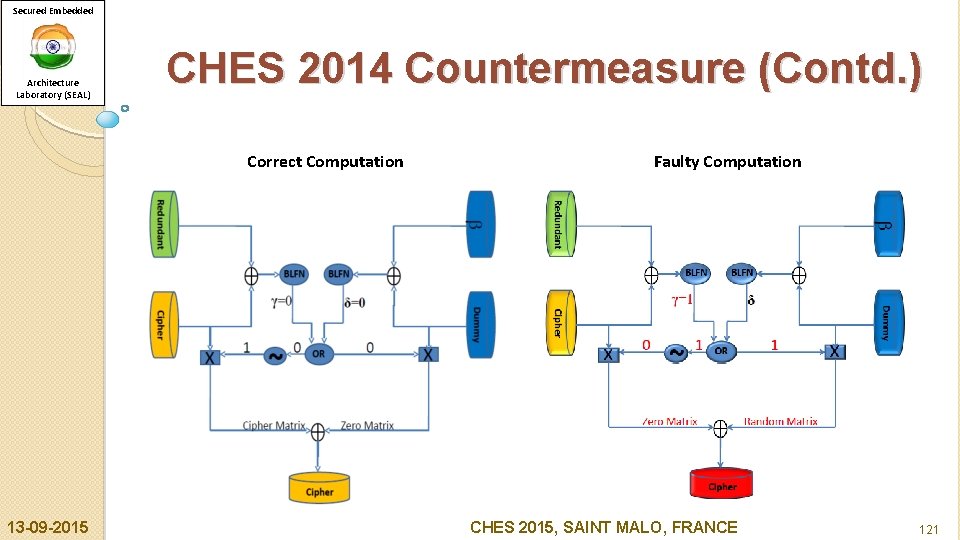
Secured Embedded Architecture Laboratory (SEAL) CHES 2014 Countermeasure (Contd. ) Correct Computation 13 -09 -2015 Faulty Computation CHES 2015, SAINT MALO, FRANCE 121
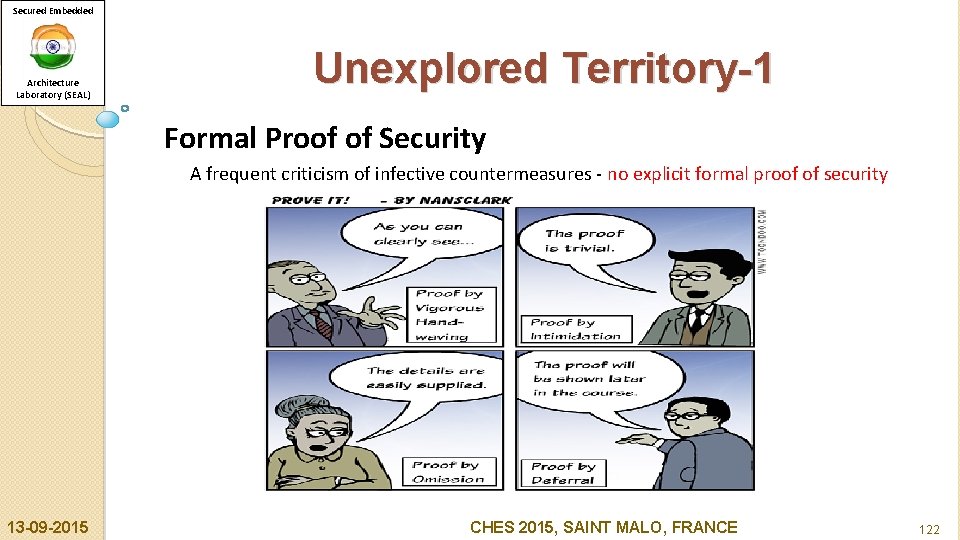
Secured Embedded Unexplored Territory-1 Architecture Laboratory (SEAL) Formal Proof of Security A frequent criticism of infective countermeasures - no explicit formal proof of security 13 -09 -2015 CHES 2015, SAINT MALO, FRANCE 122
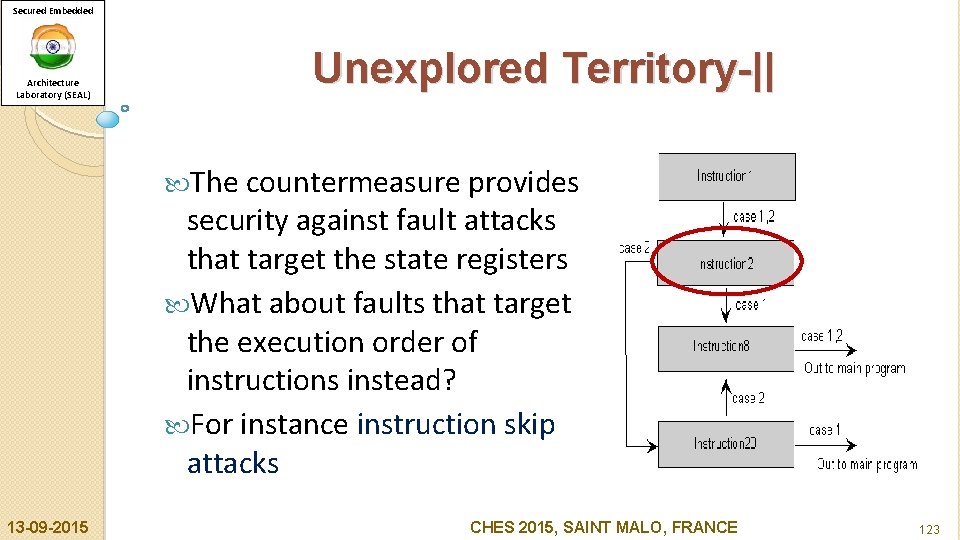
Secured Embedded Architecture Laboratory (SEAL) Unexplored Territory-|| The countermeasure provides security against fault attacks that target the state registers What about faults that target the execution order of instructions instead? For instance instruction skip attacks 13 -09 -2015 CHES 2015, SAINT MALO, FRANCE 123
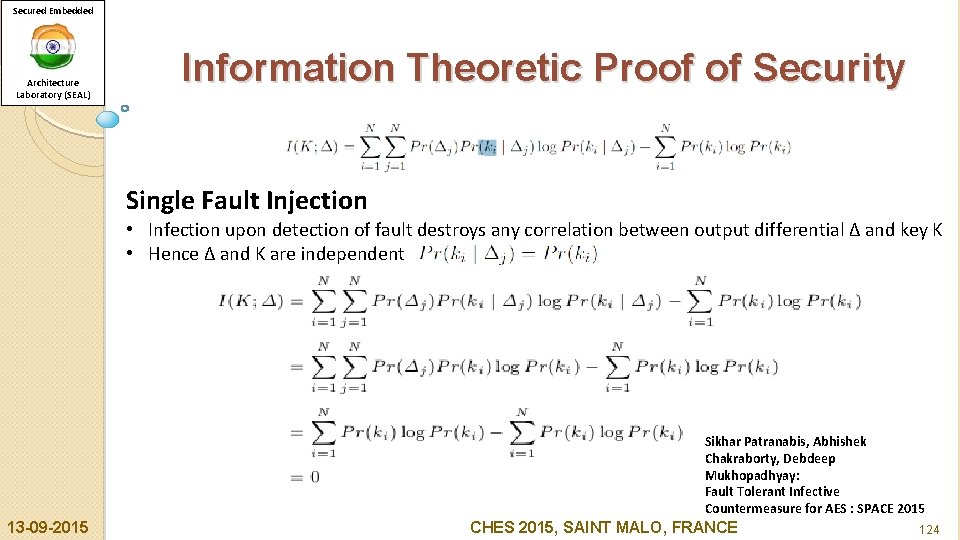
Secured Embedded Architecture Laboratory (SEAL) Information Theoretic Proof of Security Single Fault Injection • Infection upon detection of fault destroys any correlation between output differential ∆ and key K • Hence ∆ and K are independent Sikhar Patranabis, Abhishek Chakraborty, Debdeep Mukhopadhyay: Fault Tolerant Infective Countermeasure for AES : SPACE 2015 13 -09 -2015 CHES 2015, SAINT MALO, FRANCE 124
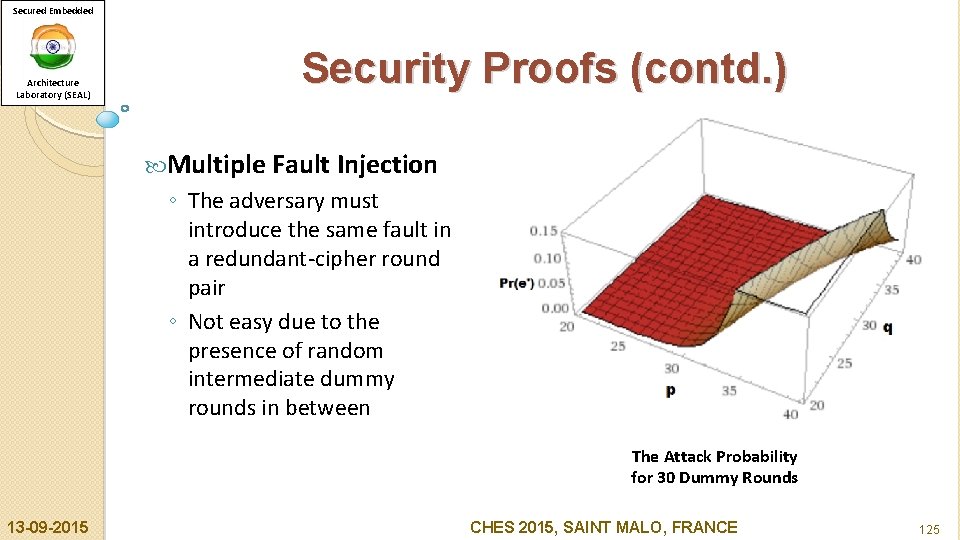
Secured Embedded Architecture Laboratory (SEAL) Security Proofs (contd. ) Multiple Fault Injection ◦ The adversary must introduce the same fault in a redundant-cipher round pair ◦ Not easy due to the presence of random intermediate dummy rounds in between The Attack Probability for 30 Dummy Rounds 13 -09 -2015 CHES 2015, SAINT MALO, FRANCE 125
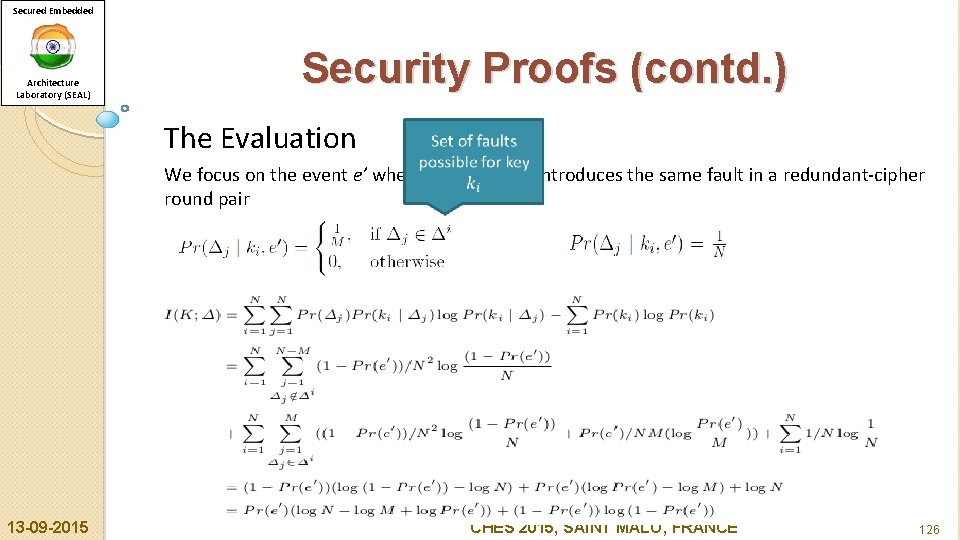
Secured Embedded Architecture Laboratory (SEAL) Security Proofs (contd. ) The Evaluation We focus on the event e’ where an adversary introduces the same fault in a redundant-cipher round pair 13 -09 -2015 CHES 2015, SAINT MALO, FRANCE 126
Secured Embedded Architecture Laboratory (SEAL) Conclusions for Part 3 Detection based countermeasures work well against 13 -09 -2015 classical uniform fault models Redundancy alone is not enough to tackle biased fault attacks Fault Space Transformation tries to make sure the adversary cannot introduce the same fault in the original and redundant rounds Infective countermeasures attempt use intermediate dummy rounds to confuse the adversary and avoid explicit detection steps CHES 2015, SAINT MALO, FRANCE 127
Secured Embedded Architecture Laboratory (SEAL) PART 4 FAULT TOLERANCE AT A GRANULAR LEVEL : IDEMPOTENT INSTRUCTION SEQUENCES 13 -09 -2015 CHES 2015, SAINT MALO, FRANCE
Secured Embedded Architecture Laboratory (SEAL) The Instruction Skip Fault Model The adversary can skip an instruction Equivalent to replacing instruction by a NOP Practically achievable on a variety of architectures ◦ 8 -bit AVR microcontrollers ◦ 32 -bit ARM 9 processor ◦ 32 -bit ARM Cortex-M 3 processor Variety of injection techniques possible - Clock glitches, EM Glitches, Voltage glitches and Laser shots 13 -09 -2015 CHES 2015, SAINT MALO, FRANCE 129
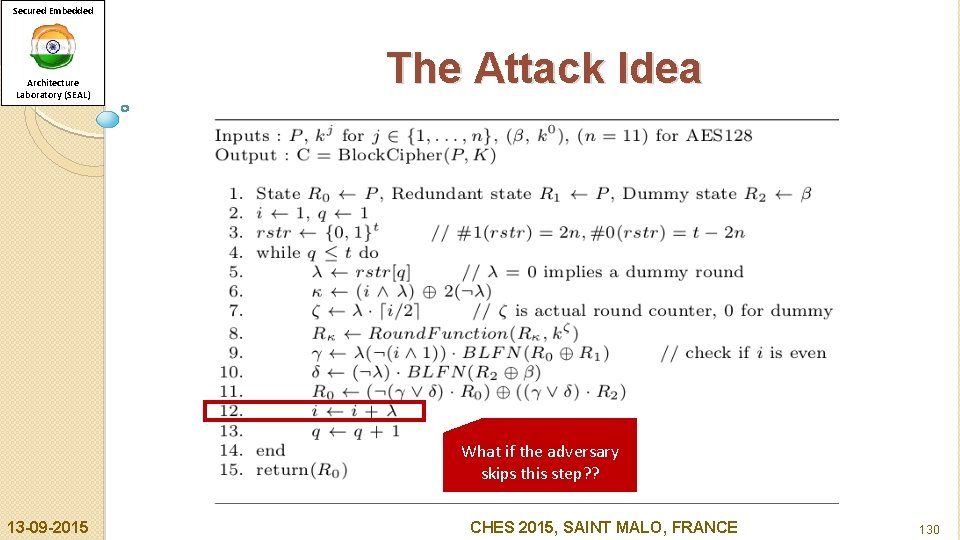
Secured Embedded Architecture Laboratory (SEAL) The Attack Idea What if the adversary skips this step? ? 13 -09 -2015 CHES 2015, SAINT MALO, FRANCE 130
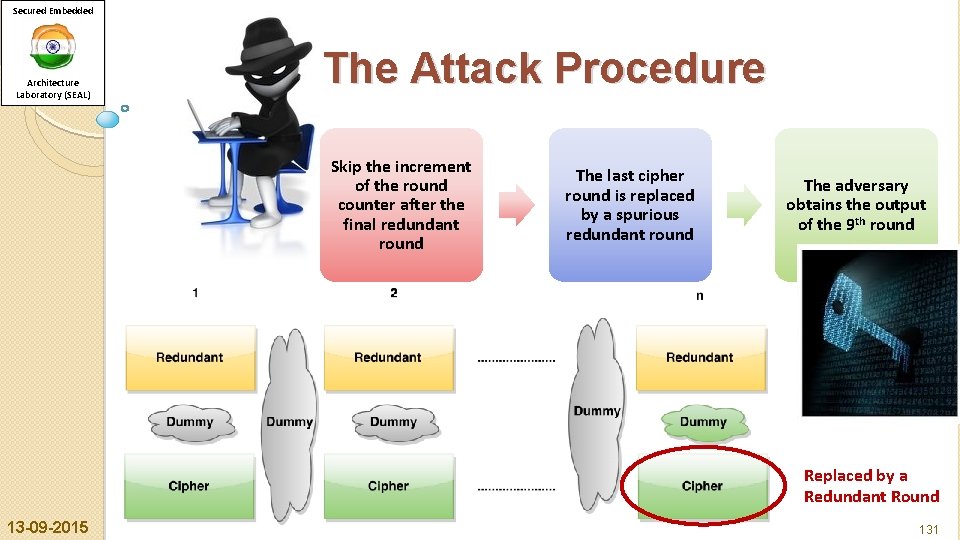
Secured Embedded Architecture Laboratory (SEAL) The Attack Procedure Skip the increment of the round counter after the final redundant round The last cipher round is replaced by a spurious redundant round The adversary obtains the output of the 9 th round Replaced by a Redundant Round 13 -09 -2015 CHES 2015, SAINT MALO, FRANCE 131
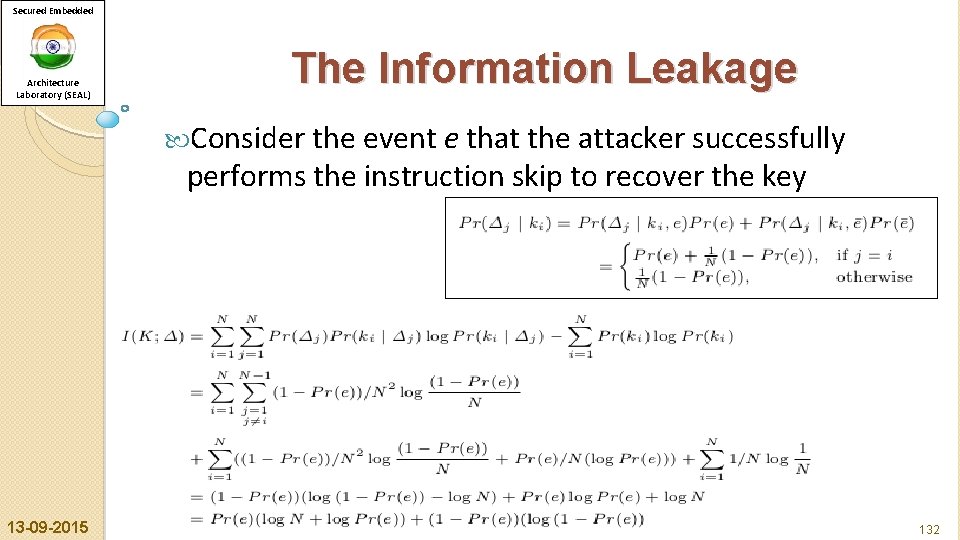
Secured Embedded Architecture Laboratory (SEAL) The Information Leakage Consider the event e that the attacker successfully performs the instruction skip to recover the key 13 -09 -2015 CHES 2015, SAINT MALO, FRANCE 132
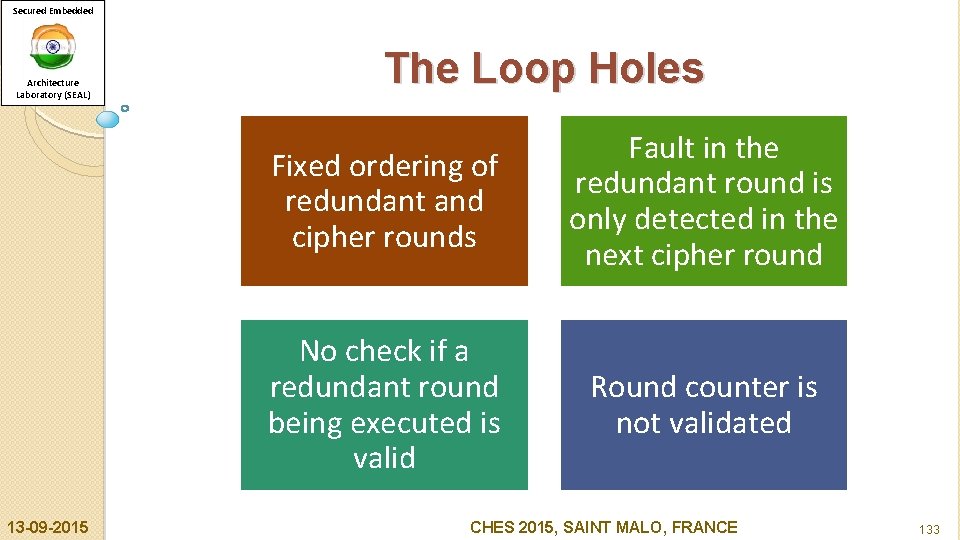
Secured Embedded Architecture Laboratory (SEAL) 13 -09 -2015 The Loop Holes Fixed ordering of redundant and cipher rounds Fault in the redundant round is only detected in the next cipher round No check if a redundant round being executed is valid Round counter is not validated CHES 2015, SAINT MALO, FRANCE 133
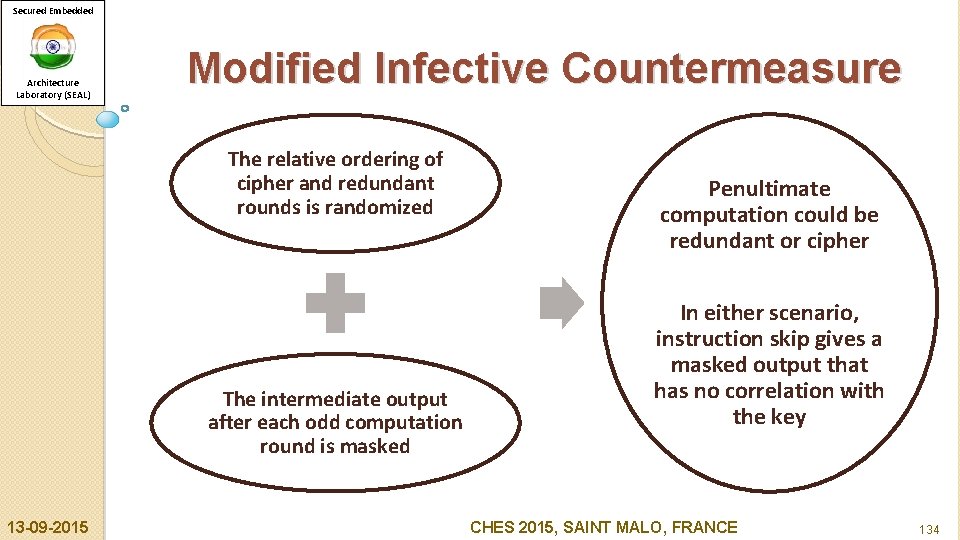
Secured Embedded Architecture Laboratory (SEAL) Modified Infective Countermeasure The relative ordering of cipher and redundant rounds is randomized The intermediate output after each odd computation round is masked 13 -09 -2015 Penultimate computation could be redundant or cipher In either scenario, instruction skip gives a masked output that has no correlation with the key CHES 2015, SAINT MALO, FRANCE 134
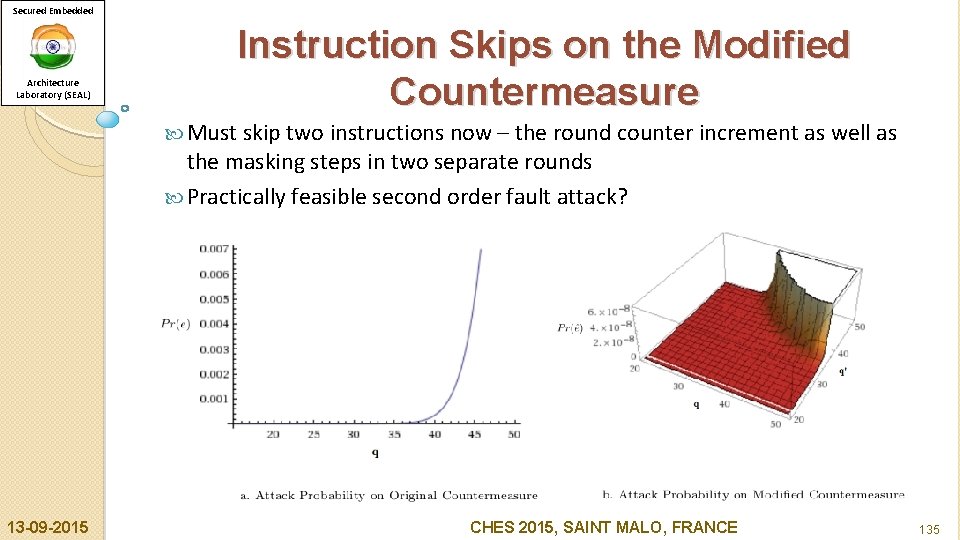
Secured Embedded Architecture Laboratory (SEAL) Instruction Skips on the Modified Countermeasure Must skip two instructions now – the round counter increment as well as the masking steps in two separate rounds Practically feasible second order fault attack? 13 -09 -2015 CHES 2015, SAINT MALO, FRANCE 135
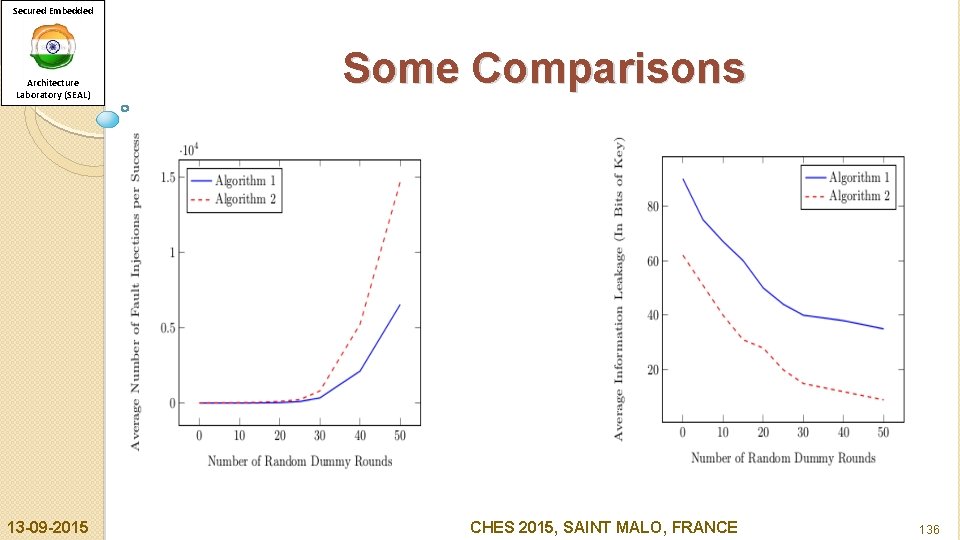
Secured Embedded Architecture Laboratory (SEAL) 13 -09 -2015 Some Comparisons CHES 2015, SAINT MALO, FRANCE 136
Secured Embedded Architecture Laboratory (SEAL) But what about other Instruction Skip instances ? ? 17 -05 -2015 NYU-Abu Dhabi 137
Secured Embedded Architecture Laboratory (SEAL) Fault Tolerance at the Instruction Level Injection of faults in two instructions separated by only a few clock cycles is difficult to achieve in practice Rewrite compiler generated assembly code by replacing each instruction by a sequence of one or more idempotent instructions All instructions belong to the x 86 instruction set and have uniform size of 32 bits Provides protection againstruction skip attacks in general 13 -09 -2015 CHES 2015, SAINT MALO, FRANCE 138
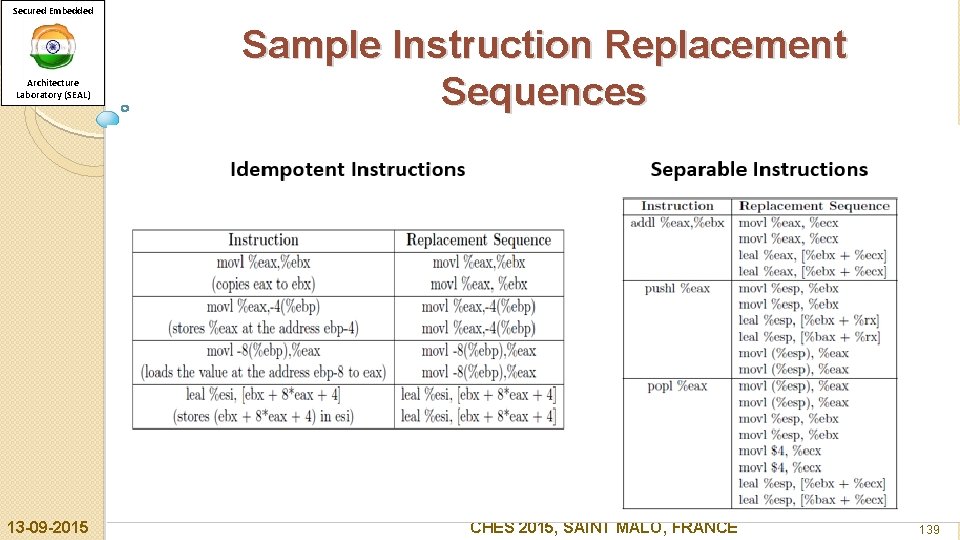
Secured Embedded Architecture Laboratory (SEAL) 13 -09 -2015 Sample Instruction Replacement Sequences CHES 2015, SAINT MALO, FRANCE 139
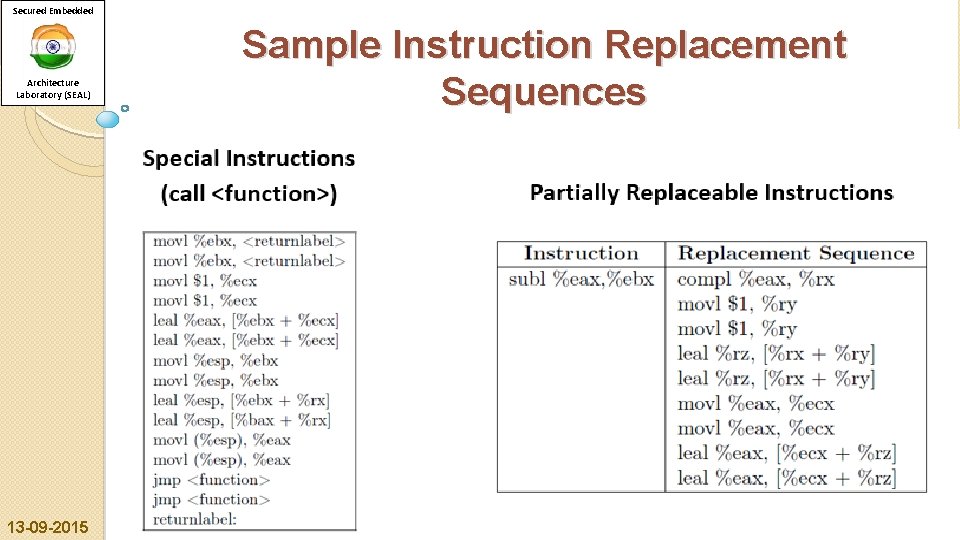
Secured Embedded Architecture Laboratory (SEAL) 13 -09 -2015 Sample Instruction Replacement Sequences CHES 2015, SAINT MALO, FRANCE 140
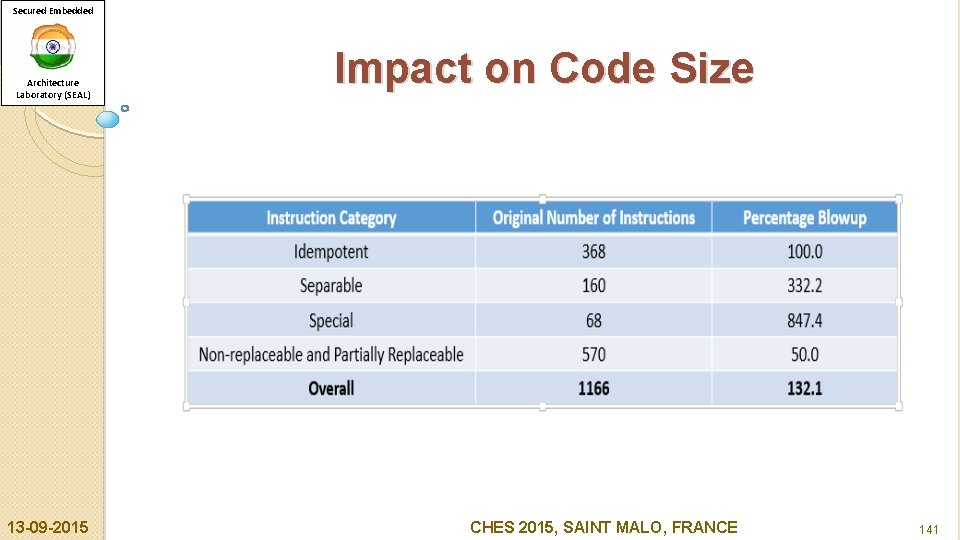
Secured Embedded Architecture Laboratory (SEAL) 13 -09 -2015 Impact on Code Size CHES 2015, SAINT MALO, FRANCE 141
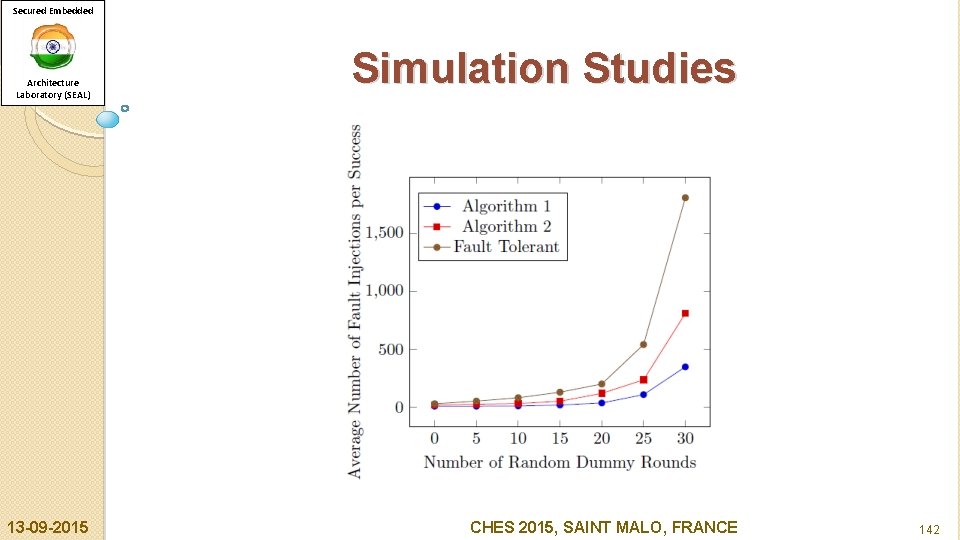
Secured Embedded Architecture Laboratory (SEAL) 13 -09 -2015 Simulation Studies CHES 2015, SAINT MALO, FRANCE 142
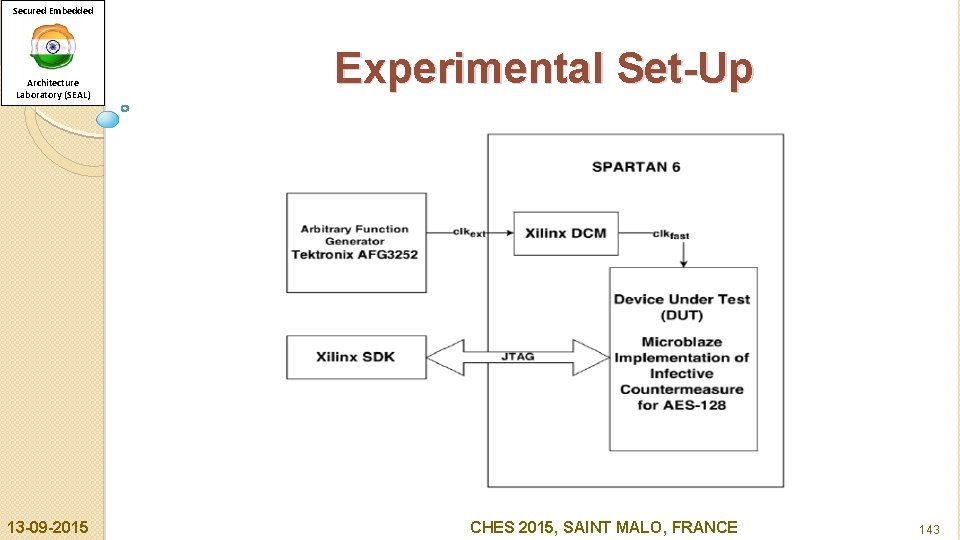
Secured Embedded Architecture Laboratory (SEAL) 13 -09 -2015 Experimental Set-Up CHES 2015, SAINT MALO, FRANCE 143
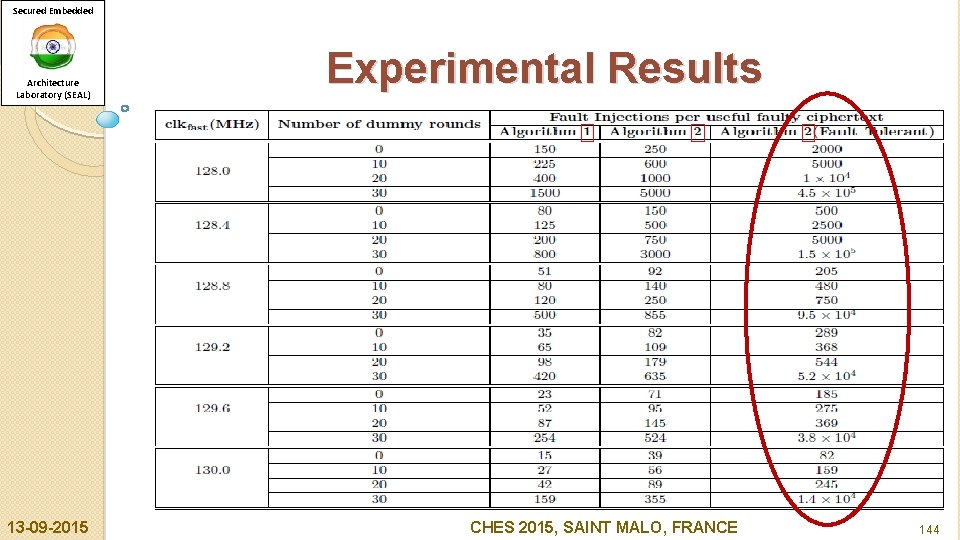
Secured Embedded Architecture Laboratory (SEAL) 13 -09 -2015 Experimental Results CHES 2015, SAINT MALO, FRANCE 144
Secured Embedded Architecture Laboratory (SEAL) Conclusions for Part 4 Instruction Skips constitute a strong class of fault attacks that allow the adversary to change the flow sequence of the algorithm It is difficult to design algorithmic countermeasures that can efficiently counter a large number of instances of instruction skip attacks Fault tolerance using idempotent instruction sequences seems to be a more effective and generic solution against this class of attacks 13 -09 -2015 CHES 2015, SAINT MALO, FRANCE 145
Secured Embedded Architecture Laboratory (SEAL) PART 5 METRICS FOR FAULT ANALYSIS 13 -09 -2015 CHES 2015, SAINT MALO, FRANCE
Secured Embedded Architecture Laboratory (SEAL) The Need for Metrics To measure the vulnerability of systems against fault attacks To make proper security/cost trade-offs 13 -09 -2015 CHES 2015, SAINT MALO, FRANCE 147
Secured Embedded Architecture Laboratory (SEAL) Timing Violation Vulnerability Factor (TVVF) Evaluates the vulnerability of a hardware structure to setup time violation attacks TVVF is probabilistic metric computed on a circuit’s netlist Comprises of two parts ◦ The probability of injecting a specific fault in the hardware structure ◦ the probability of propagating this fault to the output of the structure Bilgiday Yuce, Nahid Farhady Ghalaty, Patrick 13 -09 -2015 Schaumont: TVVF: Estimating the vulnerability of hardware cryptosystems against timing violation attacks : HOST 2015 CHES 2015, SAINT MALO, FRANCE 148
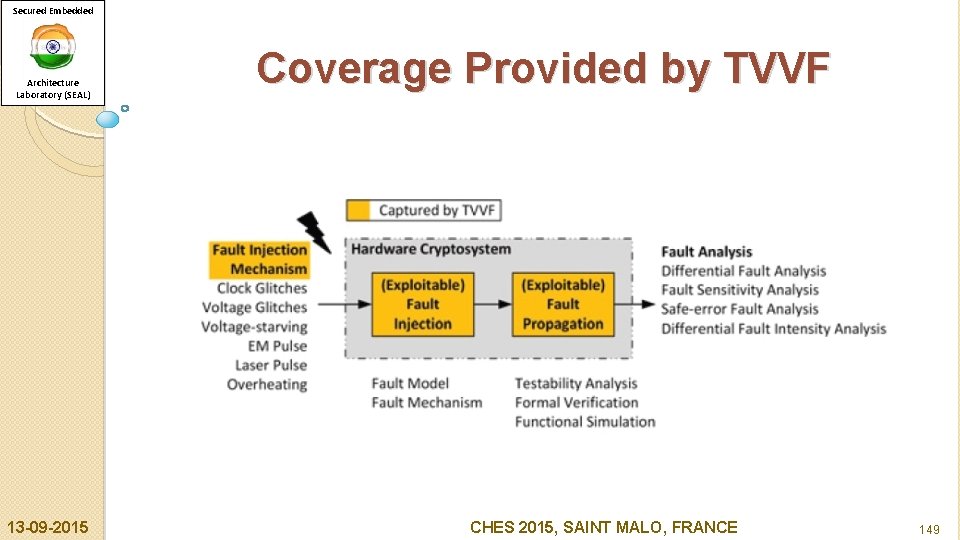
Secured Embedded Architecture Laboratory (SEAL) 13 -09 -2015 Coverage Provided by TVVF CHES 2015, SAINT MALO, FRANCE 149
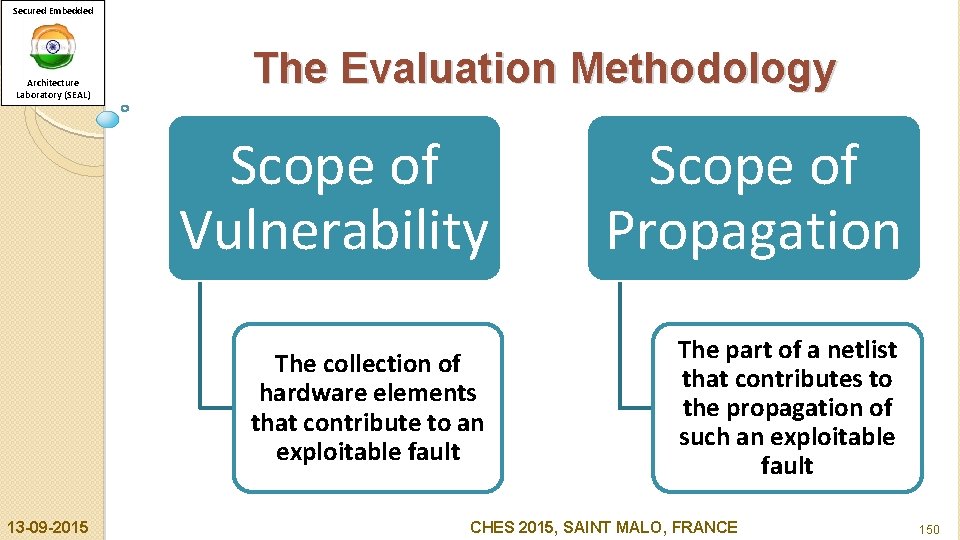
Secured Embedded Architecture Laboratory (SEAL) 13 -09 -2015 The Evaluation Methodology Scope of Vulnerability Scope of Propagation The collection of hardware elements that contribute to an exploitable fault The part of a netlist that contributes to the propagation of such an exploitable fault CHES 2015, SAINT MALO, FRANCE 150
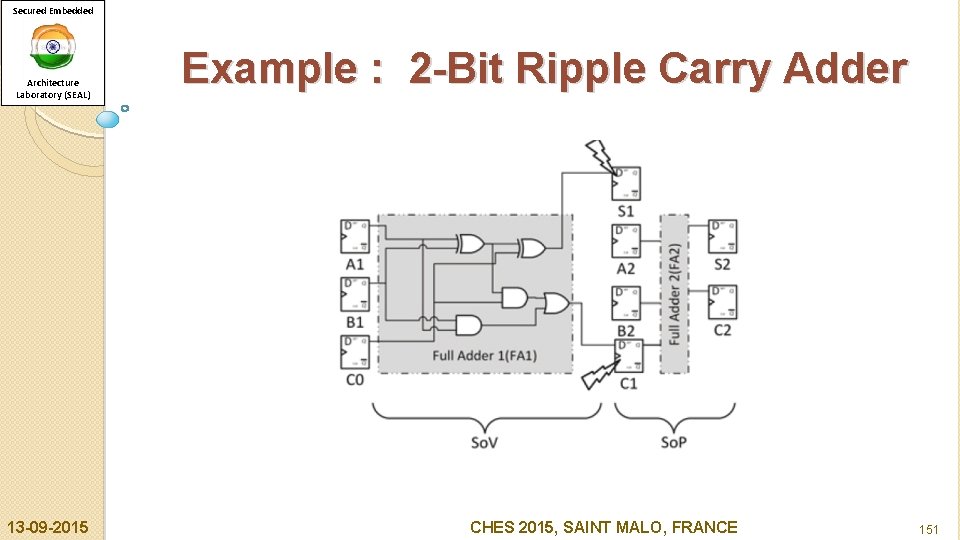
Secured Embedded Architecture Laboratory (SEAL) 13 -09 -2015 Example : 2 -Bit Ripple Carry Adder CHES 2015, SAINT MALO, FRANCE 151
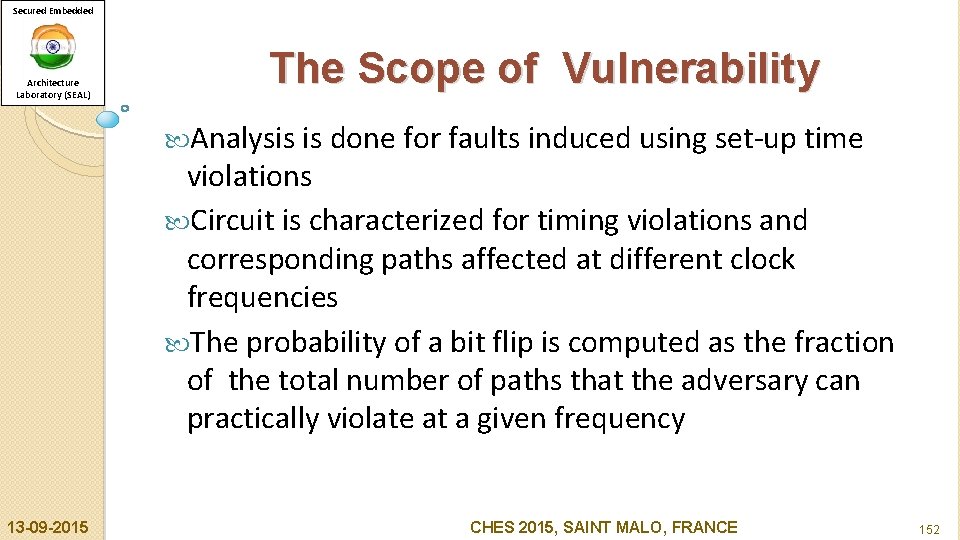
Secured Embedded Architecture Laboratory (SEAL) The Scope of Vulnerability Analysis is done for faults induced using set-up time violations Circuit is characterized for timing violations and corresponding paths affected at different clock frequencies The probability of a bit flip is computed as the fraction of the total number of paths that the adversary can practically violate at a given frequency 13 -09 -2015 CHES 2015, SAINT MALO, FRANCE 152
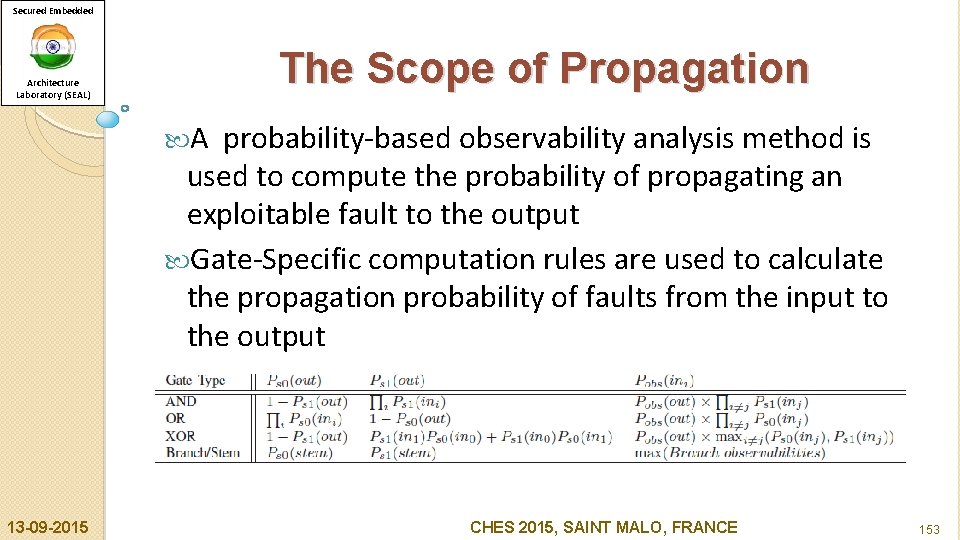
Secured Embedded Architecture Laboratory (SEAL) The Scope of Propagation A probability-based observability analysis method is used to compute the probability of propagating an exploitable fault to the output Gate-Specific computation rules are used to calculate the propagation probability of faults from the input to the output 13 -09 -2015 CHES 2015, SAINT MALO, FRANCE 153
Secured Embedded Architecture Laboratory (SEAL) The TVVF Calculation Inputs : Circuit C, Attack Model A Compute in three steps ◦ The probability of injecting a given clock glitch period ◦ The probability of obtaining a bit-flip in each output of So. V depending on the attack model A ◦ The probability of observing an exploitable fault in the output of the circuit (SOP) Combine the values for different clock periods and outputs of SOV to obtain final TVVF value 13 -09 -2015 CHES 2015, SAINT MALO, FRANCE 154
Secured Embedded Architecture Laboratory (SEAL) Merits and Demerits of TVVF Merits : TVVVF can be used for ◦ comparing the vulnerability of two hardware implementations to a given fault attack ◦ comparing the feasibility of two fault attacks on a specific hardware implementation Demerits : ◦ Very specific to fault attacks using clock glitches ◦ Does not talk about the time complexity for larger circuits 13 -09 -2015 CHES 2015, SAINT MALO, FRANCE 155
Secured Embedded Architecture Laboratory (SEAL) Conclusions for Part 5 Metrics are essential to compare different implementations of the same algorithm with respect to vulnerability to fault attacks Current metrics depend heavily on fault models and attack techniques TVVF is a recently proposed metric that can compare across implementations with respect to security against setup time violation attacks Need more general metrics that are independent of fault injection techniques 13 -09 -2015 CHES 2015, SAINT MALO, FRANCE 156
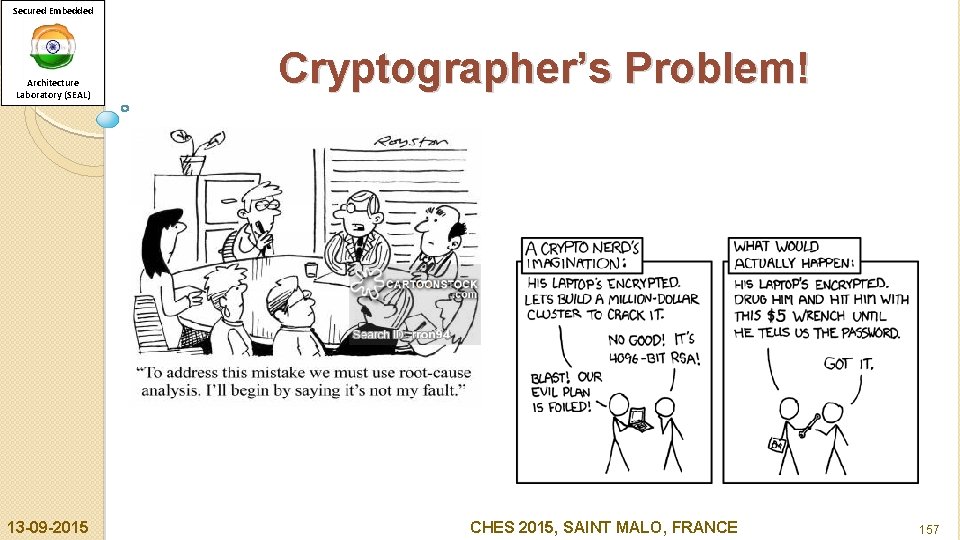
Secured Embedded Architecture Laboratory (SEAL) 13 -09 -2015 Cryptographer’s Problem! CHES 2015, SAINT MALO, FRANCE 157
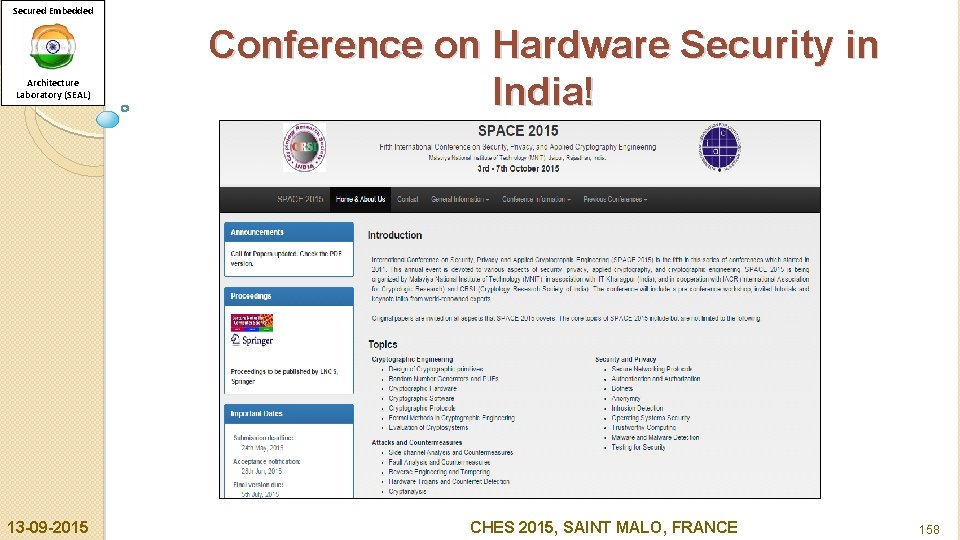
Secured Embedded Architecture Laboratory (SEAL) 13 -09 -2015 Conference on Hardware Security in India! CHES 2015, SAINT MALO, FRANCE 158

Secured Embedded Architecture Laboratory (SEAL) 13 -09 -2015 Thank You for your attention!! CHES 2015 159
- Slides: 159