
Secure Triggers Ariel Futoransky Emiliano Kargieman Carlos Sarraute
- Slides: 10
Secure Triggers Ariel Futoransky, Emiliano Kargieman, Carlos Sarraute, Ariel Waissbein Core Security Technologies {ek, wata}@coresecurity. com
Definitions • Let S be a secret and P={p} a family of predicates. Let p be a predicate in P • Def: A trigger is an algorithm T(S, p) that takes any input x in {0, 1}* and returns S iff p(x)=true. Else, it returns nothing. • Def: The trigger T(S, p) is said secure if a polynomial-time attacker, given P, the sampling distribution, and arbitrary access to T(S, p), cannot learn anything about S.
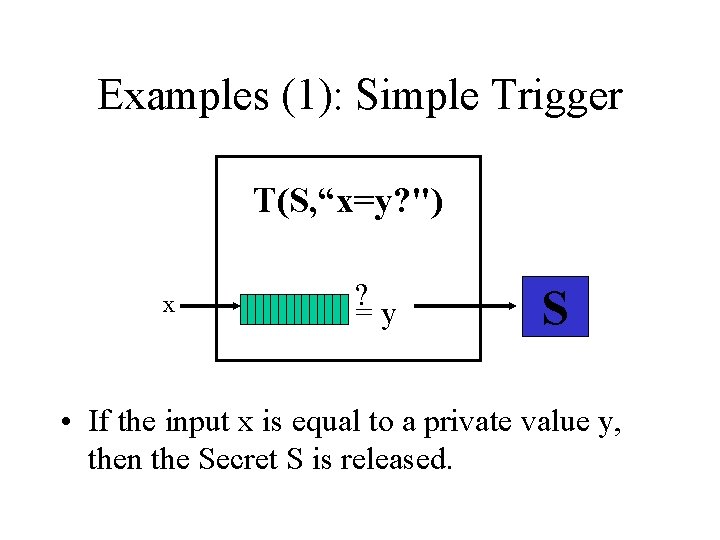
Examples (1): Simple Trigger T(S, “x=y? ") x ? =y S • If the input x is equal to a private value y, then the Secret S is released.
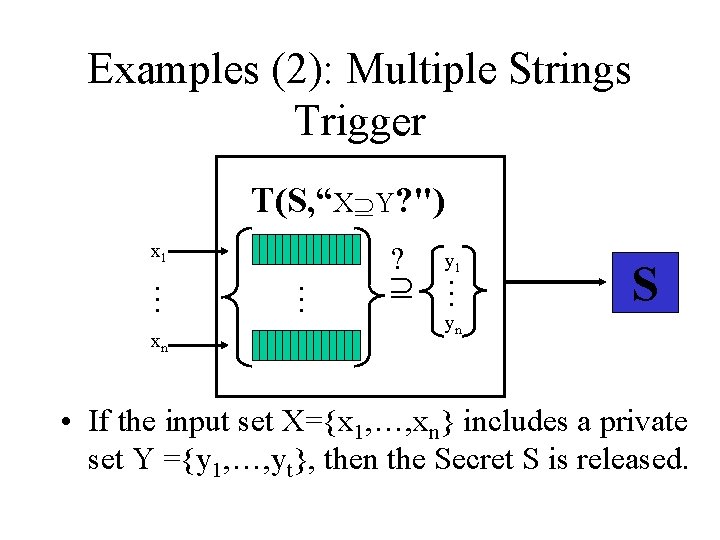
Examples (2): Multiple Strings Trigger T(S, “X Y? ") x 1 y 1 … … … xn ? S yn • If the input set X={x 1, …, xn} includes a private set Y ={y 1, …, yt}, then the Secret S is released.
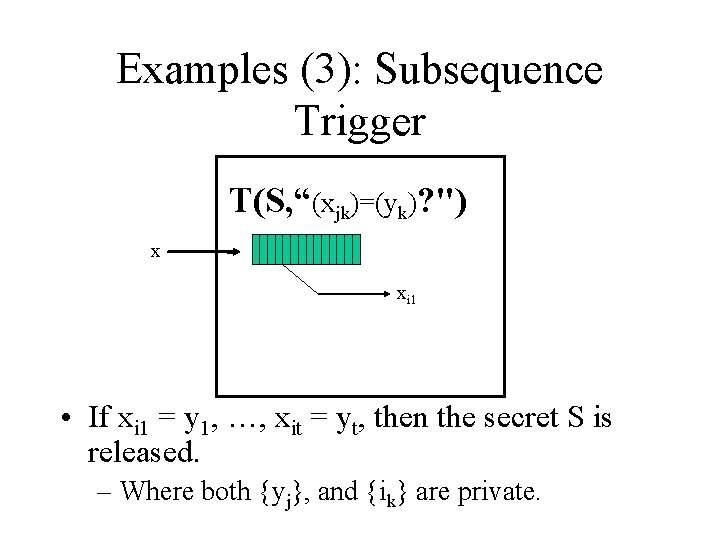
Examples (3): Subsequence Trigger T(S, “(xjk)=(yk)? ") x xi 1 • If xi 1 = y 1, …, xit = yt, then the secret S is released. – Where both {yj}, and {ik} are private.
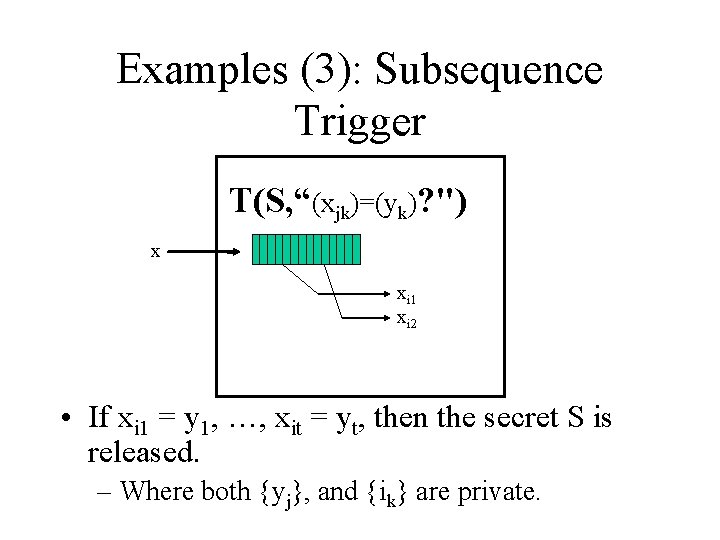
Examples (3): Subsequence Trigger T(S, “(xjk)=(yk)? ") x xi 1 xi 2 • If xi 1 = y 1, …, xit = yt, then the secret S is released. – Where both {yj}, and {ik} are private.
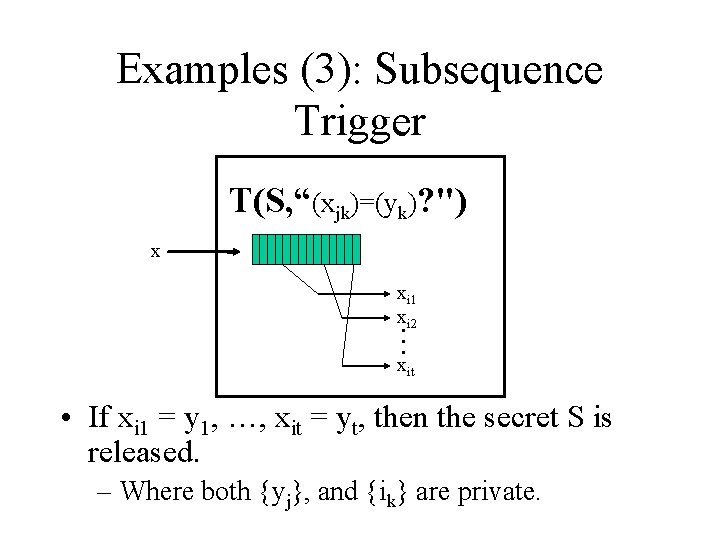
Examples (3): Subsequence Trigger T(S, “(xjk)=(yk)? ") x … xi 1 xi 2 xit • If xi 1 = y 1, …, xit = yt, then the secret S is released. – Where both {yj}, and {ik} are private.
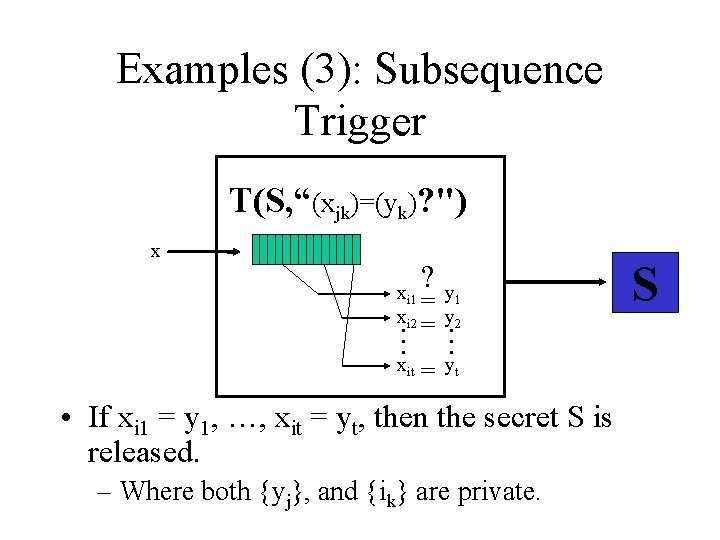
Examples (3): Subsequence Trigger T(S, “(xjk)=(yk)? ") x ? … … xi 1 = y 1 xi 2 = y 2 xit = yt • If xi 1 = y 1, …, xit = yt, then the secret S is released. – Where both {yj}, and {ik} are private. S
Applications of the triggers • Information Warfare Worm Attack • Online automated shopping • Other – Software protection – …
Results • Generic definitions of security for Secure Triggers on the UCS framework • Instantiations: • Simple triggers are secure • Multiple strings triggers are secure • Subsequence triggers are secure • Paper submitted for publication, let us know if you want a copy