
Secure Operating System Mandatory Protection Systems Problem of
Secure Operating System
Mandatory Protection Systems • Problem of discretionary access control: untrusted processes can modify protection states • Mandatory protection system: – Subjects and objects represented by labels – Protection state: the operations that subject labels may perform on object labels – Labeling state: mapping objects to labels – Transition state: defines what relabeling is allowed
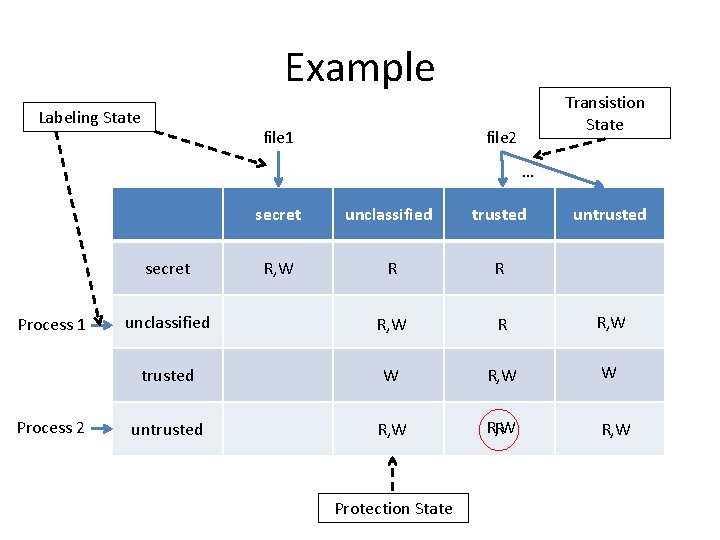
Example Labeling State file 1 Transistion State file 2 … secret unclassified trusted R, W R R unclassified R, W R R, W trusted W R, W W untrusted R, W R R, W secret Process 1 Process 2 Protection State untrusted
Mandatory Access Control • In a mandatory protection system – The set of labels are defined by trusted administrators – The set of labels are immutable – Protection state, labeling state, and transition state can only be modified by trusted administrators through trusted programs • This is called Mandatory Access Control (MAC)
Reference Monitor • An authorization system that determines whether a subject is allowed to perform an operation on an object – Takes as input a request – Returns a binary response indicating whether the request is authorized or not
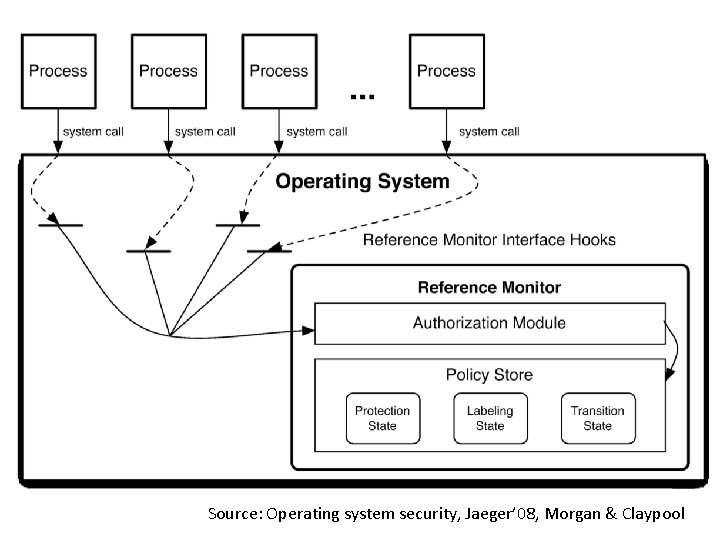
Source: Operating system security, Jaeger’ 08, Morgan & Claypool
Secure Operating System • A system with a reference monitor access enforcement mechanism that satisfies the requirements below when it enforces a mandatory protection system. – Complete Mediation: all security-sensitive ops – Tamperproof: untrusted processes cannot modify access enforcement system – Verifiable: small TCB

Examining Unix • Complete mediation – Problem 1: not all file access is mediated by RM, e. g. , if a process possesses a file descriptor, it can perform any ad hoc command on the file using system calls ioctl or fcntl, as well as read and modify file metadata. – Problem 2: not all system resources are mediated
Examining Unix • Tamperproof – Any user process can modify the protection state at its discretion. – User processes can access and modify kernels through special file systems (e. g. , /proc, /kmem. ) – Any root user process can modify any aspect of the protection system
Examining Unix • Verifiable – Effectively unbounded TCB – Impossible to prove that security goals are met as long as TCB is OK
- Slides: 10