
Secure Electronic Transaction Credit Cards on the Internet
- Slides: 32
Secure Electronic Transaction
Credit Cards on the Internet • Problem: communicate credit card and purchasing data securely to gain consumer trust – Authentication of buyer and merchant – Confidential transmissions • Systems vary by – – – Type of public-key encryption Type of symmetric encryption Message digest algorithm Number of parties having private keys Number of parties having certificates
Secure Electronic Transaction (SET) • • • Developed by Visa and Master. Card Designed to protect credit card transactions Confidentiality: all messages encrypted Trust: all parties must have digital certificates Privacy: information made available only when and where necessary
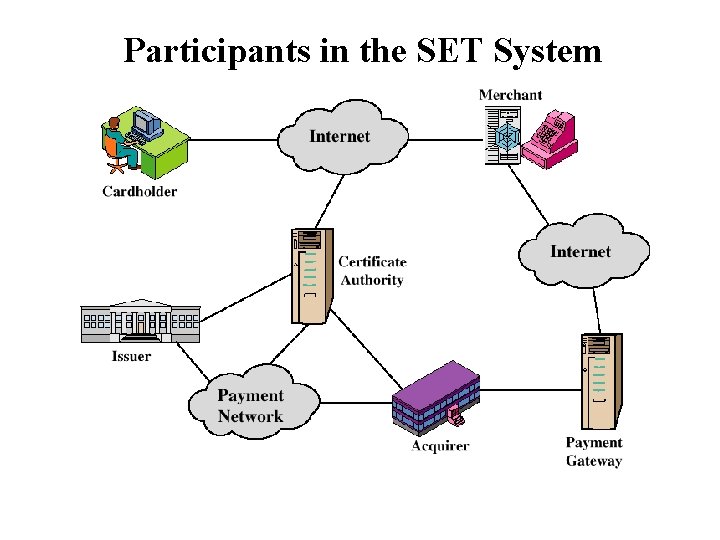
Participants in the SET System
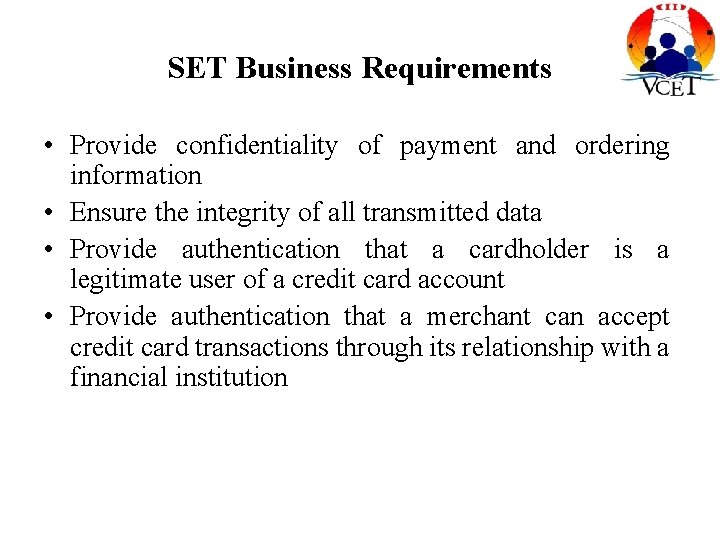
SET Business Requirements • Provide confidentiality of payment and ordering information • Ensure the integrity of all transmitted data • Provide authentication that a cardholder is a legitimate user of a credit card account • Provide authentication that a merchant can accept credit card transactions through its relationship with a financial institution
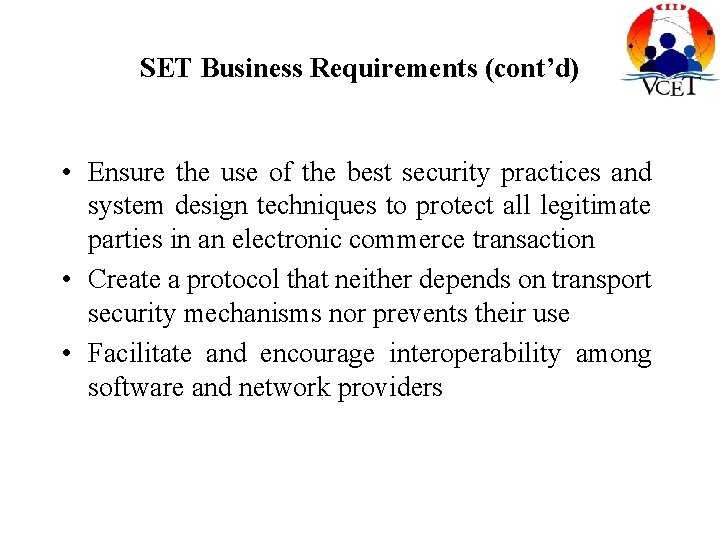
SET Business Requirements (cont’d) • Ensure the use of the best security practices and system design techniques to protect all legitimate parties in an electronic commerce transaction • Create a protocol that neither depends on transport security mechanisms nor prevents their use • Facilitate and encourage interoperability among software and network providers
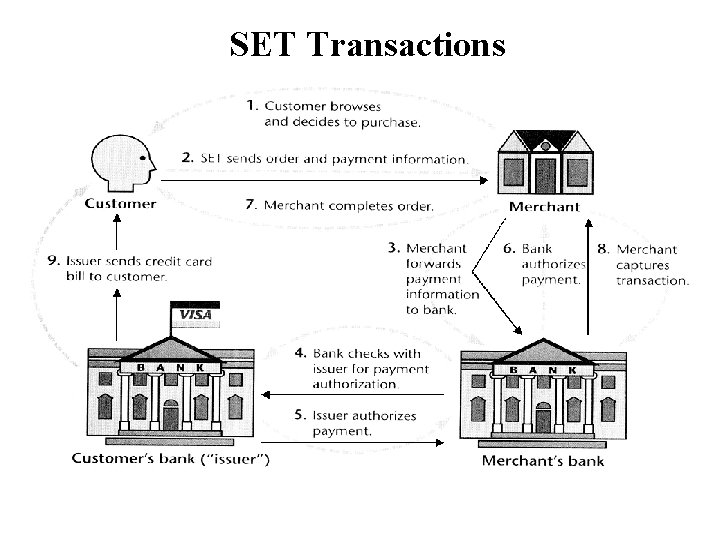
SET Transactions
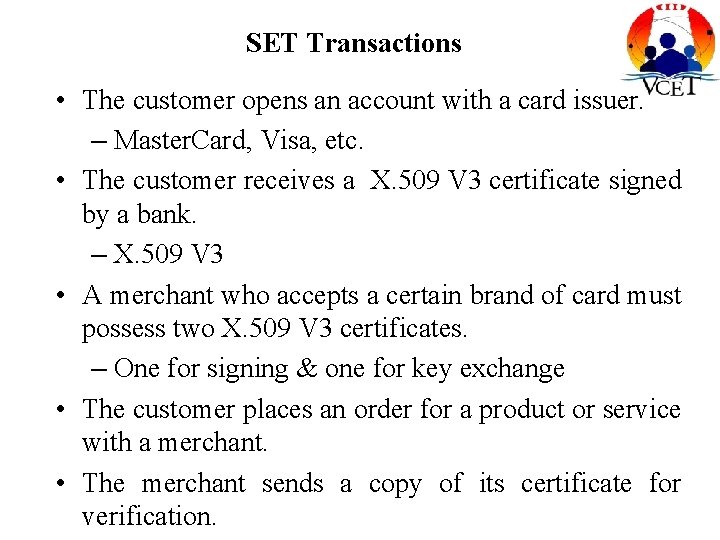
SET Transactions • The customer opens an account with a card issuer. – Master. Card, Visa, etc. • The customer receives a X. 509 V 3 certificate signed by a bank. – X. 509 V 3 • A merchant who accepts a certain brand of card must possess two X. 509 V 3 certificates. – One for signing & one for key exchange • The customer places an order for a product or service with a merchant. • The merchant sends a copy of its certificate for verification.
SET Transactions • The customer sends order and payment information to the merchant. • The merchant requests payment authorization from the payment gateway prior to shipment. • The merchant confirms order to the customer. • The merchant provides the goods or service to the customer. • The merchant requests payment from the payment gateway.
Key Technologies of SET • Confidentiality of information: DES • Integrity of data: RSA digital signatures with SHA-1 hash codes • Cardholder account authentication: X. 509 v 3 digital certificates with RSA signatures • Merchant authentication: X. 509 v 3 digital certificates with RSA signatures • Privacy: separation of order and payment information using dual signatures
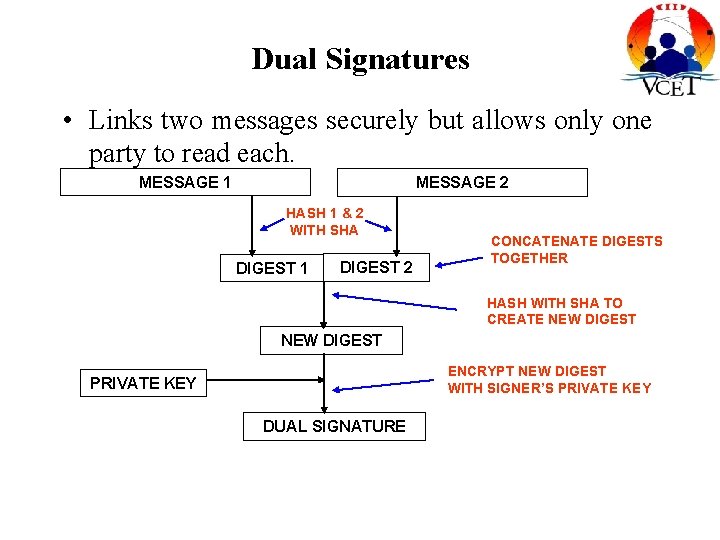
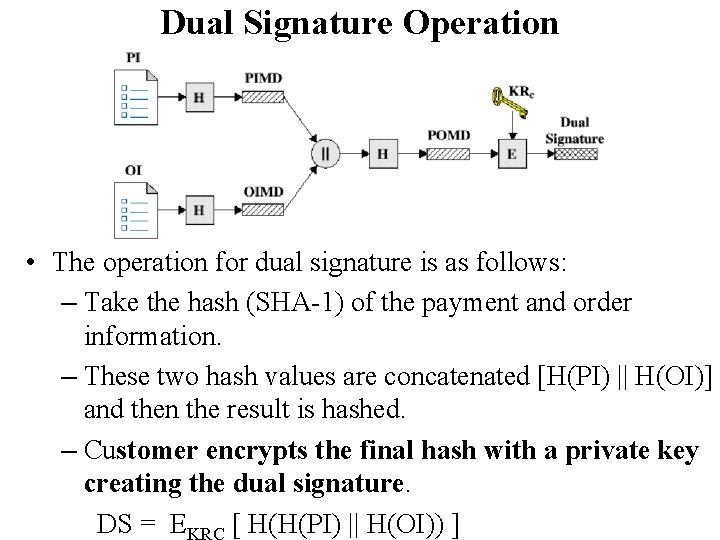
Dual Signatures • Links two messages securely but allows only one party to read each. MESSAGE 1 MESSAGE 2 HASH 1 & 2 WITH SHA DIGEST 1 DIGEST 2 CONCATENATE DIGESTS TOGETHER HASH WITH SHA TO CREATE NEW DIGEST ENCRYPT NEW DIGEST WITH SIGNER’S PRIVATE KEY DUAL SIGNATURE
Dual Signature for SET • Concept: Link Two Messages Intended for Two Different Receivers: – Order Information (OI): Customer to Merchant – Payment Information (PI): Customer to Bank • Goal: Limit Information to A “Need-to-Know” Basis: – Merchant does not need credit card number. – Bank does not need details of customer order. – Afford the customer extra protection in terms of privacy by keeping these items separate. • This link is needed to prove that payment is intended for this order and not some other one.
Why Dual Signature? • Suppose that customers send the merchant two messages: • The signed order information (OI). • The signed payment information (PI). • In addition, the merchant passes the payment information (PI) to the bank. • If the merchant can capture another order information (OI) from this customer, the merchant could claim this order goes with the payment information (PI) rather than the original.
Dual Signature Operation • The operation for dual signature is as follows: – Take the hash (SHA-1) of the payment and order information. – These two hash values are concatenated [H(PI) || H(OI)] and then the result is hashed. – Customer encrypts the final hash with a private key creating the dual signature. DS = EKRC [ H(H(PI) || H(OI)) ]
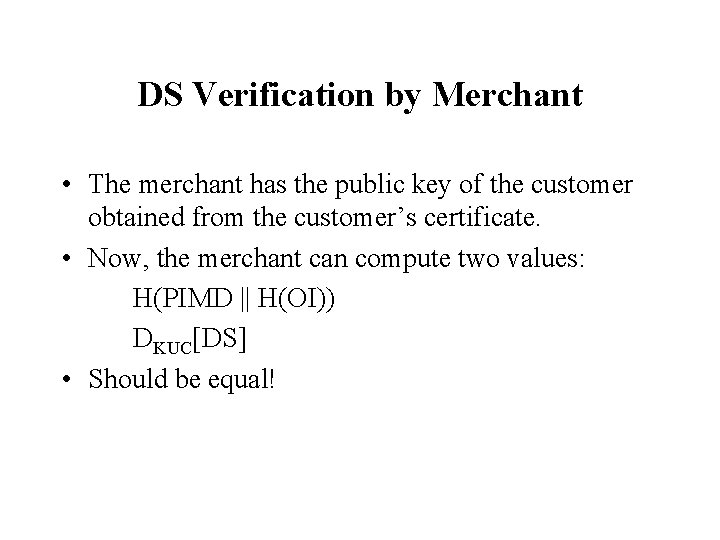
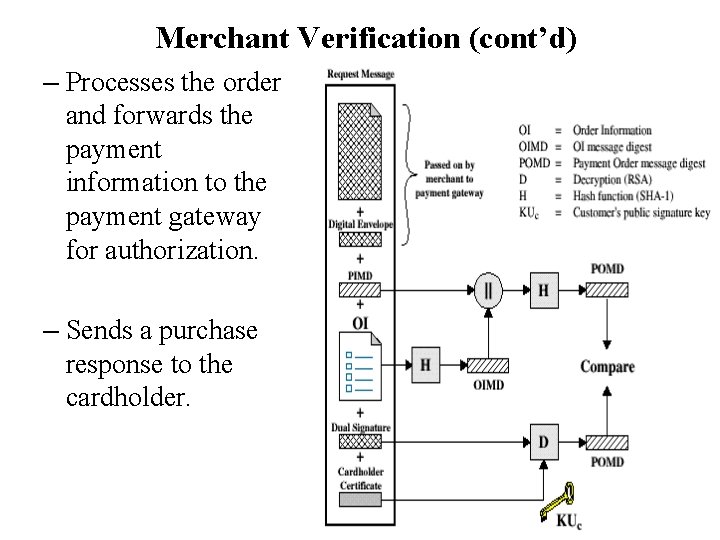
DS Verification by Merchant • The merchant has the public key of the customer obtained from the customer’s certificate. • Now, the merchant can compute two values: H(PIMD || H(OI)) DKUC[DS] • Should be equal!
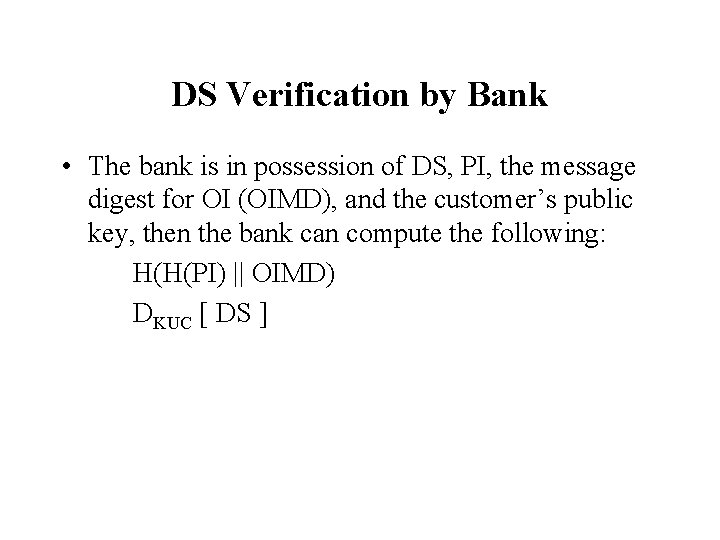
DS Verification by Bank • The bank is in possession of DS, PI, the message digest for OI (OIMD), and the customer’s public key, then the bank can compute the following: H(H(PI) || OIMD) DKUC [ DS ]
What did we accomplish? • The merchant has received OI and verified the signature. • The bank has received PI and verified the signature. • The customer has linked the OI and PI and can prove the linkage.
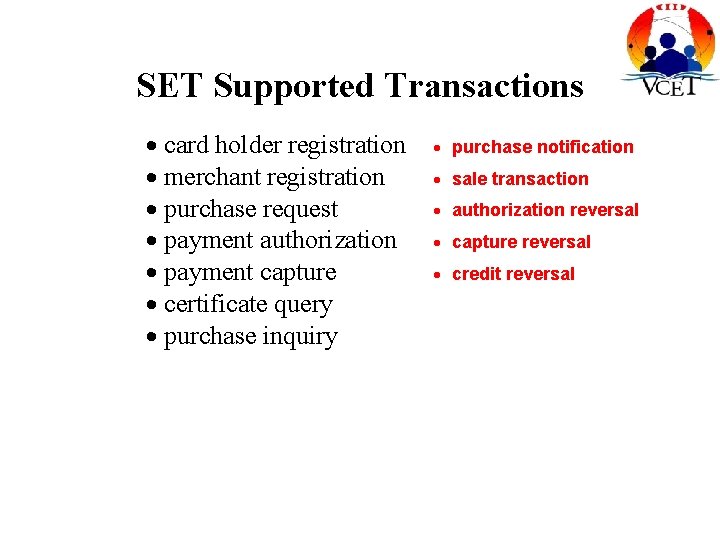
SET Supported Transactions · card holder registration · merchant registration · purchase request · payment authorization · payment capture · certificate query · purchase inquiry · purchase notification · sale transaction · authorization reversal · capture reversal · credit reversal
Purchase Request • Browsing, Selecting, and Ordering is Done • Purchasing Involves 4 Messages: – Initiate Request – Initiate Response – Purchase Request – Purchase Response
Purchase Request: Initiate Request • Basic Requirements: – Cardholder Must Have Copy of Certificates for Merchant and Payment Gateway • Customer Requests the Certificates in the Initiate Request Message to Merchant – Brand of Credit Card – ID Assigned to this Request/response pair by customer – Nonce
Purchase Request: Initiate Response • Merchant Generates a Response – Signs with Private Signature Key – Include Customer Nonce – Include Merchant Nonce (Returned in Next Message) – Transaction ID for Purchase Transaction • In Addition … – Merchant’s Signature Certificate – Payment Gateway’s Key Exchange Certificate
Purchase Request: • Cardholder Verifies Two Certificates Using Their CAs and Creates the OI and PI. • Message Includes: – Purchase-related Information – Order-related Information – Cardholder Certificate
Purchase Request • The cardholder generates a one-time symmetric encryption key, KS,
Merchant Verifies Purchase Request • When the merchant receives the Purchase Request message, it performs the following actions: – Verify the cardholder certificates by means of its CA signatures. – Verifies the dual signature using the customer’s public key signature.
Merchant Verification (cont’d) – Processes the order and forwards the payment information to the payment gateway for authorization. – Sends a purchase response to the cardholder.
Purchase Response Message • Message that Acknowledges the Order and References Corresponding Transaction Number • Block is – Signed by Merchant Using its Private Key – Block and Signature Are Sent to Customer Along with Merchant’s Signature Certificate • Upon Reception – Verifies Merchant Certificate – Verifies Signature on Response Block – Takes the Appropriate Action
Payment Process • The payment process is broken down into two steps: – Payment authorization – Payment capture
Payment Authorization • The merchant sends an authorization request message to the payment gateway consisting of the following: – Purchase-related information • PI • Dual signature calculated over the PI & OI and signed with customer’s private key. • The OI message digest (OIMD) • The digital envelop – Authorization-related information – Certificates
Payment Authorization (cont’d) – Authorization-related information • An authorization block including: – A transaction ID – Signed with merchant’s private key – Encrypted one-time session key – Certificates • Cardholder’s signature key certificate • Merchant’s key exchange certificate
Payment: Payment Gateway • Verify All Certificates • Decrypt Authorization Block Digital Envelope to Obtain Symmetric Key and Decrypt Block • Verify Merchant Signature on Authorization Block • Decrypt Payment Block Digital Envelope to Obtain Symmetric Key and Decrypt Block • Verify Dual Signature on Payment Block • Verify Received Transaction ID Received from Merchant Matches PI Received from Customer • Request and Receive Issuer Authorization
Authorization Response • Authorization Response Message – Authorization-related Information – Capture Token Information – Certificate
SET Overhead • • Simple purchase transaction: Four messages between merchant and customer Two messages between merchant and payment gateway 6 digital signatures 9 RSA encryption/decryption cycles 4 DES encryption/decryption cycles 4 certificate verifications Scaling: Multiple servers need copies of all certificates