
Secure Conjunctive Keyword Search Over Encrypted Data Philippe
- Slides: 18
Secure Conjunctive Keyword Search Over Encrypted Data Philippe Golle Jessica Staddon Palo Alto Research Center Brent Waters Princeton University
Motivating Scenario • Alice has a large amount of data – – – • Which is private Which she wants to access any time and from anywhere Example: her emails Alice stores her data on a remote server – – Good connectivity Low administration overhead Cheaper cost of storage But untrusted 1. Alice may not trust the server • Data must be stored encrypted 2. Alice wants ability to search her data • Keyword search: “All emails from Bob” 3. Alice wants powerful, efficient search • • She wants to ask conjunctive queries E. g. ask for “All emails from Bob AND received last Sunday”
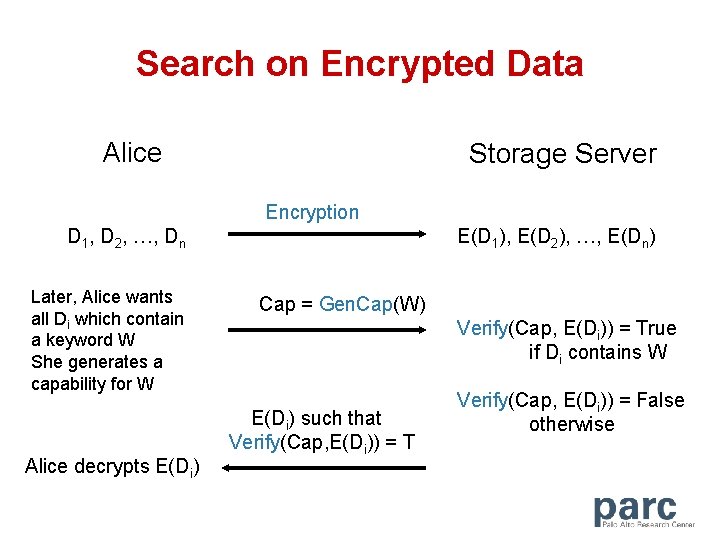
Search on Encrypted Data Alice Storage Server Encryption D 1, D 2, …, Dn Later, Alice wants all Di which contain a keyword W She generates a capability for W Alice decrypts E(Di) E(D 1), E(D 2), …, E(Dn) Cap = Gen. Cap(W) Verify(Cap, E(Di)) = True if Di contains W E(Di) such that Verify(Cap, E(Di)) = T Verify(Cap, E(Di)) = False otherwise
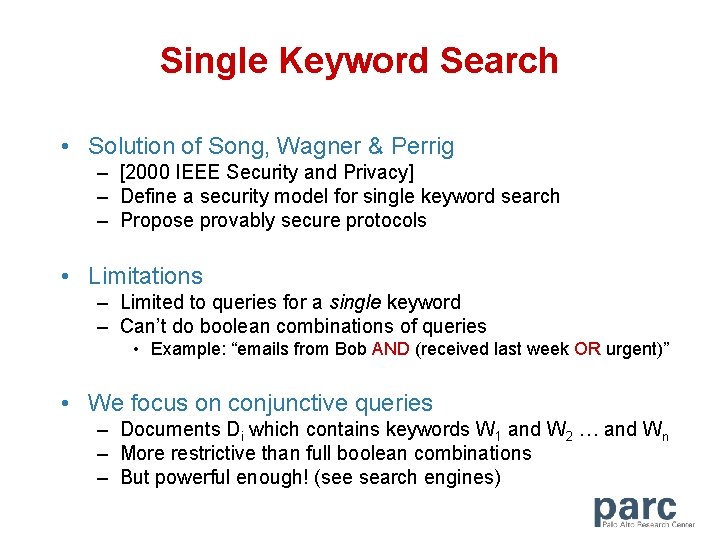
Single Keyword Search • Solution of Song, Wagner & Perrig – [2000 IEEE Security and Privacy] – Define a security model for single keyword search – Propose provably secure protocols • Limitations – Limited to queries for a single keyword – Can’t do boolean combinations of queries • Example: “emails from Bob AND (received last week OR urgent)” • We focus on conjunctive queries – Documents Di which contains keywords W 1 and W 2 … and Wn – More restrictive than full boolean combinations – But powerful enough! (see search engines)
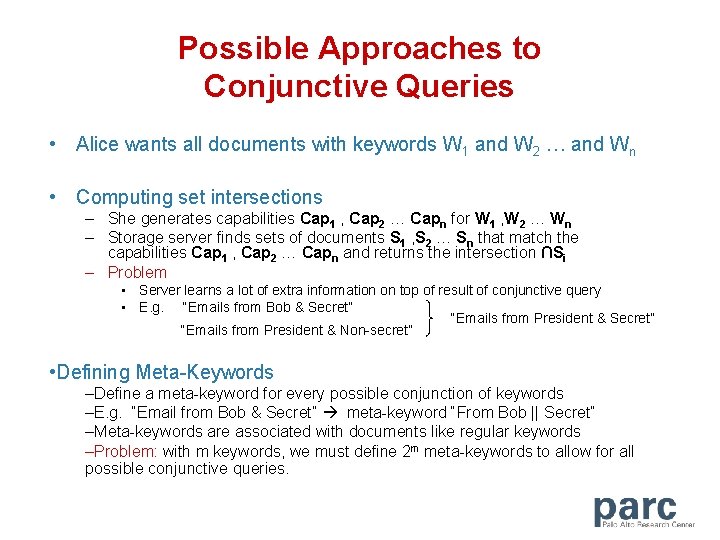
Possible Approaches to Conjunctive Queries • Alice wants all documents with keywords W 1 and W 2 … and Wn • Computing set intersections – She generates capabilities Cap 1 , Cap 2 … Capn for W 1 , W 2 … Wn – Storage server finds sets of documents S 1 , S 2 … Sn that match the capabilities Cap 1 , Cap 2 … Capn and returns the intersection ∩Si – Problem • Server learns a lot of extra information on top of result of conjunctive query • E. g. “Emails from Bob & Secret” “Emails from President & Non-secret” • Defining Meta-Keywords –Define a meta-keyword for every possible conjunction of keywords –E. g. “Email from Bob & Secret” meta-keyword “From Bob || Secret” –Meta-keywords are associated with documents like regular keywords –Problem: with m keywords, we must define 2 m meta-keywords to allow for all possible conjunctive queries.
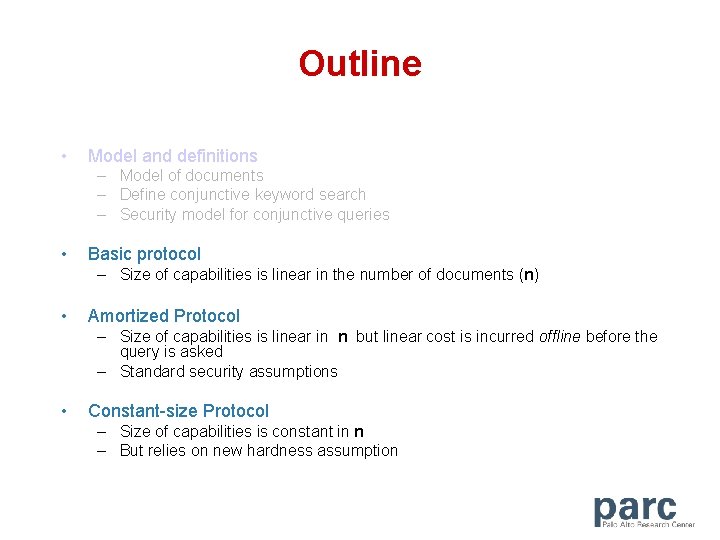
Outline • Model and definitions – Model of documents – Define conjunctive keyword search – Security model for conjunctive queries • Basic protocol – Size of capabilities is linear in the number of documents (n) • Amortized Protocol – Size of capabilities is linear in n but linear cost is incurred offline before the query is asked – Standard security assumptions • Constant-size Protocol – Size of capabilities is constant in n – But relies on new hardness assumption
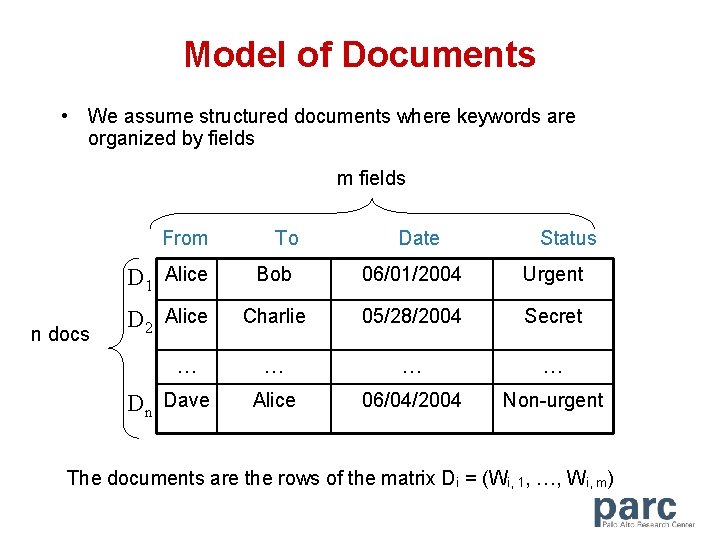
Model of Documents • We assume structured documents where keywords are organized by fields m fields From n docs To Date Status D 1 Alice Bob 06/01/2004 Urgent D 2 Alice Charlie 05/28/2004 Secret … … … Alice 06/04/2004 Non-urgent … Dn Dave The documents are the rows of the matrix Di = (Wi, 1, …, Wi, m)
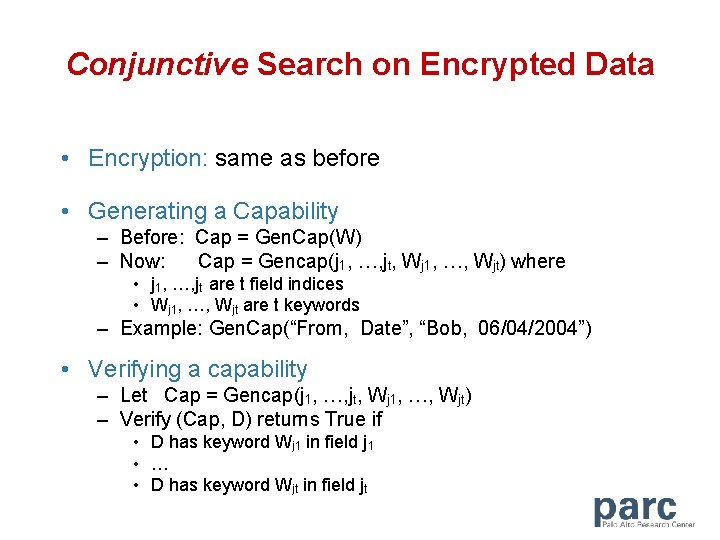
Conjunctive Search on Encrypted Data • Encryption: same as before • Generating a Capability – Before: Cap = Gen. Cap(W) – Now: Cap = Gencap(j 1, …, jt, Wj 1, …, Wjt) where • j 1, …, jt are t field indices • Wj 1, …, Wjt are t keywords – Example: Gen. Cap(“From, Date”, “Bob, 06/04/2004”) • Verifying a capability – Let Cap = Gencap(j 1, …, jt, Wj 1, …, Wjt) – Verify (Cap, D) returns True if • D has keyword Wj 1 in field j 1 • … • D has keyword Wjt in field jt
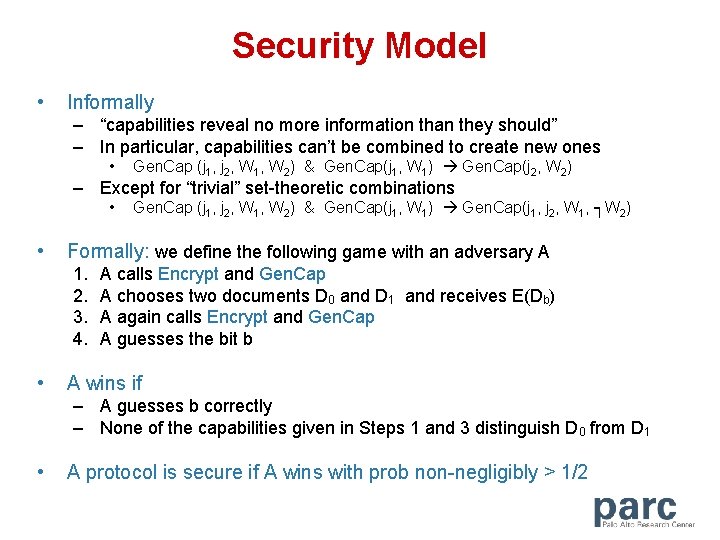
Security Model • Informally – “capabilities reveal no more information than they should” – In particular, capabilities can’t be combined to create new ones • Gen. Cap (j 1, j 2, W 1, W 2) & Gen. Cap(j 1, W 1) Gen. Cap(j 2, W 2) – Except for “trivial” set-theoretic combinations • • Formally: we define the following game with an adversary A 1. 2. 3. 4. • Gen. Cap (j 1, j 2, W 1, W 2) & Gen. Cap(j 1, W 1) Gen. Cap(j 1, j 2, W 1, ┐W 2) A calls Encrypt and Gen. Cap A chooses two documents D 0 and D 1 and receives E(Db) A again calls Encrypt and Gen. Cap A guesses the bit b A wins if – A guesses b correctly – None of the capabilities given in Steps 1 and 3 distinguish D 0 from D 1 • A protocol is secure if A wins with prob non-negligibly > 1/2
Outline • Model and definitions – Model of documents – Define conjunctive keyword search – Security model for conjunctive queries • Basic protocol – Size of capabilities is linear in the number of documents (n) • Amortized Protocol – Size of capabilities is linear in n but linear cost is incurred offline before the query is asked – Standard security assumptions • Constant-size Protocol – Size of capabilities is constant in n – But relies on new hardness assumption
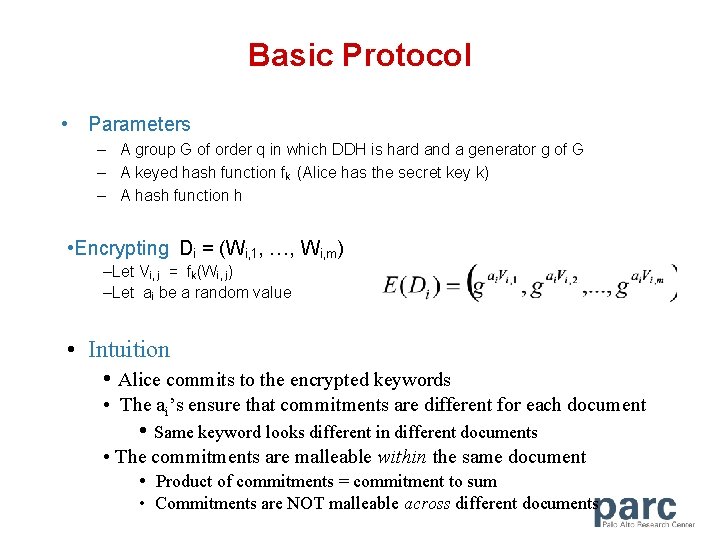
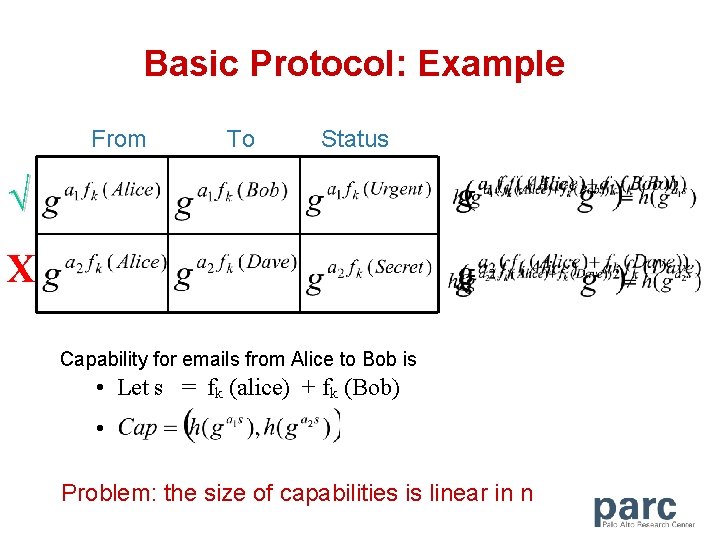
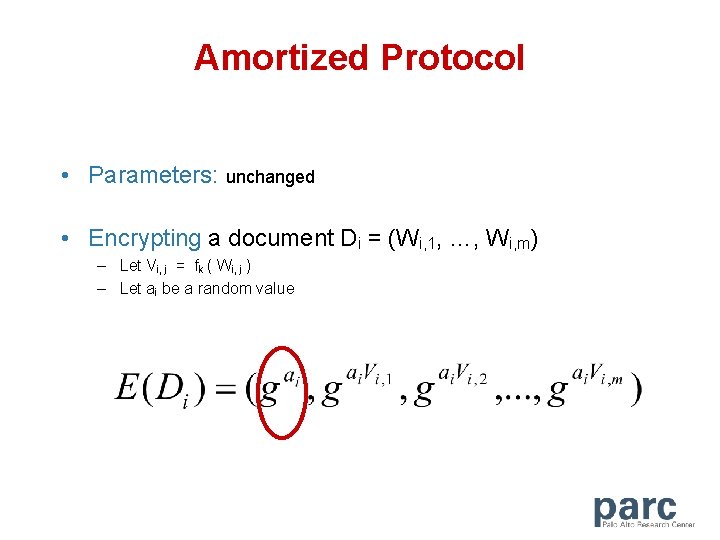
Basic Protocol • Parameters – A group G of order q in which DDH is hard and a generator g of G – A keyed hash function fk (Alice has the secret key k) – A hash function h • Encrypting Di = (Wi, 1, …, Wi, m) –Let Vi, j = fk(Wi, j) –Let ai be a random value • Intuition • Alice commits to the encrypted keywords • The ai’s ensure that commitments are different for each document • Same keyword looks different in different documents • The commitments are malleable within the same document • Product of commitments = commitment to sum • Commitments are NOT malleable across different documents
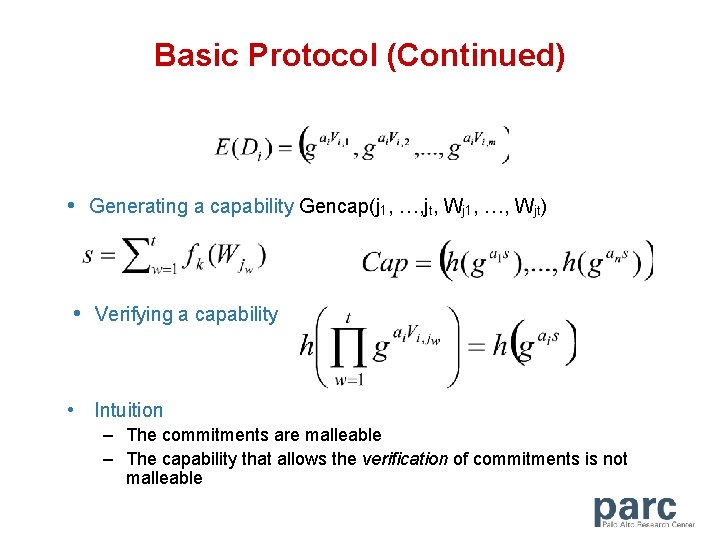
Basic Protocol (Continued) • Generating a capability Gencap(j 1, …, jt, Wj 1, …, Wjt) • Verifying a capability • Intuition – The commitments are malleable – The capability that allows the verification of commitments is not malleable
Basic Protocol: Example From To Status √ X Capability for emails from Alice to Bob is • Let s = fk (alice) + fk (Bob) • Problem: the size of capabilities is linear in n
Amortized Protocol • Parameters: unchanged • Encrypting a document Di = (Wi, 1, …, Wi, m) – Let Vi, j = fk ( Wi, j ) – Let ai be a random value
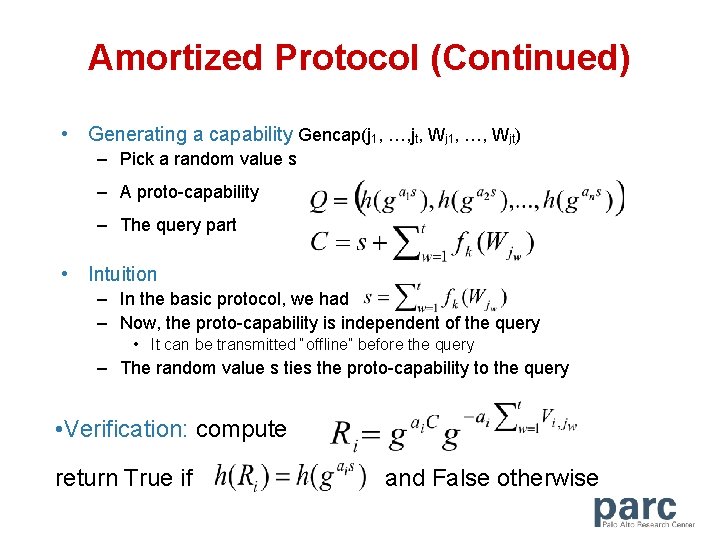
Amortized Protocol (Continued) • Generating a capability Gencap(j 1, …, jt, Wj 1, …, Wjt) – Pick a random value s – A proto-capability – The query part • Intuition – In the basic protocol, we had – Now, the proto-capability is independent of the query • It can be transmitted “offline” before the query – The random value s ties the proto-capability to the query • Verification: compute return True if and False otherwise
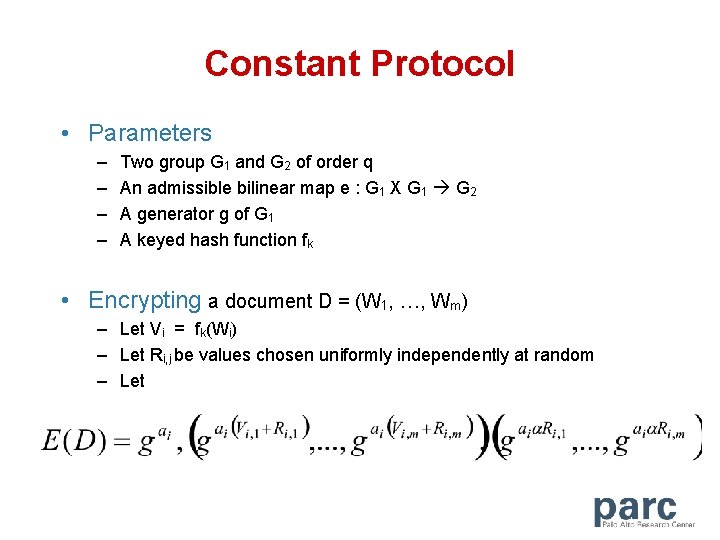
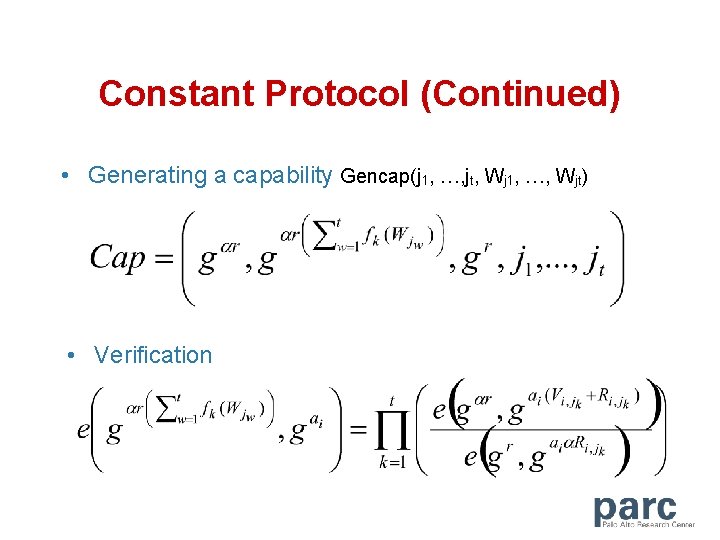
Constant Protocol • Parameters – – Two group G 1 and G 2 of order q An admissible bilinear map e : G 1 X G 1 G 2 A generator g of G 1 A keyed hash function fk • Encrypting a document D = (W 1, …, Wm) – Let Vi = fk(Wi) – Let Ri, j be values chosen uniformly independently at random – Let
Constant Protocol (Continued) • Generating a capability Gencap(j 1, …, jt, Wj 1, …, Wjt) • Verification
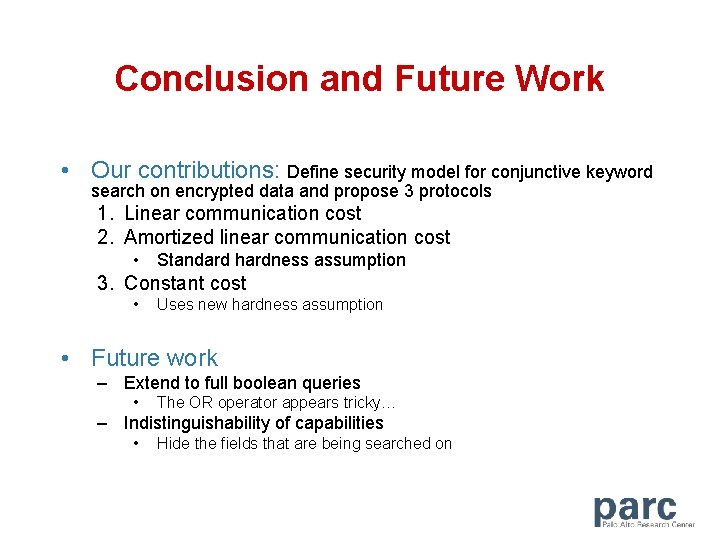
Conclusion and Future Work • Our contributions: Define security model for conjunctive keyword search on encrypted data and propose 3 protocols 1. Linear communication cost 2. Amortized linear communication cost • Standard hardness assumption 3. Constant cost • Uses new hardness assumption • Future work – Extend to full boolean queries • The OR operator appears tricky… – Indistinguishability of capabilities • Hide the fields that are being searched on