
Sector Strategies 101 Sector Strategies The Value Proposition



- Slides: 50
Sector Strategies 101
Sector Strategies: The Value Proposition
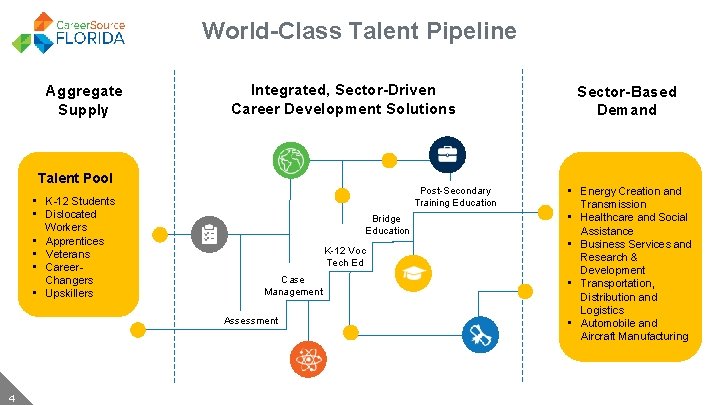
World-Class Talent Pipeline Aggregate Supply Integrated, Sector-Driven Career Development Solutions Talent Pool • K-12 Students • Dislocated Workers • Apprentices • Veterans • Career. Changers • Upskillers Post-Secondary Training Education Bridge Education K-12 Voc Tech Ed Case Management Assessment 4 Sector-Based Demand • Energy Creation and Transmission • Healthcare and Social Assistance • Business Services and Research & Development • Transportation, Distribution and Logistics • Automobile and Aircraft Manufacturing
Local Workforce Development Board Role • • • 5 Intermediaries/conveners Fiscal agents Service delivery leaders Service brokers Data and information providers Supportive partners
Sector Strategies: Six Key Elements
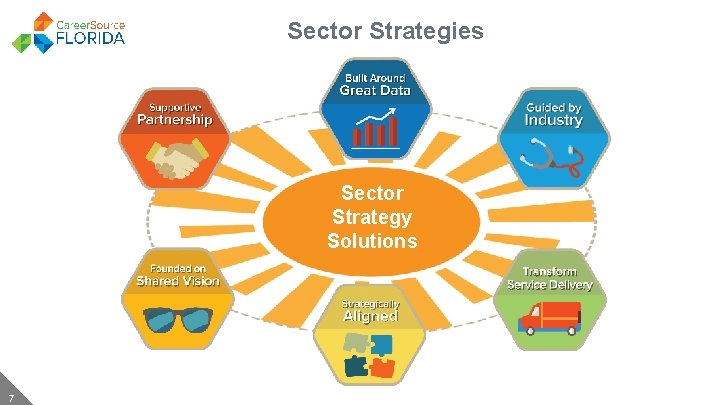
Sector Strategies Sector Strategy Solutions 7
ELEMENT 1: BUILT AROUND GREAT DATA
Built Around Great Data • Tell a story about demographics and sectors that are growing in today’s and tomorrow’s economies • Become the foundation for selecting targeted sectors • Decisions are made on great data 9
Industry Concentration and Growth • Economic Modeling Inc. o Industry employment (2 -6 digit), earnings, establishments o Occupation employment (2 -6 digit), wages, openings o Proprietary data set estimated 2001 -2021 • Moody’s Analytics (Data Buffet) o Data ranging from banking, labor market, demographics o Mostly public data, some proprietary estimates • Regional Economic Modeling Inc. o Economic Impact Model (baseline vs. adjustment) o 70 sectors x 67 counties 10
Labor Supply and Resources • Market Intelligence Portal (Career. Source Florida) o Supply and Demand analysis tool o All counties in U. S. • Job Seekers and Skill Sets: o Job seeker data (employflorida. com) o Integrated Postsecondary Education Data System historical completion data (National Center for Education Statistics) • Job Offerings: o Help Wanted Online (Conference Board) 11
Analysis Questions to consider: 1. Is the industry concentrated regionally? 2. Is the industry sizable and growing? 3. Does the industry meet the region’s outcome expectations (earnings creation, wage levels, etc. )? 4. Are there untapped assets in the region that could give an industry the opportunity to grow or emerge? 12
Data Resources • Deeper Dive into Demand-Side Data: Identifying Target Sectors • Deeper Dive into Supply-Side Data: Identifying Occupations & Skill Sets Aligned to Target Industries • Visualizing Data to Improve Workforce Development Collaboration • Labor Market Planning for Data-Driven Results: Getting Outcomes that Change Labor Markets 13
ELEMENT 2: FOUNDED ON A SHARED REGIONAL VISION
Founded on a Shared Regional Vision • Foundation for a talent pipeline that all partners support and pledge to align around • Common thread that allows us to work together 15
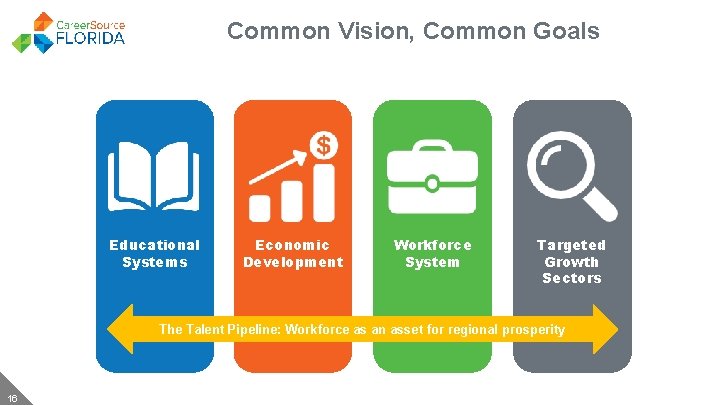
Common Vision, Common Goals Educational Systems Economic Development Workforce System Targeted Growth Sectors The Talent Pipeline: Workforce as an asset for regional prosperity 16
The Power of a Shared Vision All partners must individually and collectively own a shared regional identity and vision. Your vision is: • Critical to driving new regional behavior • A “touchstone” when a region faces challenges • The driver for regional strategies, partner investments and priority-setting 17
Institutionalize Your Vision! • Use a “Project Charter” o Defines your mission and articulates the vision o Defines membership and roles of your partnership • What is expected of each member? o Defines your objectives and timelines o Defines your outcomes and metrics • How will you measure success? o Serves as a “cornerstone” to keep you on track and focused o A “founding document” that should be “memorialized” by leadership o Serves to orient new members to your cause 18
Capacity Building and Best Practices • The Process to Establish Career Pathways: A Guide for Workforce Boards • Washington's Workforce Development Plan: Talent and Prosperity for All (TAP) • The Colorado Talent Pipeline Report • Pathways and Partnerships: New Jersey’s Blueprint For Talent Development 19
ELEMENT 3: GUIDED BY INDUSTRY
Guided by Industry • Engage with business leaders in key sectors • Form a true public-private partnership • We listen and understand their needs and align to meet those needs • Business will lead, not us; but solutions will be a winwin 21
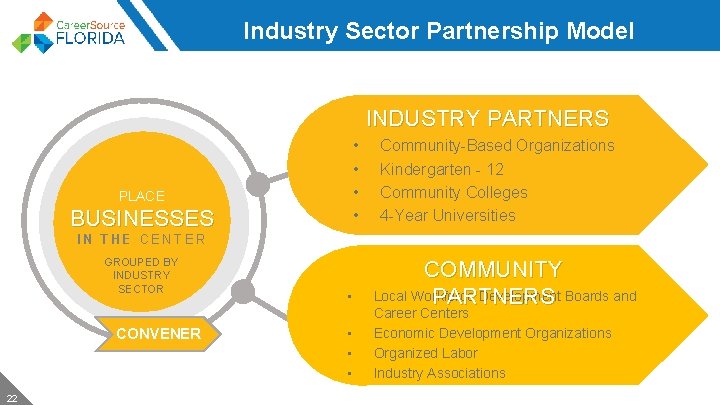
Industry Sector Partnership Model INDUSTRY PARTNERS • • PLACE BUSINESSES Community-Based Organizations Kindergarten - 12 Community Colleges 4 -Year Universities IN THE CENTER GROUPED BY INDUSTRY SECTOR CONVENER 22 • • COMMUNITY Local Workforce Development Boards and PARTNERS Career Centers Economic Development Organizations Organized Labor Industry Associations
The Employer-Customer’s Perspective • Employers have identified talent needs, challenges and obstacles as well as solutions • Partner training, education and resources are aligned and coordinated around customized solutions • Duplication is eliminated and investments are streamlined • Industry-knowledgeable staff 23
The Job Seeker-Customer’s Perspective • Receive meaningful career information • More opportunities (training, internships) to get to regional high-growth companies • Seamless and defined career pathways 24
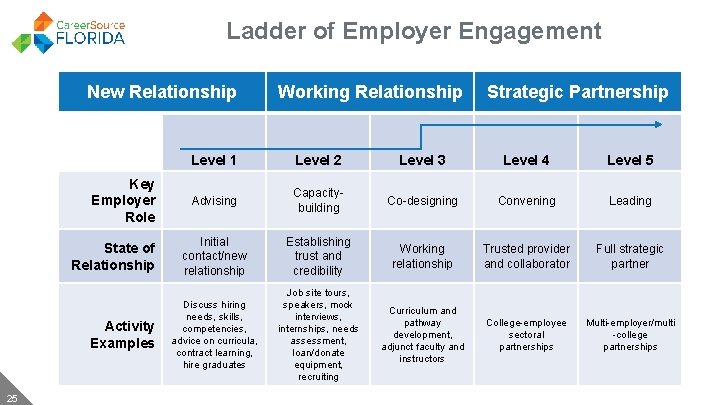
Ladder of Employer Engagement New Relationship Key Employer Role State of Relationship Activity Examples 25 Working Relationship Strategic Partnership Level 1 Level 2 Level 3 Level 4 Level 5 Advising Capacitybuilding Co-designing Convening Leading Initial contact/new relationship Establishing trust and credibility Working relationship Trusted provider and collaborator Full strategic partner Discuss hiring needs, skills, competencies, advice on curricula, contract learning, hire graduates Job site tours, speakers, mock interviews, internships, needs assessment, loan/donate equipment, recruiting Curriculum and pathway development, adjunct faculty and instructors College-employee sectoral partnerships Multi-employer/multi -college partnerships
Capacity Building and Best Practices • Industry Engagement: An Overview • A Resource Guide to Engaging Employers • Boston Healthcare Careers Consortium (The Consortium) • Colorado Regional Sector Partnership Convener Training Workbook • Sector Partnership-based Employer Engagement: A Framework for Illinois 26
ELEMENT 4: STRATEGIC ALIGNMENT
Lead to Strategic Alignment 28 • A common vision, using solid data, being led by business = strategic alignment • Sectors become everyone’s job • Everyone is committed to the vision of improved regional prosperity through a skilled workforce development program
What Does Alignment Look Like? Indicators of System Alignment: • Partners align strategic plans to target the same sectors while developing implementation/work plans with resources to serve those sectors • Partners align their policies and practices/processes to ensure focus on shared priorities and promote collaboration to achieve those priorities o Examples: • Unified business engagement/services • Data sharing • Joint case management • 29 Establish common performance measure(s) re: sectors across partners
Capacity Building and Best Practices • Organizational Capacity & Alignment Workshop • The Road to Successful Sector Partnerships • Career Pathways Toolkit: An Enhanced Guide and Workbook for System Development • Data Sharing Toolkit • Data Sharing Initiatives and Webinars - Sharing Data for Evaluation 30
ELEMENT 5: TRANSFORM HOW SERVICES ARE DELIVERED
Transform how Services are Delivered • How might sector-based approaches influence how you do your job? • Or how you work with your customers every day? • Services must be designed and delivered to support the shared vision and aligned policies, process and resources 32
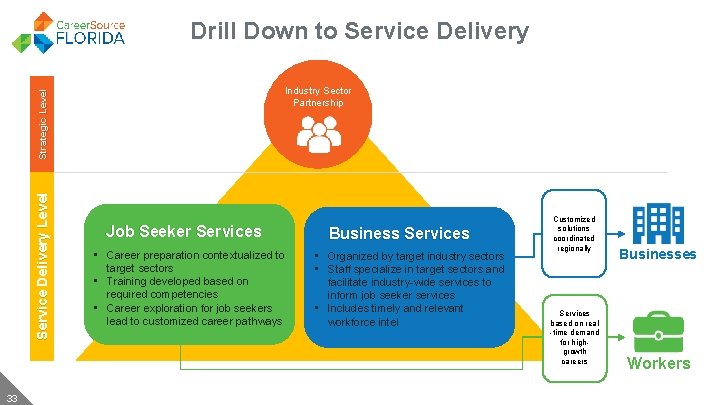
Drill Down to Service Delivery Level Strategic Level Industry Sector Partnership 33 Job Seeker Services • Career preparation contextualized to target sectors • Training developed based on required competencies • Career exploration for job seekers lead to customized career pathways Business Services • Organized by target industry sectors • Staff specialize in target sectors and facilitate industry-wide services to inform job seeker services • Includes timely and relevant workforce intel Customized solutions coordinated regionally Services based on real -time demand for highgrowth careers Businesses Workers
Unified Business Engagement and Services • Unified business engagement and services means partners are coordinating (often through Business Services Teams) to provide employers with a single point of contact who understands and speaks for the entire system. This approach is based on the following principles: o Customer at the center o Collaboration, not competition (and leveraging partners’ strengths) o Seamless communication 34
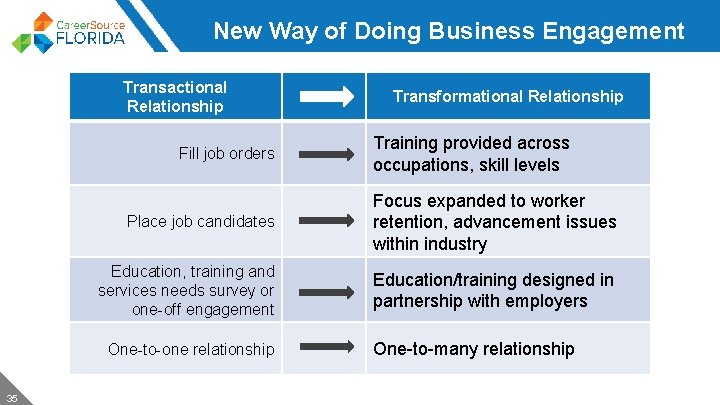
New Way of Doing Business Engagement Transactional Relationship Fill job orders Training provided across occupations, skill levels Place job candidates Focus expanded to worker retention, advancement issues within industry Education, training and services needs survey or one-off engagement Education/training designed in partnership with employers One-to-one relationship 35 Transformational Relationship One-to-many relationship
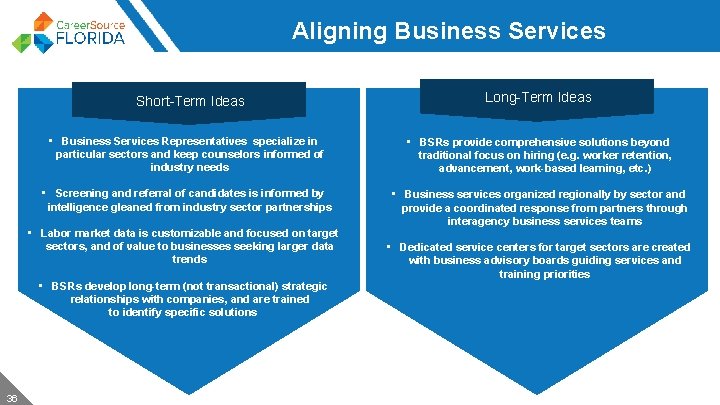
Aligning Business Services Short-Term Ideas • Business Services Representatives specialize in particular sectors and keep counselors informed of industry needs • Screening and referral of candidates is informed by intelligence gleaned from industry sector partnerships • Labor market data is customizable and focused on target sectors, and of value to businesses seeking larger data trends • BSRs develop long-term (not transactional) strategic relationships with companies, and are trained to identify specific solutions 36 Long-Term Ideas Employer and Job Seeker beyond • BSRs provide comprehensive solutions Service Providers traditional focus on hiring (e. g. worker retention, advancement, work-based learning, Feature Fouretc. ) • Workforce Service Delivery to Job passages of lorem ipsum Seekers and Employers available, but the by majority • Business services organized regionally sector and üCareer Centers/Operations suffered from alteration some of provide a coordinated response partners through Oversight formula There are many of interagency business services teams üBusiness Services Representatives variations of passages of • LWDB Strategic Plan Development lorem ipsum available • Dedicated service centers for target sectors are created and Implementation the majority • advisory Local Compliance, with business boards Financial guiding Oversight services andtraining Accountability priorities • Local Workforce Performance and Financial Tracking and Reporting
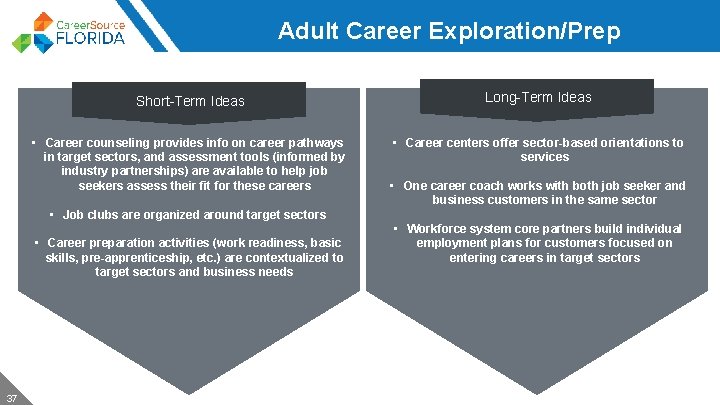
Adult Career Exploration/Prep Short-Term Ideas Long-Term Ideas • Career counseling provides info on career pathways in target sectors, and assessment tools (informed by industry partnerships) are available to help job seekers assess their fit for these careers Employer and Job Seeker • Career centers offer sector-based orientations to Service Providers services Feature Four • Workforce Service Delivery to Job passages of lorem ipsum • One career coach works both job seeker and Seekers and with Employers available, but the majority ü Career Centers/Operations business customers in the samesome sector suffered alteration of • Job clubs are organized around target sectors • Career preparation activities (work readiness, basic skills, pre-apprenticeship, etc. ) are contextualized to target sectors and business needs 37 Oversight formula There are many of üBusinessvariations Services Representatives of build passages of • Workforce system core partners individual • LWDB Strategic Plan Development lorem ipsum available employmentand plans for customers focused on Implementation the majority entering careers in target sectors • Local Compliance, Financial Oversight and Accountability • Local Workforce Performance and Financial Tracking and Reporting
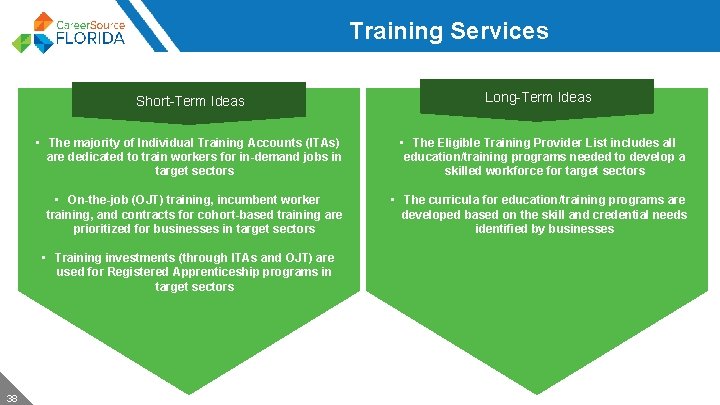
Training Services Short-Term Ideas • The majority of Individual Training Accounts (ITAs) are dedicated to train workers for in-demand jobs in target sectors • On-the-job (OJT) training, incumbent worker training, and contracts for cohort-based training are prioritized for businesses in target sectors • Training investments (through ITAs and OJT) are used for Registered Apprenticeship programs in target sectors 38 Long-Term Ideas Employer and Job. List Seeker • The Eligible Training Provider includes all Service Providers education/training programs needed to develop a Four skilled workforce for. Feature target sectors • Workforce Service Delivery to Job passages of lorem ipsum Seekers and Employers available, but the majority üCareer Centers/Operations • The curricula for education/training programs suffered alteration some of are developed based Oversight on theformula skill and credential There are many of needs üBusinessvariations Services Representatives of passages of identified by businesses • LWDB Strategic Plan Development lorem ipsum available and Implementation the majority • Local Compliance, Financial Oversight and Accountability • Local Workforce Performance and Financial Tracking and Reporting
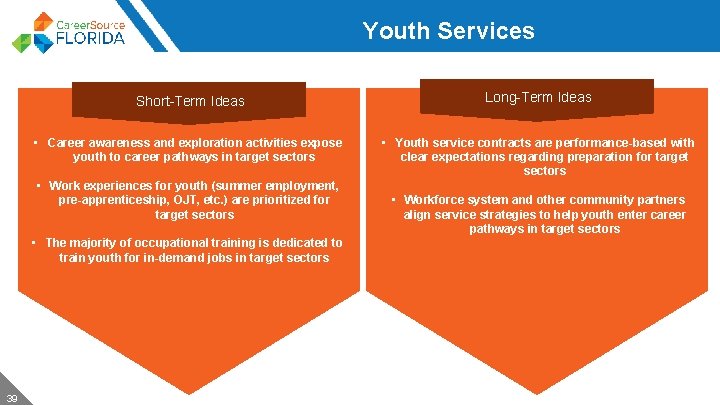
Youth Services Short-Term Ideas Long-Term Ideas • Career awareness and exploration activities expose youth to career pathways in target sectors Employer Job Seeker • Youth service contracts areand performance-based with Service Providers clear expectations regarding preparation for target Feature Four sectors • Work experiences for youth (summer employment, pre-apprenticeship, OJT, etc. ) are prioritized for target sectors • The majority of occupational training is dedicated to train youth for in-demand jobs in target sectors 39 • Workforce Service Delivery to Job passages of lorem ipsum Seekers and Employers available, but the majority üCareer • Workforce system and. Centers/Operations other community suffered alteration somepartners of Oversightto help youth enter career align service strategies formula There are many of üBusinessvariations Services Representatives of passages of pathways in target sectors • LWDB Strategic Plan Development lorem ipsum available and Implementation the majority • Local Compliance, Financial Oversight and Accountability • Local Workforce Performance and Financial Tracking and Reporting
Capacity Building and Best Practices • Changing Roles for Workforce Systems in Carrying Out Sector Strategies • Where the Rubber Hits the Road: How a Sector Strategy Plays Out at the Service Delivery Level • Integrated Service Delivery Toolkit 40
ELEMENT 6: SERVICES ARE MEASURED, IMPROVED AND SUSTAINED
Measured, Improved and Sustained How you’ll: • measure performance • adjust to changing needs • support your own workforce 42
Why Measure Sector Strategy Work? • Capturing benefits to employers helps build their ownership of the initiative • Capturing benefits to workers helps build partner engagement • Tracking outcomes ensures full benefits can be communicated to stakeholders, funding organizations and the community 43
Measuring Regional Sector Strategy Work • Work with employer partners early on to decide outcomes they want to see • May be different short- and long-term measures (short term allows for progress checks and refining strategy) • Establish a baseline so outcome measures are meaningful 44
Measuring Outputs and Impact • Outputs and products are evidence of active sector partnerships o Ex. mapping competencies, training programs, career pathways, solutions for employers regarding both workforce and beyond • Impact measures demonstrate real benefits o Ex. placement, advancement and retention rates, reduced turnover, reduced recruiting costs 45
Impact Measures for Employers • Reduced recruitment costs • Lower training costs • Reduced turnover • Lower production costs • Greater promotion potential of entry-level employees • Higher quality customer service 46
Impact Measures for Workers • Increased earnings • Increased hours worked • Greater access to employee benefits, such as healthcare and leave • Improved job retention 47
Capacity Building and Best Practices • Sector Strategies: Measuring Success • Measuring Board Success • Policy to Performance Toolkit: Transitioning Adults to Opportunity 48
General Resources • Building the Talent Pipeline: An Implementation Guide • Connecting People to Work: Workforce Intermediaries and Sector Strategies 49