
SECTOR SKILLS PLANNING WORKSHOP Sector Skills Plan Update
- Slides: 15
SECTOR SKILLS PLANNING WORKSHOP Sector Skills Plan Update 2019 -20 June – July 2019 training, educating & developing the skills workforce
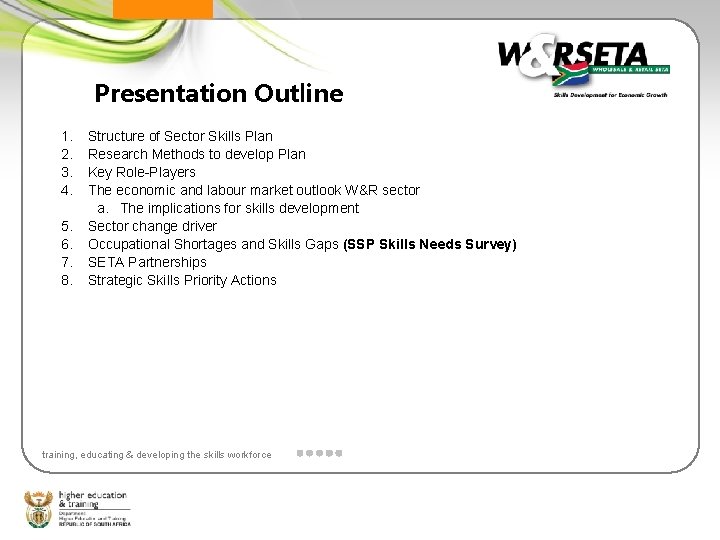
1. 2. 3. 4. 5. 6. 7. 8. Presentation Outline Structure of Sector Skills Plan Research Methods to develop Plan Key Role-Players The economic and labour market outlook W&R sector a. The implications for skills development Sector change driver Occupational Shortages and Skills Gaps (SSP Skills Needs Survey) SETA Partnerships Strategic Skills Priority Actions training, educating & developing the skills workforce
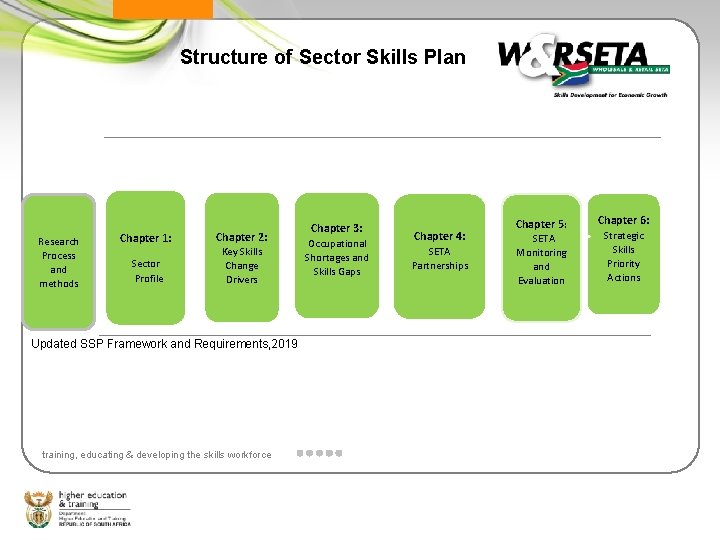
Structure of Sector Skills Plan Research Process and methods Chapter 1: Sector Profile Chapter 2: Key Skills Change Drivers Updated SSP Framework and Requirements, 2019 training, educating & developing the skills workforce Chapter 3: Occupational Shortages and Skills Gaps Chapter 4: SETA Partnerships Chapter 5: SETA Monitoring and Evaluation Chapter 6: Strategic Skills Priority Actions
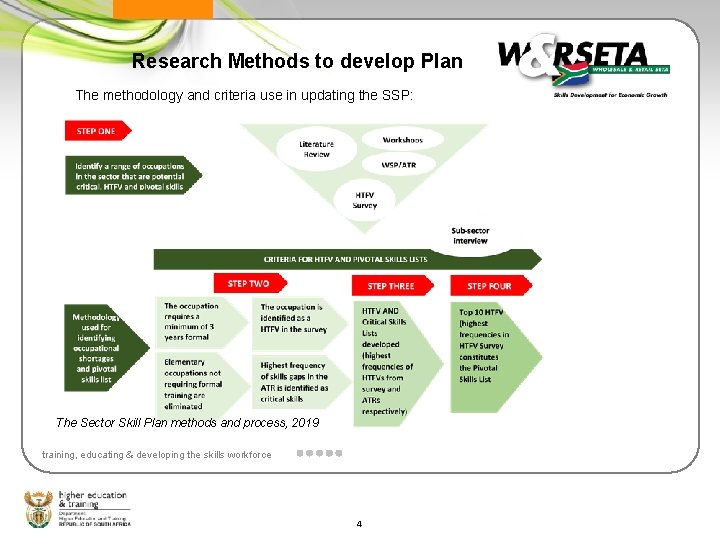
Research Methods to develop Plan The methodology and criteria use in updating the SSP: The Sector Skill Plan methods and process, 2019 training, educating & developing the skills workforce 4
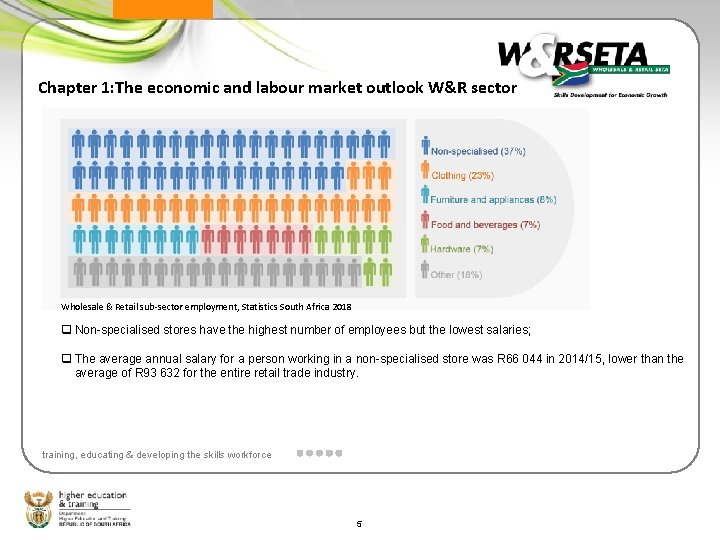
Chapter 1: The economic and labour market outlook W&R sector Wholesale & Retail sub-sector employment, Statistics South Africa 2018 Non-specialised stores have the highest number of employees but the lowest salaries; The average annual salary for a person working in a non-specialised store was R 66 044 in 2014/15, lower than the average of R 93 632 for the entire retail trade industry. training, educating & developing the skills workforce 5
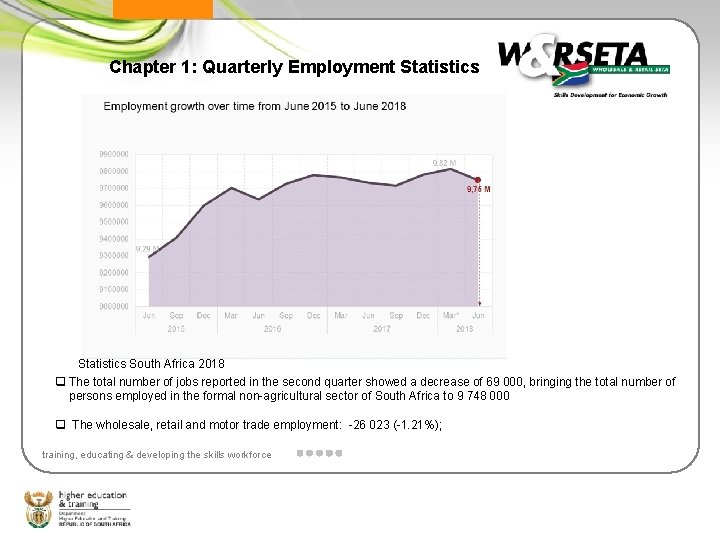
Chapter 1: Quarterly Employment Statistics South Africa 2018 The total number of jobs reported in the second quarter showed a decrease of 69 000, bringing the total number of persons employed in the formal non-agricultural sector of South Africa to 9 748 000 The wholesale, retail and motor trade employment: -26 023 (-1. 21%); training, educating & developing the skills workforce
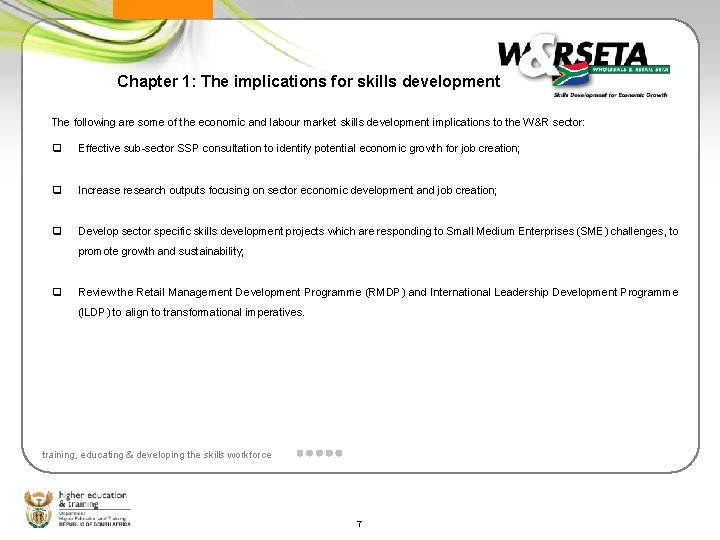
Chapter 1: The implications for skills development The following are some of the economic and labour market skills development implications to the W&R sector: Effective sub-sector SSP consultation to identify potential economic growth for job creation; Increase research outputs focusing on sector economic development and job creation; Develop sector specific skills development projects which are responding to Small Medium Enterprises (SME) challenges, to promote growth and sustainability; Review the Retail Management Development Programme (RMDP) and International Leadership Development Programme (ILDP) to align to transformational imperatives. training, educating & developing the skills workforce 7
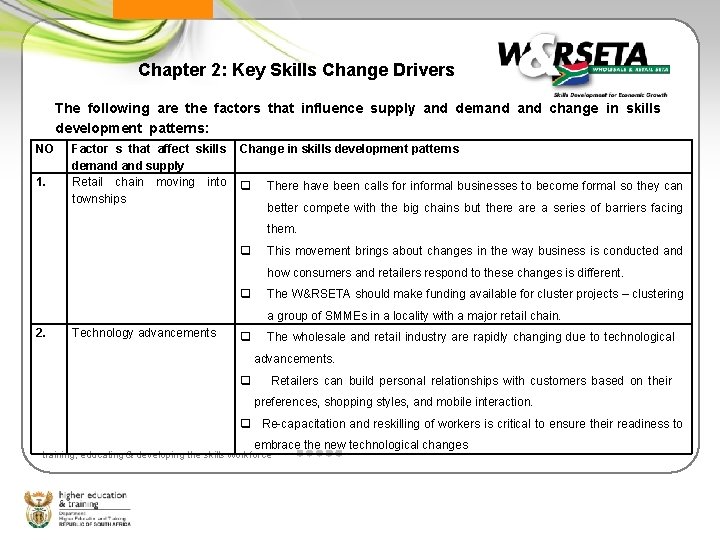
Chapter 2: Key Skills Change Drivers The following are the factors that influence supply and demand change in skills development patterns: NO 1. Factor s that affect skills Change in skills development patterns demand supply Retail chain moving into There have been calls for informal businesses to become formal so they can townships better compete with the big chains but there a series of barriers facing them. This movement brings about changes in the way business is conducted and how consumers and retailers respond to these changes is different. The W&RSETA should make funding available for cluster projects – clustering a group of SMMEs in a locality with a major retail chain. 2. Technology advancements The wholesale and retail industry are rapidly changing due to technological advancements. Retailers can build personal relationships with customers based on their preferences, shopping styles, and mobile interaction. Re-capacitation and reskilling of workers is critical to ensure their readiness to embrace the new technological changes training, educating & developing the skills workforce
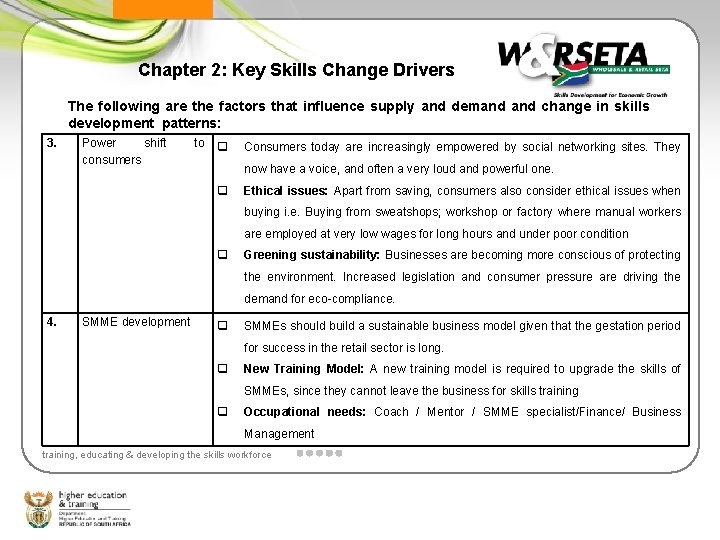
Chapter 2: Key Skills Change Drivers The following are the factors that influence supply and demand change in skills development patterns: 3. Power shift consumers to Consumers today are increasingly empowered by social networking sites. They now have a voice, and often a very loud and powerful one. Ethical issues: Apart from saving, consumers also consider ethical issues when buying i. e. Buying from sweatshops; workshop or factory where manual workers are employed at very low wages for long hours and under poor condition Greening sustainability: Businesses are becoming more conscious of protecting the environment. Increased legislation and consumer pressure are driving the demand for eco-compliance. 4. SMME development SMMEs should build a sustainable business model given that the gestation period for success in the retail sector is long. New Training Model: A new training model is required to upgrade the skills of SMMEs, since they cannot leave the business for skills training Occupational needs: Coach / Mentor / SMME specialist/Finance/ Business Management training, educating & developing the skills workforce
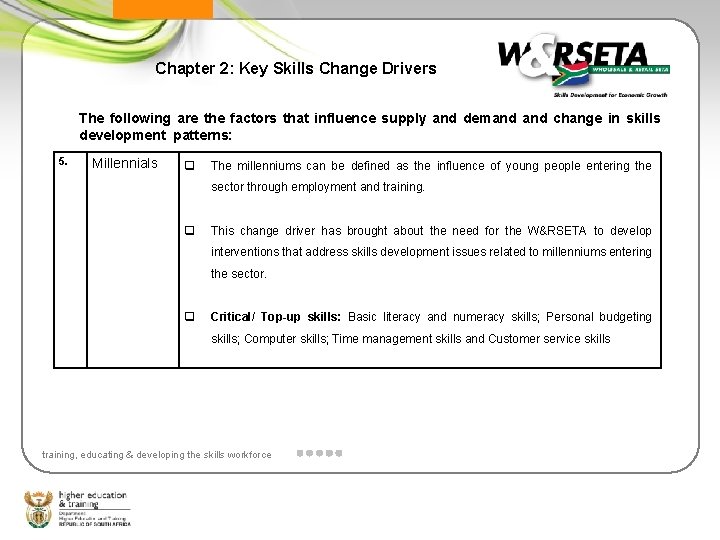
Chapter 2: Key Skills Change Drivers The following are the factors that influence supply and demand change in skills development patterns: 5. Millennials The millenniums can be defined as the influence of young people entering the sector through employment and training. This change driver has brought about the need for the W&RSETA to develop interventions that address skills development issues related to millenniums entering the sector. Critical/ Top-up skills: Basic literacy and numeracy skills; Personal budgeting skills; Computer skills; Time management skills and Customer service skills training, educating & developing the skills workforce
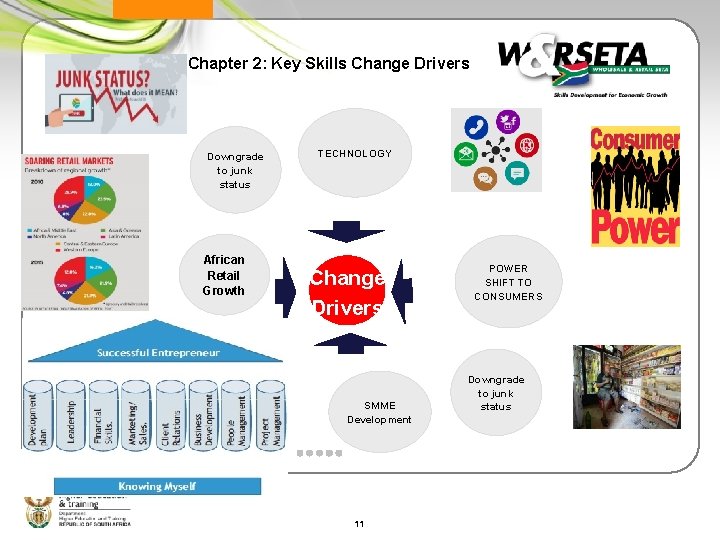
Chapter 2: Key Skills Change Drivers Downgrade to junk status African Retail Growth TECHNOLOGY Change Drivers SMME Development training, educating & developing the skills workforce 11 POWER SHIFT TO CONSUMERS Downgrade to junk status
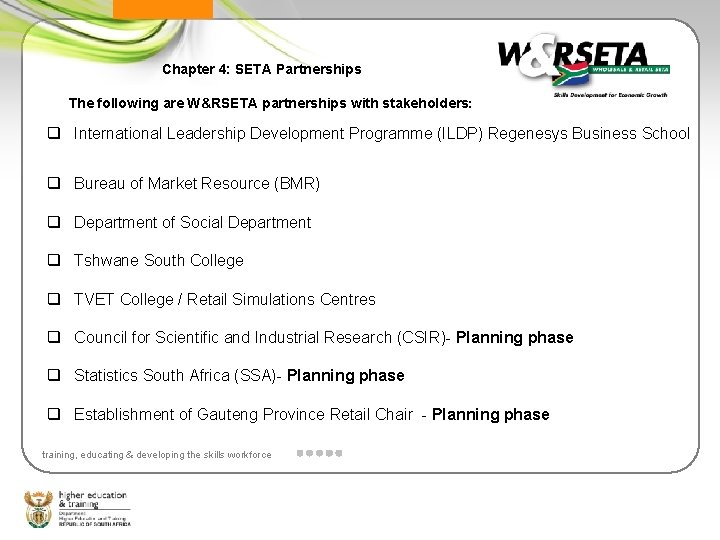
Chapter 4: SETA Partnerships The following are W&RSETA partnerships with stakeholders : International Leadership Development Programme (ILDP) Regenesys Business School Bureau of Market Resource (BMR) Department of Social Department Tshwane South College TVET College / Retail Simulations Centres Council for Scientific and Industrial Research (CSIR)- Planning phase Statistics South Africa (SSA)- Planning phase Establishment of Gauteng Province Retail Chair - Planning phase training, educating & developing the skills workforce
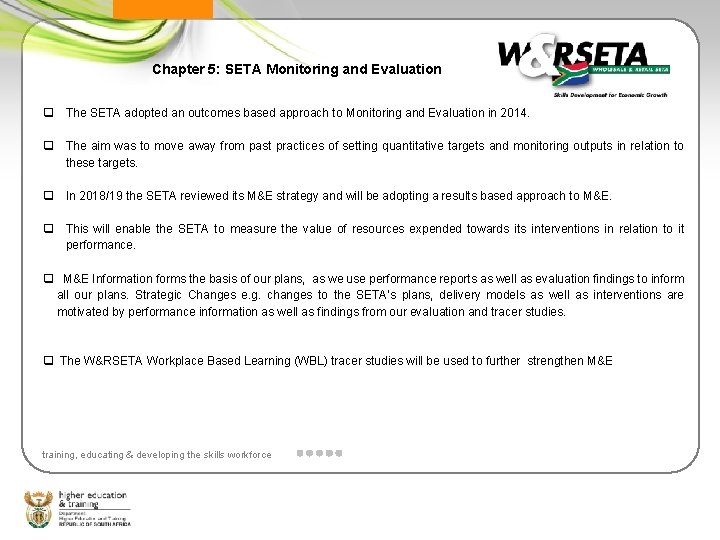
Chapter 5: SETA Monitoring and Evaluation The SETA adopted an outcomes based approach to Monitoring and Evaluation in 2014. The aim was to move away from past practices of setting quantitative targets and monitoring outputs in relation to these targets. In 2018/19 the SETA reviewed its M&E strategy and will be adopting a results based approach to M&E. This will enable the SETA to measure the value of resources expended towards its interventions in relation to it performance. M&E Information forms the basis of our plans, as we use performance reports as well as evaluation findings to inform all our plans. Strategic Changes e. g. changes to the SETA’s plans, delivery models as well as interventions are motivated by performance information as well as findings from our evaluation and tracer studies. The W&RSETA Workplace Based Learning (WBL) tracer studies will be used to further strengthen M&E training, educating & developing the skills workforce
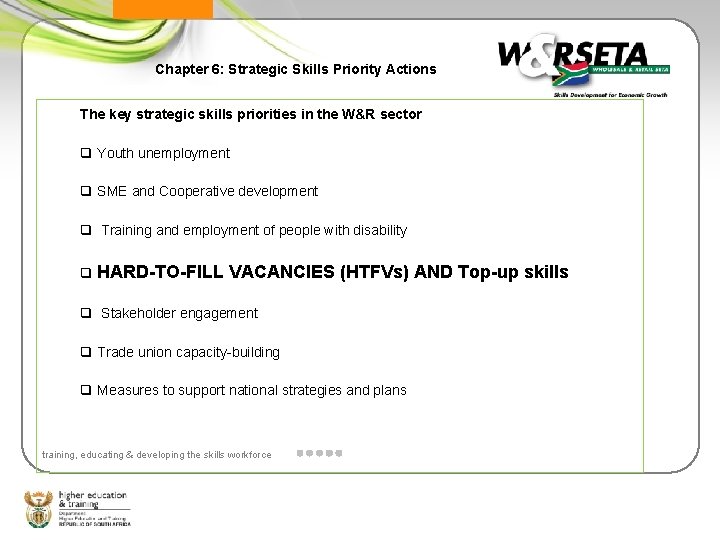
Chapter 6: Strategic Skills Priority Actions The key strategic skills priorities in the W&R sector Youth unemployment SME and Cooperative development Training and employment of people with disability HARD-TO-FILL VACANCIES (HTFVs) AND Top-up skills Stakeholder engagement Trade union capacity-building Measures to support national strategies and plans training, educating & developing the skills workforce
THANK YOU training, educating & developing the skills workforce 15