
Sections of the Rehabilitation Act of 1973 Pat
Sections of the Rehabilitation Act of 1973 Pat Sheehan (VA) and Gary Morin (NIH NCI) talk about the relationship between the Section 508 Coordinator and Reasonable Accommodations
Pat - Bio Pat joined the Department of Veterans Affairs in 1989 as a Computer Specialist and worked within the VA’s IT test facility as an adaptive trainer until 2001. Pat joined the Section 508 Office in 2001 and is currently the Chief of the 508 Office within the Department of Veterans Affairs and serves as the agency 508 Coordinator. In this capacity Pat has the responsibility of leading a team of government and contractor staff, all of whom ensures that all ICT that the VA uses, procures, maintains, or develops meet the requirements of Section 508. This includes the enforcement of the multimedia provisions within the Department to include closed captioning and audio description. The Departments 508 Office is available to IT professionals, procurement officials, and disabled VA employees to explain what Section 508 is, what disabled employees can expect from the VA regarding access and the VA’s responsibilities under Section 504 and 508.
Gary - Bio Gary is the Section 508 Coordinator the NIH’s National Cancer Institute, since early March 2020, situated within NCI’s Office of Communications and Public Liaison (OCPL). Prior to that, he was NIH’s Section 508 SME for the NIH Office of the Chief Information Officer (2008 – 2020) and the NIH Office of Equity, Diversity, and Inclusion (EDI) (2000 – 2008) In this capacity, Mr. Morin provides consultation to NCI staff regarding Information and Communication Technology’s (ICT) accessibility and its conformance with Section 508. Since the law’s implementation, he has been NIH’s sole agency-wide subject matter expert for the coordination and implementation of Section 508 of the Rehabilitation Act of 1973, as Amended, and its integration with both business ICT and digital content, as well as the role of assistive technology (AT).
The Rehabilitation Act of 1973 The Rehabilitation Act of 1973, as Amended (Rehab Act) prohibits discrimination on the basis of disability in programs conducted by federal agencies, in programs receiving federal financial assistance, in federal employment and in the employment practices of federal contractors.
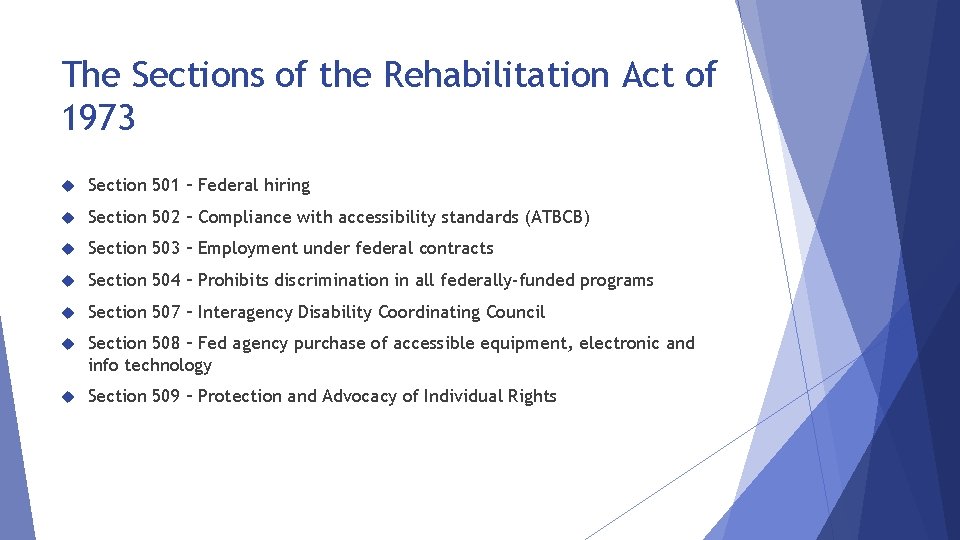
The Sections of the Rehabilitation Act of 1973 Section 501 – Federal hiring Section 502 – Compliance with accessibility standards (ATBCB) Section 503 – Employment under federal contracts Section 504 – Prohibits discrimination in all federally-funded programs Section 507 – Interagency Disability Coordinating Council Section 508 – Fed agency purchase of accessible equipment, electronic and info technology Section 509 – Protection and Advocacy of Individual Rights
Section 501 requires affirmative action and nondiscrimination in employment by Federal agencies of the executive branch. Section 501 of the Rehabilitation Act of 1973, as amended, section 501, requires a Federal Government Agency to provide reasonable accommodation for individuals with disabilities, unless it would cause undue hardship. A reasonable accommodation is any change in the work environment or in the way a job is performed that enables a person with a disability to enjoy equal employment opportunities.
Section 503 requires affirmative action and prohibits employment discrimination by Federal government contractors and subcontractors with contracts of more than $10, 000.
Section 504 states that "no qualified individual with a disability in the United States shall be excluded from, denied the benefits of, or be subjected to discrimination under" any program or activity that either receives Federal financial assistance or is conducted by any Executive agency or the United States Postal Service.
Section 508 establishes requirements for electronic and information technology developed, maintained, procured, or used by the Federal government. Section 508 requires Federal electronic and information technology to be accessible to people with disabilities, including employees and members of the public. In theory, the more that Section 508 is implemented The less reasonable accommodations may be needed The easier it is to install, implement, and use reasonable accommodations (those of an Assistive technology (AT) nature)
Key Points to Section 504 Requires nondiscrimination in federal programs, services, or activities to qualified persons with disabilities (i. e. “program access”). Applies to federal agencies and federal fund recipients.
Key Points to Section 508 Applies to federal government information and communication technology (ICT) Specific legal Exceptions: National security systems Contractor incidental Located in maintenance or monitoring spaces Undue burden (still requires alternate means) Fundamental alteration (still requires alternate means) Best meets (still requires alternate means) June 21, 2001 start date for enforcement COTS create “best meets” requirement Non-COTS still must meet all standards
Sections 504 and 508 Work Well Together Broad Generalization: Section 508 creates the accessible IT infrastructure that makes ad hoc Section 504 accommodations possible and easier. Existing technology: Section 508 enforcement is limited to procured ICT and 504 helps cover maintenance, use, and development Also complements “alternate means” requirement in Section 508 when undue burden defense is available.
Our Respective Roles Agency Section 508 Program Manager Manage an agency Section 508 program on behalf of the agency CIO, to include developing and maintaining agency policies, guidance, and best practices. Disability Employment Program Manager Responsible for ensuring your agency is a model employer for people with disabilities.
At the National Institutes of Health Disability Employment Program Manager, David Rice Supports the employment of Deaf and disabled employees across the NIH – recruitment, retention, promotion, etc. https: //www. edi. nih. gov/people/sep/pwd/about Reasonable Accommodation Consultant Team Focused on individual employees with disabilities and their requests for reasonable accommodations https: //www. edi. nih. gov/consulting/reasonable-accommodation/about Section 508: Accessibility at NIH The NIH Office of the Chief Information Officer (OCIO) is responsible for the oversight of the Section 508 program at NIH.

At the US Department of Veterans Affairs U. S. Department of Veterans Affairs, Office of Resolution Management, Diversity & Inclusion (ORMDI) https: //www. va. gov/ORM/index. asp Disability Program Manager, Roberto Rojo Reasonable Accommodations, Andree Sutton VA Section 508 Office https: //www. section 508. va. gov/
Open Discussion How do you, as Section 508 Coordinators, work with your Disability Employment Program Manager? Are you called in when an employee requests Assistive Technology? are you contacted by the Person with a Disability? the Disability Program Manager a Desktop Support staff? Does this contact with you occur before their AT is selected? How much influence do you have on the AT selected? What if their preferred AT does is not compatible with the current IT environment?
References The Rehabilitation Act of 1973: 45 Years of Activism and Progress. https: //www. insightintodiversity. com/the-rehabilitation-act-of-1973 -45 -years -of-activism-and-progress/ Web. AIM. Overview of the Rehabilitation Act of 1973 (Sections 504 and 508). https: //webaim. org/articles/laws/usa/rehab ADA. A Guide to Disability Rights Laws (February 2020). https: //www. ada. gov/cguide. htm#anchor 65610 EEOC. The Rehabilitation Act of 1973. https: //www. eeoc. gov/statutes/rehabilitation-act-1973
Contact Pat and Gary Pat Sheehan Gary M. Morin Department of Veterans Affairs VA Central Office (VACO) NCI Office of Communications and Public Liaison (OCPL) Section 508 Office, Room C 28 NCI Shady Grove Campus, Room 2 E-568 810 Vermont Ave, NW 9609 Medical Center Drive Washington, DC Rockville, MD 20850 (202) 461 -5207 (240) 276 -6920 (301) 922 -2995 cell (301) 980 -9649 cell/text Sheehan, Pat <pat. Sheehan@va. gov> Morin, Gary (NIH/NCI) [E] <moring@mail. nih. gov>
- Slides: 18