
Section VI Comprehension Chapter 14 Narrative Reading Teaching
- Slides: 18
Section VI: Comprehension Chapter 14: Narrative Reading Teaching Reading Sourcebook 2 nd edition
Reader Competencies l l Each reader brings unique competencies that affect comprehension. Comprehension builds upon the reader’s l l l speed and accuracy of decoding; reading fluency; vocabulary size; general world knowledge; specific comprehension strategies.
Dimensions of Text l l l l l Content: subject matter Genre: category of literature Structure: narrative story structure or informational Language: author’s expression of ideas: tone, voice Adept diction: skillful and precise use of words Writing quality: text clarity and coherence Complexity: readability: words, sentences, concepts Graphic design features: physical features of text Media: means of communication: print, web-based
Elements of Comprehension l Text l l l Activity l l Narrative Informational Purpose for reading: identifying reading task Processes for reading: determining approach for reading Consequences of reading: increased knowledge, engagement Context l Social and cultural factors: school, family, community
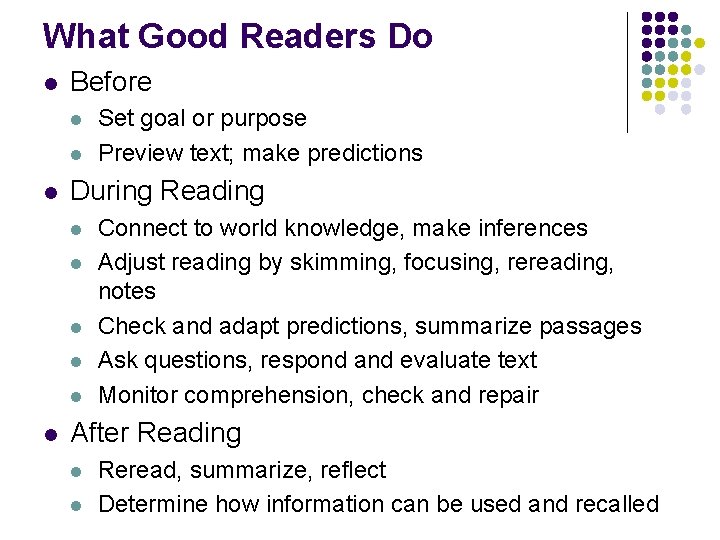
What Good Readers Do l Before l l l During Reading l l l Set goal or purpose Preview text; make predictions Connect to world knowledge, make inferences Adjust reading by skimming, focusing, rereading, notes Check and adapt predictions, summarize passages Ask questions, respond and evaluate text Monitor comprehension, check and repair After Reading l l Reread, summarize, reflect Determine how information can be used and recalled
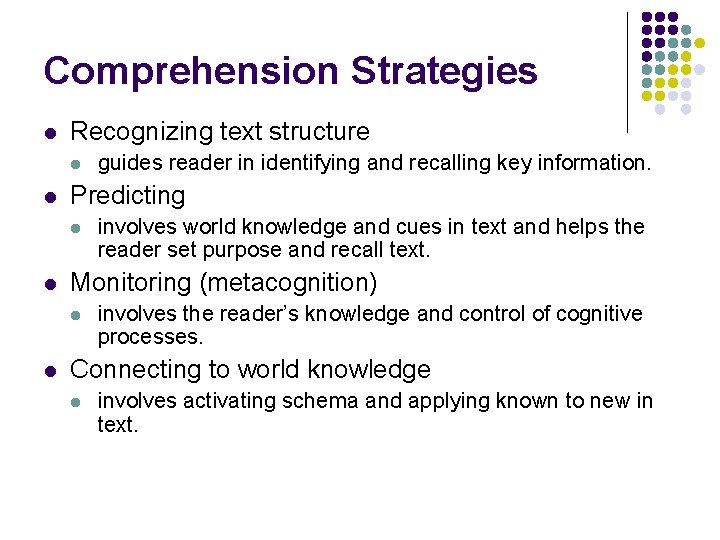
Comprehension Strategies l Recognizing text structure l l Predicting l l involves world knowledge and cues in text and helps the reader set purpose and recall text. Monitoring (metacognition) l l guides reader in identifying and recalling key information. involves the reader’s knowledge and control of cognitive processes. Connecting to world knowledge l involves activating schema and applying known to new in text.
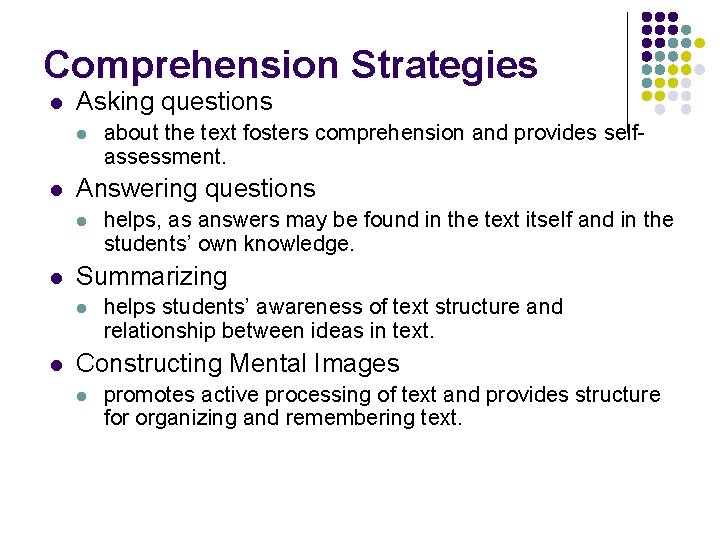
Comprehension Strategies l Asking questions l l Answering questions l l helps, as answers may be found in the text itself and in the students’ own knowledge. Summarizing l l about the text fosters comprehension and provides selfassessment. helps students’ awareness of text structure and relationship between ideas in text. Constructing Mental Images l promotes active processing of text and provides structure for organizing and remembering text.
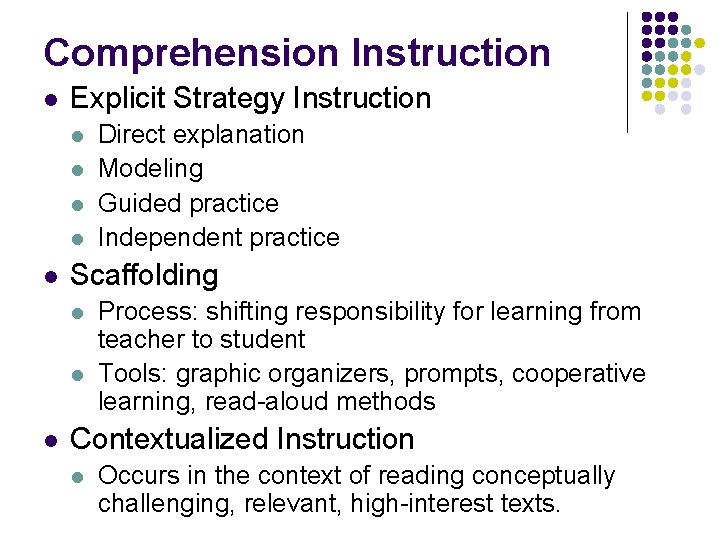
Comprehension Instruction l Explicit Strategy Instruction l l l Scaffolding l l l Direct explanation Modeling Guided practice Independent practice Process: shifting responsibility for learning from teacher to student Tools: graphic organizers, prompts, cooperative learning, read-aloud methods Contextualized Instruction l Occurs in the context of reading conceptually challenging, relevant, high-interest texts.
Reader Response l l Meaning is constructed through interaction between the reader and the text. Different readers respond in different ways. Readers in collaboration often produce meanings no single reader could. Discussion and writing are effective ways to foster reader response. l l Discussion Oriented Instruction: teacher guided/ student-led discussions, book clubs, literacy circles Writing into (before), writing through (during), writing out (after)
Narrative Reading l Comprehension instruction typically begins with narrative text because children l l l develop an awareness of narrative text early; connect narrative text elements to their own lives. Types of Narrative Text include l l fables, folk tales, fairy tales fantasies, science fiction myths, legends, tall tales plays, poems, short stories, novels
Story Structure l l l Recognizing story structure is a prerequisite to effective strategy use. Knowing story structure helps students identify what is relevant for understanding. Story elements include: l l l setting characters plot theme A story map is a graphic organizer for narrative text structure.
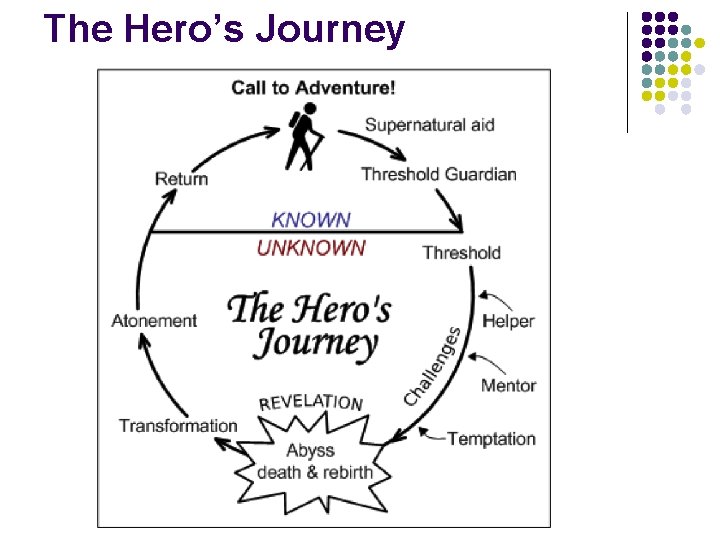
The Hero’s Journey
l https: //tackk. com/monomyth
Strategy Application l Asking questions l l Answering questions l l Teacher directed questions can encourage deeper levels of comprehension. Monitoring Comprehension l l Initially teachers model the types of questions readers need to ask while reading. Teachers model thinking aloud self monitoring questions. Connecting to World Knowledge l Teachers guide students to connect to relevant prior experiences or to other stories.
Strategy Application l Predicting l l Constructing Mental Images l l Teachers provide explicit teaching to help students create mental images as they read. Summarizing l l Teachers guide students to make predictions based on prior knowledge or story structure. Narrative text summaries often take the form of retelling and focus on story elements. Transactional Strategies l Emphasize collaborative discussion among learners.
Research on Transactional Theories l l l Meaning is not found in text alone but is constructed by reader and text. Group interpretation is different from that of any single reader. Over time, group work helps students internalize the processes of the group. Reader Response to Literature: This refers to how readers form personal responses through discussion and writing. Transactional Strategies Instruction TSI: This emphasizes collaborative discussion, metacognition, motivation and reader response.
When to Teach, Assess, Intervene l l l Comprehension instruction should begin as soon as students interact with text and continue through high school. Students learn comprehension strategies in tandem with word-level strategies. Reliable comprehension assessment should be aligned with instruction and include: l l ongoing assessments of strategy use; retellings, student think aloud protocols, and other process-focused measures, which can be used for diagnosing and remediation.
Instruction for ELLs l Reading comprehension is closely tied to oral language proficiency. l l Promote language production and vocabulary acquisition while working on comprehension skills. Explicit and direct instruction actively engages students in monitoring their use of strategies in comprehension process. For novice readers in their primary language: provide explicit word-level skills instruction to help them attain the level of performance of native English speakers. For able readers in their primary language: emphasize transferring strategies from their native language to English.