
Section Outline Section 1 1 1 1 What
- Slides: 20
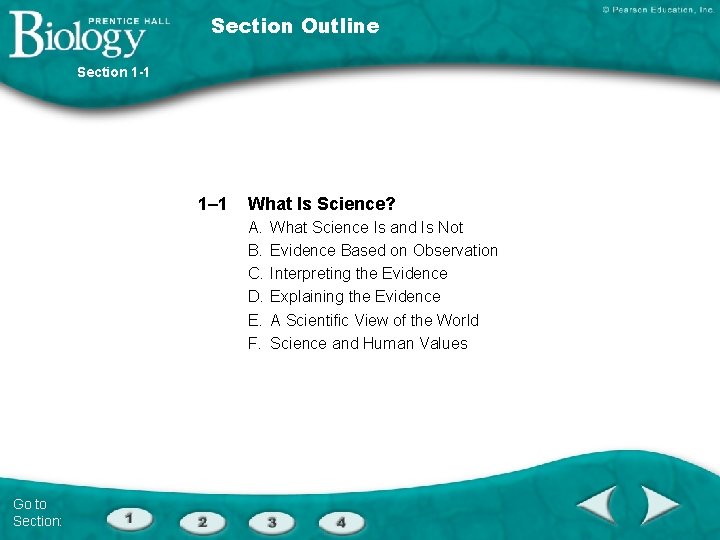
Section Outline Section 1 -1 1– 1 What Is Science? A. B. C. D. E. F. Go to Section: What Science Is and Is Not Evidence Based on Observation Interpreting the Evidence Explaining the Evidence A Scientific View of the World Science and Human Values
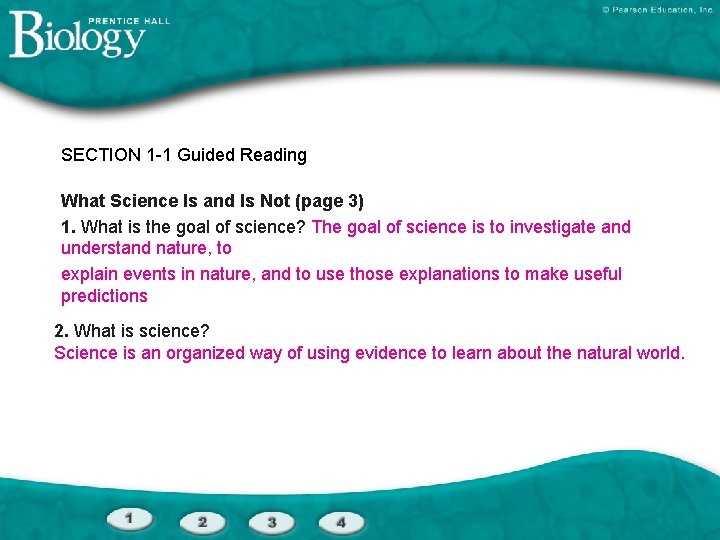
SECTION 1 -1 Guided Reading What Science Is and Is Not (page 3) 1. What is the goal of science? The goal of science is to investigate and understand nature, to explain events in nature, and to use those explanations to make useful predictions 2. What is science? Science is an organized way of using evidence to learn about the natural world.
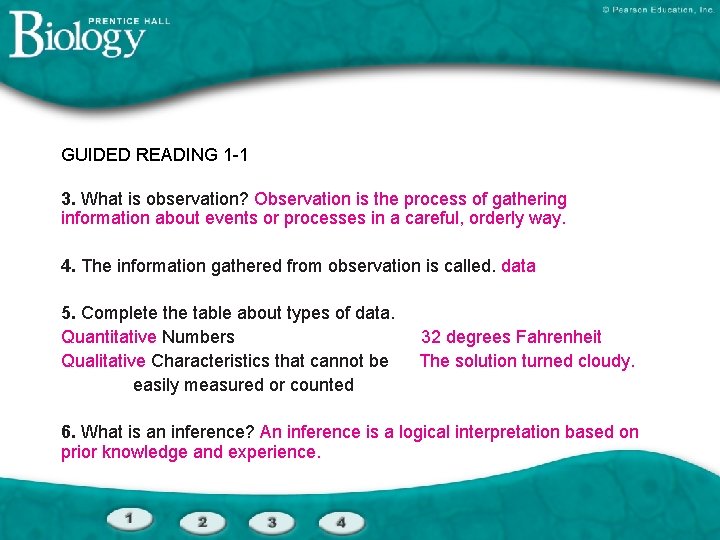
GUIDED READING 1 -1 3. What is observation? Observation is the process of gathering information about events or processes in a careful, orderly way. 4. The information gathered from observation is called. data 5. Complete the table about types of data. Quantitative Numbers Qualitative Characteristics that cannot be easily measured or counted 32 degrees Fahrenheit The solution turned cloudy. 6. What is an inference? An inference is a logical interpretation based on prior knowledge and experience.
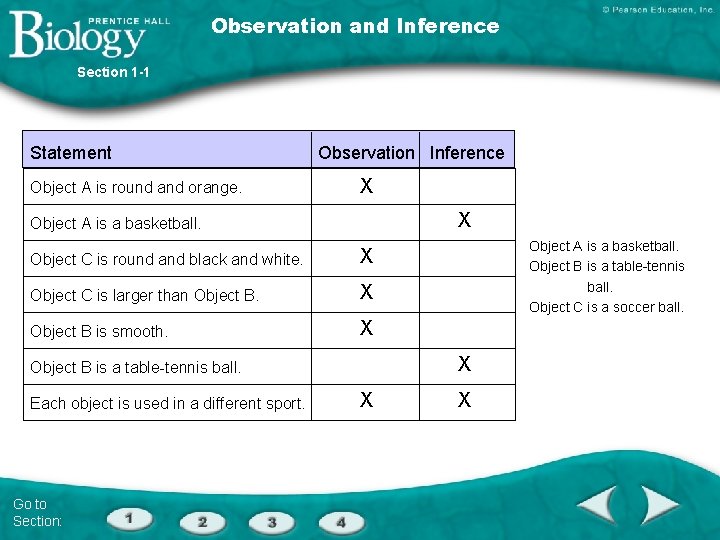
Observation and Inference Section 1 -1 Statement Object A is round and orange. Observation Inference X X Object A is a basketball. Object C is round and black and white. X Object C is larger than Object B. X Object B is smooth. X X Object B is a table-tennis ball. Each object is used in a different sport. Go to Section: Object A is a basketball. Object B is a table-tennis ball. Object C is a soccer ball. X X
Observations/Inferences lead to Hypotheses Writing a hypothesis Step 1 Form a question based on observations. For instance, if you notice your pet mice have more babies when you feed them corn rather than pellets, this is an observation. Your question, therefore, may be: Do mice produce more babies when fed corn? You can test this, but first you must form a hypothesis. Step 2 Write down what you predict will happen in your experiment. For instance, you can predict that if you feed some of your mice corn, they will produce more babies than mice to which you feed pellets.
Step 3 Determine your manipulated (ind) and responding variables (dep). For example, if mice are fed a diet of corn, they will have more babies. The corn diet is the manipulated variable, and mice babies are the responding variable. Both the manipulated and responding variables must be measurable and testable. Step 4 Most often, hypotheses are stated as ‘if-then’ statements. That is, you are stating that if X is the relationship, then Y should prove it. In our example using mice and corn feed, an appropriate hypothesis would be: "(IF) corn is the cause of more babies (THEN) mice fed corn while pregnant will have more babies than similar mice fed with pellets.
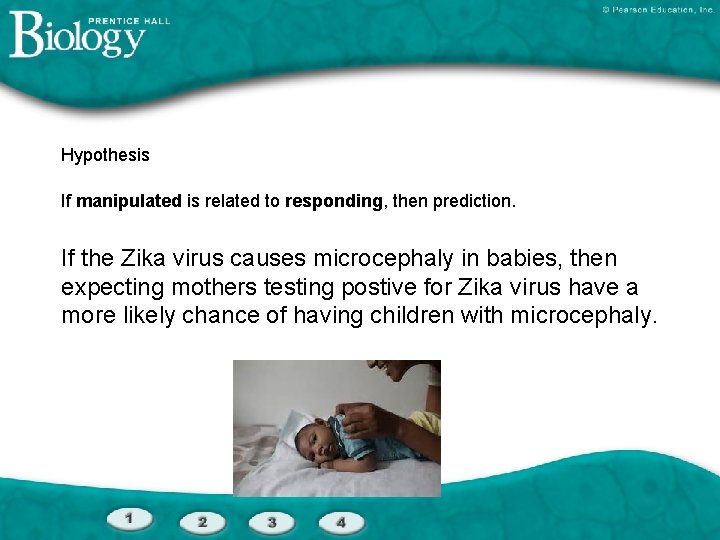
Hypothesis If manipulated is related to responding, then prediction. If the Zika virus causes microcephaly in babies, then expecting mothers testing postive for Zika virus have a more likely chance of having children with microcephaly.
Section Outline Section 1 -2 1– 2 How Scientists Work A. Designing an Experiment 1. Stating the Problem 2. Forming a Hypothesis 3. Setting Up a Controlled Experiment 4. Recording and Analyzing Results 5. Drawing a Conclusion B. Publishing and Repeating Investigations 1. Needham’s Test of Redi’s Findings 2. Spallanzani’s Test of Redi’s Findings 3. Pasteur’s Test of Spontaneous Generation 4. The Impact of Pasteur’s Work C. When Experiments Are Not Possible D. How a Theory Develops Go to Section:
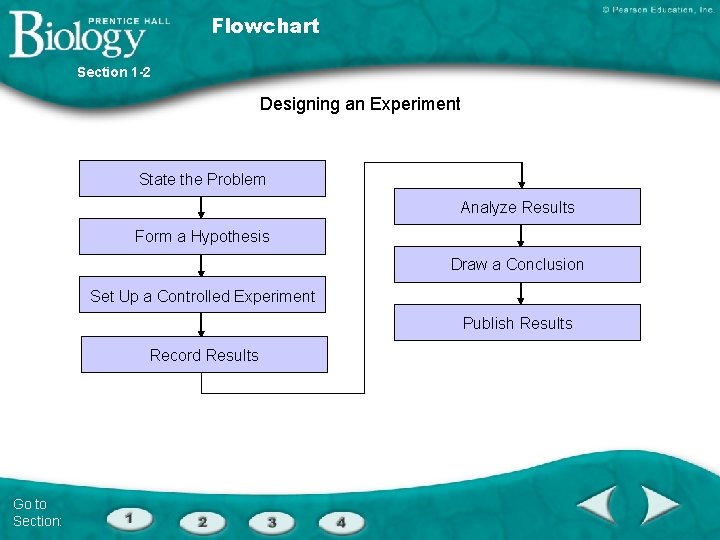
Flowchart Section 1 -2 Designing an Experiment State the Problem Analyze Results Form a Hypothesis Draw a Conclusion Set Up a Controlled Experiment Publish Results Record Results Go to Section:
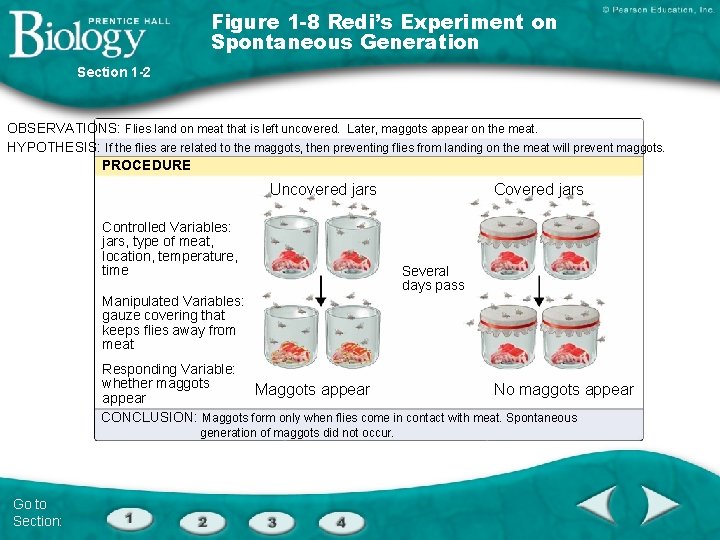
Figure 1 -8 Redi’s Experiment on Spontaneous Generation Section 1 -2 OBSERVATIONS: Flies land on meat that is left uncovered. Later, maggots appear on the meat. HYPOTHESIS: If the flies are related to the maggots, then preventing flies from landing on the meat will prevent maggots. PROCEDURE Uncovered jars Controlled Variables: jars, type of meat, location, temperature, time Covered jars Several days pass Manipulated Variables: gauze covering that keeps flies away from meat Responding Variable: whether maggots Maggots appear No maggots appear CONCLUSION: Maggots form only when flies come in contact with meat. Spontaneous generation of maggots did not occur. Go to Section:
1. Why they had to conduct new experiments? 2. What did Needham do? And what did he find out? Problems? ? ? 3. What did Spallanzani do? What did he find out? Problems? ? 4. What did Pasteur do? What did he find out?
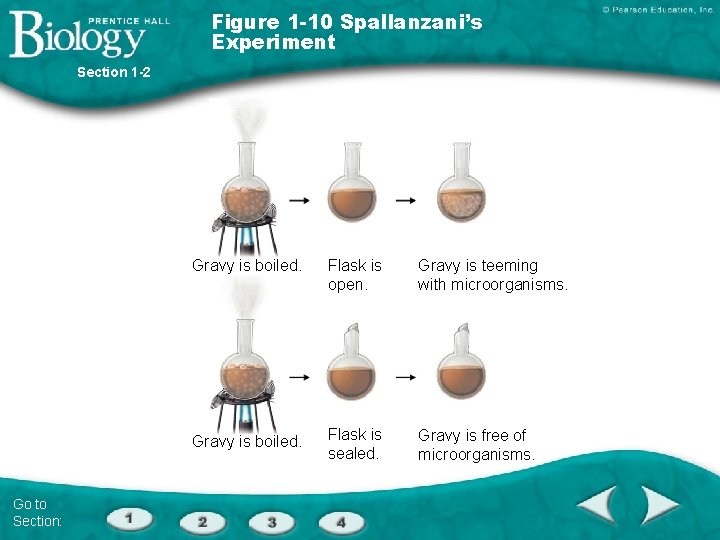
Figure 1 -10 Spallanzani’s Experiment Section 1 -2 Go to Section: Gravy is boiled. Flask is open. Gravy is teeming with microorganisms. Gravy is boiled. Flask is sealed. Gravy is free of microorganisms.
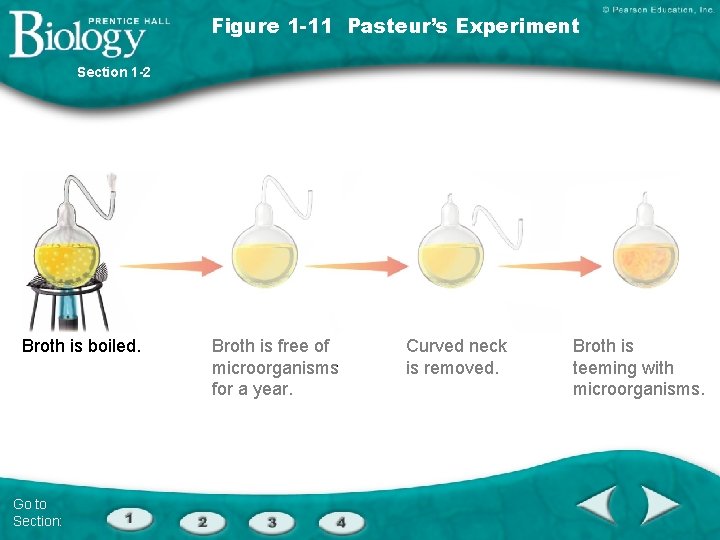
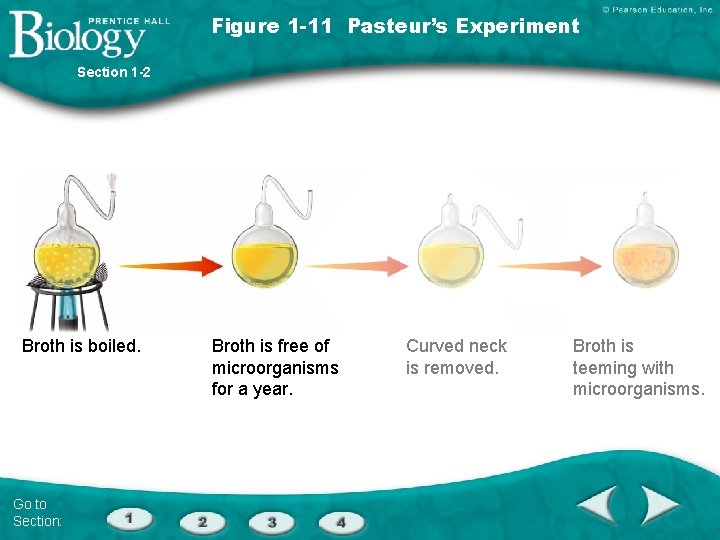
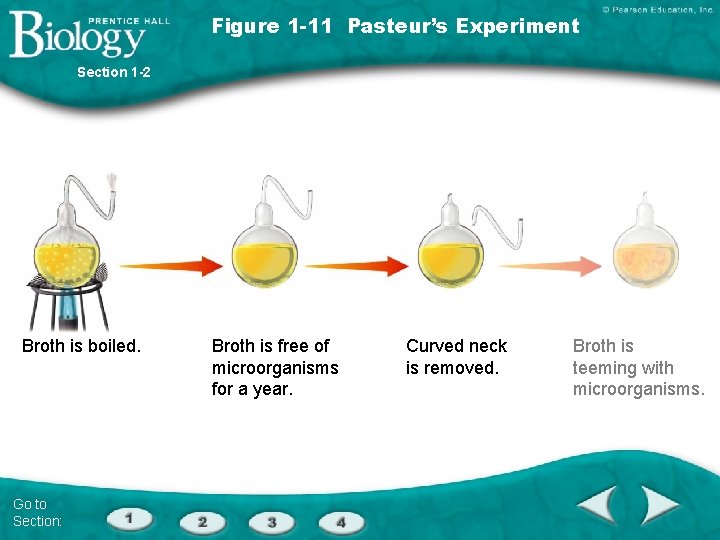
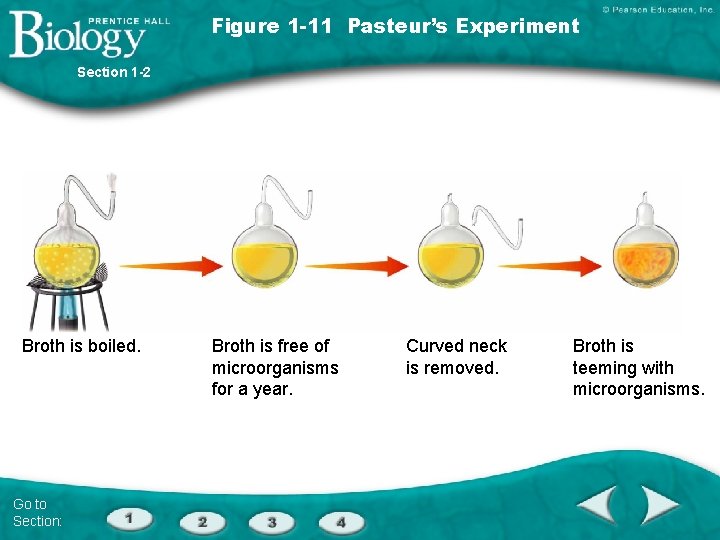
Figure 1 -11 Pasteur’s Experiment Section 1 -2 Broth is boiled. Go to Section: Broth is free of microorganisms for a year. Curved neck is removed. Broth is teeming with microorganisms.
Figure 1 -11 Pasteur’s Experiment Section 1 -2 Broth is boiled. Go to Section: Broth is free of microorganisms for a year. Curved neck is removed. Broth is teeming with microorganisms.
Figure 1 -11 Pasteur’s Experiment Section 1 -2 Broth is boiled. Go to Section: Broth is free of microorganisms for a year. Curved neck is removed. Broth is teeming with microorganisms.
Figure 1 -11 Pasteur’s Experiment Section 1 -2 Broth is boiled. Go to Section: Broth is free of microorganisms for a year. Curved neck is removed. Broth is teeming with microorganisms.
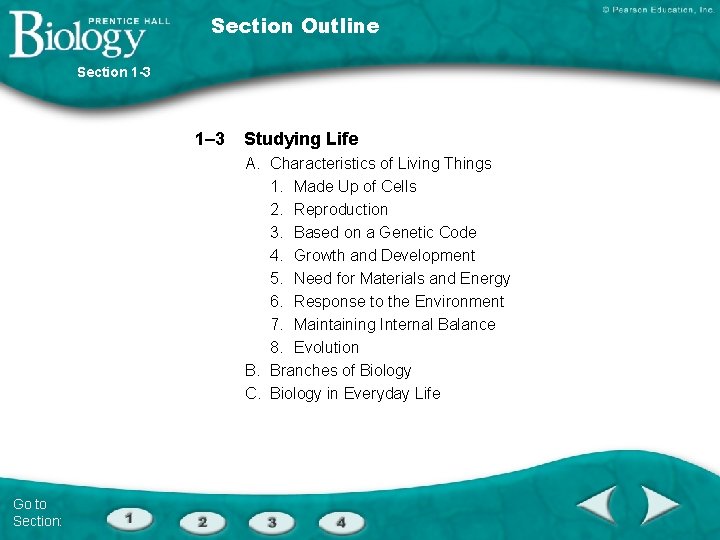
Section Outline Section 1 -3 1– 3 Studying Life A. Characteristics of Living Things 1. Made Up of Cells 2. Reproduction 3. Based on a Genetic Code 4. Growth and Development 5. Need for Materials and Energy 6. Response to the Environment 7. Maintaining Internal Balance 8. Evolution B. Branches of Biology C. Biology in Everyday Life Go to Section:
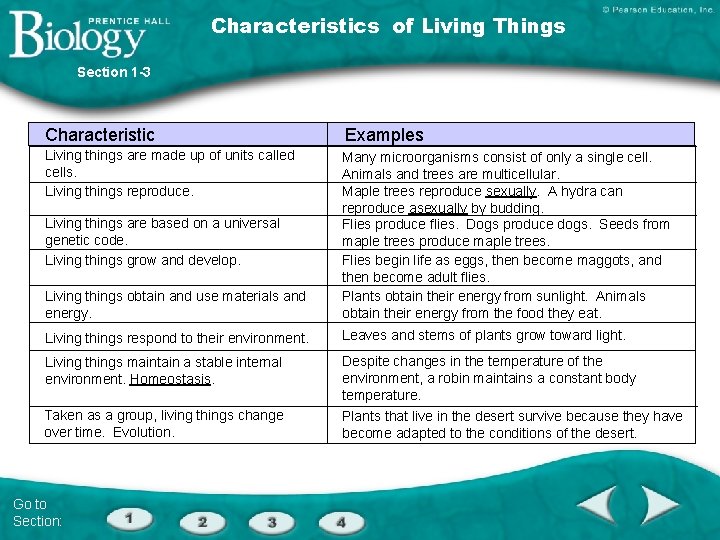
Characteristics of Living Things Section 1 -3 Characteristic Examples Living things are made up of units called cells. Living things reproduce. Living things obtain and use materials and energy. Many microorganisms consist of only a single cell. Animals and trees are multicellular. Maple trees reproduce sexually. A hydra can reproduce asexually by budding. Flies produce flies. Dogs produce dogs. Seeds from maple trees produce maple trees. Flies begin life as eggs, then become maggots, and then become adult flies. Plants obtain their energy from sunlight. Animals obtain their energy from the food they eat. Living things respond to their environment. Leaves and stems of plants grow toward light. Living things maintain a stable internal environment. Homeostasis. Despite changes in the temperature of the environment, a robin maintains a constant body temperature. Taken as a group, living things change over time. Evolution. Plants that live in the desert survive because they have become adapted to the conditions of the desert. Living things are based on a universal genetic code. Living things grow and develop. Go to Section:
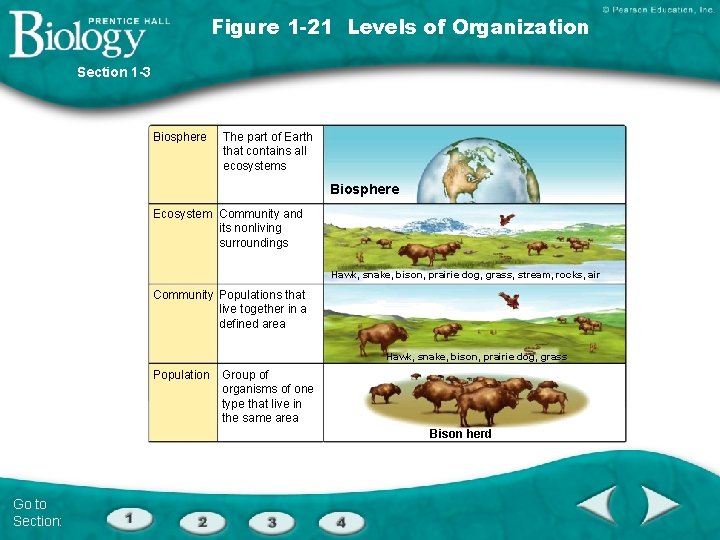
Figure 1 -21 Levels of Organization Section 1 -3 Biosphere The part of Earth that contains all ecosystems Biosphere Ecosystem Community and its nonliving surroundings Hawk, snake, bison, prairie dog, grass, stream, rocks, air Community Populations that live together in a defined area Hawk, snake, bison, prairie dog, grass Population Group of organisms of one type that live in the same area Bison herd Go to Section:
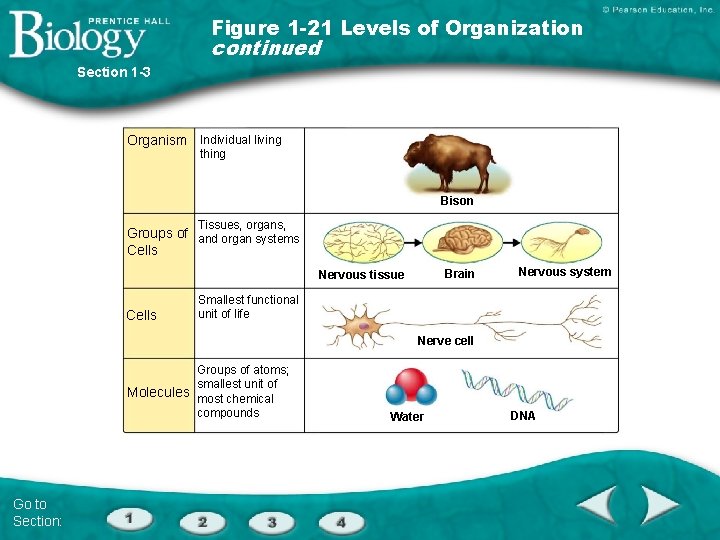
Figure 1 -21 Levels of Organization continued Section 1 -3 Organism Individual living thing Bison Tissues, organs, Groups of and organ systems Cells Brain Nervous tissue Cells Nervous system Smallest functional unit of life Nerve cell Groups of atoms; smallest unit of Molecules most chemical compounds Go to Section: Water DNA