
Section One Introduction 1 2 Ecological Methods 1

- Slides: 25
Section One Introduction 1. 2 Ecological Methods 1. 3 Spatial Scale 2003 生態學
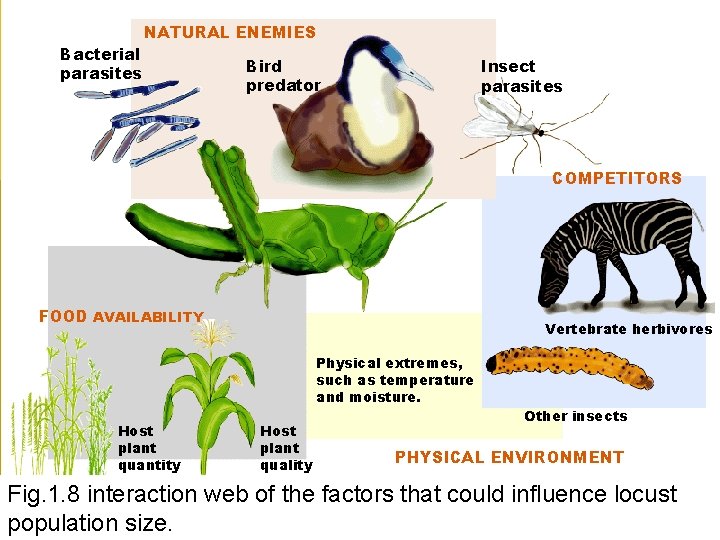
1. 2 Ecological methods • Example: Study of Locust Outbreaks – What causes outbreaks of locusts, which destroys crops and other vegetation? – Development of study plan. – Interaction web (Figure 1. 8) 2003 生態學 2
Bacterial parasites NATURAL ENEMIES Bird predator Insect parasites COMPETITORS FOOD AVAILABILITY Vertebrate herbivores Physical extremes, such as temperature and moisture. Host plant quantity Host plant quality Other insects PHYSICAL ENVIRONMENT Fig. 1. 8 interaction web of the factors that could influence locust population size. 2003 生態學 3
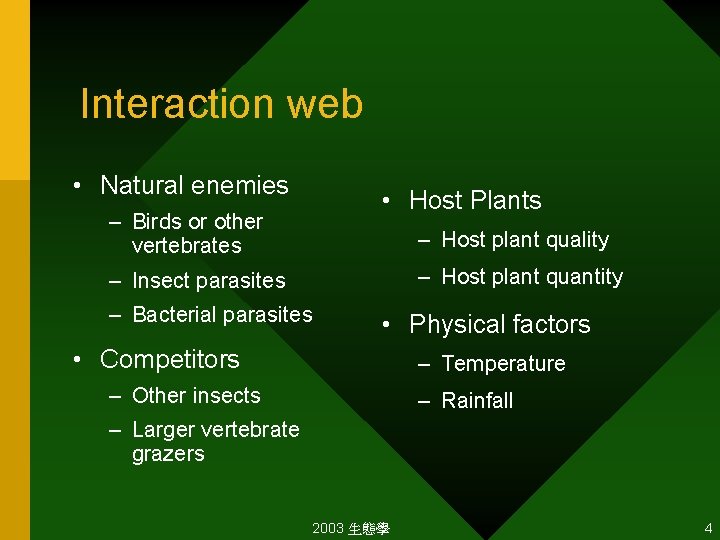
Interaction web • Natural enemies • Host Plants – Birds or other vertebrates – Host plant quality – Host plant quantity – Insect parasites – Bacterial parasites • Physical factors • Competitors – Temperature – Other insects – Rainfall – Larger vertebrate grazers 2003 生態學 4
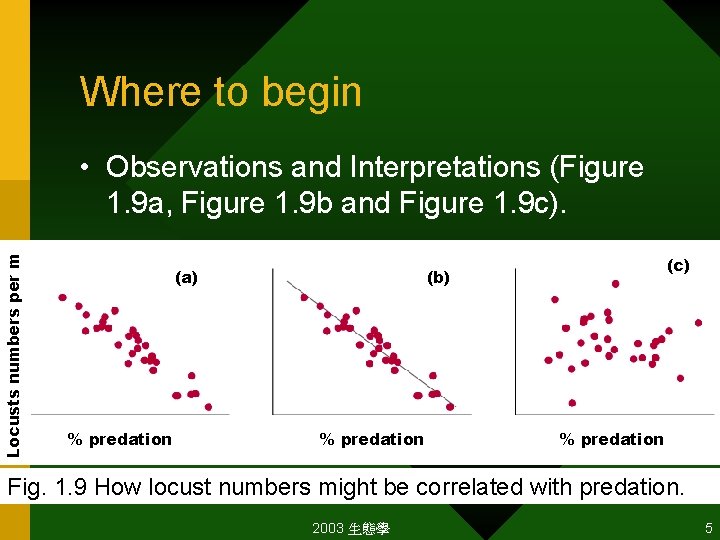
Where to begin Locusts numbers per m • Observations and Interpretations (Figure 1. 9 a, Figure 1. 9 b and Figure 1. 9 c). (a) % predation (c) (b) % predation Fig. 1. 9 How locust numbers might be correlated with predation. 2003 生態學 5
Observations and Interpretations • Statistical tests to determine significance of relationships. • Causation vs. correlation. • Experimentation – Predator study • Hypothesis: Increased predators will decrease locust population. 2003 生態學 6
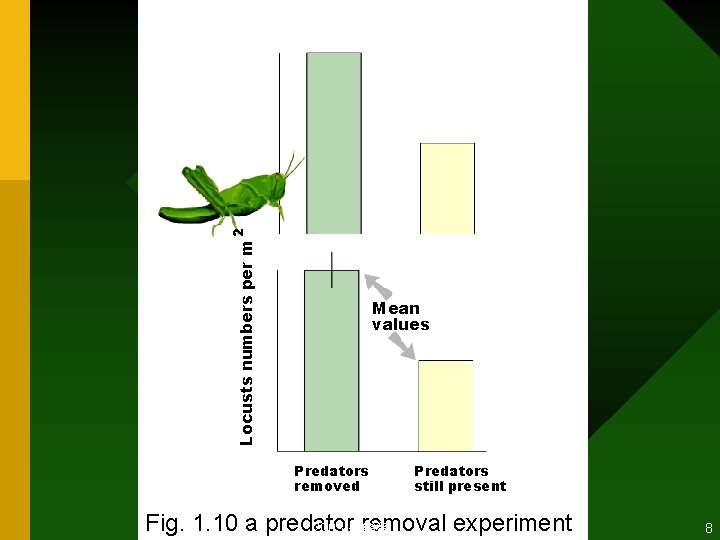
Experimentation • Two study groups – Treatment Group: Locusts with predators removed – Control Group: Locusts with nothing done – predators present. • Measurements • Replications (Figure 1. 10) 2003 生態學 7
2 Locusts numbers per m Mean values Predators removed Predators still present Fig. 1. 10 a predator removal experiment 2003 生態學 8
Experimentation • Statistical Tests – ANOVA and t-tests. – Means and Standard error • Types of Experimentation – Laboratory – Field – Natural 2003 生態學 9
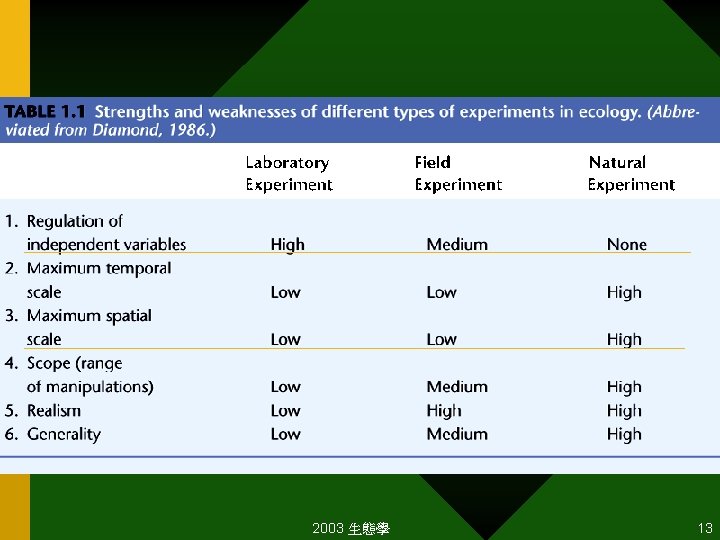
Laboratory Experiments • Most exact regulation of abiotic and biotic factors. • Vary only the factor of interest. • Disadvantage: Oversimplification of the biotic community. • Best uses: Physiological responses of individuals. 2003 生態學 10
Field Experiments • Conducted outdoors. • Manipulation of abiotic or biotic factors (eg. Elimination of a competitor). • Disadvantage: Methods of exclusion are unlikely to be generated by nature. 2003 生態學 11
Natural Experiments • Uses natural perturbations to disrupt biotic community. • Used to follow the trajectory of the perturbation over time. • Results can be extrapolated to other communities. 2003 生態學 12
2003 生態學 13
Experimental Problems • Logistic problems lead to low replication • Which leads to a Type I error; declaring that a hypothesis is false when in fact it is true. (否定 null 假說,但事實上是「null 假 說是成立的」) • Low replications lead to greater standard error (SE) values. 2003 生態學 14
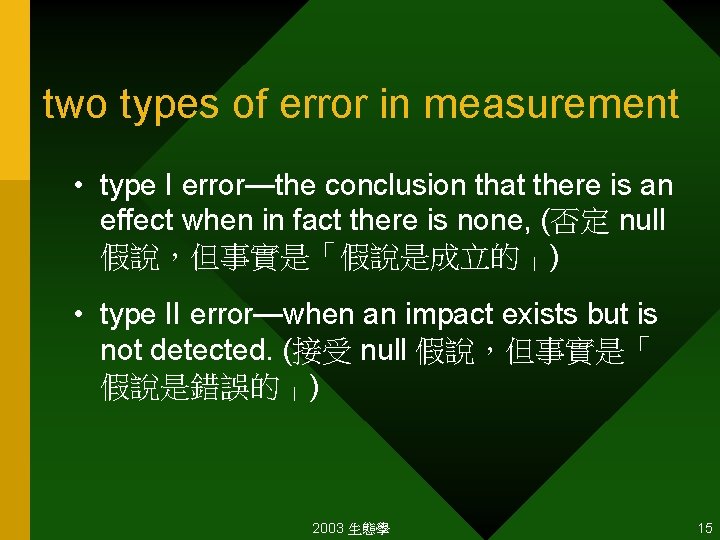
two types of error in measurement • type I error—the conclusion that there is an effect when in fact there is none, (否定 null 假說,但事實是「假說是成立的」) • type II error—when an impact exists but is not detected. (接受 null 假說,但事實是「 假說是錯誤的」) 2003 生態學 15
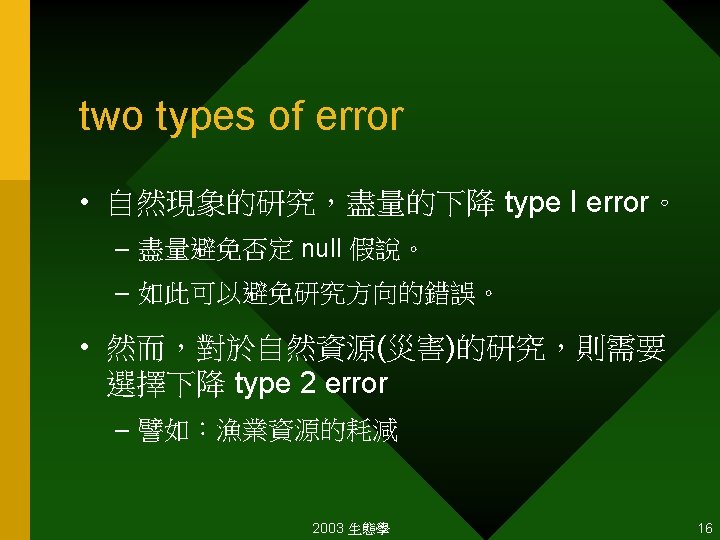
declining fish stocks • Current management focuses on reducing type I errors because maximizing fish catch is of primary economic importance (Paully et al. , 1998; Williams, 1998). • However, scientific advice should be explicit about type II errors also, because the environmental consequences from type II errors are much more serious and take longer to recover from. • Type I errors usually result in only short-term economic costs. 2003 生態學 17
Experimental Problems • Difficulty in combining studies with differences in statistical power. • Meta-analysis – a technique for combining studies. – Meta-analysis weights different studies primarily on the basis of their sample size. – Starts by estimating the size of the effect of a treatment from every experiment and then pooling all the effects together to get one overall effect size, usually called d. 2003 生態學 18
Mathematical Models • Experiments may not be possible. • Give valuable signposts on how natural systems might work. • Indicate need for further data • Indicate need for further observations. 2003 生態學 19
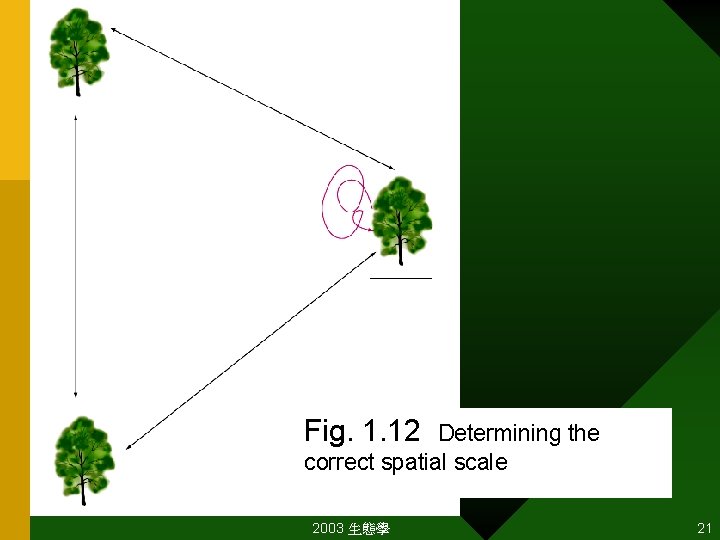
1. 3 Spatial scale • A space occupied by an individual (behavior ecology) • A local patch occupied by many individuals (a population) • A large enough space to comprise multiple populations (a community) • A biogeographic scale large enough to encompass a community, and its nutrients and energy cycles (an ecosystem). 2003 生態學 20
• Fig. 1. 12 Determining the correct spatial scale 2003 生態學 21
Temporal Scale • Proper choice of scale, depends on phenomenon and species studied. • Short time scale studies for behavioral responses. • Longer time scales studies for population dynamics and ecosystem processes. 2003 生態學 22
Discussion Question • In a local park, forest, or even in your backyard think about five ecological questions you could ask and the information you would need to answer them. • Do your questions relate to behavioral, population, community, or ecosystems ecology or do they cross categories? 2003 生態學 23
網路資源 • http: //www. prenhall. com/stiling • The tools that you'll find on our site include: • CHAPTER OUTLINES: help summarize all of the key information in the chapter. • CHAPTER QUIZZES: self-grading quizzes for each chapter to help you reinforce your understanding • CASE STUDIES: concise reviews and analysis of important ecological research • DESTINATIONS: accurate, dependable Web sites 2003 生態學 24
v 問題與討論! Japalura@hotmail. com Ayo 台南站: http: //mail. nutn. edu. tw/~hycheng/ 2003 生態學 25