
Section Objectives Relate the structural adaptations of fishes
Section Objectives: • Relate the structural adaptations of fishes to their environments. • Compare and contrast the characteristics of the different groups of fishes. • Interpret the phylogeny of fishes.
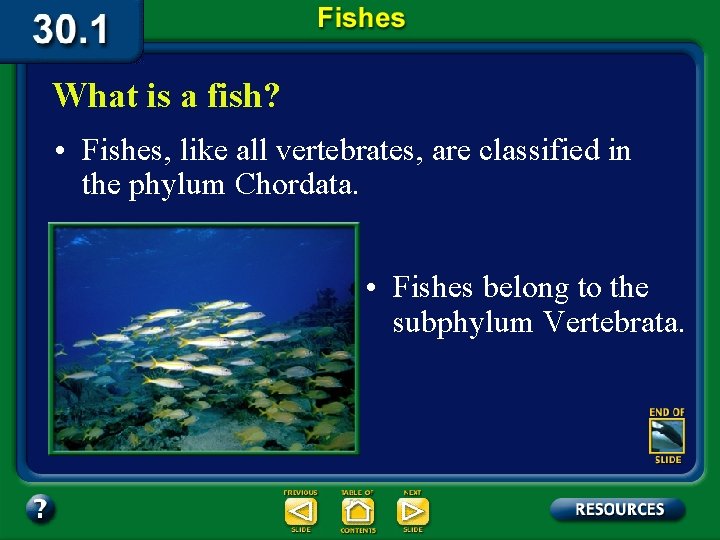
What is a fish? • Fishes, like all vertebrates, are classified in the phylum Chordata. • Fishes belong to the subphylum Vertebrata.

What is a fish? • In addition to fishes, subphylum Vertebrata includes amphibians, reptiles, birds, and mammals.
What is a fish? • In vertebrates, the embryo’s notochord is replaced by a backbone in adult animals. • All vertebrates are bilaterally symmetrical, coelomates that have endoskeletons, closed circulatory systems, nervous systems with complex brains and sense organs, and efficient respiratory systems.

Classes of fishes Fishes Class Organisms Myxini Hagfishes Cephalaspidomorphi Lampreys Chondrichthyes Sharks, skates, rays Osteichthyes Lobe-finned fishes, ray-finned fishes Characteristics Jawless, cartilaginous skeleton, gills Jaws, cartilaginous skeleton, paired fins, gills, scales, internal fertilization Jaws, bony skeleton, paired fins, gills, scales, swim bladder
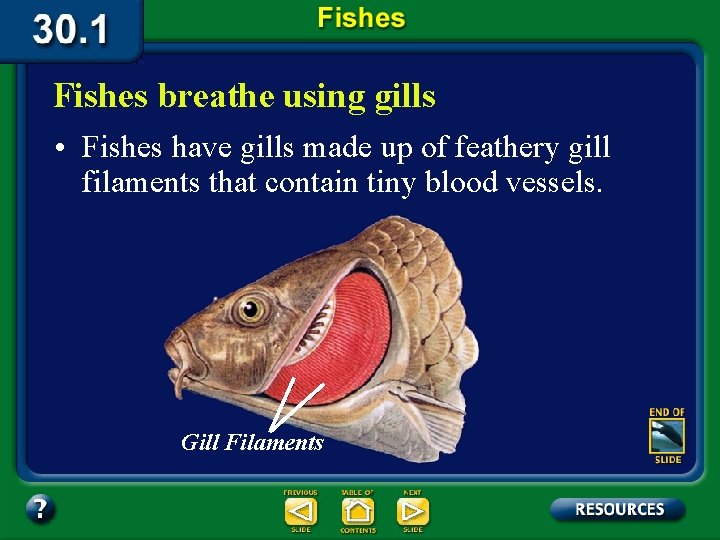
Fishes breathe using gills • Fishes have gills made up of feathery gill filaments that contain tiny blood vessels. Gill Filaments
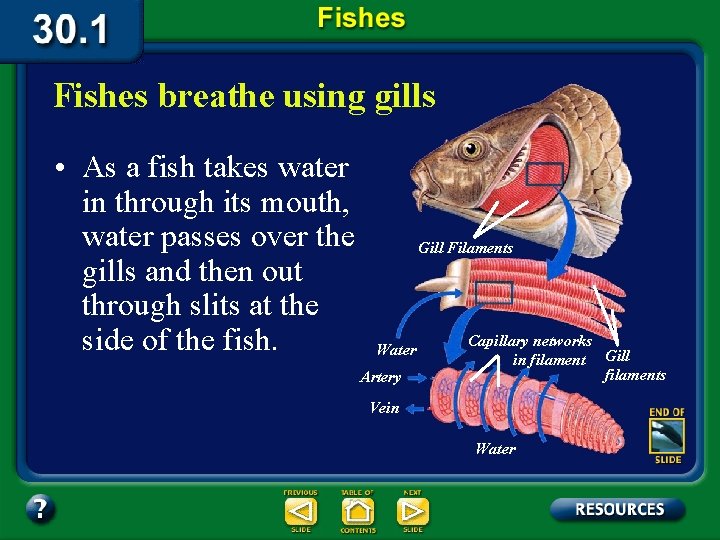
Fishes breathe using gills • As a fish takes water in through its mouth, water passes over the gills and then out through slits at the side of the fish. Gill Filaments Water Artery Capillary networks in filament Gill filaments Vein Water
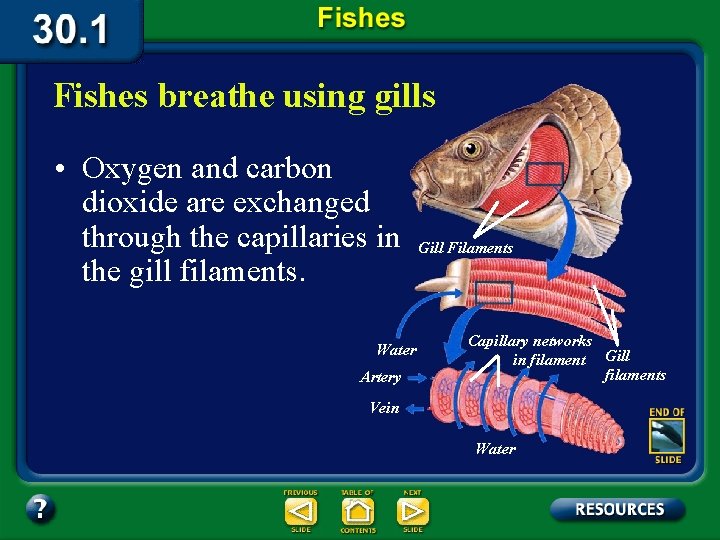
Fishes breathe using gills • Oxygen and carbon dioxide are exchanged through the capillaries in the gill filaments. Water Artery Gill Filaments Capillary networks in filament Gill filaments Vein Water
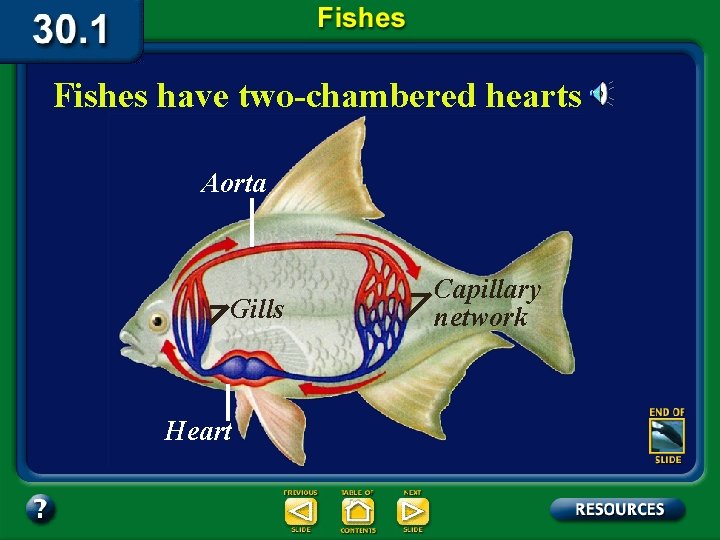
Fishes have two-chambered hearts Aorta Gills Heart Capillary network
Fishes reproduce sexually • Although the method may vary, all fishes reproduce sexually. • Fertilization and development is external in most fishes. • Eggs and sperm can be released directly into the water, or deposited in more protected areas, such as on floating aquatic plants.
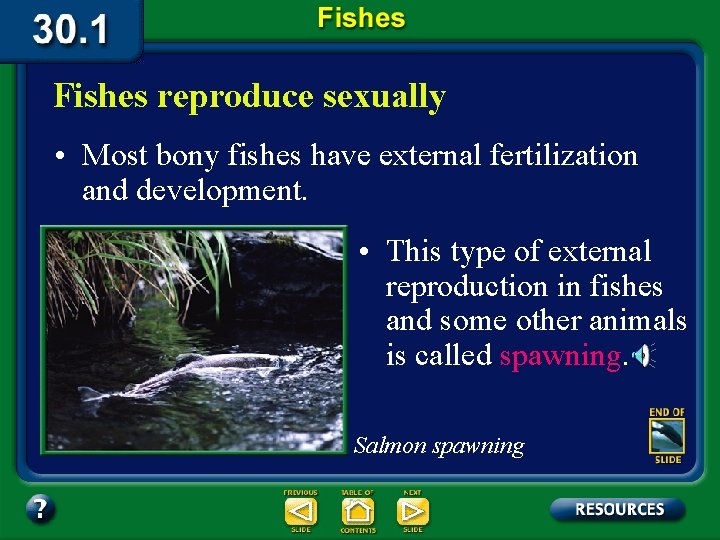
Fishes reproduce sexually • Most bony fishes have external fertilization and development. • This type of external reproduction in fishes and some other animals is called spawning. Salmon spawning
Fishes reproduce sexually • In some bony fishes, such as guppies and mollies, fertilization and development is internal. • Most fishes that produce millions of eggs provide no care for their offspring after spawning. • Some fishes, such as the mouth-brooding cichlids, stay with their young after they hatch.
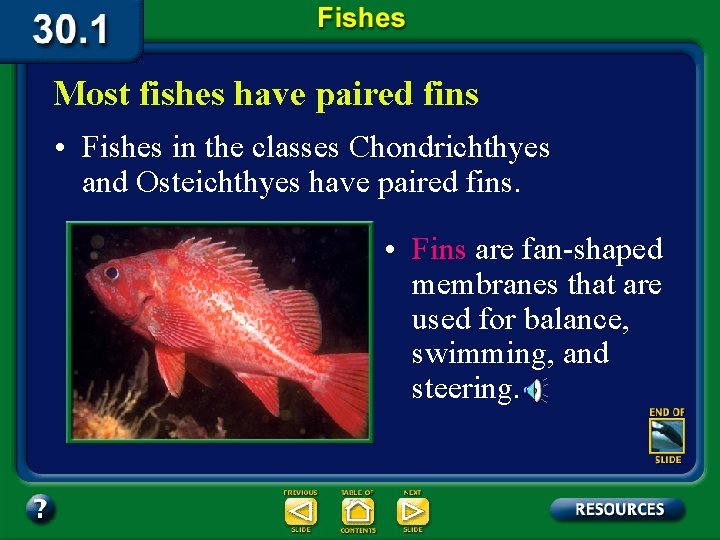
Most fishes have paired fins • Fishes in the classes Chondrichthyes and Osteichthyes have paired fins. • Fins are fan-shaped membranes that are used for balance, swimming, and steering.
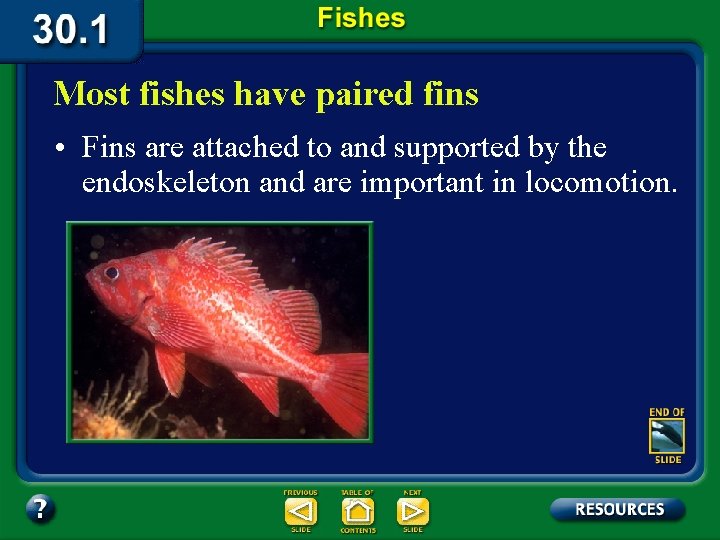
Most fishes have paired fins • Fins are attached to and supported by the endoskeleton and are important in locomotion.
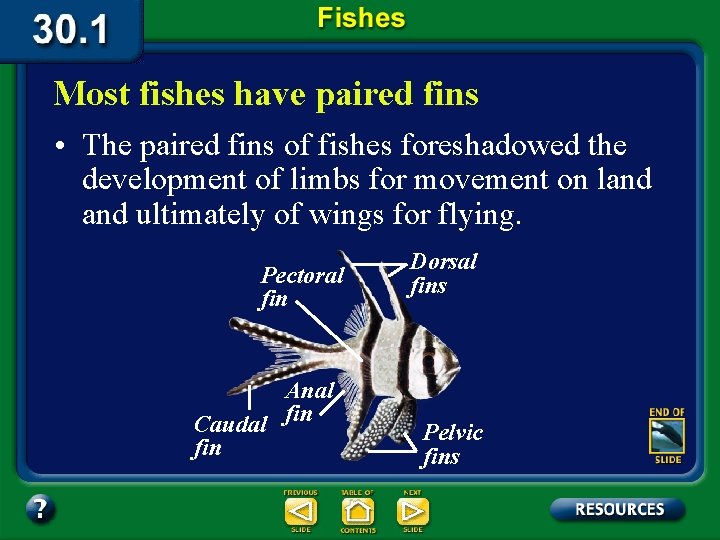
Most fishes have paired fins • The paired fins of fishes foreshadowed the development of limbs for movement on land ultimately of wings for flying. Pectoral fin Anal Caudal fin Dorsal fins Pelvic fins
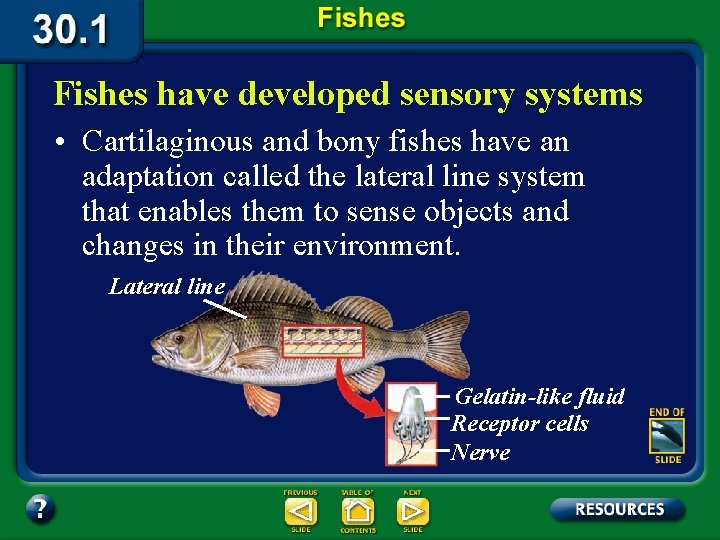
Fishes have developed sensory systems • Cartilaginous and bony fishes have an adaptation called the lateral line system that enables them to sense objects and changes in their environment. Lateral line Gelatin-like fluid Receptor cells Nerve
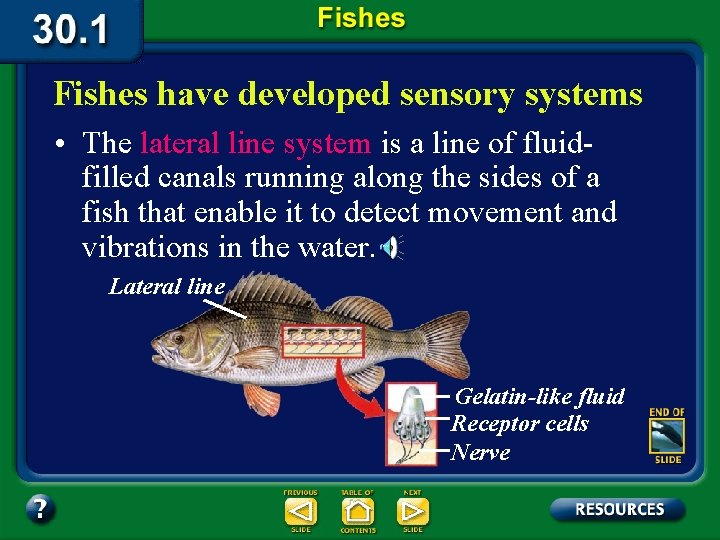
Fishes have developed sensory systems • The lateral line system is a line of fluidfilled canals running along the sides of a fish that enable it to detect movement and vibrations in the water. Lateral line Gelatin-like fluid Receptor cells Nerve
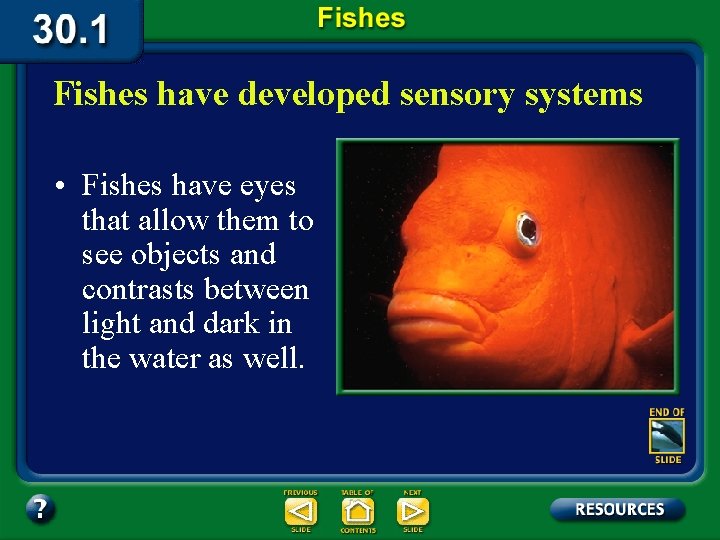
Fishes have developed sensory systems • Fishes have eyes that allow them to see objects and contrasts between light and dark in the water as well.
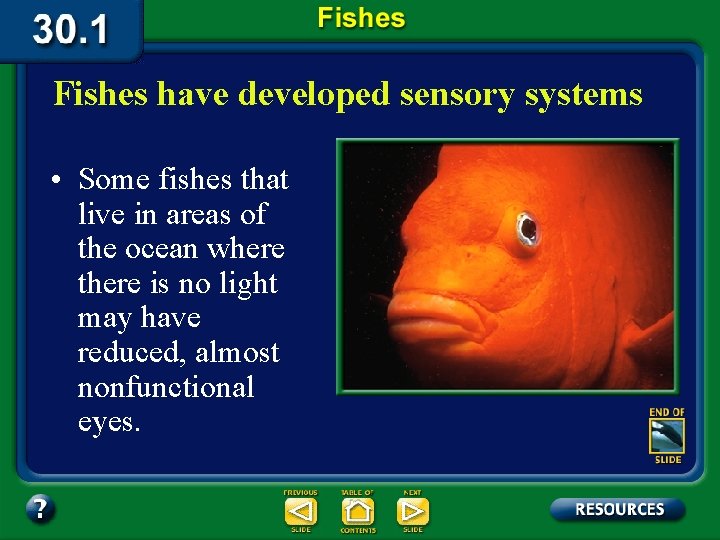
Fishes have developed sensory systems • Some fishes that live in areas of the ocean where there is no light may have reduced, almost nonfunctional eyes.
Fishes have developed sensory systems • Some fishes also have an extremely sensitive sense of smell and can detect small amounts of chemicals in the water. • Sharks can follow a trail of blood through the water for several hundred meters.
Most fishes have scales • Scales are thin bony plates formed from the skin. • Scales can be toothlike, diamond-shaped, cone-shaped, or round. Shark scales are similar to teeth found in other vertebrates.
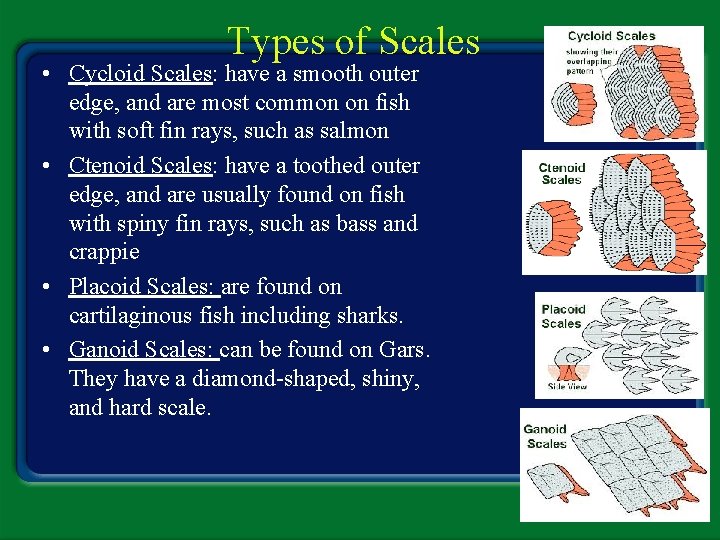
Types of Scales • Cycloid Scales: have a smooth outer edge, and are most common on fish with soft fin rays, such as salmon • Ctenoid Scales: have a toothed outer edge, and are usually found on fish with spiny fin rays, such as bass and crappie • Placoid Scales: are found on cartilaginous fish including sharks. • Ganoid Scales: can be found on Gars. They have a diamond-shaped, shiny, and hard scale.
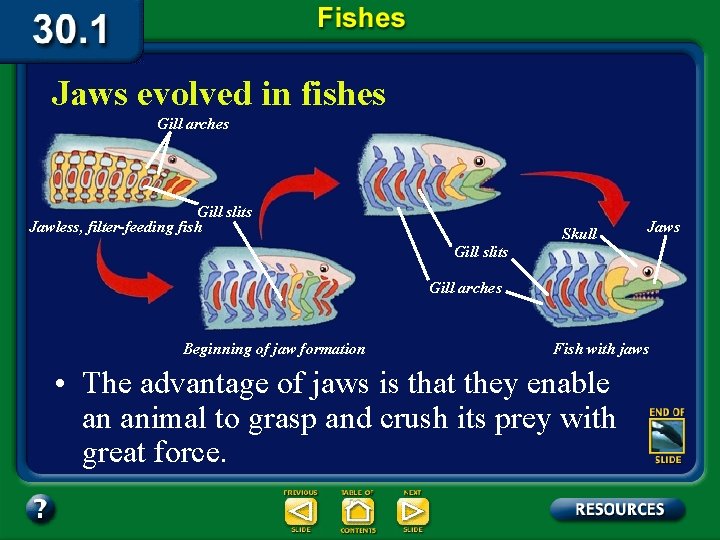
Jaws evolved in fishes Gill arches Gill slits Jawless, filter-feeding fish Skull Jaws Gill slits Gill arches Beginning of jaw formation Fish with jaws • The advantage of jaws is that they enable an animal to grasp and crush its prey with great force.
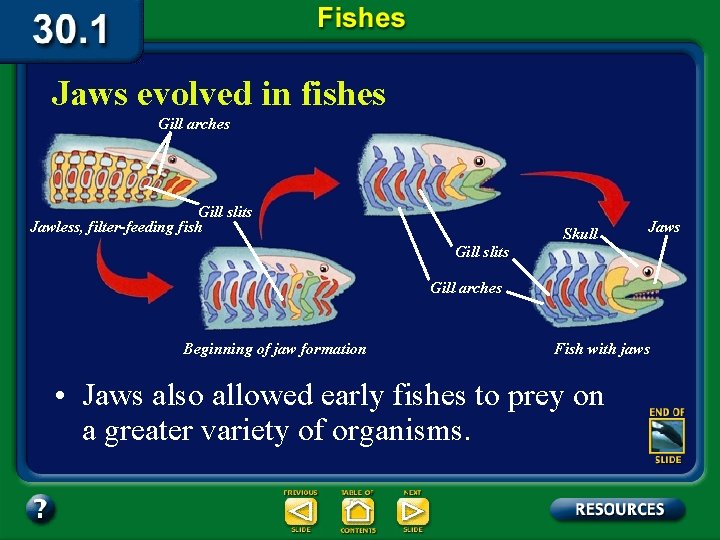
Jaws evolved in fishes Gill arches Gill slits Jawless, filter-feeding fish Skull Jaws Gill slits Gill arches Beginning of jaw formation Fish with jaws • Jaws also allowed early fishes to prey on a greater variety of organisms.
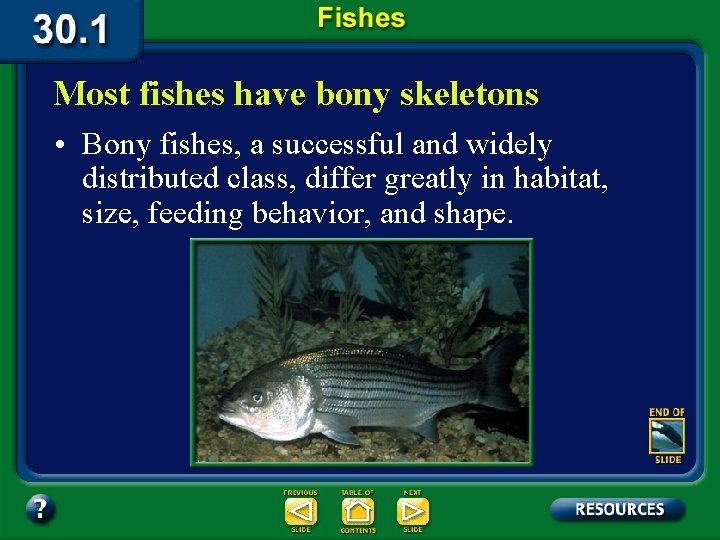
Most fishes have bony skeletons • Bony fishes, a successful and widely distributed class, differ greatly in habitat, size, feeding behavior, and shape.
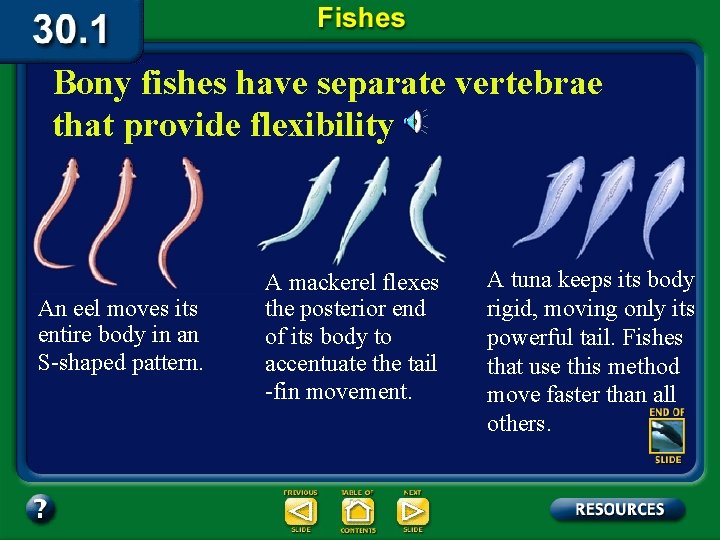
Bony fishes have separate vertebrae that provide flexibility An eel moves its entire body in an S-shaped pattern. A mackerel flexes the posterior end of its body to accentuate the tail -fin movement. A tuna keeps its body rigid, moving only its powerful tail. Fishes that use this method move faster than all others.
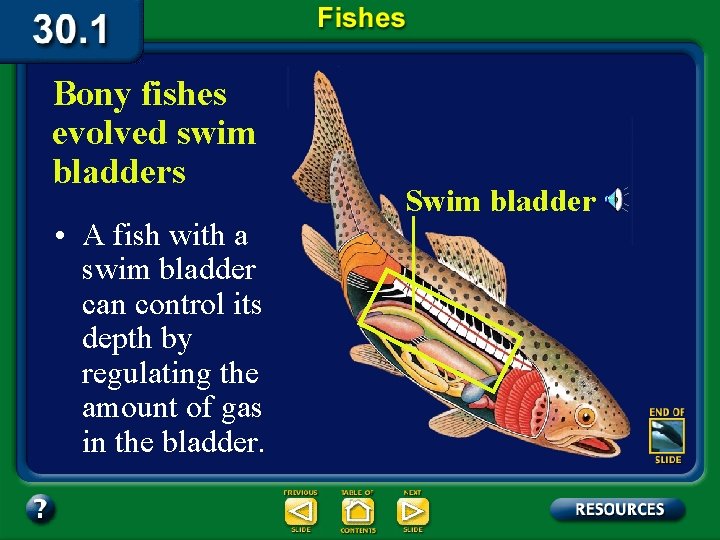
Bony fishes evolved swim bladders • A fish with a swim bladder can control its depth by regulating the amount of gas in the bladder. Swim bladder
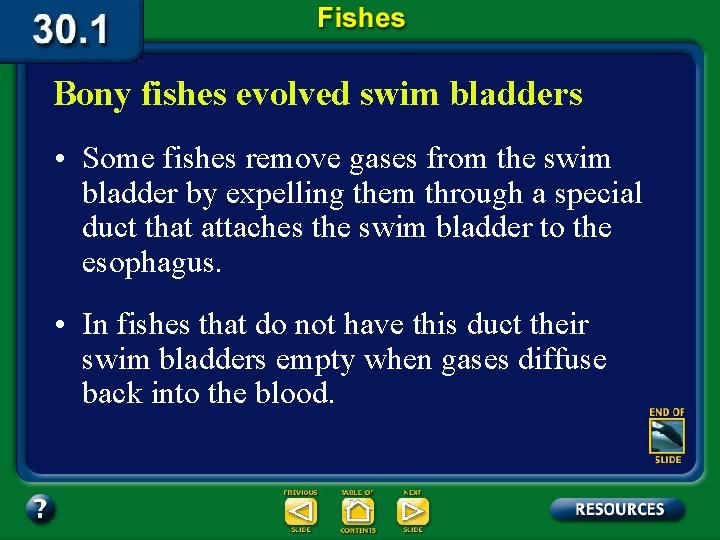
Bony fishes evolved swim bladders • Some fishes remove gases from the swim bladder by expelling them through a special duct that attaches the swim bladder to the esophagus. • In fishes that do not have this duct their swim bladders empty when gases diffuse back into the blood.
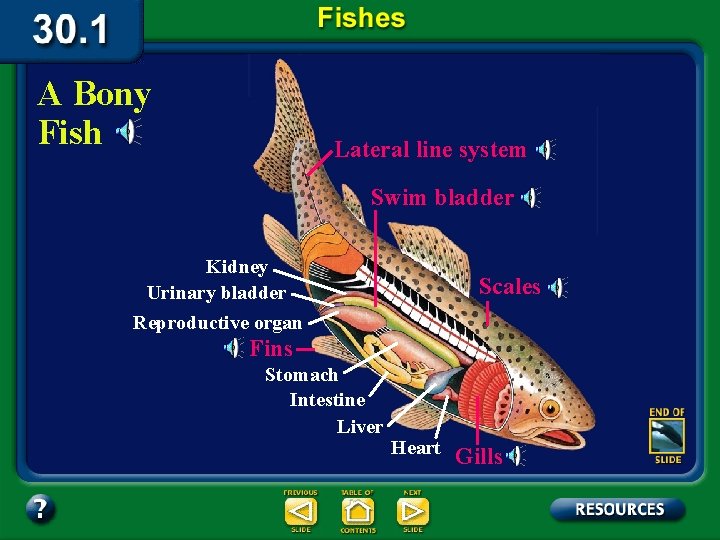
A Bony Fish Lateral line system Swim bladder Kidney Urinary bladder Reproductive organ Scales Fins Stomach Intestine Liver Heart Gills
Summary of Ray-Finned Fishes • Class Actinopterygii (Ray-finned fishes) Skeleton made of bone. Scales can be ganoid, cycloid, ctenoid or absent. Paired and median fins present. Jaws present. Teeth usually present with enamaloid covering. Respiration by gills and covered with an operculum. Swim bladder often present with or without a duct connecting to esophagus. Two chambered heart. Sexes usually separate. Fertilization usually external. Nervous system of a brain with small cerebrum, optic lobes, and cerebellum. •
Summary of Lobe-Finned fishes • Class Sarcopterygii (Lobe-finned fishes) Skeleton made of bone. Paired and median fins present. Jaws present, teeth are covered with true enamel and typically are crushing plates restricted to palate. Gills supported by bony arches and covered by an operculum. Swim bladder vascularized and used for respiration and buoyancy. Nervous system with a cerebrum, cerebellum, and optic lobe. Sexes separate; fertilization external or internal.
- Slides: 31