
Section K Swallowing and Nutritional Status Presented by
Section K: Swallowing and Nutritional Status Presented by: Jennifer Callahan, MSP, CCC-SLP; RAC-CT Clinical Outcomes Specialist Karen Welsh, MA, CCC-SLP; RAC-CT Director of Clinical Outcomes
Agenda MDS Section K: • Importance • Understanding the parts • How to report items accurately • Examples of scoring • Who should be reporting on this section • Q and A Therapy services and intellectual property provided by Functional Pathways. © 2019 All rights reserved. This information and materials was created by and is proprietary to Functional Pathways of Tennessee, LLC. Any unauthorized use, dissemination, distribution, or copying of this information and material, in whole or in part, is strictly prohibited.
Importance of Section K is one of many MDS items nursing facilities are required to fill out in order to determine the proper care for each of their residents. Along with determining and planning for care, the MDS also establishes costs of caring for residents based on information within the assessment. Each section has a part to play in making sure the “picture” painted of the resident by the MDS assessment is accurate. • • The presence of swallowing problems or a diet other than a regular consistency diet, can affect the resident’s care and reimbursement for that care. Accurate weight and height helps to determine if the patient is considered to be morbidly obese and may require additional clinical support Therapy services and intellectual property provided by Functional Pathways. © 2019 All rights reserved. This information and materials was created by and is proprietary to Functional Pathways of Tennessee, LLC. Any unauthorized use, dissemination, distribution, or copying of this information and material, in whole or in part, is strictly prohibited.
Understanding Parts of Section K: • Is all about making sure the resident is getting enough to eat and drink in order to get well and stay well • Includes height and weight • Reports how a resident takes in food and liquids • Indicates difficulties the resident is having with eating and drinking or taking medication • Includes changes to type and consistency of diet the resident receives Therapy services and intellectual property provided by Functional Pathways. © 2019 All rights reserved. This information and materials was created by and is proprietary to Functional Pathways of Tennessee, LLC. Any unauthorized use, dissemination, distribution, or copying of this information and material, in whole or in part, is strictly prohibited.

Understanding Parts of Section K: Therapy services and intellectual property provided by Functional Pathways. © 2019 All rights reserved. This information and materials was created by and is proprietary to Functional Pathways of Tennessee, LLC. Any unauthorized use, dissemination, distribution, or copying of this information and material, in whole or in part, is strictly prohibited.
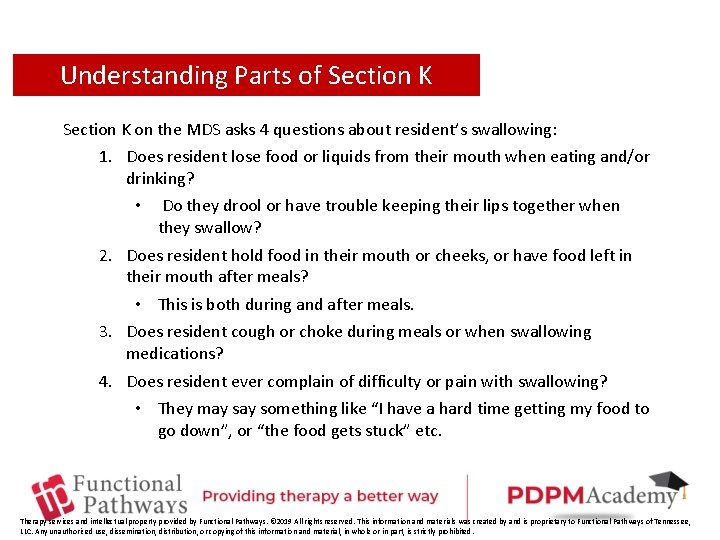
Understanding Parts of Section K on the MDS asks 4 questions about resident’s swallowing: 1. Does resident lose food or liquids from their mouth when eating and/or drinking? • Do they drool or have trouble keeping their lips together when they swallow? 2. Does resident hold food in their mouth or cheeks, or have food left in their mouth after meals? • This is both during and after meals. 3. Does resident cough or choke during meals or when swallowing medications? 4. Does resident ever complain of difficulty or pain with swallowing? • They may something like “I have a hard time getting my food to go down”, or “the food gets stuck” etc. Therapy services and intellectual property provided by Functional Pathways. © 2019 All rights reserved. This information and materials was created by and is proprietary to Functional Pathways of Tennessee, LLC. Any unauthorized use, dissemination, distribution, or copying of this information and material, in whole or in part, is strictly prohibited.
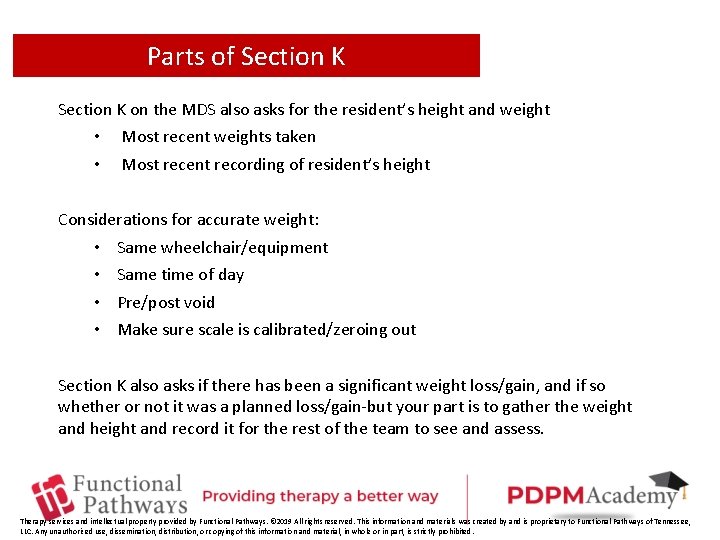
Parts of Section K on the MDS also asks for the resident’s height and weight • • Most recent weights taken Most recent recording of resident’s height Considerations for accurate weight: • • Same wheelchair/equipment Same time of day Pre/post void Make sure scale is calibrated/zeroing out Section K also asks if there has been a significant weight loss/gain, and if so whether or not it was a planned loss/gain-but your part is to gather the weight and height and record it for the rest of the team to see and assess. Therapy services and intellectual property provided by Functional Pathways. © 2019 All rights reserved. This information and materials was created by and is proprietary to Functional Pathways of Tennessee, LLC. Any unauthorized use, dissemination, distribution, or copying of this information and material, in whole or in part, is strictly prohibited.
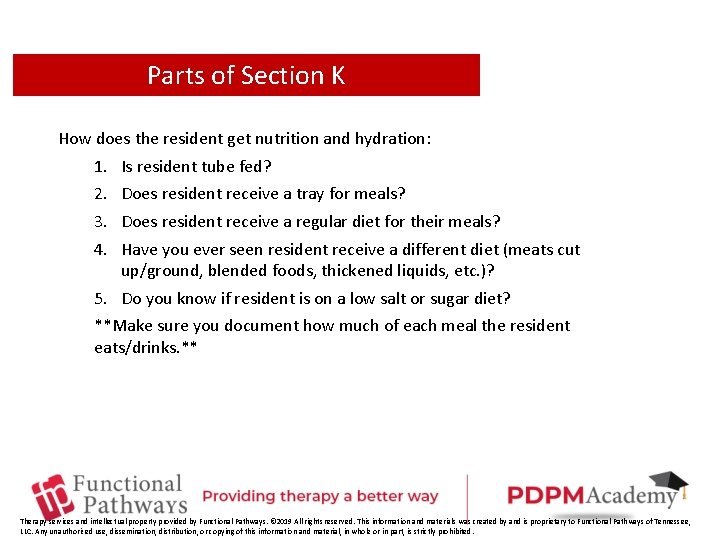
Parts of Section K How does the resident get nutrition and hydration: 1. 2. 3. 4. Is resident tube fed? Does resident receive a tray for meals? Does resident receive a regular diet for their meals? Have you ever seen resident receive a different diet (meats cut up/ground, blended foods, thickened liquids, etc. )? 5. Do you know if resident is on a low salt or sugar diet? **Make sure you document how much of each meal the resident eats/drinks. ** Therapy services and intellectual property provided by Functional Pathways. © 2019 All rights reserved. This information and materials was created by and is proprietary to Functional Pathways of Tennessee, LLC. Any unauthorized use, dissemination, distribution, or copying of this information and material, in whole or in part, is strictly prohibited.
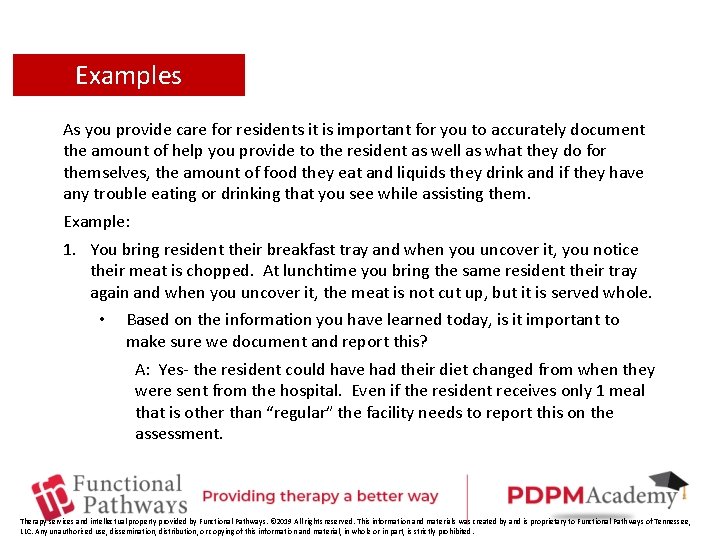
Examples As you provide care for residents it is important for you to accurately document the amount of help you provide to the resident as well as what they do for themselves, the amount of food they eat and liquids they drink and if they have any trouble eating or drinking that you see while assisting them. Example: 1. You bring resident their breakfast tray and when you uncover it, you notice their meat is chopped. At lunchtime you bring the same resident their tray again and when you uncover it, the meat is not cut up, but it is served whole. • Based on the information you have learned today, is it important to make sure we document and report this? A: Yes- the resident could have had their diet changed from when they were sent from the hospital. Even if the resident receives only 1 meal that is other than “regular” the facility needs to report this on the assessment. Therapy services and intellectual property provided by Functional Pathways. © 2019 All rights reserved. This information and materials was created by and is proprietary to Functional Pathways of Tennessee, LLC. Any unauthorized use, dissemination, distribution, or copying of this information and material, in whole or in part, is strictly prohibited.
Examples Example: 2. You are helping a resident eat their lunch. At the end of the meal, you notice the resident still has some food in their mouth. You take them to their room to clean their mouth. • Based on the information you have learned today, is it important to make sure we document and report this? A: Yes- one of the 4 questions Section K specifically asks is whether the resident has food left in their mouth at the end of the meal. You are taking very good care of the resident by helping them to clean their mouth after the meal and clear any leftovers, but it is important to document this and report so it can be added their MDS assessment and appropriate referral to speech therapy can be made as needed. Food that remains in a residents’ mouth after meals increases their risk for aspiration. Therapy services and intellectual property provided by Functional Pathways. © 2019 All rights reserved. This information and materials was created by and is proprietary to Functional Pathways of Tennessee, LLC. Any unauthorized use, dissemination, distribution, or copying of this information and material, in whole or in part, is strictly prohibited.
Examples Example: 3. You are collecting trays at the end of a meal. Mr. S is a new resident, and you know he has a tube feeding, but he also gets a tray at mealtimes. You note that Mr. S has only eaten a small amount of the food on his tray. You continue and pick up the rest of the trays. • Based on the information you have learned today, is it important to make sure we document and report this? A: Yes- one of the questions in Section K is related to the percent of nutrition received by tube feeding as compared to food taken in by mouth. This information is important in making sure the resident is taking in enough food and drink to get well and stay well. The amount of food by mouth vs tube feeding can also affect the resident’s assessment and the cost of their total care. Therapy services and intellectual property provided by Functional Pathways. © 2019 All rights reserved. This information and materials was created by and is proprietary to Functional Pathways of Tennessee, LLC. Any unauthorized use, dissemination, distribution, or copying of this information and material, in whole or in part, is strictly prohibited.
Section K: Who should be reporting this information? Whether it is frontline care staff, housekeeping, maintenance, activities, therapy, social work or the administrator, anyone who observes the patient eating or drinking anything or taking medication (Coughing/choking on food or drink, food spilling from mouth, etc. ) should be reporting to nursing. This ensures not only that the issue gets treated, but also that it is documented and included on their assessment. Everyone is a part of the team and needs to document and communicate what they see when interacting with our residents. Therapy services and intellectual property provided by Functional Pathways. © 2019 All rights reserved. This information and materials was created by and is proprietary to Functional Pathways of Tennessee, LLC. Any unauthorized use, dissemination, distribution, or copying of this information and material, in whole or in part, is strictly prohibited.
Therapy services and intellectual property provided by Functional Pathways. © 2019 All rights reserved. This information and materials was created by and is proprietary to Functional Pathways of Tennessee, LLC. Any unauthorized use, dissemination, distribution, or copying of this information and material, in whole or in part, is strictly prohibited.
- Slides: 13