
SECTION I Introduction 1 This page intentionally left











































- Slides: 192
SECTION I Introduction 1
This page intentionally left blank 2
Introductions • Recognition of the Review Committee and Gemini • Introductions 3
Overview of the Presentation · We will start with the current status of the project including an overview of the project schedule, summary of the opto-mechanical design, electrical design, systems design, and the cost performance to date. · The summary of the committee report items will include an issues compliance matrix, and address specific committee concerns. · In the project overview section we will present both the plan to the RR and the plan to completion. A discussion of the remaining issues between Gemini and NOAO is included. · Project management will cover the GNIRS project organization, the schedule, critical path, remaining capital and labor costs, cost performance tracking, reporting, etc. · The new GNIRS configuration will be presented in summary to familiarize the committee with the new instrument design. We will present examples of the requirements flowdown process, the top level configuration, and system integration. · Risk ID and mitigation is planned for the second day and will address all risk items previously pointed out by the committee plus additional items related to the new design, and the plan to mitigate these risks. · Sidney Wolff will then conclude our presentations and we will adjourn for the committee to caucus. 4
Overview of the Presentation • • 5 Current status of the project Summary of committee report items Project overview Project management The new GNIRS configuration Risk identification and mitigation plan Conclusion Committee Caucus
This page intentionally left blank 6
Committee Charge 7 · What is NOAO’s current cost estimate to complete GNIRS and on what schedule? · Is this estimate consistent with NOAO’s planned resources over the duration of the GNIRS project? · Have the technical issues (AURA report attached for reference) identified by the AURA review committee been addressed adequately to permit continuation of GNIRS? · Does NOAO now have in place an appropriate management structure to track, plan, and control resources to ensure that GNIRS will be delivered on time and budget? · Are there any approaches to designing and fabricating GNIRS that can significantly accelerate the planned delivery, e. g. , through the injection of additional NOAO resources, outsourcing the fabrication of components, etc. ? · Have all contractual matters involving out of scope work, definition of work, and interfacing requirements been settled with IGPO?
GNIRS Reprogramming Addresses All Committee Report Items · USGP WPM meets nearly daily with PM · All information USGP requests is provided, in the format requested · USGP attends all weekly staff meetings, notified of all other meetings in advance · PM solicits USGP input frequently · More involvement of USGP in daily GNIRS activities · Actively soliciting IGPO input · Responsive to IGPO concerns · More direct communication with NOAO Director · Between Project and USGP WPM · Systems engineering is a critical capability · Meets all technical requirements · Meets original weight requirements 8
GNIRS Reprogramming Addresses All Committee Report Items · Clearly defined NOAO/USGP relationship · We have a new philosophy of working · IGPO is a customer · Our project is open (e. g. , web site) · We have a new management structure · Full time Project Manager who reports directly to NOAO Director · USGP WPM reports to NOAO Director · GNIRS has new engineering & systems team · Engineers do the design · Formed systems engineering team (3 scientists plus PM) · GNIRS is a new configuration · Optical design is essentially intact · Repackaged or redesigned entire instrument · Addresses all technical issues in the AURA committee report 9
This page intentionally left blank 10
SECTION II Summary of Committee Report Items 11
Committee Report Identified 9 Basic Concerns · · · · · 12 New design addresses technical issues Systems engineering guided the design effort We have addressed the risk items and have a mitigation plan We have the best engineers in the organization on the project The project has high priority and reports directly to Sidney Wolff The IFU and OIWFS interfaces and integration have been addressed The instrument integration will be led by the project scientists Project Management shortcomings have been addressed We are confident the instrument will meet requirements
Committee Report Identified 9 Basic Concerns · · · · · 13 Unresolved technical issues No rigorous requirements flow down Lack of risk ID and mitigation plan Capability of engineering staff Organizational hierarchy IFU and OIWFS integration issues Lines of responsibility for systems integration Project management Overall technical capabilities of the GNIRS instrument
This page intentionally left blank 14
Committee Report Pointed Out 5 Technical Risk Areas · Cool down time and thermal gradients · Optical focus, alignment, mirror finish and baffling · Handling frame and local handling · OIWFS modularity and integration/test · IFU ICD and space constraints 15
This page intentionally left blank 16
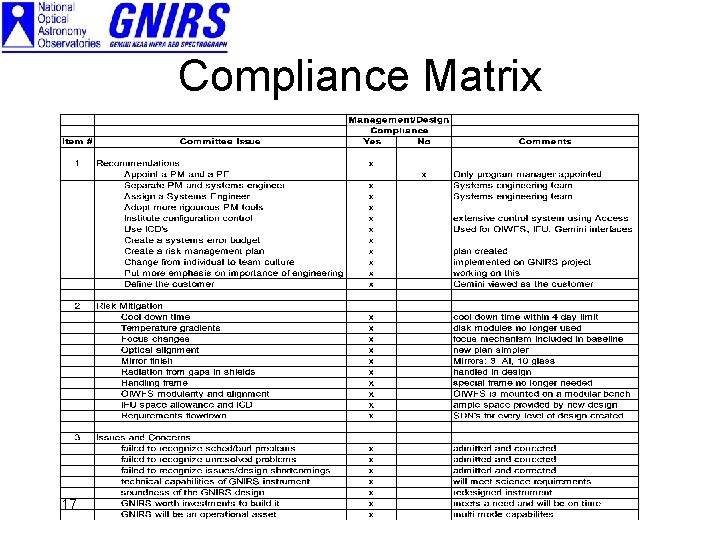
Compliance Matrix 17
This page intentionally left blank 18
SECTION III Current Status of the GNIRS Project 19
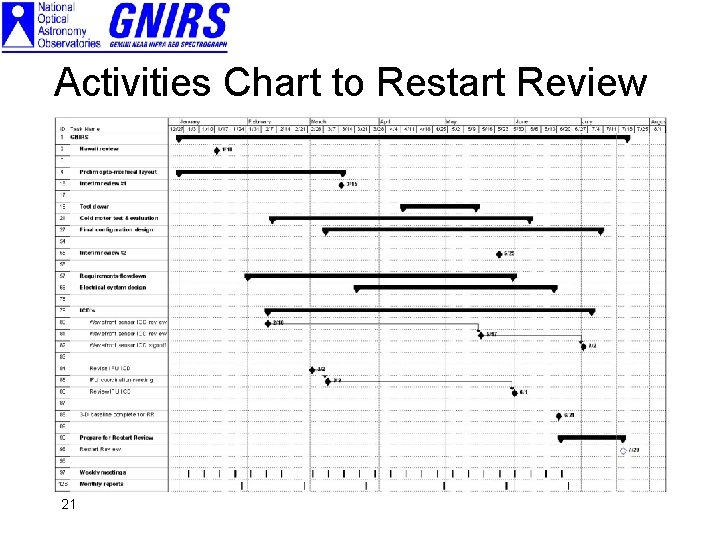
Activities Chart to Restart Review · Major milestones: · · · · 1/18 2/10 3/9 3/15 5/25 6/21 6/1, 7/20 -21 Hawaii review OIWFS ICD deficiencies identified Durham IFU meeting Interim review #1 Interim review #2 Baseline completed for RR ICD reviews Restart Review · Major activities: · · · 20 Preliminary opto-mechanical layout Cold motor T&E Final configuration design Requirements flowdown Electrical systems design · Restart Review preparation
Activities Chart to Restart Review 21
Projected Cost Performance Through July 31, 1999 · · · 22 Labor budget: Projected thru 8/1: Capital budget: Projected thru 8/1: Total under plan $443. 8 K $337. 1 K $ 59. 0 K $ 75. 0 K $ 90. 7 K
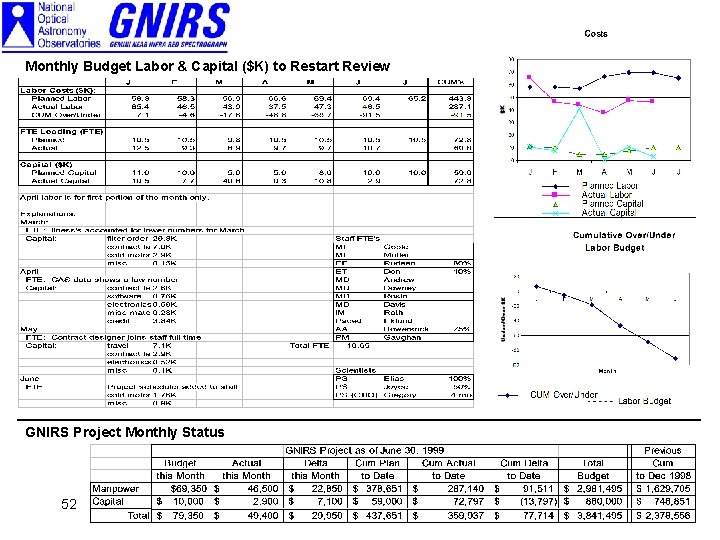
Restart Review work is approximately 89% complete · Budgeted labor dollars through RR is 76% spent · RR budgeted non-payroll capital is 127% spent · Performance (1/1 -7/30) · · · BCWS = $443. 8 K (budgeted cost of work scheduled) BCWP = $394. 9 K (budgeted cost of work performed, total project to RR) ACWP = $337. 1 K (actual cost of work performed total project to RR) CPI = 1. 17 (cost performance index = BCWP/ACWP) SPI = 0. 89 (schedule performance index = BCWP/BCWS) Project is 11% behind schedule (overall to RR) · Critical path is 19% behind schedule (opto-mechanical design) · Schedule to completion takes this into account · Under-spending reflects actual costs vs average rate planning · FTE loading very close to prediction · Cost delta’s related to actual salary rated vs planning numbers 23
Reviews Prior to Restart Review · Virtual reviews solicited from · Tom O’Brien, OSU · Donald Pettie, ROE · Bobby Ulich, Kaman Aerospace · In-process reviews: · March 15 · May 25 24
Engineering Design will Finish December ‘ 99 · Under-estimated the opto-mechanical design task · OIWFS more complicated than anticipated · Design is mature enough to qualify for this review · Three in-process reviews held · Virtual reviews solicited from individuals outside NOAO · Reviewed by NSF and AURA in May ‘ 99 25
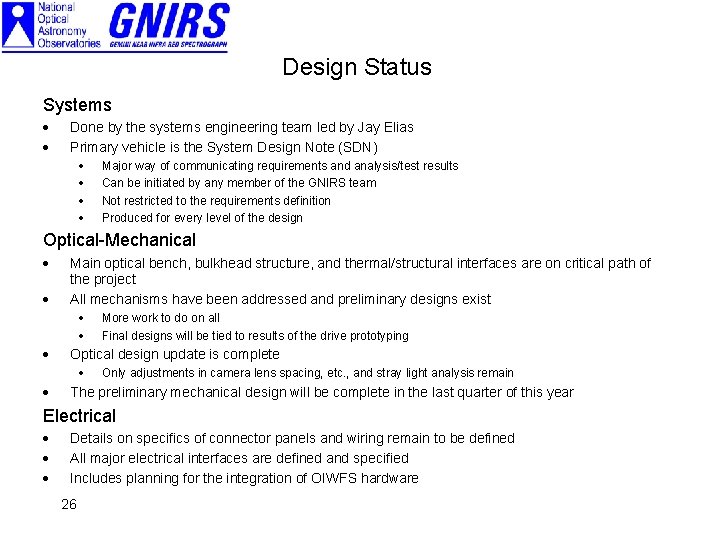
Design Status Systems · · Done by the systems engineering team led by Jay Elias Primary vehicle is the System Design Note (SDN) · · Major way of communicating requirements and analysis/test results Can be initiated by any member of the GNIRS team Not restricted to the requirements definition Produced for every level of the design Optical-Mechanical · · Main optical bench, bulkhead structure, and thermal/structural interfaces are on critical path of the project All mechanisms have been addressed and preliminary designs exist · · · Optical design update is complete · · More work to do on all Final designs will be tied to results of the drive prototyping Only adjustments in camera lens spacing, etc. , and stray light analysis remain The preliminary mechanical design will be complete in the last quarter of this year Electrical · · · Details on specifics of connector panels and wiring remain to be defined All major electrical interfaces are defined and specified Includes planning for the integration of OIWFS hardware 26
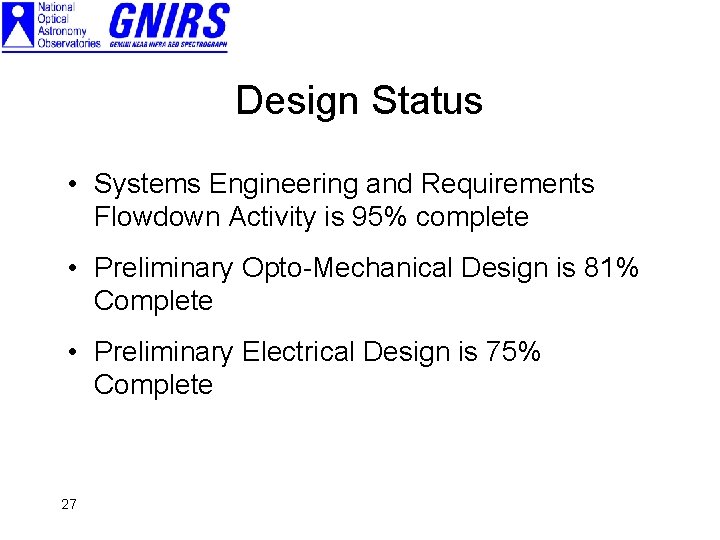
Design Status • Systems Engineering and Requirements Flowdown Activity is 95% complete • Preliminary Opto-Mechanical Design is 81% Complete • Preliminary Electrical Design is 75% Complete 27
This page intentionally left blank 28
SECTION IV Project Overview 29
This page intentionally left blank 30
Outline · WBS · Total Project including work to RR · Project schedule · · 31 Plan to completion Critical path Capital and labor costs Resource needs
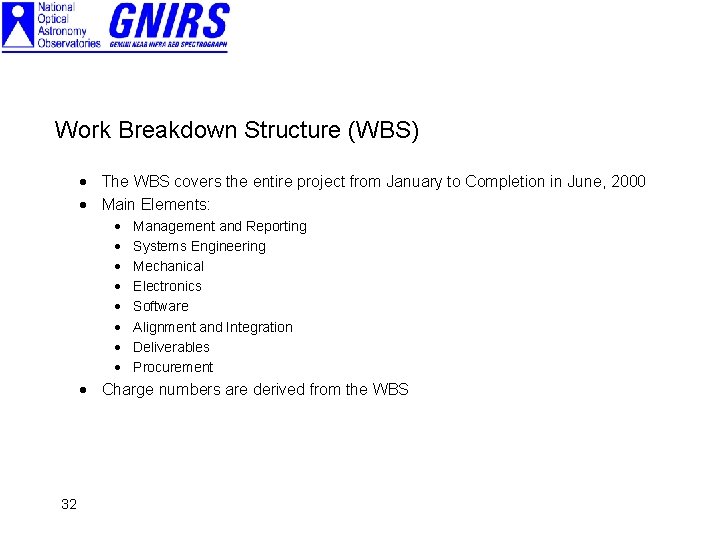
Work Breakdown Structure (WBS) · The WBS covers the entire project from January to Completion in June, 2000 · Main Elements: · · · · Management and Reporting Systems Engineering Mechanical Electronics Software Alignment and Integration Deliverables Procurement · Charge numbers are derived from the WBS 32
WBS · Chart on wall · Accounts for activities to 6 th level · Contains summary rollups of costs of each work element · Main tool for tracking costs and assessing cost performance 33
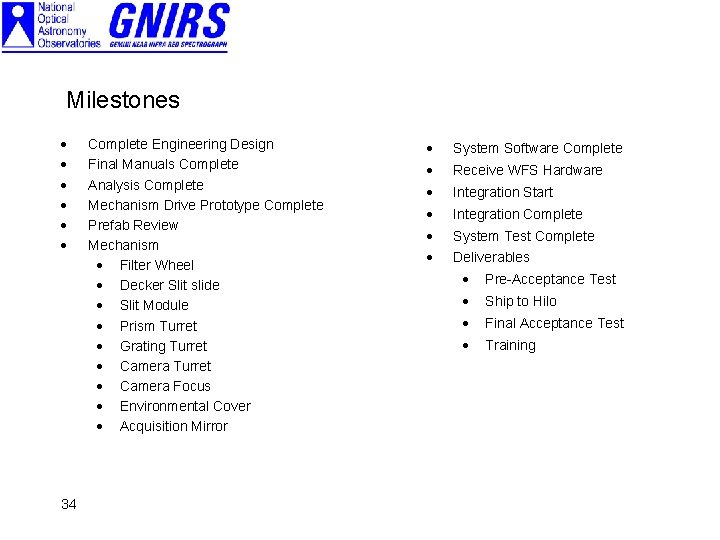
Milestones · · · 34 Complete Engineering Design Final Manuals Complete Analysis Complete Mechanism Drive Prototype Complete Prefab Review Mechanism · Filter Wheel · Decker Slit slide · Slit Module · Prism Turret · Grating Turret · Camera Focus · Environmental Cover · Acquisition Mirror · System Software Complete · Receive WFS Hardware · Integration Start · Integration Complete · System Test Complete · Deliverables · Pre-Acceptance Test · Ship to Hilo · Final Acceptance Test · Training
Project Schedule · Schedule overview to completion · Summary schedule chart · Detail schedule on wall · Project plan on wall · Highlights of the Project Plan · Plan to completion · key milestones · milestone chart 35
This page intentionally left blank 36
Critical Path · Engineering design · Prototype mechanism drive testing · Pre-Fab review · Integration and test · Camera turret assembly · Acceptance Test 37
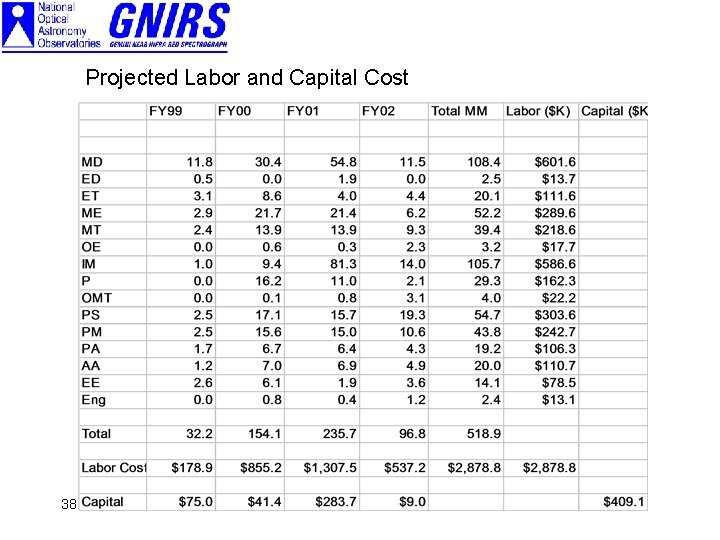
Projected Labor and Capital Cost 38
Capital and Labor Cost · Cost to complete is $3. 9 million · Includes expenditures from January 1, 1999 · Labor cost to Restart Review was $443. 8 K and capital cost was $75 K. · Labor cost to go is $2. 88 million for 519 man months · Capital cost to go is $409 K, including outsourcing of fabrication items 39
This page intentionally left blank 40
Sufficient Key Resources are Committed to do this Project · Facilities are available and designated for this project effort · · · Shop Lab space Cleanroom Test dewar Equipment · ME’s, MD’s, IM’s are key resources to complete design and fabrication · PS(s) will be involved in and supervise integration and test · PS(s) form systems engineering team to monitor all technical activities 41
This page intentionally left blank 42
Strategy Based on New Design with Proven Concepts · No new development · Design for ease of fabrication/assembly/test · Fabrication strategy · In-house IM’s used primarily for mechanism fabrication and assembly with conventional machining · Out-sourcing to vendors where cost effective · Castings are planned for several large assemblies 43
This page intentionally left blank 44
SECTION V Project Management 45
This page intentionally left blank 46
Outline • • • 47 Project organization Management methods Reporting Reviews planned Configuration control Customer relations
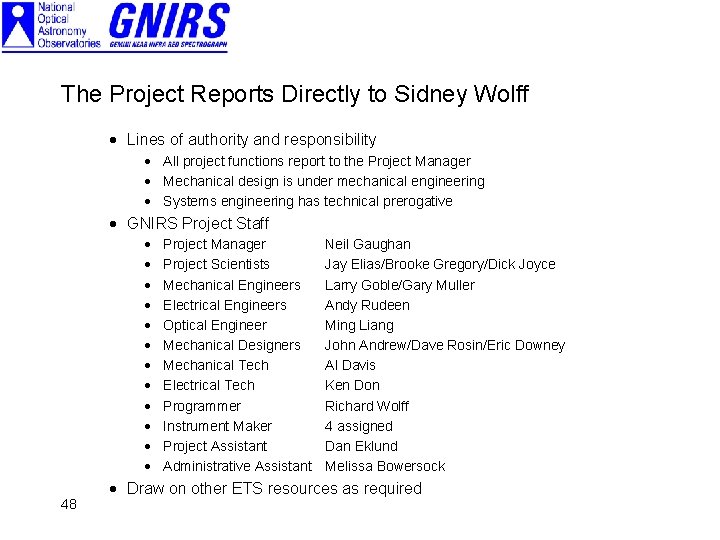
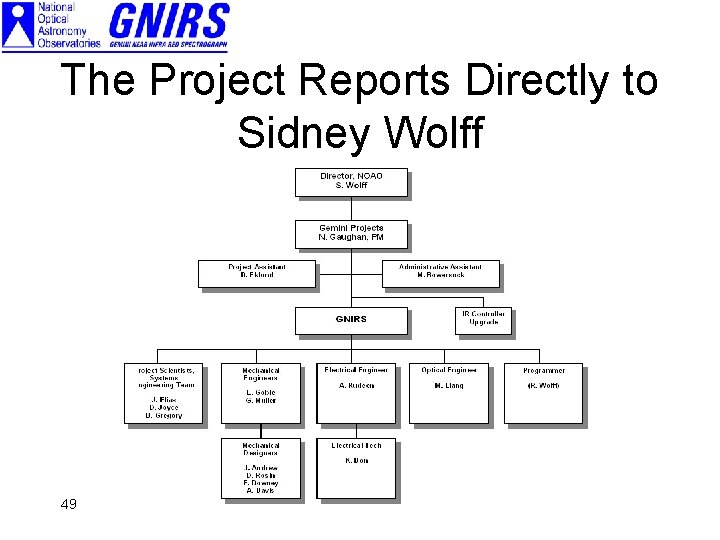
The Project Reports Directly to Sidney Wolff · Lines of authority and responsibility · All project functions report to the Project Manager · Mechanical design is under mechanical engineering · Systems engineering has technical prerogative · GNIRS Project Staff · · · 48 Project Manager Project Scientists Mechanical Engineers Electrical Engineers Optical Engineer Mechanical Designers Mechanical Tech Electrical Tech Programmer Instrument Maker Project Assistant Administrative Assistant Neil Gaughan Jay Elias/Brooke Gregory/Dick Joyce Larry Goble/Gary Muller Andy Rudeen Ming Liang John Andrew/Dave Rosin/Eric Downey Al Davis Ken Don Richard Wolff 4 assigned Dan Eklund Melissa Bowersock · Draw on other ETS resources as required
The Project Reports Directly to Sidney Wolff 49
This page intentionally left blank 50
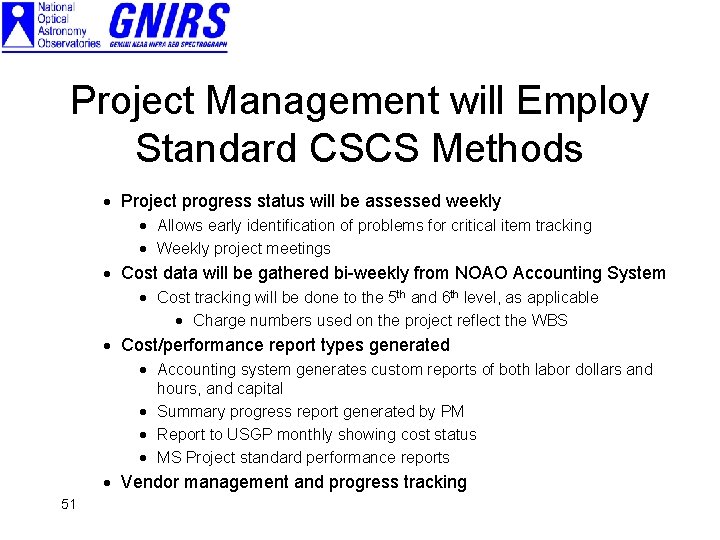
Project Management will Employ Standard CSCS Methods · Project progress status will be assessed weekly · Allows early identification of problems for critical item tracking · Weekly project meetings · Cost data will be gathered bi-weekly from NOAO Accounting System · Cost tracking will be done to the 5 th and 6 th level, as applicable · Charge numbers used on the project reflect the WBS · Cost/performance report types generated · Accounting system generates custom reports of both labor dollars and hours, and capital · Summary progress report generated by PM · Report to USGP monthly showing cost status · MS Project standard performance reports · Vendor management and progress tracking 51
Monthly Budget Labor & Capital ($K) to Restart Review GNIRS Project Monthly Status 52
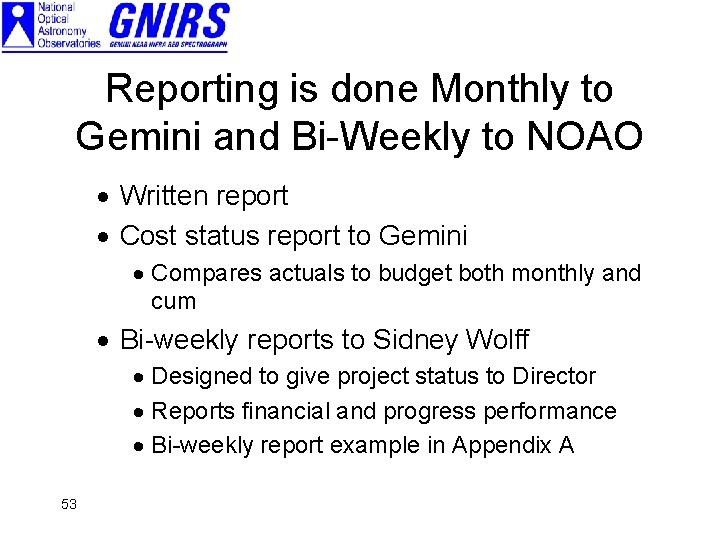
Reporting is done Monthly to Gemini and Bi-Weekly to NOAO · Written report · Cost status report to Gemini · Compares actuals to budget both monthly and cum · Bi-weekly reports to Sidney Wolff · Designed to give project status to Director · Reports financial and progress performance · Bi-weekly report example in Appendix A 53
Reviews · Gemini review participation · All formal reviews given to Gemini as the Customer · Gemini is encouraged to attend and participate in all reviews · Web reviews · Our design will be placed on the GNIRS web site as it matures · Review and comments are always welcome · GNIRS is publicly accessible <http: //www. noao. edu/ets/gnirs> 54
Formal and Informal Reviews are Planned · Pre-Fabrication review · Formal review at completion of prototyping and engineering design · Design will be frozen at this point and placed under configuration control · Mid-Fabrication review to assess schedule performance · Held approximately one year after fabrication start · Internal reviews will be held as required 55 · Informal to assess readiness for fabrication, procurement, etc.
This page intentionally left blank 56
Configuration Control is Already Implemented on the Project · Example is on the table · Provides for complete tracking of all assemblies · Contained in an Access Data Base · Managed by Gary Muller, Sr. Mechanical Engineer responsible for design and fabrication 57
This page intentionally left blank 58
Customer Relations · Improved NOAO/USGP relationship · USGP WPM meets nearly daily with PM · All information USGP requests is provided, in the format requested · USGP attends all weekly staff meetings, notified of all other meetings in advance · PM solicits USGP input frequently · More involvement of USGP in daily GNIRS activities · IGPO is viewed as the customer · Actively soliciting IGPO input · Responsive to IGPO concerns · Our project is open (e. g. , web site) 59
This page intentionally left blank 60
Section VI GNIRS Configuration 61
This page intentionally left blank 62
GNIRS is a New Configuration • Requirements (Elias) • Top Level Configuration (Elias) • Detailed Configuration (Gregory, Muller, Goble, Elias, Rudeen) • Sub-System Integration (Elias) • System Integration and Test (Elias) 63
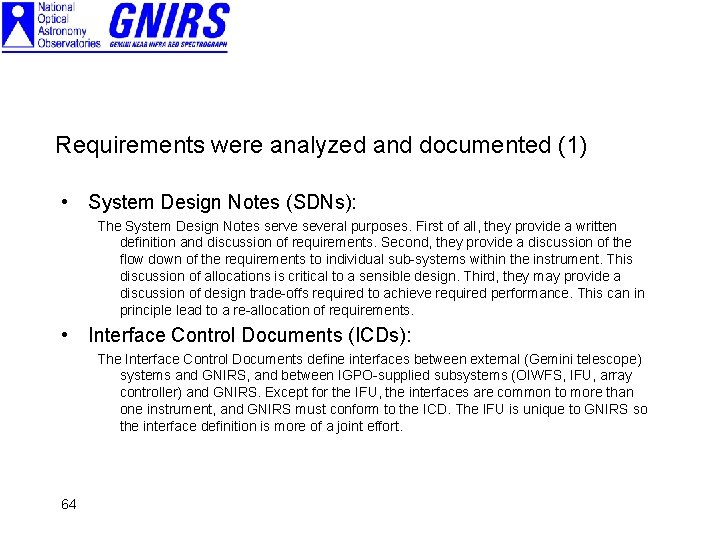
Requirements were analyzed and documented (1) • System Design Notes (SDNs): The System Design Notes serve several purposes. First of all, they provide a written definition and discussion of requirements. Second, they provide a discussion of the flow down of the requirements to individual sub-systems within the instrument. This discussion of allocations is critical to a sensible design. Third, they may provide a discussion of design trade-offs required to achieve required performance. This can in principle lead to a re-allocation of requirements. • Interface Control Documents (ICDs): The Interface Control Documents define interfaces between external (Gemini telescope) systems and GNIRS, and between IGPO-supplied subsystems (OIWFS, IFU, array controller) and GNIRS. Except for the IFU, the interfaces are common to more than one instrument, and GNIRS must conform to the ICD. The IFU is unique to GNIRS so the interface definition is more of a joint effort. 64
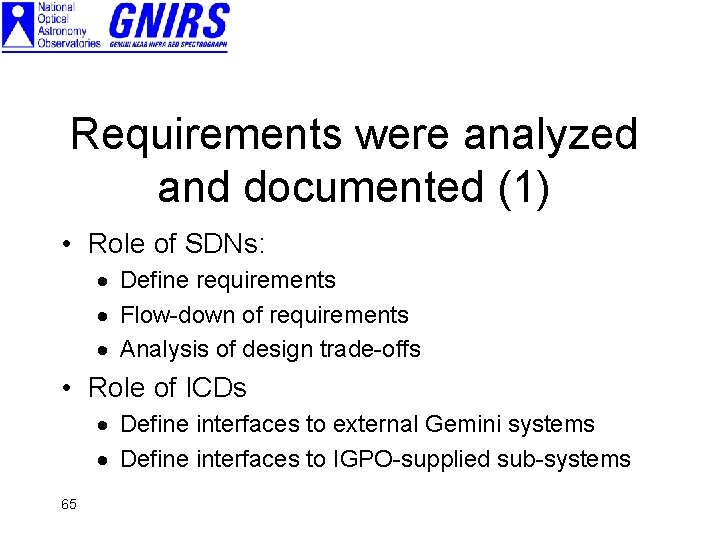
Requirements were analyzed and documented (1) • Role of SDNs: · Define requirements · Flow-down of requirements · Analysis of design trade-offs • Role of ICDs · Define interfaces to external Gemini systems · Define interfaces to IGPO-supplied sub-systems 65
Requirements were analyzed and documented (2) • Requirement Flow-Down: The design notes include summaries of the requirements and an allocations to subsystems. The flow-down chart illustrates this. What is particularly important is that the requirements, as they flow down to individual subsystems, are taken seriously by the engineering team. Thus, the approach to designing mechanisms is to design each within a weight budget rather than charging a “weight czar” to find out afterward whether the budget has been met. The design note approach permits feedback from the engineers in defining the allocations, and helps ensure that they “sign on” to the requirements. 66
Requirements were analyzed and documented (2) • Requirements Flow-Down: · Formal allocation of requirements · Engineering team understands requirements and implements them in design 67
Key Science Requirements (1) • Optical Performance · · Image Quality: several requirements, can be simplified as design image quality of 85% of light in 1 pixel with fabrication and assembly tolerances producing less than 5% degradation of delivered image. Throughput: to be maximized, expectations >40%. Excess Background: light leaks and other excess thermal emission to be less than detector dark current. Scattered light: scattered light to be less than detector dark for short wavelengths (scattered light from night sky airglow). • Flexure · · Flexure between OIWFS and spectrograph slit to be <12 microns (at slit) in 1 hour (5% light loss with narrow slit) Flexure between spectrograph slit and detector to be <2. 7 microns (at detector) in 1 hour (0. 1 pixel) Shift of telescope secondary image on cold stop to be 1% of diameter maximum Should include effects of thermal variations as well as gravity • Repeatability · · 68 Repeatability during acquisition < 0. 1 pixel Repeatability between configurations <10 pixels
Key Science Requirements (1) • Optical Performance • Flexure • Repeatability 69
Key Science Requirements (2) · Cool-Down and Warm-Up · · Cool-down to take place in 4 days or less (96 hours). Warm up to take place in 1 day or less (24 hours). · Weight and Center of Gravity · · · Instrument weight = 2000 kg (ballast if necessary) Instrument center of gravity located 1000 mm from ISS face, on optical axis Allowable error in moment is 400 N-m relative to telescope elevation axis. · Supports On-Instrument Wave-Front Sensor · · Provides near-IR guiding on stars within 3 arcmin field (excluding those in spectrograph slit and acquisition field) Minimizes flexure effects (ISS, instrument and bench support) Parallel “instrument” within GNIRS: optical system, detector/controller, 3 mechanisms (4 axes) Provided as sub-system by If. A (Hawaii) through IGPO · Support of Multiple Observing Modes · 70 Detailed below
Key Science Requirements (2) • • 71 Cool-Down and Warm-Up Weight and Center of Gravity Supports OIWFS Support of Multiple Observing Modes
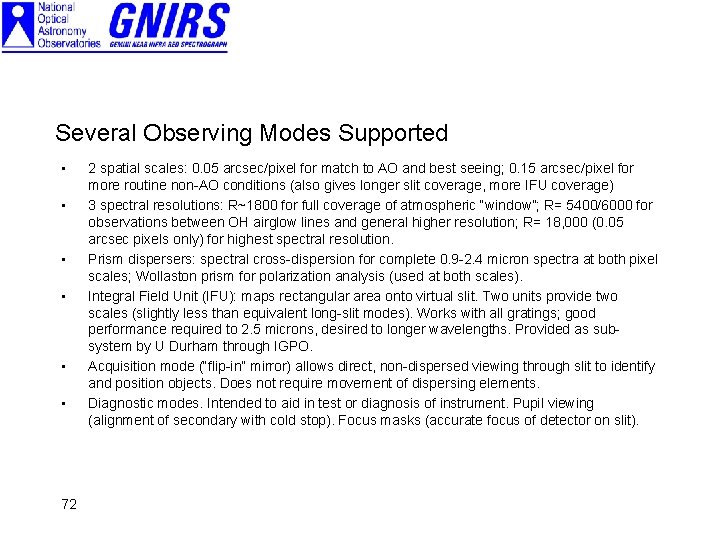
Several Observing Modes Supported • • • 72 2 spatial scales: 0. 05 arcsec/pixel for match to AO and best seeing; 0. 15 arcsec/pixel for more routine non-AO conditions (also gives longer slit coverage, more IFU coverage) 3 spectral resolutions: R~1800 for full coverage of atmospheric “window”; R= 5400/6000 for observations between OH airglow lines and general higher resolution; R= 18, 000 (0. 05 arcsec pixels only) for highest spectral resolution. Prism dispersers: spectral cross-dispersion for complete 0. 9 -2. 4 micron spectra at both pixel scales; Wollaston prism for polarization analysis (used at both scales). Integral Field Unit (IFU): maps rectangular area onto virtual slit. Two units provide two scales (slightly less than equivalent long-slit modes). Works with all gratings; good performance required to 2. 5 microns, desired to longer wavelengths. Provided as subsystem by U Durham through IGPO. Acquisition mode (“flip-in” mirror) allows direct, non-dispersed viewing through slit to identify and position objects. Does not require movement of dispersing elements. Diagnostic modes. Intended to aid in test or diagnosis of instrument. Pupil viewing (alignment of secondary with cold stop). Focus masks (accurate focus of detector on slit).
Several Observing Modes Supported • • • 73 2 Spatial Scales 3 Spectral Resolutions Cross-Dispersion and Polarization Analysis Integral Field Unit Acquisition Diagnostics
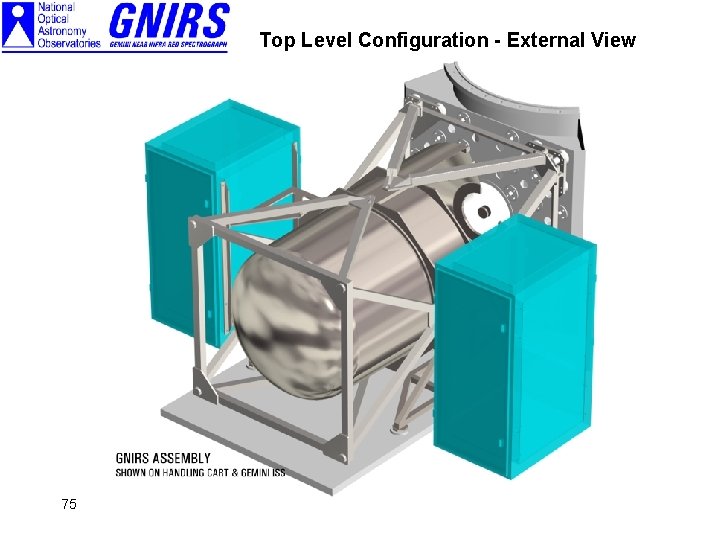
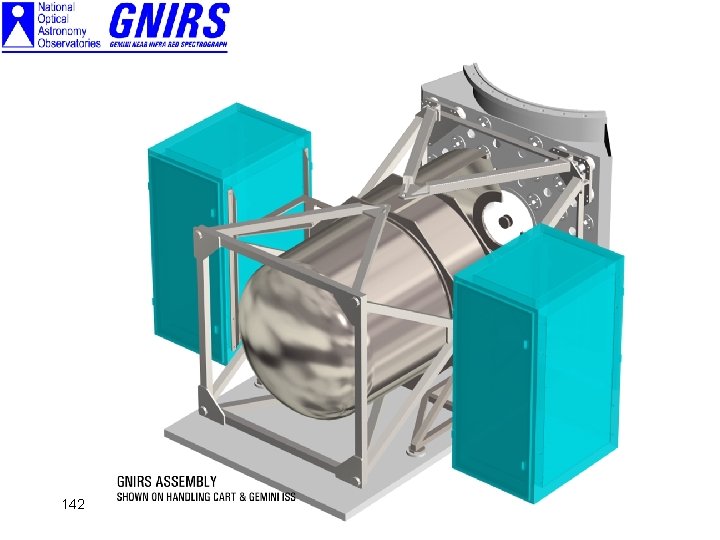
Top Level Configuration - External View • • • 74 Illustrates concept (details of dewar design will conform to internal structure). Truss structure interfaces to telescope; controls flexure, responds to thermal variations Additional trusses support instrument for handling, attach electronics to main structure. Interfaces to Gemini handling equipment are part of these trusses. Design leads to minimal complexity in dewar shell Central bulkhead contains all interfaces to innards: cooling system, structural (bench support), electrical
Top Level Configuration - External View 75
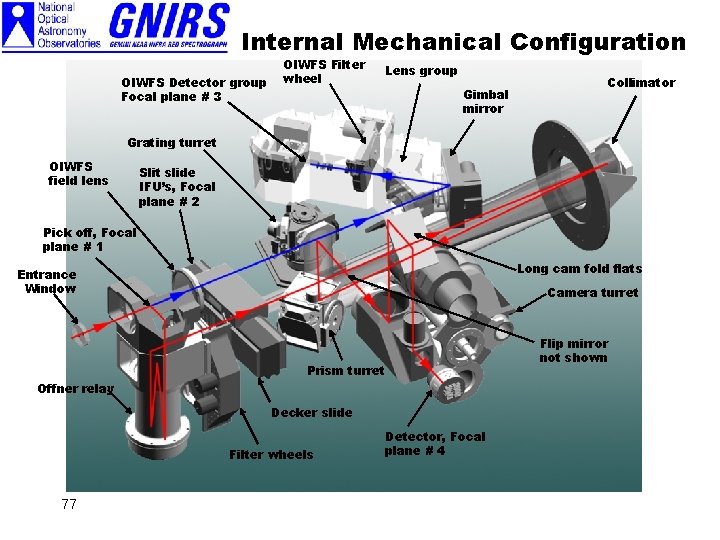
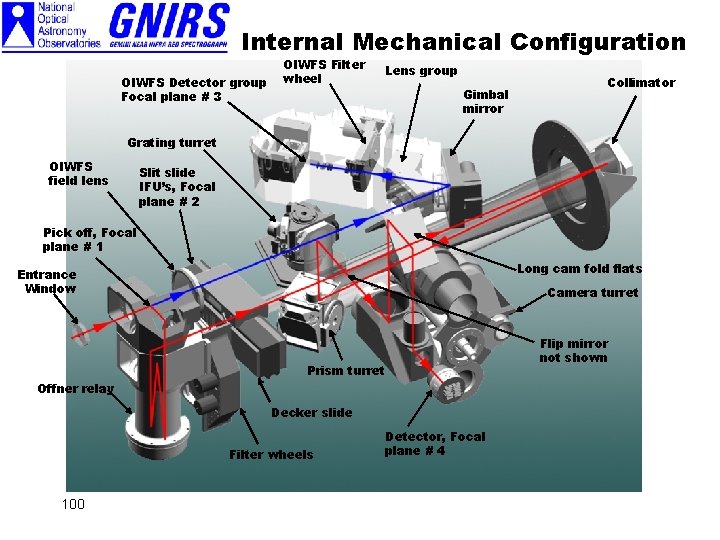
Top Level Configuration - Internal View • • • 76 Illustrates layout of mechanical assemblies. The design permits use of NIRI layout for OIWFS (2 folds removed). Key elements of OIWFS identified: field lens, combination lens group (collimator/camera), gimbal mirror (field selection), filter wheel, combination Shack-Hartmann optics group and detector mount (“detector group”) The design minimizes folds in spectrograph. Key elements identified: fore-optics (spectrograph pick-off mirror, Offner relay and folds, filters, slit/decker), collimator, prism turret, grating turret, camera turret assembly (cameras, focus, detector) The design permits use of acquisition (“flip”) mirror (intercepts light from collimator and directs to camera). Minimizes motion requirements on disperser turrets. Central location for most large assemblies simplifies structural and thermal design.
Internal Mechanical Configuration OIWFS Detector group Focal plane # 3 OIWFS Filter wheel Lens group Gimbal mirror Collimator Grating turret OIWFS field lens Slit slide IFU’s, Focal plane # 2 Pick off, Focal plane # 1 Long cam fold flats Entrance Window Camera turret Prism turret Offner relay Decker slide Filter wheels 77 Detector, Focal plane # 4 Flip mirror not shown
This page intentionally left blank 78
Detailed Configuration • Optical Design (Gregory) • Mechanical Design (Muller, Goble, Elias) • Electronic Design (Rudeen) 79
This page intentionally left blank 80
Outline: Optical Design • • 81 Overview Foreoptics Dispersers Cameras Performance Materials selection and coatings Background, stray light
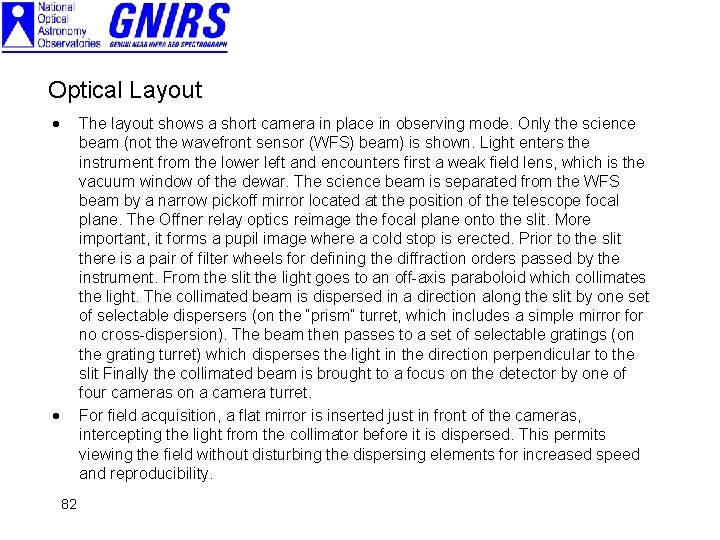
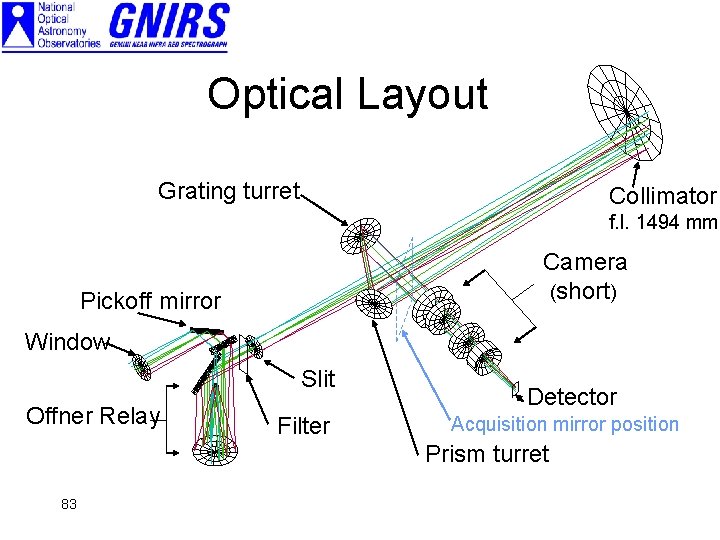
Optical Layout · The layout shows a short camera in place in observing mode. Only the science beam (not the wavefront sensor (WFS) beam) is shown. Light enters the instrument from the lower left and encounters first a weak field lens, which is the vacuum window of the dewar. The science beam is separated from the WFS beam by a narrow pickoff mirror located at the position of the telescope focal plane. The Offner relay optics reimage the focal plane onto the slit. More important, it forms a pupil image where a cold stop is erected. Prior to the slit there is a pair of filter wheels for defining the diffraction orders passed by the instrument. From the slit the light goes to an off-axis paraboloid which collimates the light. The collimated beam is dispersed in a direction along the slit by one set of selectable dispersers (on the “prism” turret, which includes a simple mirror for no cross-dispersion). The beam then passes to a set of selectable gratings (on the grating turret) which disperses the light in the direction perpendicular to the slit Finally the collimated beam is brought to a focus on the detector by one of four cameras on a camera turret. For field acquisition, a flat mirror is inserted just in front of the cameras, intercepting the light from the collimator before it is dispersed. This permits viewing the field without disturbing the dispersing elements for increased speed and reproducibility. · 82
Optical Layout Grating turret Collimator f. l. 1494 mm Camera (short) Pickoff mirror Window Slit Offner Relay Filter Detector Acquisition mirror position Prism turret 83
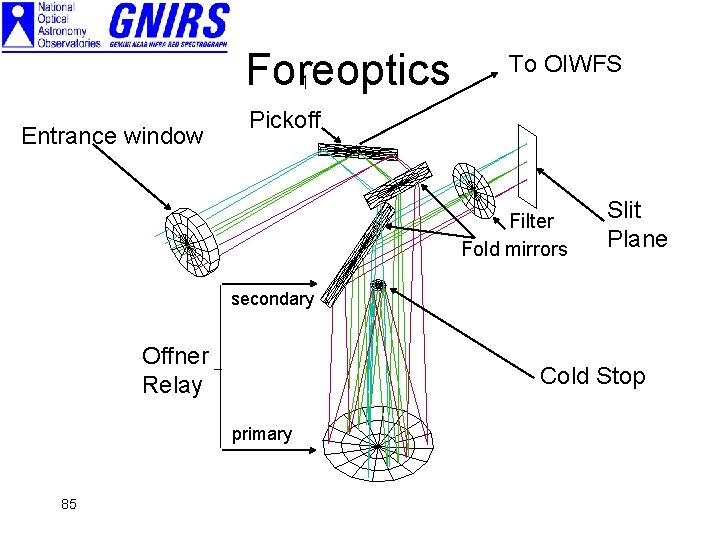
Foreoptics · · 84 The purpose of the foreoptics is to reduce the level of background radiation in the instrument. The Offner Relay reimages the telescope focal plane onto the slit, achromatically, 1: 1 and with a very low level of aberration. The combination of the entrance window of the dewar (which is a weak lens) and the primary of the Offner (in first pass) makes an image of the aperture stop of the telescope (the secondary) on the secondary of the Offner. At the secondary, a black, circular, baffle is erected to suppress light from outside the telescope beam. Additional baffles will be erected before and after the secondary to further suppress out-of-beam light. On the second pass off the primary, the beam is restored to telecentricity. This has the important result that the next image of the pupil in the spectrograph falls one focal length from the collimator mirror, where it is convenient to place the gratings and other dispersers. Cold filters before slit restrict optical bandwidth entering spectrograph, for ordersorting and suppression of out-of-band radiation.
Foreoptics Entrance window To OIWFS Pickoff Filter Fold mirrors Slit Plane secondary Offner Relay Cold Stop primary 85
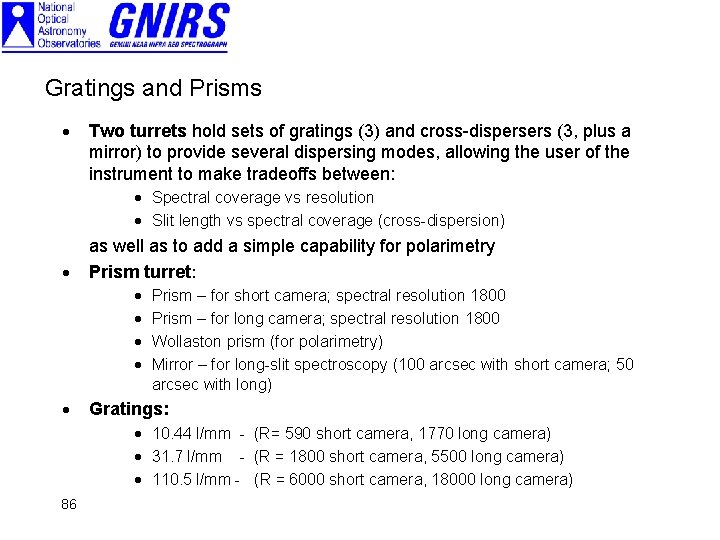
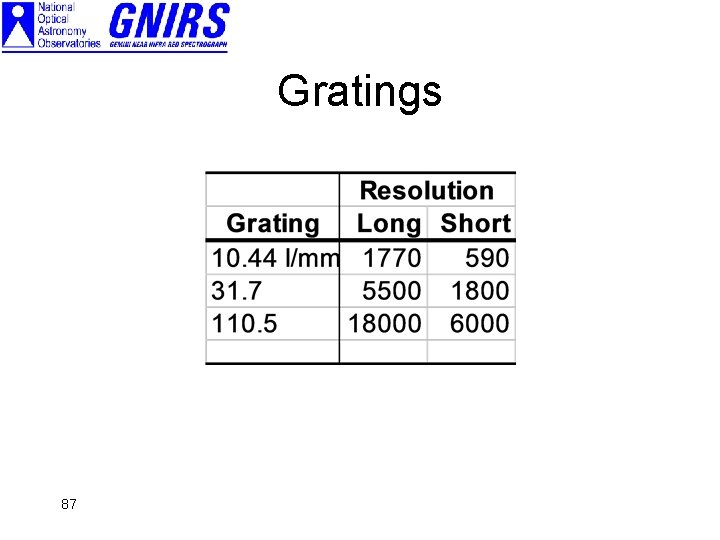
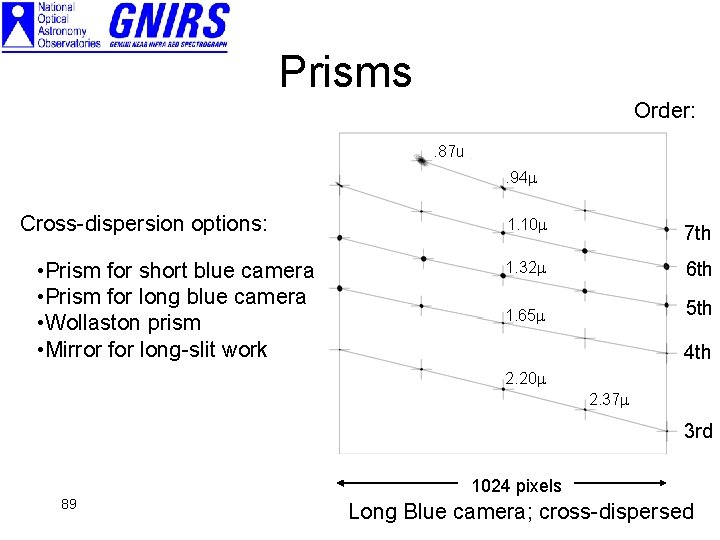
Gratings and Prisms · Two turrets hold sets of gratings (3) and cross-dispersers (3, plus a mirror) to provide several dispersing modes, allowing the user of the instrument to make tradeoffs between: · Spectral coverage vs resolution · Slit length vs spectral coverage (cross-dispersion) · as well as to add a simple capability for polarimetry Prism turret: · · · Prism – for short camera; spectral resolution 1800 Prism – for long camera; spectral resolution 1800 Wollaston prism (for polarimetry) Mirror – for long-slit spectroscopy (100 arcsec with short camera; 50 arcsec with long) Gratings: · 10. 44 l/mm - (R= 590 short camera, 1770 long camera) · 31. 7 l/mm - (R = 1800 short camera, 5500 long camera) · 110. 5 l/mm - (R = 6000 short camera, 18000 long camera) 86
Gratings 87
This slide intentionally left blank 88
Prisms Order: . 87 u. 94 Cross-dispersion options: • Prism for short blue camera • Prism for long blue camera • Wollaston prism • Mirror for long-slit work 1. 10 7 th 1. 32 6 th 1. 65 5 th 4 th 2. 20 2. 37 3 rd 1024 pixels 89 Long Blue camera; cross-dispersed
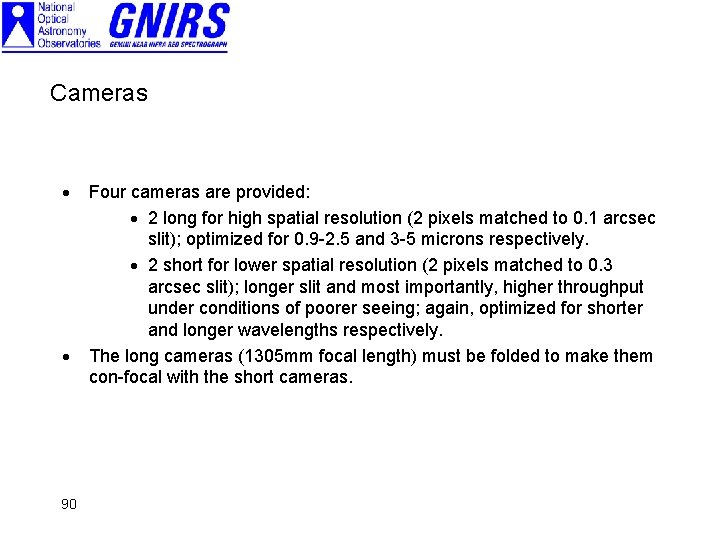
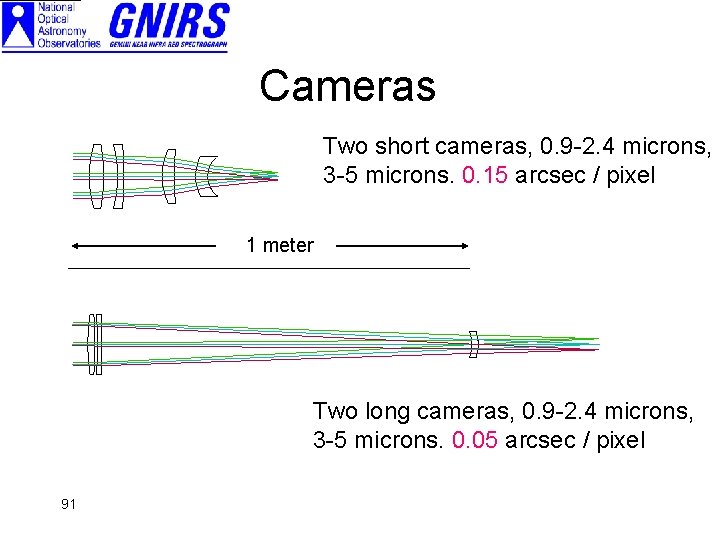
Cameras · · 90 Four cameras are provided: · 2 long for high spatial resolution (2 pixels matched to 0. 1 arcsec slit); optimized for 0. 9 -2. 5 and 3 -5 microns respectively. · 2 short for lower spatial resolution (2 pixels matched to 0. 3 arcsec slit); longer slit and most importantly, higher throughput under conditions of poorer seeing; again, optimized for shorter and longer wavelengths respectively. The long cameras (1305 mm focal length) must be folded to make them con-focal with the short cameras.
Cameras Two short cameras, 0. 9 -2. 4 microns, 3 -5 microns. 0. 15 arcsec / pixel 1 meter Two long cameras, 0. 9 -2. 4 microns, 3 -5 microns. 0. 05 arcsec / pixel 91
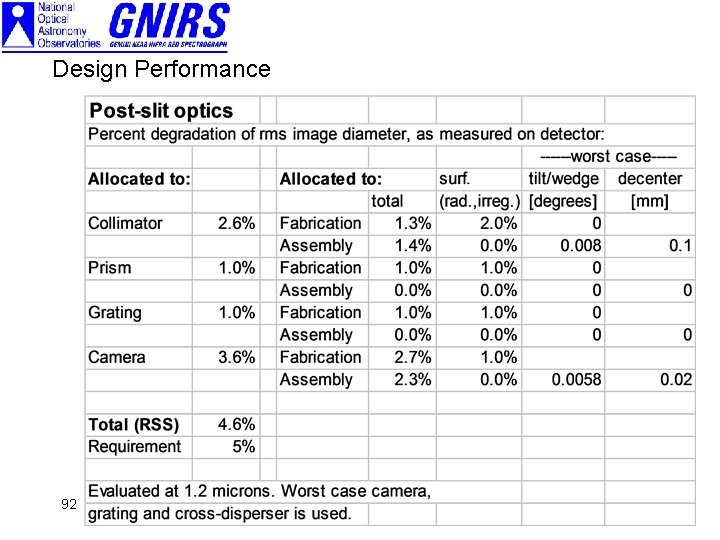
Design Performance 92
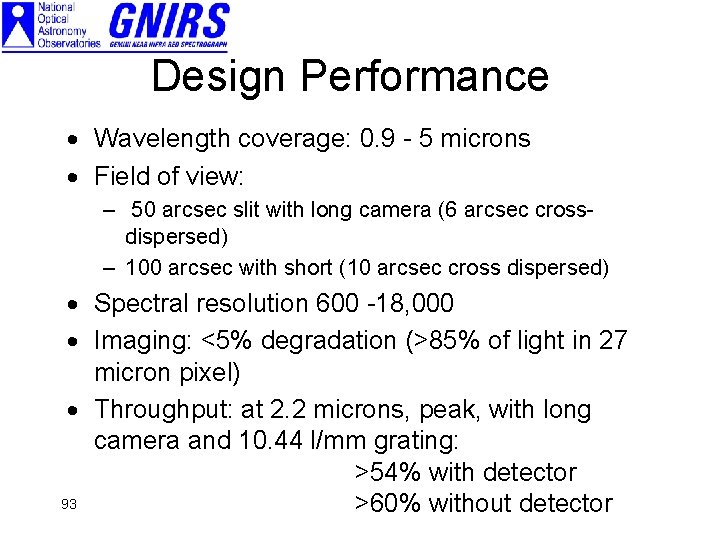
Design Performance · Wavelength coverage: 0. 9 - 5 microns · Field of view: – 50 arcsec slit with long camera (6 arcsec crossdispersed) – 100 arcsec with short (10 arcsec cross dispersed) · Spectral resolution 600 -18, 000 · Imaging: <5% degradation (>85% of light in 27 micron pixel) · Throughput: at 2. 2 microns, peak, with long camera and 10. 44 l/mm grating: >54% with detector 93 >60% without detector
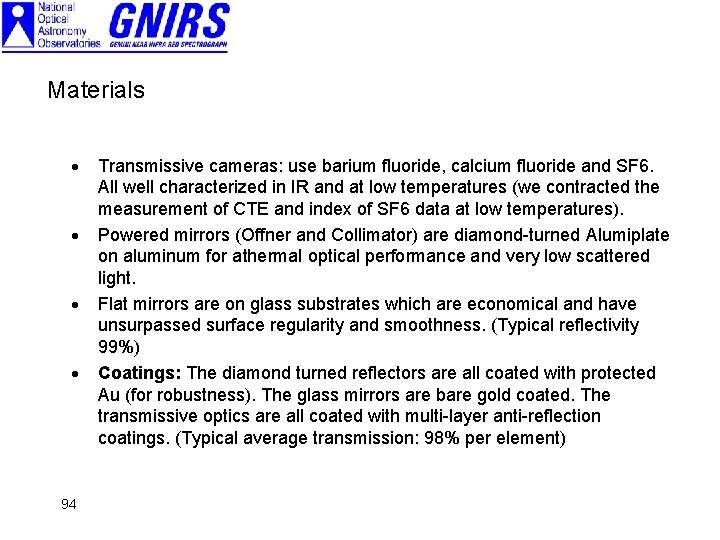
Materials · · 94 Transmissive cameras: use barium fluoride, calcium fluoride and SF 6. All well characterized in IR and at low temperatures (we contracted the measurement of CTE and index of SF 6 data at low temperatures). Powered mirrors (Offner and Collimator) are diamond-turned Alumiplate on aluminum for athermal optical performance and very low scattered light. Flat mirrors are on glass substrates which are economical and have unsurpassed surface regularity and smoothness. (Typical reflectivity 99%) Coatings: The diamond turned reflectors are all coated with protected Au (for robustness). The glass mirrors are bare gold coated. The transmissive optics are all coated with multi-layer anti-reflection coatings. (Typical average transmission: 98% per element)
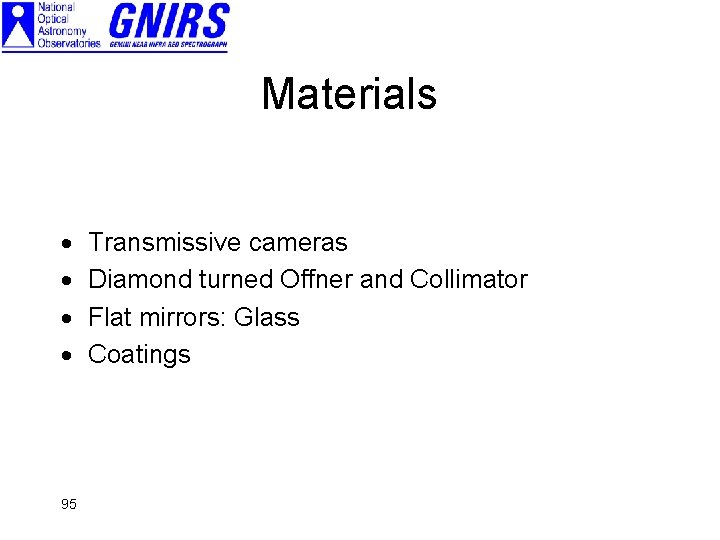
Materials · · 95 Transmissive cameras Diamond turned Offner and Collimator Flat mirrors: Glass Coatings
Stray Light We aggressively reduce extraneous sources of light. This topic may be revisited in the discussion of thermal design, but it is convenient to summarize the various approaches being used: · Low operating temperature (<65 K) · Scattered light: · No obstructions in beam to scatter · Low-scattering surfaces · Baffling will be based on scattering analysis 96 · Cold motors to eliminate feedthroughs from ambient temperatures (and active removal of heat evolved by motors) · Thermal stationing of electrical feedthroughs · No light leaks: The entire low-temperature portion of the spectrograph from the pickoff mirror to the detector will be enclosed in a nearly isothermal enclosure at <65 K. Joints will be baffled by a labyrinth construction. Path for vacuum pumping interior of instrument will be provided for. The cold, light-tight enclosure will be thoroughly light-leak tested at room temperature.
Stray Light · Low operating temperature (<65 K) · Scattered light: · No obstructions in beam to scatter · Low-scattering surfaces · Baffling will be based on scattering analysis · Cold motors to eliminate feedthroughs from ambient temperatures (and active removal of heat evolved by motors) · Thermal stationing of electrical feedthroughs · No light leaks! 97
This slide intentionally left blank 98
Mechanical Design • • 99 Structural Design (Goble) Mechanism Design (Muller) Handling (Elias) Thermal Design (Elias)
Internal Mechanical Configuration OIWFS Detector group Focal plane # 3 OIWFS Filter wheel Lens group Gimbal mirror Collimator Grating turret OIWFS field lens Slit slide IFU’s, Focal plane # 2 Pick off, Focal plane # 1 Long cam fold flats Entrance Window Camera turret Prism turret Offner relay Decker slide Filter wheels 100 Detector, Focal plane # 4 Flip mirror not shown
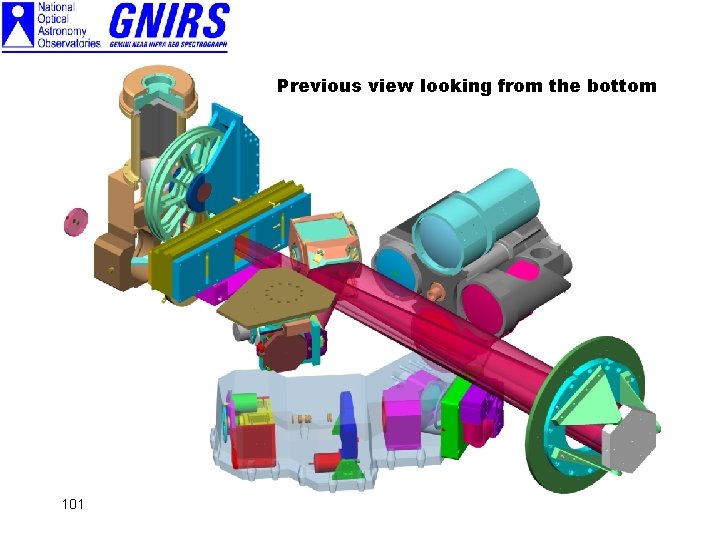
Previous view looking from the bottom 101
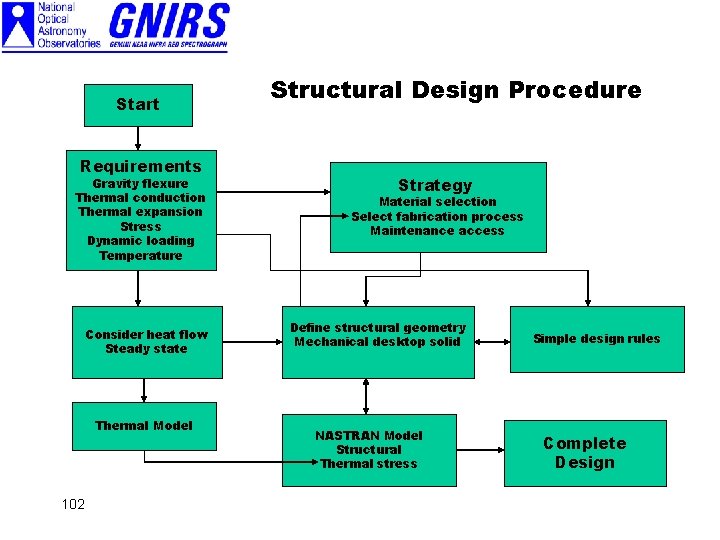
Start Requirements Gravity flexure Thermal conduction Thermal expansion Stress Dynamic loading Temperature Consider heat flow Steady state Thermal Model 102 Structural Design Procedure Strategy Material selection Select fabrication process Maintenance access Define structural geometry Mechanical desktop solid NASTRAN Model Structural Thermal stress Simple design rules Complete Design
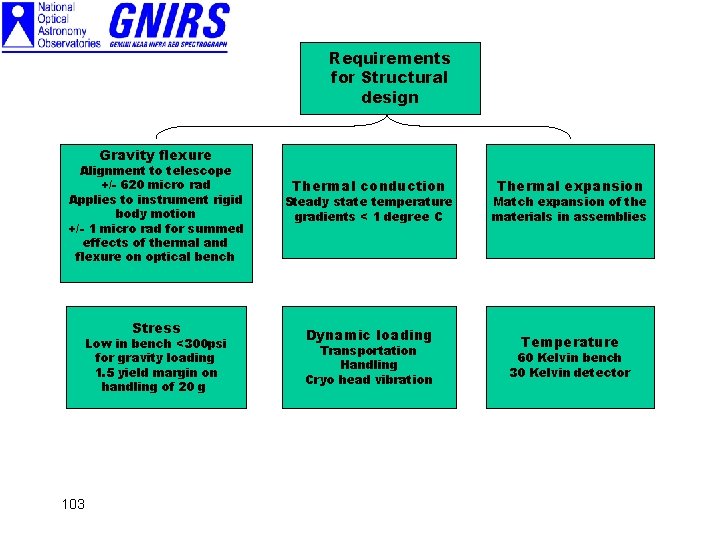
Requirements for Structural design Gravity flexure Alignment to telescope +/- 620 micro rad Applies to instrument rigid body motion +/- 1 micro rad for summed effects of thermal and flexure on optical bench Stress Low in bench <300 psi for gravity loading 1. 5 yield margin on handling of 20 g 103 Thermal conduction Steady state temperature gradients < 1 degree C Dynamic loading Transportation Handling Cryo head vibration Thermal expansion Match expansion of the materials in assemblies Temperature 60 Kelvin bench 30 Kelvin detector
Structural Design Strategy • More flexure of Instrument support is allowed because of the OIWFS, tilt < +/- 0. 62 mrad. Optical bench must be very stiff, displacement of the image on the detector < 2. 7 micron for 15 degree change in gravity vector, ~+/- 1 microrad • Central Dewar bulkhead supported on trusses, incorporates mechanical, electrical, and thermal interfaces; Dewar end caps have minimal complexity to reduce weight, fabrication cost, and allow access to the bench parts • The optical bench is a three dimensional Aluminum casting. Structure is divided at the optimum places, Offner, forward bench, center bench, aft bench. The internal bulkhead truss connects to the center casting. • Boxes that contain the mechanisms are the structure thus saving weight and enhancing heat transfer. 104
Structural Design Strategy • • • 105 Mounting flexure vs Bench flexure Use of trusses Central bulkhead for all interfaces Three dimensional Bench The Box is the Structure
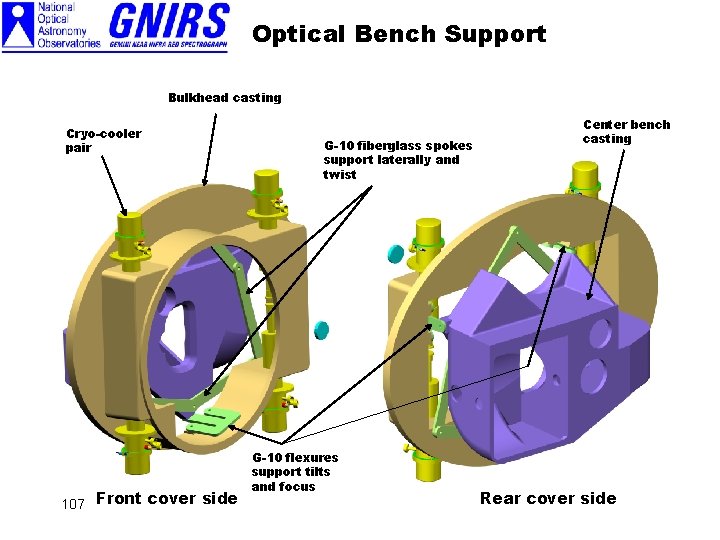
Bench Support · A set of 6 G-10 spokes between the Dewar bulkhead and the center bench casting supports two lateral degrees of freedom and twist about optical axis. · Rigidity, ~ 60 Hz lateral resonance, more FEA later · Thermal expansion compensating geometry · Low thermal conduction, space between used for wiring, cryo system, and radiation shield support · Set of 3 G-10 support flexures constrain the focus translation, and tilt about X and Y. · Design provides mount of bench while cold and also can be used to hold bench for maintenance while the cover is removed from Dewar 106
Optical Bench Support Bulkhead casting Cryo-cooler pair 107 Front cover side G-10 fiberglass spokes support laterally and twist G-10 flexures support tilts and focus Center bench casting Rear cover side
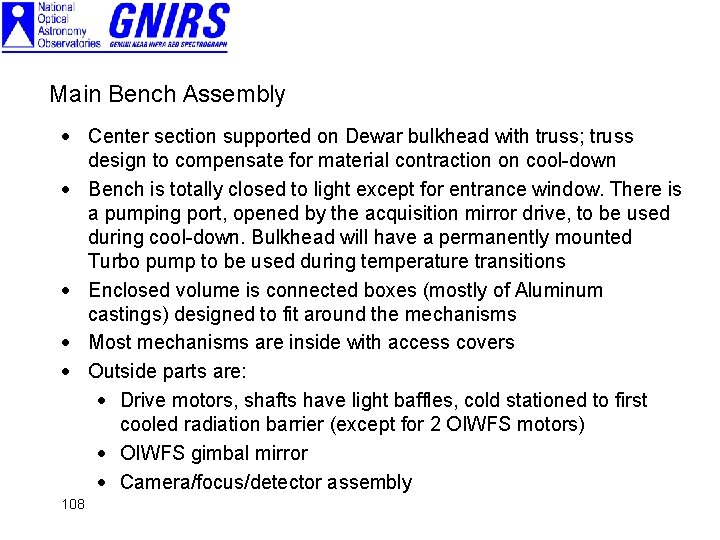
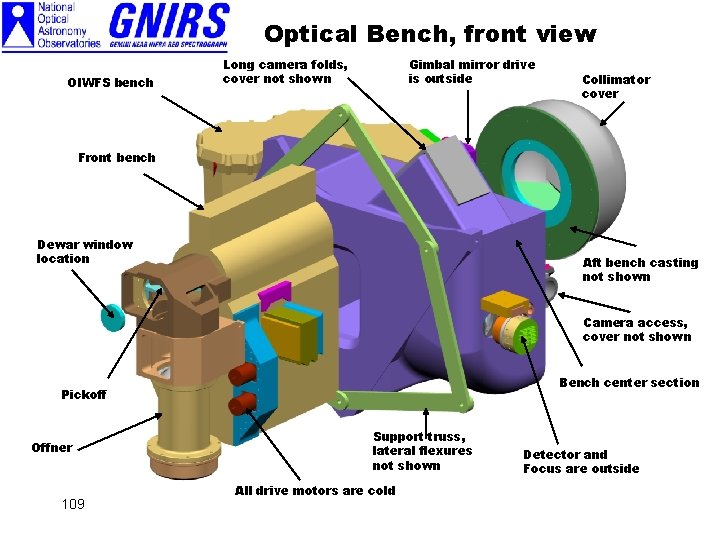
Main Bench Assembly · Center section supported on Dewar bulkhead with truss; truss design to compensate for material contraction on cool-down · Bench is totally closed to light except for entrance window. There is a pumping port, opened by the acquisition mirror drive, to be used during cool-down. Bulkhead will have a permanently mounted Turbo pump to be used during temperature transitions · Enclosed volume is connected boxes (mostly of Aluminum castings) designed to fit around the mechanisms · Most mechanisms are inside with access covers · Outside parts are: · Drive motors, shafts have light baffles, cold stationed to first cooled radiation barrier (except for 2 OIWFS motors) · OIWFS gimbal mirror · Camera/focus/detector assembly 108
Optical Bench, front view OIWFS bench Long camera folds, cover not shown Gimbal mirror drive is outside Collimator cover Front bench Dewar window location Aft bench casting not shown Camera access, cover not shown Bench center section Pickoff Offner 109 Support truss, lateral flexures not shown All drive motors are cold Detector and Focus are outside
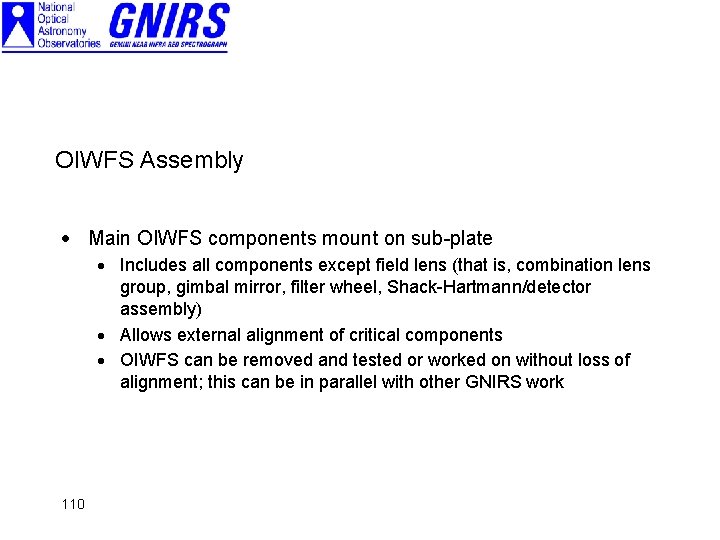
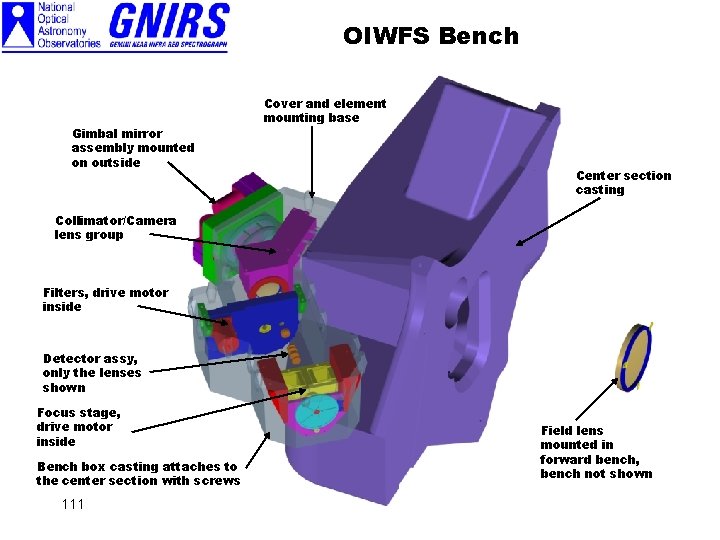
OIWFS Assembly · Main OIWFS components mount on sub-plate · Includes all components except field lens (that is, combination lens group, gimbal mirror, filter wheel, Shack-Hartmann/detector assembly) · Allows external alignment of critical components · OIWFS can be removed and tested or worked on without loss of alignment; this can be in parallel with other GNIRS work 110
OIWFS Bench Gimbal mirror assembly mounted on outside Cover and element mounting base Center section casting Collimator/Camera lens group Filters, drive motor inside Detector assy, only the lenses shown Focus stage, drive motor inside Bench box casting attaches to the center section with screws 111 Field lens mounted in forward bench, bench not shown
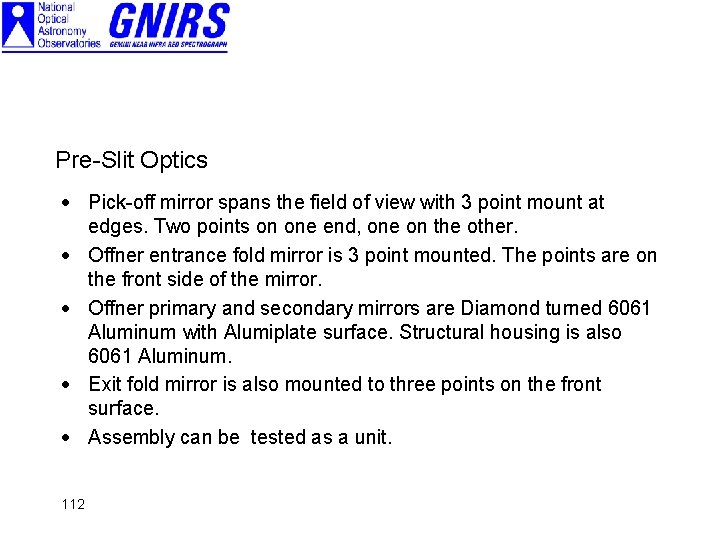
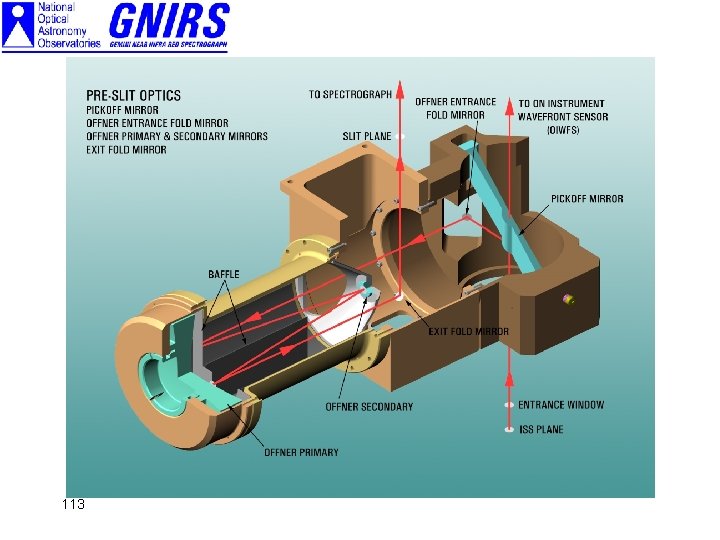
Pre-Slit Optics · Pick-off mirror spans the field of view with 3 point mount at edges. Two points on one end, one on the other. · Offner entrance fold mirror is 3 point mounted. The points are on the front side of the mirror. · Offner primary and secondary mirrors are Diamond turned 6061 Aluminum with Alumiplate surface. Structural housing is also 6061 Aluminum. · Exit fold mirror is also mounted to three points on the front surface. · Assembly can be tested as a unit. 112
113
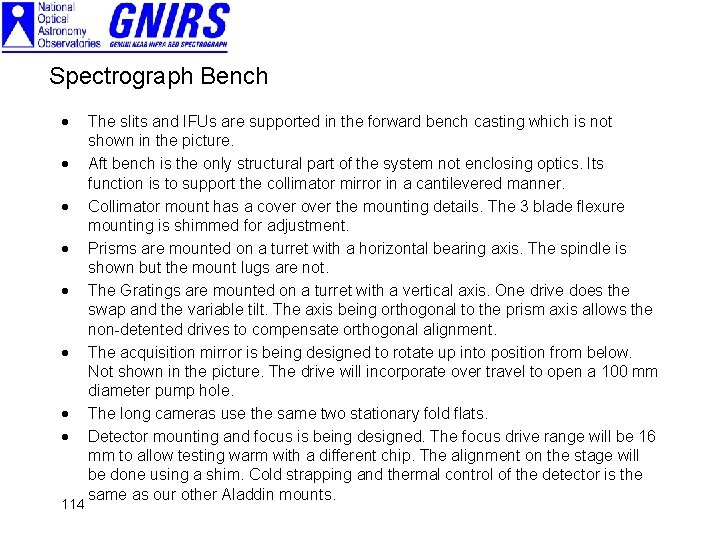
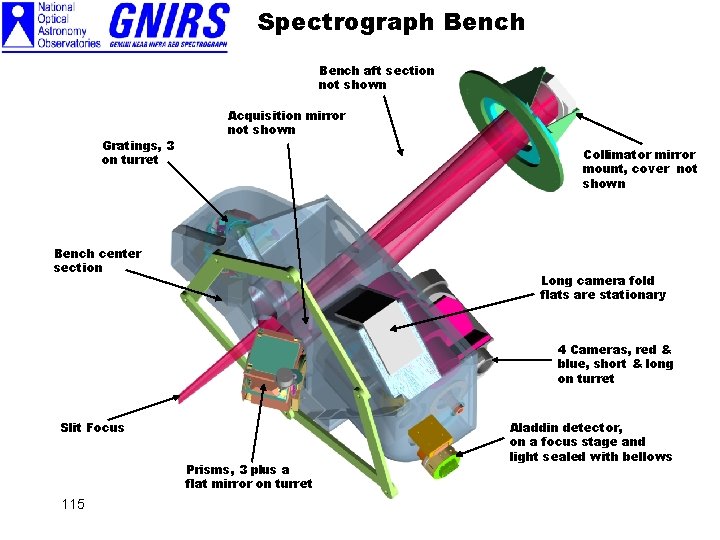
Spectrograph Bench · · · · 114 The slits and IFUs are supported in the forward bench casting which is not shown in the picture. Aft bench is the only structural part of the system not enclosing optics. Its function is to support the collimator mirror in a cantilevered manner. Collimator mount has a cover the mounting details. The 3 blade flexure mounting is shimmed for adjustment. Prisms are mounted on a turret with a horizontal bearing axis. The spindle is shown but the mount lugs are not. The Gratings are mounted on a turret with a vertical axis. One drive does the swap and the variable tilt. The axis being orthogonal to the prism axis allows the non-detented drives to compensate orthogonal alignment. The acquisition mirror is being designed to rotate up into position from below. Not shown in the picture. The drive will incorporate over travel to open a 100 mm diameter pump hole. The long cameras use the same two stationary fold flats. Detector mounting and focus is being designed. The focus drive range will be 16 mm to allow testing warm with a different chip. The alignment on the stage will be done using a shim. Cold strapping and thermal control of the detector is the same as our other Aladdin mounts.
Spectrograph Bench aft section not shown Gratings, 3 on turret Acquisition mirror not shown Collimator mirror mount, cover not shown Bench center section Long camera fold flats are stationary 4 Cameras, red & blue, short & long on turret Slit Focus Prisms, 3 plus a flat mirror on turret 115 Aladdin detector, on a focus stage and light sealed with bellows
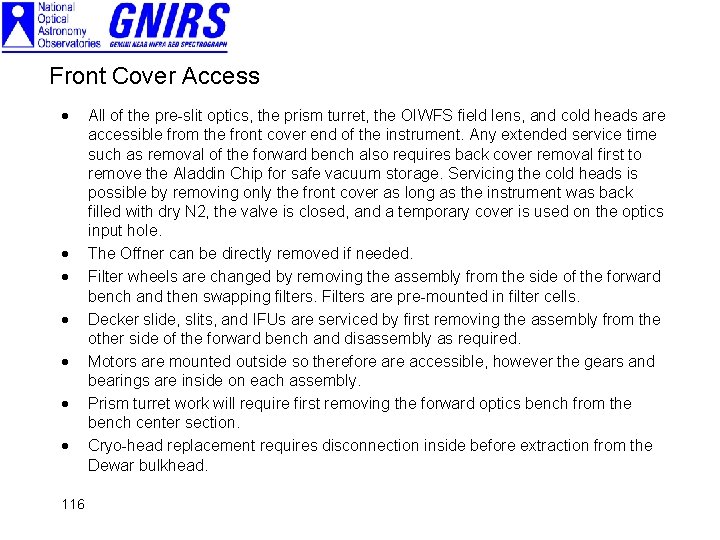
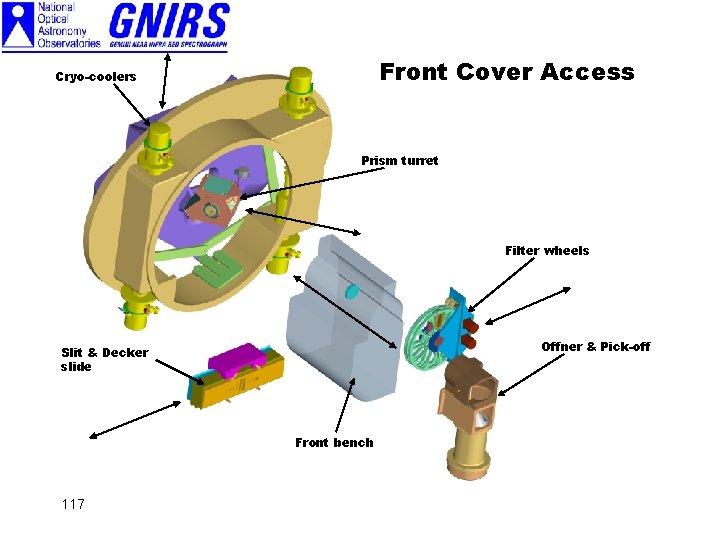
Front Cover Access · · · · 116 All of the pre-slit optics, the prism turret, the OIWFS field lens, and cold heads are accessible from the front cover end of the instrument. Any extended service time such as removal of the forward bench also requires back cover removal first to remove the Aladdin Chip for safe vacuum storage. Servicing the cold heads is possible by removing only the front cover as long as the instrument was back filled with dry N 2, the valve is closed, and a temporary cover is used on the optics input hole. The Offner can be directly removed if needed. Filter wheels are changed by removing the assembly from the side of the forward bench and then swapping filters. Filters are pre-mounted in filter cells. Decker slide, slits, and IFUs are serviced by first removing the assembly from the other side of the forward bench and disassembly as required. Motors are mounted outside so therefore accessible, however the gears and bearings are inside on each assembly. Prism turret work will require first removing the forward optics bench from the bench center section. Cryo-head replacement requires disconnection inside before extraction from the Dewar bulkhead.
Front Cover Access Cryo-coolers Prism turret Filter wheels Offner & Pick-off Slit & Decker slide Front bench 117
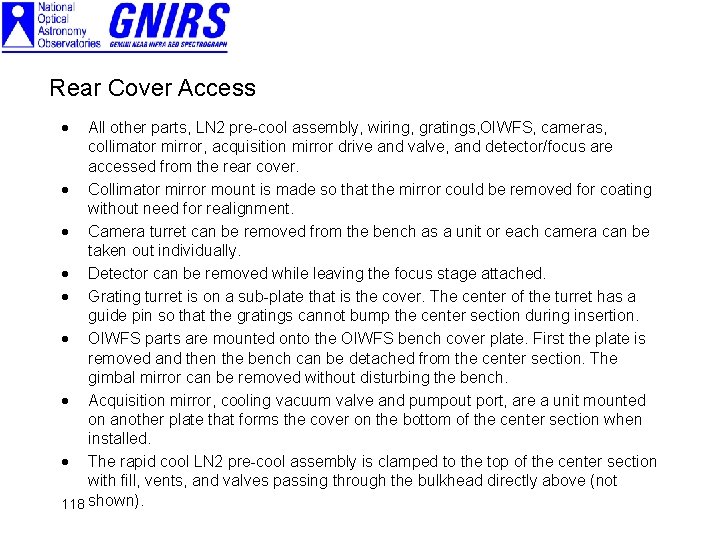
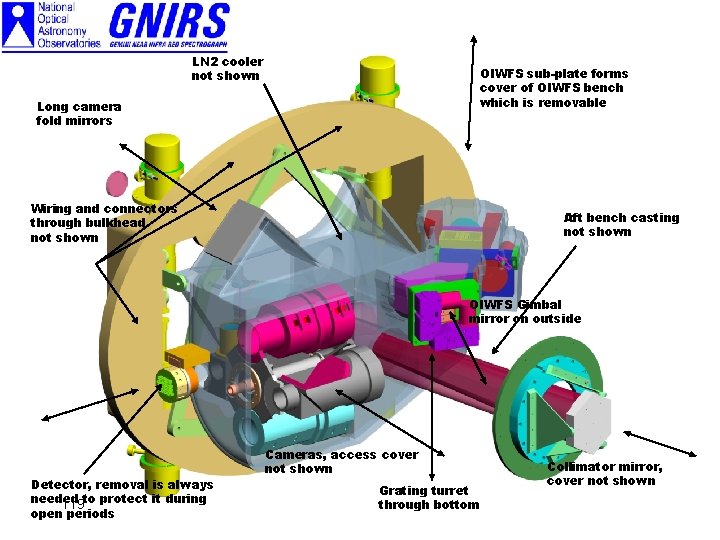
Rear Cover Access · All other parts, LN 2 pre-cool assembly, wiring, gratings, OIWFS, cameras, collimator mirror, acquisition mirror drive and valve, and detector/focus are accessed from the rear cover. · Collimator mirror mount is made so that the mirror could be removed for coating without need for realignment. · Camera turret can be removed from the bench as a unit or each camera can be taken out individually. · Detector can be removed while leaving the focus stage attached. · Grating turret is on a sub-plate that is the cover. The center of the turret has a guide pin so that the gratings cannot bump the center section during insertion. · OIWFS parts are mounted onto the OIWFS bench cover plate. First the plate is removed and then the bench can be detached from the center section. The gimbal mirror can be removed without disturbing the bench. · Acquisition mirror, cooling vacuum valve and pumpout port, are a unit mounted on another plate that forms the cover on the bottom of the center section when installed. · The rapid cool LN 2 pre-cool assembly is clamped to the top of the center section with fill, vents, and valves passing through the bulkhead directly above (not 118 shown).
LN 2 cooler not shown OIWFS sub-plate forms cover of OIWFS bench which is removable Long camera fold mirrors Wiring and connectors through bulkhead not shown Aft bench casting not shown OIWFS Gimbal mirror on outside Detector, removal is always needed 119 to protect it during open periods Cameras, access cover not shown Grating turret through bottom Collimator mirror, cover not shown
This page intentionally left blank 120
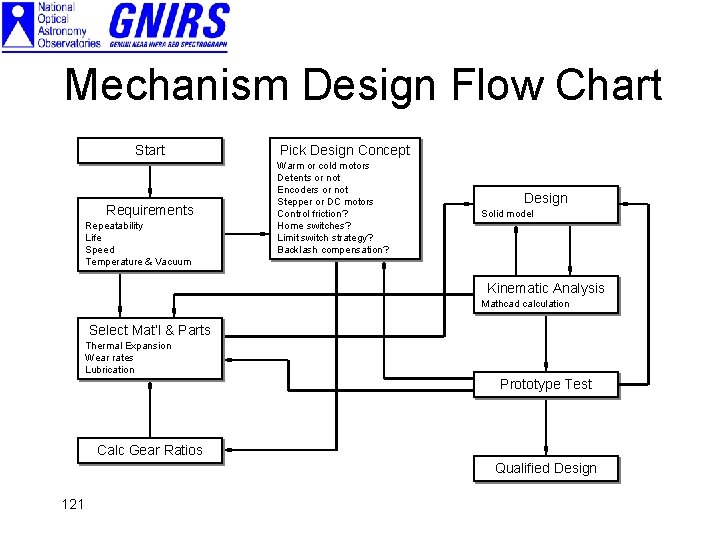
Mechanism Design Flow Chart Start Requirements Repeatability Life Speed Temperature & Vacuum Pick Design Concept Warm or cold motors Detents or not Encoders or not Stepper or DC motors Control friction? Home switches? Limit switch strategy? Backlash compensation? Design Solid model Kinematic Analysis Mathcad calculation Select Mat’l & Parts Thermal Expansion Wear rates Lubrication Prototype Test Calc Gear Ratios Qualified Design 121
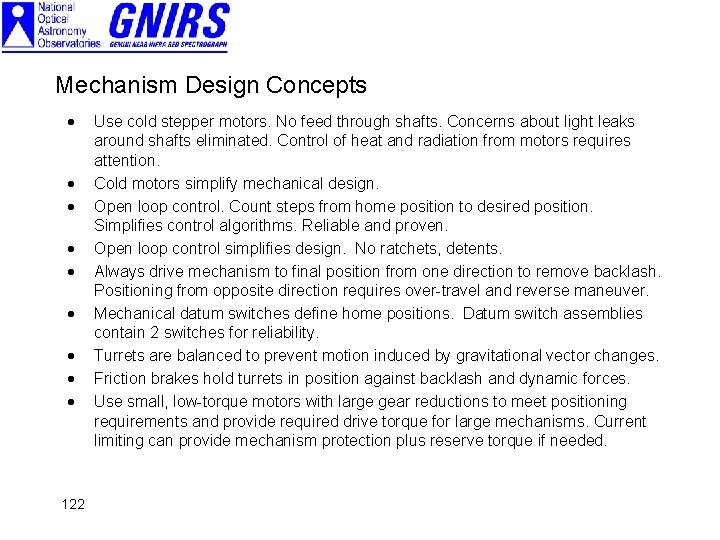
Mechanism Design Concepts · · · · · 122 Use cold stepper motors. No feed through shafts. Concerns about light leaks around shafts eliminated. Control of heat and radiation from motors requires attention. Cold motors simplify mechanical design. Open loop control. Count steps from home position to desired position. Simplifies control algorithms. Reliable and proven. Open loop control simplifies design. No ratchets, detents. Always drive mechanism to final position from one direction to remove backlash. Positioning from opposite direction requires over-travel and reverse maneuver. Mechanical datum switches define home positions. Datum switch assemblies contain 2 switches for reliability. Turrets are balanced to prevent motion induced by gravitational vector changes. Friction brakes hold turrets in position against backlash and dynamic forces. Use small, low-torque motors with large gear reductions to meet positioning requirements and provide required drive torque for large mechanisms. Current limiting can provide mechanism protection plus reserve torque if needed.
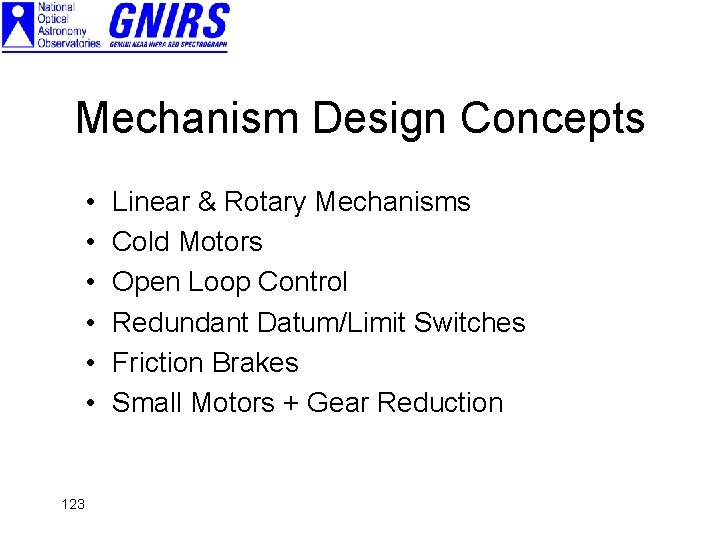
Mechanism Design Concepts • • • 123 Linear & Rotary Mechanisms Cold Motors Open Loop Control Redundant Datum/Limit Switches Friction Brakes Small Motors + Gear Reduction
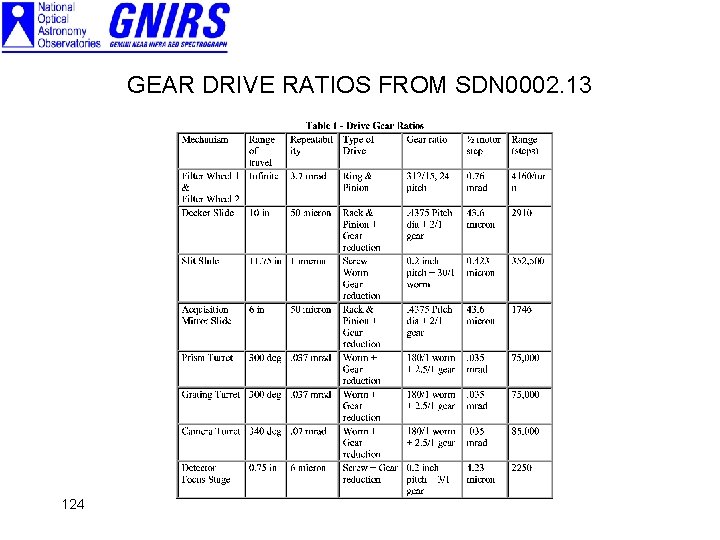
GEAR DRIVE RATIOS FROM SDN 0002. 13 124
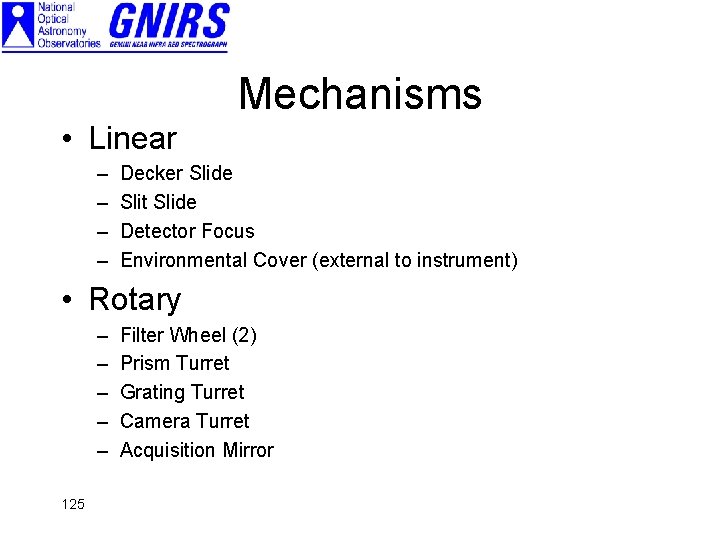
Mechanisms • Linear – – Decker Slide Slit Slide Detector Focus Environmental Cover (external to instrument) • Rotary – – – 125 Filter Wheel (2) Prism Turret Grating Turret Camera Turret Acquisition Mirror
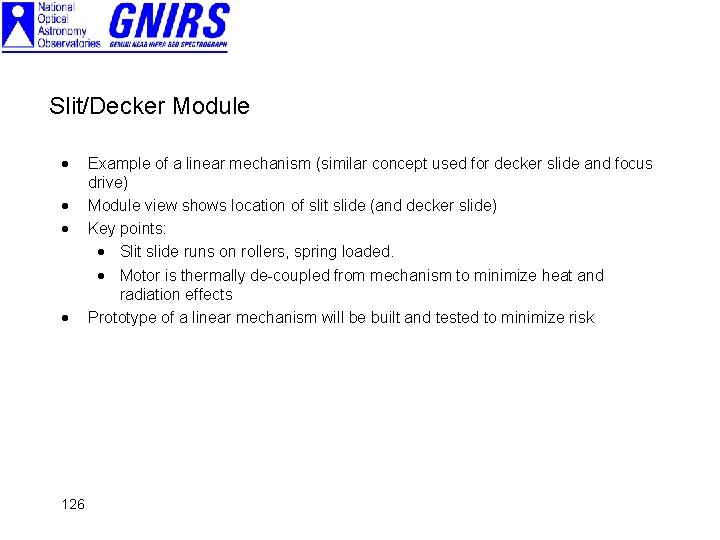
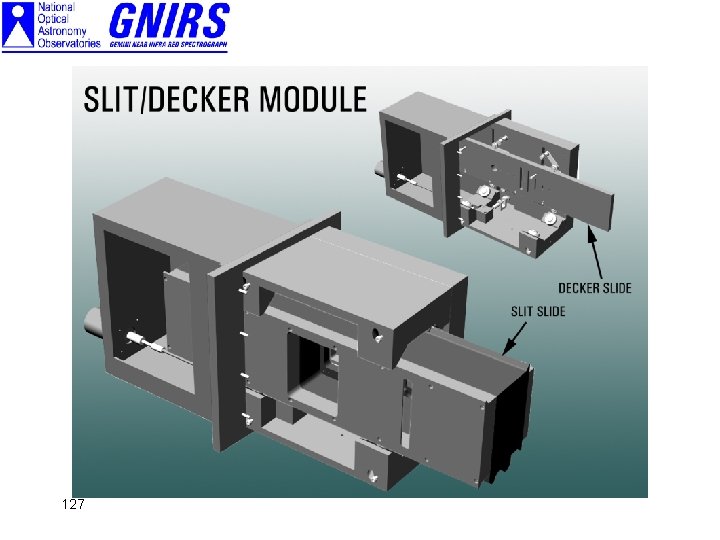
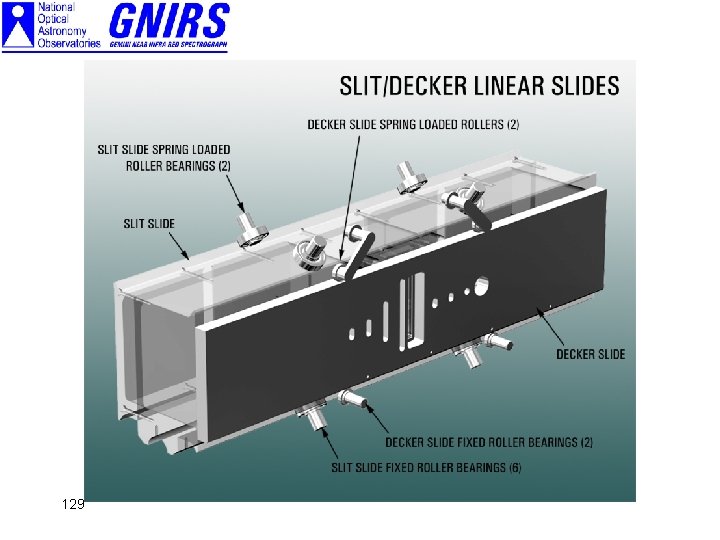
Slit/Decker Module · · 126 Example of a linear mechanism (similar concept used for decker slide and focus drive) Module view shows location of slit slide (and decker slide) Key points: · Slit slide runs on rollers, spring loaded. · Motor is thermally de-coupled from mechanism to minimize heat and radiation effects Prototype of a linear mechanism will be built and tested to minimize risk
127
This page intentionally left blank 128
129
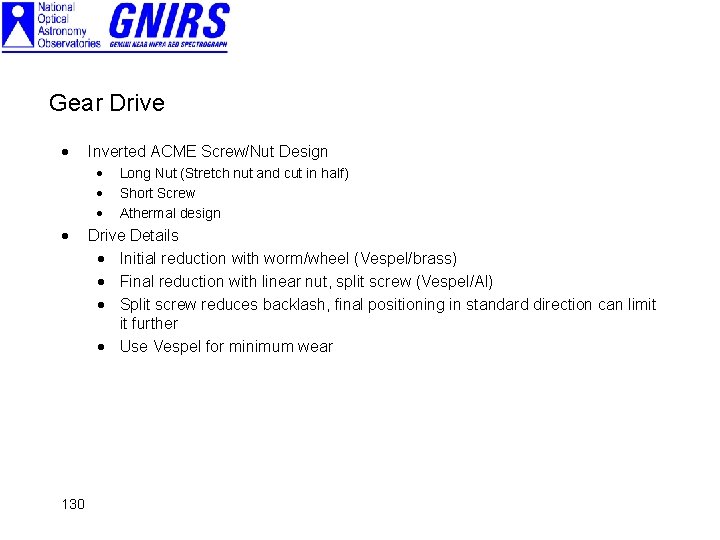
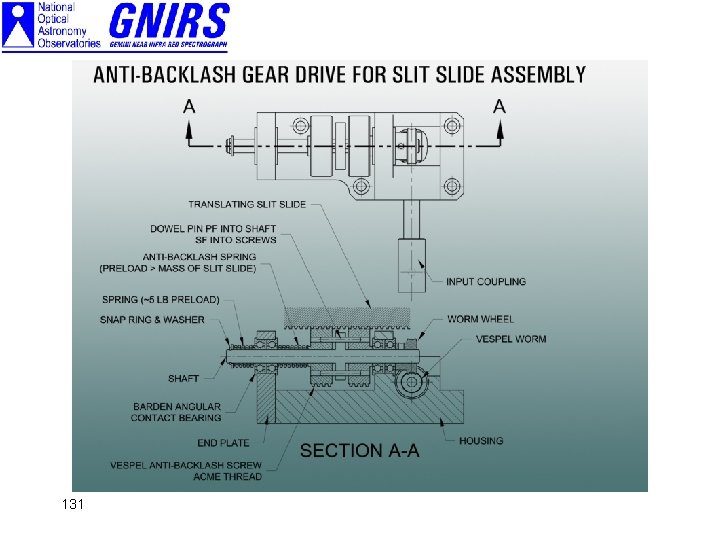
Gear Drive · Inverted ACME Screw/Nut Design · · 130 Long Nut (Stretch nut and cut in half) Short Screw Athermal design Drive Details · Initial reduction with worm/wheel (Vespel/brass) · Final reduction with linear nut, split screw (Vespel/Al) · Split screw reduces backlash, final positioning in standard direction can limit it further · Use Vespel for minimum wear
131
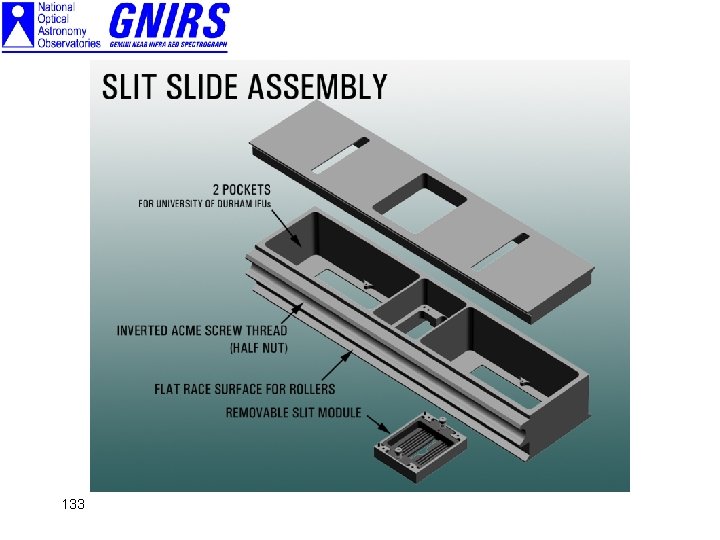
Slit Slide Assembly · 132 Slit Slide Assembly · Shows location of pockets for 2 IFU modules, including datum locations for assembly · Shows slit module and its location
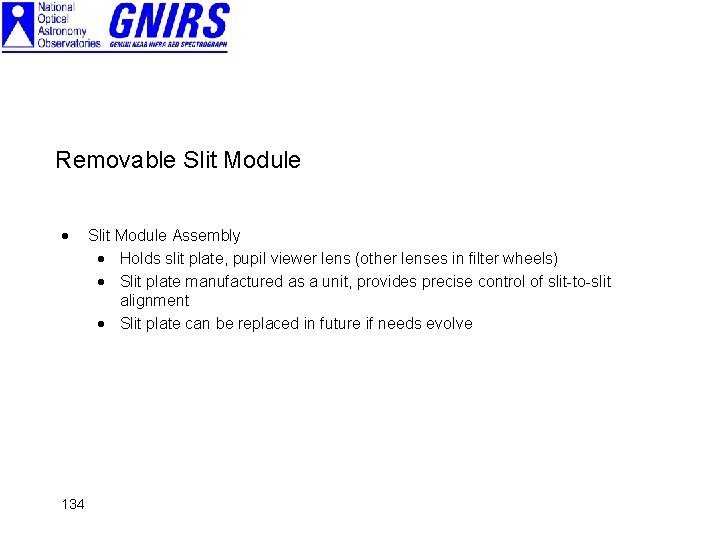
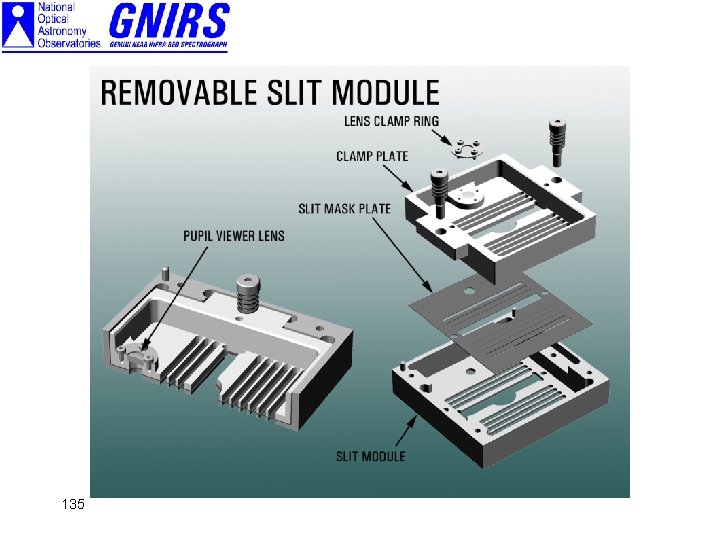
133
Removable Slit Module · 134 Slit Module Assembly · Holds slit plate, pupil viewer lens (other lenses in filter wheels) · Slit plate manufactured as a unit, provides precise control of slit-to-slit alignment · Slit plate can be replaced in future if needs evolve
135
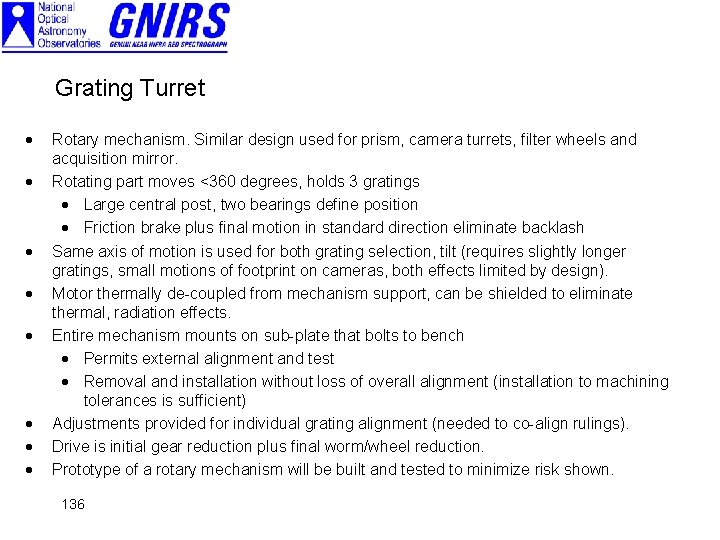
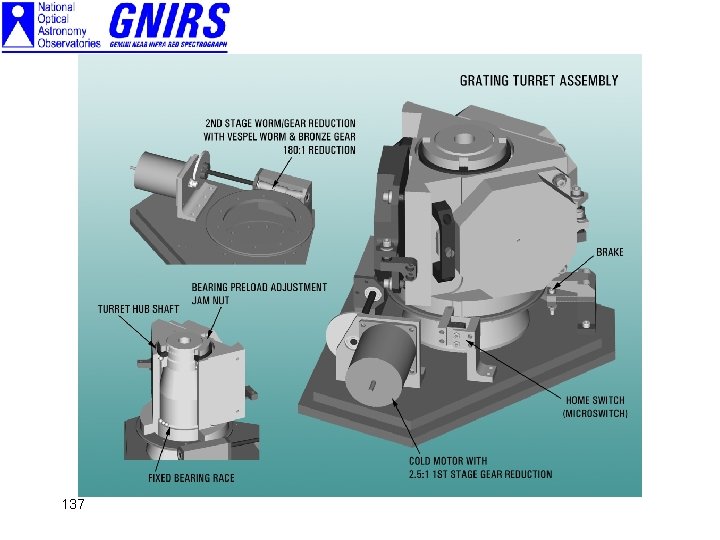
Grating Turret · · · · Rotary mechanism. Similar design used for prism, camera turrets, filter wheels and acquisition mirror. Rotating part moves <360 degrees, holds 3 gratings · Large central post, two bearings define position · Friction brake plus final motion in standard direction eliminate backlash Same axis of motion is used for both grating selection, tilt (requires slightly longer gratings, small motions of footprint on cameras, both effects limited by design). Motor thermally de-coupled from mechanism support, can be shielded to eliminate thermal, radiation effects. Entire mechanism mounts on sub-plate that bolts to bench · Permits external alignment and test · Removal and installation without loss of overall alignment (installation to machining tolerances is sufficient) Adjustments provided for individual grating alignment (needed to co-align rulings). Drive is initial gear reduction plus final worm/wheel reduction. Prototype of a rotary mechanism will be built and tested to minimize risk shown. 136
137
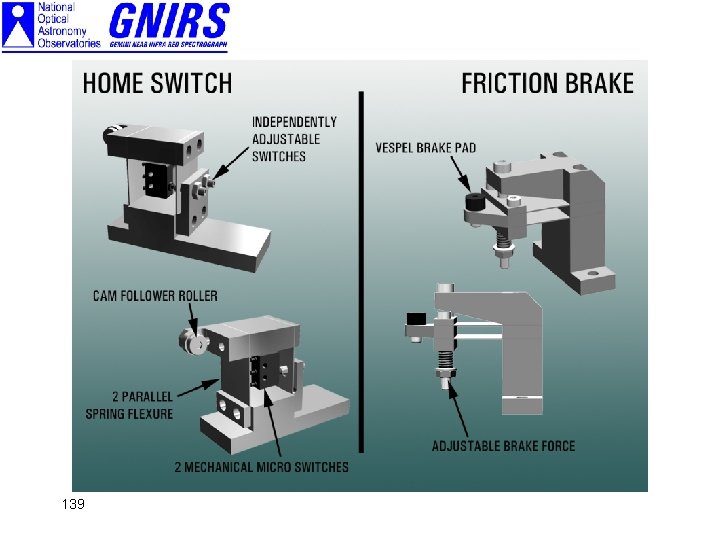
Home Switch and Parking Brake · · · All mechanisms requiring precision positioning use a repeatable, redundant, parallel spring flexure home switch. Use on filter wheels, decker and slit slides, prism, grating, turrets, and detector focus. Home switch will be tested to characterize repeatability. · · Friction brake used on rotary mechanisms. Final drive worm wheel will also serve as a brake disk. 138
139
Configuration Management Tools · · · · · 140 Established Databased on experience gained on 2 previous successful instrumentation projects. Use database to define drawing/assemblies, track progress of part from design/ draft through fabrication and final assembly. Engineer defines Drawing Breakdown Structure (DBS) and assigns tasks to designers/drafters. Compare budgeted weight with calculated/measured weight and adjust budget accordingly. Tool to flag over budget conditions early so that corrective action can be taken. Make status reports for on a periodic basis for status meetings. All mechanical designs are being solid modeled. Reduces errors and increases confidence. Extract mass properties from solid models. Weight, CG, Moments of Inertia. Solid model files named per DBS.
Configuration Management Tools • Microsoft Access Database – – Drawing Breakdown Structure (DBS) Weight Budget Project Tracking Customize Database as needs evolve • Autodesk Mechanical Desktop – – 141 Solid Modeling Mass Properties Interference checking Produce 2 D fabrication drawings
142
Handling complies with Gemini interfaces • Instrument can be installed in up-looking or horizontal position • Provides proper interfaces to Gemini handling equipment (cart, hoists) • Interface to ISS similar to Gemini ballast weight assemblies (better locating features needed) 143
This page intentionally left blank 144
Thermal Design • Meets Gemini cool-down requirements • Provides optical stability for OIWFS and for camera and collimator focus • Meets Gemini warm-up requirements 145
Instrument Cool-Down · Liquid nitrogen pre-cool system · Accelerates cool-down to ~80 K · Can be by-passed · Recommended by review committees · 4 cryocoolers · Required for cool-down from 80 to 60 K · Supplement pre-cool; can be used alone · Cool-down meets 4 -day Gemini requirement · Cool down with cryocoolers alone close to 4 days 146
Instrument Cool-Down • Liquid Nitrogen Pre-Cool • 4 Cryocoolers • Meets 4 -day Gemini Requirement 147
Thermal Stability and Control · Radiation shield design minimizes thermal gradients in optical bench · Main effect of gradients in current design is on collimator and OIWFS focus · Baseline design is 2 “floating” shields, 1 active shield · Use of MLI possible (either as thermal or weight risk mitigation) · Active thermal control of bench required · Without control, will see temperature variations due to variations in ambient temperature, motor use (and control protocols) and in cryocooler performance · Temperature control is needed to ensure stable performance of OIWFS (ability to maintain guide star on slit) -- recommended by ICD · Temperature control also simplifies software control of camera focus (would otherwise need a correction for bench temperature) 148
Thermal Stability and Control • Radiation Shield Design Minimizes Gradients • Active Thermal Control of Bench Required 149
This page intentionally left blank 150
Instrument Warm-Up • Distributed Heaters Provide Rapid Warm-Up • Stand-Alone Control Box Provides Off-Line Warm-Up • Warm-Up Meets 1 -Day Gemini Requirement 151
This page intentionally left blank 152
Dwg #89 -NOAO-4201 -5025 (postscript), shown here in book Title: Instrument External Cabling diagram B-sized copy in review books (hardcopy) A-sized viewgraph for R. Rvw is used (for reference only) 153
This page intentionally left blank 154
GNIRS ELECTRICAL DESIGN · System Overview · Control Architecture · Electrical Packaging · Spectrograph Controller packaging · Thermal Enclosure · ALADDIN Detector Controller packaging · Thermal Enclosure 155
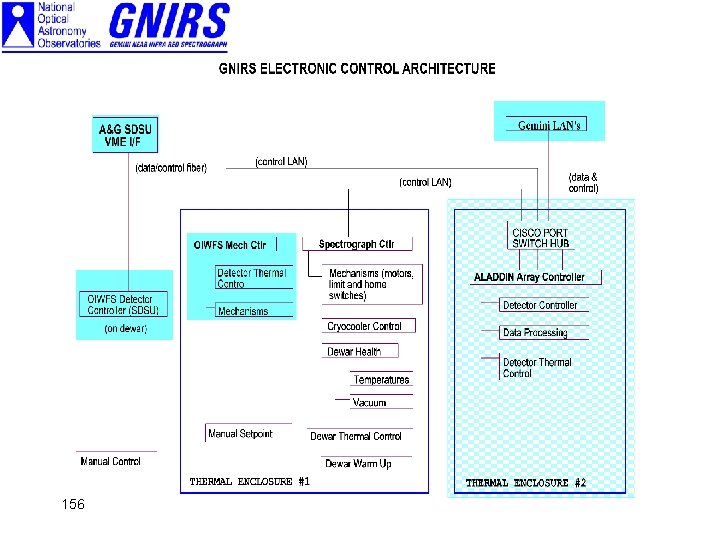
156
Instrument Sequencer Controls Three Subsystems • Spectrograph Controller, Thermal Enclosure #1 • OIWFS Controller, Gemini-furnished, Thermal Enclosure #1 • ALADDIN Array Controller, Geminifurnished, Thermal Enclosure #2 157
This page intentionally left blank 158
Dwg #89 -NOAO-4201 -5020 (postscript), Title: Spectrograph Control schematic Block Diagram shown here: B-sized copy in review books (hardcopy) A-sized viewgraph for R. Rvw is used (this viewgraph is for reference only - isn’t shown initially) 159
This page intentionally left blank 160
Spectrograph Controller Architecture is Complete · Addresses all Gemini interface requirements · All major functions identified · · Mechanism control Cryocooler control Dewar thermal control Dewar health (vacuum/temp sensing) · All individual cards identified · All control interfaces defined · Dewar wiring, cable/connector pinouts remain 161
This page intentionally left blank 162
Dwg #89 -NOAO-4201 -5011 (postscript), Spectrograph TE Layout, Power, Grounding schematic shown here: A-sized copy in review books (hardcopy) A-sized viewgraph for R. Rvw is used 163
This page intentionally left blank 164
Electronics is Contained in Two Cabinets · Spectrograph Thermal Enclosure · Array Controller Thermal Enclosure · Additional External Electronics mount on dewar · Set by detector requirements · ALADDIN preamp · OIWFS SDSU 2 controller · Stand-alone warm-up controller box 165
This page intentionally left blank 166
Sub-System Integration · 3 Externally Provided Sub-Systems: · IFU · OIWFS · Array Controller 167
This page intentionally left blank 168
IFU · Provided by University of Durham through IGPO · Two modular sub-assemblies · Aligned and tested prior to installation · Space provided on slit slide · Installed and aligned to datums, following ICD · Final alignment check during GNIRS integration 169
OIWFS · · · 170 Provided by If. A, Hawaii through IGPO. Includes optical components and subassemblies, packaged controller, electronics boards and subassemblies, test cables, software, alignment and test procedures Optical components and mechanisms mount on modular bench assembly Optical component integration ties to ICD, includes alignment procedures and tolerances Electronics require wiring and cabling within GNIRS Electronics require installation of controller hardware, which includes Leach (SDSU 2) controller mounted on dewar bulkhead structure and components controller mounted inside instrument thermal enclosure Testing capability limited to low-level tests (supplied by If. A); essentially limited to functional testing of devices and detector. This is sufficient, in principle, to check instrument flexure (OIWFS to slit).
OIWFS • Provided by If. A, Hawaii through IGPO • Opto-mechanical assemblies mount on bench structure • Requires integration and alignment of assemblies • Requires installation of controller hardware, wiring and cabling • Limited testing of capability 171
This page intentionally left blank 172
Array Controller · Provided by NOAO through IGPO · Requires integration of hardware · · 173 Detector Pre-amplifier Thermal enclosure Wiring and cabling
System Integration & Test (1) · Critical Assumptions: · Sub-systems can be tested externally and independently. These tests include tests of mechanism flexure, cold tests of functionality (repeatability, torque requirements). Alignment of components within mechanism or modules, where required, can also be done externally (e. g, gratings within turret). · Minimize alignment procedures. This implies design of appropriate interfaces (and proper location) so that assembly tolerances are controlled and are sufficient to meet alignment requirements. 174
System Integration & Test (1) · Critical Assumptions · External Tests and Alignment of Sub-Systems · Minimize Alignment 175
System Integration & Test (2) · Integration and Alignment Plan · Sub-systems are assumed to have been “pre-tested” and to have their optics aligned (if required); system test is therefore primarily a test of the instrument as a whole and not of functionality of individual mechanisms. · Testing vacuum and thermal systems is carried out in two stages and precedes testing of the complete instrument in order to isolate any problems in these areas as early as possible. · Assembly and warm test of the bench with mechanisms provides access for diagnosis. It includes testing for light leaks. · Final integration and cold testing covers full instrument functionality (partial for OIWFS). 176
System Integration & Test (2) · Integration and Alignment Plan · · 177 Sub-systems “pre-tested” Test vacuum and thermal systems Assemble and warm test bench Integrate and cold test
This page intentionally left blank 178
System Integration & Test (3) · System Tests Include: · · · Functionality Repeatability Flexure Thermal (cool-down, warm-up, stability, gradients) Optical (image quality, background [light leaks and scattering], throughput) · Configuration characterization 179
This page intentionally left blank 180
SECTION VII Risk Identification and Mitigation Plan 181
This page intentionally left blank 182
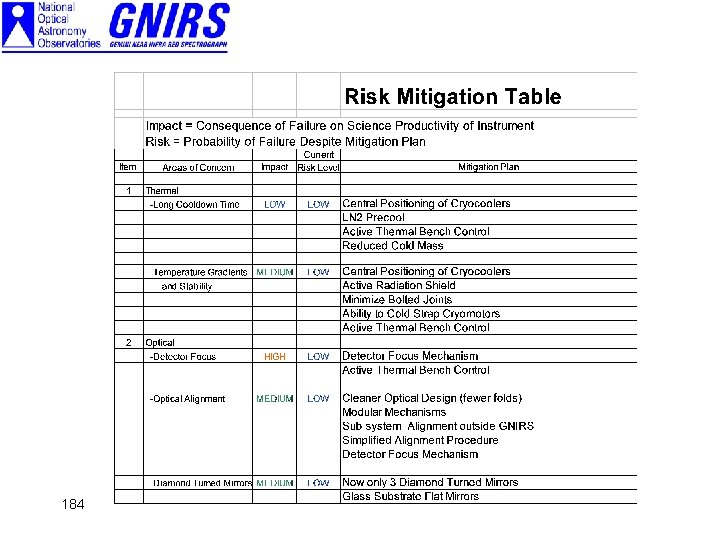
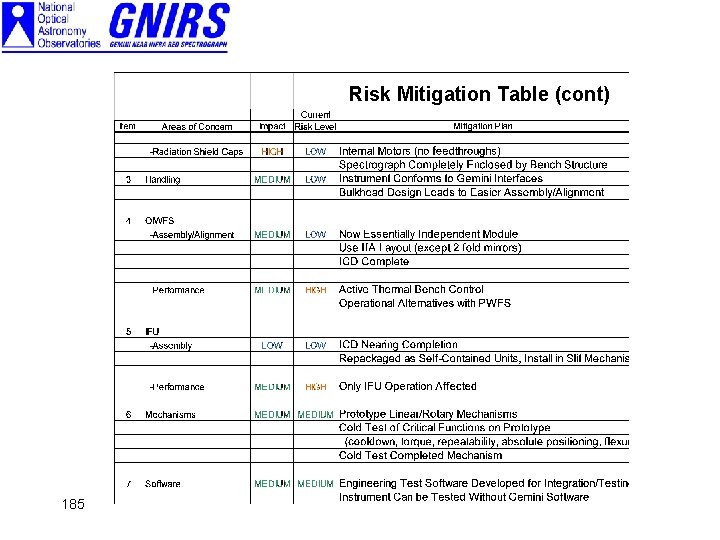
Risk Items · Risk Items pointed out by the Committee · Thermal (Instrument cool-down and thermal gradients) · Optical (Focus control, alignment procedures, mirror finish, light leaks) · Handling · OIWFS Integration and Alignment · IFU Integration · Additional Risk Items 183 · Software · OIWFS performance · Mechanism repeatability
184
Risk Mitigation Table (cont) 185
This page intentionally left blank 186
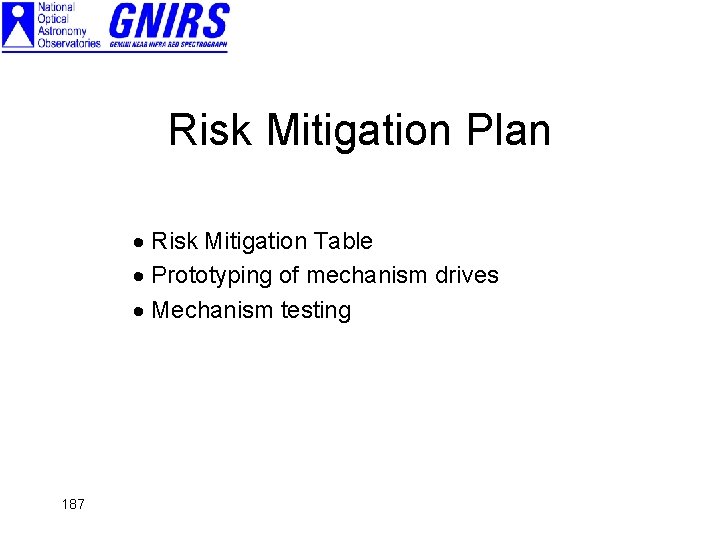
Risk Mitigation Plan · Risk Mitigation Table · Prototyping of mechanism drives · Mechanism testing 187
This page intentionally left blank 188
SECTION VIII Conclusion 189
This page intentionally left blank 190
Summary • We have presented the current status of the project and engineering design • NOAO has put into place the required engineering team and management structure • GNIRS is a new design configuration which addresses committee concerns and risks • We have the required resources in place • The GNIRS instrument will deliver in mid-2002 191
This page intentionally left blank 192