
Section B Exercise Physiology Training Methods Training Methods
Section B- Exercise Physiology Training Methods
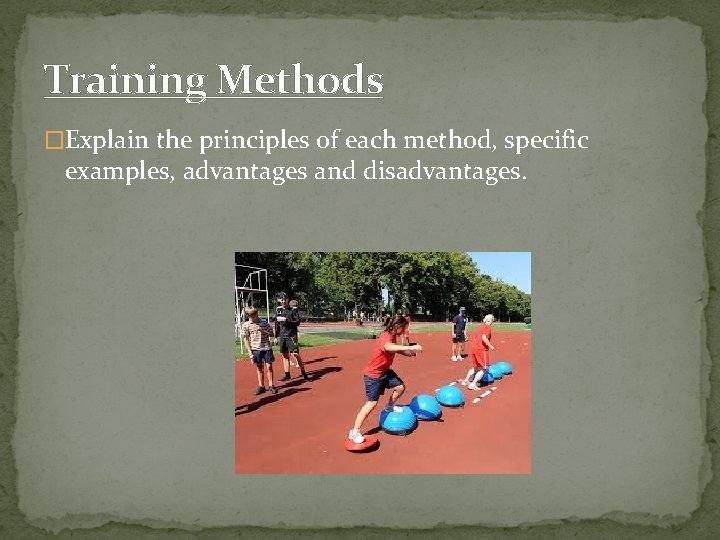
Training Methods �Explain the principles of each method, specific examples, advantages and disadvantages.
Fartlek Training � Swedish term meaning ‘speed play’. Continuous training where you vary the speed and intensity of your effort– more like actual games! � IMPROVES: Stamina, Muscular Endurance and Speed. � Intensity measured using % HR � EXAMPLE: Jog at 60% HR max for 10 mins, then sprint 100 m x jog for 50 m (repeat 10 times without rest). � ADVANTAGES: Variety, higher intensities can be included which recreates sporting conditions. � DISADVANTAGES: Not specific to all sports, higher intensities may cause injury. �
Interval Training � Exercise interspersed with rest periods. The distance/ intensity/ number of sets/repetitions/ number and time of rest periods can be varied depending on your goal. � IMPROVES: Can be used for speed/ power and strength or stamina and muscular endurance. � Intensity measured using % HR � EXAMPLE: To improve speed— 3 sets x 10 repetitions of 30 m sprints with rest between reps. To improve stamina 3 x 1000 m run with 4 min rest between reps. � ADVANTAGES: Variety of pace and duration. � DISADVANTAGES: Requires a measured distance to train on
Weight Training � Using free weights or resistance machines to overload the body. � IMPROVES: Strength and Power if lifting heavy weights or Muscular Endurance if completing lots of repetitions. � Intensity measured using % 1 rep max � EXAMPLE: For strength gains 5 sets of 6 reps at 85% 1 rep max. For ME 3 sets of 20 reps at 50% 1 rep max. � ADVANTAGES: Best method to improve strength and power, can focus of specific muscle groups. � DISADVANTAGES: Injury risk at higher intensities, need specialist equipment, need to know the correct techniques, need more recovery time compared to other forms of training.
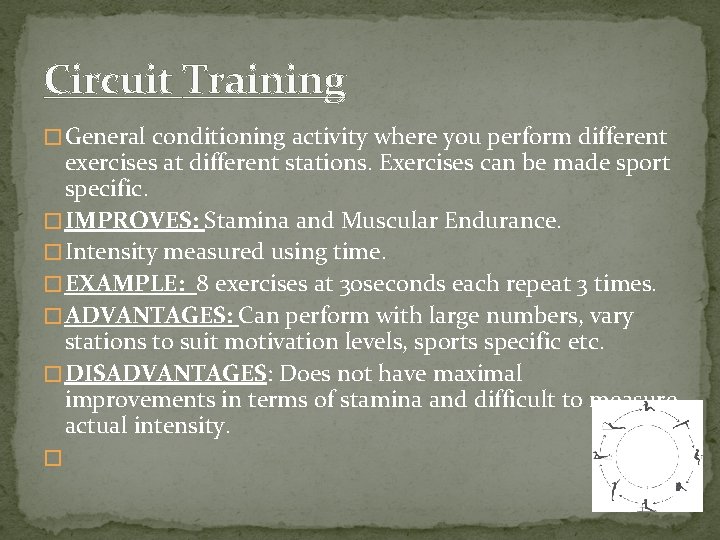
Circuit Training � General conditioning activity where you perform different exercises at different stations. Exercises can be made sport specific. � IMPROVES: Stamina and Muscular Endurance. � Intensity measured using time. � EXAMPLE: 8 exercises at 30 seconds each repeat 3 times. � ADVANTAGES: Can perform with large numbers, vary stations to suit motivation levels, sports specific etc. � DISADVANTAGES: Does not have maximal improvements in terms of stamina and difficult to measure actual intensity. �

Plyometrics �Eccentric muscle contraction (down phase) followed by an explosive concentric contraction. �IMPROVES: Strength, Power and Speed. �Intensity measured using repetitions/ distance. �EXAMPLE: Plyometric circuit that includes depth jumps, hopping, skipping etc. �ADVANTAGES: Excellent method of developing Power. Activities can represent actions from sport. �DISADVANTAGES: Injury risk at higher intensities, appropriate technique is essential. �
PNF Proprioceptive neuromuscular facilitation � Stretching technique that inhibits the stretch reflex that occurs when a muscle is stretched to its limit. By isometrically stretching a muscle, with the aid of a partner, the stretch reflex is diminished and a greater stretch can occur. � IMPROVES: Flexibility. � Intensity measured using time/ distance. � EXAMPLE: Stretch a muscle to its maximum, isometrically contract it against a partner, then stretch further. � ADVANTAGES: Excellent method of developing flexibility. � DISADVANTAGES: Injury risk at higher intensities, appropriate technique is essential, need a partner.

SAQ Speed, Agility and Quickness training. �Specific exercises created to improve Speed, Agility and Power. �IMPROVES: Speed, Agility and Power. �Intensity measured using repetitions. �EXAMPLE: SAQ circuit that includes hurdles, ladder drills, parachute sprints. �ADVANTAGES: Variety of exercises, can be sport specific. �DISADVANTAGES: Requires some specialist equipment.
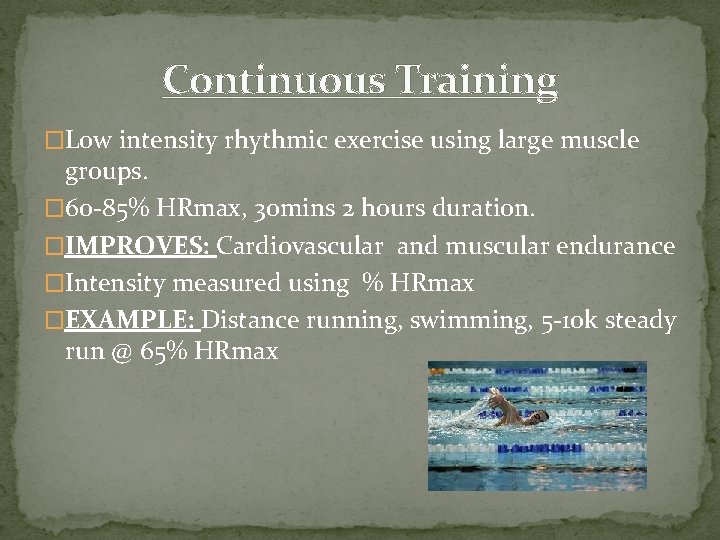
Continuous Training �Low intensity rhythmic exercise using large muscle groups. � 60 -85% HRmax, 30 mins 2 hours duration. �IMPROVES: Cardiovascular and muscular endurance �Intensity measured using % HRmax �EXAMPLE: Distance running, swimming, 5 -10 k steady run @ 65% HRmax
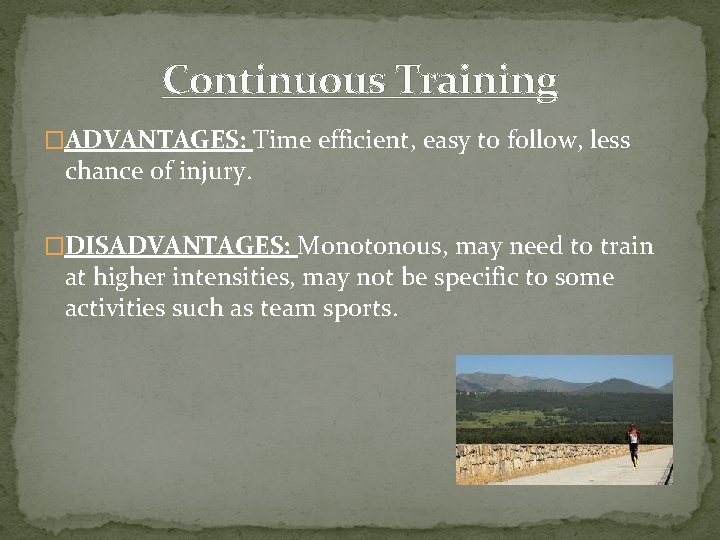
Continuous Training �ADVANTAGES: Time efficient, easy to follow, less chance of injury. �DISADVANTAGES: Monotonous, may need to train at higher intensities, may not be specific to some activities such as team sports.
- Slides: 11