
Section 9 6 Momentum and Collisions in Two


- Slides: 22
Section 9. 6 Momentum and Collisions in Two Dimensions (cont. ) © 2015 Pearson Education, Inc.
Example Problem Two pucks of equal mass 100. g collide on an air hockey table. Neglect friction. Prior to the collision, puck A travels in a direction that can be considered the +x-axis at 1. 0 m/s, and puck B travels in the –y-direction at 2. 0 m/s prior to the collision. After the collision, puck B travels 30 degrees above the +x-direction (between +x and +y) at 0. 80 m/s. a) What is the velocity (direction and speed) of puck A after the collision? b) Is the collision completely inelastic? © 2015 Pearson Education, Inc. Slide 10 -2
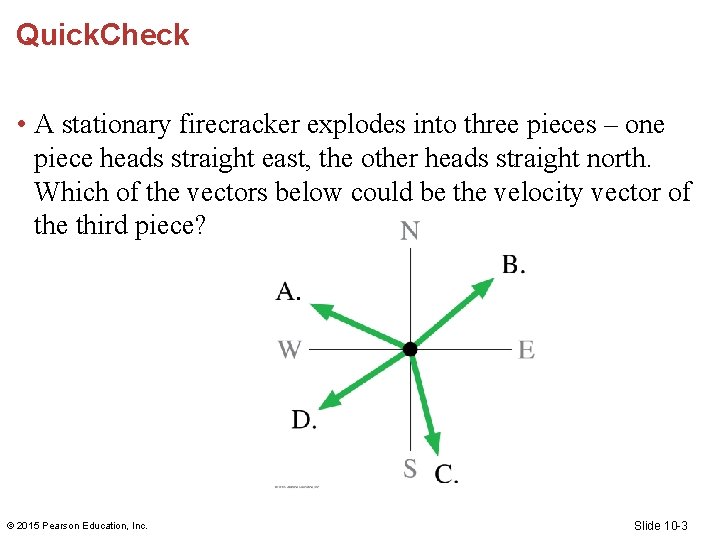
Quick. Check • A stationary firecracker explodes into three pieces – one piece heads straight east, the other heads straight north. Which of the vectors below could be the velocity vector of the third piece? © 2015 Pearson Education, Inc. Slide 10 -3
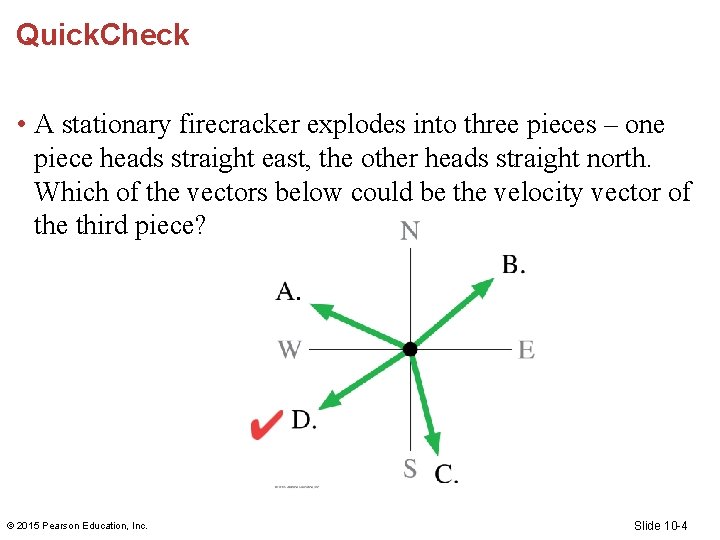
Quick. Check • A stationary firecracker explodes into three pieces – one piece heads straight east, the other heads straight north. Which of the vectors below could be the velocity vector of the third piece? © 2015 Pearson Education, Inc. Slide 10 -4
Section 9. 7 Angular Momentum © 2015 Pearson Education, Inc.
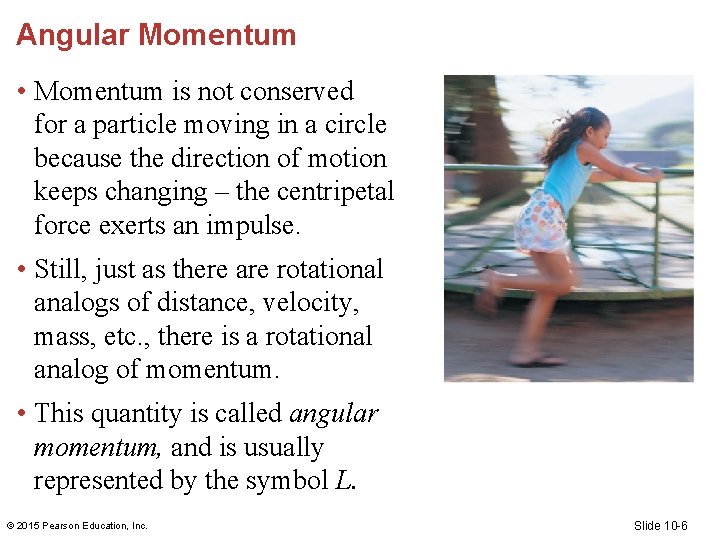
Angular Momentum • Momentum is not conserved for a particle moving in a circle because the direction of motion keeps changing – the centripetal force exerts an impulse. • Still, just as there are rotational analogs of distance, velocity, mass, etc. , there is a rotational analog of momentum. • This quantity is called angular momentum, and is usually represented by the symbol L. © 2015 Pearson Education, Inc. Slide 10 -6
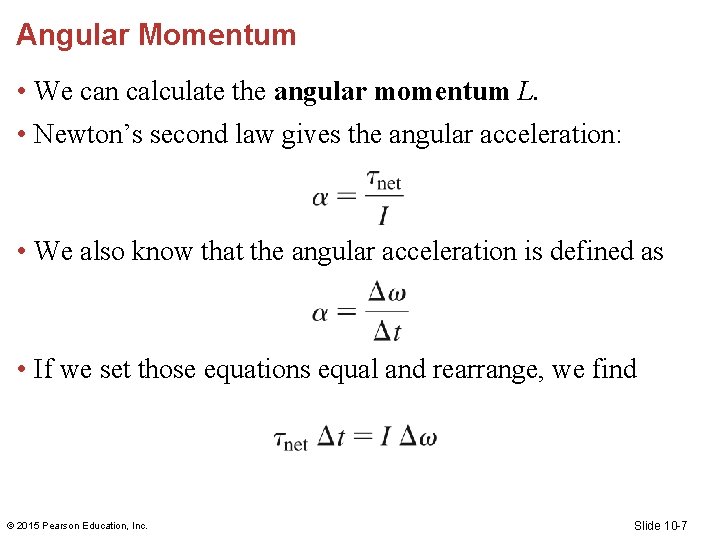
Angular Momentum • We can calculate the angular momentum L. • Newton’s second law gives the angular acceleration: • We also know that the angular acceleration is defined as • If we set those equations equal and rearrange, we find © 2015 Pearson Education, Inc. Slide 10 -7
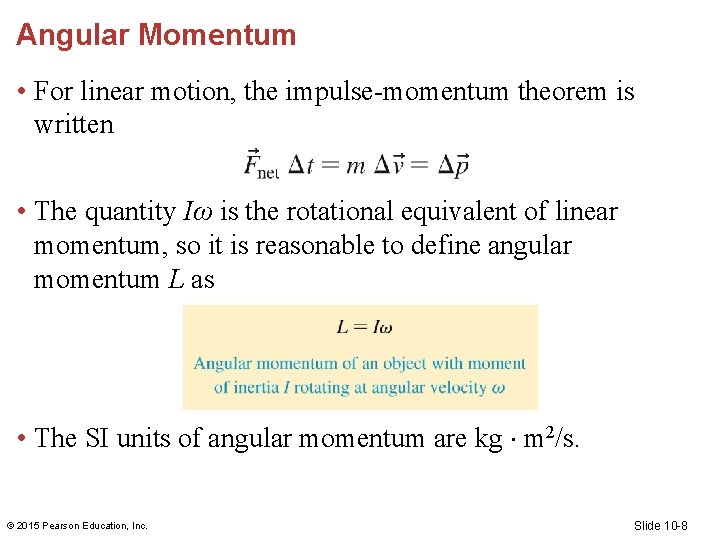
Angular Momentum • For linear motion, the impulse-momentum theorem is written • The quantity Iω is the rotational equivalent of linear momentum, so it is reasonable to define angular momentum L as • The SI units of angular momentum are kg m 2/s. © 2015 Pearson Education, Inc. Slide 10 -8
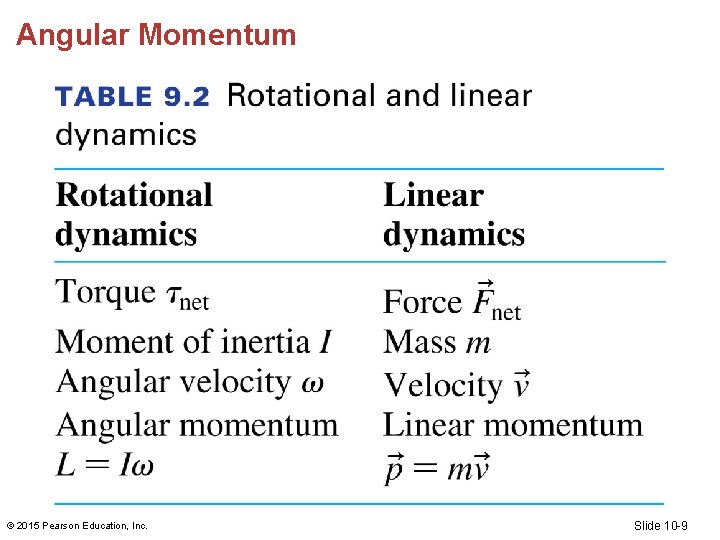
Angular Momentum © 2015 Pearson Education, Inc. Slide 10 -9
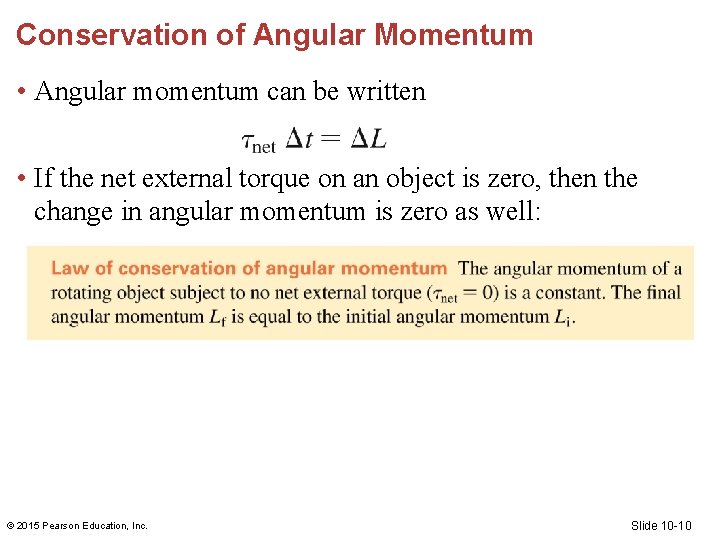
Conservation of Angular Momentum • Angular momentum can be written • If the net external torque on an object is zero, then the change in angular momentum is zero as well: © 2015 Pearson Education, Inc. Slide 10 -10
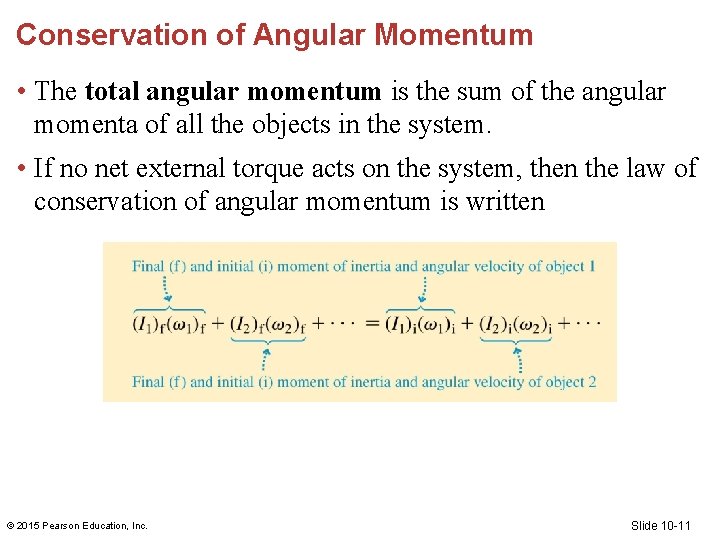
Conservation of Angular Momentum • The total angular momentum is the sum of the angular momenta of all the objects in the system. • If no net external torque acts on the system, then the law of conservation of angular momentum is written © 2015 Pearson Education, Inc. Slide 10 -11
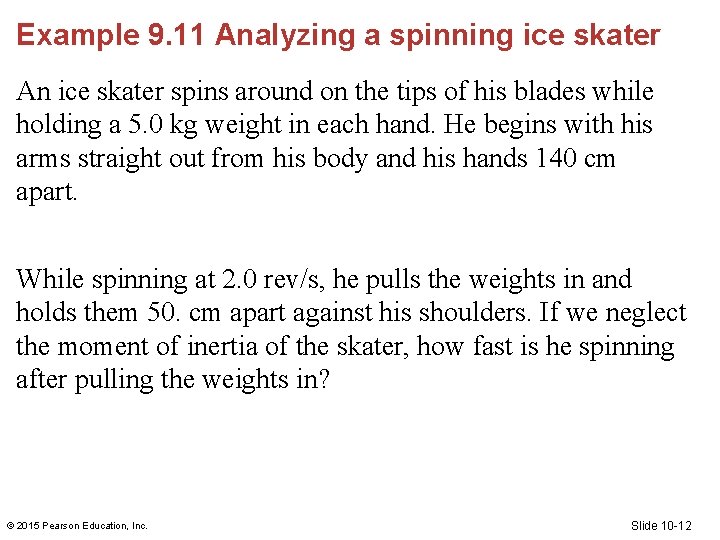
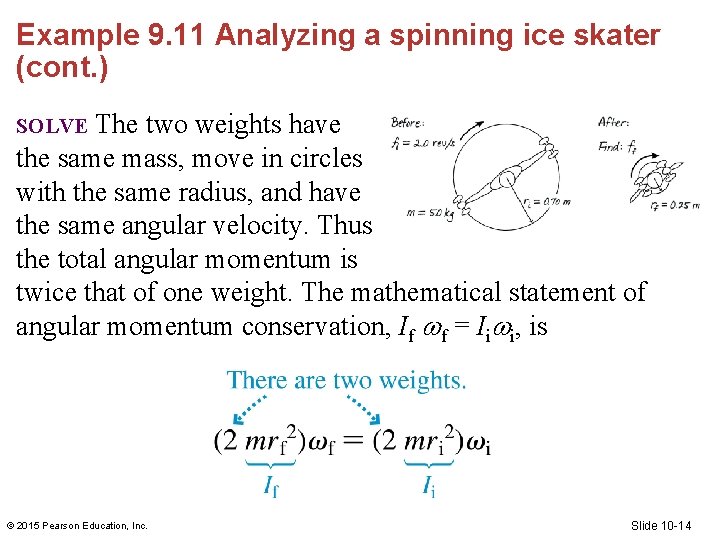
Example 9. 11 Analyzing a spinning ice skater An ice skater spins around on the tips of his blades while holding a 5. 0 kg weight in each hand. He begins with his arms straight out from his body and his hands 140 cm apart. While spinning at 2. 0 rev/s, he pulls the weights in and holds them 50. cm apart against his shoulders. If we neglect the moment of inertia of the skater, how fast is he spinning after pulling the weights in? © 2015 Pearson Education, Inc. Slide 10 -12
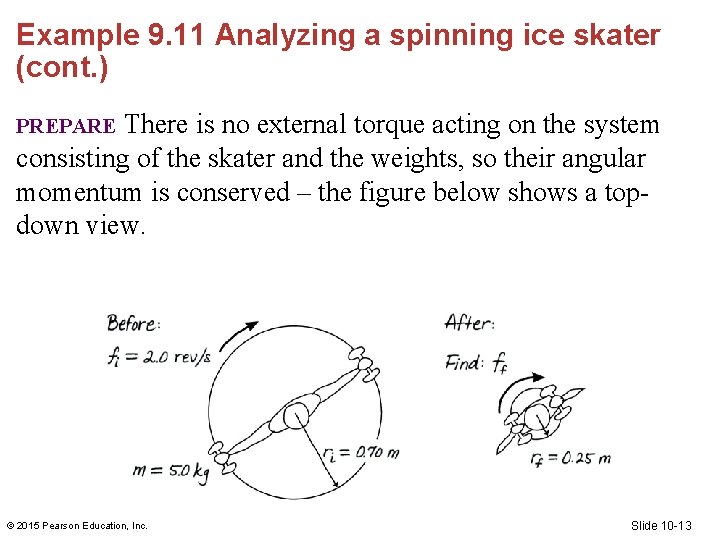
Example 9. 11 Analyzing a spinning ice skater (cont. ) There is no external torque acting on the system consisting of the skater and the weights, so their angular momentum is conserved – the figure below shows a topdown view. PREPARE © 2015 Pearson Education, Inc. Slide 10 -13
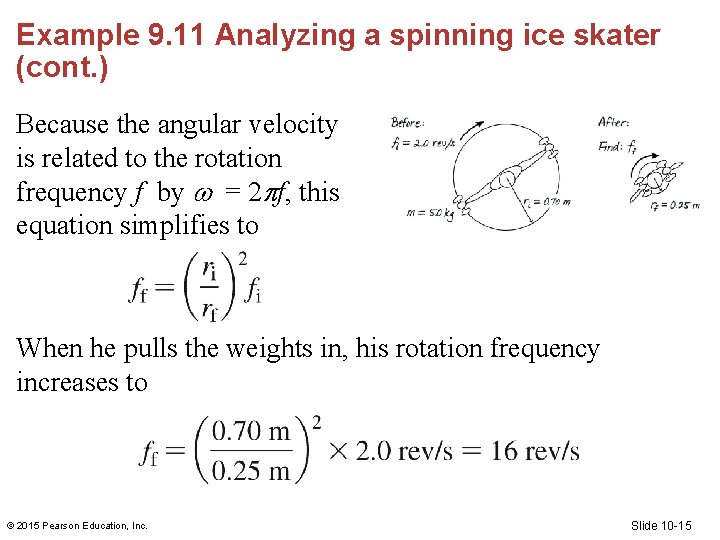
Example 9. 11 Analyzing a spinning ice skater (cont. ) The two weights have the same mass, move in circles with the same radius, and have the same angular velocity. Thus the total angular momentum is twice that of one weight. The mathematical statement of angular momentum conservation, If f = Ii i, is SOLVE © 2015 Pearson Education, Inc. Slide 10 -14
Example 9. 11 Analyzing a spinning ice skater (cont. ) Because the angular velocity is related to the rotation frequency f by = 2 f, this equation simplifies to When he pulls the weights in, his rotation frequency increases to © 2015 Pearson Education, Inc. Slide 10 -15
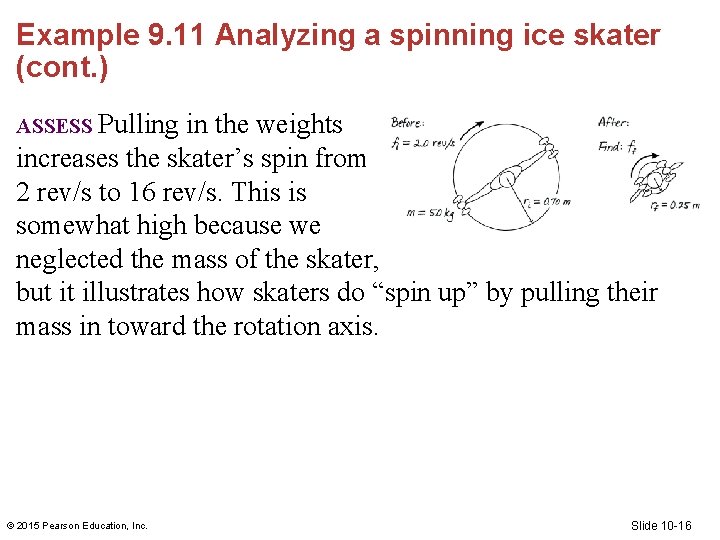
Example 9. 11 Analyzing a spinning ice skater (cont. ) ASSESS Pulling in the weights increases the skater’s spin from 2 rev/s to 16 rev/s. This is somewhat high because we neglected the mass of the skater, but it illustrates how skaters do “spin up” by pulling their mass in toward the rotation axis. © 2015 Pearson Education, Inc. Slide 10 -16
Example Problem Bicycle riders can stay upright because a torque is required to change the direction of the angular momentum of the spinning wheels. A bike with wheels with a radius of 33 cm and a mass of 1. 5 kg (each) travels at a speed of 10 mph. What is the magnitude of the angular momentum of the bike? Treat the wheels of the bike as though all the mass is at the rim. © 2015 Pearson Education, Inc. Slide 10 -17
Quick. Check • If the Earth warms significantly, the polar ice caps will melt, and water will move from near the poles (near the Earth’s axis of rotation), and spread out evenly around the globe. What effect will this have on the length of the day? A. Increase slightly B. Stay exactly the same C. Decrease slightly © 2015 Pearson Education, Inc. Slide 10 -18
Quick. Check • If the Earth warms significantly, the polar ice caps will melt, and water will move from near the poles (near the Earth’s axis of rotation), and spread out evenly around the globe. What effect will this have on the length of the day? A. Increase slightly B. Stay exactly the same C. Decrease slightly © 2015 Pearson Education, Inc. Slide 10 -19
Intermezzo: Practice with Torque and Statics © 2015 Pearson Education, Inc.
Example Problem A baseball bat has a mass of 0. 82 kg and is 0. 86 m long. It’s held vertically and then allowed to fall. What is the bat’s angular acceleration when it has reached 20° from the vertical? (Model the bat as a uniform cylinder). © 2015 Pearson Education, Inc. Slide 10 -21
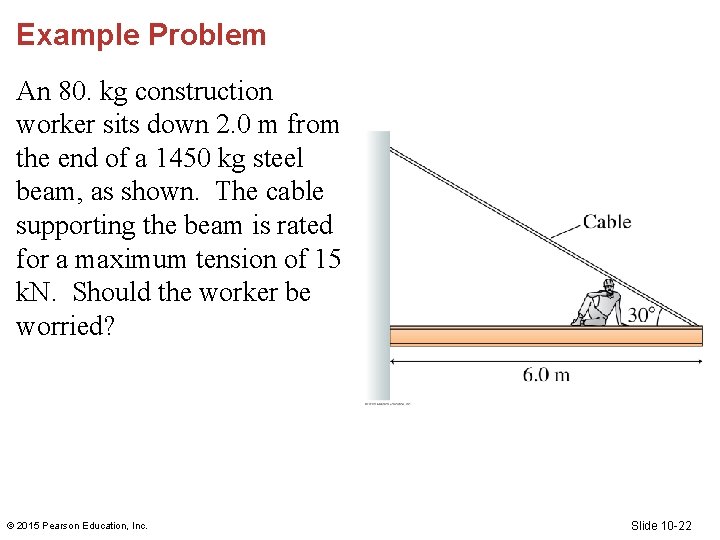
Example Problem An 80. kg construction worker sits down 2. 0 m from the end of a 1450 kg steel beam, as shown. The cable supporting the beam is rated for a maximum tension of 15 k. N. Should the worker be worried? © 2015 Pearson Education, Inc. Slide 10 -22