
Section 9 4 Stability Balance STATICS Equilibrium F

Section 9 -4: Stability & Balance • STATICS (Equilibrium) ∑F = 0 and ∑τ = 0 • Now: A body initially at equilibrium. Apply a small force & then take that force away. The body moves slightly away from equilibrium. 3 Possible Results: 1. Object returns to the original position. The original position was a STABLE EQUILIBRIUM. 2. Object moves even further from the original position. The original position was an UNSTABLE EQUILIBRIUM. 3. Object remains in the new position. The original position was a NEUTRAL EQUILIBRIUM.

• Usually: Interested in maintaining a Stable Equilibrium “BALANCE”. • General: Object with Center of Gravity (CG) below its support point is in Stable Equilibrium. • CG above base of support? Stable as long as remains above base. Unstable if displaced so CG is no longer above base. Critical point = point where CG is just above edge of base.

• Stable (BALANCED): Vertical line from CG falls within support base. • Unstable: Vertical line falls outside support base. • Critical point in changing from stable to unstable = point where CG is above edge of support base.
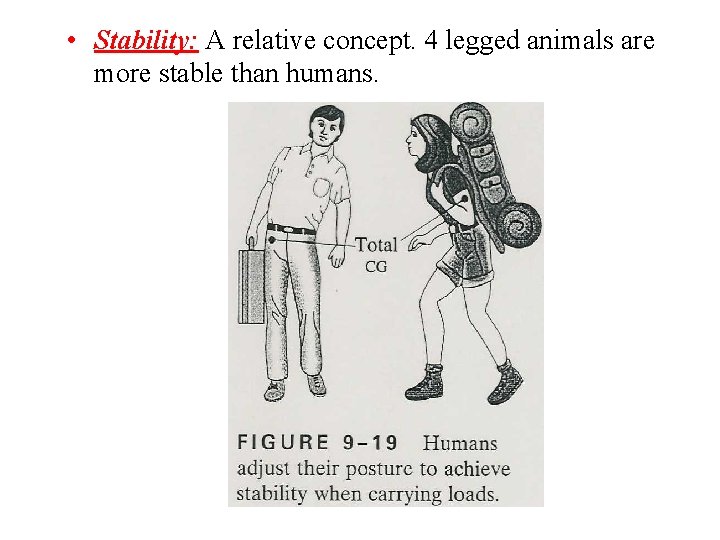
• Stability: A relative concept. 4 legged animals are more stable than humans.
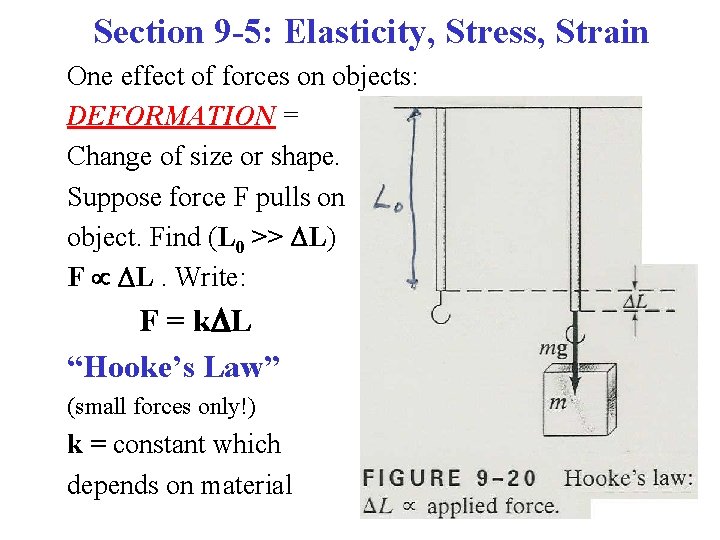
Section 9 -5: Elasticity, Stress, Strain One effect of forces on objects: DEFORMATION = Change of size or shape. Suppose force F pulls on object. Find (L 0 >> L) F L. Write: F = k L “Hooke’s Law” (small forces only!) k = constant which depends on material
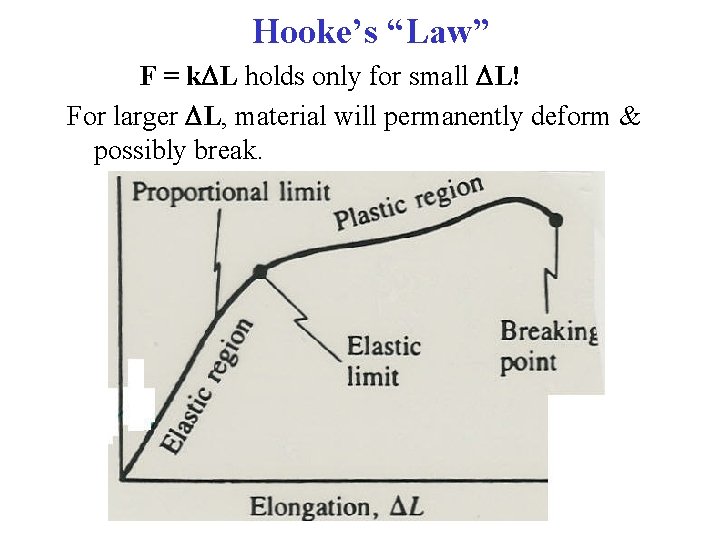
Hooke’s “Law” F = k L holds only for small L! For larger L, material will permanently deform & possibly break.
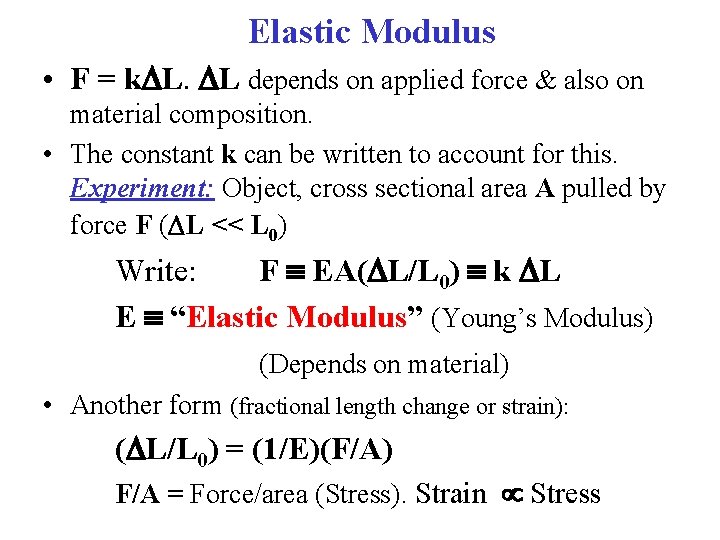
Elastic Modulus • F = k L. L depends on applied force & also on material composition. • The constant k can be written to account for this. Experiment: Object, cross sectional area A pulled by force F ( L << L 0) Write: F EA( L/L 0) k L E “Elastic Modulus” (Young’s Modulus) (Depends on material) • Another form (fractional length change or strain): ( L/L 0) = (1/E)(F/A) F/A = Force/area (Stress). Strain Stress
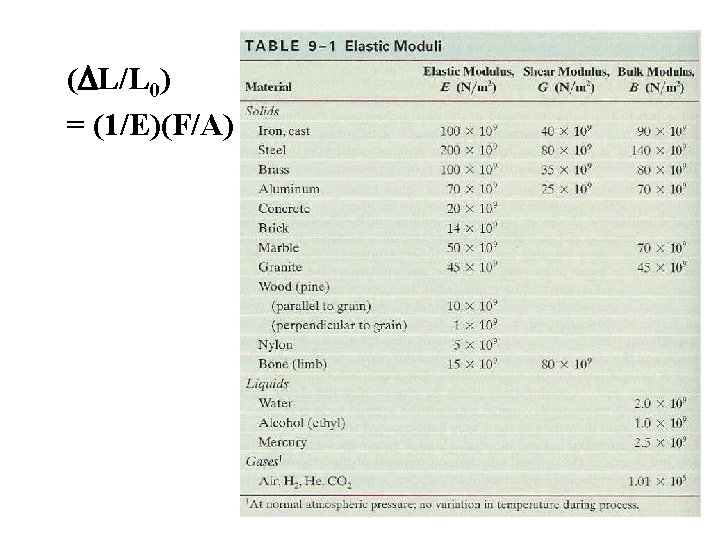
( L/L 0) = (1/E)(F/A)
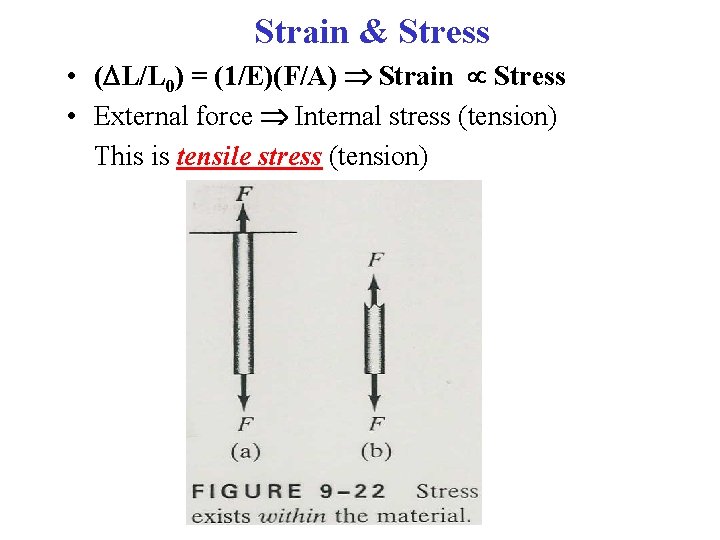
Strain & Stress • ( L/L 0) = (1/E)(F/A) Strain Stress • External force Internal stress (tension) This is tensile stress (tension)
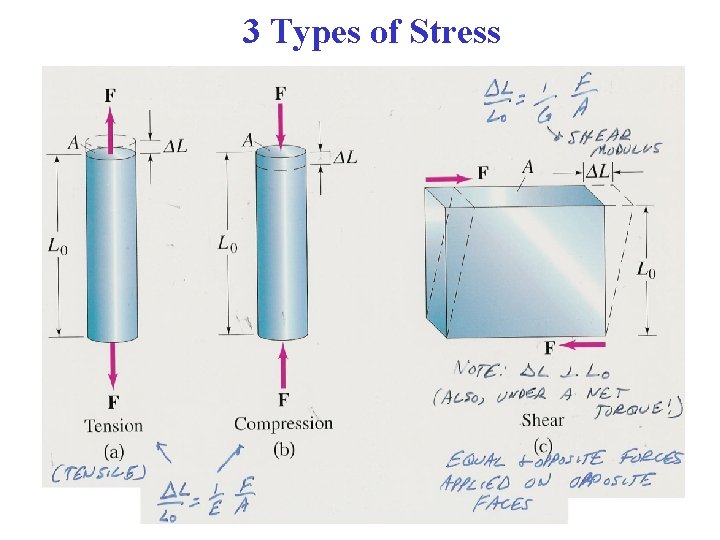
3 Types of Stress
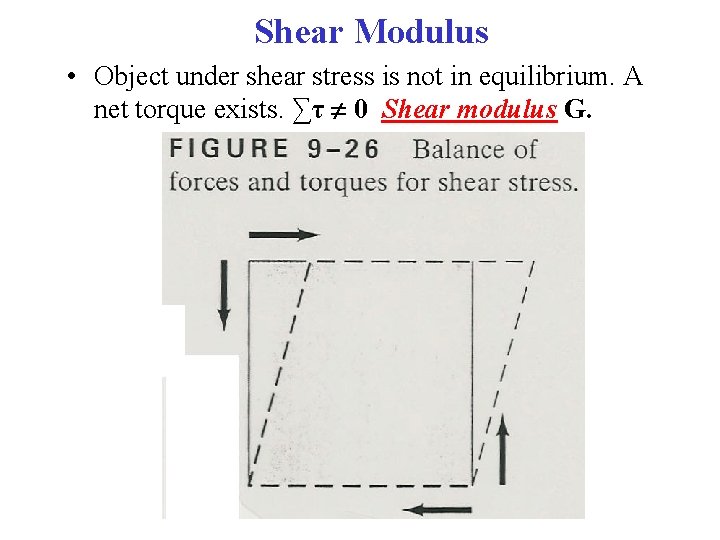
Shear Modulus • Object under shear stress is not in equilibrium. A net torque exists. ∑τ 0 Shear modulus G.
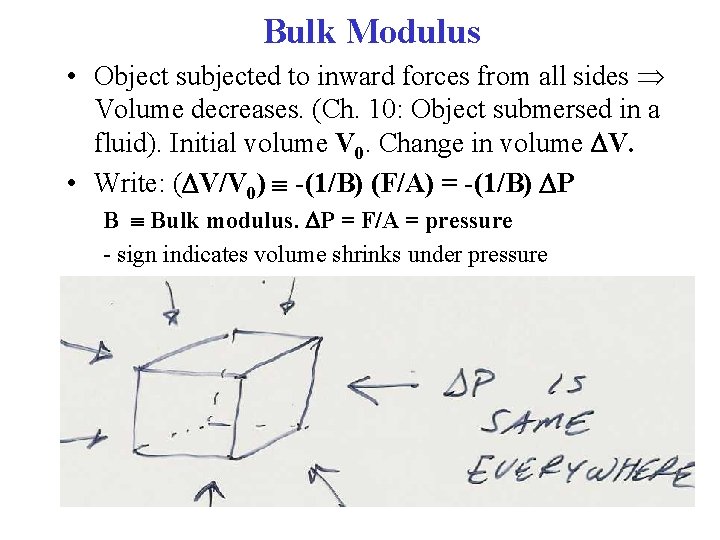
Bulk Modulus • Object subjected to inward forces from all sides Volume decreases. (Ch. 10: Object submersed in a fluid). Initial volume V 0. Change in volume V. • Write: ( V/V 0) -(1/B) (F/A) = -(1/B) P B Bulk modulus. P = F/A = pressure - sign indicates volume shrinks under pressure
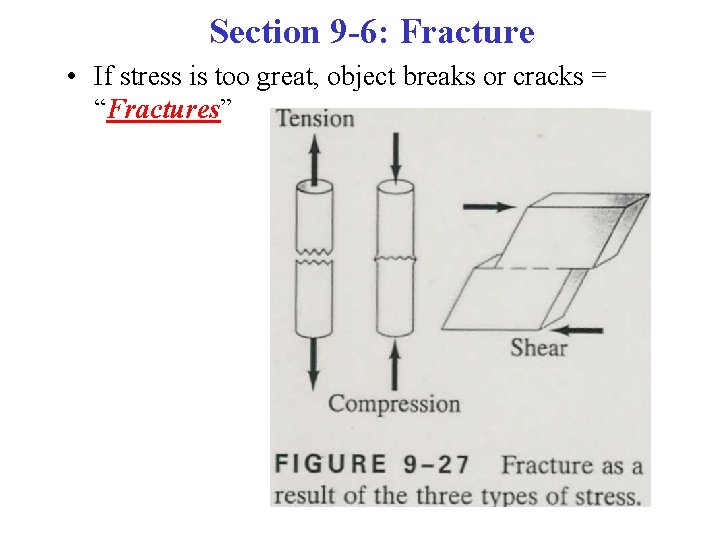
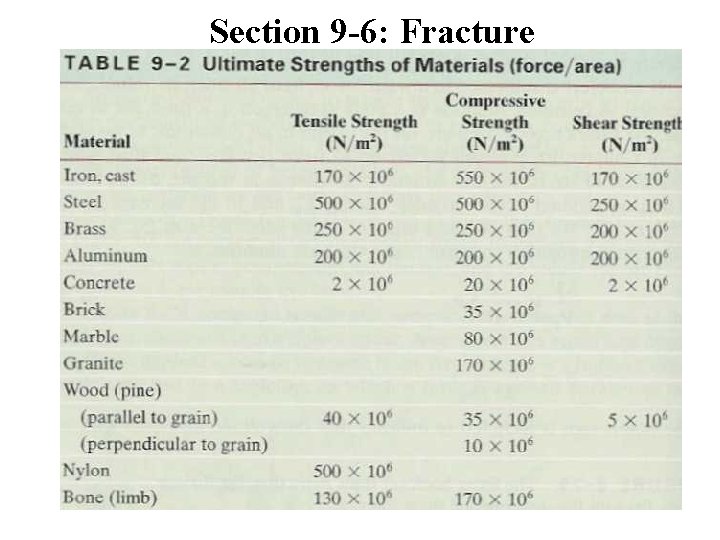
Section 9 -6: Fracture • If stress is too great, object breaks or cracks = “Fractures”
Section 9 -6: Fracture
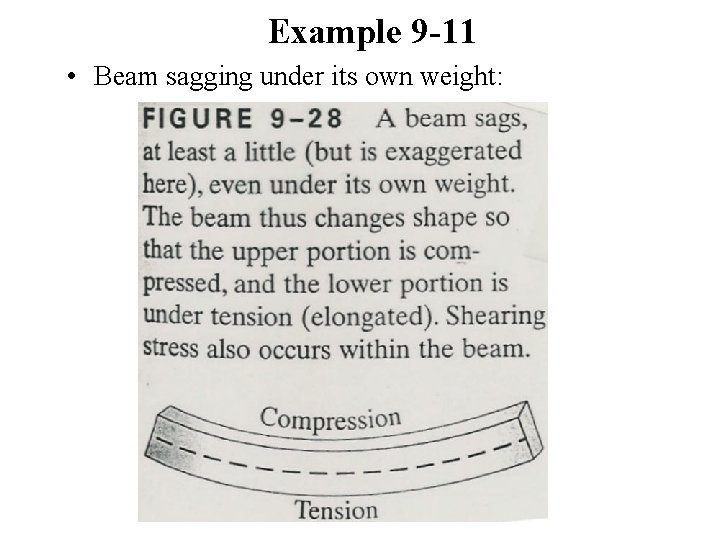
Example 9 -11 • Beam sagging under its own weight:
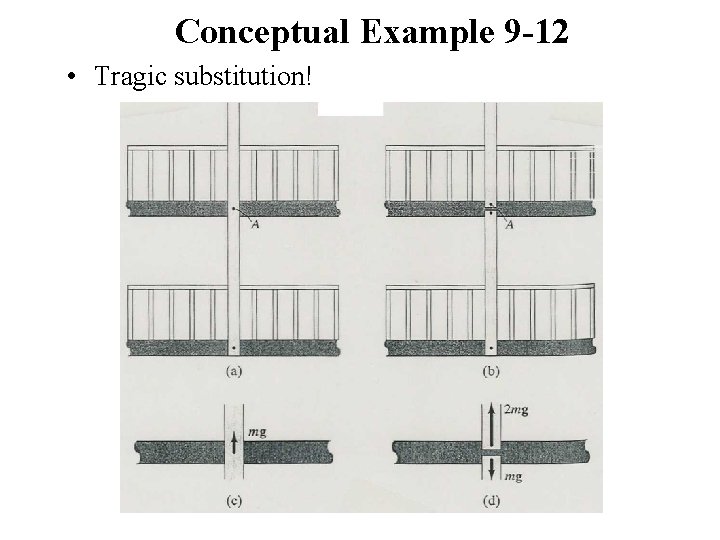
Conceptual Example 9 -12 • Tragic substitution!
- Slides: 18