
Section 9 4 Polyhedrons Spheres Section 9 4
- Slides: 6
Section 9. 4 Polyhedrons & Spheres Section 9. 4 Nack/Jones 1
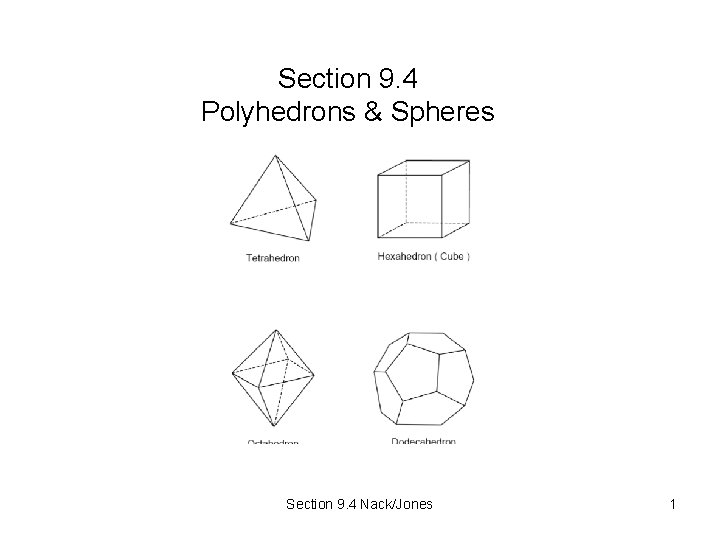
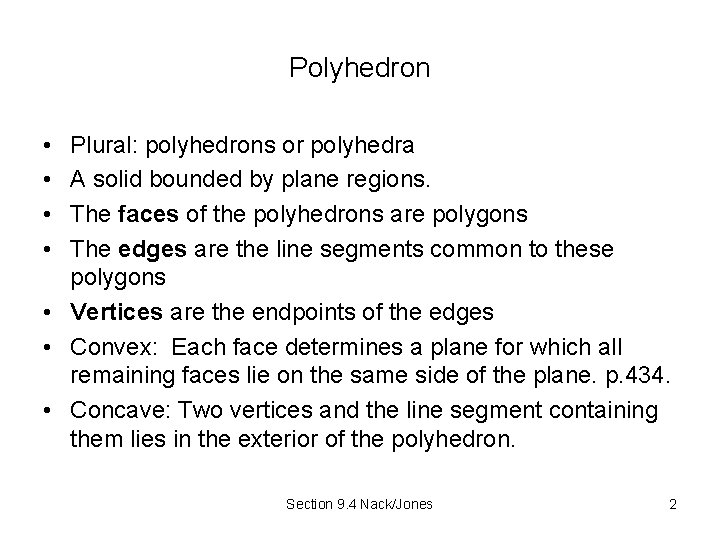
Polyhedron • • Plural: polyhedrons or polyhedra A solid bounded by plane regions. The faces of the polyhedrons are polygons The edges are the line segments common to these polygons • Vertices are the endpoints of the edges • Convex: Each face determines a plane for which all remaining faces lie on the same side of the plane. p. 434. • Concave: Two vertices and the line segment containing them lies in the exterior of the polyhedron. Section 9. 4 Nack/Jones 2
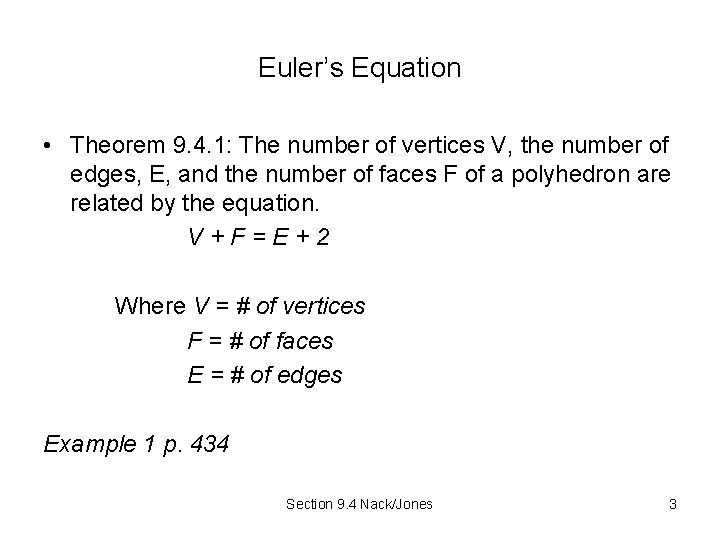
Euler’s Equation • Theorem 9. 4. 1: The number of vertices V, the number of edges, E, and the number of faces F of a polyhedron are related by the equation. V+F=E+2 Where V = # of vertices F = # of faces E = # of edges Example 1 p. 434 Section 9. 4 Nack/Jones 3
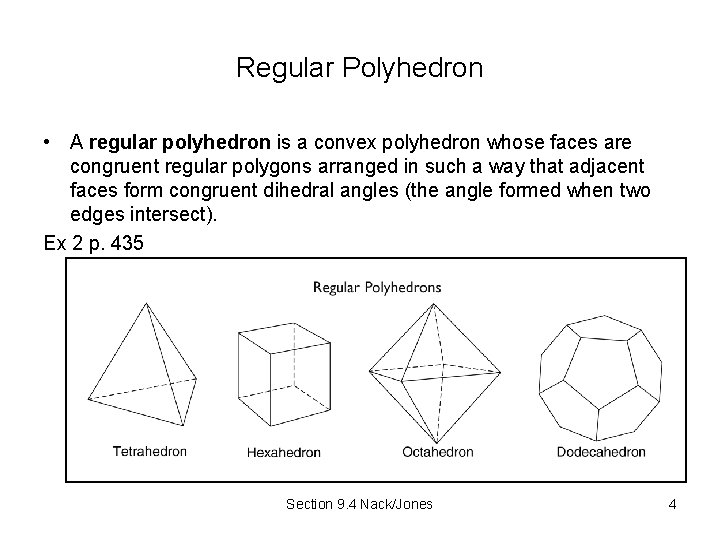
Regular Polyhedron • A regular polyhedron is a convex polyhedron whose faces are congruent regular polygons arranged in such a way that adjacent faces form congruent dihedral angles (the angle formed when two edges intersect). Ex 2 p. 435 Section 9. 4 Nack/Jones 4
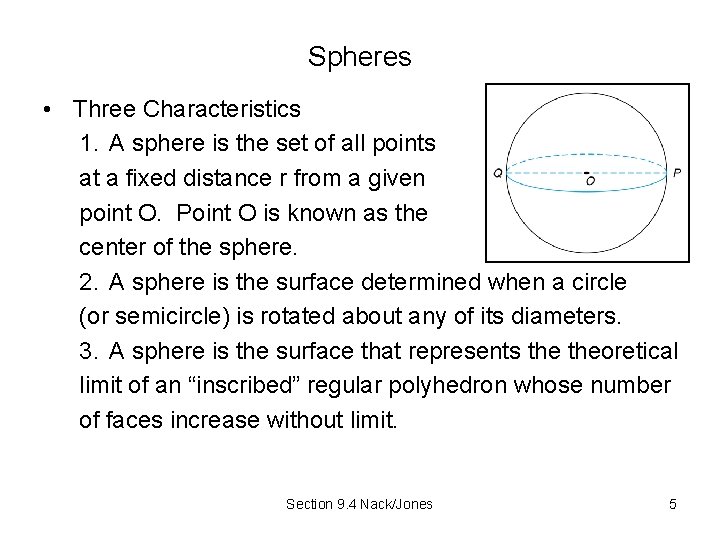
Spheres • Three Characteristics 1. A sphere is the set of all points at a fixed distance r from a given point O. Point O is known as the center of the sphere. 2. A sphere is the surface determined when a circle (or semicircle) is rotated about any of its diameters. 3. A sphere is the surface that represents theoretical limit of an “inscribed” regular polyhedron whose number of faces increase without limit. Section 9. 4 Nack/Jones 5
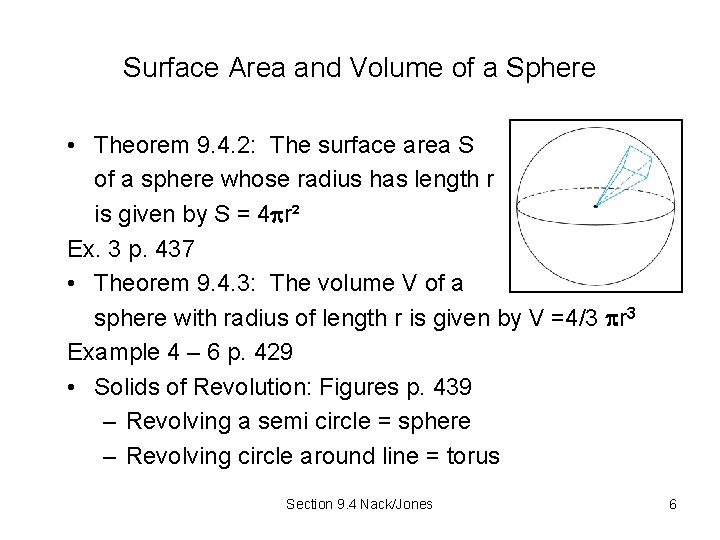
Surface Area and Volume of a Sphere • Theorem 9. 4. 2: The surface area S of a sphere whose radius has length r is given by S = 4 r² Ex. 3 p. 437 • Theorem 9. 4. 3: The volume V of a sphere with radius of length r is given by V =4/3 r 3 Example 4 – 6 p. 429 • Solids of Revolution: Figures p. 439 – Revolving a semi circle = sphere – Revolving circle around line = torus Section 9. 4 Nack/Jones 6