
Section 8 5 Translation Biology Translation Process that
Section 8. 5: Translation Biology
Translation �Process that converts an m. RNA message into a polypeptide (protein) �DNA code: � A, T, G, C �RNA code: � A, G, C, U �Proteins � 20 amino acids �How does the m. RNA message get converted to amino acids
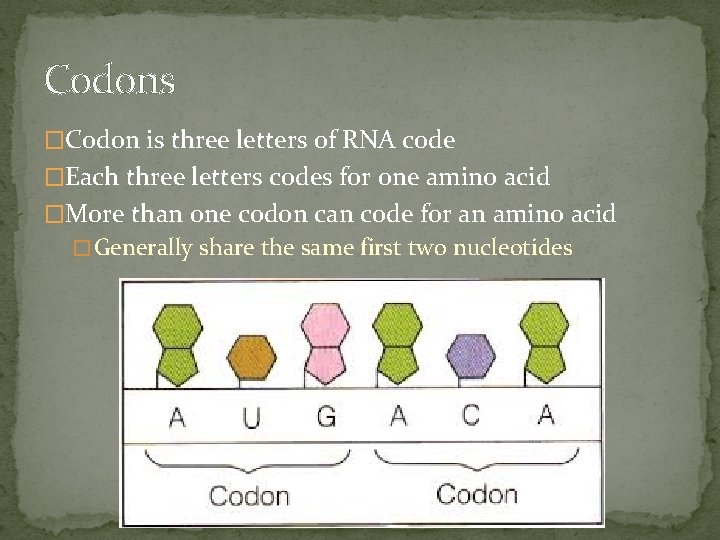
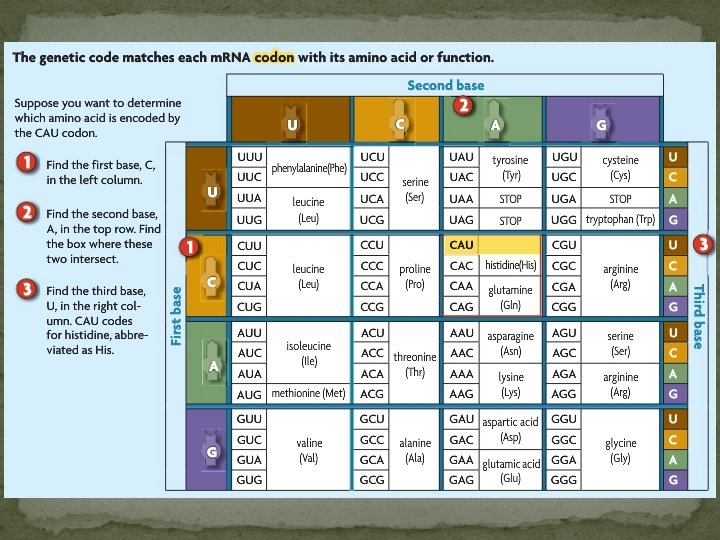
Codons �Codon is three letters of RNA code �Each three letters codes for one amino acid �More than one codon can code for an amino acid � Generally share the same first two nucleotides
Start/Stop Codons �Codons code for more than just amino acids �Three stop codons � UAA � UAG � UGA �One start codon � AUG � Also codes for methionine, which is often removed later in the translation process
Reading The Genetic Code �Codons must be read in the correct order �A start codon (AUG) begins the reading �Then the codon is read, without spaces, three nucleotides at a time � DO NOT OVERLAP �Stop codon stops the reading process �This is called the reading frame �If the reading frame is changed, then translation produces a different protein �Any adjustment to this code will change the protein
Everyone’s The Same! �The genetic code and what it codes for is the same for almost all organisms �Because almost all organisms follow this code, it leads scientists to believe that we all have a common ancestor �Also allows for insertion of genes from one organism into another � HELLO JURASSIC PARK….
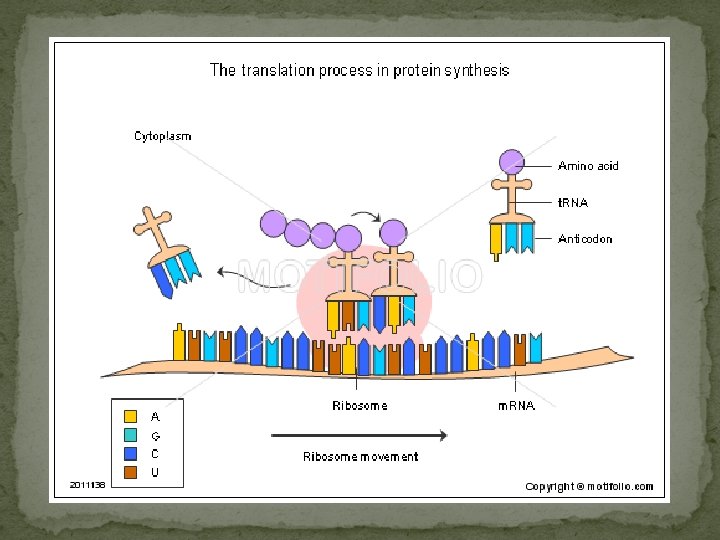
Linked A. A. Make A Protein �m. RNA is read in codons, but how does a codon get matched to an amino acid �Ribosomes: Site of protein synthesis � Hold and pull the m. RNA through � Small subunit hold the m. RNA � Large subunit holds the growing protein �t. RNA acts as an adapter between m. RNA and amino acids � t. RNA code is complementary to the m. RNA code
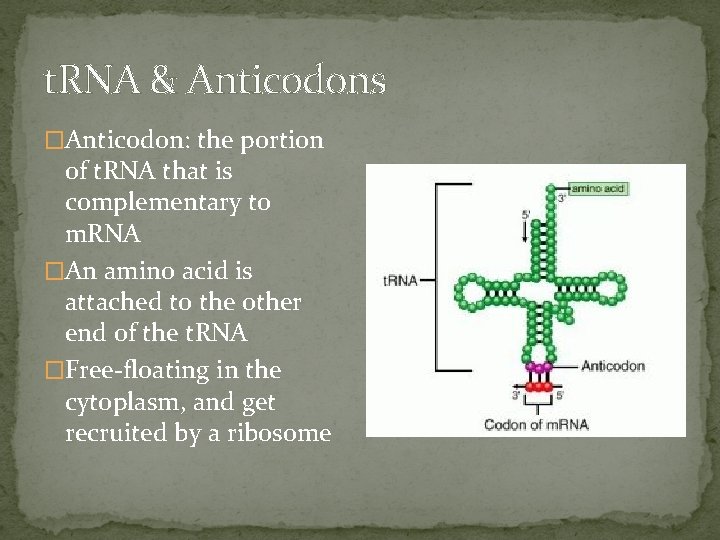
t. RNA & Anticodons �Anticodon: the portion of t. RNA that is complementary to m. RNA �An amino acid is attached to the other end of the t. RNA �Free-floating in the cytoplasm, and get recruited by a ribosome
Process of Translation �Takes a lot of energy from the cell �Occurs in the cytoplasm of both prokaryote and eukaryotes �Before translation: � Small ribosomal subunit binds to the m. RNA � t. RNA binds to the start codon � Large ribosomal subunit binds �Has three binding sites for t. RNA (can hold 3 codons at a time) �Ribosome pulls the m. RNA through one codon at a time
Process of Translation �One the start site amino acid (methionine) has been added there are two more t. RNA binding sites on the large ribosomal unit �The shift of the methionine leaves a m. RNA codon exposed �The matching t. RNA anticodon binds to the m. RNA � This puts the two amino acids close together �Ribosome helps form a peptide bond between two amino acids, and also breaks the bond between amino acid and t. RNA
Process of Translation �The ribosome moves the m. RNA through, now putting the codon in the exit site, and leaving another m. RNA codon exposed �The t. RNA leaves the ribosome (amino acids stays as it is linked to another amino acid) �t. RNA can be re-charged with another amino acid �m. RNA keeps getting shifted through the three amino acids binding sites on the ribosome until a stop codon is reached and the protein is released �The ribosome then falls apart
- Slides: 13