
Section 8 4 Ions Electron Configurations and Sizes
![Noble Gas Configurations Write the noble gas configurations for: As [Ar] 4 s 23](https://slidetodoc.com/presentation_image_h2/930924800a38311fda55ab8c676d7562/image-31.jpg "Noble Gas Configurations Write the noble gas configurations for: As [Ar] 4 s 23")
![Exceptions to Aufbau Cr [Ar] 4 s 13 d 5 Mo [Kr] 5 s](https://slidetodoc.com/presentation_image_h2/930924800a38311fda55ab8c676d7562/image-35.jpg "Exceptions to Aufbau Cr [Ar] 4 s 13 d 5 Mo [Kr] 5 s")
![Exceptions to Aufbau Cu [Ar]4 s 13 d 10 Ag [Kr]5 s 14 d](https://slidetodoc.com/presentation_image_h2/930924800a38311fda55ab8c676d7562/image-37.jpg "Exceptions to Aufbau Cu [Ar]4 s 13 d 10 Ag [Kr]5 s 14 d")
- Slides: 38
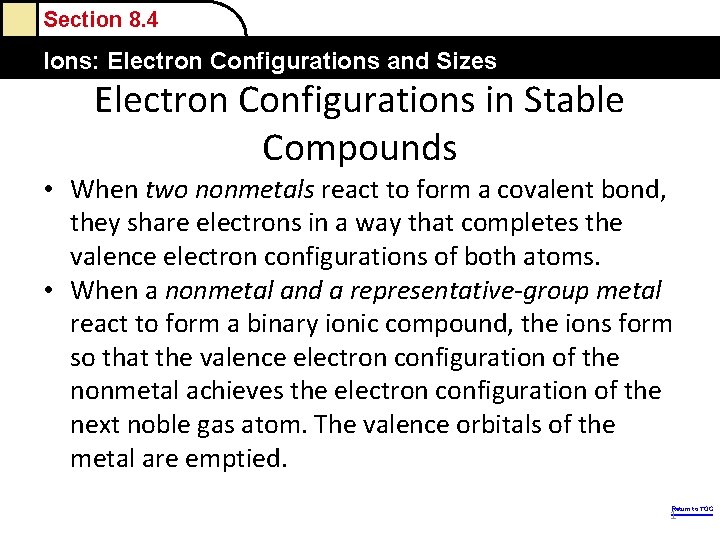
Section 8. 4 Ions: Electron Configurations and Sizes Electron Configurations in Stable Compounds • When two nonmetals react to form a covalent bond, they share electrons in a way that completes the valence electron configurations of both atoms. • When a nonmetal and a representative-group metal react to form a binary ionic compound, the ions form so that the valence electron configuration of the nonmetal achieves the electron configuration of the next noble gas atom. The valence orbitals of the metal are emptied. Return to TOC 1
Section 8. 4 Ions: Electron Configurations and Sizes An ion is an atom with a charge Cation – positively charged atom Anion – negatively charged atom The question becomes…. why do atoms form ions? 2 Return to TOC
Section 8. 4 Ions: Electron Configurations and Sizes Atoms will gain or lose e- in an attempt to form the same electron configuration as the closest noble gas. ***Move the LEAST number of e- possible. 3 Return to TOC
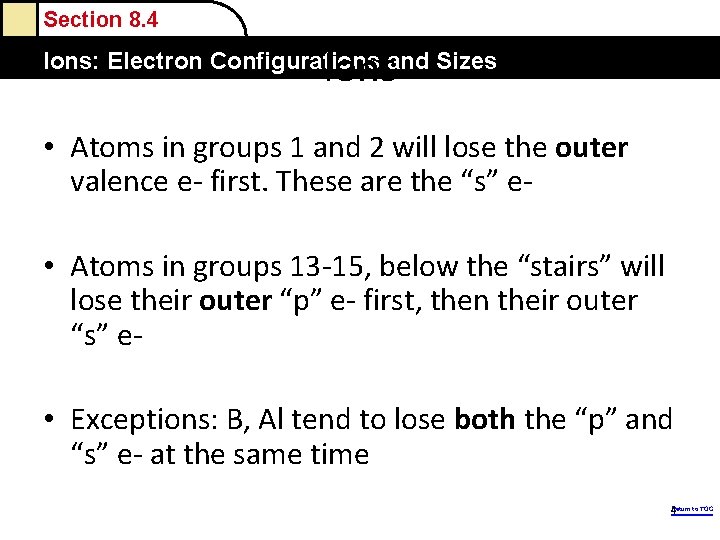
Section 8. 4 Ions: Electron Configurations and Sizes • Atoms in groups 1 and 2 will lose the outer valence e- first. These are the “s” e • Atoms in groups 13 -15, below the “stairs” will lose their outer “p” e- first, then their outer “s” e • Exceptions: B, Al tend to lose both the “p” and “s” e- at the same time 4 Return to TOC
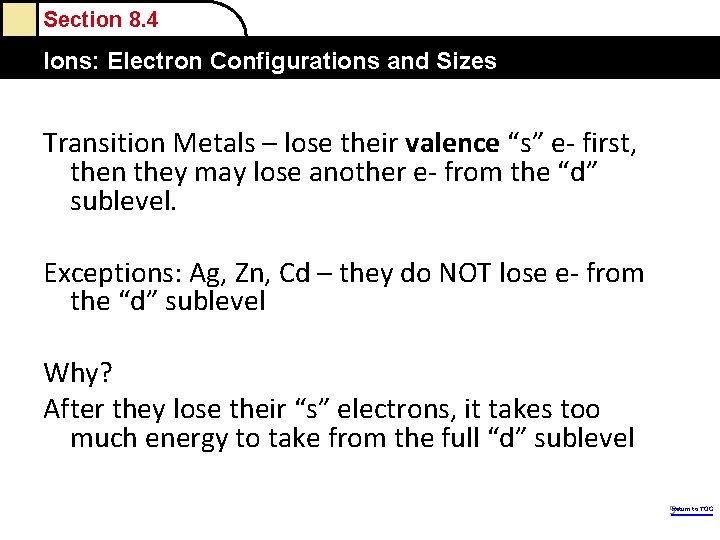
Section 8. 4 Ions: Electron Configurations and Sizes Transition Metals – lose their valence “s” e- first, then they may lose another e- from the “d” sublevel. Exceptions: Ag, Zn, Cd – they do NOT lose e- from the “d” sublevel Why? After they lose their “s” electrons, it takes too much energy to take from the full “d” sublevel 5 Return to TOC
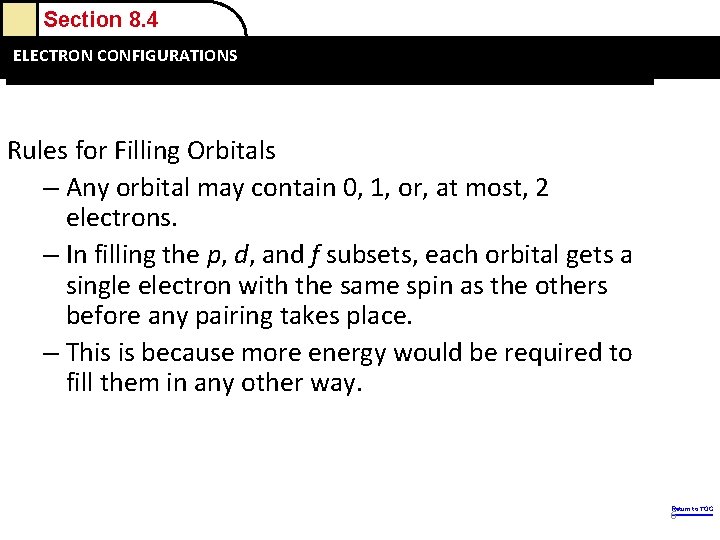
Section 8. 4 ELECTRON Ions: CONFIGURATIONS Electron Configurations and Sizes Rules for Filling Orbitals – Any orbital may contain 0, 1, or, at most, 2 electrons. – In filling the p, d, and f subsets, each orbital gets a single electron with the same spin as the others before any pairing takes place. – This is because more energy would be required to fill them in any other way. Return to TOC 6
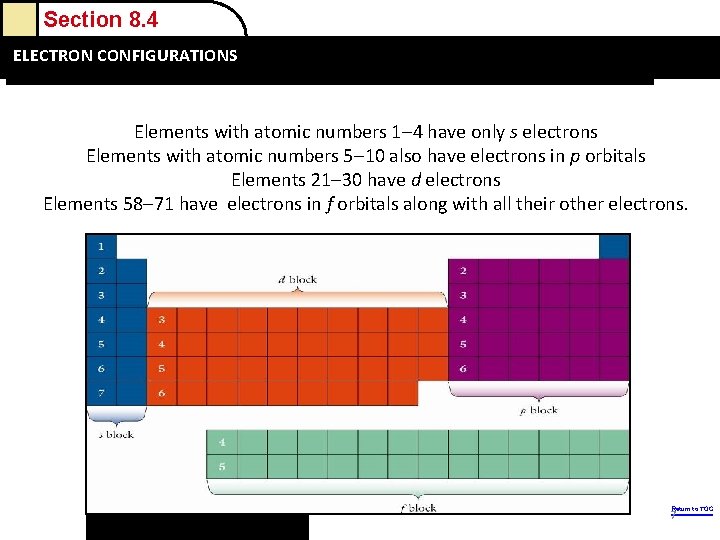
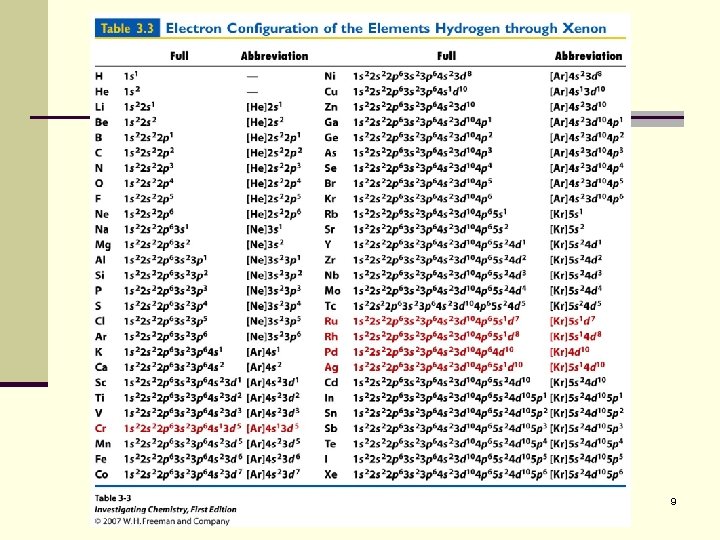
Section 8. 4 ELECTRON Ions: CONFIGURATIONS Electron Configurations and Sizes Elements with atomic numbers 1 4 have only s electrons Elements with atomic numbers 5 10 also have electrons in p orbitals Elements 21 30 have d electrons Elements 58 71 have electrons in f orbitals along with all their other electrons. Return to TOC Figure 3. 18, pg. 78 Investigating Chemistry, 2 nd Edition 7
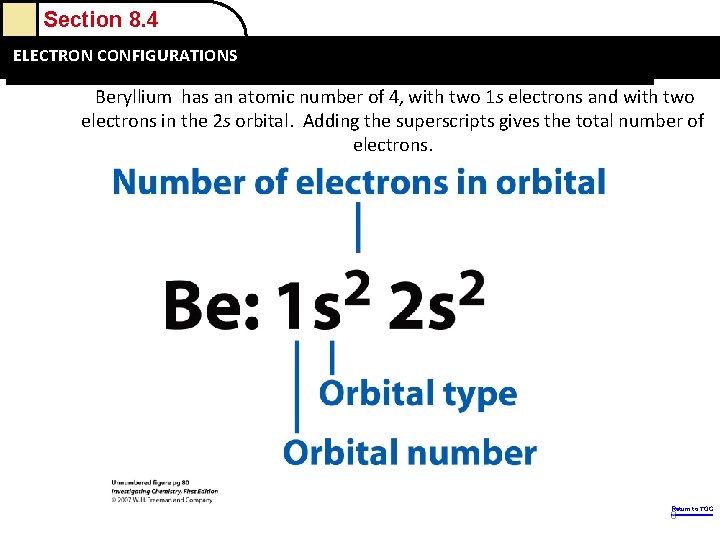
Section 8. 4 ELECTRON Ions: CONFIGURATIONS Electron Configurations and Sizes Beryllium has an atomic number of 4, with two 1 s electrons and with two electrons in the 2 s orbital. Adding the superscripts gives the total number of electrons. Return to TOC 8
9
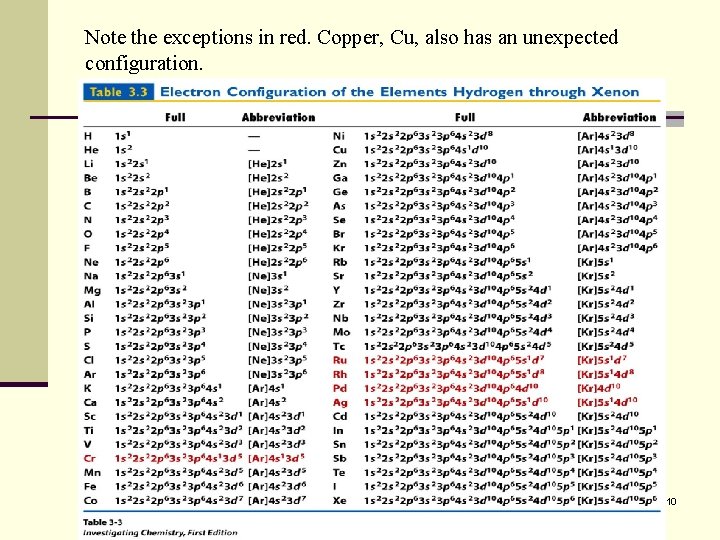
Note the exceptions in red. Copper, Cu, also has an unexpected configuration. 10
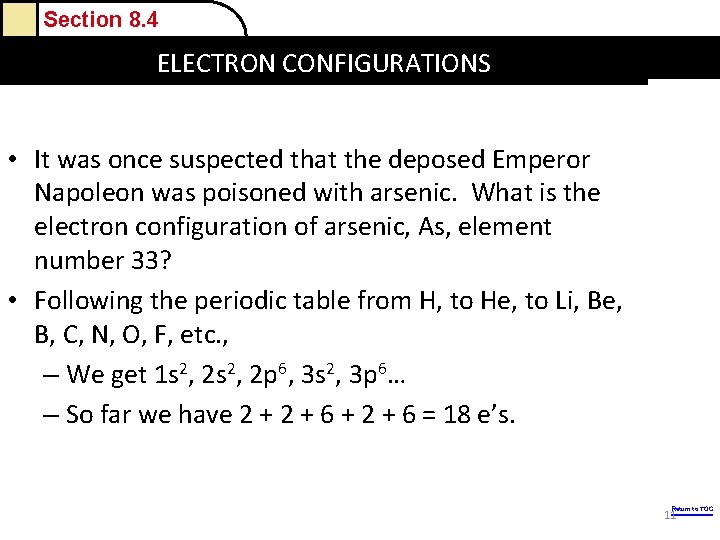
Section 8. 4 Ions: Electron Configurations and Sizes ELECTRON CONFIGURATIONS • It was once suspected that the deposed Emperor Napoleon was poisoned with arsenic. What is the electron configuration of arsenic, As, element number 33? • Following the periodic table from H, to He, to Li, Be, B, C, N, O, F, etc. , – We get 1 s 2, 2 p 6, 3 s 2, 3 p 6… – So far we have 2 + 6 + 2 + 6 = 18 e’s. Return to TOC 11
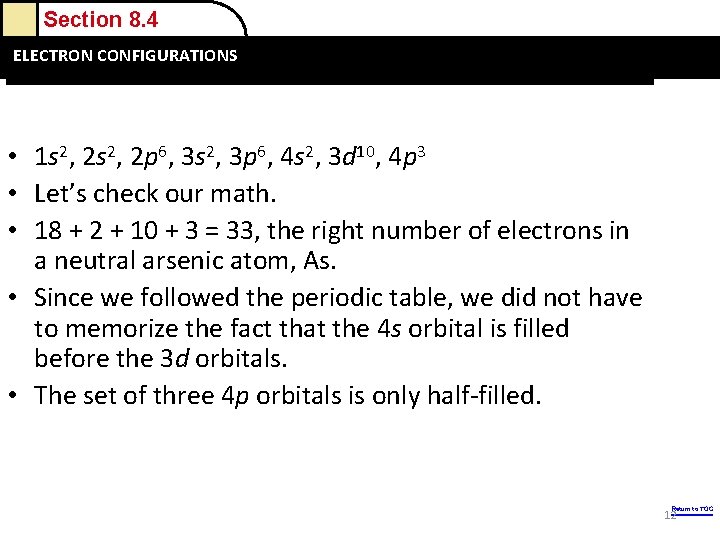
Section 8. 4 ELECTRON Ions: CONFIGURATIONS Electron Configurations and Sizes • 1 s 2, 2 p 6, 3 s 2, 3 p 6, 4 s 2, 3 d 10, 4 p 3 • Let’s check our math. • 18 + 2 + 10 + 3 = 33, the right number of electrons in a neutral arsenic atom, As. • Since we followed the periodic table, we did not have to memorize the fact that the 4 s orbital is filled before the 3 d orbitals. • The set of three 4 p orbitals is only half-filled. Return to TOC 12
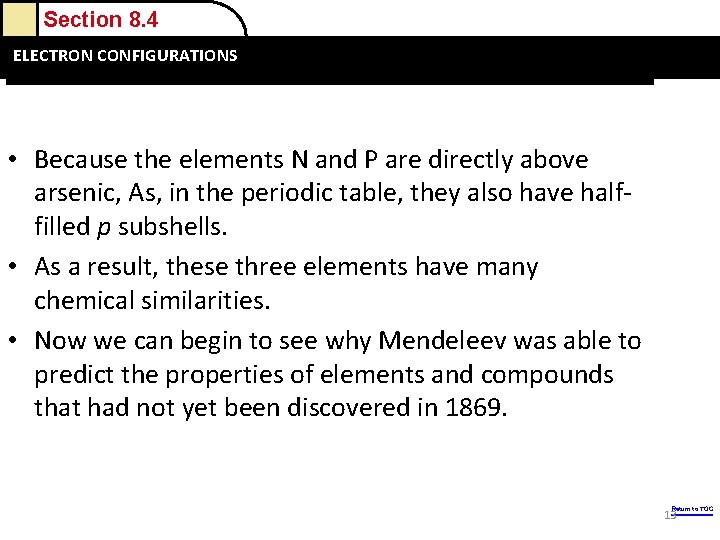
Section 8. 4 ELECTRON Ions: CONFIGURATIONS Electron Configurations and Sizes • Because the elements N and P are directly above arsenic, As, in the periodic table, they also have halffilled p subshells. • As a result, these three elements have many chemical similarities. • Now we can begin to see why Mendeleev was able to predict the properties of elements and compounds that had not yet been discovered in 1869. Return to TOC 13
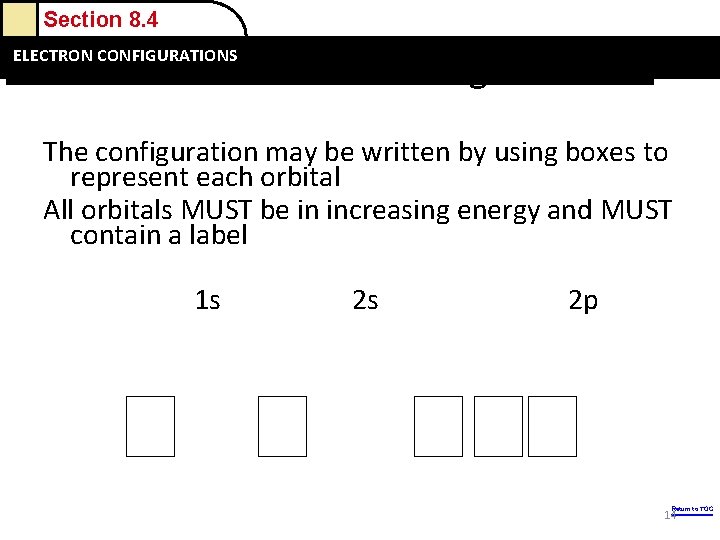
Section 8. 4 and Sizes Electron Orbital Configurations ELECTRON Ions: CONFIGURATIONS Electron Configurations The configuration may be written by using boxes to represent each orbital All orbitals MUST be in increasing energy and MUST contain a label 1 s 2 s 2 p Return to TOC 14
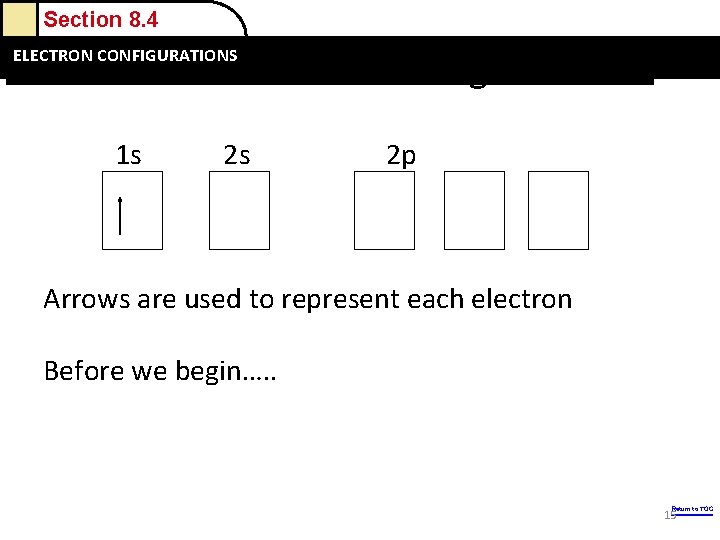
Section 8. 4 and Sizes Electron Orbital Configurations ELECTRON Ions: CONFIGURATIONS Electron Configurations 1 s 2 s 2 p Arrows are used to represent each electron Before we begin…. . Return to TOC 15
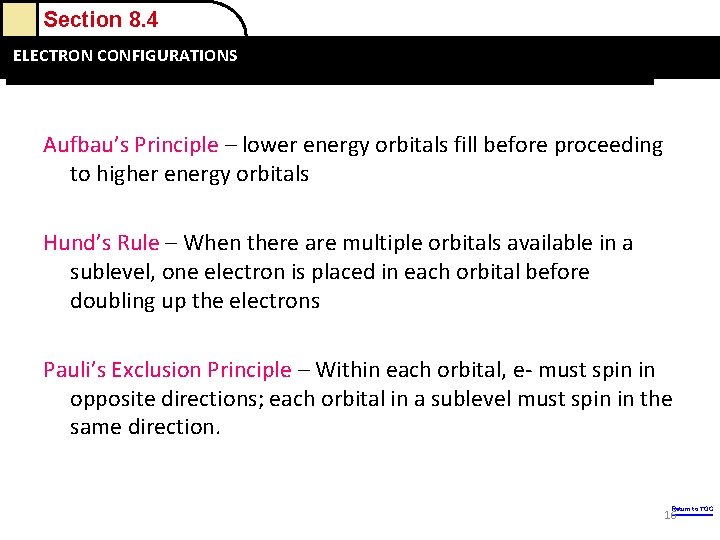
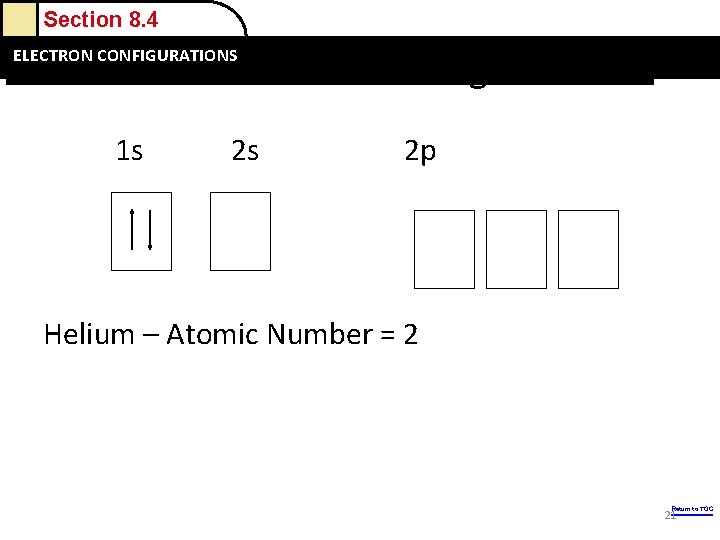
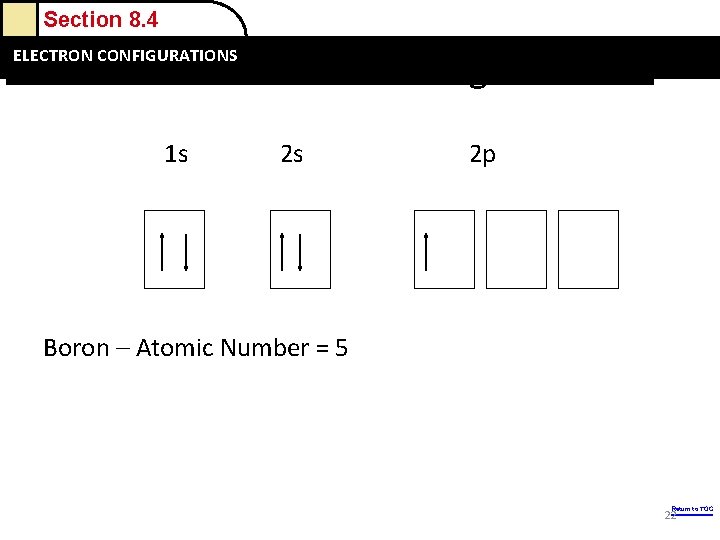
Section 8. 4 and Sizes Three Rules ELECTRON Ions: CONFIGURATIONS Electron Configurations Aufbau’s Principle – lower energy orbitals fill before proceeding to higher energy orbitals Hund’s Rule – When there are multiple orbitals available in a sublevel, one electron is placed in each orbital before doubling up the electrons Pauli’s Exclusion Principle – Within each orbital, e- must spin in opposite directions; each orbital in a sublevel must spin in the same direction. Return to TOC 16
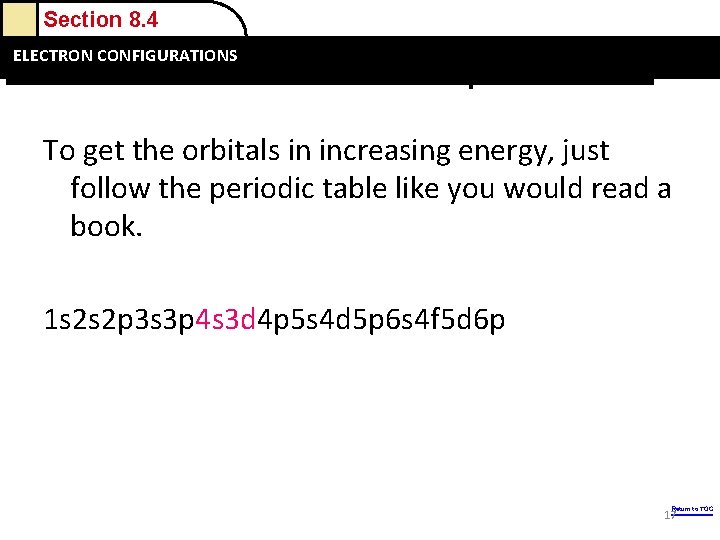
Section 8. 4 and Sizes Aufbau’s Principle ELECTRON Ions: CONFIGURATIONS Electron Configurations To get the orbitals in increasing energy, just follow the periodic table like you would read a book. 1 s 2 s 2 p 3 s 3 p 4 s 3 d 4 p 5 s 4 d 5 p 6 s 4 f 5 d 6 p Return to TOC 17
Section 8. 4 Sizes Hund’s and Rule ELECTRON Ions: CONFIGURATIONS Electron Configurations Never double up electrons in an orbital until each orbital in that sublevel has one electron. Once each orbital in a sublevel has one electron, then begin to double up the electrons. Return to TOC 18
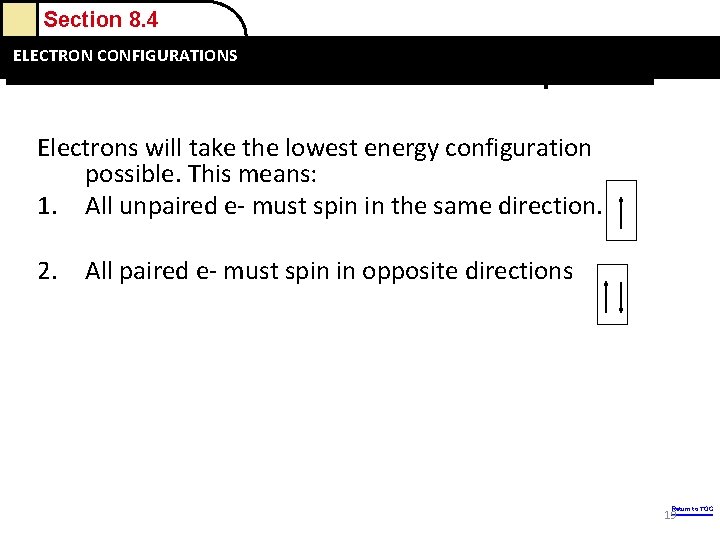
Section 8. 4 and Sizes Pauli’s Exclusions Principle ELECTRON Ions: CONFIGURATIONS Electron Configurations Electrons will take the lowest energy configuration possible. This means: 1. All unpaired e- must spin in the same direction. 2. All paired e- must spin in opposite directions Return to TOC 19
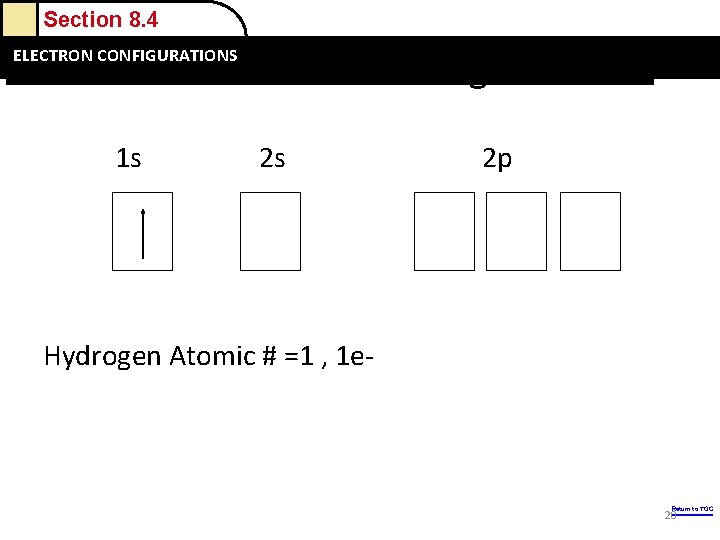
Section 8. 4 and Sizes Electron Orbital Configurations ELECTRON Ions: CONFIGURATIONS Electron Configurations 1 s 2 s 2 p Hydrogen Atomic # =1 , 1 e- Return to TOC 20
Section 8. 4 and Sizes Electron Orbital Configurations ELECTRON Ions: CONFIGURATIONS Electron Configurations 1 s 2 s 2 p Helium – Atomic Number = 2 Return to TOC 21
Section 8. 4 and Sizes Electron Orbital Configurations ELECTRON Ions: CONFIGURATIONS Electron Configurations 1 s 2 s 2 p Boron – Atomic Number = 5 Return to TOC 22
Section 8. 4 and Sizes Stable Compounds ELECTRON Ions: CONFIGURATIONS Electron Configurations • Atoms in stable compounds usually have a noble gas electron configuration. Return to TOC 23
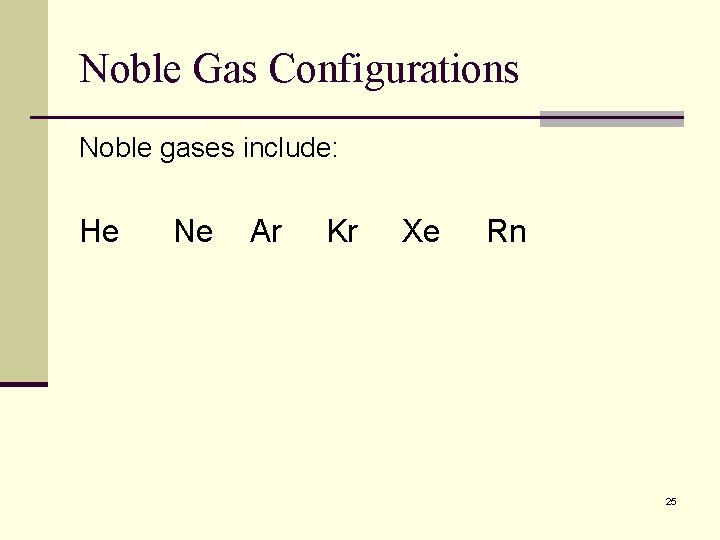
Noble Gas Configuration What is a noble gas? Noble gases are located in group 8 A, 18 on the periodic table. Noble gases are extremely unreactive, because their outer energy level is filled 24
Noble Gas Configurations Noble gases include: He Ne Ar Kr Xe Rn 25
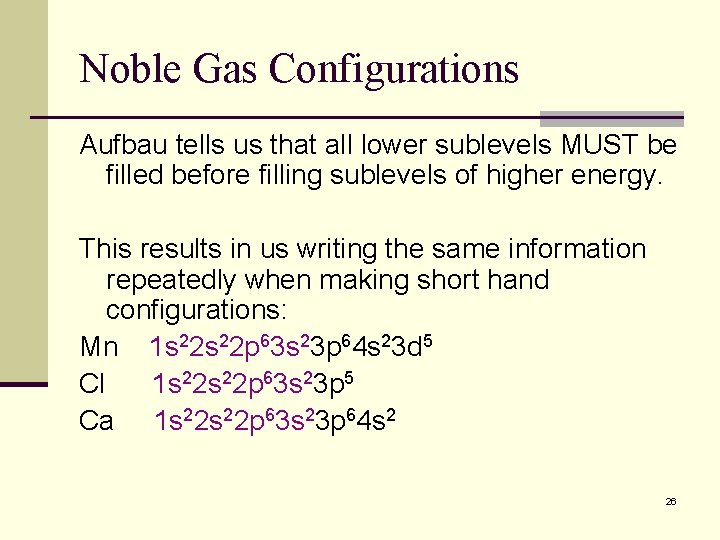
Noble Gas Configurations Aufbau tells us that all lower sublevels MUST be filled before filling sublevels of higher energy. This results in us writing the same information repeatedly when making short hand configurations: Mn 1 s 22 p 63 s 23 p 64 s 23 d 5 Cl 1 s 22 p 63 s 23 p 5 Ca 1 s 22 p 63 s 23 p 64 s 2 26
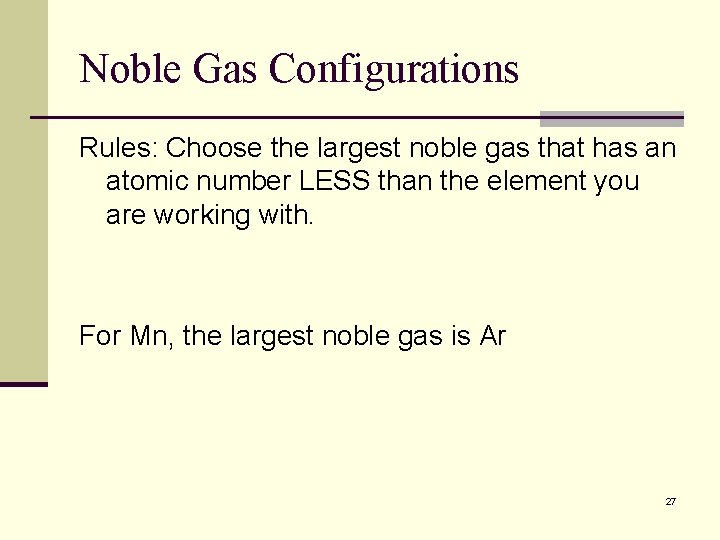
Noble Gas Configurations Rules: Choose the largest noble gas that has an atomic number LESS than the element you are working with. For Mn, the largest noble gas is Ar 27
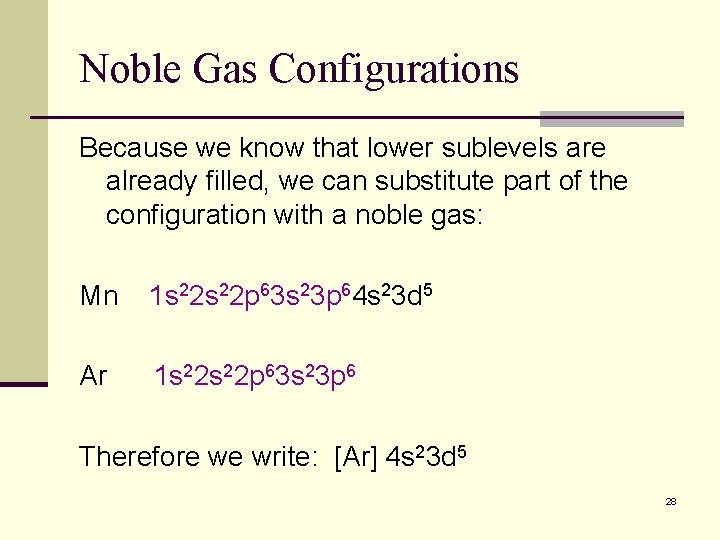
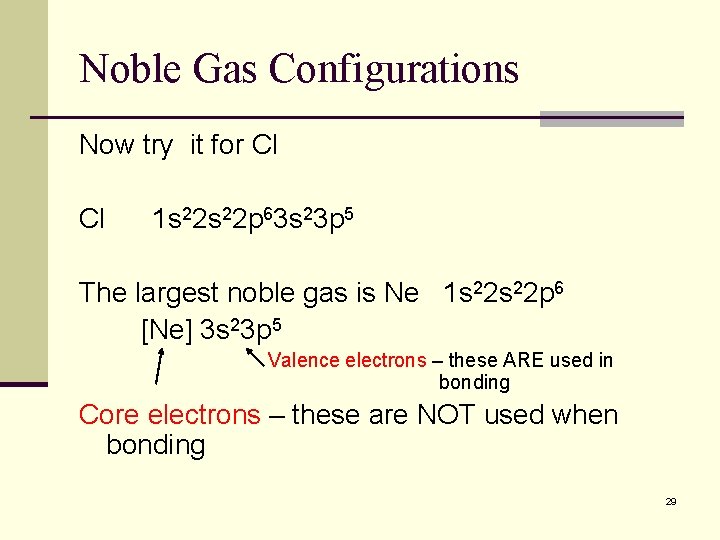
Noble Gas Configurations Because we know that lower sublevels are already filled, we can substitute part of the configuration with a noble gas: Mn 1 s 22 p 63 s 23 p 64 s 23 d 5 Ar 1 s 22 p 63 s 23 p 6 Therefore we write: [Ar] 4 s 23 d 5 28
Noble Gas Configurations Now try it for Cl Cl 1 s 22 p 63 s 23 p 5 The largest noble gas is Ne 1 s 22 p 6 [Ne] 3 s 23 p 5 Valence electrons – these ARE used in bonding Core electrons – these are NOT used when bonding 29
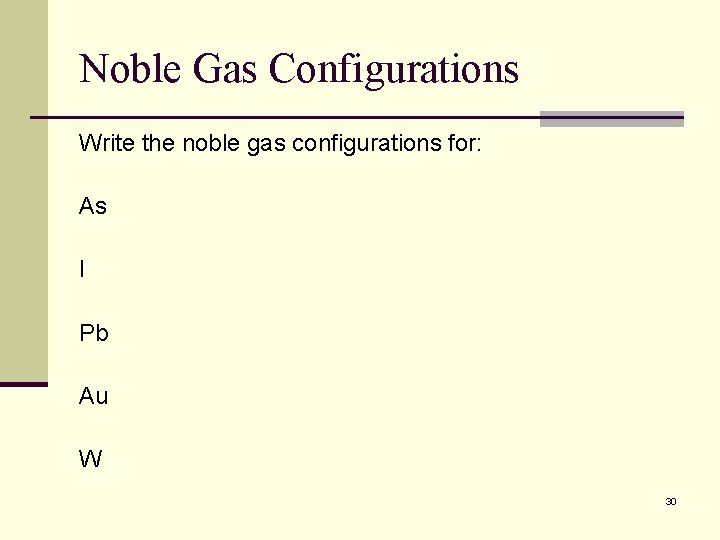
Noble Gas Configurations Write the noble gas configurations for: As I Pb Au W 30
Noble Gas Configurations Write the noble gas configurations for: As [Ar] 4 s 23 d 104 p 3 I [Kr] 5 s 24 d 105 p 5 Pb [Xe] 6 s 24 f 145 d 106 p 2 Au [Xe] 6 s 24 f 145 d 9 W [Xe] 6 s 24 f 145 d 4 31
Exceptional Configurations …. and ions 32
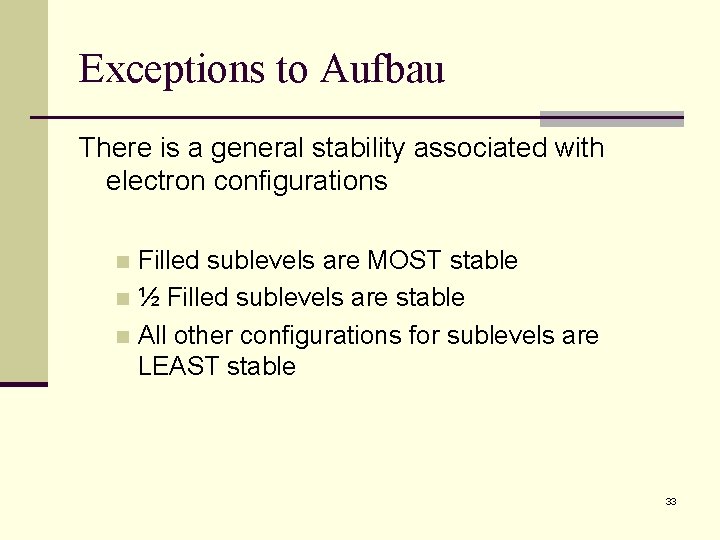
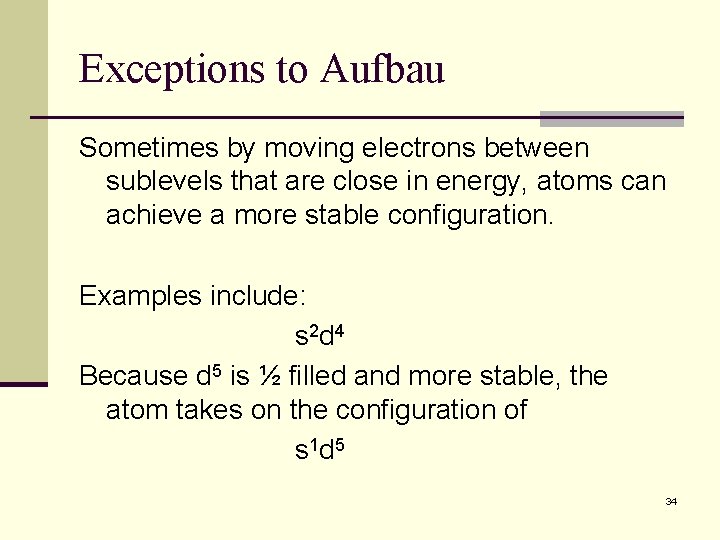
Exceptions to Aufbau There is a general stability associated with electron configurations Filled sublevels are MOST stable n ½ Filled sublevels are stable n All other configurations for sublevels are LEAST stable n 33
Exceptions to Aufbau Sometimes by moving electrons between sublevels that are close in energy, atoms can achieve a more stable configuration. Examples include: s 2 d 4 Because d 5 is ½ filled and more stable, the atom takes on the configuration of s 1 d 5 34
Exceptions to Aufbau Cr [Ar] 4 s 13 d 5 Mo [Kr] 5 s 14 d 5 W [Xe] 6 s 14 f 145 d 5 35
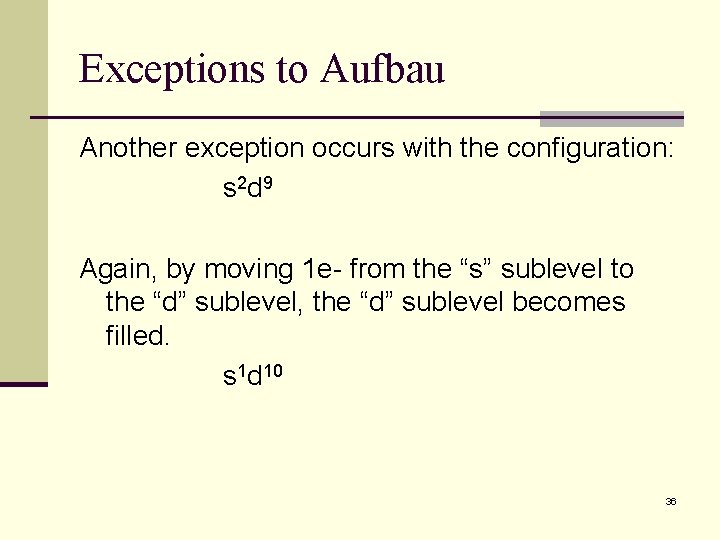
Exceptions to Aufbau Another exception occurs with the configuration: s 2 d 9 Again, by moving 1 e- from the “s” sublevel to the “d” sublevel, the “d” sublevel becomes filled. s 1 d 10 36
Exceptions to Aufbau Cu [Ar]4 s 13 d 10 Ag [Kr]5 s 14 d 10 Au [Xe]6 s 14 f 145 d 10 37
WARNING Exceptional configurations only happen between “s” and “d” sublevels…. NEVER between “s” and “p” sublevels. 38