
Section 8 3 DNA Replication Biology Objectives Essential
Section 8. 3: DNA Replication Biology
Objectives Essential Question: How does DNA provide the blueprint for the amino acid code of proteins? Objectives: 1. When is the genetic information copied? 2. What types of RNA exist to help DNA form proteins? 3. Explain the process of DNA replication. 4. How does the body ensure that DNA copying is fast and accurate?
Watson & Crick “It has not escaped our notice that the specific pairing we have postulated immediately suggests a possible copying mechanism for the genetic material. ” The base pairing rule provided an explanation for DNA replication A-T C-G One DNA strand can act as a template for another strand, providing exact copies We call this DNA replication
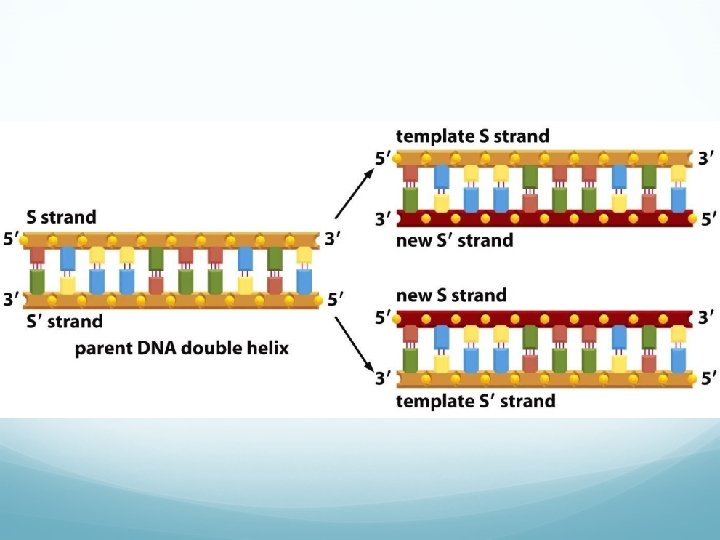
DNA Replication Each strand can act as a template The order of the bases is preserved, allowing for DNA to be replicated over and over again Ensures that each cell has a complete set of identical genetic information
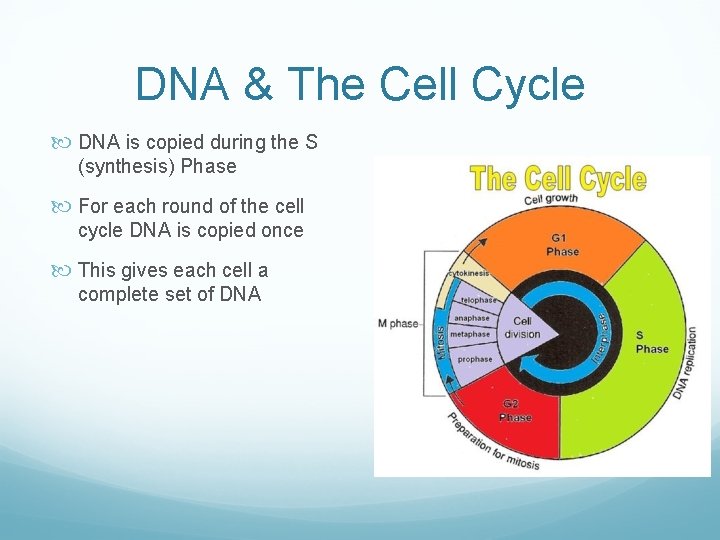
DNA & The Cell Cycle DNA is copied during the S (synthesis) Phase For each round of the cell cycle DNA is copied once This gives each cell a complete set of DNA
DNA Does Not Copy Itself Enzymes and proteins do the work of replication Enzymes: Start process by unzipping DNA Proteins: Hold strands apart while each strand serves as template Nucleotides: Free floating in the nucleus, can be paired with the template DNA strand
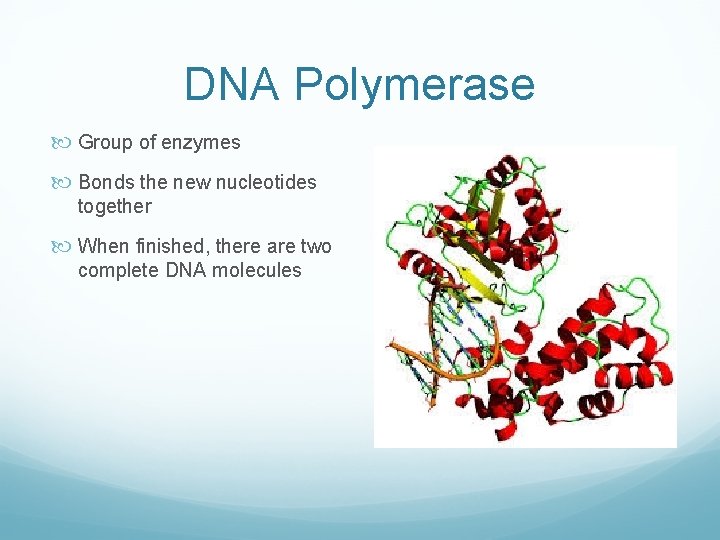
DNA Polymerase Group of enzymes Bonds the new nucleotides together When finished, there are two complete DNA molecules
Process of DNA Replication 1. DNA is unzipped hydrogen bonds connecting the base pairs is broken strands of DNA separate, exposing each strand proceeds in two directions at the same time Gives 2 replication forks 2. Free-floating nucleotides pair with the bases on the template strand DNA polymerases bond the nucleotides together to form new strands of DNA One stand has smooth continuous replication (leading strand) The other has short DNA segments joined together due to the directional nature of DNA polymerase (lagging strand)
Process of DNA Replication 1. DNA is unzipped 2. Free-floating nucleotides pair with the bases on the template strand 3. Two identical molecules of DNA Each molecule has a strand from original molecule and one new strand Semi-conservative: One old strand is conserved (saved), while on new one is made
Fast And Accurate Unzipping does not occur at one spot at a time Multiple origins of replication per strand 50 nucleotides added per second Process take just a few hours Proofreading Function: DNA polymerase detects error (addition of incorrect nucleotide) and replaces it with the correct nucleotide Errors at 1 per 1 billion nucleotides
- Slides: 11