
Section 8 2 Distribution of the Sample Proportion
Section 8. 2 Distribution of the Sample Proportion © 2010 Pearson Prentice Hall. All rights reserved
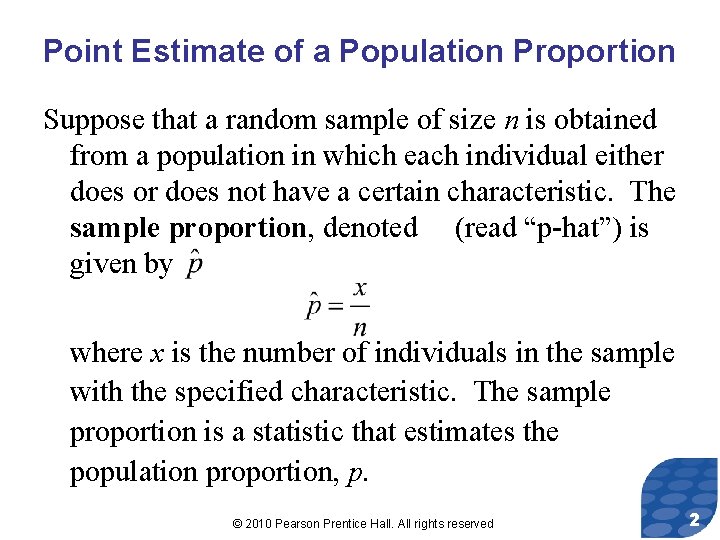
Point Estimate of a Population Proportion Suppose that a random sample of size n is obtained from a population in which each individual either does or does not have a certain characteristic. The sample proportion, denoted (read “p-hat”) is given by where x is the number of individuals in the sample with the specified characteristic. The sample proportion is a statistic that estimates the population proportion, p. © 2010 Pearson Prentice Hall. All rights reserved 2
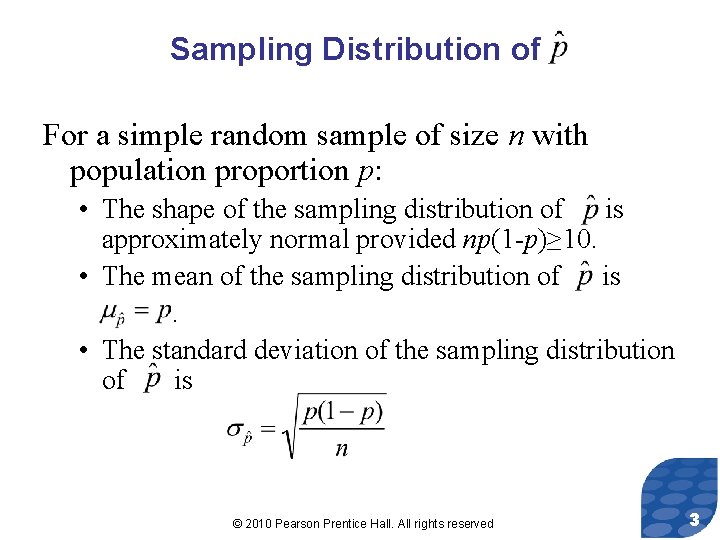
Sampling Distribution of For a simple random sample of size n with population proportion p: • The shape of the sampling distribution of is approximately normal provided np(1 -p)≥ 10. • The mean of the sampling distribution of is. • The standard deviation of the sampling distribution of is © 2010 Pearson Prentice Hall. All rights reserved 3
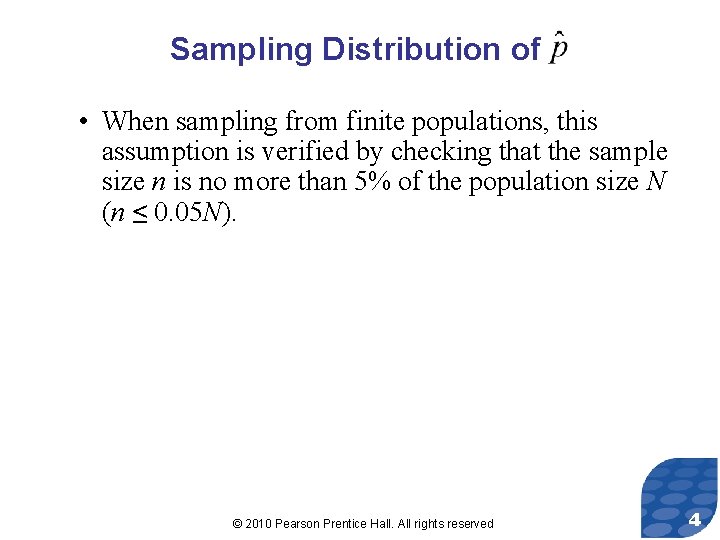
Sampling Distribution of • When sampling from finite populations, this assumption is verified by checking that the sample size n is no more than 5% of the population size N (n ≤ 0. 05 N). © 2010 Pearson Prentice Hall. All rights reserved 4
Parallel Example 4: Compute Probabilities of a Sample Proportion According to the Centers for Disease Control and Prevention, 18. 8% of school-aged children, aged 6 -11 years, were overweight in 2004. (a) In a random sample of 90 school-aged children, aged 6 -11 years, what is the probability that at least 19% are overweight? (b) Suppose a random sample of 90 school-aged children, aged 6 -11 years, results in 24 overweight children. What might you conclude? © 2010 Pearson Prentice Hall. All rights reserved 5
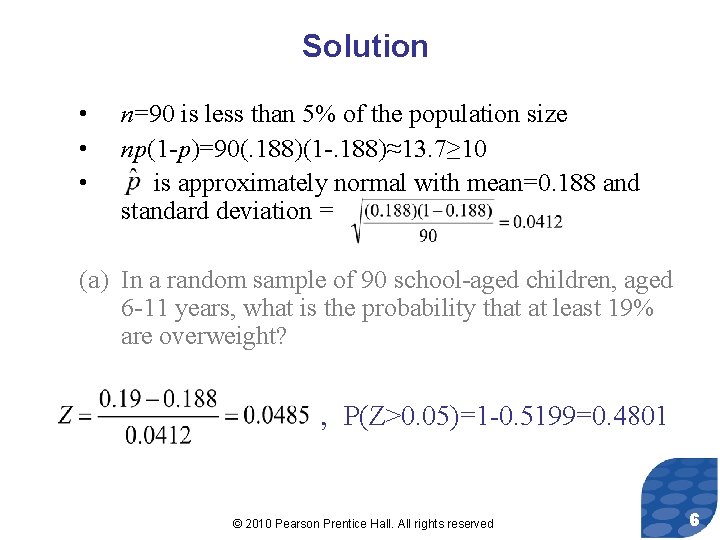
Solution • • • n=90 is less than 5% of the population size np(1 -p)=90(. 188)(1 -. 188)≈13. 7≥ 10 is approximately normal with mean=0. 188 and standard deviation = (a) In a random sample of 90 school-aged children, aged 6 -11 years, what is the probability that at least 19% are overweight? , P(Z>0. 05)=1 -0. 5199=0. 4801 © 2010 Pearson Prentice Hall. All rights reserved 6
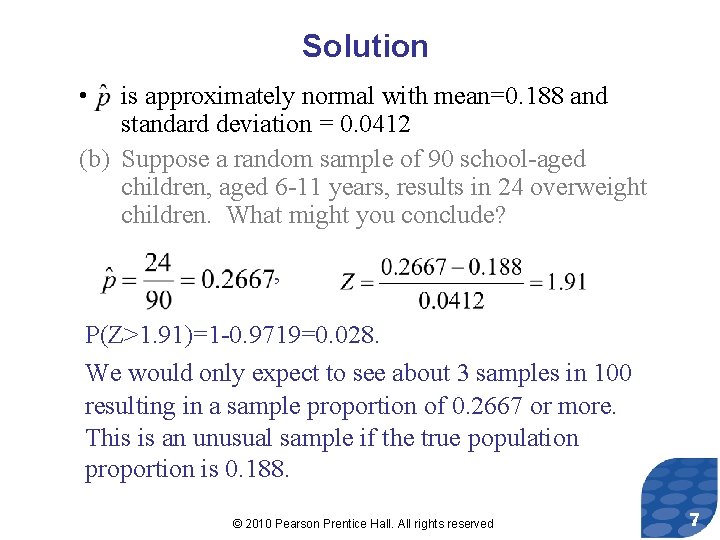
Solution • is approximately normal with mean=0. 188 and standard deviation = 0. 0412 (b) Suppose a random sample of 90 school-aged children, aged 6 -11 years, results in 24 overweight children. What might you conclude? , P(Z>1. 91)=1 -0. 9719=0. 028. We would only expect to see about 3 samples in 100 resulting in a sample proportion of 0. 2667 or more. This is an unusual sample if the true population proportion is 0. 188. © 2010 Pearson Prentice Hall. All rights reserved 7
- Slides: 7