
SECTION 8 1 SEQUENCES BACK TO WORK SECTION
SECTION 8. 1 SEQUENCES
BACK TO WORK…
SECTION 8. 1 SEQUENCES • Learning Targets: – I can identify and use arithmetic and geometric sequences – I can graph a sequence – I can find the limits of sequences (arithmetic and geometric)
DEFINING A SEQUENCE A sequence an is a list of numbers written in an explicit order. If the domain is finite, then the sequence is a finite sequence. If the domain is an infinite subset of positive integers, it is an infinite sequence.
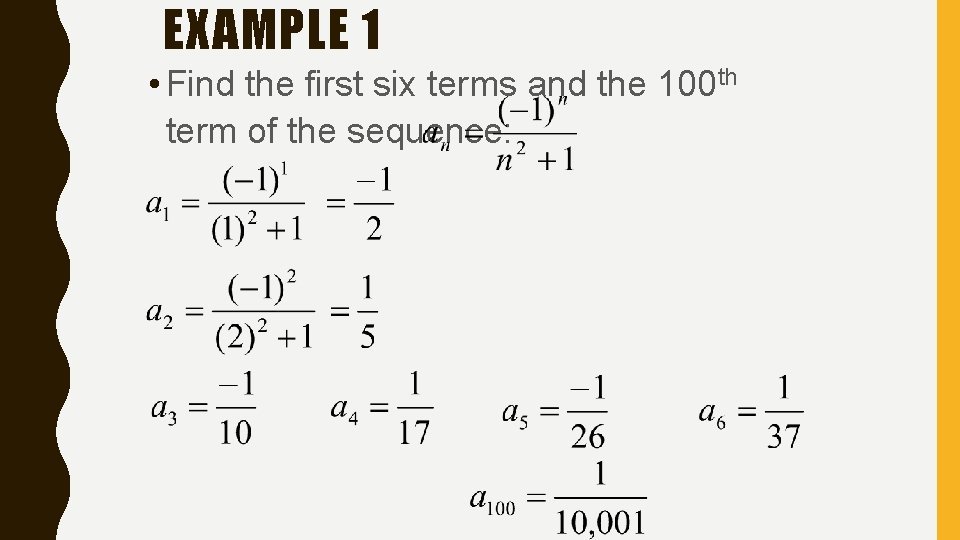
EXAMPLE 1 • Find the first six terms and the 100 th term of the sequence:
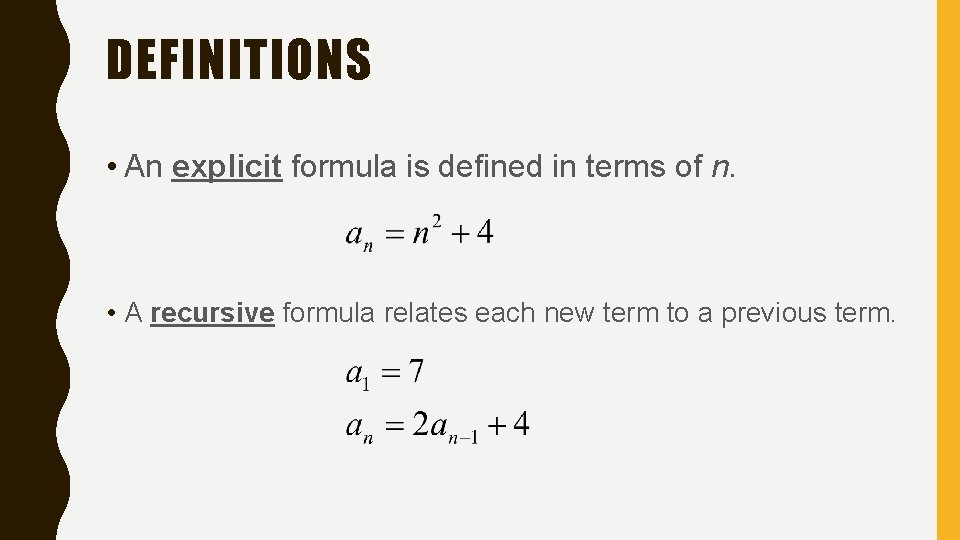
DEFINITIONS • An explicit formula is defined in terms of n. • A recursive formula relates each new term to a previous term.
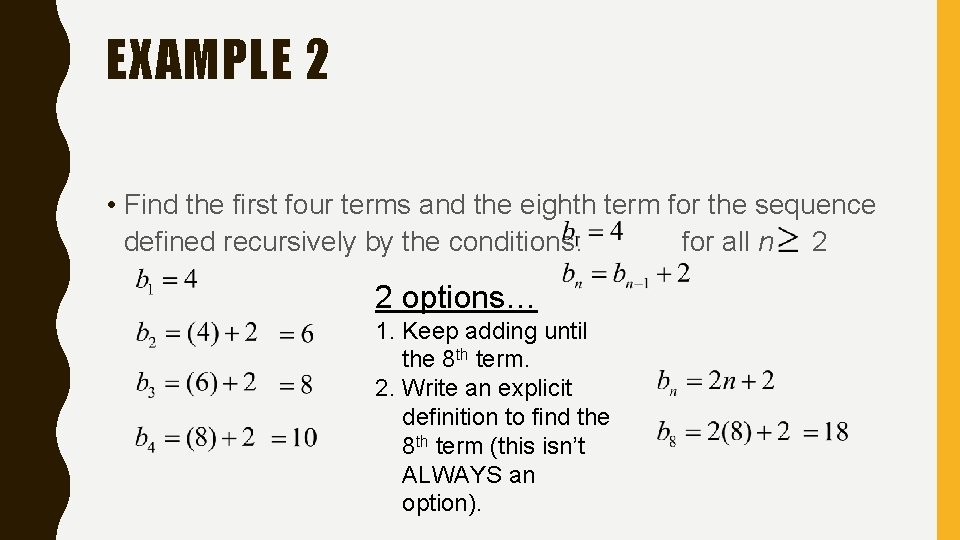
EXAMPLE 2 • Find the first four terms and the eighth term for the sequence defined recursively by the conditions: for all n 2 2 options… 1. Keep adding until the 8 th term. 2. Write an explicit definition to find the 8 th term (this isn’t ALWAYS an option).
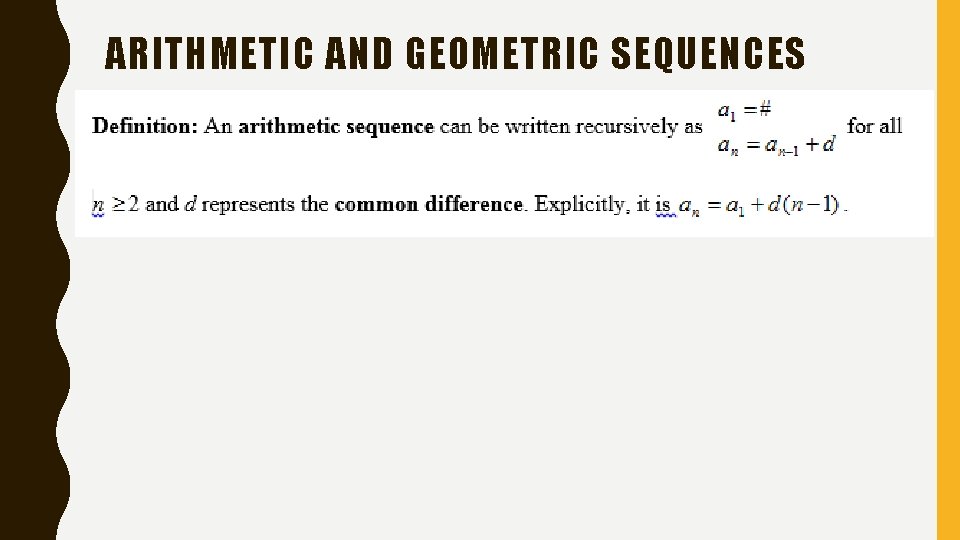
ARITHMETIC AND GEOMETRIC SEQUENCES
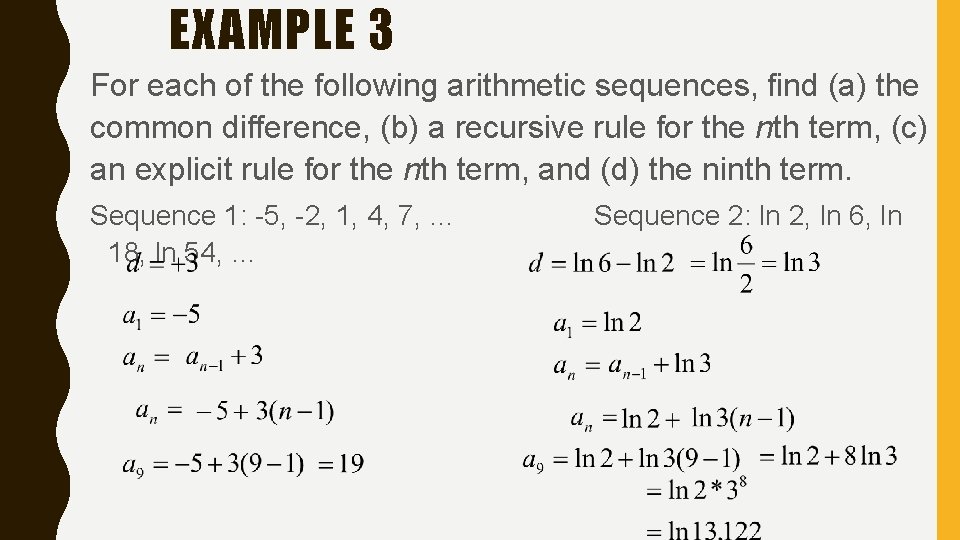
EXAMPLE 3 For each of the following arithmetic sequences, find (a) the common difference, (b) a recursive rule for the nth term, (c) an explicit rule for the nth term, and (d) the ninth term. Sequence 1: -5, -2, 1, 4, 7, … 18, ln 54, … Sequence 2: ln 2, ln 6, ln
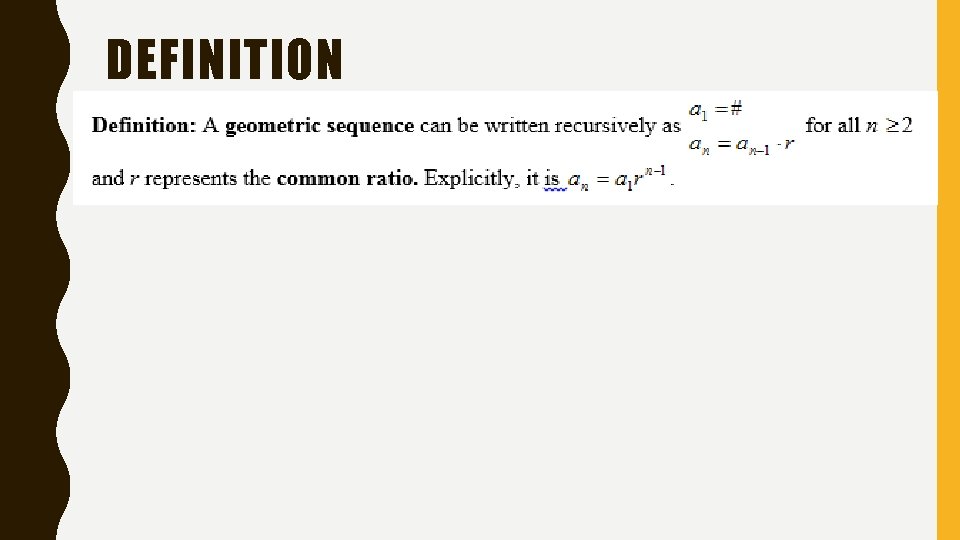
DEFINITION
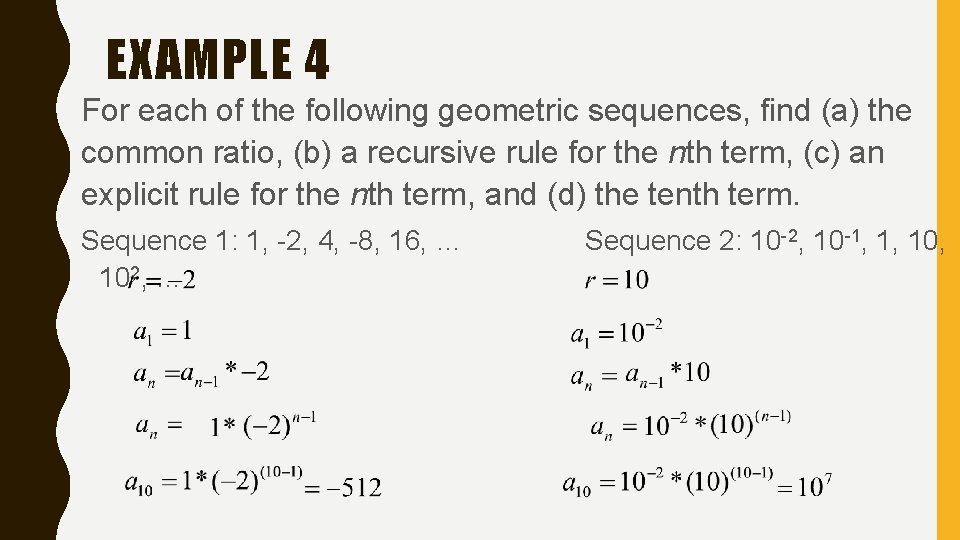
EXAMPLE 4 For each of the following geometric sequences, find (a) the common ratio, (b) a recursive rule for the nth term, (c) an explicit rule for the nth term, and (d) the tenth term. Sequence 1: 1, -2, 4, -8, 16, … 102, … Sequence 2: 10 -2, 10 -1, 1, 10,
8. 1 A HOMEWORK #5, 9, 11, 15, 19, 21

Please have your homework out so I can come around to check it off!
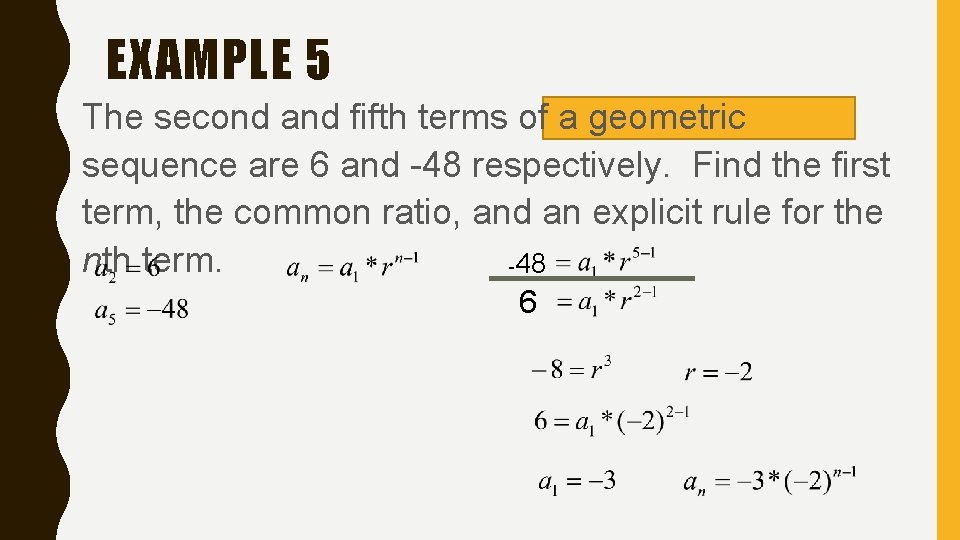
EXAMPLE 5 The second and fifth terms of a geometric sequence are 6 and -48 respectively. Find the first term, the common ratio, and an explicit rule for the nth term. -48 6
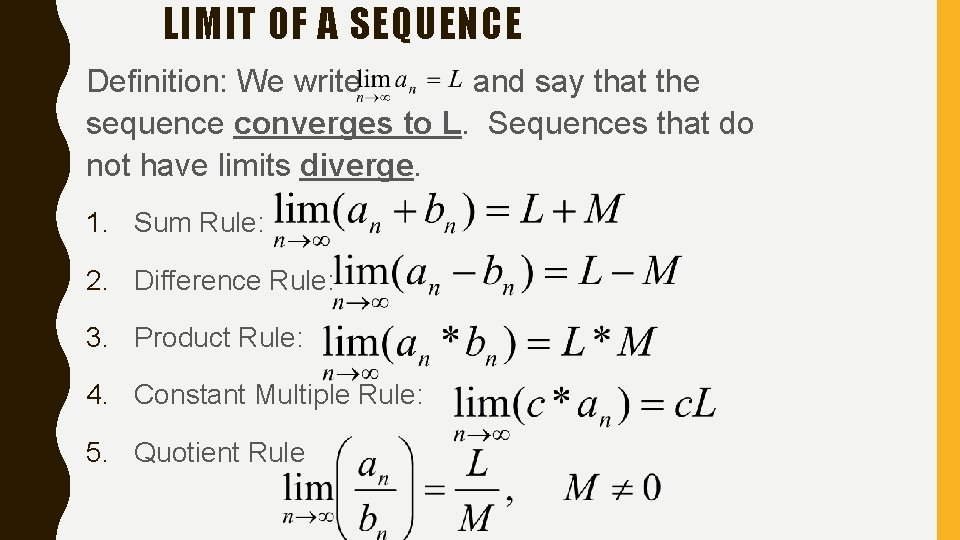
LIMIT OF A SEQUENCE Definition: We write and say that the sequence converges to L. Sequences that do not have limits diverge. 1. Sum Rule: 2. Difference Rule: 3. Product Rule: 4. Constant Multiple Rule: 5. Quotient Rule
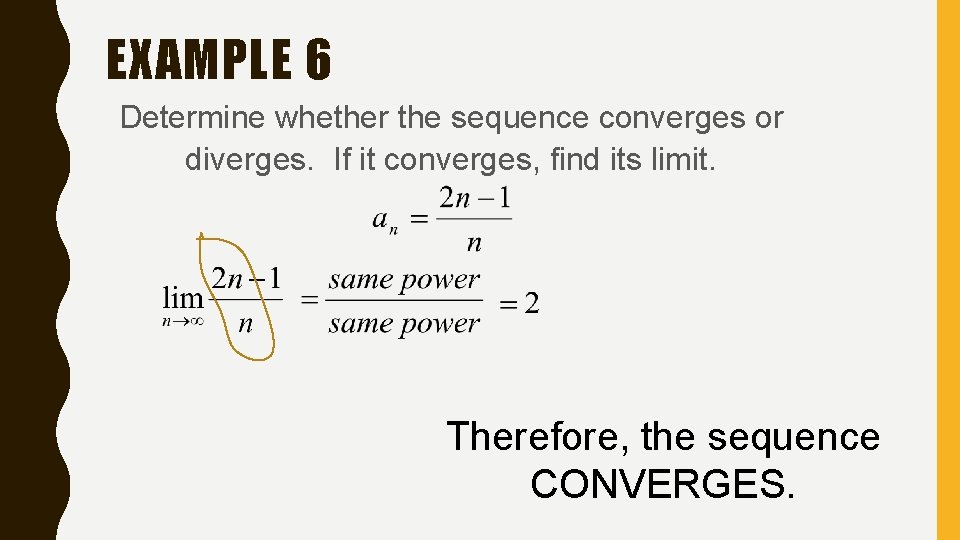
EXAMPLE 6 Determine whether the sequence converges or diverges. If it converges, find its limit. Therefore, the sequence CONVERGES.
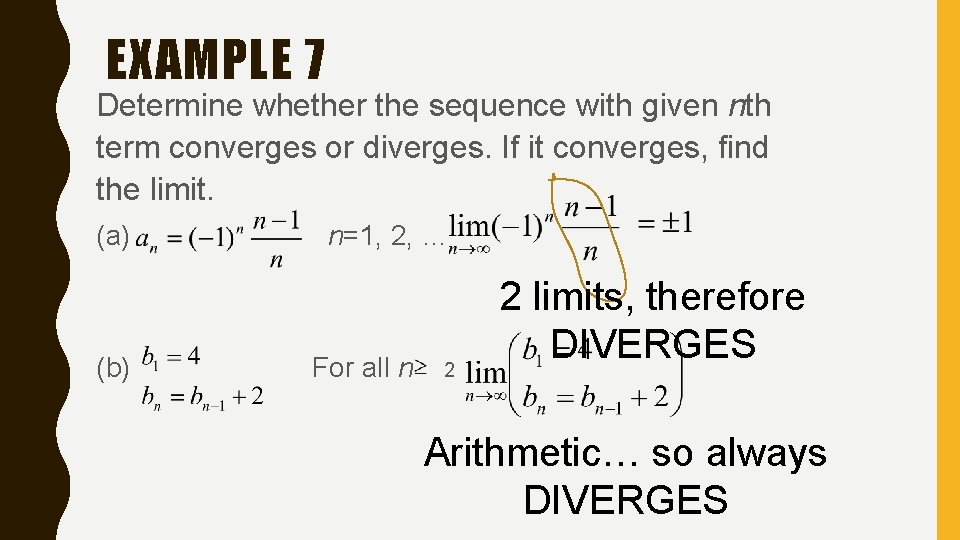
EXAMPLE 7 Determine whether the sequence with given nth term converges or diverges. If it converges, find the limit. (a) (b) n=1, 2, … For all n 2 2 limits, therefore DIVERGES Arithmetic… so always DIVERGES
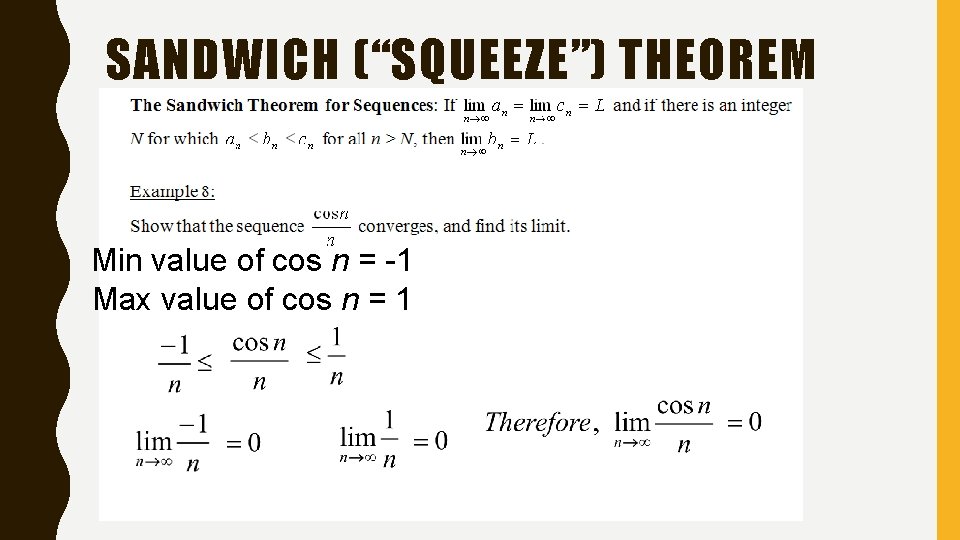
SANDWICH (“SQUEEZE”) THEOREM Min value of cos n = -1 Max value of cos n = 1
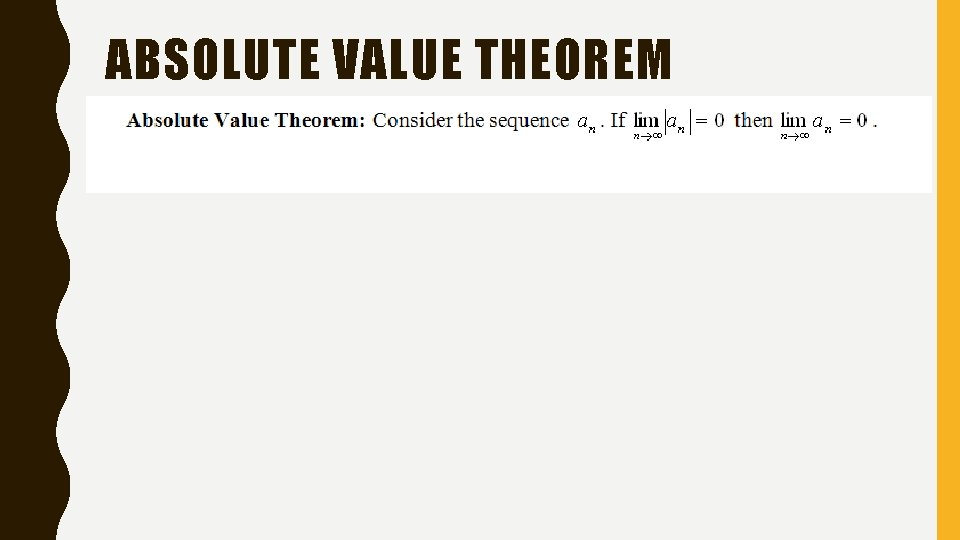
ABSOLUTE VALUE THEOREM
8. 1 B HOMEWORK #31 – 37 odd, 41, 49 - 54
- Slides: 20