
Section 7 4 Trigonometric Functions of General Angles
- Slides: 8
Section 7. 4 Trigonometric Functions of General Angles
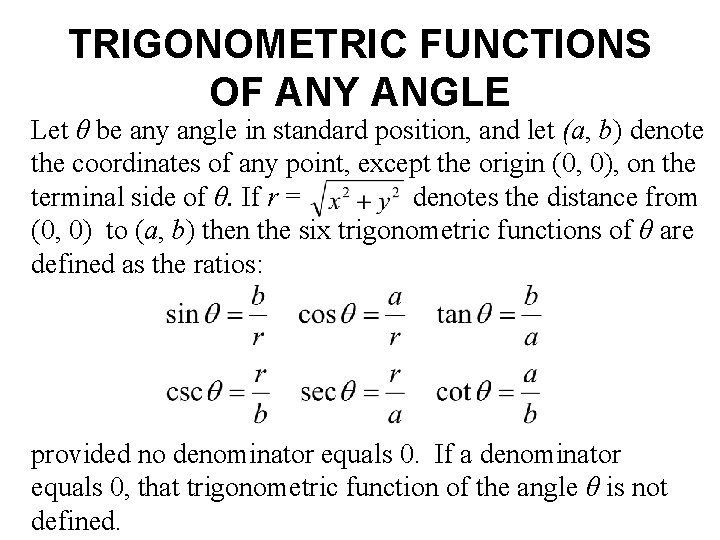
TRIGONOMETRIC FUNCTIONS OF ANY ANGLE Let θ be any angle in standard position, and let (a, b) denote the coordinates of any point, except the origin (0, 0), on the terminal side of θ. If r = denotes the distance from (0, 0) to (a, b) then the six trigonometric functions of θ are defined as the ratios: provided no denominator equals 0. If a denominator equals 0, that trigonometric function of the angle θ is not defined.
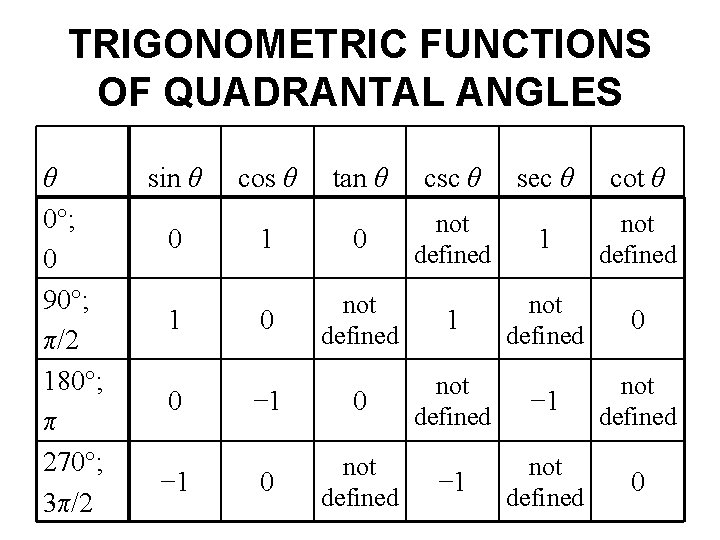
TRIGONOMETRIC FUNCTIONS OF QUADRANTAL ANGLES θ 0°; 0 90°; π/2 180°; π 270°; 3π/2 sin θ 0 1 0 − 1 cos θ tan θ csc θ sec θ cot θ not defined 1 0 not defined 1 not defined 0 0 − 1 0 not defined − 1 not defined 0
COTERMINAL ANGLES Two angles in standard position are said to be coterminal if they have the same terminal side NOTE: Coterminal angles are NOT equal, they merely stop at the same place.
COTERMINAL ANGLES AND TRIGONOMETRIC FUNCTIONS Because coterminal angles have the same terminal side, the values of the six trigonometric functions of coterminal angles are equal.
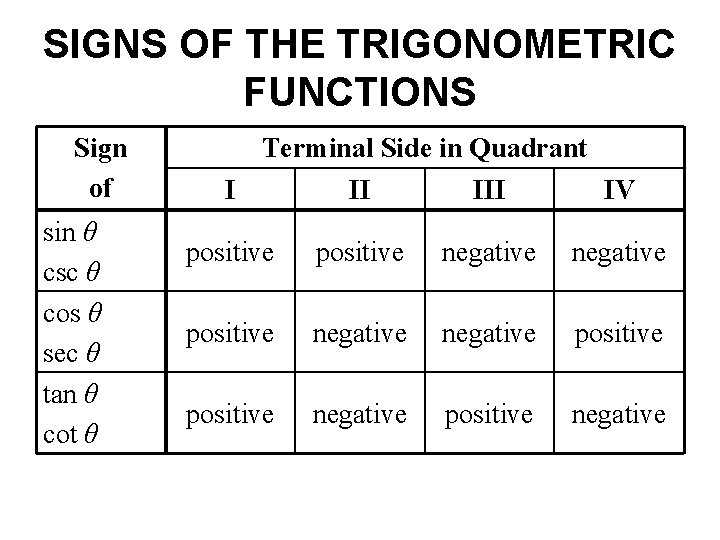
SIGNS OF THE TRIGONOMETRIC FUNCTIONS Sign of sin θ csc θ cos θ sec θ tan θ cot θ Terminal Side in Quadrant I II IV positive negative positive negative
REFERENCE ANGLES Let θ denote a nonacute angle, in standard position, that lies in a quadrant. The acute angle formed by the terminal side of θ and either the positive x-axis or the negative x-axis is called the reference angle for θ.
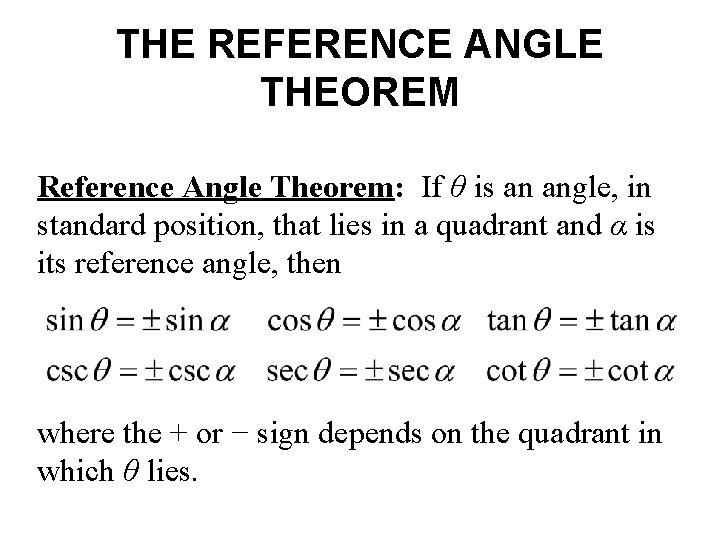
THE REFERENCE ANGLE THEOREM Reference Angle Theorem: If θ is an angle, in standard position, that lies in a quadrant and α is its reference angle, then where the + or − sign depends on the quadrant in which θ lies.