
Section 7 1 Introduction to Hypothesis Testing A
- Slides: 15
Section 7. 1 Introduction to Hypothesis Testing
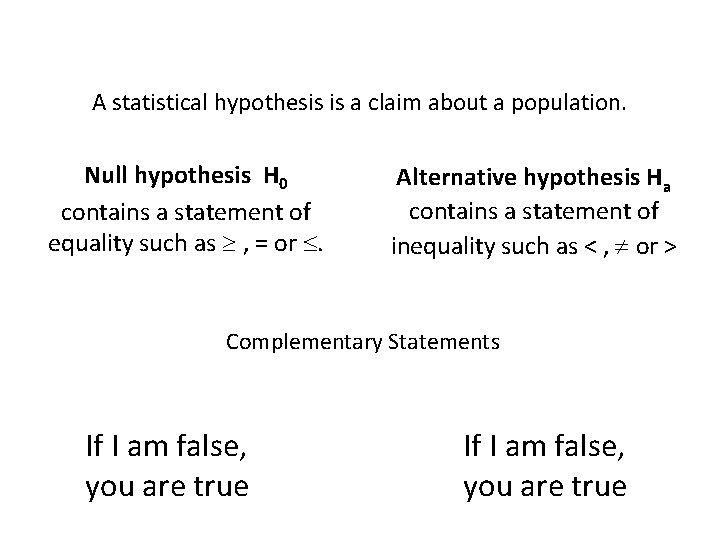
A statistical hypothesis is a claim about a population. Null hypothesis H 0 contains a statement of equality such as ³ , = or £. Alternative hypothesis Ha contains a statement of inequality such as < , ¹ or > Complementary Statements If I am false, you are true
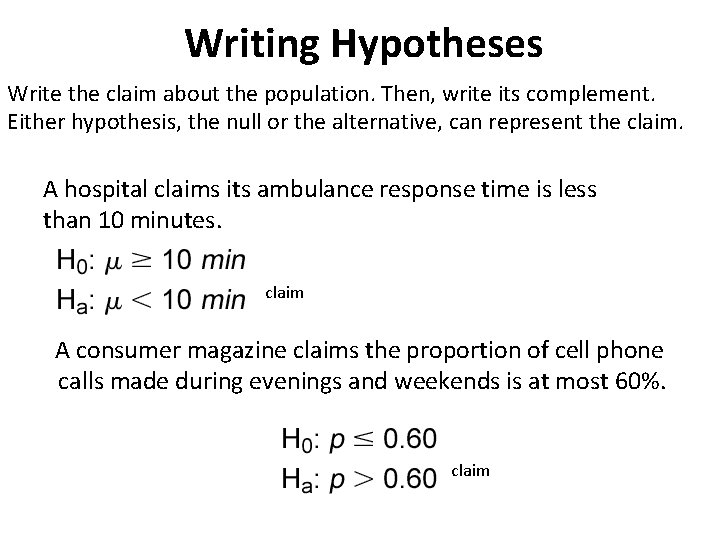
Writing Hypotheses Write the claim about the population. Then, write its complement. Either hypothesis, the null or the alternative, can represent the claim. A hospital claims its ambulance response time is less than 10 minutes. claim A consumer magazine claims the proportion of cell phone calls made during evenings and weekends is at most 60%. claim
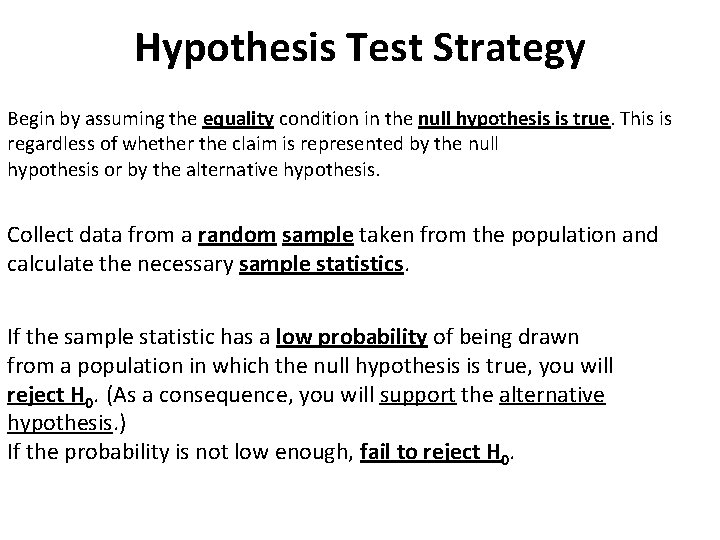
Hypothesis Test Strategy Begin by assuming the equality condition in the null hypothesis is true. This is regardless of whether the claim is represented by the null hypothesis or by the alternative hypothesis. Collect data from a random sample taken from the population and calculate the necessary sample statistics. If the sample statistic has a low probability of being drawn from a population in which the null hypothesis is true, you will reject H 0. (As a consequence, you will support the alternative hypothesis. ) If the probability is not low enough, fail to reject H 0.
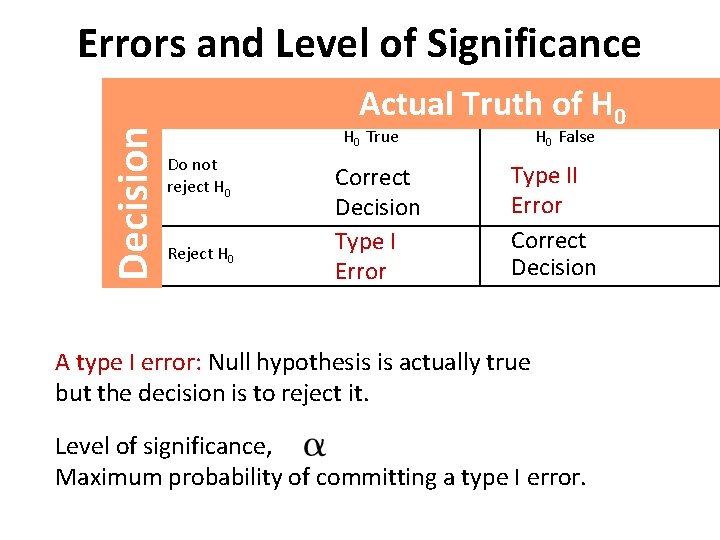
Decision Errors and Level of Significance Actual Truth of H 0 True Do not reject H 0 Reject H 0 Correct Decision Type I Error H 0 False Type II Error Correct Decision A type I error: Null hypothesis is actually true but the decision is to reject it. Level of significance, Maximum probability of committing a type I error.
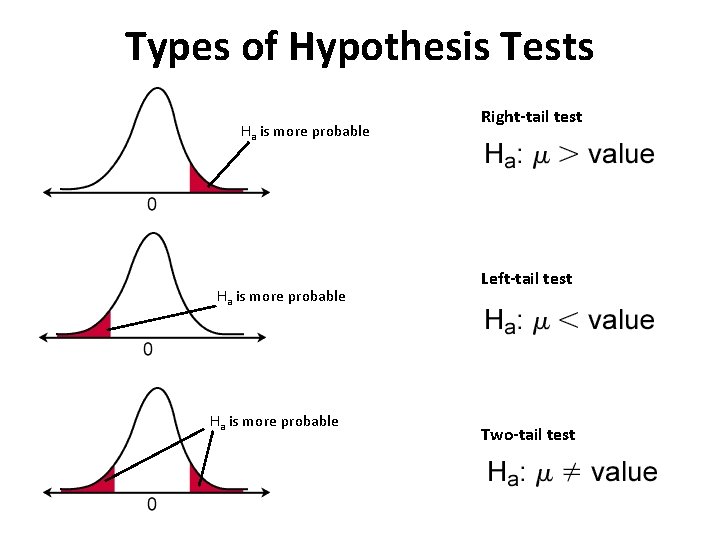
Types of Hypothesis Tests Ha is more probable Right-tail test Left-tail test Two-tail test
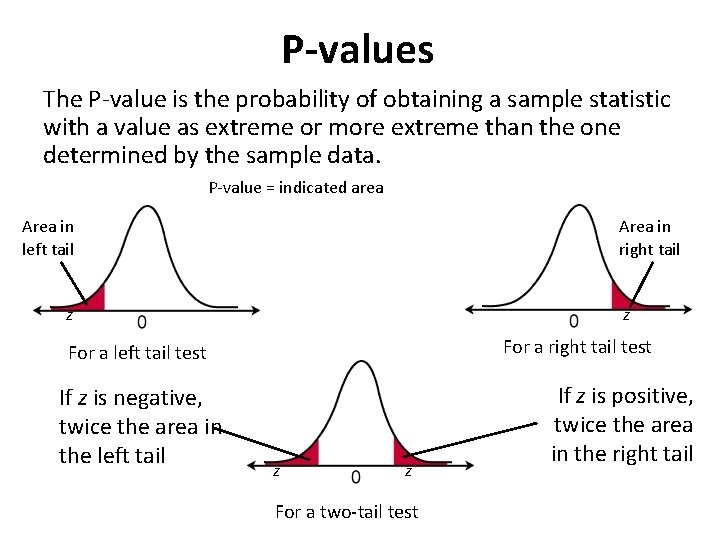
P-values The P-value is the probability of obtaining a sample statistic with a value as extreme or more extreme than the one determined by the sample data. P-value = indicated area Area in left tail Area in right tail z z For a right tail test For a left tail test If z is negative, twice the area in the left tail z z For a two-tail test If z is positive, twice the area in the right tail
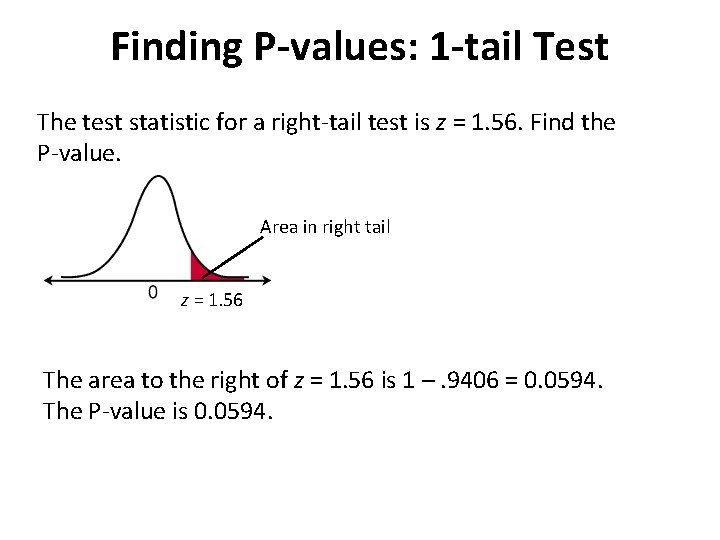
Finding P-values: 1 -tail Test The test statistic for a right-tail test is z = 1. 56. Find the P-value. Area in right tail z = 1. 56 The area to the right of z = 1. 56 is 1 –. 9406 = 0. 0594. The P-value is 0. 0594.
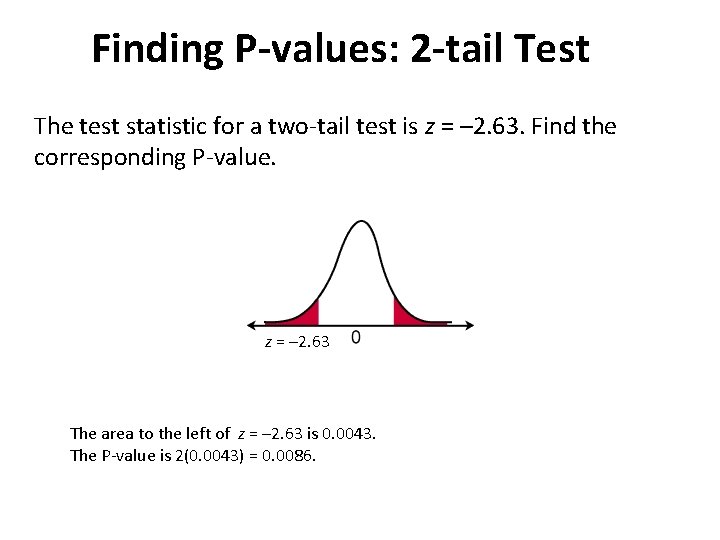
Finding P-values: 2 -tail Test The test statistic for a two-tail test is z = – 2. 63. Find the corresponding P-value. z = – 2. 63 The area to the left of z = – 2. 63 is 0. 0043. The P-value is 2(0. 0043) = 0. 0086.
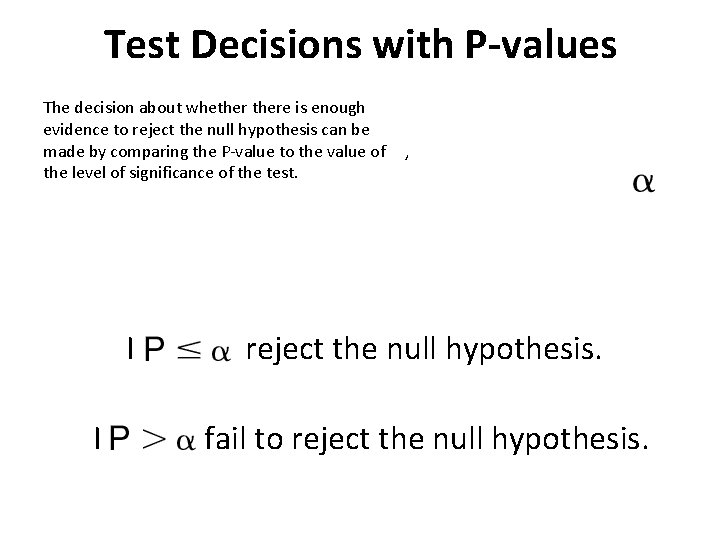
Test Decisions with P-values The decision about whethere is enough evidence to reject the null hypothesis can be made by comparing the P-value to the value of the level of significance of the test. If If , reject the null hypothesis. fail to reject the null hypothesis.
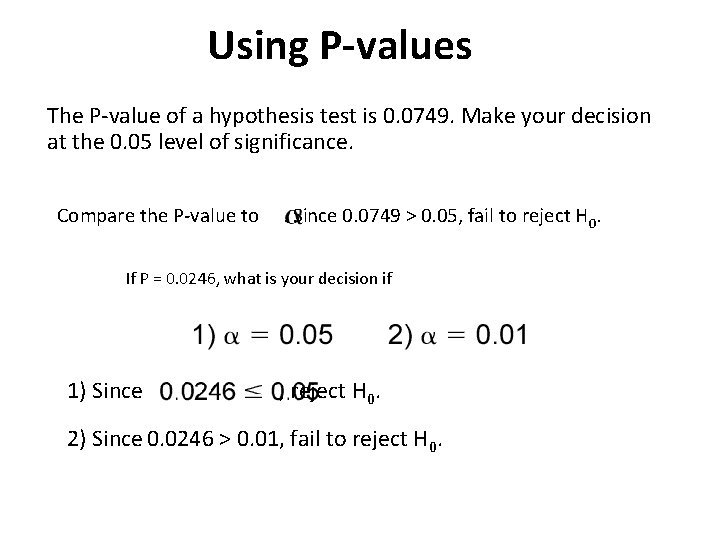
Using P-values The P-value of a hypothesis test is 0. 0749. Make your decision at the 0. 05 level of significance. Compare the P-value to . Since 0. 0749 > 0. 05, fail to reject H 0. If P = 0. 0246, what is your decision if 1) Since , reject H 0. 2) Since 0. 0246 > 0. 01, fail to reject H 0.
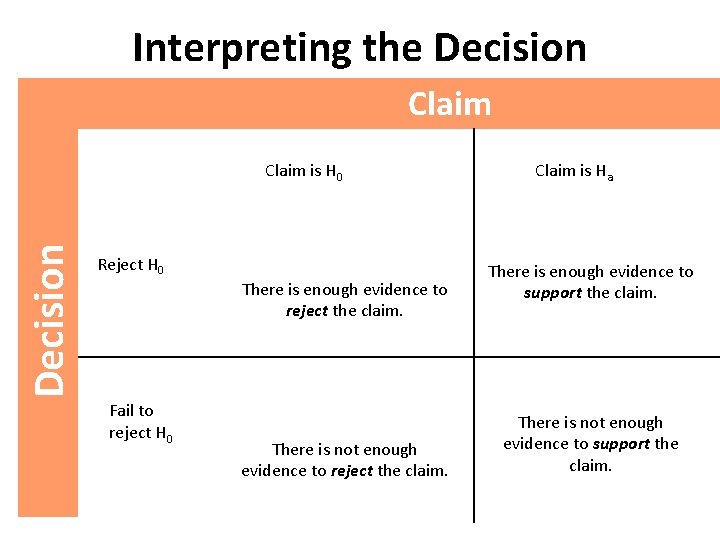
Interpreting the Decision Claim is H 0 Reject H 0 Fail to reject H 0 There is enough evidence to reject the claim. There is not enough evidence to reject the claim. Claim is Ha There is enough evidence to support the claim. There is not enough evidence to support the claim.
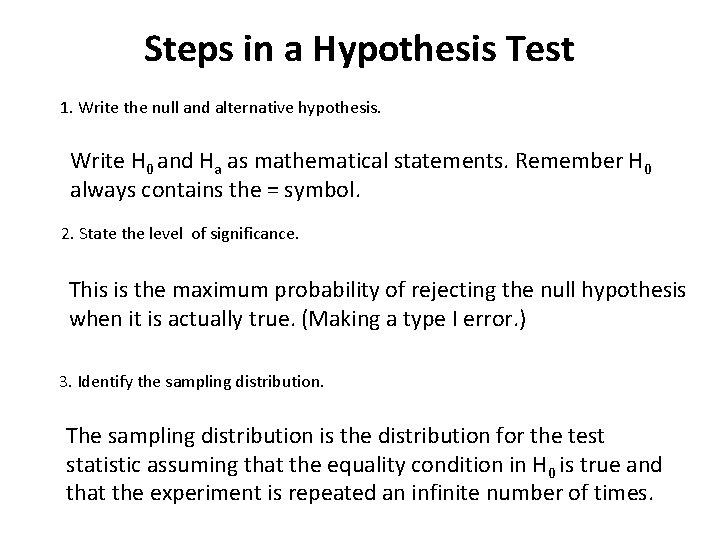
Steps in a Hypothesis Test 1. Write the null and alternative hypothesis. Write H 0 and Ha as mathematical statements. Remember H 0 always contains the = symbol. 2. State the level of significance. This is the maximum probability of rejecting the null hypothesis when it is actually true. (Making a type I error. ) 3. Identify the sampling distribution. The sampling distribution is the distribution for the test statistic assuming that the equality condition in H 0 is true and that the experiment is repeated an infinite number of times.
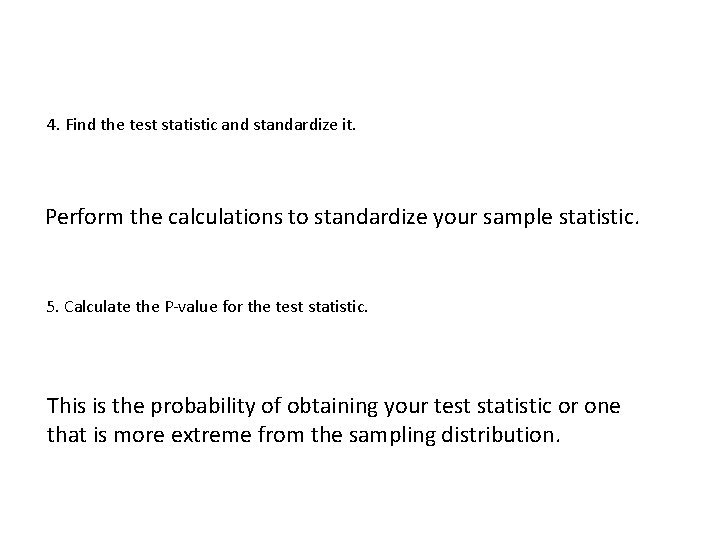
4. Find the test statistic and standardize it. Perform the calculations to standardize your sample statistic. 5. Calculate the P-value for the test statistic. This is the probability of obtaining your test statistic or one that is more extreme from the sampling distribution.
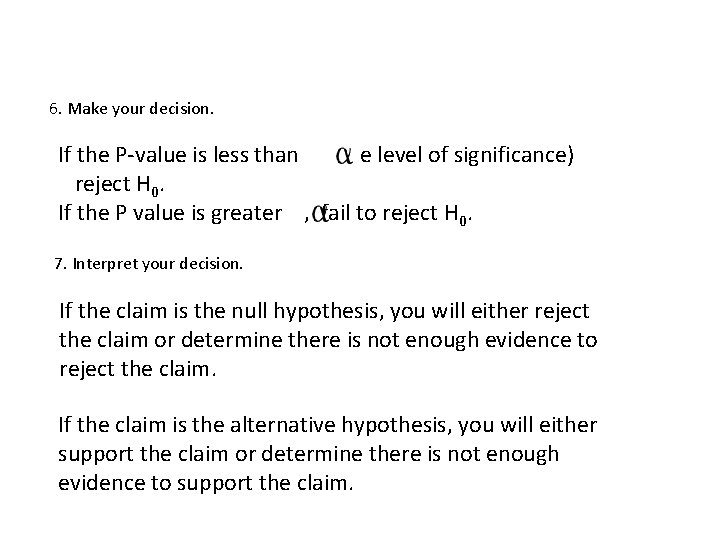
6. Make your decision. If the P-value is less than (the level of significance) reject H 0. If the P value is greater , fail to reject H 0. 7. Interpret your decision. If the claim is the null hypothesis, you will either reject the claim or determine there is not enough evidence to reject the claim. If the claim is the alternative hypothesis, you will either support the claim or determine there is not enough evidence to support the claim.