
Section 7 1 Fundamental Identities and Their Uses



- Slides: 25
Section 7. 1 Fundamental Identities and Their Uses Copyright © by Hawkes Learning All rights reserved.
Topics o o Previously encountered identities Simplifying trigonometric expressions Verifying trigonometric identities Trigonometric substitutions Copyright © by Hawkes Learning All rights reserved.
Previously Encountered Identities Already Seen Reciprocal Identities Quotient Identities Copyright © by Hawkes Learning All rights reserved.
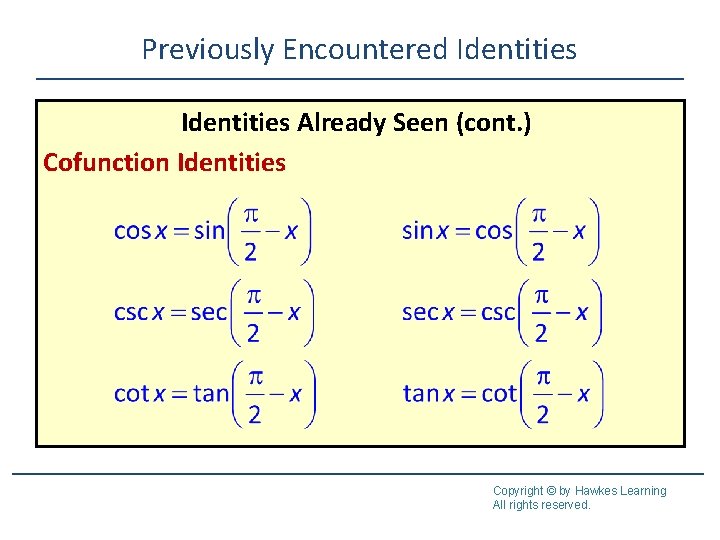
Previously Encountered Identities Already Seen (cont. ) Cofunction Identities Copyright © by Hawkes Learning All rights reserved.
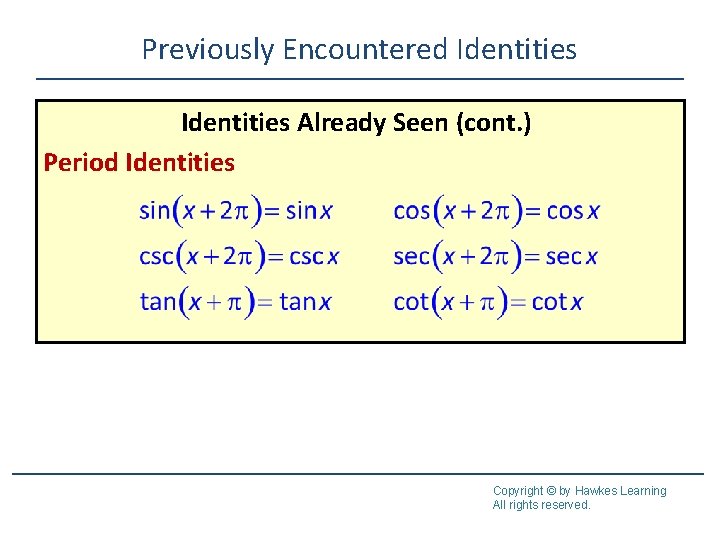
Previously Encountered Identities Already Seen (cont. ) Period Identities Copyright © by Hawkes Learning All rights reserved.
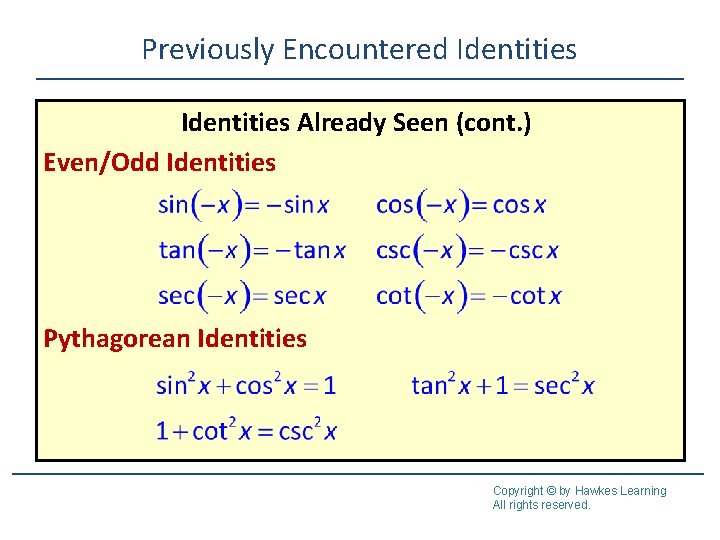
Previously Encountered Identities Already Seen (cont. ) Even/Odd Identities Pythagorean Identities Copyright © by Hawkes Learning All rights reserved.
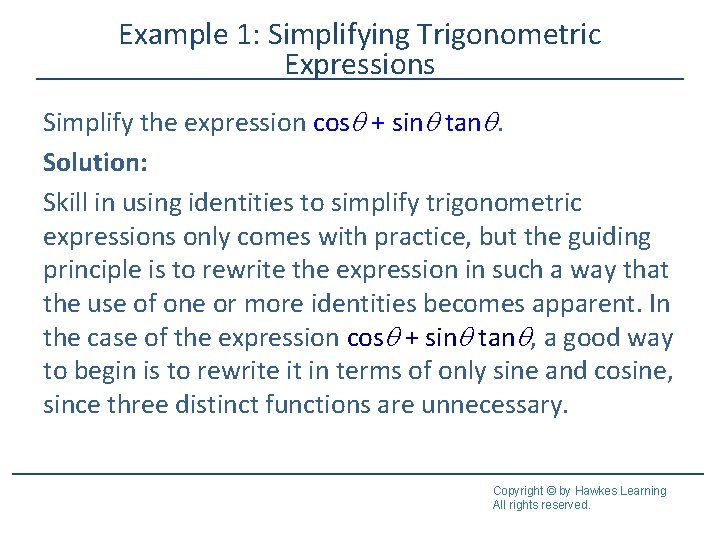
Example 1: Simplifying Trigonometric Expressions Simplify the expression cos + sin tan. Solution: Skill in using identities to simplify trigonometric expressions only comes with practice, but the guiding principle is to rewrite the expression in such a way that the use of one or more identities becomes apparent. In the case of the expression cos + sin tan , a good way to begin is to rewrite it in terms of only sine and cosine, since three distinct functions are unnecessary. Copyright © by Hawkes Learning All rights reserved.
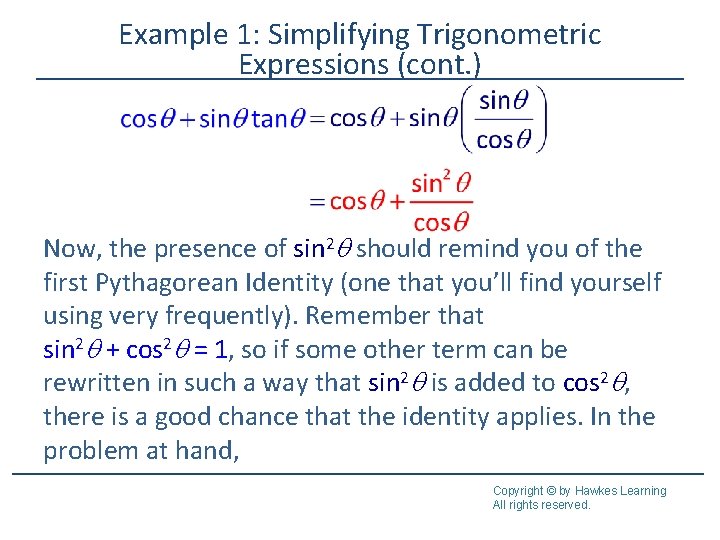
Example 1: Simplifying Trigonometric Expressions (cont. ) Now, the presence of sin 2 should remind you of the first Pythagorean Identity (one that you’ll find yourself using very frequently). Remember that sin 2 + cos 2 = 1, so if some other term can be rewritten in such a way that sin 2 is added to cos 2 , there is a good chance that the identity applies. In the problem at hand, Copyright © by Hawkes Learning All rights reserved.
Example 1: Simplifying Trigonometric Expressions (cont. ) Copyright © by Hawkes Learning All rights reserved.
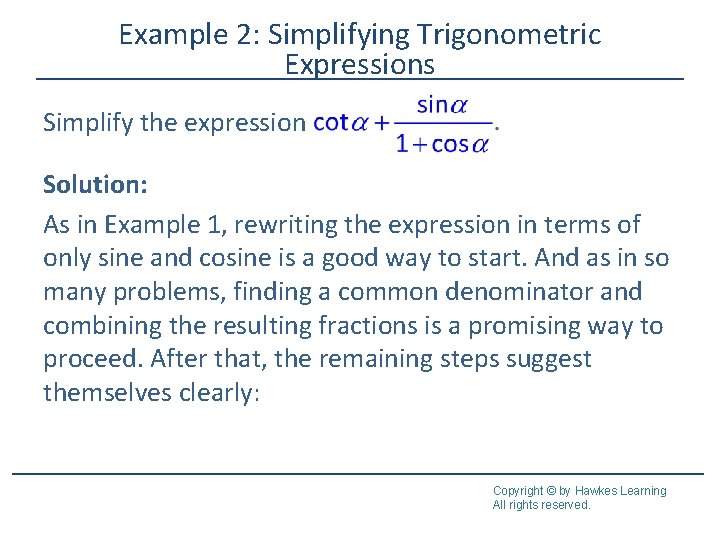
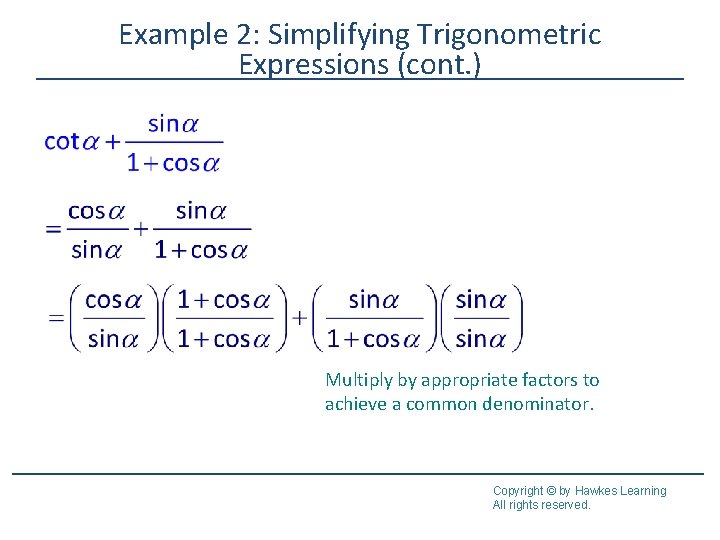
Example 2: Simplifying Trigonometric Expressions Simplify the expression Solution: As in Example 1, rewriting the expression in terms of only sine and cosine is a good way to start. And as in so many problems, finding a common denominator and combining the resulting fractions is a promising way to proceed. After that, the remaining steps suggest themselves clearly: Copyright © by Hawkes Learning All rights reserved.
Example 2: Simplifying Trigonometric Expressions (cont. ) Multiply by appropriate factors to achieve a common denominator. Copyright © by Hawkes Learning All rights reserved.
Example 2: Simplifying Trigonometric Expressions (cont. ) Apply the first Pythagorean Identity. Cancel the common factors. Copyright © by Hawkes Learning All rights reserved.
Verifying Trigonometric Identities Guidelines for Verifying Trigonometric Identities 1. Work with one side at a time. Choose one side of the equation to work with and simplify it. The more complicated side is usually the best choice. The goal is to transform it into the other side. 2. Apply trigonometric identities as appropriate. To do so, it will probably be necessary to combine fractions, add or subtract terms, factor expressions, or use other algebraic manipulations. Copyright © by Hawkes Learning All rights reserved.
Verifying Trigonometric Identities Guidelines for Verifying Trigonometric Identities (cont. ) 3. Rewrite in terms of sine and cosine if necessary. If you are stuck, expressing everything in terms of sine and cosine often leads to inspiration. Copyright © by Hawkes Learning All rights reserved.
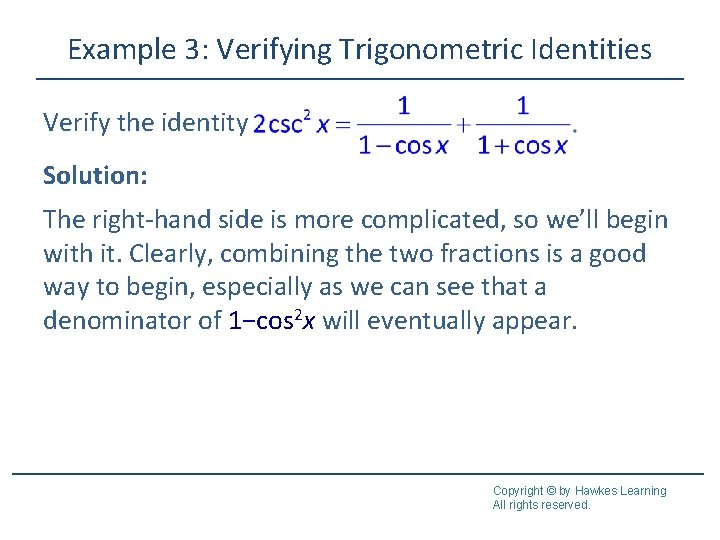
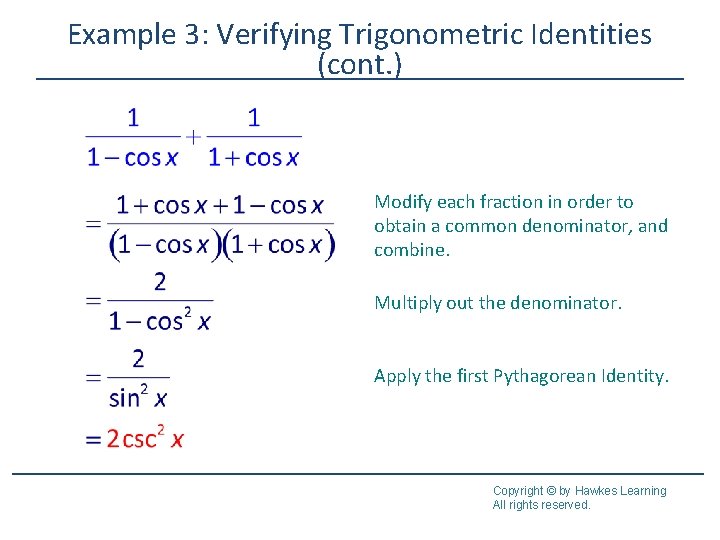
Example 3: Verifying Trigonometric Identities Verify the identity Solution: The right-hand side is more complicated, so we’ll begin with it. Clearly, combining the two fractions is a good way to begin, especially as we can see that a denominator of 1−cos 2 x will eventually appear. Copyright © by Hawkes Learning All rights reserved.
Example 3: Verifying Trigonometric Identities (cont. ) Modify each fraction in order to obtain a common denominator, and combine. Multiply out the denominator. Apply the first Pythagorean Identity. Copyright © by Hawkes Learning All rights reserved.
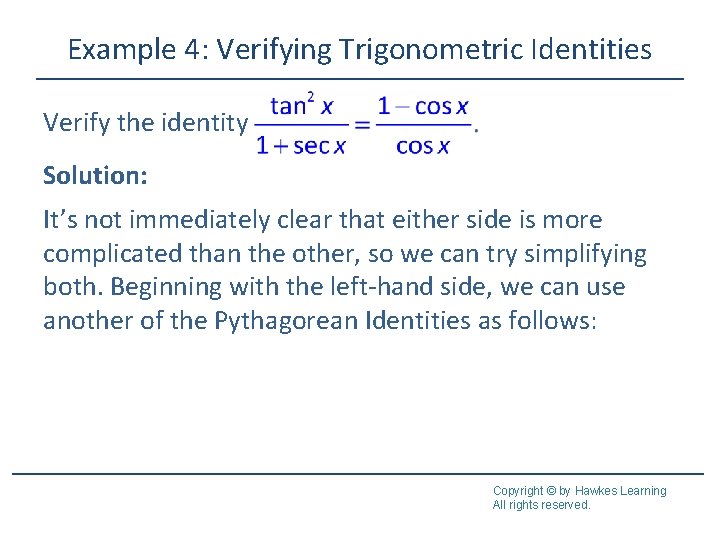
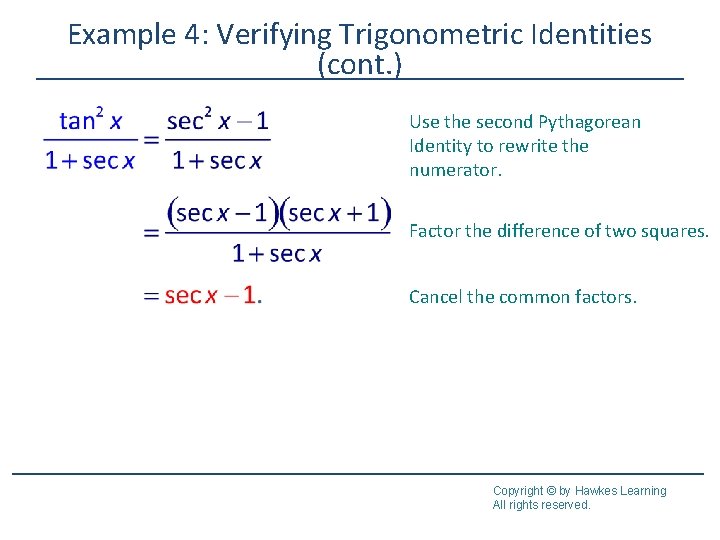
Example 4: Verifying Trigonometric Identities Verify the identity Solution: It’s not immediately clear that either side is more complicated than the other, so we can try simplifying both. Beginning with the left-hand side, we can use another of the Pythagorean Identities as follows: Copyright © by Hawkes Learning All rights reserved.
Example 4: Verifying Trigonometric Identities (cont. ) Use the second Pythagorean Identity to rewrite the numerator. Factor the difference of two squares. Cancel the common factors. Copyright © by Hawkes Learning All rights reserved.
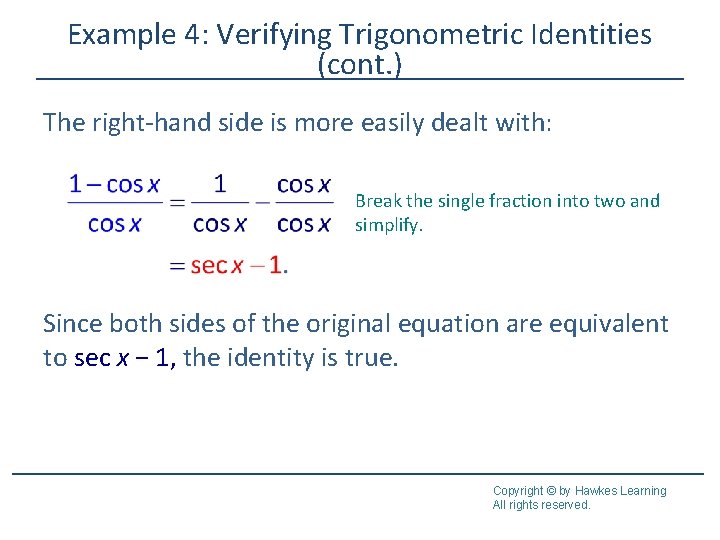
Example 4: Verifying Trigonometric Identities (cont. ) The right-hand side is more easily dealt with: Break the single fraction into two and simplify. Since both sides of the original equation are equivalent to sec x − 1, the identity is true. Copyright © by Hawkes Learning All rights reserved.
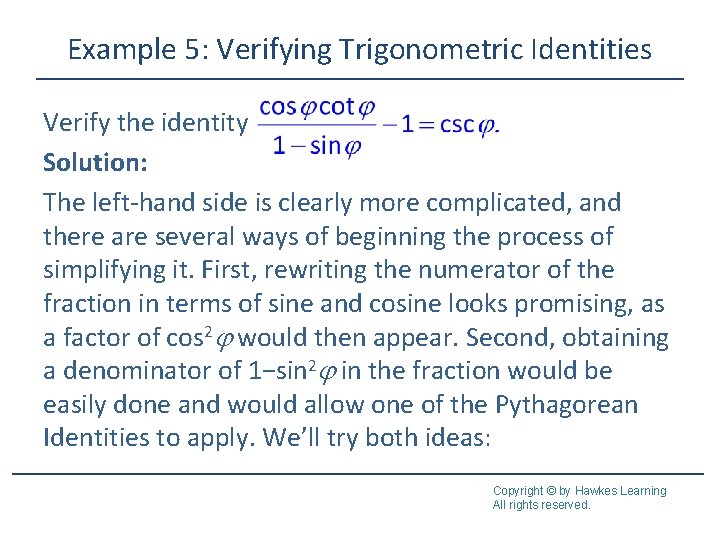
Example 5: Verifying Trigonometric Identities Verify the identity Solution: The left-hand side is clearly more complicated, and there are several ways of beginning the process of simplifying it. First, rewriting the numerator of the fraction in terms of sine and cosine looks promising, as a factor of cos 2 would then appear. Second, obtaining a denominator of 1−sin 2 in the fraction would be easily done and would allow one of the Pythagorean Identities to apply. We’ll try both ideas: Copyright © by Hawkes Learning All rights reserved.
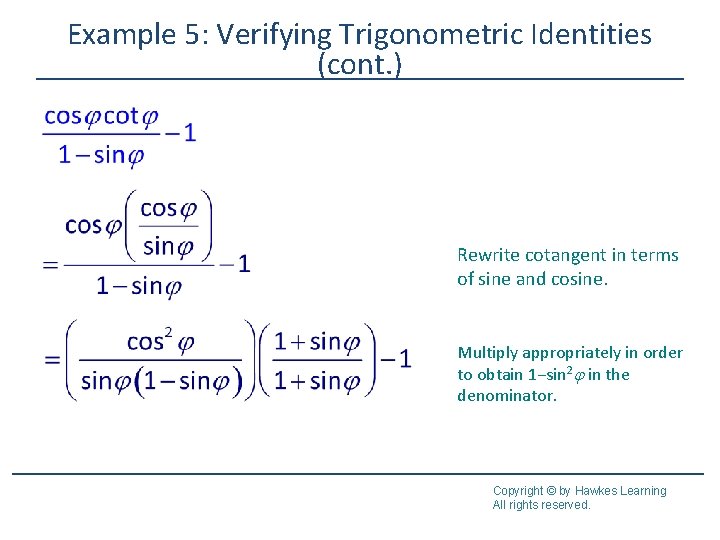
Example 5: Verifying Trigonometric Identities (cont. ) Rewrite cotangent in terms of sine and cosine. Multiply appropriately in order to obtain 1−sin 2 in the denominator. Copyright © by Hawkes Learning All rights reserved.
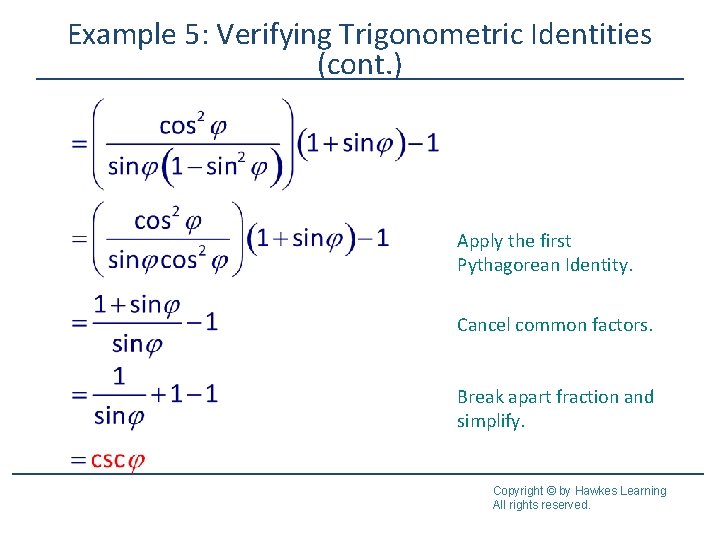
Example 5: Verifying Trigonometric Identities (cont. ) Apply the first Pythagorean Identity. Cancel common factors. Break apart fraction and simplify. Copyright © by Hawkes Learning All rights reserved.
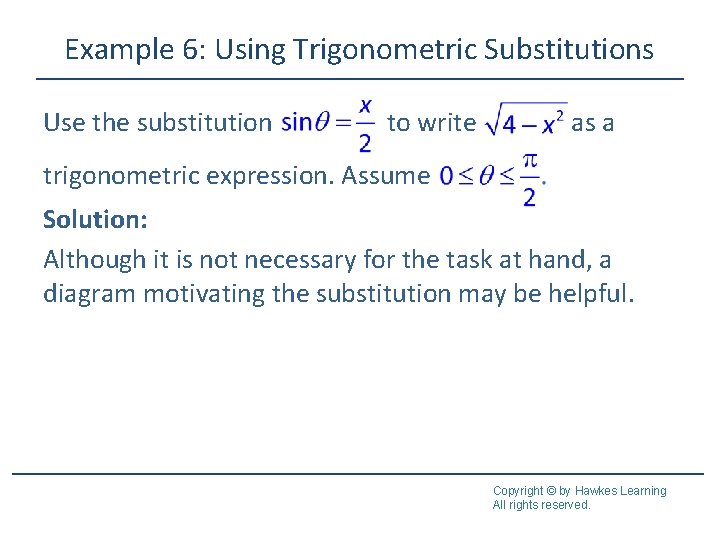
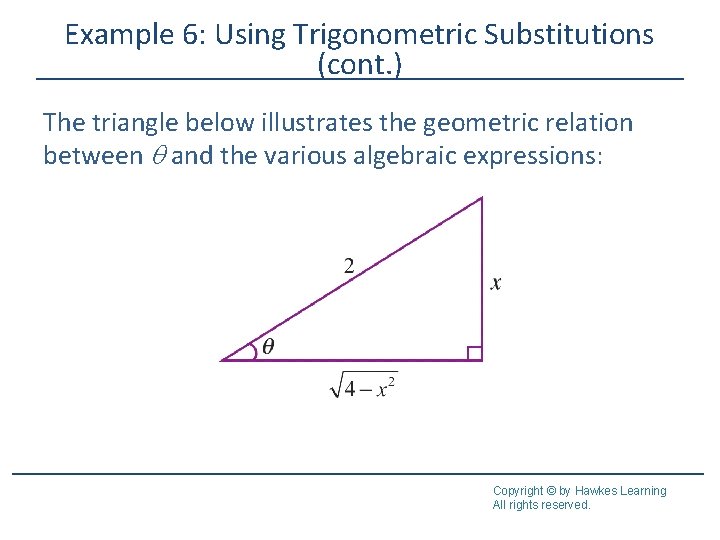
Example 6: Using Trigonometric Substitutions Use the substitution to write as a trigonometric expression. Assume Solution: Although it is not necessary for the task at hand, a diagram motivating the substitution may be helpful. Copyright © by Hawkes Learning All rights reserved.
Example 6: Using Trigonometric Substitutions (cont. ) The triangle below illustrates the geometric relation between and the various algebraic expressions: Copyright © by Hawkes Learning All rights reserved.
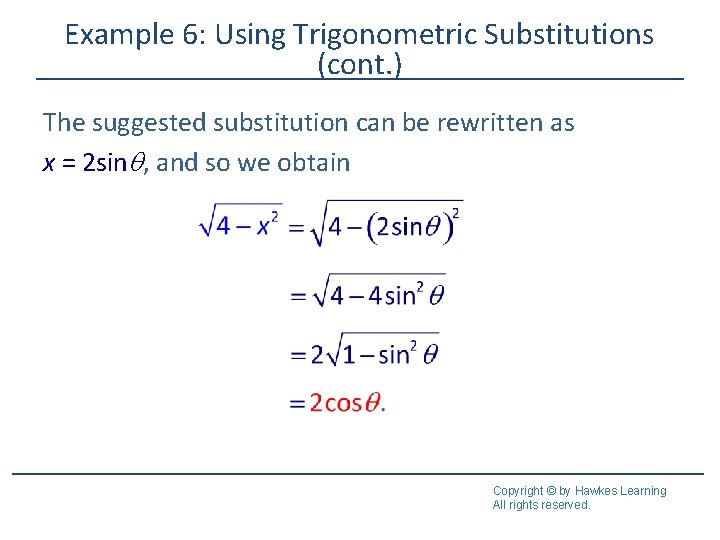
Example 6: Using Trigonometric Substitutions (cont. ) The suggested substitution can be rewritten as x = 2 sin , and so we obtain Copyright © by Hawkes Learning All rights reserved.