
Section 6 3 Orthonormal Bases GramSchmidt Process QRDecomposition
Section 6. 3 Orthonormal Bases; Gram-Schmidt Process; QR-Decomposition
ORTHONORMAL SETS OF VECTORS A set of vectors in an inner product space is called an orthogonal set if all pairs of distinct vectors in the set are orthogonal. An orthogonal set in which each vector has norm 1 is called orthonormal.
ORTHOGONAL AND ORTHONORMAL BASES • In an inner product space, a basis consisting of orthogonal vectors is called an orthogonal basis. • In an inner product space, a basis consisting of orthonormal vectors is called an orthonormal basis.
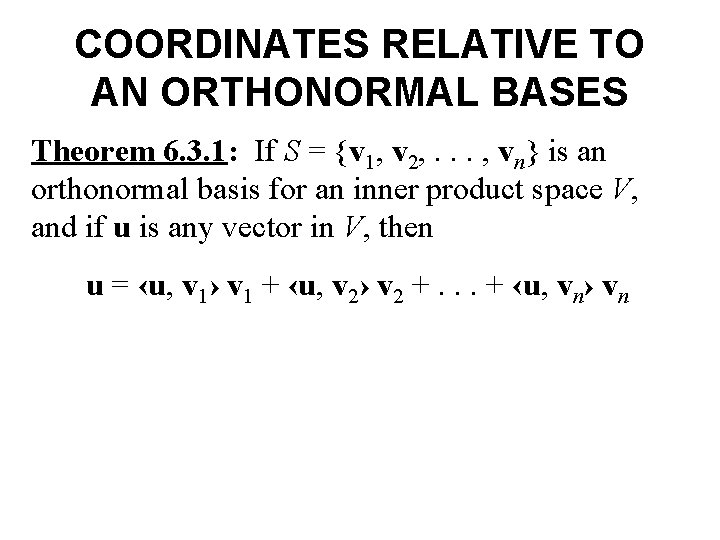
COORDINATES RELATIVE TO AN ORTHONORMAL BASES Theorem 6. 3. 1: If S = {v 1, v 2, . . . , vn} is an orthonormal basis for an inner product space V, and if u is any vector in V, then u = ‹u, v 1› v 1 + ‹u, v 2› v 2 +. . . + ‹u, vn› vn
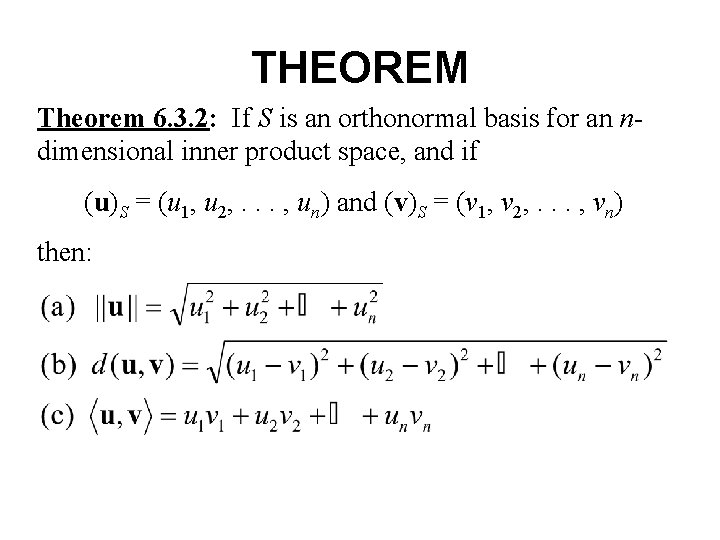
THEOREM Theorem 6. 3. 2: If S is an orthonormal basis for an ndimensional inner product space, and if (u)S = (u 1, u 2, . . . , un) and (v)S = (v 1, v 2, . . . , vn) then:
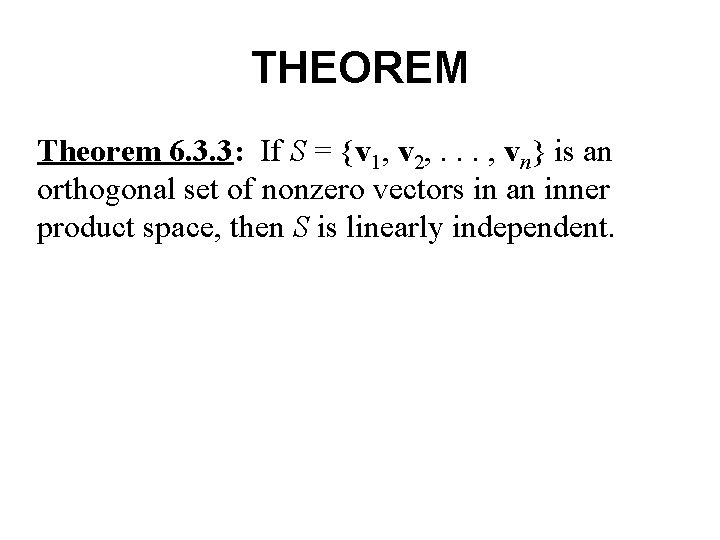
THEOREM Theorem 6. 3. 3: If S = {v 1, v 2, . . . , vn} is an orthogonal set of nonzero vectors in an inner product space, then S is linearly independent.
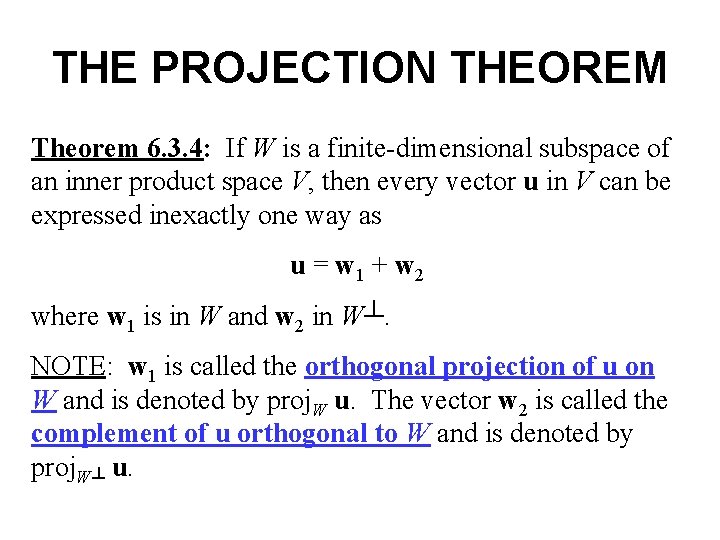
THE PROJECTION THEOREM Theorem 6. 3. 4: If W is a finite-dimensional subspace of an inner product space V, then every vector u in V can be expressed inexactly one way as u = w 1 + w 2 where w 1 is in W and w 2 in W┴. NOTE: w 1 is called the orthogonal projection of u on W and is denoted by proj. W u. The vector w 2 is called the complement of u orthogonal to W and is denoted by proj. W┴ u.
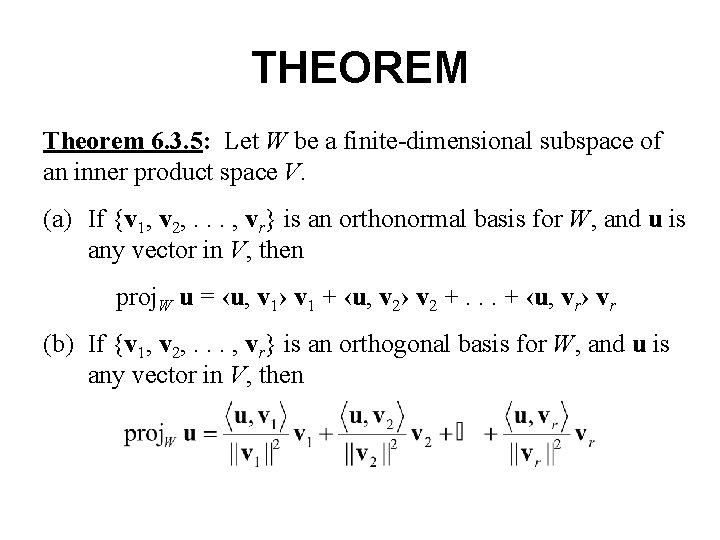
THEOREM Theorem 6. 3. 5: Let W be a finite-dimensional subspace of an inner product space V. (a) If {v 1, v 2, . . . , vr} is an orthonormal basis for W, and u is any vector in V, then proj. W u = ‹u, v 1› v 1 + ‹u, v 2› v 2 +. . . + ‹u, vr› vr (b) If {v 1, v 2, . . . , vr} is an orthogonal basis for W, and u is any vector in V, then
THEOREM Theorem 6. 3. 6: Every nonzero finite-dimensional inner product space has an orthonormal basis.
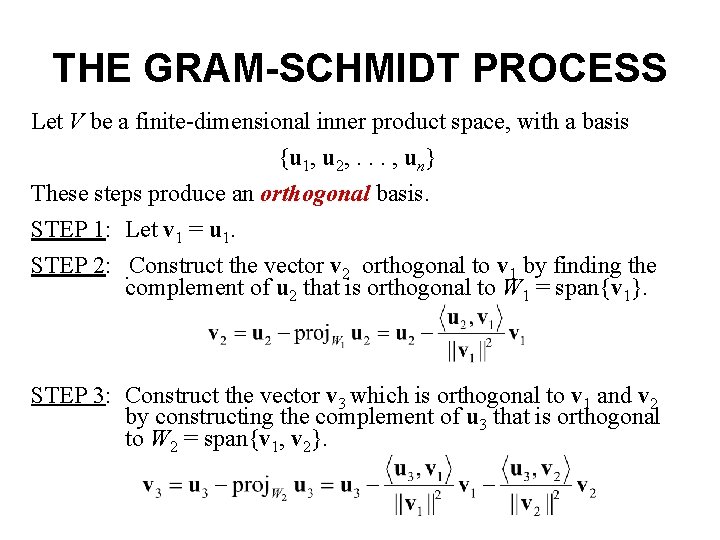
THE GRAM-SCHMIDT PROCESS Let V be a finite-dimensional inner product space, with a basis {u 1, u 2, . . . , un} These steps produce an orthogonal basis. STEP 1: Let v 1 = u 1. STEP 2: . Construct the vector v 2 orthogonal to v 1 by finding the complement of u 2 that is orthogonal to W 1 = span{v 1}. STEP 3: Construct the vector v 3 which is orthogonal to v 1 and v 2 by constructing the complement of u 3 that is orthogonal to W 2 = span{v 1, v 2}.
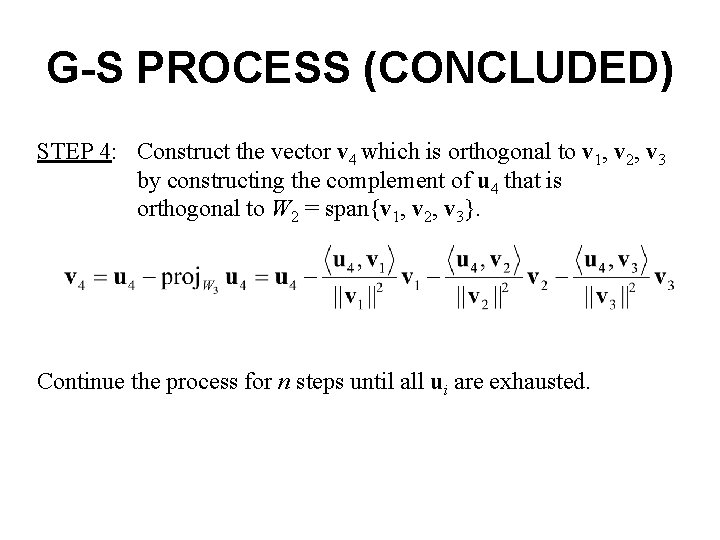
G-S PROCESS (CONCLUDED) STEP 4: Construct the vector v 4 which is orthogonal to v 1, v 2, v 3 by constructing the complement of u 4 that is orthogonal to W 2 = span{v 1, v 2, v 3}. Continue the process for n steps until all ui are exhausted.
- Slides: 11