
Section 6 3 Ionic Bonding and Ionic Compounds
Section 6. 3 Ionic Bonding and Ionic Compounds Jump to first page
Warm-Up How is a chemical formula for a covalent compound different from the chemical formula for an ionic compound? Jump to first page
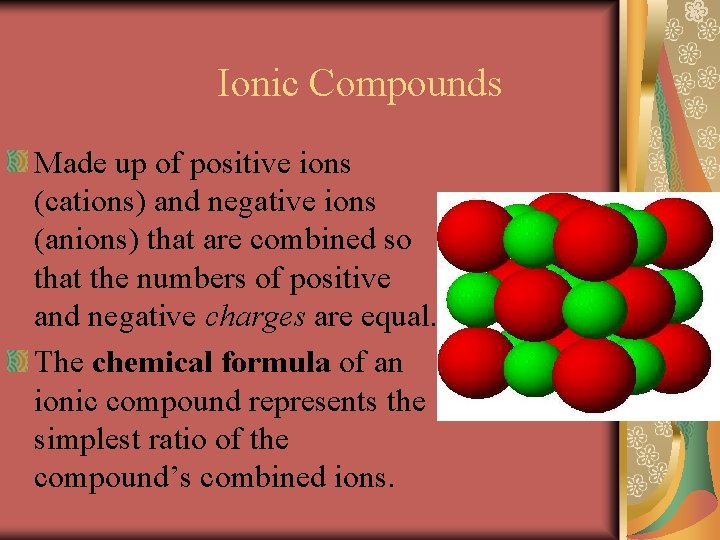
Ionic Compounds Made up of positive ions (cations) and negative ions (anions) that are combined so that the numbers of positive and negative charges are equal. The chemical formula of an ionic compound represents the simplest ratio of the compound’s combined ions.
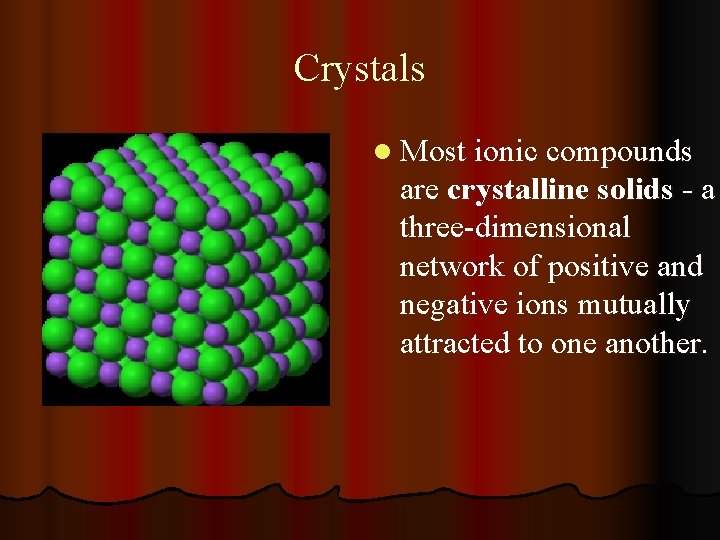
Crystals l Most ionic compounds are crystalline solids - a three-dimensional network of positive and negative ions mutually attracted to one another.
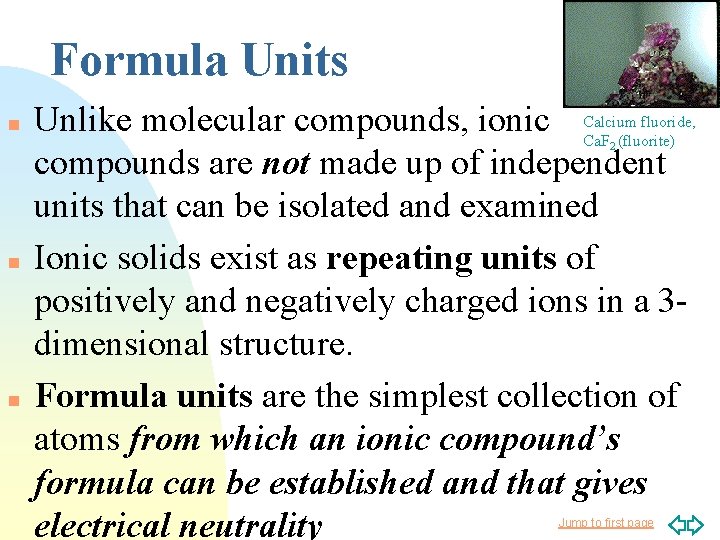
Formula Units n fluoride, Unlike molecular compounds, ionic Calcium Ca. F (fluorite) compounds are not made up of independent units that can be isolated and examined Ionic solids exist as repeating units of positively and negatively charged ions in a 3 dimensional structure. Formula units are the simplest collection of atoms from which an ionic compound’s formula can be established and that gives electrical neutrality 2 n n Jump to first page
Monatomic Ions By gaining or losing electrons many main group elements form ions with noble gas configurations. Ions formed from a single atom are called monatomic ions.
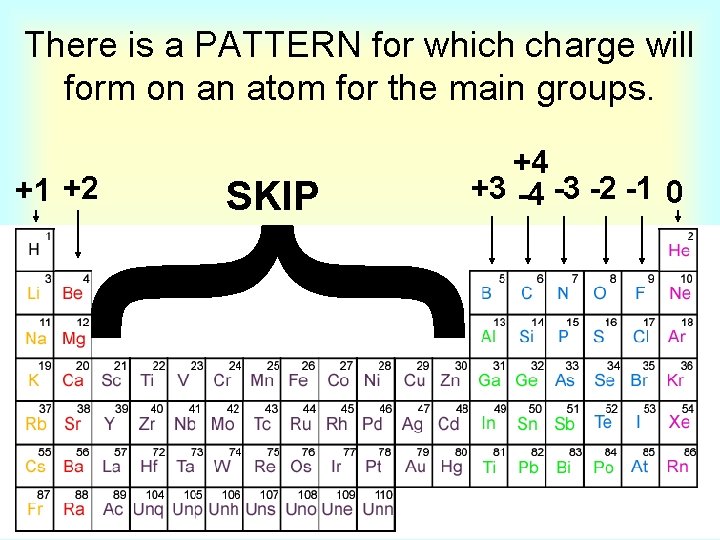
There is a PATTERN for which charge will form on an atom for the main groups. SKIP } +1 +2 +4 +3 -4 -3 -2 -1 0
Formulas for Ionic Compounds n The charges must balance to 0, and the formula must reflect this. n Ionic compounds do not form by the combination of isolated ions, but we can use electron dot notation to see the changes that take place in ionic bonding. n Li and F Li. F Mg and F Mg. F 2
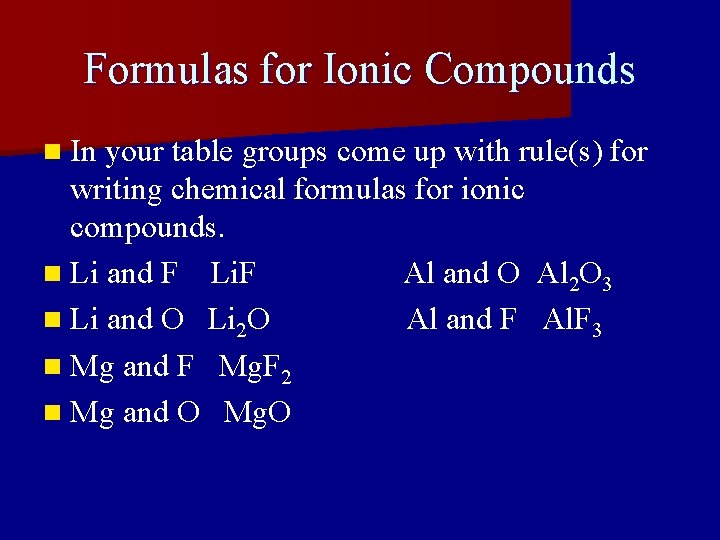
Formulas for Ionic Compounds n In your table groups come up with rule(s) for writing chemical formulas for ionic compounds. n Li and F Li. F Al and O Al 2 O 3 n Li and O Li 2 O Al and F Al. F 3 n Mg and F Mg. F 2 n Mg and O Mg. O
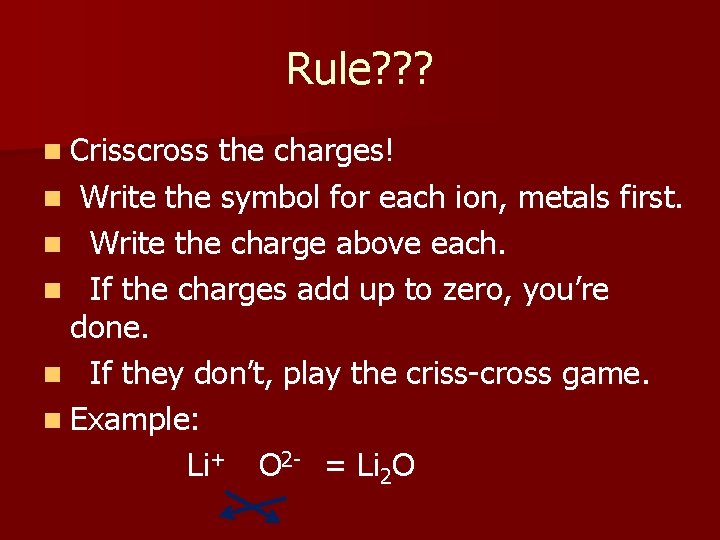
Rule? ? ? n Crisscross the charges! n Write the symbol for each ion, metals first. n Write the charge above each. n If the charges add up to zero, you’re done. n If they don’t, play the criss-cross game. n Example: Li+ O 2 - = Li 2 O
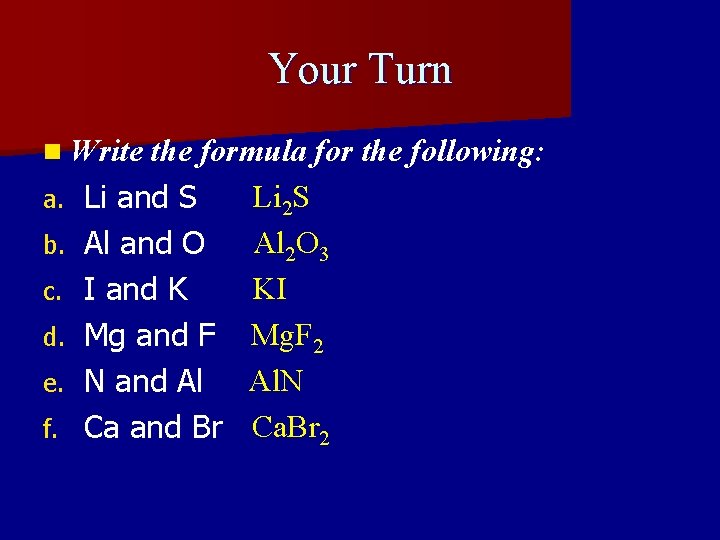
Your Turn n Write a. b. c. d. e. f. the formula for the following: Li 2 S Li and S Al 2 O 3 Al and O KI I and K Mg and F Mg. F 2 N and Al Al. N Ca and Br Ca. Br 2
What’s in a name? Activity Directions: 1. In your table groups, examine the table on page 2 and come up with at least three rules for naming ionic compounds based on the examples given. 2. Answer the making sense question and practice problems #1 -6 and 1 -8.
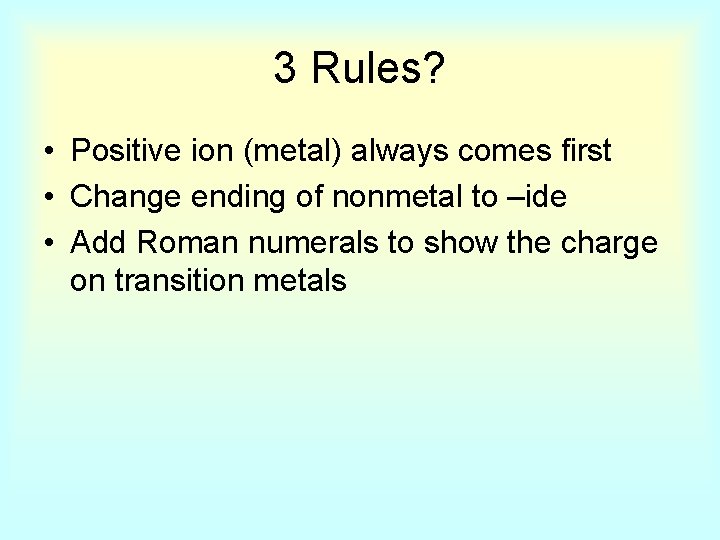
3 Rules? • Positive ion (metal) always comes first • Change ending of nonmetal to –ide • Add Roman numerals to show the charge on transition metals
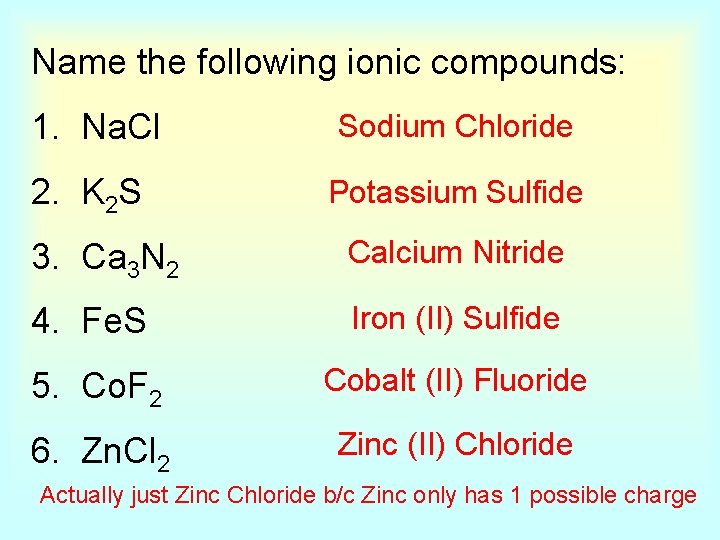
Name the following ionic compounds: 1. Na. Cl Sodium Chloride 2. K 2 S Potassium Sulfide 3. Ca 3 N 2 Calcium Nitride 4. Fe. S Iron (II) Sulfide 5. Co. F 2 Cobalt (II) Fluoride 6. Zn. Cl 2 Zinc (II) Chloride Actually just Zinc Chloride b/c Zinc only has 1 possible charge

Write the following ionic compounds: 1. Magnesium iodide Mg. I 2 2. Lithium bromide Li. Br 3. Calcium Phosphide 4. Aluminum Nitride 4. Aluminum Chloride 5. Potassium Oxide Ca 3 P 2 Al. N Al. Cl 3 K 2 O 6. Iron (III) Sulfide Fe 2 S 3 7. Copper (II) Chloride Cu. Cl 2
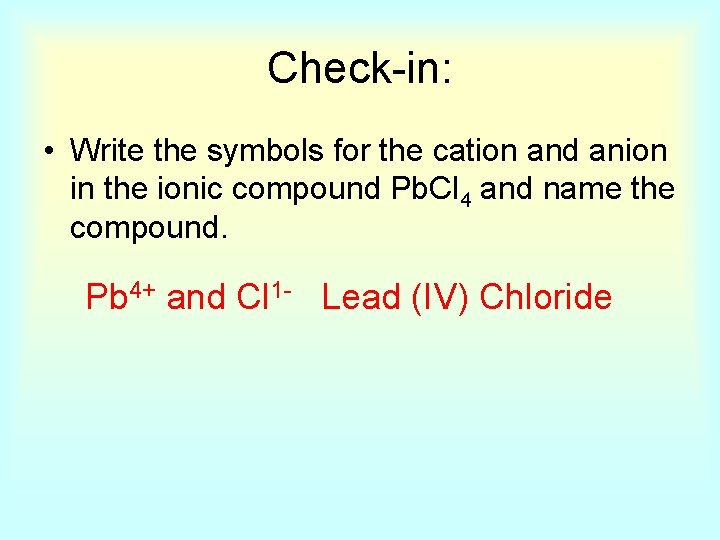
Check-in: • Write the symbols for the cation and anion in the ionic compound Pb. Cl 4 and name the compound. Pb 4+ and Cl 1 - Lead (IV) Chloride
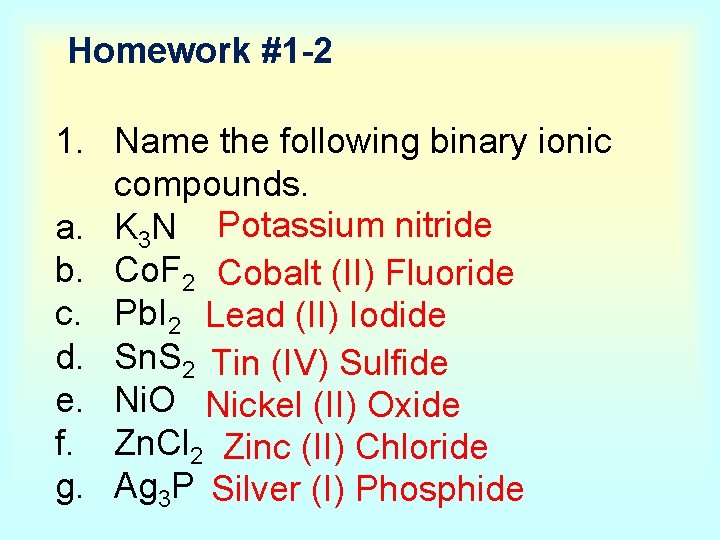
Homework #1 -2 1. Name the following binary ionic compounds. a. K 3 N Potassium nitride b. Co. F 2 Cobalt (II) Fluoride c. Pb. I 2 Lead (II) Iodide d. Sn. S 2 Tin (IV) Sulfide e. Ni. O Nickel (II) Oxide f. Zn. Cl 2 Zinc (II) Chloride g. Ag 3 P Silver (I) Phosphide
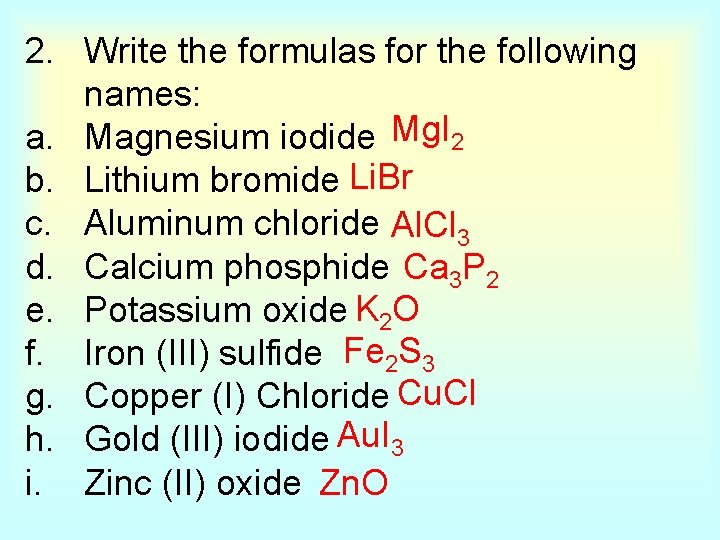
2. Write the formulas for the following names: a. Magnesium iodide Mg. I 2 b. Lithium bromide Li. Br c. Aluminum chloride Al. Cl 3 d. Calcium phosphide Ca 3 P 2 e. Potassium oxide K 2 O f. Iron (III) sulfide Fe 2 S 3 g. Copper (I) Chloride Cu. Cl h. Gold (III) iodide Au. I 3 i. Zinc (II) oxide Zn. O
Monotomic Ions § Ions formed from a single atom. Main group ions form to a noble gas configuration: Al 3+, O 2 -, etc. Transition metals can show many different charges: Pb 2+, Pb 4+, etc.
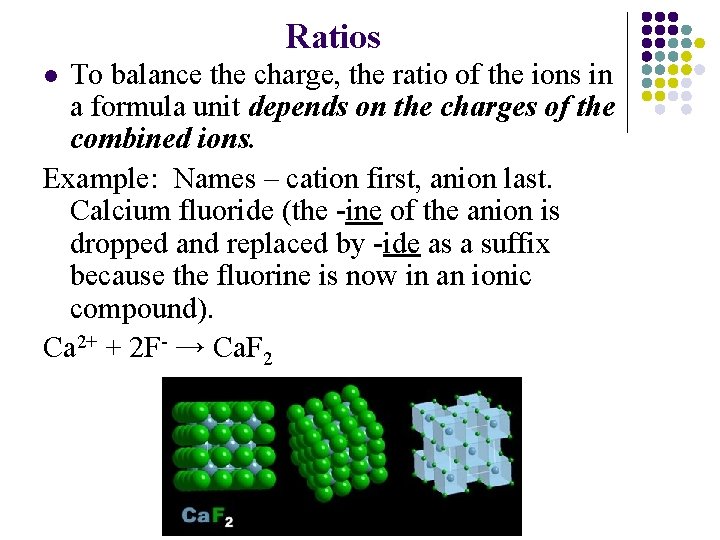
Ratios To balance the charge, the ratio of the ions in a formula unit depends on the charges of the combined ions. Example: Names – cation first, anion last. Calcium fluoride (the -ine of the anion is dropped and replaced by -ide as a suffix because the fluorine is now in an ionic compound). Ca 2+ + 2 F- → Ca. F 2 l
Naming Binary Ionic Compounds l l l Nomenclature: naming system. We will go over the Stock System of Nomenclature (Chapter 7, Section 1, pp. 206 -210). You MUST use Table 7 -1 p. 205 and Table 7 -2 p. 210 to help you in naming ionic compounds.
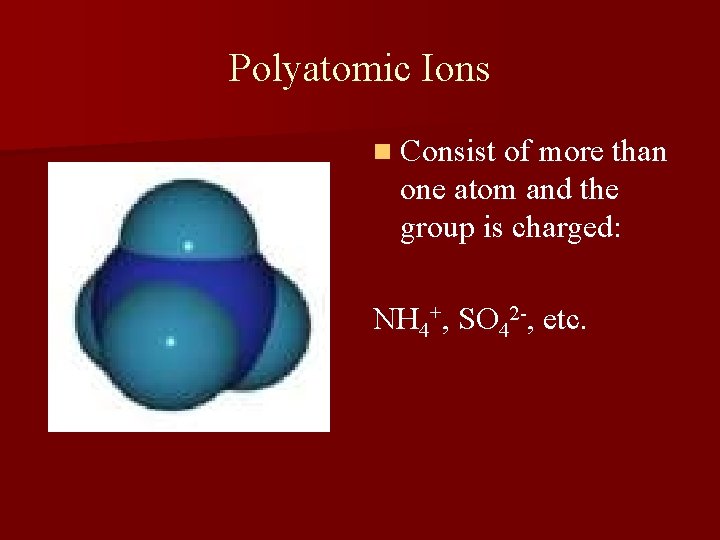
Polyatomic Ions n Consist of more than one atom and the group is charged: NH 4+, SO 42 -, etc.
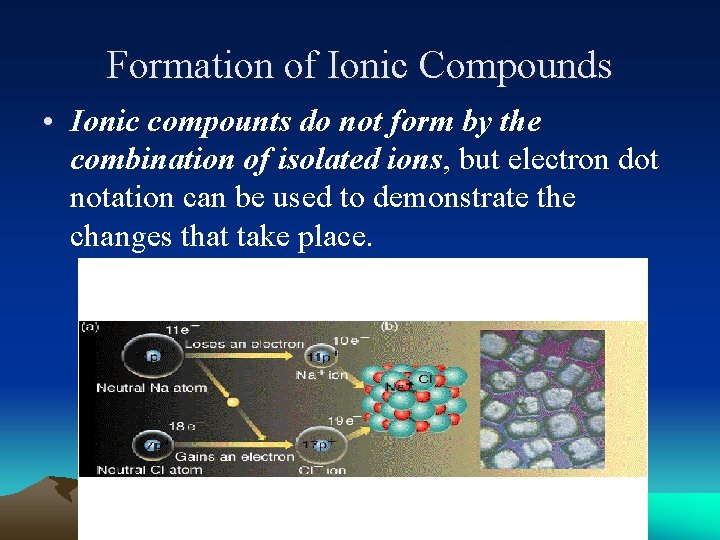
Formation of Ionic Compounds • Ionic compounts do not form by the combination of isolated ions, but electron dot notation can be used to demonstrate the changes that take place.
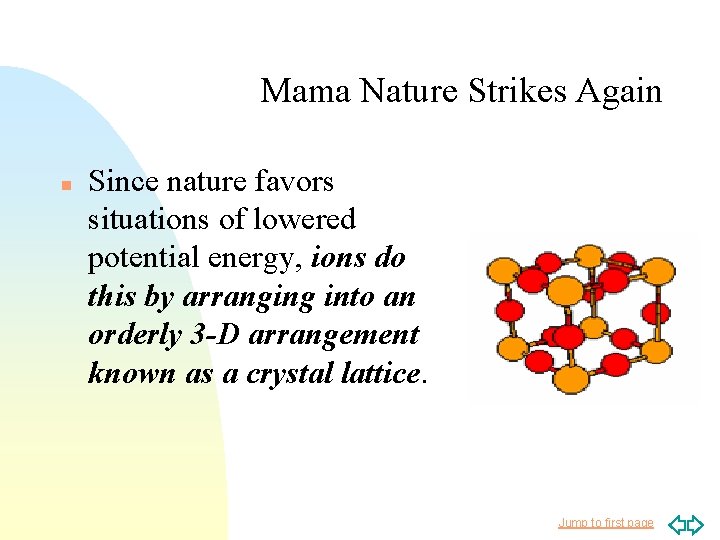
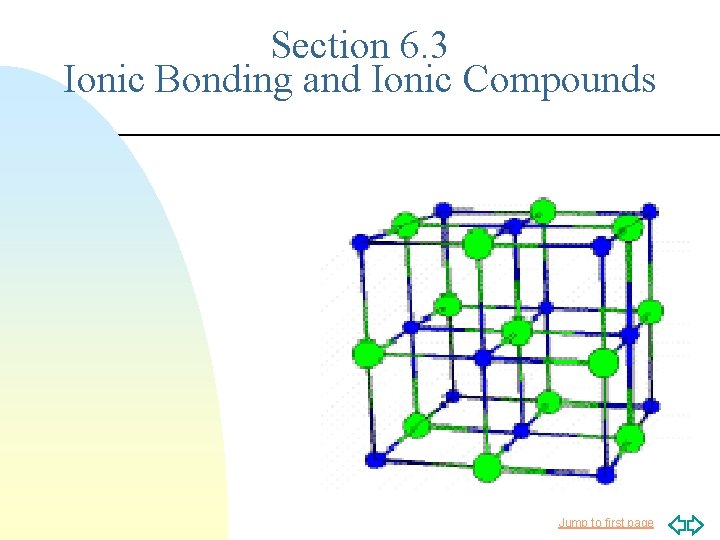
Mama Nature Strikes Again n Since nature favors situations of lowered potential energy, ions do this by arranging into an orderly 3 -D arrangement known as a crystal lattice. Jump to first page
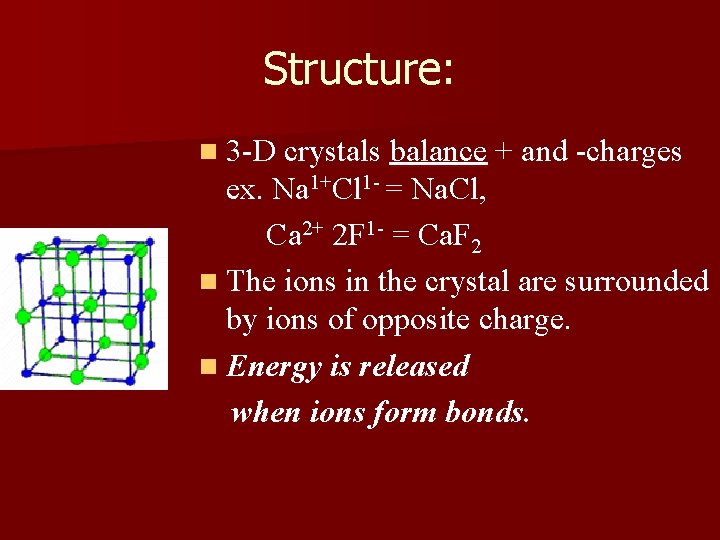
Structure: n 3 -D crystals balance + and -charges ex. Na 1+Cl 1 - = Na. Cl, Ca 2+ 2 F 1 - = Ca. F 2 n The ions in the crystal are surrounded by ions of opposite charge. n Energy is released when ions form bonds.
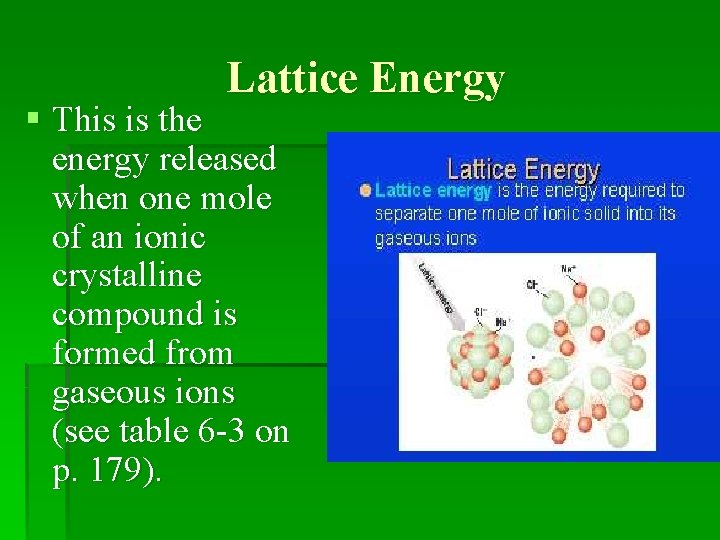
Lattice Energy § This is the energy released when one mole of an ionic crystalline compound is formed from gaseous ions (see table 6 -3 on p. 179).
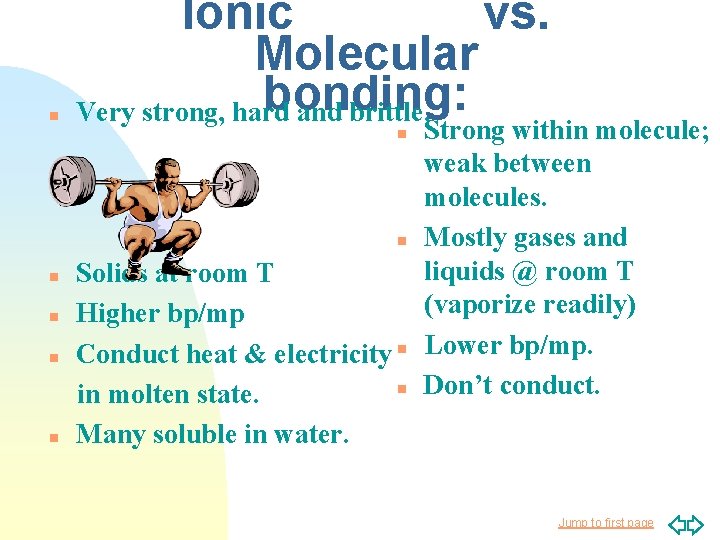
n Ionic vs. Molecular bonding: Very strong, hard and brittle. n n n Solids at room T Higher bp/mp Conduct heat & electricity n n in molten state. Many soluble in water. Strong within molecule; weak between molecules. Mostly gases and liquids @ room T (vaporize readily) Lower bp/mp. Don’t conduct. Jump to first page
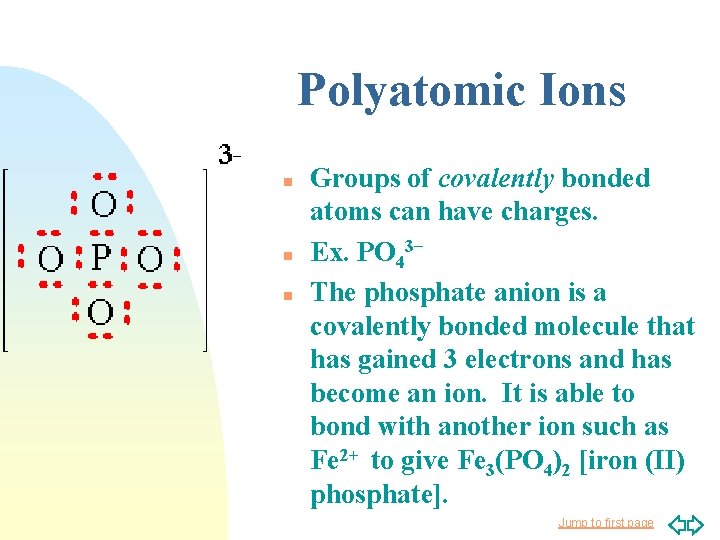
Polyatomic Ions n n n Groups of covalently bonded atoms can have charges. Ex. PO 43− The phosphate anion is a covalently bonded molecule that has gained 3 electrons and has become an ion. It is able to bond with another ion such as Fe 2+ to give Fe 3(PO 4)2 [iron (II) phosphate]. Jump to first page
Assignment: Worksheets: 6 -3 Review Chapter 6 Review, pp. 195 -198, 11, 19, 35 -39, 41, 42, 54, 56, 57, 6365. Do all assignments from the book separately. Jump to first page
- Slides: 29