
Section 6 3 Ionic Bonding and Ionic Compounds
Section 6. 3 “Ionic Bonding and Ionic Compounds” Take this and be mine!
Chapter 6 Vocabulary 14. ionic compound 15. formula unit 16. lattice energy 17. polyatomic ion What is the show Cesium and Iodine love watching together?
Chapter 6 Section 3 Objectives Ionic Bonding and Ionic Compounds • Compare a chemical formula for a molecular compounds with one for an ionic compound. • Discuss the arrangements of ions in crystals. • Define lattice energy and explain its significance. • List and compare the distinctive properties of ionic and molecular compounds. • Write the Lewis structure for a polyatomic ion given the identity of the atoms combined and other appropriate information.
Ionic Compounds • Most of the rocks and minerals that make up Earth’s crust consist of positive and negative ions held together by ionic bonding. • example: table salt, Na. Cl, consists of sodium and chloride ions combined in a one-to-one ratio— Na+Cl–—so that each positive charge is balanced by a negative charge. • An ionic compound is composed of positive and negative ions that are combined so that the numbers of positive and negative charges are equal.
Ionic Compounds • Most ionic compounds exist as crystalline solids. • A crystal of any ionic compound is a threedimensional network of positive and negative ions mutually attracted to each other. • In contrast to a molecular compound, an ionic compound is not composed of independent, neutral units that can be isolated.
Ionic Compounds • The chemical formula of an ionic compound represents the simplest ratio of the compound’s ions that make the compound electrically neutral. • A formula unit is the simplest collection of atoms from which an ionic compound’s formula can be written.
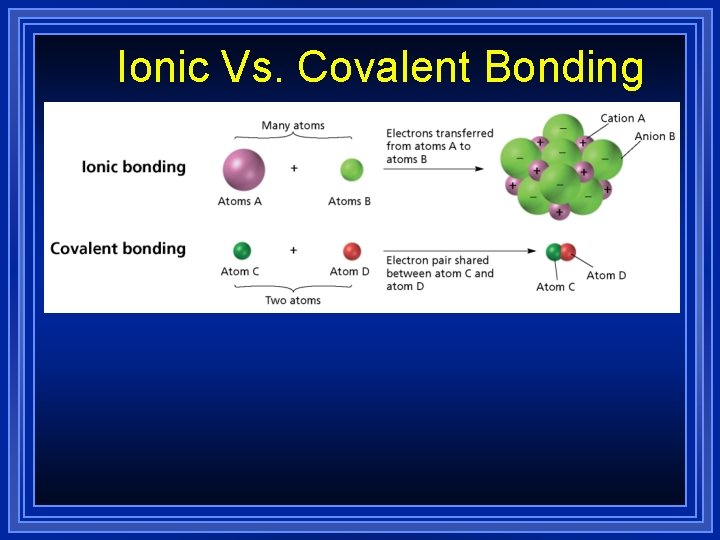
Ionic Vs. Covalent Bonding
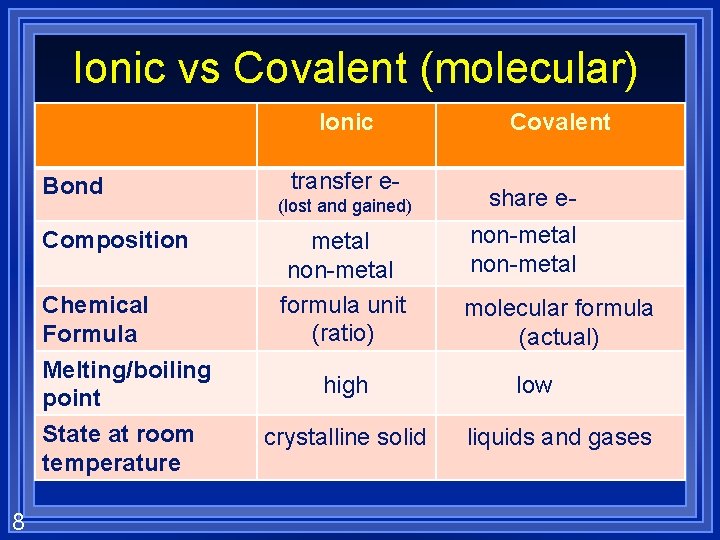
Ionic vs Covalent (molecular) Ionic Bond Composition Chemical Formula Melting/boiling point State at room temperature 8 transfer e(lost and gained) metal non-metal formula unit (ratio) high crystalline solid Covalent share enon-metal molecular formula (actual) low liquids and gases
Ionic Compound l MAIN IDEA: ØIonic bonds form from attractions between positive cations and negative anions.
Section 6. 3 - Ions l OBJECTIVE: – Describe how cations form. – Atoms of the metallic elements tend to loose their valence e-, leaving a complete octet in the next-lowest energy level
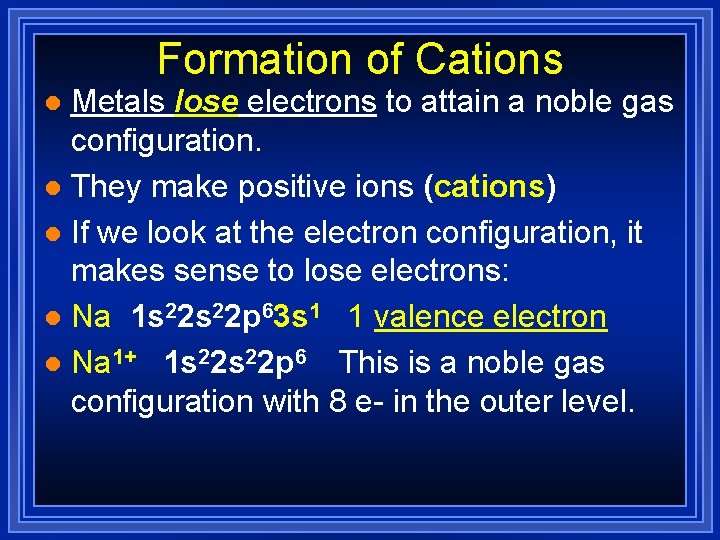
Formation of Cations Metals lose electrons to attain a noble gas configuration. l They make positive ions (cations) l If we look at the electron configuration, it makes sense to lose electrons: l Na 1 s 22 p 63 s 1 1 valence electron l Na 1+ 1 s 22 p 6 This is a noble gas configuration with 8 e- in the outer level. l
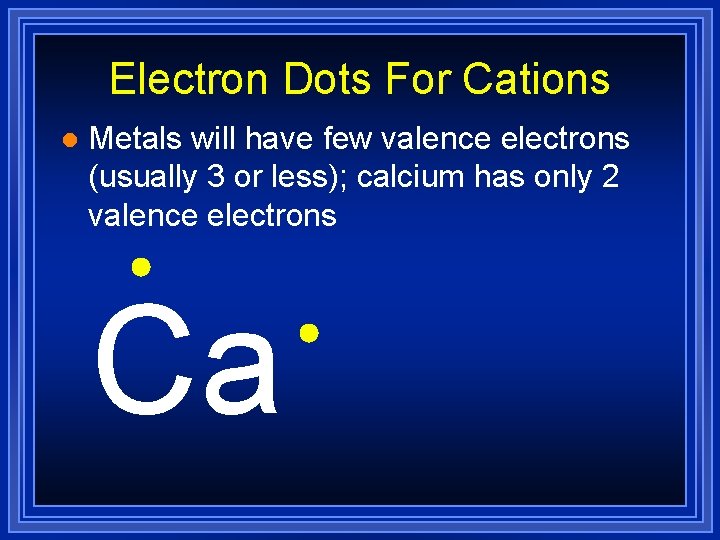
Electron Dots For Cations l Metals will have few valence electrons (usually 3 or less); calcium has only 2 valence electrons Ca
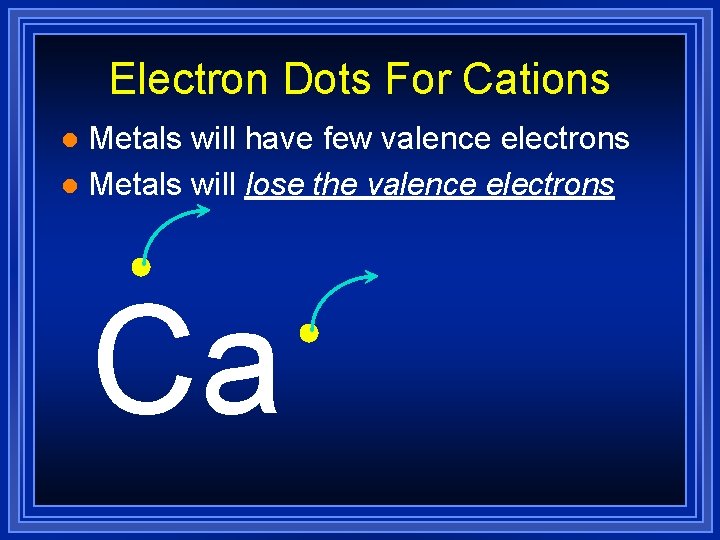
Electron Dots For Cations Metals will have few valence electrons l Metals will lose the valence electrons l Ca
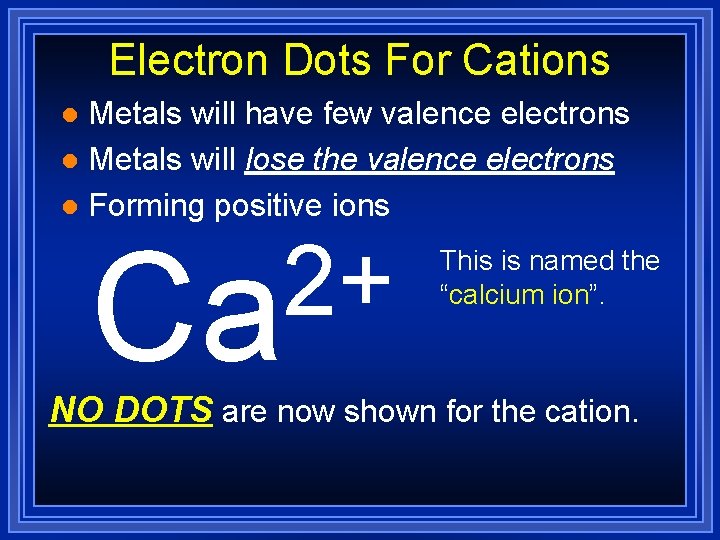
Electron Dots For Cations Metals will have few valence electrons l Metals will lose the valence electrons l Forming positive ions l 2+ Ca This is named the “calcium ion”. NO DOTS are now shown for the cation.
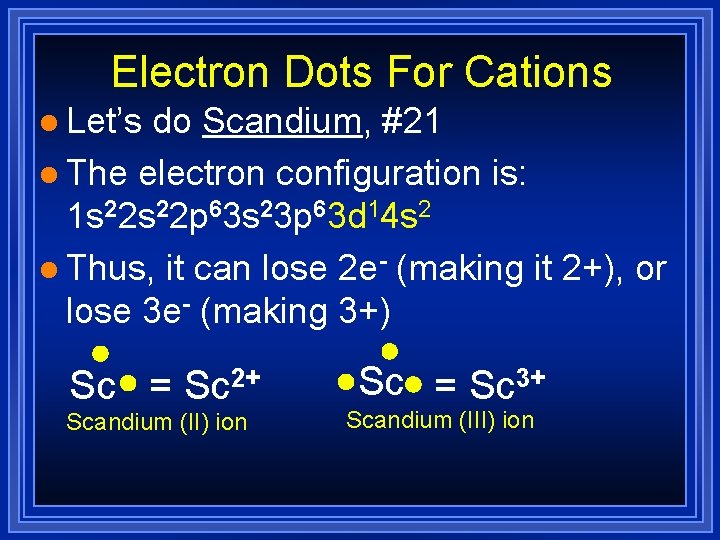
Electron Dots For Cations l Let’s do Scandium, #21 l The electron configuration is: 1 s 22 p 63 s 23 p 63 d 14 s 2 l Thus, it can lose 2 e- (making it 2+), or lose 3 e- (making 3+) Sc = Sc 2+ Scandium (II) ion Sc = Sc 3+ Scandium (III) ion
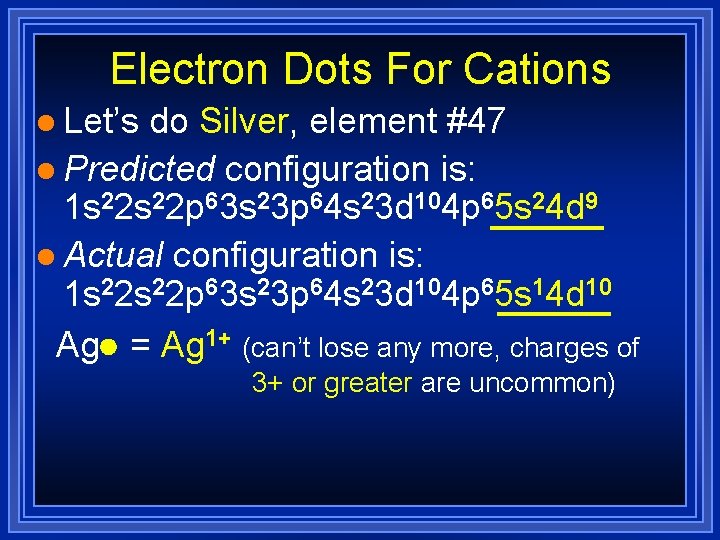
Electron Dots For Cations l Let’s do Silver, element #47 l Predicted configuration is: 1 s 22 p 63 s 23 p 64 s 23 d 104 p 65 s 24 d 9 l Actual configuration is: 1 s 22 p 63 s 23 p 64 s 23 d 104 p 65 s 14 d 10 Ag = Ag 1+ (can’t lose any more, charges of 3+ or greater are uncommon)
Electron Dots For Cations l Silver did the best job it could, but it did not achieve a true Noble Gas configuration l Instead, it is called a “pseudonoble gas configuration”
Section 6. 3 - Ions l OBJECTIVES: –Explain how anions form.
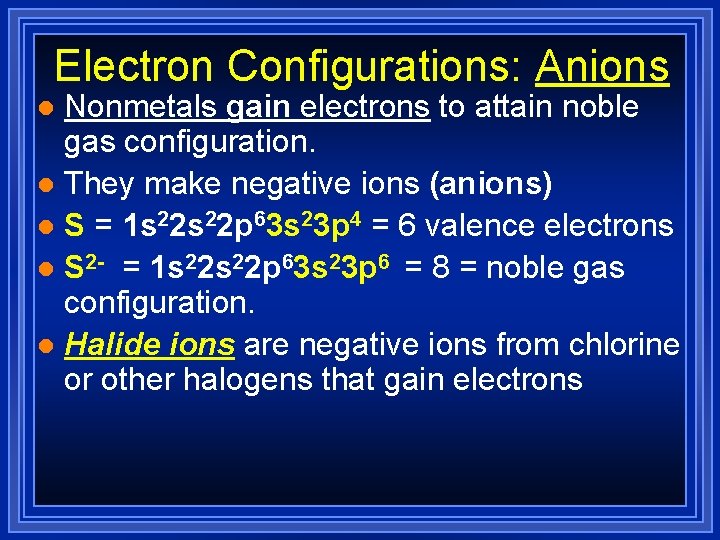
Electron Configurations: Anions Nonmetals gain electrons to attain noble gas configuration. l They make negative ions (anions) l S = 1 s 22 p 63 s 23 p 4 = 6 valence electrons l S 2 - = 1 s 22 p 63 s 23 p 6 = 8 = noble gas configuration. l Halide ions are negative ions from chlorine or other halogens that gain electrons l
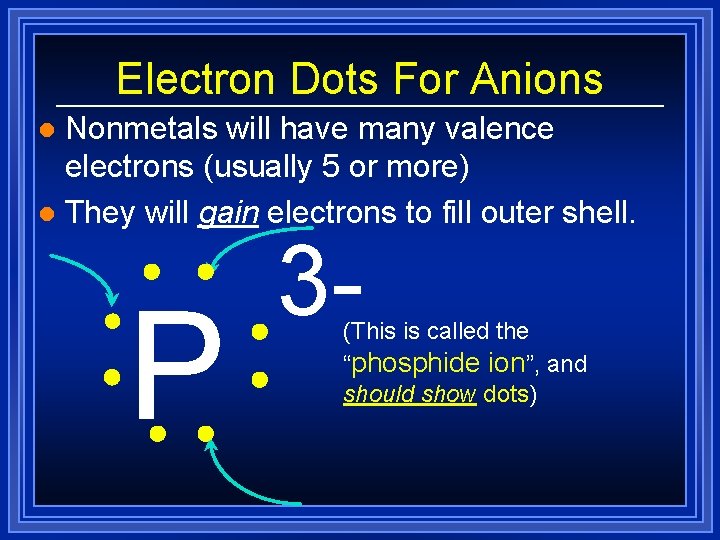
Electron Dots For Anions Nonmetals will have many valence electrons (usually 5 or more) l They will gain electrons to fill outer shell. l P 3 - (This is called the “phosphide ion”, and should show dots)
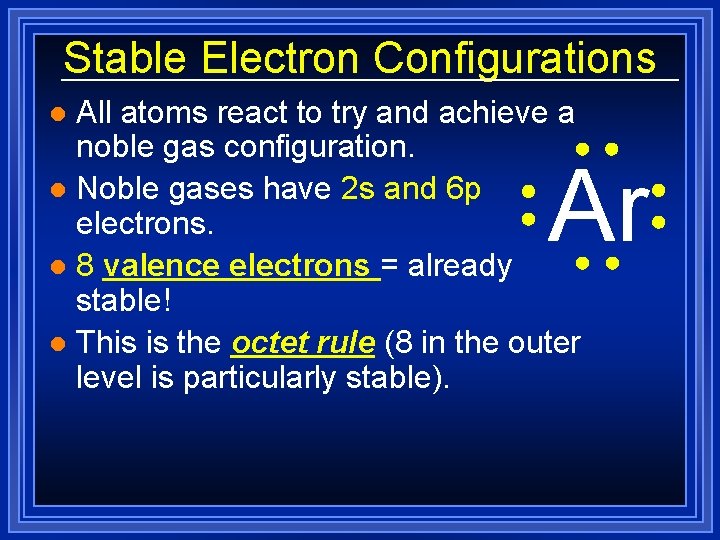
Stable Electron Configurations All atoms react to try and achieve a noble gas configuration. l Noble gases have 2 s and 6 p electrons. l 8 valence electrons = already stable! l This is the octet rule (8 in the outer level is particularly stable). l Ar
Ions Atoms of some non-metallic elements tend to gain e- or share e- with other nonmetallic elements to achieve a complete octet An atom’s loss of valence e- produces a cation, or positively charged ion The gain of negatively charged e- by a neutral atom produces an anion
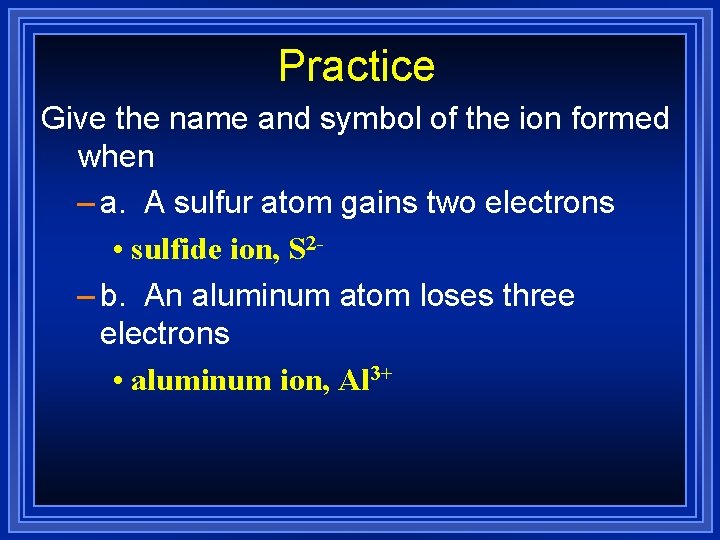
Practice Give the name and symbol of the ion formed when – a. A sulfur atom gains two electrons • sulfide ion, S 2– b. An aluminum atom loses three electrons • aluminum ion, Al 3+
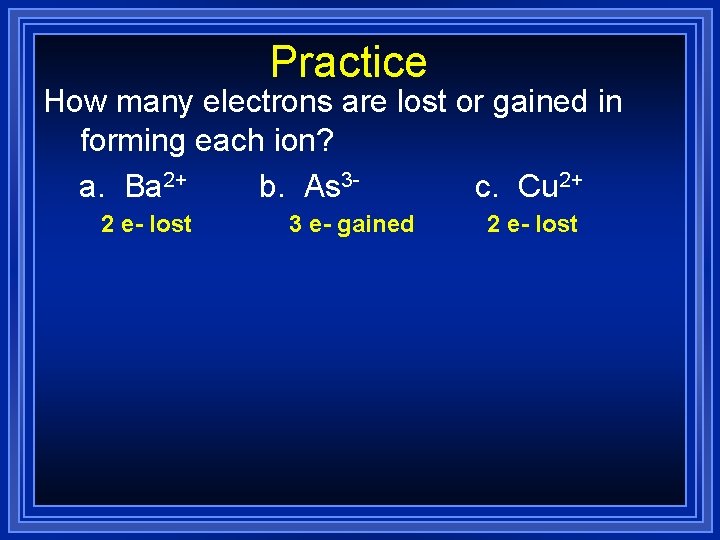
Practice How many electrons are lost or gained in forming each ion? a. Ba 2+ b. As 3 c. Cu 2+ 2 e- lost 3 e- gained 2 e- lost
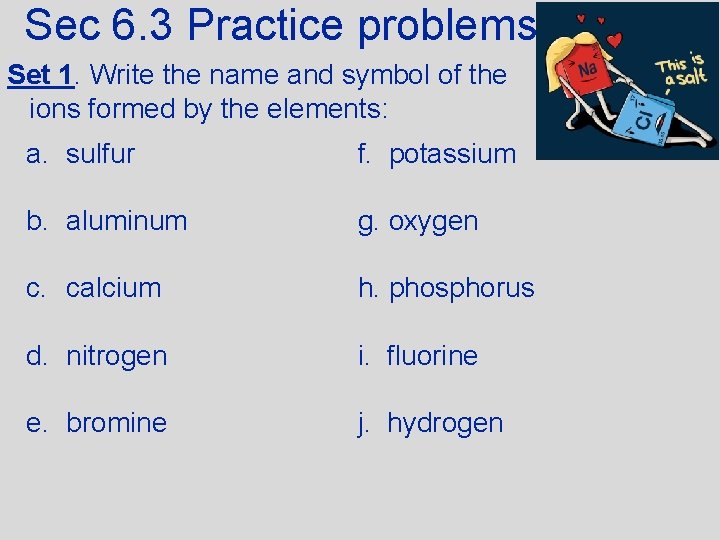
Sec 6. 3 Practice problems Set 1. Write the name and symbol of the ions formed by the elements: a. sulfur f. potassium b. aluminum g. oxygen c. calcium h. phosphorus d. nitrogen i. fluorine e. bromine j. hydrogen
“Perhaps one of you gentlemen would mind telling me just what it is outside the window that you find so attractive…? ”
Section 6. 3 Ionic Bonds and Ionic Compounds l OBJECTIVE: – Explain the electrical charge of an ionic compound. – Describe three properties of ionic compounds.
Ionic Bonding l l l Anions and cations are held together by opposite charges (+ and -) Ionic compounds are called salts. Simplest ratio of elements in an ionic compound is called the formula unit. The bond is formed through the transfer of electrons (lose and gain) Electrons are transferred to achieve noble gas configuration.
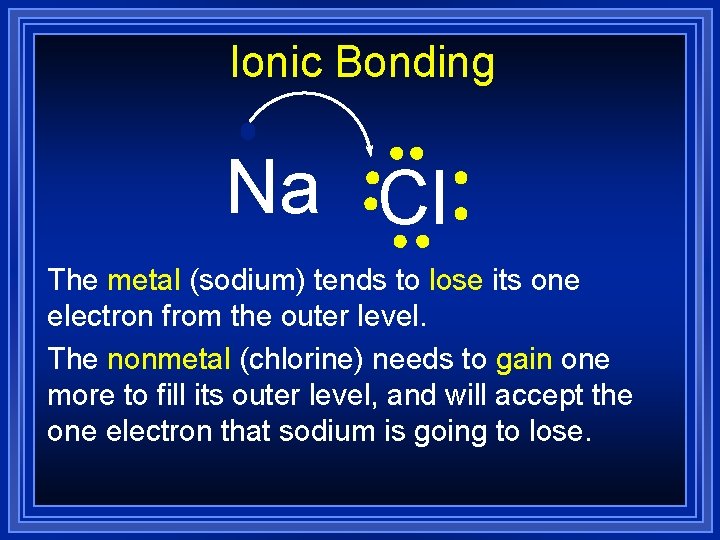
Ionic Bonding Na Cl The metal (sodium) tends to lose its one electron from the outer level. The nonmetal (chlorine) needs to gain one more to fill its outer level, and will accept the one electron that sodium is going to lose.
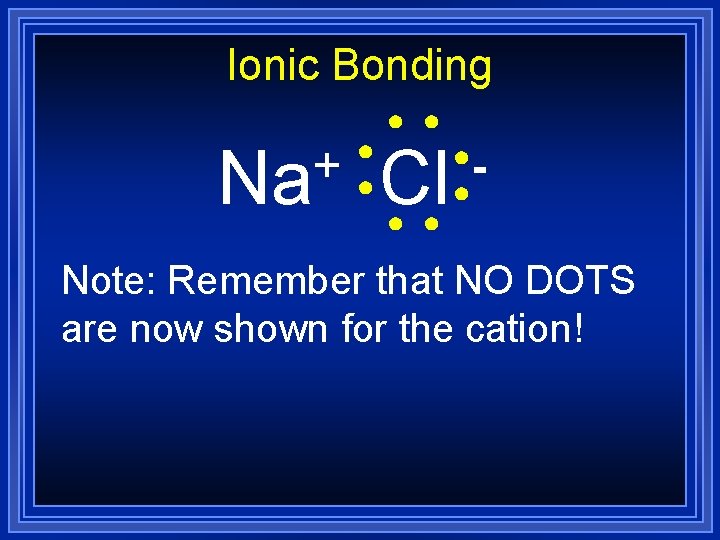
Ionic Bonding + Na Cl - Note: Remember that NO DOTS are now shown for the cation!
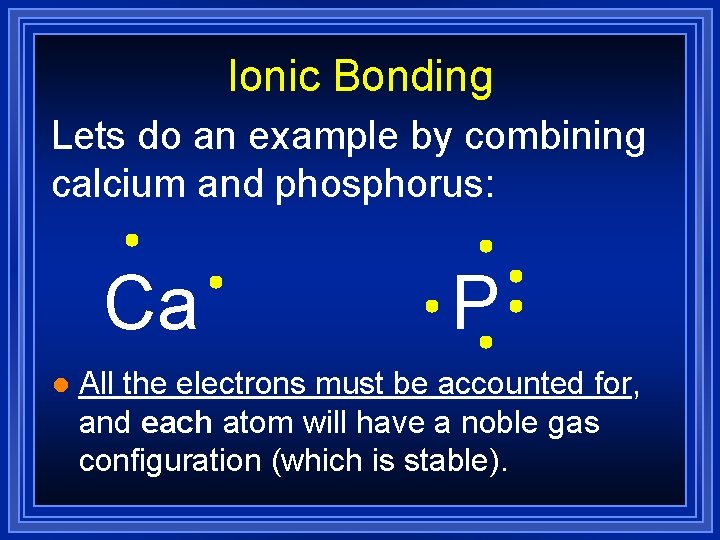
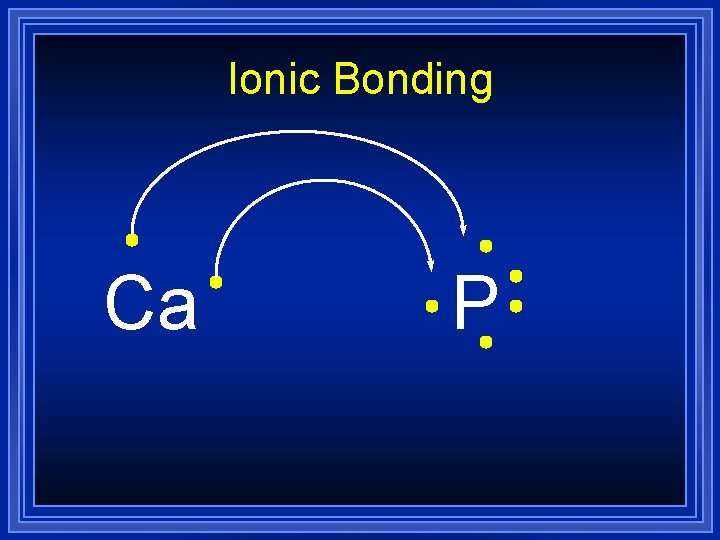
Ionic Bonding Lets do an example by combining calcium and phosphorus: Ca l P All the electrons must be accounted for, and each atom will have a noble gas configuration (which is stable).
Ionic Bonding Ca P
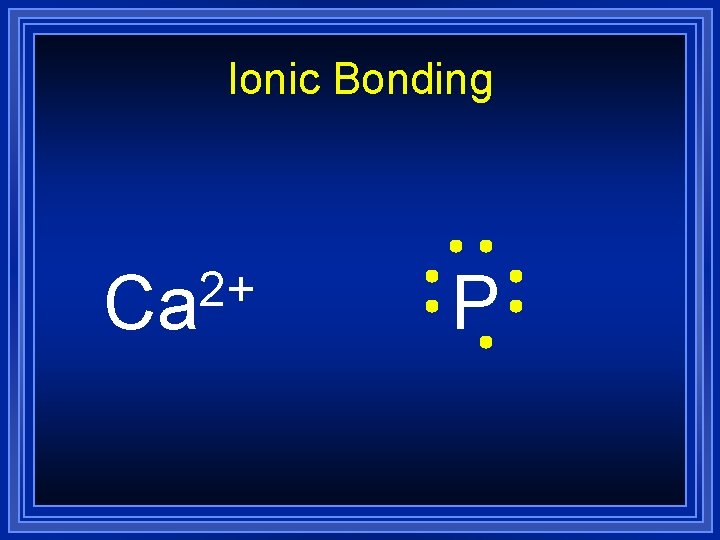
Ionic Bonding 2+ Ca P
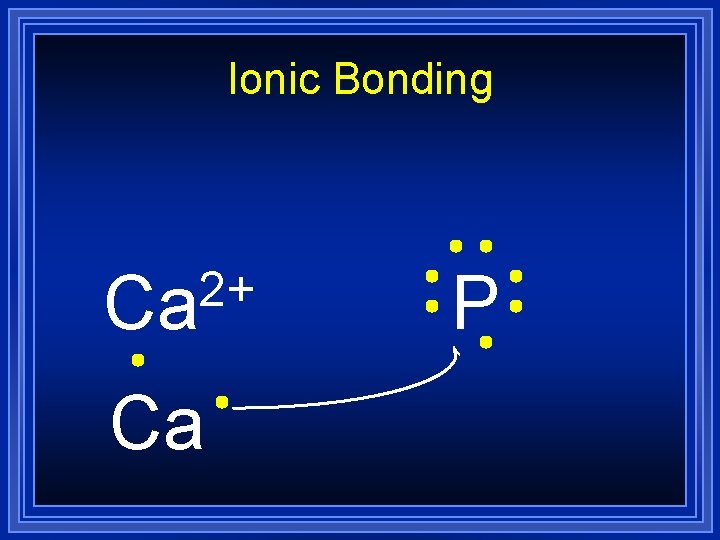
Ionic Bonding 2+ Ca Ca P
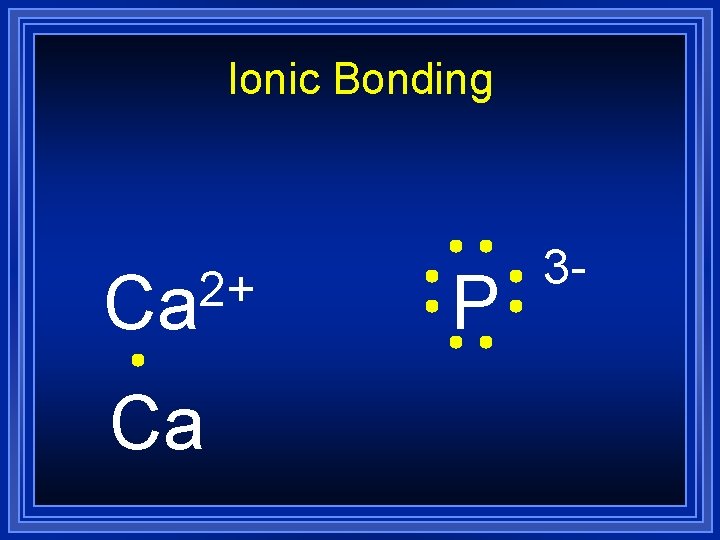
Ionic Bonding 2+ Ca Ca P 3 -
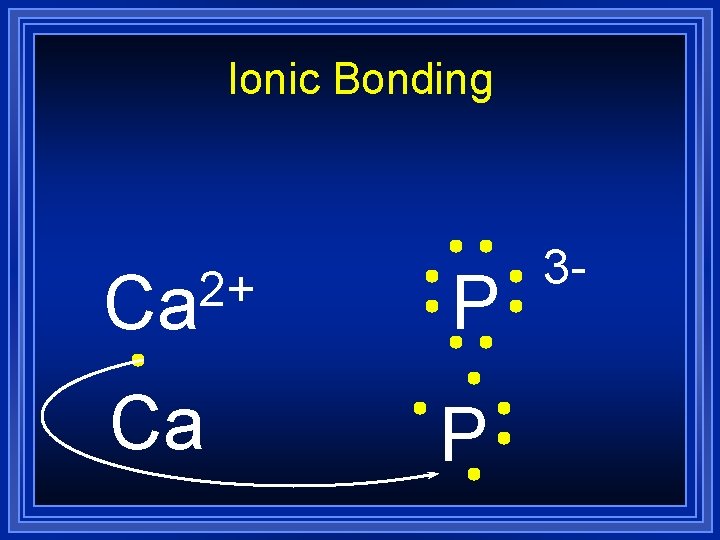
Ionic Bonding 2+ Ca P 3 -
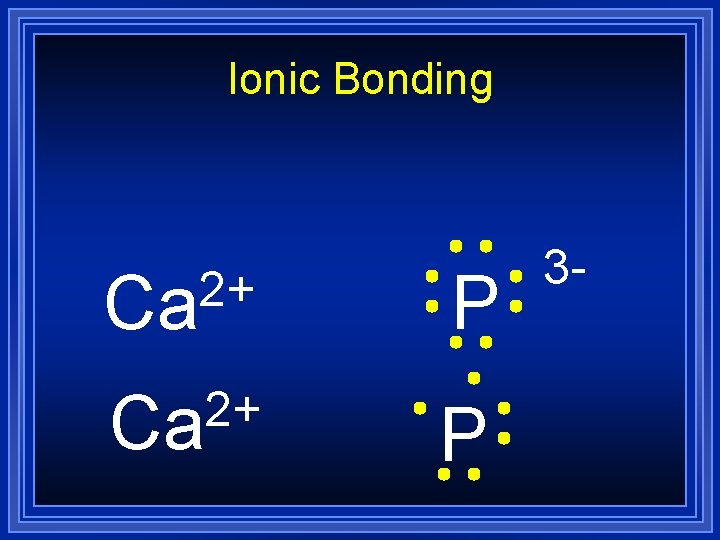
Ionic Bonding 2+ Ca P 3 -
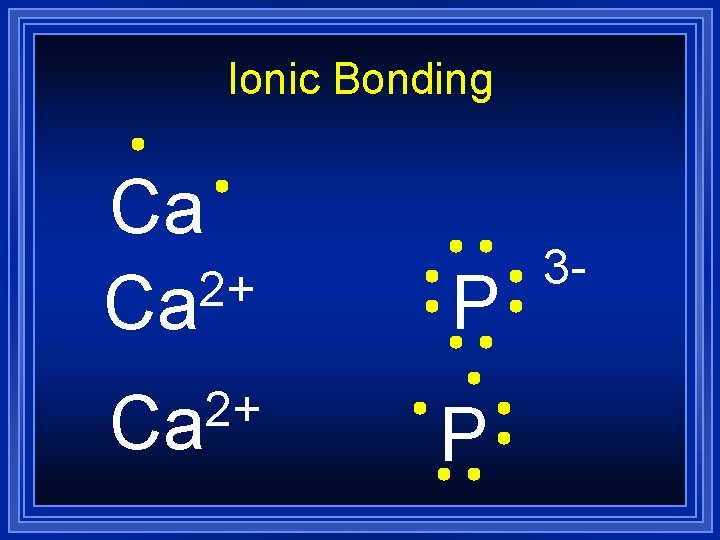
Ionic Bonding Ca 2+ Ca P 3 -
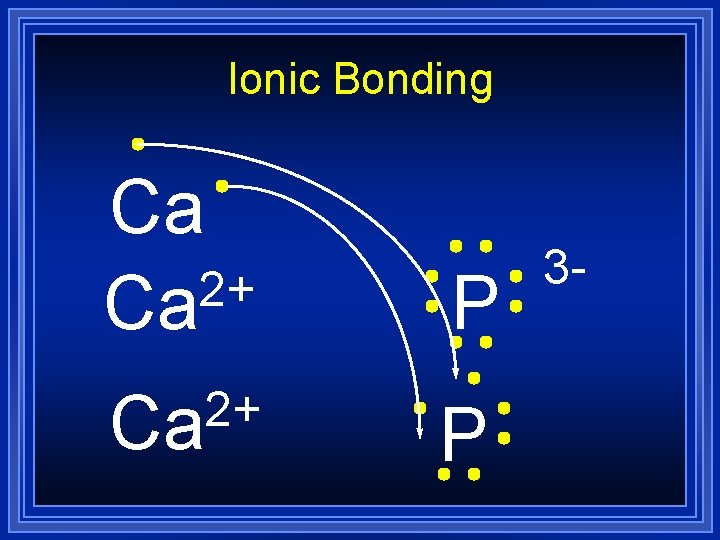
Ionic Bonding Ca 2+ Ca P 3 -
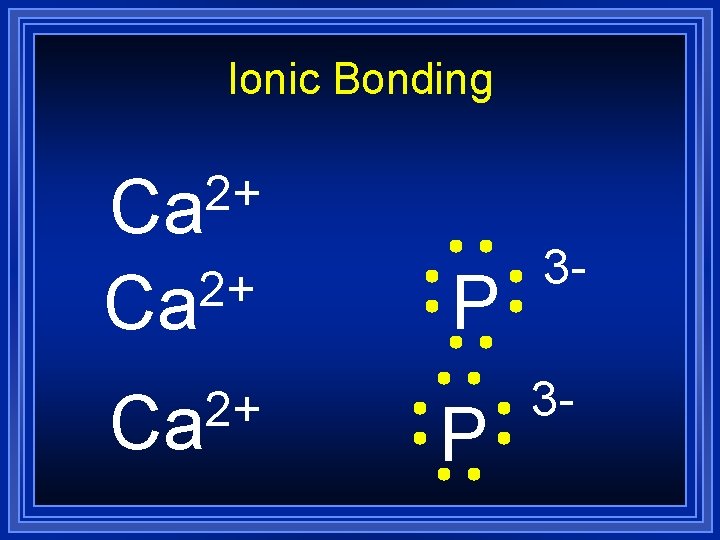
Ionic Bonding 2+ Ca P 3 -
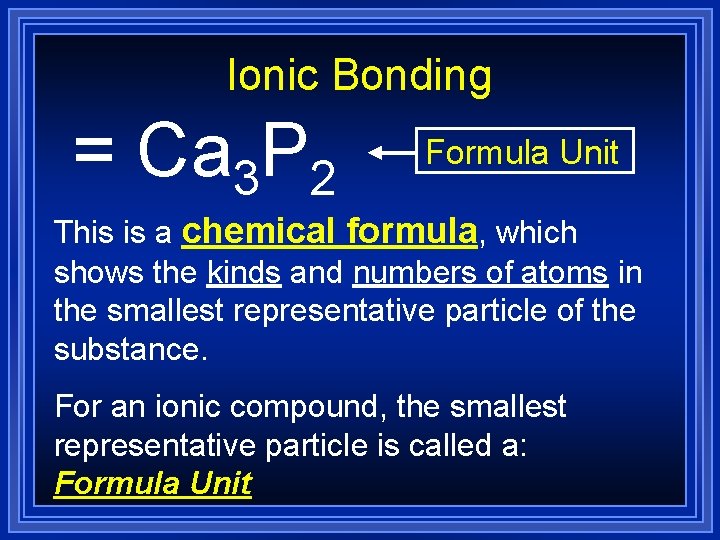
Ionic Bonding = Ca 3 P 2 Formula Unit This is a chemical formula, which shows the kinds and numbers of atoms in the smallest representative particle of the substance. For an ionic compound, the smallest representative particle is called a: Formula Unit
Ionic Compound l MAIN IDEA: ØDifferences in attraction strength give ionic and molecular compounds different properties
Formation of Ionic Compounds, continued • In an ionic crystal, ions minimize their potential energy by combining in an orderly arrangement known as a crystal lattice. • Attractive forces exist between oppositely charged ions within the lattice. • Repulsive forces exist between like-charged ions within the lattice. (electrons repel each other) • The combined attractive and repulsive forces within a crystal lattice determine: • the distances between ions • the pattern of the ions’ arrangement in the crystal
Chapter 6 Section 3 Ionic Bonding and Ionic Compounds Characteristics of Ion Click below to watch the Visual Concept. Bonding in a Crystal Lattice Visual Concept
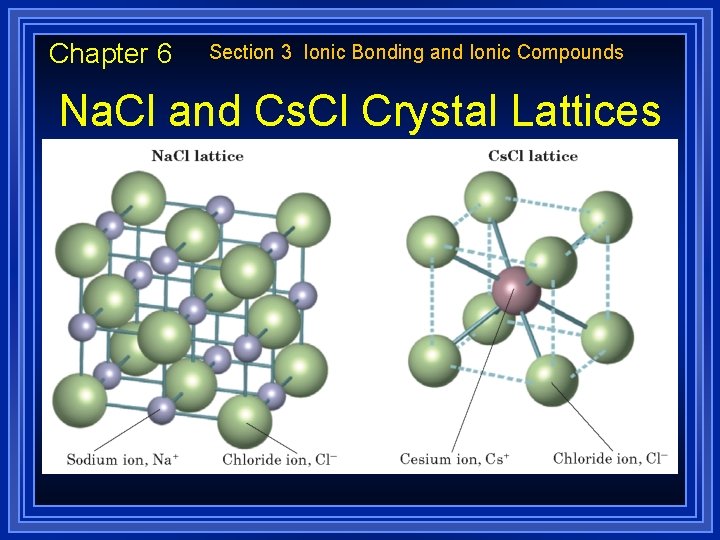
Chapter 6 Section 3 Ionic Bonding and Ionic Compounds Na. Cl and Cs. Cl Crystal Lattices
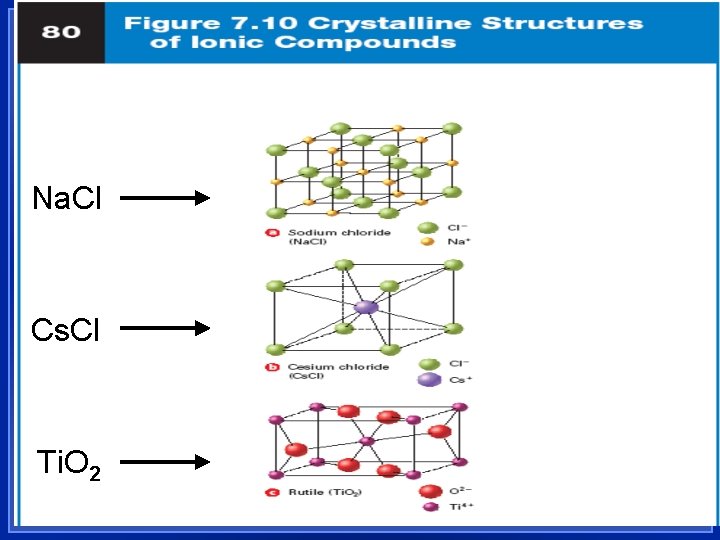
Na. Cl Cs. Cl Ti. O 2
Chapter 6 Section 3 Ionic Bonding and Ionic Compounds Lattice Energy Click below to watch the Visual Concept
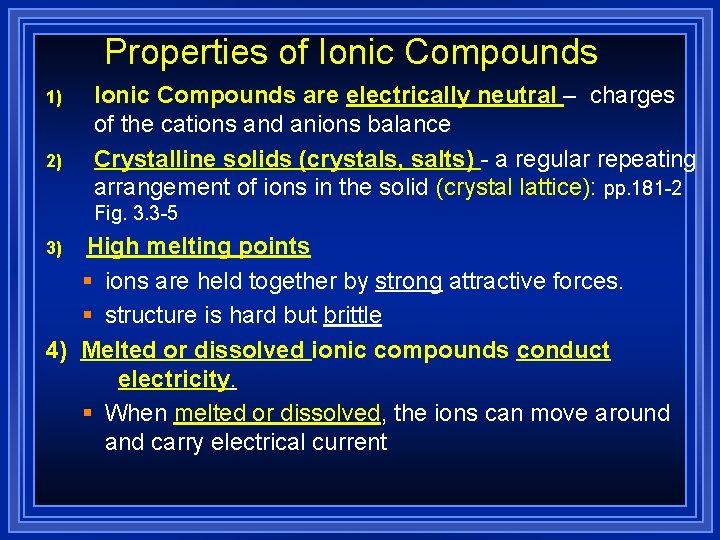
Properties of Ionic Compounds 1) 2) Ionic Compounds are electrically neutral – charges of the cations and anions balance Crystalline solids (crystals, salts) - a regular repeating arrangement of ions in the solid (crystal lattice): pp. 181 -2 Fig. 3. 3 -5 High melting points § ions are held together by strong attractive forces. § structure is hard but brittle 4) Melted or dissolved ionic compounds conduct electricity. § When melted or dissolved, the ions can move around and carry electrical current 3)
Melted ionic compounds conduct. l l Conducting electricity means allowing charges to move. In a solid, the ions are locked in place. Ionic solids are insulators. When melted, the ions can move around. – Na. Cl: must get to about 800 ºC. – Dissolved in water, they also conduct (free to move in aqueous solutions)
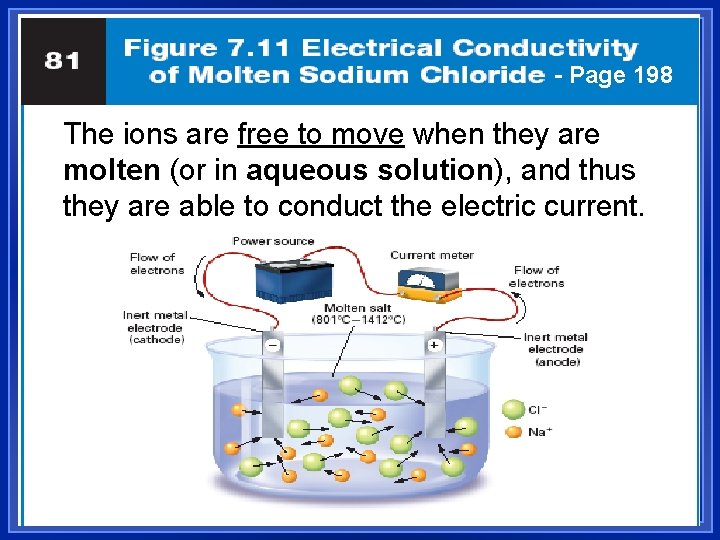
- Page 198 The ions are free to move when they are molten (or in aqueous solution), and thus they are able to conduct the electric current.
Properties of Ionic Compounds • • Although they are composed of ions, ionic compounds are electrically neutral. Most ionic compounds are crystalline solids at room temperature (crystals, salts). Ionic compounds generally have high melting points Ionic compounds can conduct an electric current when melted or dissolved in water
Section 3 Ionic Bonding and Ionic Compounds Chapter 6 A Comparison of Ionic and Molecular Compounds • The force that holds ions together in an ionic compound is a very strong electrostatic attraction (hard). • In contrast, the forces of attraction between molecules of a covalent compound are much weaker. • This difference in the strength of attraction between the basic units of molecular and ionic compounds gives rise to different properties between the two types of compounds.
Chapter 6 Section 3 Ionic Bonding and Ionic Compounds A Comparison of Ionic and Molecular Compounds • Molecular compounds have relatively weak forces between individual molecules. • They melt at low temperatures. • The strong attraction between ions in an ionic compound gives ionic compounds some characteristic properties, listed below. • very high melting points • hard but brittle • not electrical conductors in the solid state, because the ions cannot move
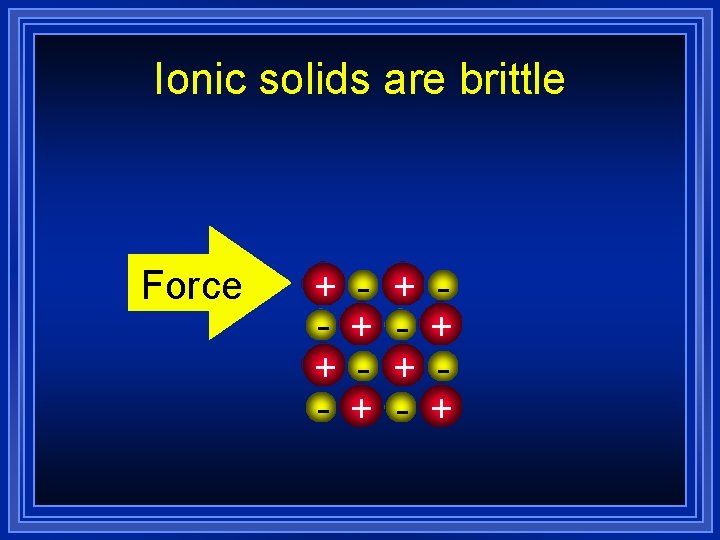
Ionic solids are brittle Force + + - + +
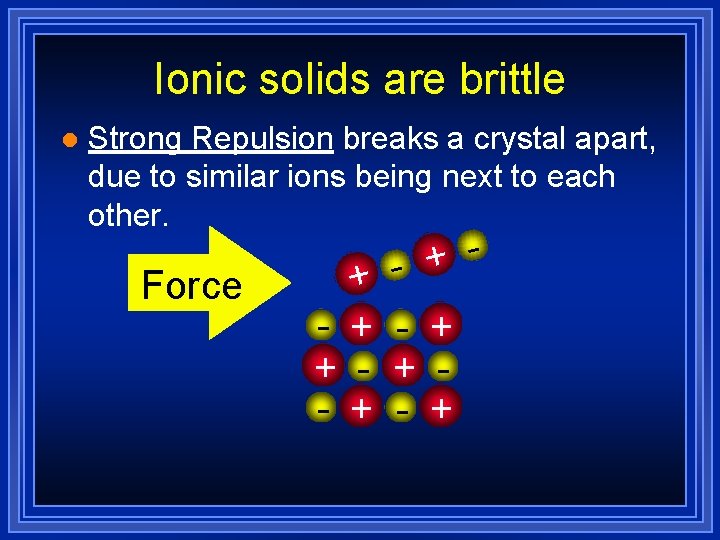
Ionic solids are brittle l Strong Repulsion breaks a crystal apart, due to similar ions being next to each other. Force + + - + - + - +
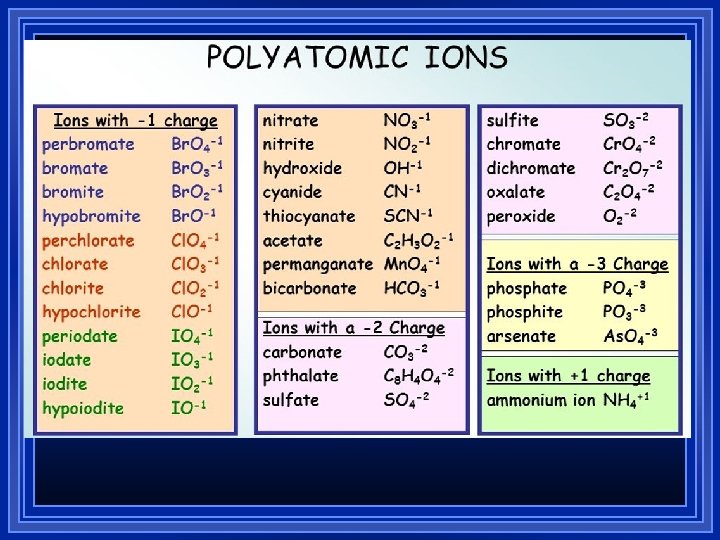
Polyatomic Ions • Certain atoms bond covalently with each other to form a group of atoms that has both molecular and ionic characteristics. • A charged group of covalently bonded atoms is known as a polyatomic ion. • Like other ions, polyatomic ions have a charge that results from either a shortage or excess of electrons.
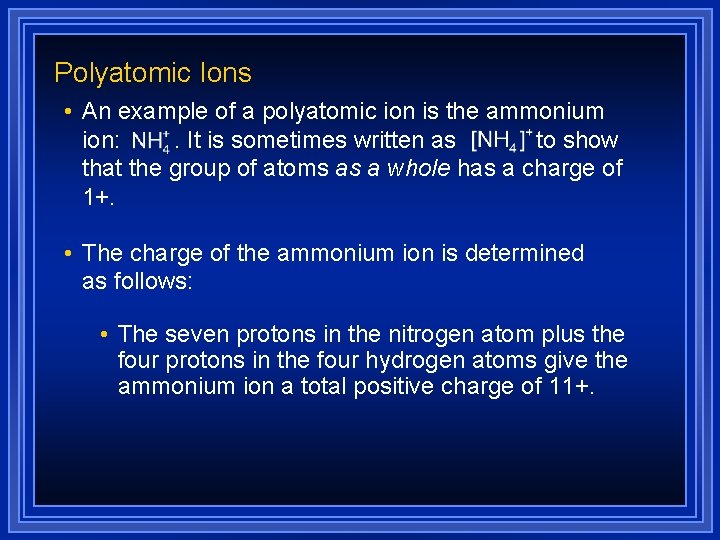
Polyatomic Ions • An example of a polyatomic ion is the ammonium ion: . It is sometimes written as to show that the group of atoms as a whole has a charge of 1+. • The charge of the ammonium ion is determined as follows: • The seven protons in the nitrogen atom plus the four protons in the four hydrogen atoms give the ammonium ion a total positive charge of 11+.
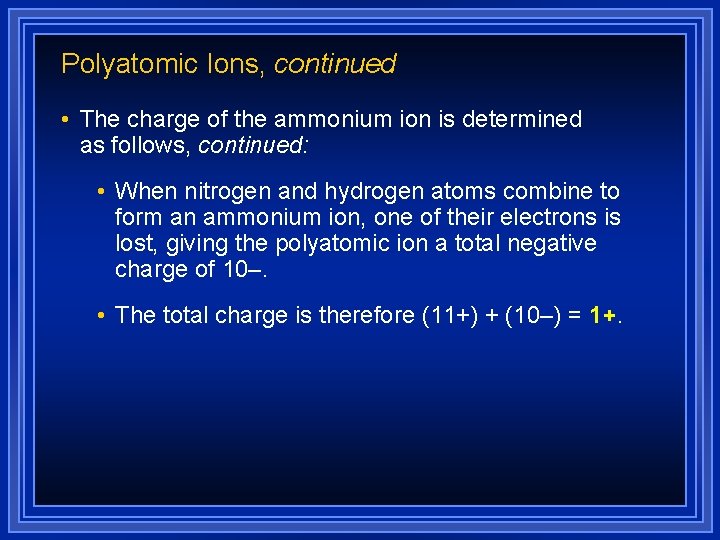
Polyatomic Ions, continued • The charge of the ammonium ion is determined as follows, continued: • When nitrogen and hydrogen atoms combine to form an ammonium ion, one of their electrons is lost, giving the polyatomic ion a total negative charge of 10–. • The total charge is therefore (11+) + (10–) = 1+.
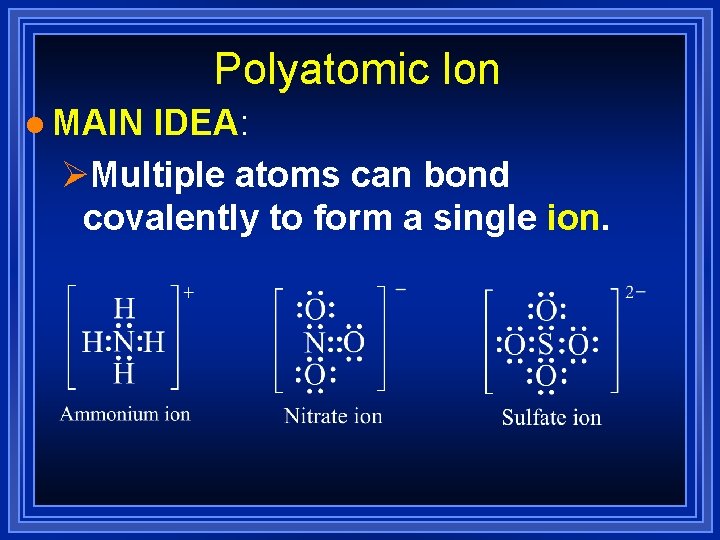
Polyatomic Ion l MAIN IDEA: ØMultiple atoms can bond covalently to form a single ion.
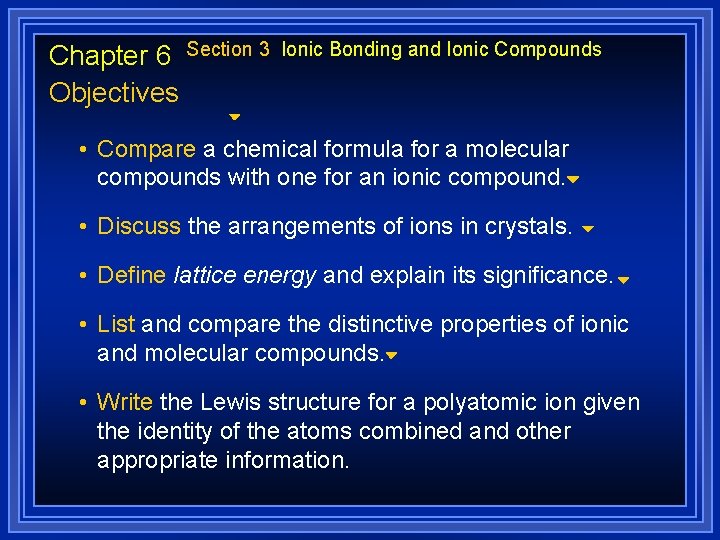
Chapter 6 Section 3 Objectives Ionic Bonding and Ionic Compounds • Compare a chemical formula for a molecular compounds with one for an ionic compound. • Discuss the arrangements of ions in crystals. • Define lattice energy and explain its significance. • List and compare the distinctive properties of ionic and molecular compounds. • Write the Lewis structure for a polyatomic ion given the identity of the atoms combined and other appropriate information.
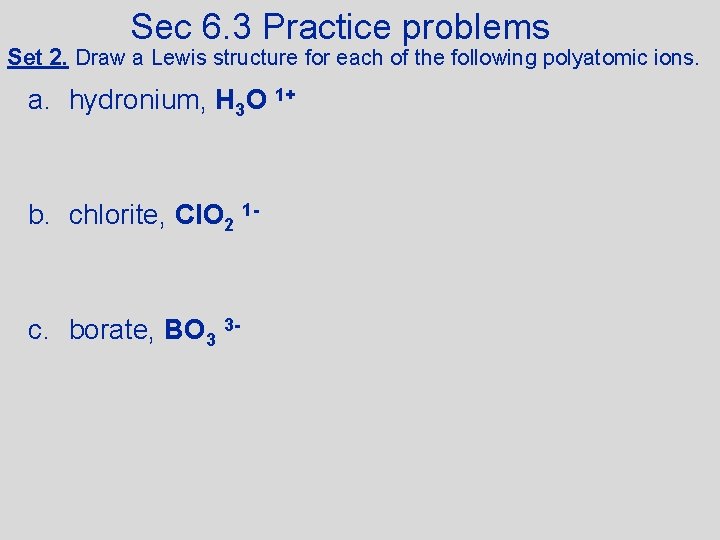
Sec 6. 3 Practice problems Set 2. Draw a Lewis structure for each of the following polyatomic ions. a. hydronium, H 3 O 1+ b. chlorite, Cl. O 2 1 - c. borate, BO 3 3 -
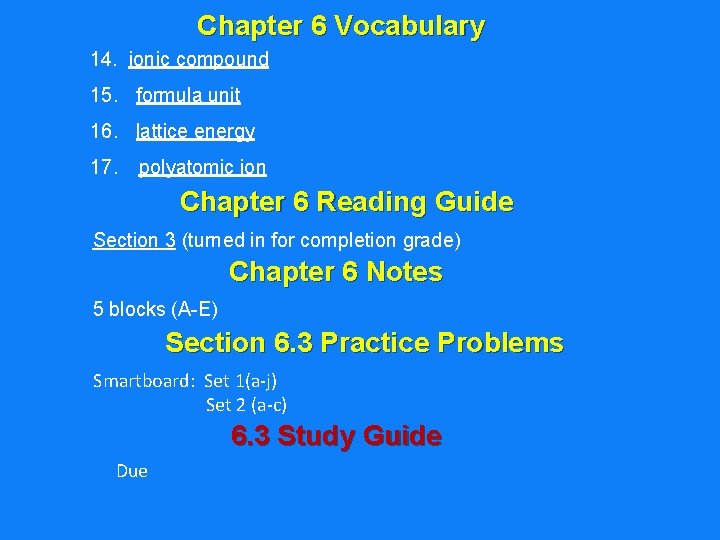
Chapter 6 Vocabulary 14. ionic compound 15. formula unit 16. lattice energy 17. polyatomic ion Chapter 6 Reading Guide Section 3 (turned in for completion grade) Chapter 6 Notes 5 blocks (A-E) Section 6. 3 Practice Problems Smartboard: Set 1(a-j) Set 2 (a-c) 6. 3 Study Guide Due
- Slides: 63