
Section 6 2 The Work Energy Theorem and

- Slides: 11
Section 6 -2 The Work Energy Theorem and Kinetic Energy
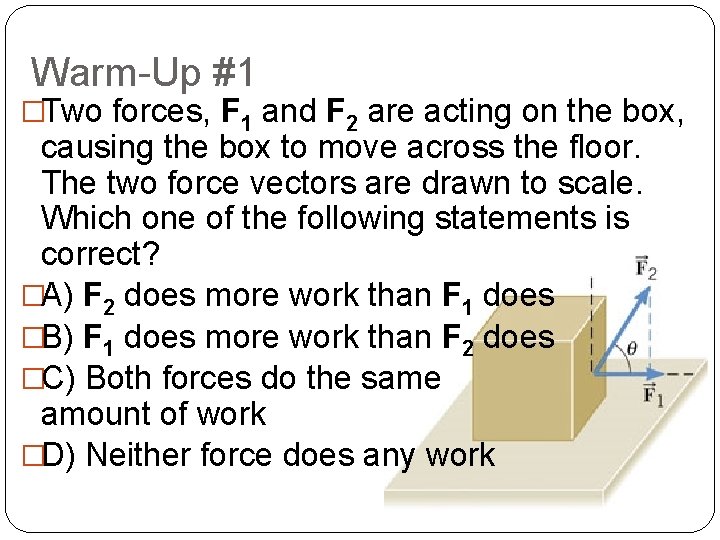
Warm-Up #1 �Two forces, F 1 and F 2 are acting on the box, causing the box to move across the floor. The two force vectors are drawn to scale. Which one of the following statements is correct? �A) F 2 does more work than F 1 does �B) F 1 does more work than F 2 does �C) Both forces do the same amount of work �D) Neither force does any work
Warm-Up #2 �A box is being moved with a velocity v by a force P (in the same direction as v) along a level floor. The normal force is FN, the kinetic frictional force is fk, and the weight is mg. Which one of the following statements is correct? �A) FN does positive work, P and fk do zero work, and mg does negative work �B) FN does positive work, P and f. K do zero work, and mg does negative work �C) f. K does positive work, FN and mg do zero work, and P does negative work �D) P does positive work, FN and mg do zero work, and f. K does negative work
6. 2 The Work-Energy Theorem �In physics, when a net force performs work on an object, the result is a change in the kinetic energy of the object.
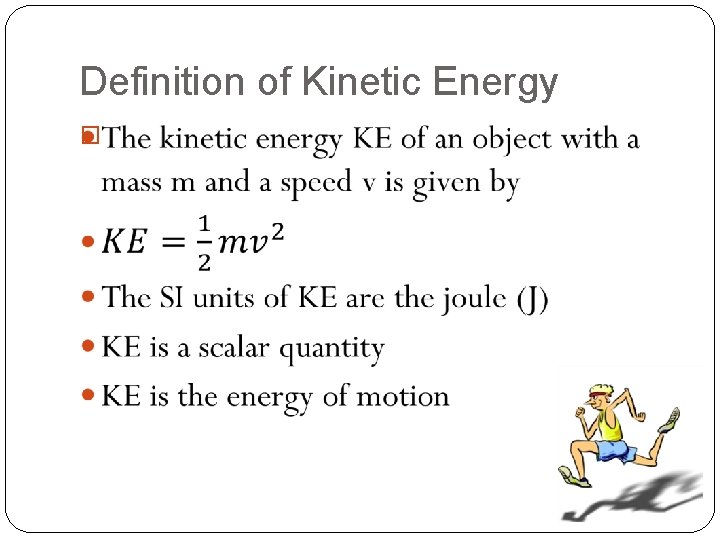
Definition of Kinetic Energy �
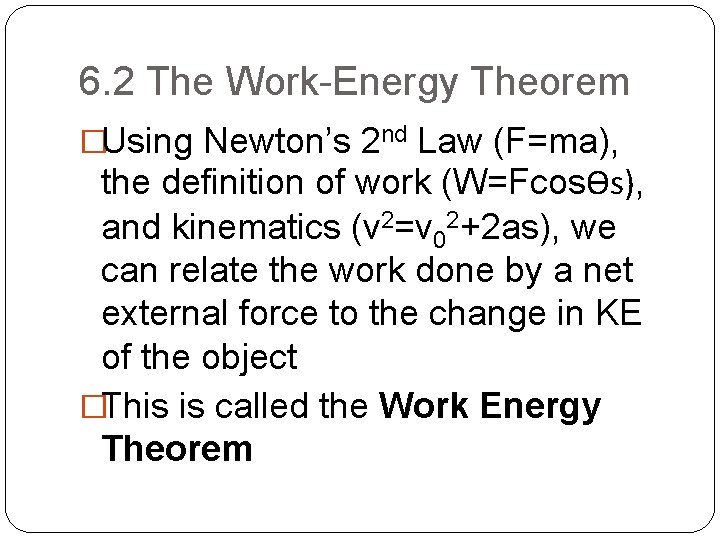
6. 2 The Work-Energy Theorem �Using Newton’s 2 nd Law (F=ma), the definition of work (W=FcosƟs), and kinematics (v 2=v 02+2 as), we can relate the work done by a net external force to the change in KE of the object �This is called the Work Energy Theorem
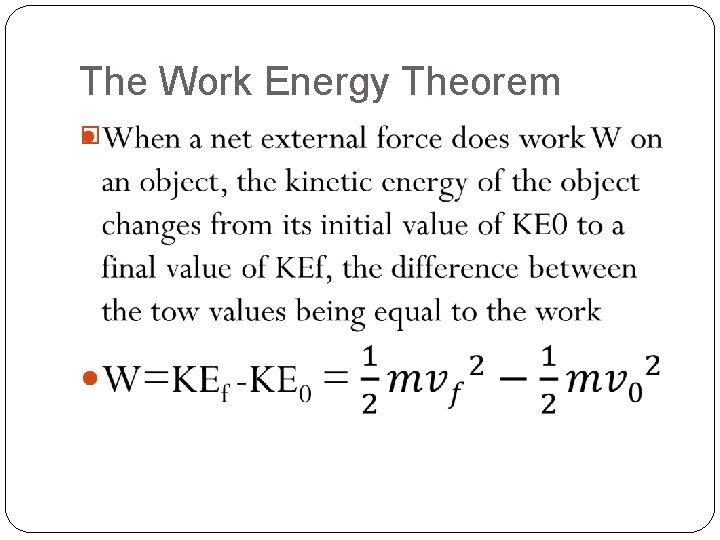
The Work Energy Theorem �
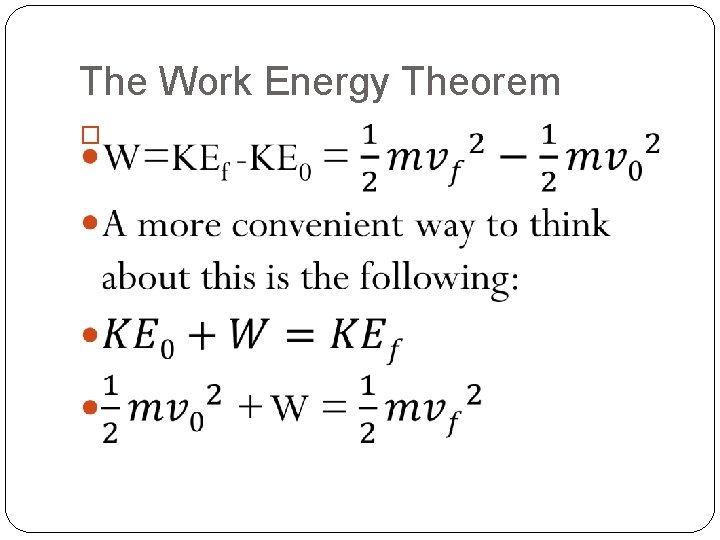
The Work Energy Theorem �
Example 1 p. 165 �Deep Space 1 was a probe launched in 1998. Its engine produced a constant, low-level thrust force of 0. 0560 N. The probe has a mass of 474 kg. If it traveled at an initial speed of 275 m/s and no forces acted on it except the engine. This force is directed parallel to the displacement, d (of course!). The probe moved a distance of 2. 42 x 109 meters. Determine the final speed of the probe, assuming that the mass remains constant.
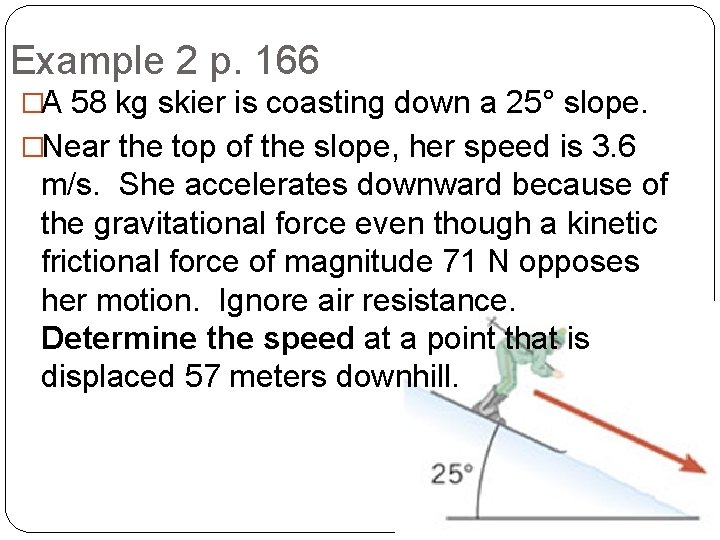
Example 2 p. 166 �A 58 kg skier is coasting down a 25° slope. �Near the top of the slope, her speed is 3. 6 m/s. She accelerates downward because of the gravitational force even though a kinetic frictional force of magnitude 71 N opposes her motion. Ignore air resistance. Determine the speed at a point that is displaced 57 meters downhill.
Assignment �p. 187 Focus on Concepts #8, 9 �p. 188 #13 -27 odds