
Section 6 2 The Student Class Continued Fundamentals

- Slides: 10
Section 6. 2 The Student Class Continued Fundamentals of Java: AP Computer Science Essentials, 4 th Edition Lambert / Osborne
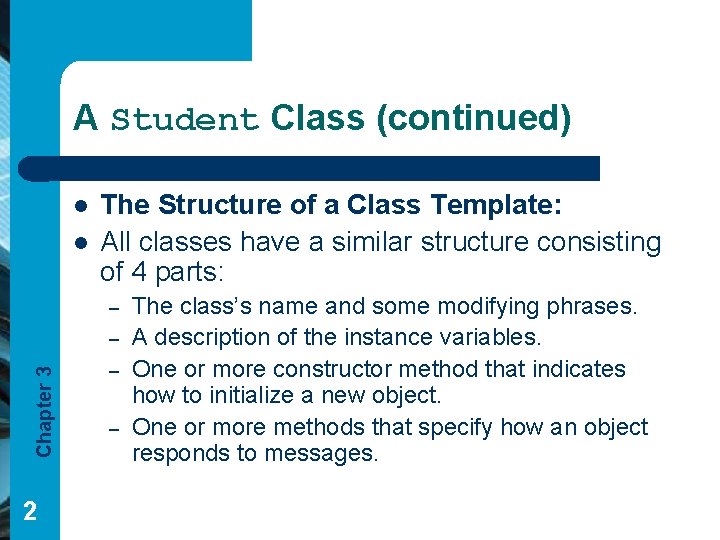
A Student Class (continued) l l The Structure of a Class Template: All classes have a similar structure consisting of 4 parts: – Chapter 3 – 2 – – The class’s name and some modifying phrases. A description of the instance variables. One or more constructor method that indicates how to initialize a new object. One or more methods that specify how an object responds to messages.
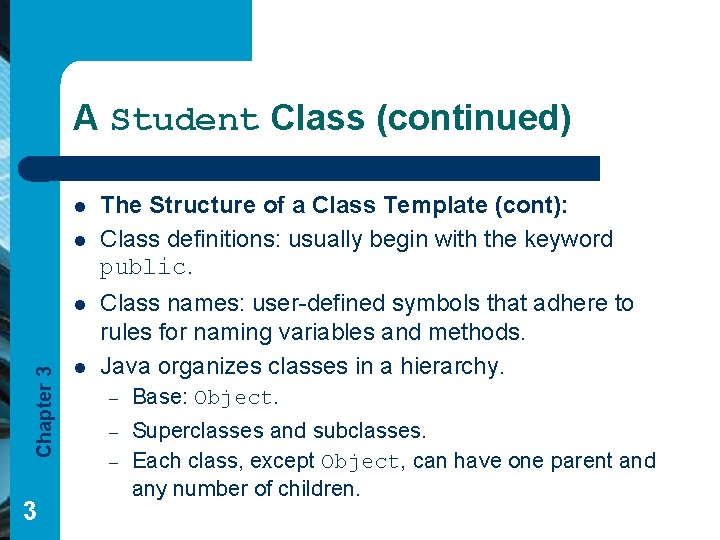
A Student Class (continued) l l Chapter 3 l The Structure of a Class Template (cont): Class definitions: usually begin with the keyword public. Class names: user-defined symbols that adhere to rules for naming variables and methods. Java organizes classes in a hierarchy. – Base: Object. – Superclasses and subclasses. Each class, except Object, can have one parent and any number of children. –
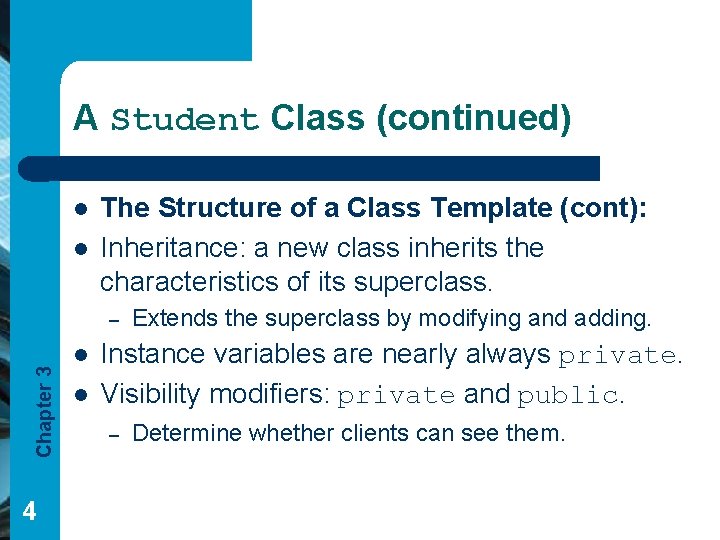
A Student Class (continued) l l The Structure of a Class Template (cont): Inheritance: a new class inherits the characteristics of its superclass. Chapter 3 – 4 l l Extends the superclass by modifying and adding. Instance variables are nearly always private. Visibility modifiers: private and public. – Determine whether clients can see them.
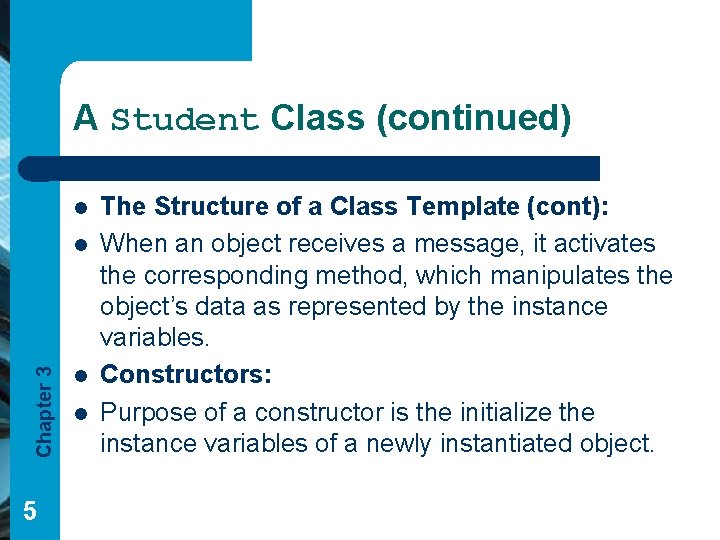
A Student Class (continued) l Chapter 3 l 5 l l The Structure of a Class Template (cont): When an object receives a message, it activates the corresponding method, which manipulates the object’s data as represented by the instance variables. Constructors: Purpose of a constructor is the initialize the instance variables of a newly instantiated object.
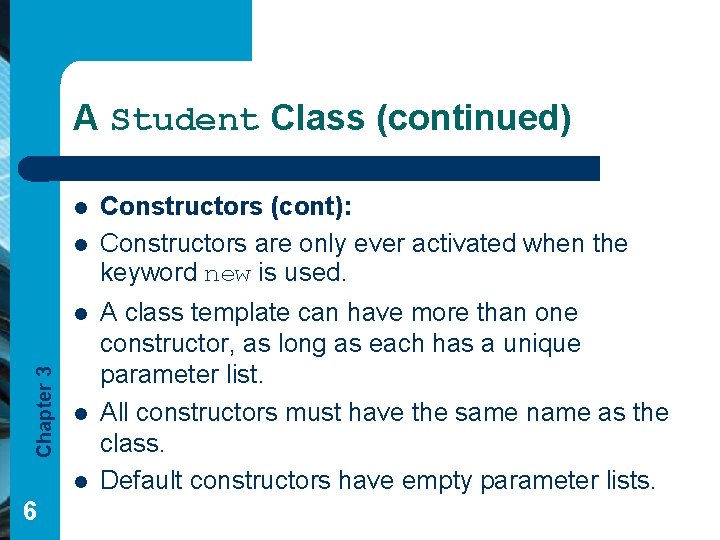
A Student Class (continued) l l Chapter 3 l l l 6 Constructors (cont): Constructors are only ever activated when the keyword new is used. A class template can have more than one constructor, as long as each has a unique parameter list. All constructors must have the same name as the class. Default constructors have empty parameter lists.
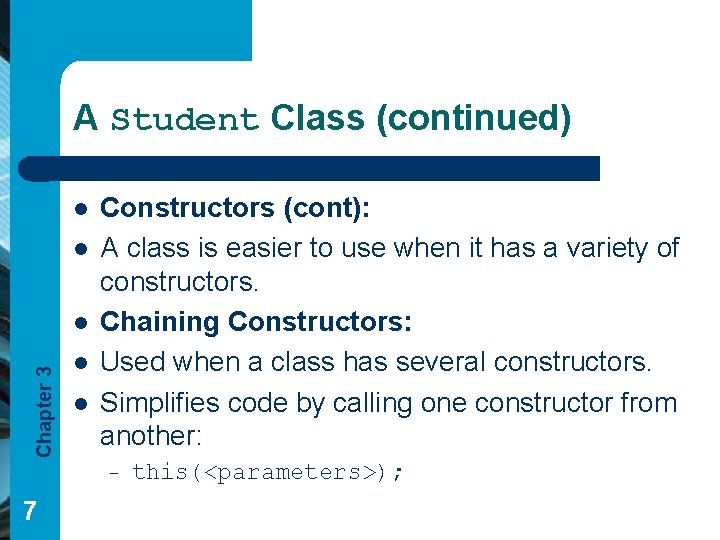
A Student Class (continued) l l Chapter 3 l l l Constructors (cont): A class is easier to use when it has a variety of constructors. Chaining Constructors: Used when a class has several constructors. Simplifies code by calling one constructor from another: – 7 this(<parameters>);
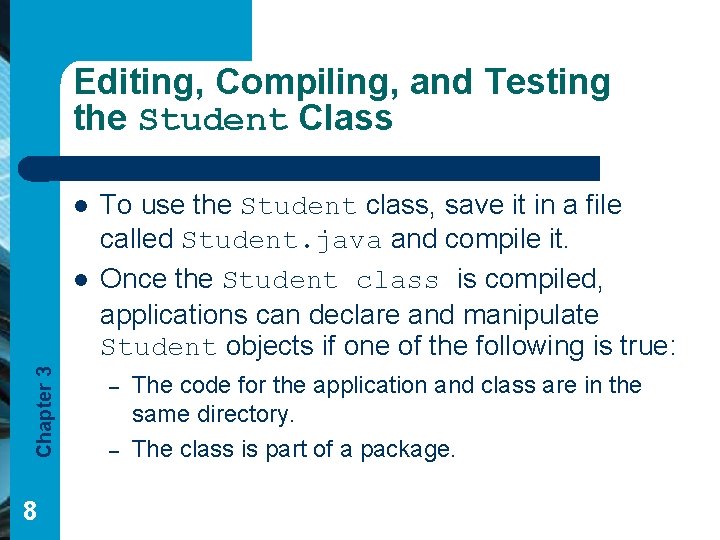
Editing, Compiling, and Testing the Student Class l Chapter 3 l 8 To use the Student class, save it in a file called Student. java and compile it. Once the Student class is compiled, applications can declare and manipulate Student objects if one of the following is true: – – The code for the application and class are in the same directory. The class is part of a package.
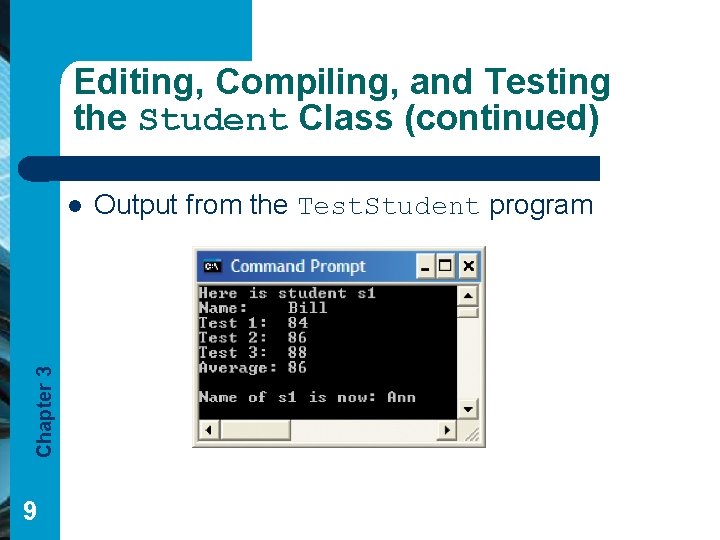
Editing, Compiling, and Testing the Student Class (continued) Chapter 3 l 9 Output from the Test. Student program
10 Chapter 3