
Section 6 2 The Binomial Distribution Binomial Probabilities
Section 6. 2 The Binomial Distribution
Binomial Probabilities Binomial situations: each trial has two possible outcomes
Binomial Probabilities Binomial situations: each trial has two possible outcomes • # of doubles in n rolls of a pair of dice -- either get doubles or you don’t
Binomial Probabilities Binomial situations: each trial has two possible outcomes • # of doubles in n rolls of a pair of dice -- either get doubles or you don’t • # of patients with hepatitis in sample of n patients -- either has hepatitis or does not
Notation n: number of trials

Notation n: number of trials p: probability of success on any one trial
Notation n: number of trials p: probability of success on any one trial 1 – p: probability of failure on any one trial
Notation n: number of trials p: probability of success on any one trial 1 – p: probability of failure on any one trial q: often used in place of 1 - p
Binomial Probability Distribution To have a binomial probability distribution 4 conditions must be satisfied.
Binomial Probability Distribution To have a binomial probability distribution 4 conditions must be satisfied. Check BINS
BINS B: a series of trials must be binomial -- each trial must have one of two different outcomes, one called a “success” and the other a “failure”
BINS B: a series of trials must be binomial I: each trial is independent of the others
BINS B: a series of trials must be binomial I: each trial is independent of the others N: there is a fixed number, n, of trials
BINS B: a series of trials must be binomial I: each trial is independent of the others N: there is a fixed number, n, of trials S: the probability, p, of a success is the same on each trial, with 0 < p <1
Binomial Distribution? From a class of 20 students, half of whom are seniors, the teacher selects 10 students at random to check for completion of today’s paper.
Binomial Distribution? From a class of 20 students, half of whom are seniors, the teacher selects 10 students at random to check for completion of today’s paper. If X denotes the number of papers belonging to seniors among those checked , will X have a binomial distribution? Explain why or why not.
Binomial Distribution? No, the binomial distribution will not be a good model in this scenario because the sampling is without replacement from a small population. An important assumption of a binomial distribution is that the trials are independent.
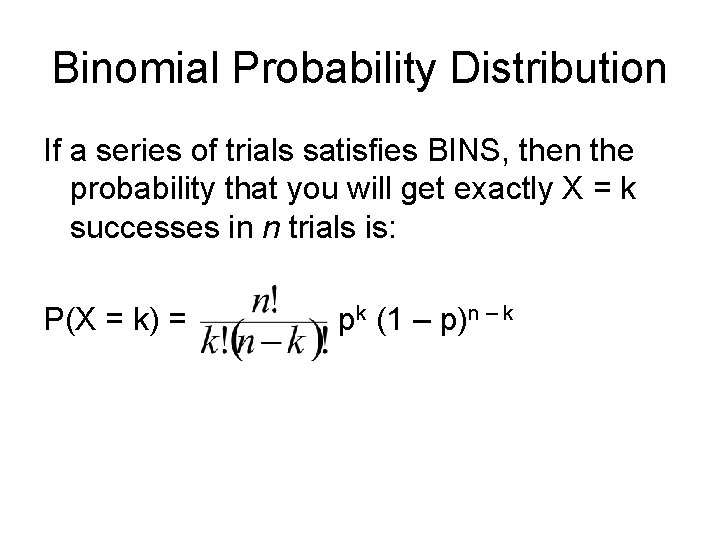
Binomial Probability Distribution If a series of trials satisfies BINS, then the probability that you will get exactly X = k successes in n trials is: P(X = k) = pk (1 – p)n – k
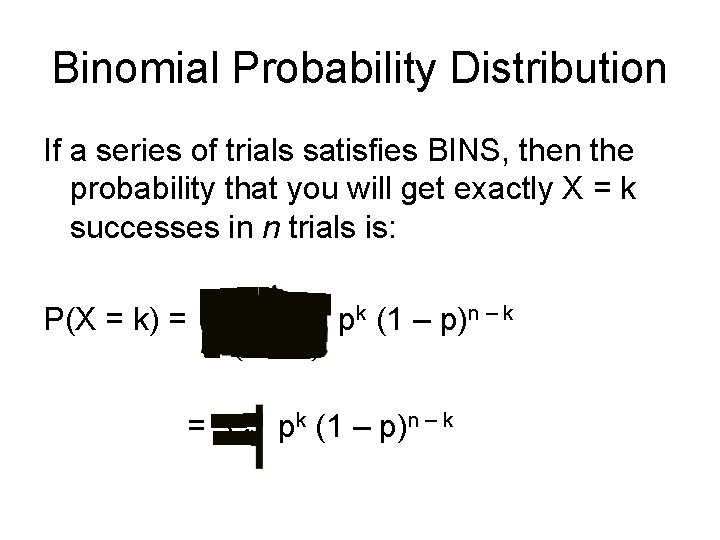
Binomial Probability Distribution If a series of trials satisfies BINS, then the probability that you will get exactly X = k successes in n trials is: P(X = k) = pk (1 – p)n – k = n. Ck pk (1 – p)n – k
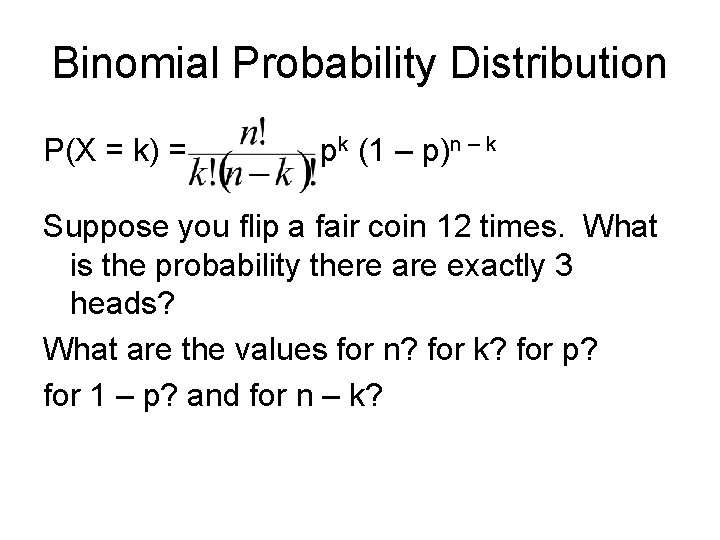
Binomial Probability Distribution P(X = k) = pk (1 – p)n – k Suppose you flip a fair coin 12 times. What is the probability there are exactly 3 heads? What are the values for n? for k? for p? for 1 – p? and for n – k?
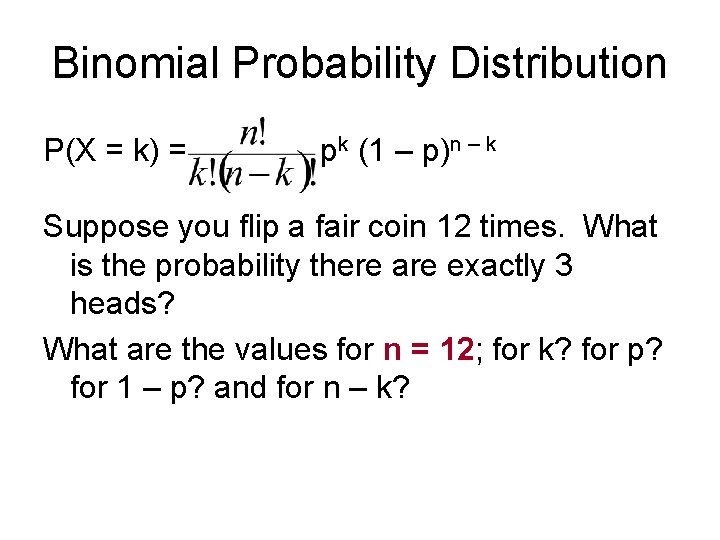
Binomial Probability Distribution P(X = k) = pk (1 – p)n – k Suppose you flip a fair coin 12 times. What is the probability there are exactly 3 heads? What are the values for n = 12; for k? for p? for 1 – p? and for n – k?
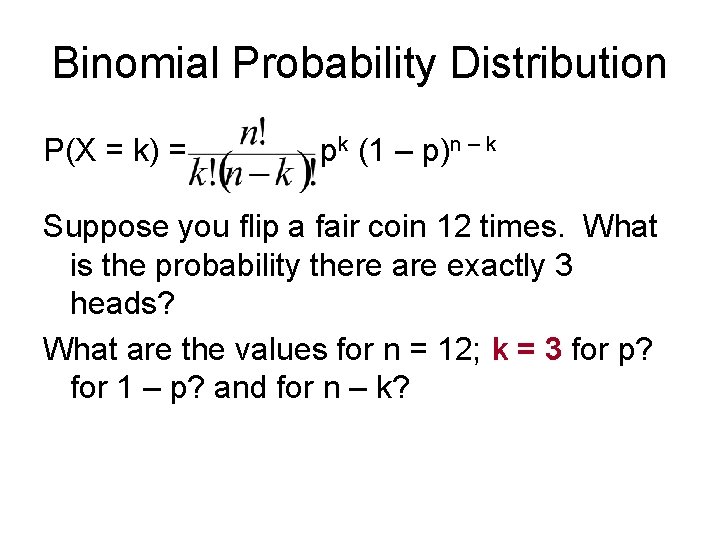
Binomial Probability Distribution P(X = k) = pk (1 – p)n – k Suppose you flip a fair coin 12 times. What is the probability there are exactly 3 heads? What are the values for n = 12; k = 3 for p? for 1 – p? and for n – k?
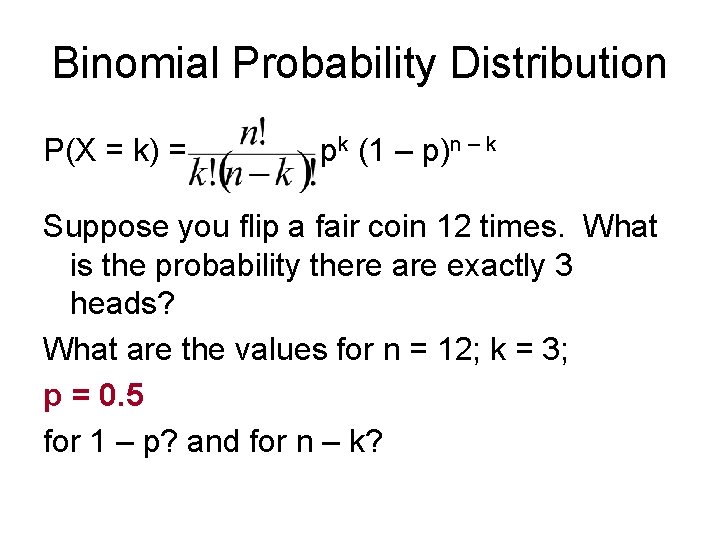
Binomial Probability Distribution P(X = k) = pk (1 – p)n – k Suppose you flip a fair coin 12 times. What is the probability there are exactly 3 heads? What are the values for n = 12; k = 3; p = 0. 5 for 1 – p? and for n – k?
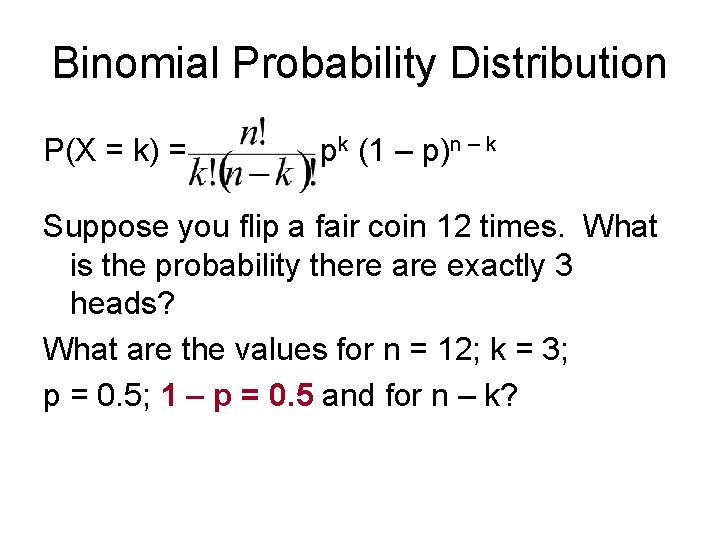
Binomial Probability Distribution P(X = k) = pk (1 – p)n – k Suppose you flip a fair coin 12 times. What is the probability there are exactly 3 heads? What are the values for n = 12; k = 3; p = 0. 5; 1 – p = 0. 5 and for n – k?
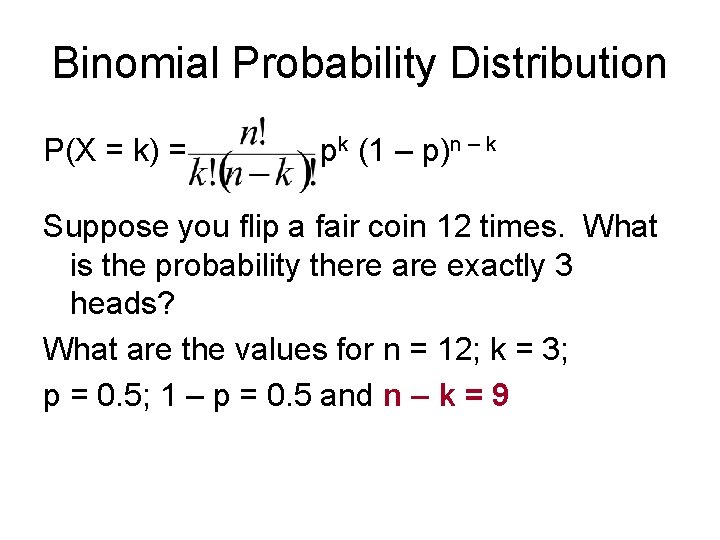
Binomial Probability Distribution P(X = k) = pk (1 – p)n – k Suppose you flip a fair coin 12 times. What is the probability there are exactly 3 heads? What are the values for n = 12; k = 3; p = 0. 5; 1 – p = 0. 5 and n – k = 9
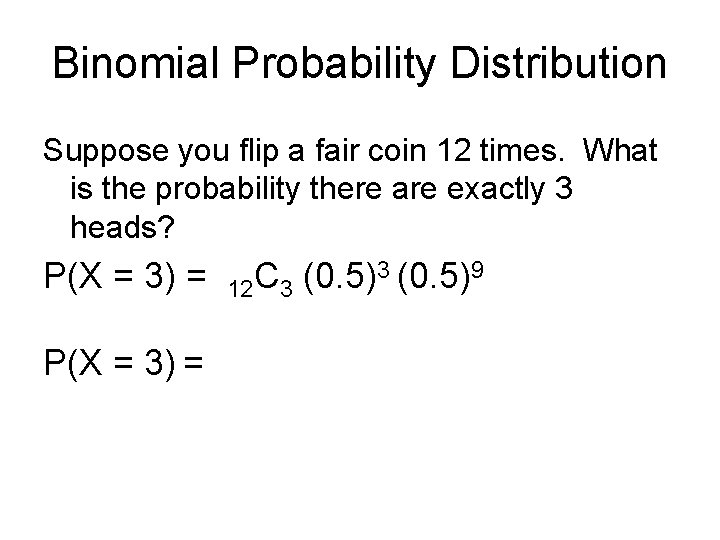
Binomial Probability Distribution Suppose you flip a fair coin 12 times. What is the probability there are exactly 3 heads? P(X = 3) = 3 (0. 5)9 C (0. 5) 12 3
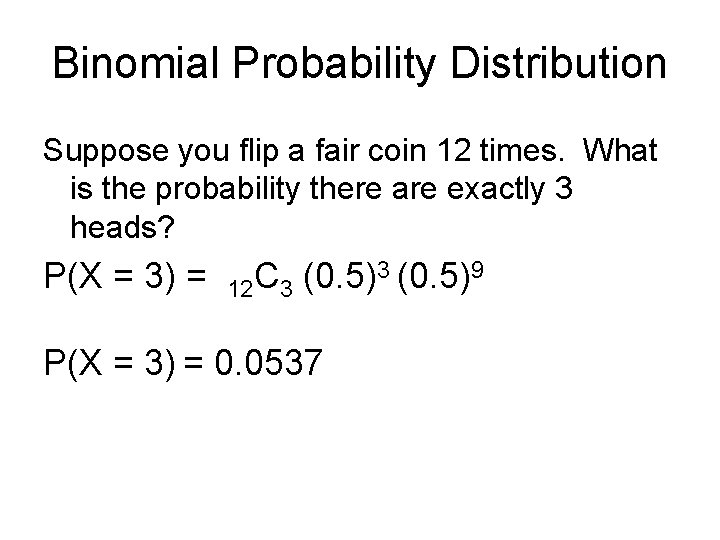
Binomial Probability Distribution Suppose you flip a fair coin 12 times. What is the probability there are exactly 3 heads? P(X = 3) = 3 (0. 5)9 C (0. 5) 12 3 P(X = 3) = 0. 0537
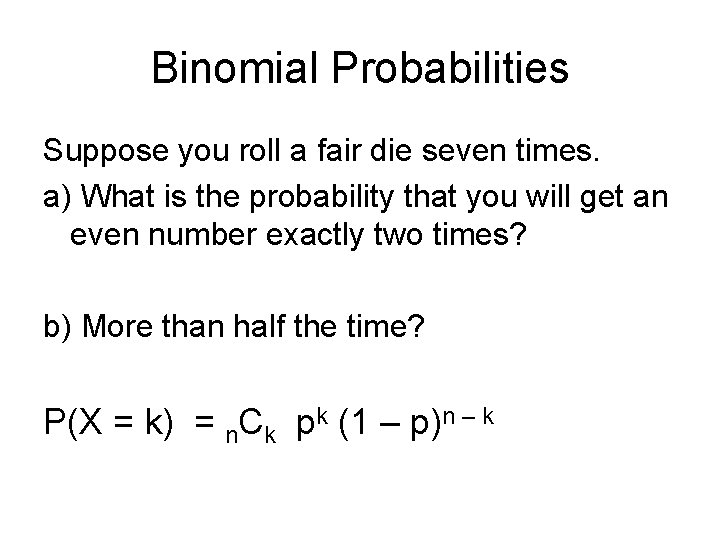
Binomial Probabilities Suppose you roll a fair die seven times. a) What is the probability that you will get an even number exactly two times? b) More than half the time? P(X = k) = n. Ck pk (1 – p)n – k
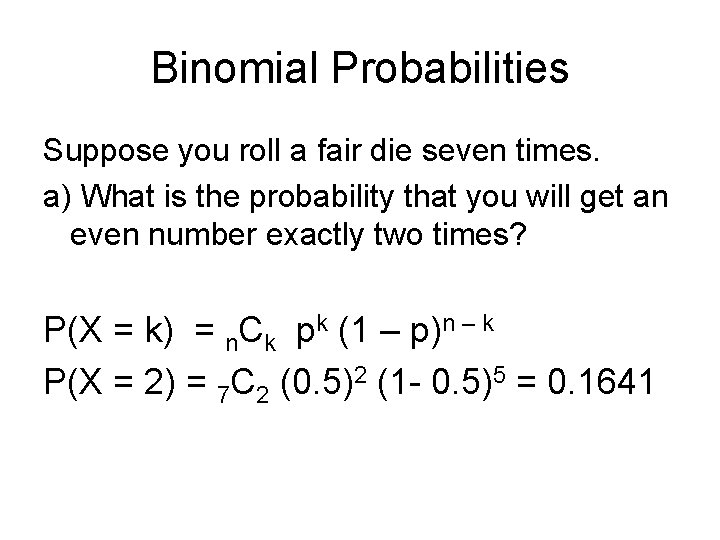
Binomial Probabilities Suppose you roll a fair die seven times. a) What is the probability that you will get an even number exactly two times? P(X = k) = n. Ck pk (1 – p)n – k P(X = 2) = 7 C 2 (0. 5)2 (1 - 0. 5)5 = 0. 1641
Binomial Probabilities Suppose you roll a fair die seven times. b) What is the probability that you will get an even number more than half the time?
Binomial Probabilities Suppose you roll a fair die seven times. b) What is the probability that you will get an even number more than half the time? P(X > 3) = P(X = 4) + P(X = 5) + P(X = 6) + P(X = 7) = 0. 5
Calculator Notes A binomial probability distribution is easier if you use a calculator. binompdf(n, p, k)
Calculator Notes A binomial probability distribution is easier if you use a calculator. binompdf(n, p, k) binompdf(number of trials, probability of success, number of successes)
Calculator Notes A binomial probability distribution is easier if you use a calculator. binompdf(n, p, k) 2 nd DISTR A: binompdf(
Calculator Notes A binomial probability distribution is easier if you use a calculator. Suppose you flip a fair coin 12 times. What is the probability there are exactly 3 heads? (Calculated before as 0. 0537) binompdf(n, p, k) = binompdf(12, 0. 5, 3) =
Calculator Notes A binomial probability distribution is easier if you use a calculator. Suppose you flip a fair coin 12 times. What is the probability there are exactly 3 heads? (Calculated before as 0. 0537) binompdf(n, p, k) = binompdf(12, 0. 5, 3) = 0. 0537
Probability Distribution Table There are n + 1 possible outcomes when you count the number of successes in n binomial trials.
Probability Distribution Table There are n + 1 possible outcomes when you count the number of successes in n binomial trials. Students tend to ignore the probability of 0 successes.
Probability Distribution Table Make a probability distribution table for the number of college graduates in a random sample of seven adults if 27% of adults are college graduates. How many possible outcomes are there?
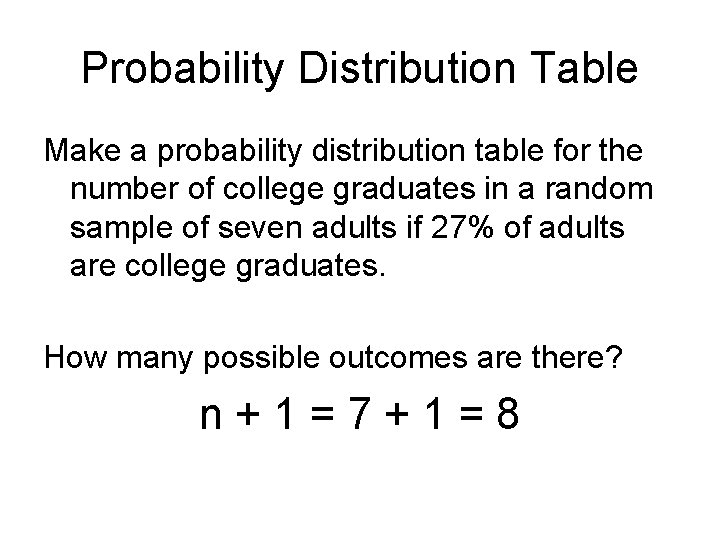
Probability Distribution Table Make a probability distribution table for the number of college graduates in a random sample of seven adults if 27% of adults are college graduates. How many possible outcomes are there? n+1=7+1=8
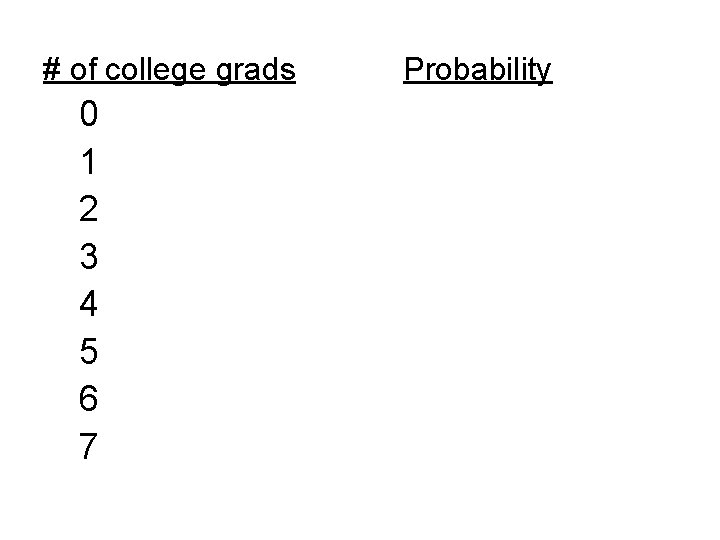
# of college grads 0 1 2 3 4 5 6 7 Probability
Make a probability distribution table for the number of college graduates in a random sample of seven adults if 27% of adults are college graduates. binompdf( 7, 0. 27)
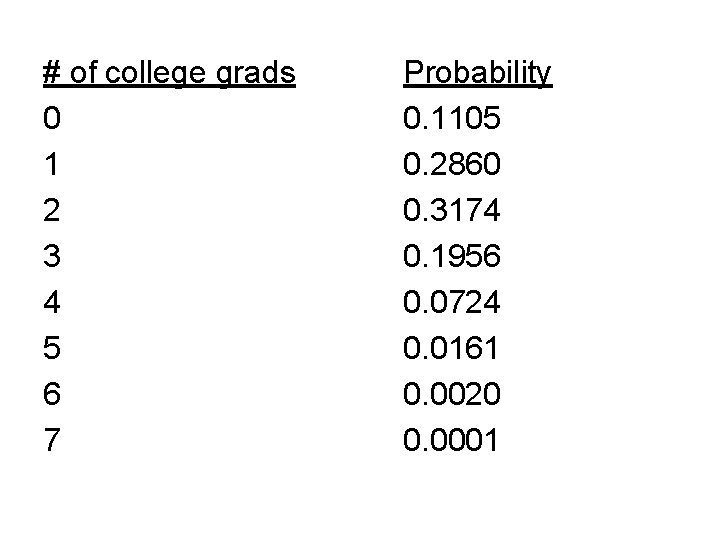
# of college grads 0 1 2 3 4 5 6 7 Probability 0. 1105 0. 2860 0. 3174 0. 1956 0. 0724 0. 0161 0. 0020 0. 0001
According to a recent government report, 73% of drivers now use seat belts regularly. Suppose a police officer at a road check randomly stops four cars to check for seat belt usage. Find the probability distribution of X, the number of drivers using seat belts.
According to a recent government report, 73% of drivers now use seat belts regularly. Suppose a police officer at a road check randomly stops four cars to check for seat belt usage. Find the probability distribution of X, the number of drivers using seat belts. binompdf(4, . 73)
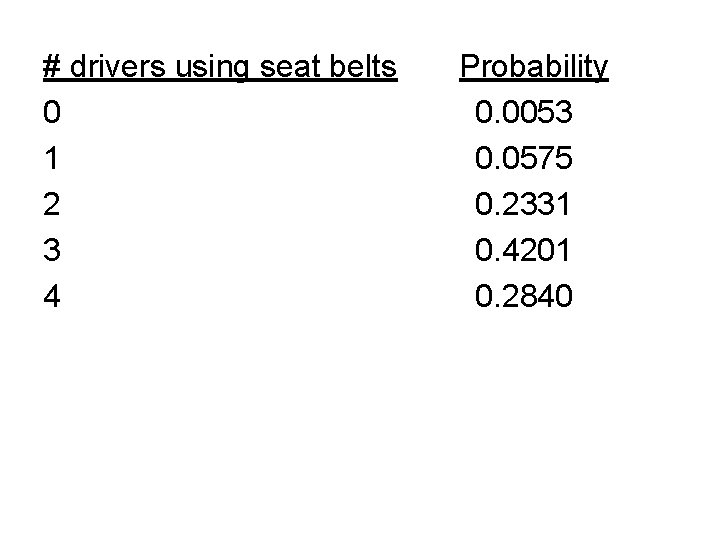
# drivers using seat belts 0 1 2 3 4 Probability 0. 0053 0. 0575 0. 2331 0. 4201 0. 2840
Shape, Center, and Spread For a random variable, X having a binomial distribution with n trials and probability of success p: Shape? Center? Spread?
Shape, Center, and Spread As n increases, the shape of the distribution becomes more normal.
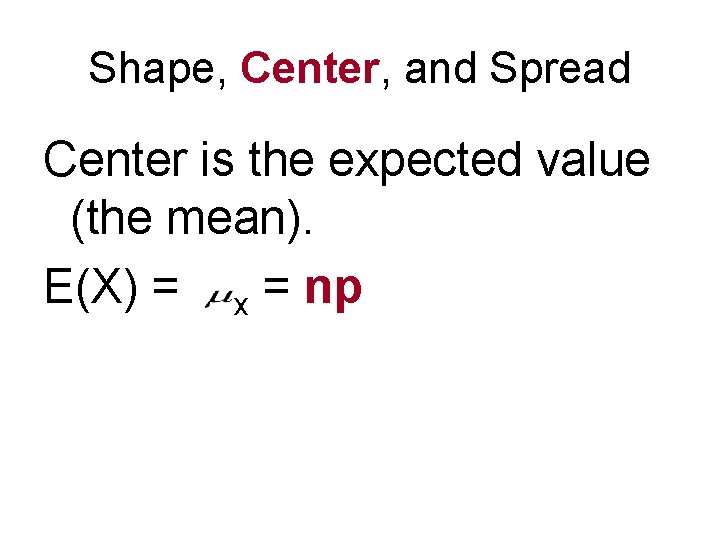
Shape, Center, and Spread Center is the expected value (the mean). E(X) = x = np
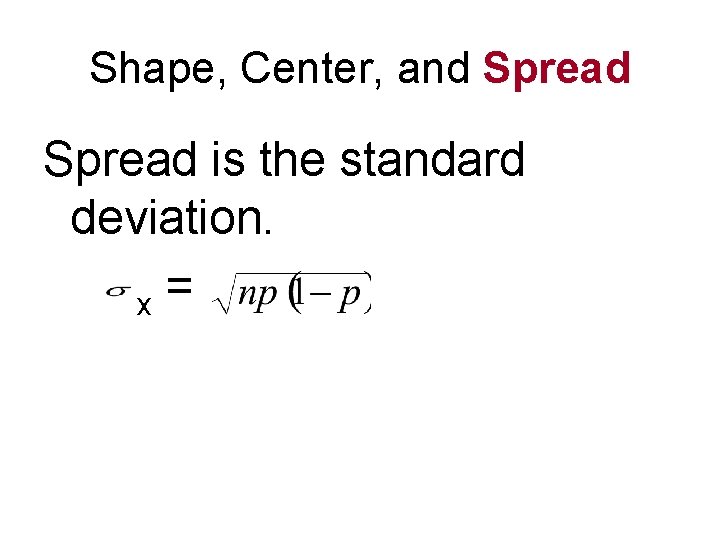
Shape, Center, and Spread is the standard deviation. x =
About 27% of U. S. adults have at least a bachelor’s degree. If you select 100 adults at random from all adults in the United States, how many do you expect to have a bachelor’s degree and with what standard deviation?
About 27% of U. S. adults have at least a bachelor’s degree. If you select 100 adults at random from all adults in the United States, how many do you expect to have a bachelor’s degree and with what standard deviation? E(X) = np = 100(. 27) = 27
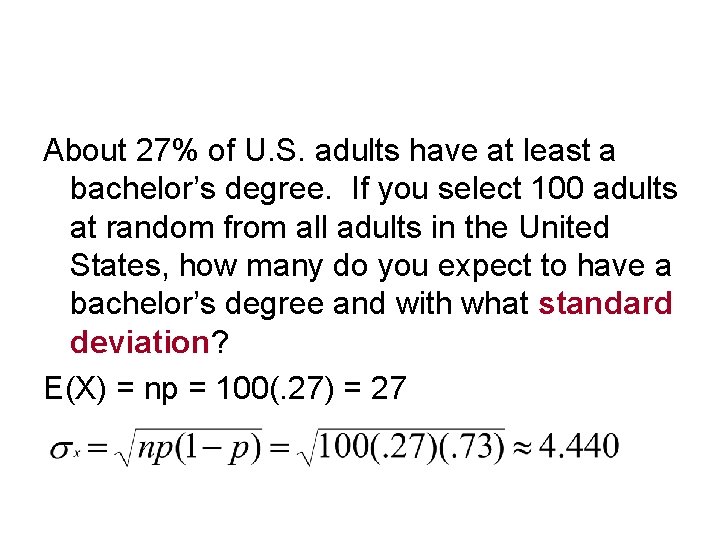
About 27% of U. S. adults have at least a bachelor’s degree. If you select 100 adults at random from all adults in the United States, how many do you expect to have a bachelor’s degree and with what standard deviation? E(X) = np = 100(. 27) = 27
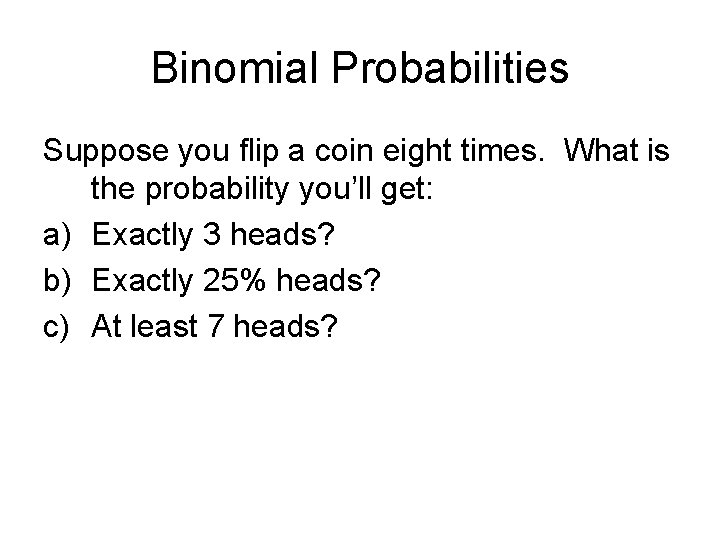
Binomial Probabilities Suppose you flip a coin eight times. What is the probability you’ll get: a) Exactly 3 heads? b) Exactly 25% heads? c) At least 7 heads?
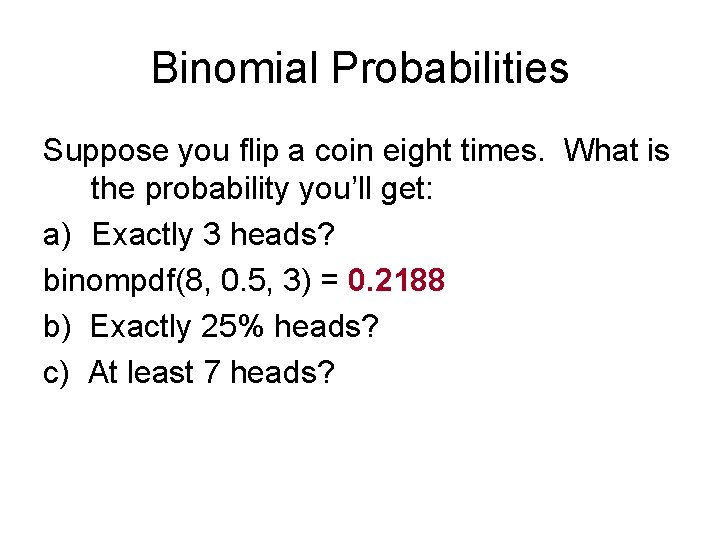
Binomial Probabilities Suppose you flip a coin eight times. What is the probability you’ll get: a) Exactly 3 heads? binompdf(8, 0. 5, 3) = 0. 2188 b) Exactly 25% heads? c) At least 7 heads?
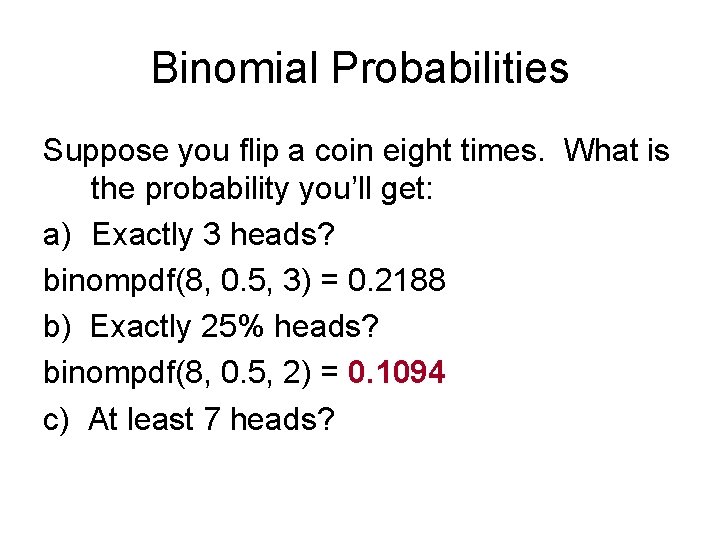
Binomial Probabilities Suppose you flip a coin eight times. What is the probability you’ll get: a) Exactly 3 heads? binompdf(8, 0. 5, 3) = 0. 2188 b) Exactly 25% heads? binompdf(8, 0. 5, 2) = 0. 1094 c) At least 7 heads?
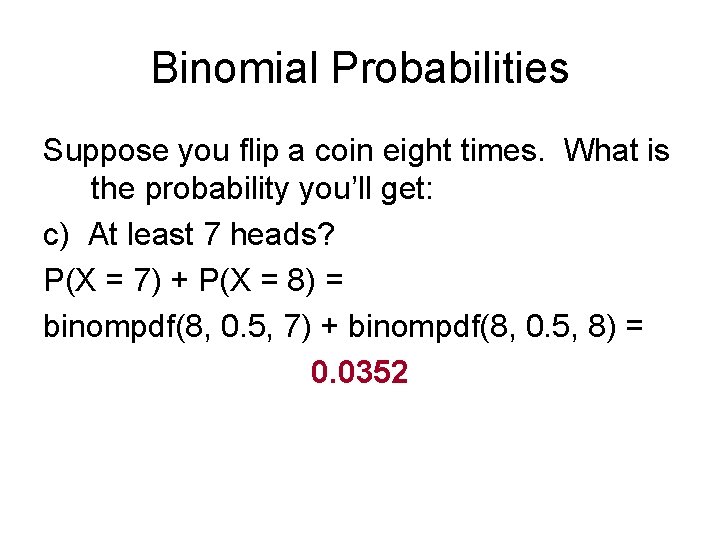
Binomial Probabilities Suppose you flip a coin eight times. What is the probability you’ll get: c) At least 7 heads? P(X = 7) + P(X = 8) = binompdf(8, 0. 5, 7) + binompdf(8, 0. 5, 8) = 0. 0352
Questions?
- Slides: 58