
Section 6 2 Calculating Coefficients Of Generating Functions
- Slides: 17
Section 6. 2 Calculating Coefficients Of Generating Functions Aaron Desrochers Ben Epstein Colleen Raimondi Tucker, Section 6. 2 1
Calculating Coefficients Of Generating Functions • This chapter is about developing algebraic techniques for calculating the coefficients of generating functions. • All methods seek to reduce a given generating function to a simple binomial –type generating function, or a product of binomial-type generating functions. Tucker, Section 6. 2 2
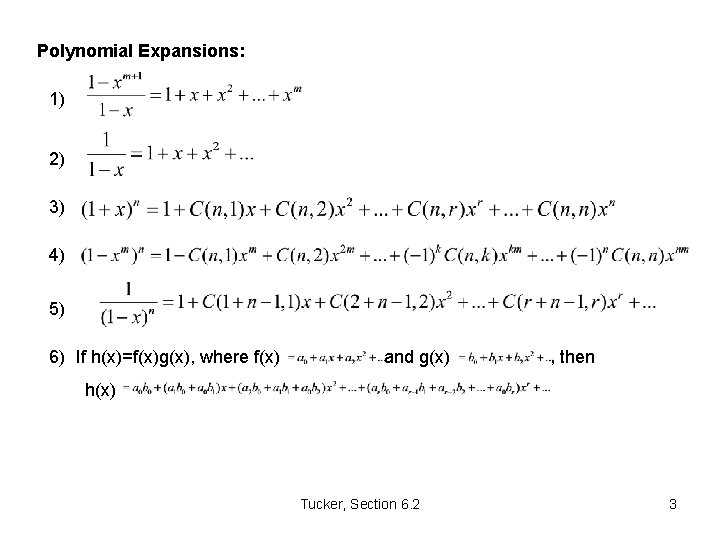
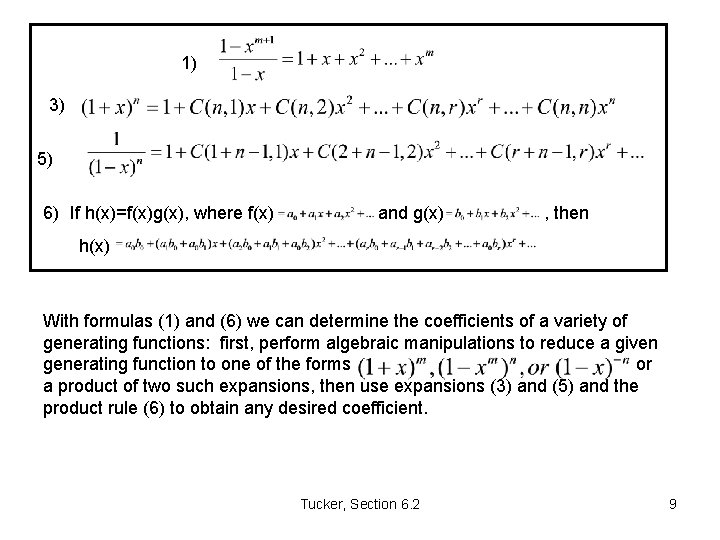
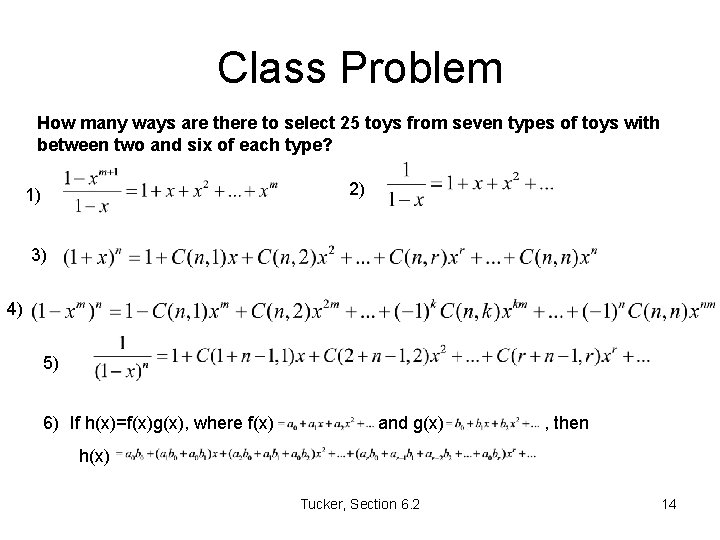
Polynomial Expansions: 1) 2) 3) 4) 5) 6) If h(x)=f(x)g(x), where f(x) and g(x) , then h(x) Tucker, Section 6. 2 3
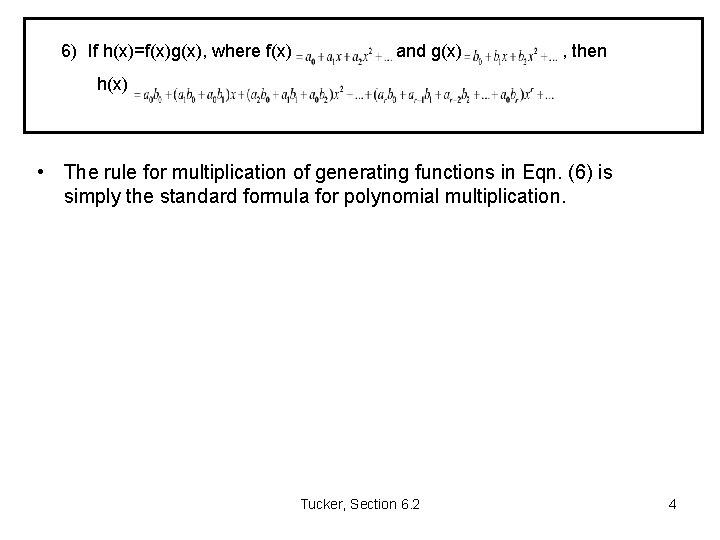
6) If h(x)=f(x)g(x), where f(x) and g(x) , then h(x) • The rule for multiplication of generating functions in Eqn. (6) is simply the standard formula for polynomial multiplication. Tucker, Section 6. 2 4
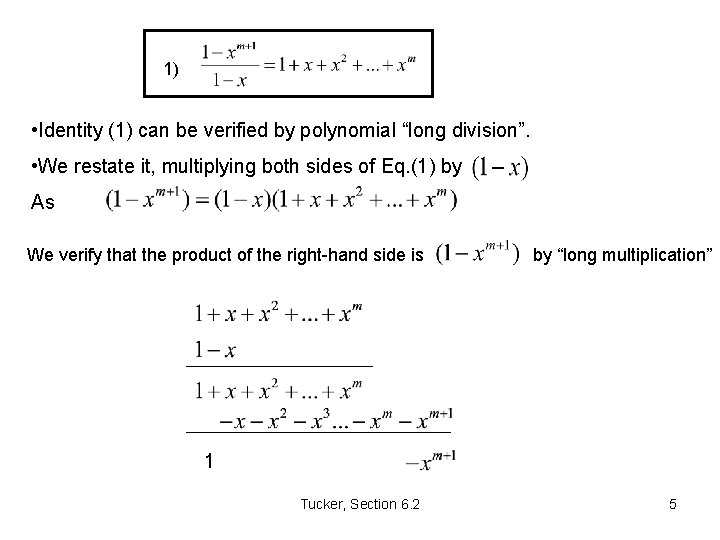
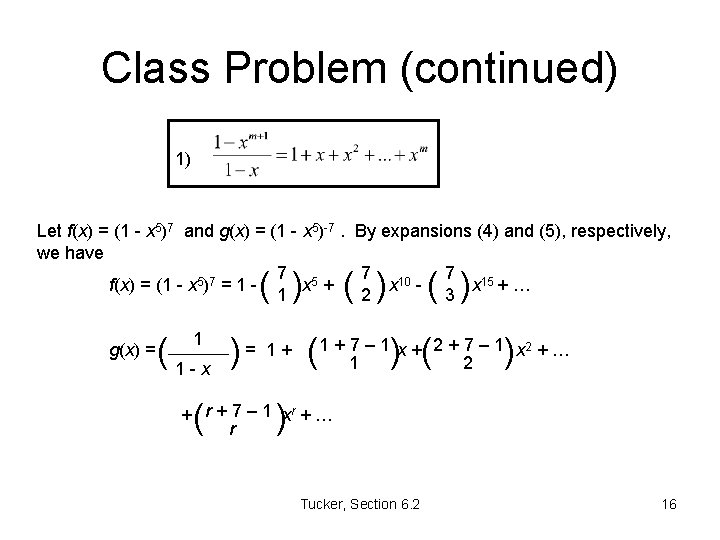
1) • Identity (1) can be verified by polynomial “long division”. • We restate it, multiplying both sides of Eq. (1) by As We verify that the product of the right-hand side is by “long multiplication” 1 Tucker, Section 6. 2 5
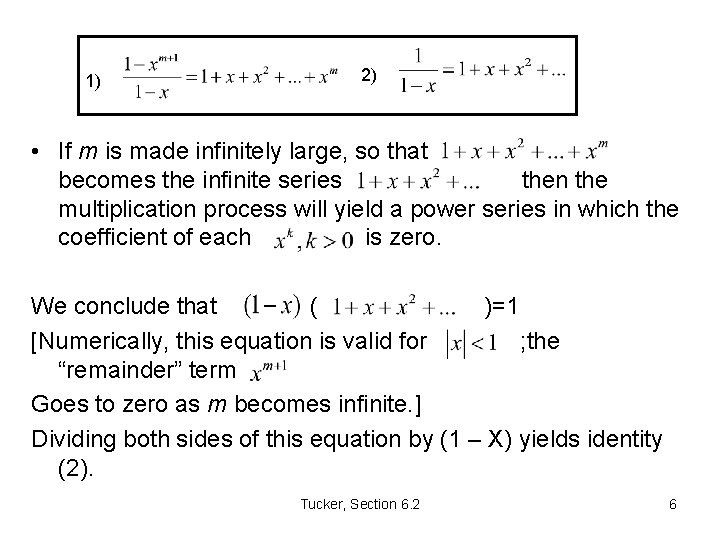
1) 2) • If m is made infinitely large, so that becomes the infinite series then the multiplication process will yield a power series in which the coefficient of each is zero. We conclude that ( )=1 [Numerically, this equation is valid for ; the “remainder” term Goes to zero as m becomes infinite. ] Dividing both sides of this equation by (1 – X) yields identity (2). Tucker, Section 6. 2 6
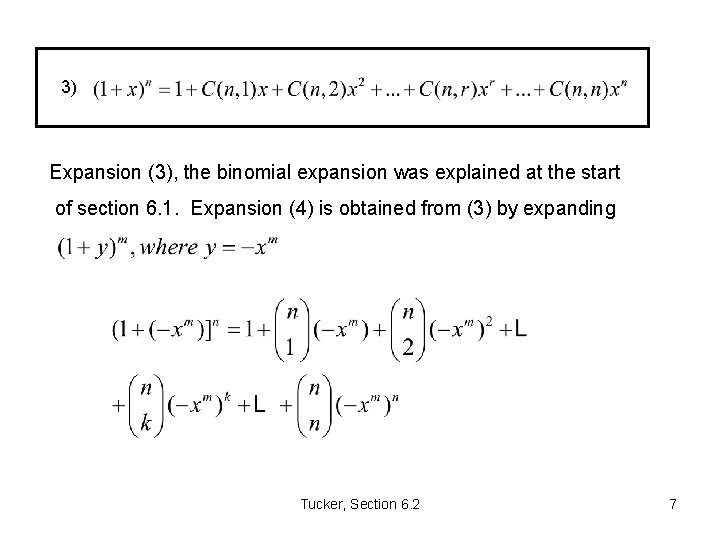
3) Expansion (3), the binomial expansion was explained at the start of section 6. 1. Expansion (4) is obtained from (3) by expanding Tucker, Section 6. 2 7
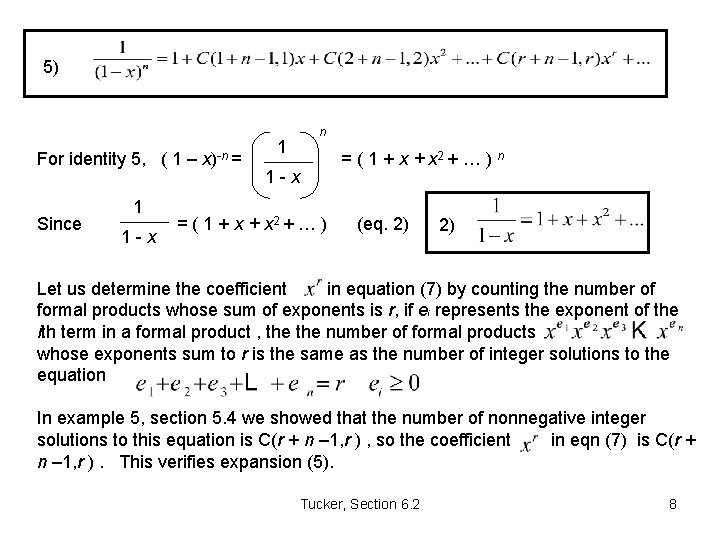
5) For identity 5, ( 1 – x)-n = Since 1 1 -x n 1 1 -x = ( 1 + x + x 2 + … ) n (eq. 2) 2) Let us determine the coefficient in equation (7) by counting the number of formal products whose sum of exponents is r, if ei represents the exponent of the ith term in a formal product , the number of formal products whose exponents sum to r is the same as the number of integer solutions to the equation In example 5, section 5. 4 we showed that the number of nonnegative integer solutions to this equation is C(r + n – 1, r ) , so the coefficient in eqn (7) is C(r + n – 1, r ). This verifies expansion (5). Tucker, Section 6. 2 8
1) 3) 5) 6) If h(x)=f(x)g(x), where f(x) and g(x) , then h(x) With formulas (1) and (6) we can determine the coefficients of a variety of generating functions: first, perform algebraic manipulations to reduce a given generating function to one of the forms or a product of two such expansions, then use expansions (3) and (5) and the product rule (6) to obtain any desired coefficient. Tucker, Section 6. 2 9
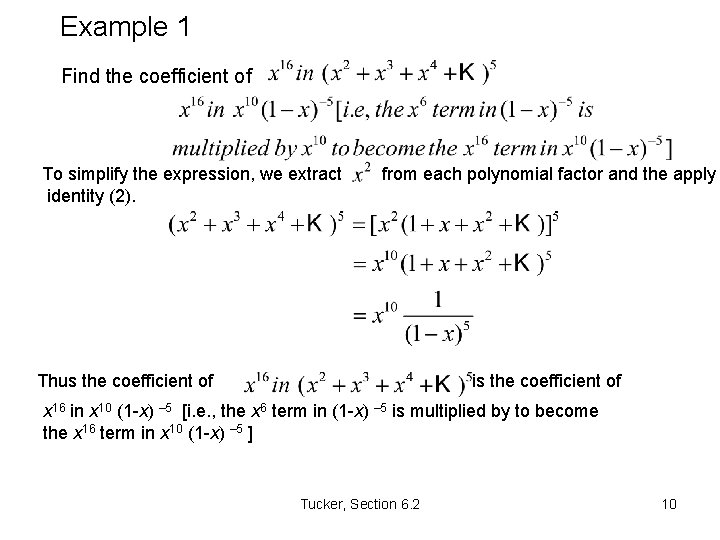
Example 1 Find the coefficient of To simplify the expression, we extract identity (2). from each polynomial factor and the apply Thus the coefficient of is the coefficient of x 16 in x 10 (1 -x) – 5 [i. e. , the x 6 term in (1 -x) – 5 is multiplied by to become the x 16 term in x 10 (1 -x) – 5 ] Tucker, Section 6. 2 10
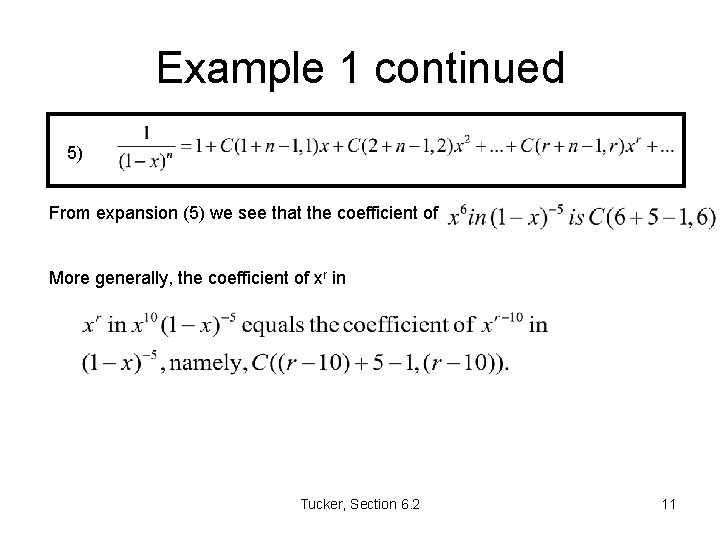
Example 1 continued 5) From expansion (5) we see that the coefficient of More generally, the coefficient of xr in Tucker, Section 6. 2 11
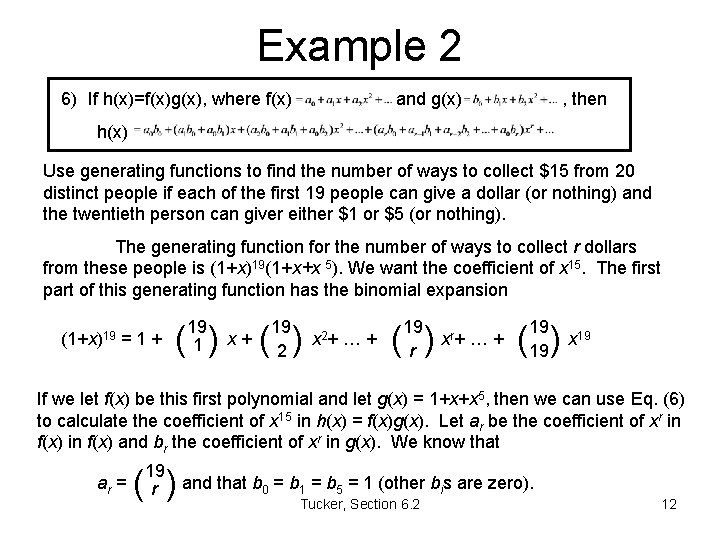
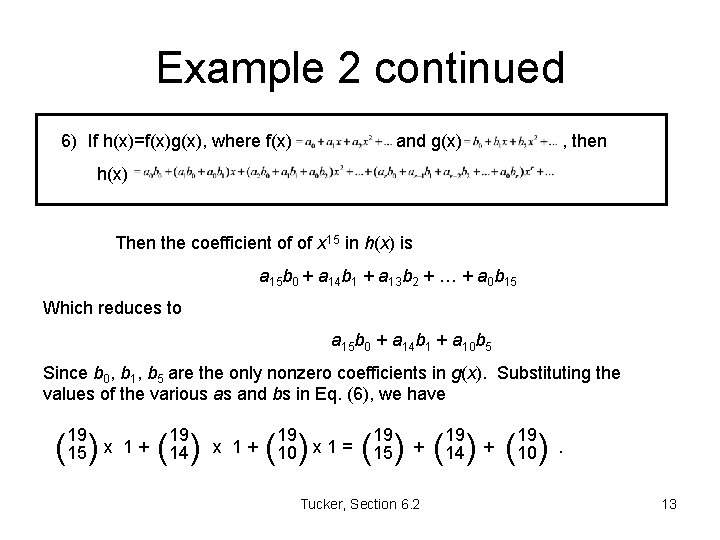
Example 2 6) If h(x)=f(x)g(x), where f(x) and g(x) , then h(x) Use generating functions to find the number of ways to collect $15 from 20 distinct people if each of the first 19 people can give a dollar (or nothing) and the twentieth person can giver either $1 or $5 (or nothing). The generating function for the number of ways to collect r dollars from these people is (1+x)19(1+x+x 5). We want the coefficient of x 15. The first part of this generating function has the binomial expansion (1+x)19 = 1 + 19 1 ( ) x+ 19 2 ( ) x 2+ … + 19 r x+…+ r ( ) 19 19 ( )x 19 If we let f(x) be this first polynomial and let g(x) = 1+x+x 5, then we can use Eq. (6) to calculate the coefficient of x 15 in h(x) = f(x)g(x). Let ar be the coefficient of xr in f(x) and br the coefficient of xr in g(x). We know that ar = 19 r and that b 0 = b 1 = b 5 = 1 (other bis are zero). ( ) Tucker, Section 6. 2 12
Example 2 continued 6) If h(x)=f(x)g(x), where f(x) and g(x) , then h(x) Then the coefficient of of x 15 in h(x) is a 15 b 0 + a 14 b 1 + a 13 b 2 + … + a 0 b 15 Which reduces to a 15 b 0 + a 14 b 1 + a 10 b 5 Since b 0, b 1, b 5 are the only nonzero coefficients in g(x). Substituting the values of the various as and bs in Eq. (6), we have 19 15 x 1 + ( ) 19 14 ( ) x 1+ 19 10 x 1 = ( ) 19 15 19 14 + 19 10 ( ) ( ). + Tucker, Section 6. 2 13
Class Problem How many ways are there to select 25 toys from seven types of toys with between two and six of each type? 2) 1) 3) 4) 5) 6) If h(x)=f(x)g(x), where f(x) and g(x) , then h(x) Tucker, Section 6. 2 14
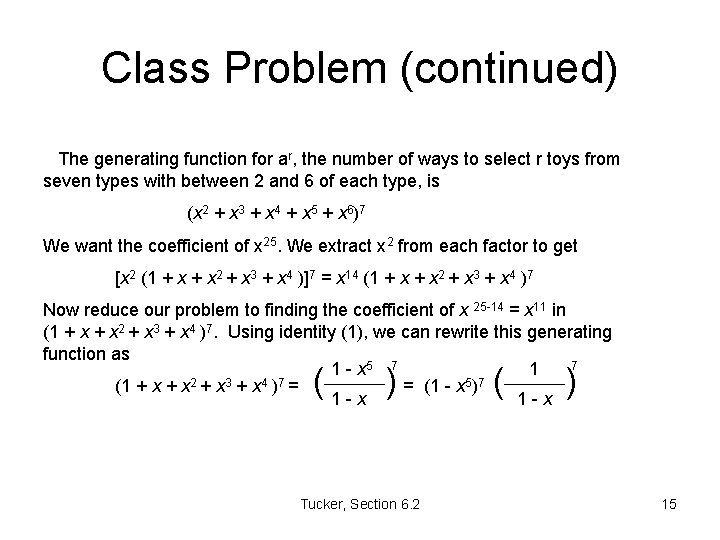
Class Problem (continued) The generating function for ar, the number of ways to select r toys from seven types with between 2 and 6 of each type, is (x 2 + x 3 + x 4 + x 5 + x 6)7 We want the coefficient of x 25. We extract x 2 from each factor to get [x 2 (1 + x 2 + x 3 + x 4 )]7 = x 14 (1 + x 2 + x 3 + x 4 )7 Now reduce our problem to finding the coefficient of x 25 -14 = x 11 in (1 + x 2 + x 3 + x 4 )7. Using identity (1), we can rewrite this generating function as 7 1 - x 5 7 1 (1 + x 2 + x 3 + x 4 )7 = = (1 - x 5)7 1 -x ( ) Tucker, Section 6. 2 ( ) 15
Class Problem (continued) 1) Let f(x) = (1 - x 5)7 and g(x) = (1 - x 5)-7. By expansions (4) and (5), respectively, we have 7 5 7 10 7 15 f(x) = (1 - x 5)7 = 1 x + x x +… 1 2 3 ( ) g(x) = ( ) 1 ( ) ( 1 - x ) = 1 + (1 + 17 – 1)x +(2 + 27 – 1) x ( 2 +… ) + r + 7 – 1 xr + … r Tucker, Section 6. 2 16
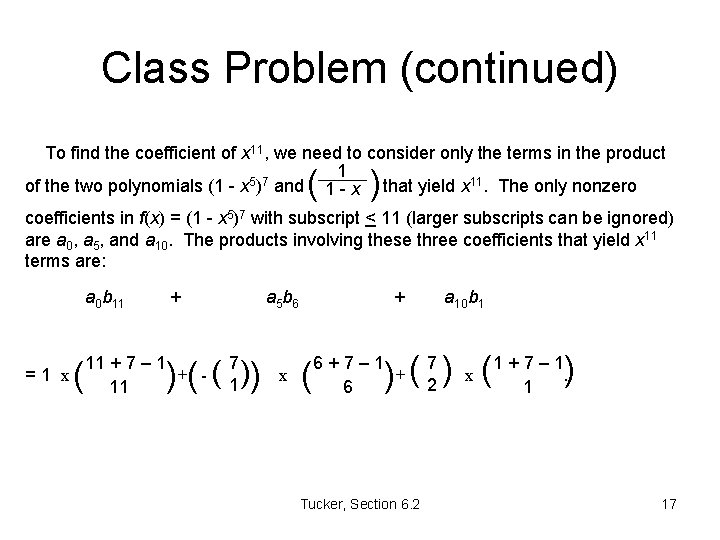
Class Problem (continued) To find the coefficient of x 11, we need to consider only the terms in the product 1 of the two polynomials (1 - x 5)7 and 1 - x that yield x 11. The only nonzero ( ) coefficients in f(x) = (1 - x 5)7 with subscript < 11 (larger subscripts can be ignored) are a 0, a 5, and a 10. The products involving these three coefficients that yield x 11 terms are: a 0 b 11 =1 x ( + 11 + 7 – 1 + 11 7 ( ) ( 1)) a 5 b 6 x + ( a 10 b 1 7 1+7– 1 ( ). x ) 2 1 6+7– 1 + 6 Tucker, Section 6. 2 17