
Section 6 1 Solving Quadratic Equations by Graphing
Section 6 -1 Solving Quadratic Equations by Graphing Objective: To write functions in quadratic form. To graph quadratic functions. To solve quadratic equations by graphing.
Vocabulary • • Quadratic Function Quadratic Term Linear Term Constant Term Parabola Axis of Symmetry Vertex Zeros
Quadratic Functions • A quadratic function is a function described by an equation that can be written in the form of f(x) = ax 2 + bx + c. • ax 2 is called the quadratic term. • bx is called the linear term. • c is called the constant term.

Example 1 • Write each function in quadratic form. Identify the quadratic term, the linear term, and the constant term. a. f(x) = 2 x 2 + 7 - 9 x b. f(x) = (x + 4)2 - 20
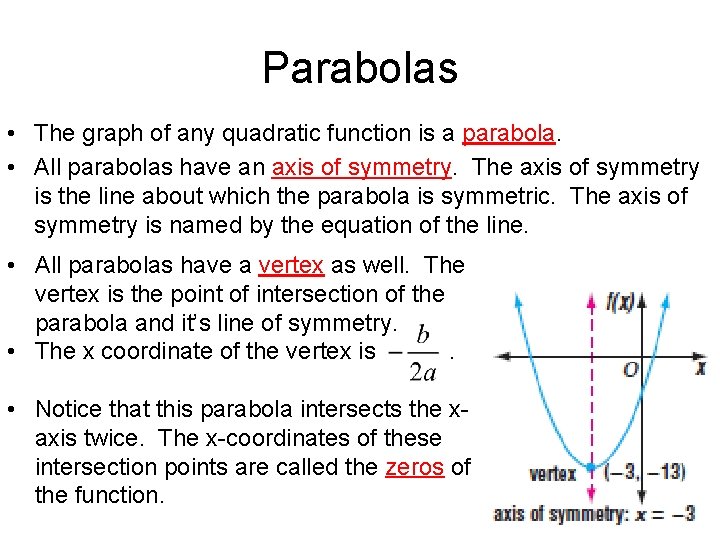
Parabolas • The graph of any quadratic function is a parabola. • All parabolas have an axis of symmetry. The axis of symmetry is the line about which the parabola is symmetric. The axis of symmetry is named by the equation of the line. • All parabolas have a vertex as well. The vertex is the point of intersection of the parabola and it’s line of symmetry. • The x coordinate of the vertex is. • Notice that this parabola intersects the xaxis twice. The x-coordinates of these intersection points are called the zeros of the function.
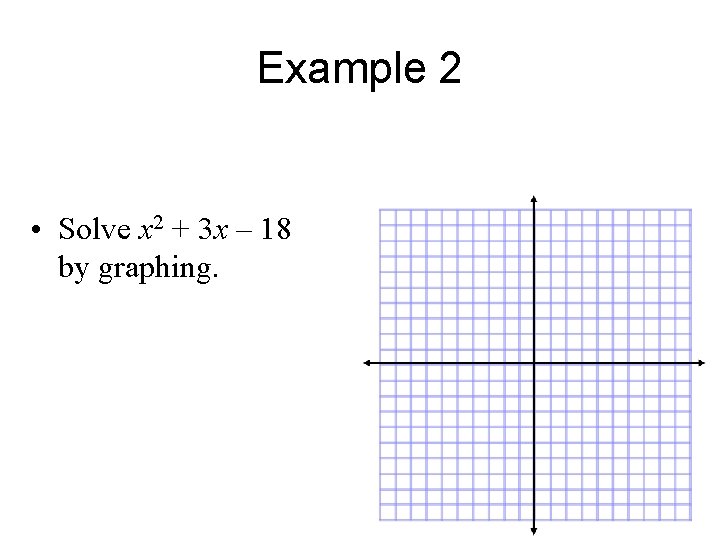
Example 2 • Solve x 2 + 3 x – 18 by graphing.
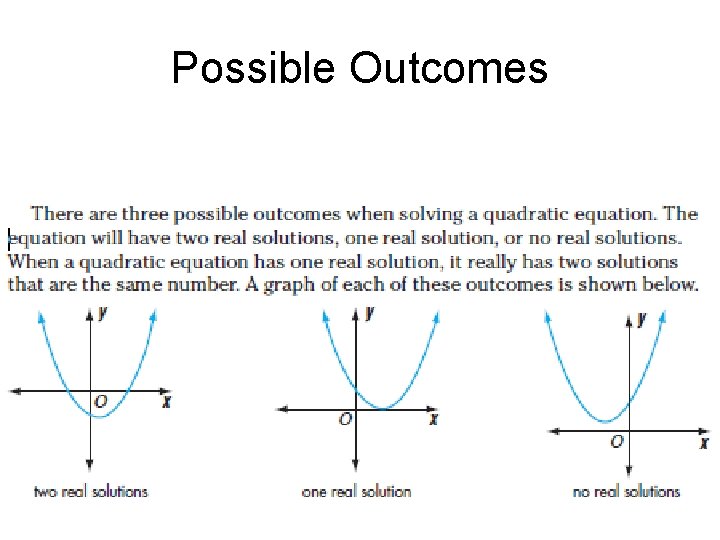
Possible Outcomes
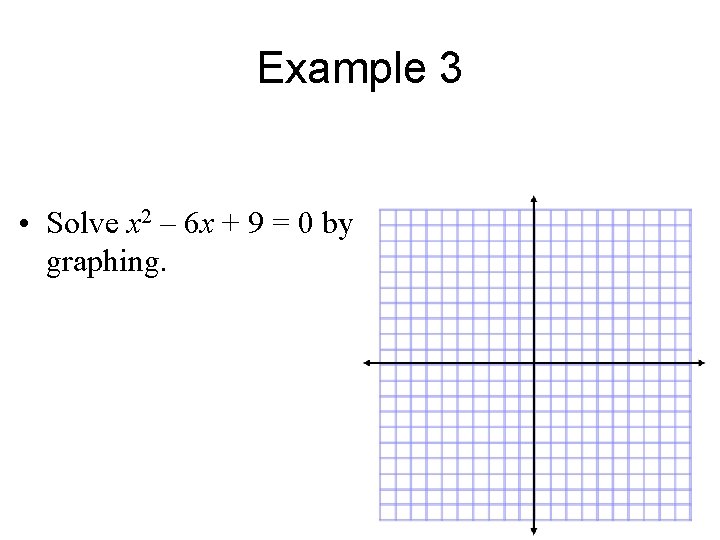
Example 3 • Solve x 2 – 6 x + 9 = 0 by graphing.
Assignment 6 -1 pg 339 #19 -39 odd
- Slides: 9