
Section 6 1 CauchyEuler Equation THE CAUCHYEULER EQUATION
- Slides: 9
Section 6. 1 Cauchy-Euler Equation
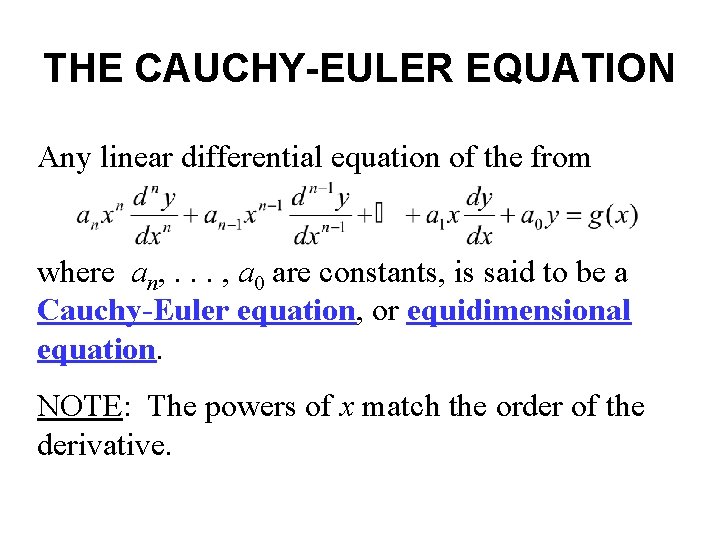
THE CAUCHY-EULER EQUATION Any linear differential equation of the from where an, . . . , a 0 are constants, is said to be a Cauchy-Euler equation, or equidimensional equation. NOTE: The powers of x match the order of the derivative.
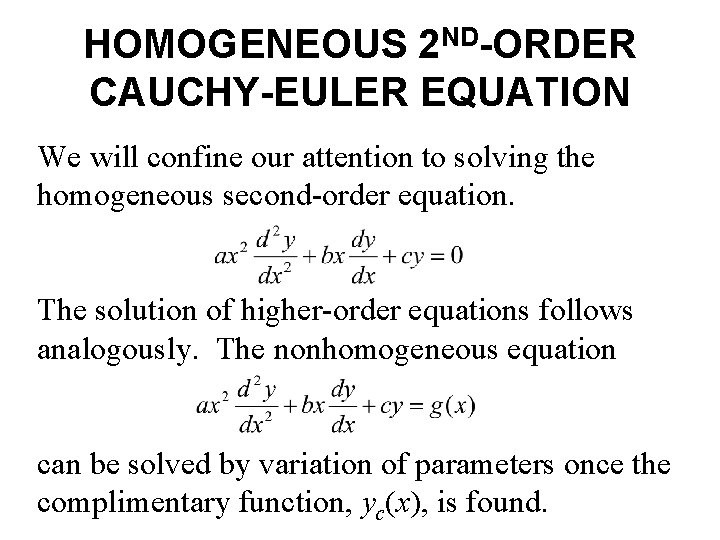
HOMOGENEOUS 2 ND-ORDER CAUCHY-EULER EQUATION We will confine our attention to solving the homogeneous second-order equation. The solution of higher-order equations follows analogously. The nonhomogeneous equation can be solved by variation of parameters once the complimentary function, yc(x), is found.
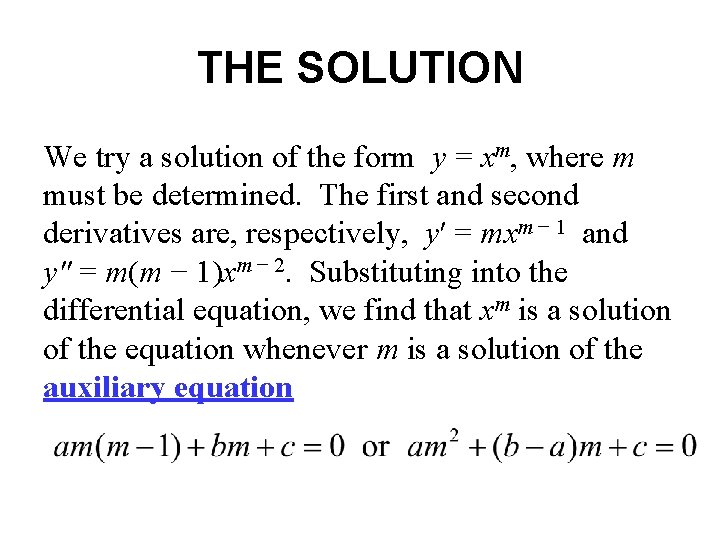
THE SOLUTION We try a solution of the form y = xm, where m must be determined. The first and second derivatives are, respectively, y′ = mxm − 1 and y″ = m(m − 1)xm − 2. Substituting into the differential equation, we find that xm is a solution of the equation whenever m is a solution of the auxiliary equation
THREE CASES There are three cases to consider, depending on the roots of the auxiliary equation. Case I: Distinct Real Roots Case II: Repeated Real Roots Case III: Conjugate Complex Roots
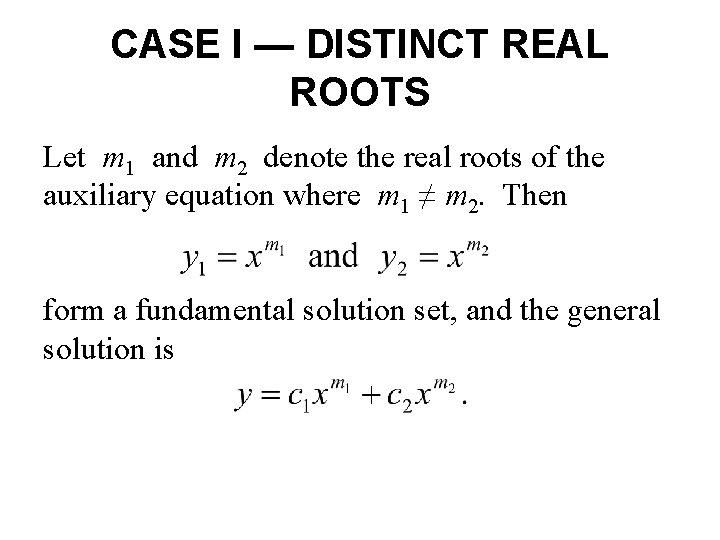
CASE I — DISTINCT REAL ROOTS Let m 1 and m 2 denote the real roots of the auxiliary equation where m 1 ≠ m 2. Then form a fundamental solution set, and the general solution is
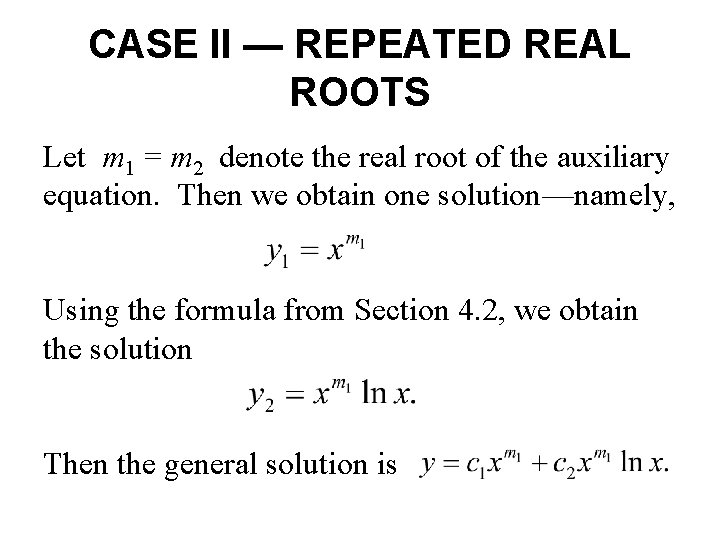
CASE II — REPEATED REAL ROOTS Let m 1 = m 2 denote the real root of the auxiliary equation. Then we obtain one solution—namely, Using the formula from Section 4. 2, we obtain the solution Then the general solution is
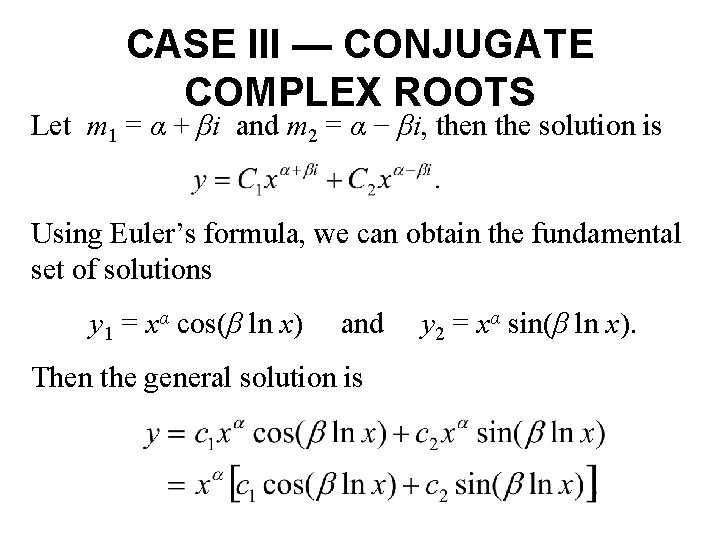
CASE III — CONJUGATE COMPLEX ROOTS Let m 1 = α + βi and m 2 = α − βi, then the solution is Using Euler’s formula, we can obtain the fundamental set of solutions y 1 = xα cos(β ln x) and Then the general solution is y 2 = xα sin(β ln x).
ALTERNATE METHOD OF SOLUTION Any Cauchy-Euler equation can be reduced to an equation with constant coefficients by means of the substitution x = et.