
Section 5 Trauma Chapter 18 Mechanisms and Patterns

- Slides: 26
Section 5: Trauma
Chapter 18 Mechanisms and Patterns of Injury
Chapter 18: Mechanisms and Patterns of Injury Objectives (1 of 2) • Describe what is meant by “mechanism of injury” (MOI). • Discuss the importance of kinetic energy in producing injuries. • Describe the types of trauma and give examples of injuries produced by each type. 3
Chapter 18: Mechanisms and Patterns of Injury Objectives (2 of 2) • List some significant mechanisms of injury. • Relate how the characteristics of the human body tissues and organs and the laws of physics apply to trauma injuries. • Describe the process of using the mechanism of injury to predict injuries. 4
Chapter 18: Mechanisms and Patterns of Injury Mechanism of Injury • A concept that uses the characteristics of the human body and the laws of physics to understand, predict, and anticipate injury and injury patterns 5
Chapter 18: Mechanisms and Patterns of Injury Tissue Characteristics • Determine ease of injury • Influence manner and frequency of injury – Skin - lacerations – Bones - fractures • Skeleton provides protection for organs. • Injuries are associated with motion. • Extremities are more likely to be injured, due to frequent motion. 6
Chapter 18: Mechanisms and Patterns of Injury Mechanism Terms (1 of 3) • Force – Any action that changes the rest or motion of a body • Body – Any mass of matter distinct from other masses • Energy – The capacity for doing work 7
Chapter 18: Mechanisms and Patterns of Injury Mechanism Terms (2 of 3) • Work – Force acting over distance • Kinetic energy – Energy of moving object • Potential energy – Product of weight, gravity, and height 8
Chapter 18: Mechanisms and Patterns of Injury Mechanism Terms (3 of 3) • Trauma – End effect of force applied to the human body • Injury – Actual type and extent of damage to the body 9
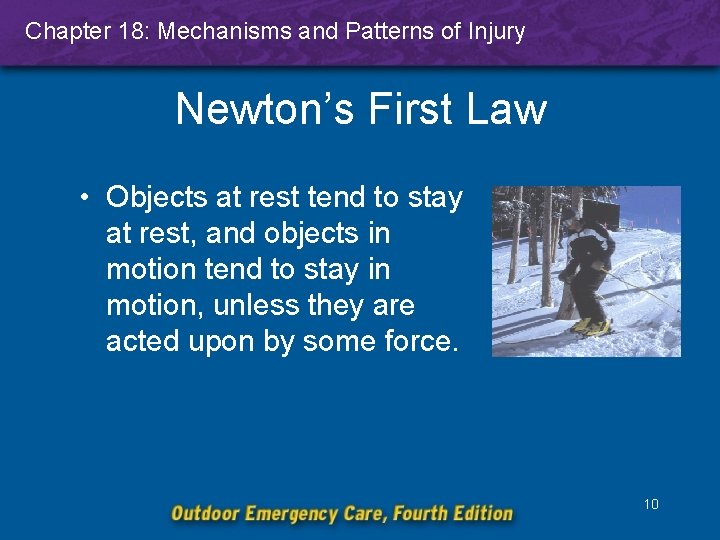
Chapter 18: Mechanisms and Patterns of Injury Newton’s First Law • Objects at rest tend to stay at rest, and objects in motion tend to stay in motion, unless they are acted upon by some force. 10
Chapter 18: Mechanisms and Patterns of Injury Law of Conservation of Energy (1 of 2) • Energy can neither be created nor destroyed, but may be changed from one form to another. • When an object strikes the body, the energy of motion is dispersed and dissipated by body tissue; this can cause injury. • Velocity or speed is a critical factor when considering kinetic energy. 11
Chapter 18: Mechanisms and Patterns of Injury Law of Conservation of Energy (2 of 2) • Kinetic energy from falling is important to consider. • A body will accelerate to the terminal velocity when falling (approx 200’/sec). • Kinetic energy has both strength and direction to cause the body to accelerate or decelerate. 12
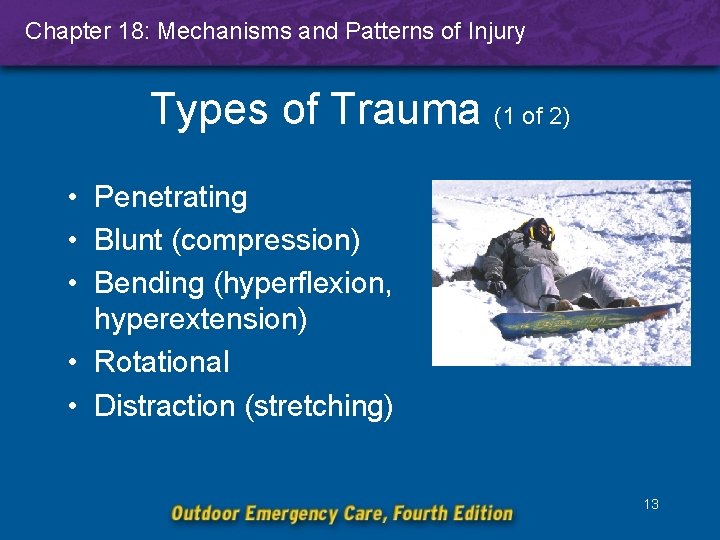
Chapter 18: Mechanisms and Patterns of Injury Types of Trauma (1 of 2) • Penetrating • Blunt (compression) • Bending (hyperflexion, hyperextension) • Rotational • Distraction (stretching) 13
Chapter 18: Mechanisms and Patterns of Injury Types of Trauma (2 of 2) • Trauma can be a combination of types. • Determined by magnitude and direction of forces • Techniques and equipment can modify, control, and dissipate forces, ie, helmets rolling with the fall. 14
Chapter 18: Mechanisms and Patterns of Injury Types of Injuries (1 of 4) • Puncture wounds are caused by objects that focus force and penetrate skin. • Contusions and hematomas are caused by blunt force: – Do not break skin – Injure skin and tissue underneath – Can injure both organs and bones 15
Chapter 18: Mechanisms and Patterns of Injury Types of Injuries (2 of 4) • Fractures, dislocations, and sprains occur when joints are bent or rotated beyond normal range. • Crushing injuries can occur when blunt forces act on the body, either: – Gradual – Momentary 16
Chapter 18: Mechanisms and Patterns of Injury Types of Injuries (3 of 4) • Dislocations, lacerations, and fractures occur when forces distract or stretch tissue. • Internal bleeding/organ contusions can occur with rapid acceleration/deceleration. – Tissue is subjected to blunt force from contact with other body structures. 17
Chapter 18: Mechanisms and Patterns of Injury Types of Injuries (4 of 4) • Amount of damage is proportional to amount of energy involved. • Injuries may reflect multiple types of trauma (ie, bending and distraction). • Be aware of fulcrum points that may focus and multiply forces. 18
Chapter 18: Mechanisms and Patterns of Injury • Concept that uses MOI to anticipate injuries that are not readily apparent • Injuries tend to occur in patterns with predictable types: – Vehicle collisions – Falls – Outdoor sports – White water sports 19
Chapter 18: Mechanisms and Patterns of Injury MOI Factors (1 of 2) • Energy: speed, direction, and focus • Surface: smooth/rough, hard/soft • Body: which parts, body position • Trauma: blunt, penetrating, bending… 20
Chapter 18: Mechanisms and Patterns of Injury MOI Factors (2 of 2) • External/internal injuries • Signs and symptoms of specific injuries not apparent: shock, fractures… • Spinal injuries 21
Chapter 18: Mechanisms and Patterns of Injury Scene Size-Up (1 of 2) • MOI is an essential part of assessment. • Use your experience to understand discover all injuries. • Recognize that internal injuries can be difficult to detect. 22
Chapter 18: Mechanisms and Patterns of Injury Scene Size-Up (2 of 2) • Treat for internal injuries before they become obvious. • Determine the magnitude of forces, areas of the body involved, and external protection to identify the significance of MOI. 23
Chapter 18: Mechanisms and Patterns of Injury Significant MOIs (1 of 3) • Fall: 2. 5 to 3 times body height, less if in motion before fall • Moderate to high speed vehicle collision: – Fatality has occurred – Patient was unrestrained – Ejected from vehicle – Vehicle rolled over – Major intrusion into vehicle (motorcycle, snowmobile) – Patient was not wearing a helmet 24
Chapter 18: Mechanisms and Patterns of Injury Significant MOIs (2 of 3) • Pedestrian struck by a vehicle moving faster than 25 mph. • Collision with another skier or rider • Collision with a fixed object while skiing or riding • Gunshot wound to head, neck, chest abdomen, or pelvis • Patient unresponsive due to head injury 25
Chapter 18: Mechanisms and Patterns of Injury Significant MOIs (3 of 3) • Shock or respiratory distress with no explanation • Avalanche burial • Explosion • Struck by a falling object • High voltage or high amperage electrical shock 26