
Section 5 Thin Film Deposition part 1 sputtering
- Slides: 22
Section 5: Thin Film Deposition part 1 : sputtering and evaporation Jaeger Chapter 6 EE 143 – Ali Javey
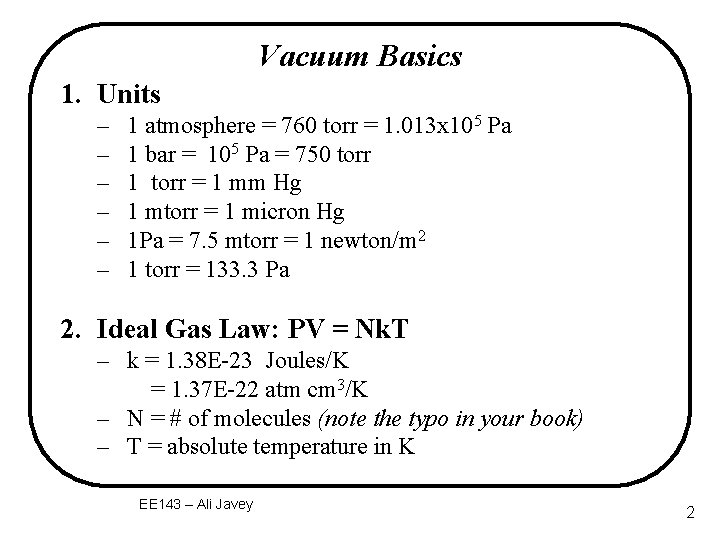
Vacuum Basics 1. Units – – – 1 atmosphere = 760 torr = 1. 013 x 105 Pa 1 bar = 105 Pa = 750 torr 1 torr = 1 mm Hg 1 mtorr = 1 micron Hg 1 Pa = 7. 5 mtorr = 1 newton/m 2 1 torr = 133. 3 Pa 2. Ideal Gas Law: PV = Nk. T – k = 1. 38 E-23 Joules/K = 1. 37 E-22 atm cm 3/K – N = # of molecules (note the typo in your book) – T = absolute temperature in K EE 143 – Ali Javey 2
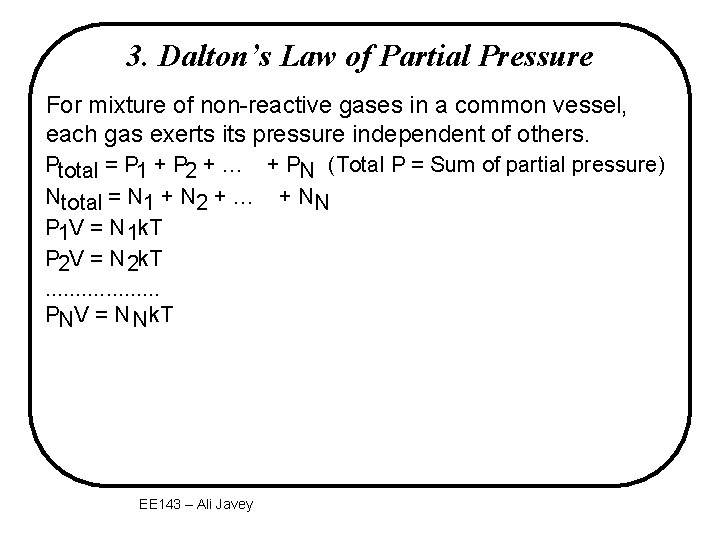
3. Dalton’s Law of Partial Pressure For mixture of non-reactive gases in a common vessel, each gas exerts its pressure independent of others. Ptotal = P 1 + P 2 + … + PN (Total P = Sum of partial pressure) N total = N 1 + N 2 + … + NN P 1 V = N 1 k. T P 2 V = N 2 k. T. . . . . PN V = N N k. T EE 143 – Ali Javey
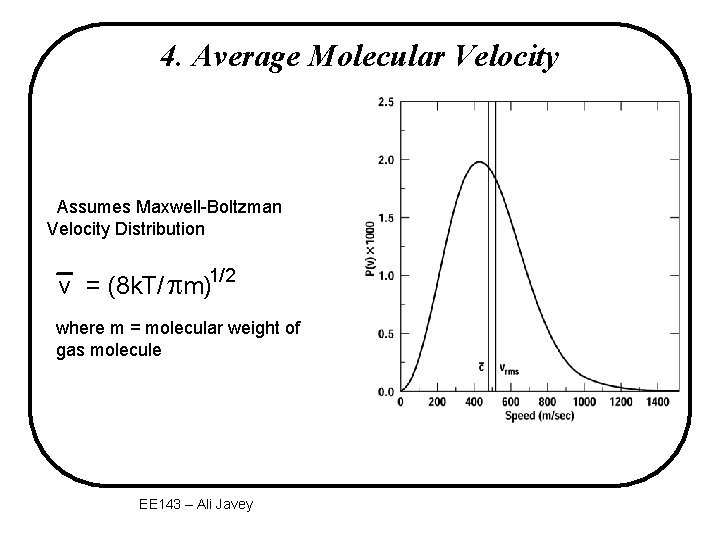
4. Average Molecular Velocity Assumes Maxwell-Boltzman Velocity Distribution v = (8 k. T/ pm)1/2 where m = molecular weight of gas molecule EE 143 – Ali Javey
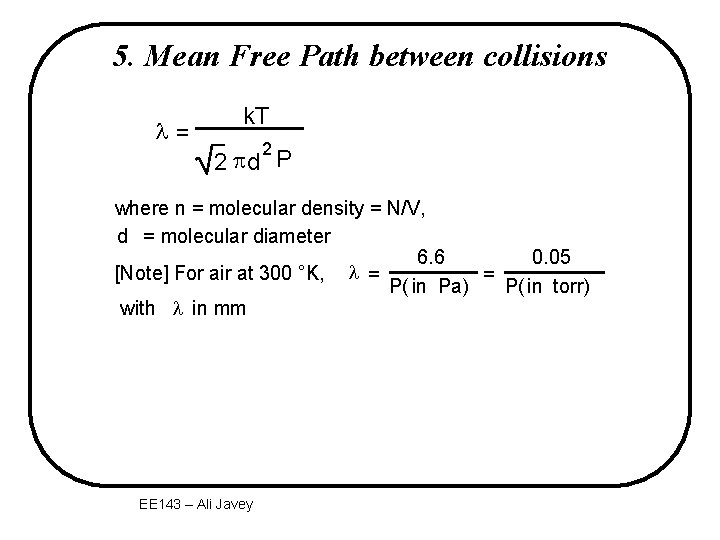
5. Mean Free Path between collisions l= k. T 2 2 pd P where n = molecular density = N/V, d = molecular diameter 6. 6 0. 05 [Note] For air at 300 °K, l = = P( in Pa) P( in torr) with l in mm EE 143 – Ali Javey
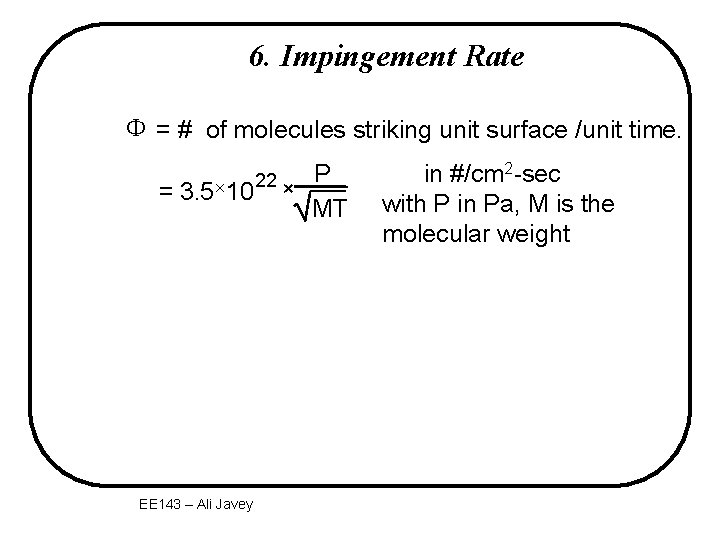
6. Impingement Rate F = # of molecules striking unit surface /unit time. = 3. 5 ´ 10 EE 143 – Ali Javey 22 P × MT in #/cm 2 -sec with P in Pa, M is the molecular weight
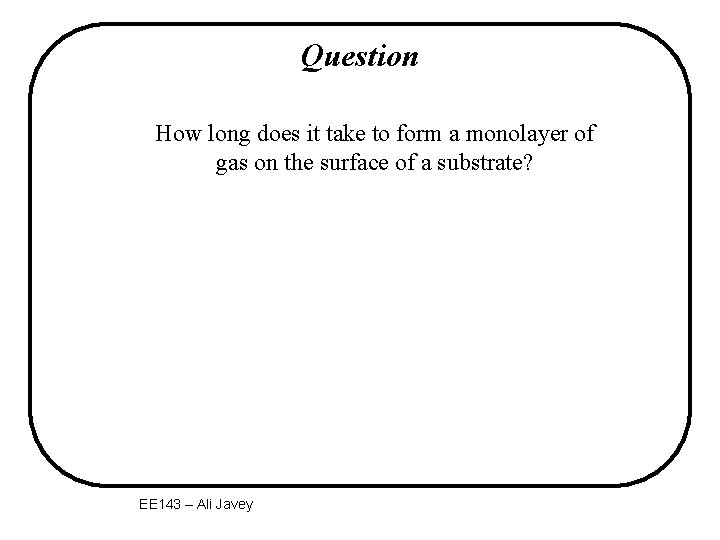
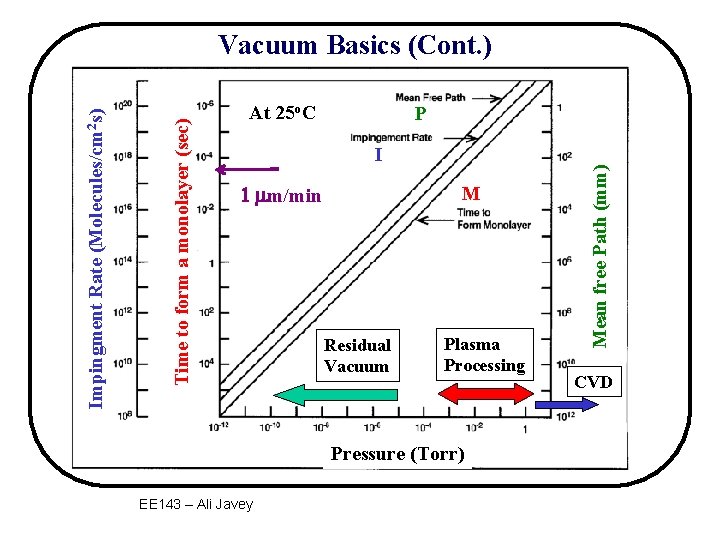
Question How long does it take to form a monolayer of gas on the surface of a substrate? EE 143 – Ali Javey
At 25 o. C P I 1 mm/min M Residual Vacuum Plasma Processing Pressure (Torr) EE 143 – Ali Javey Mean free Path (mm) Time to form a monolayer (sec) Impingment Rate (Molecules/cm 2 s) Vacuum Basics (Cont. ) CVD
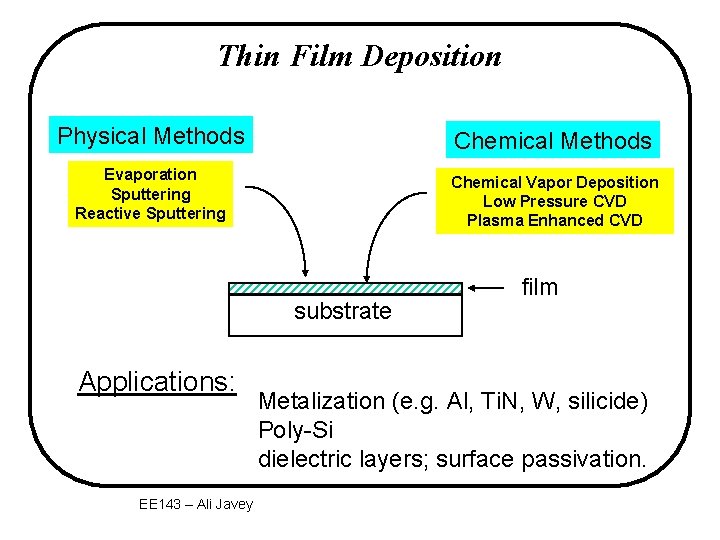
Thin Film Deposition Physical Methods Chemical Methods Evaporation Sputtering Reactive Sputtering Chemical Vapor Deposition Low Pressure CVD Plasma Enhanced CVD substrate Applications: EE 143 – Ali Javey film Metalization (e. g. Al, Ti. N, W, silicide) Poly-Si dielectric layers; surface passivation.
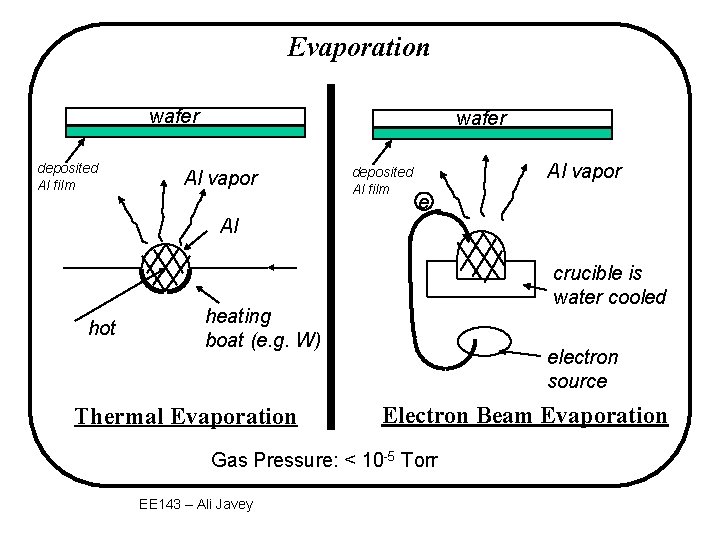
Evaporation wafer deposited Al film wafer Al vapor deposited Al film Al vapor e Al hot crucible is water cooled heating boat (e. g. W) Thermal Evaporation electron source Electron Beam Evaporation Gas Pressure: < 10 -5 Torr EE 143 – Ali Javey
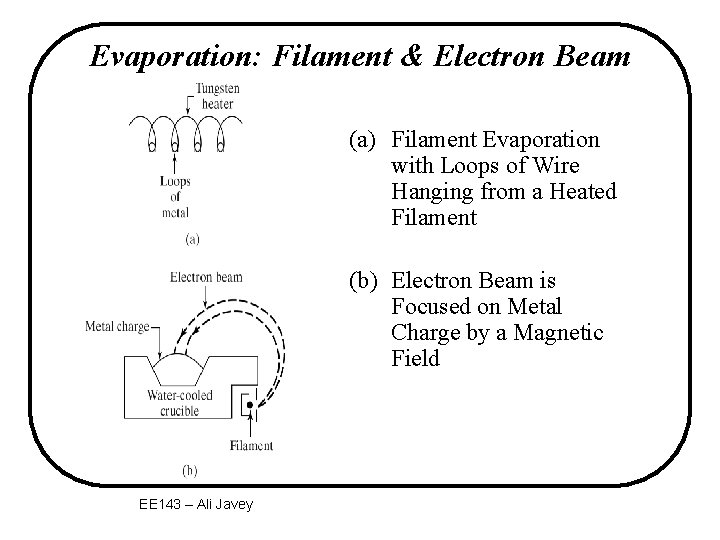
Evaporation: Filament & Electron Beam (a) Filament Evaporation with Loops of Wire Hanging from a Heated Filament (b) Electron Beam is Focused on Metal Charge by a Magnetic Field EE 143 – Ali Javey
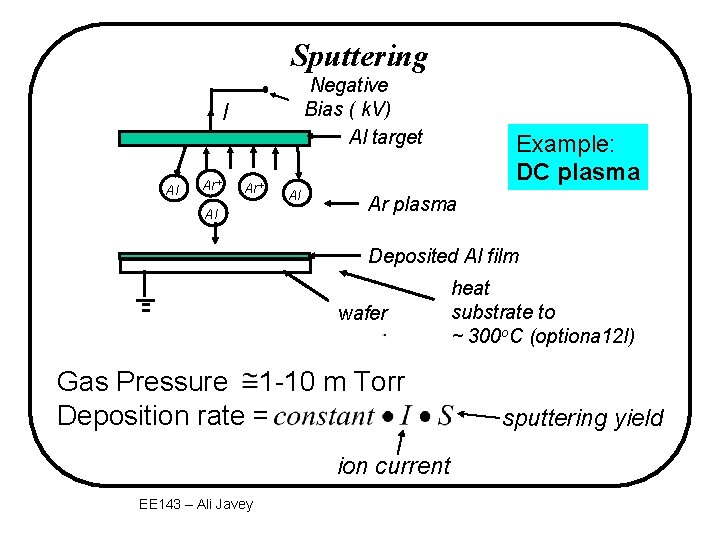
Sputtering Negative Bias ( k. V) Al target I Al Ar+ Al Al Example: DC plasma Ar plasma Deposited Al film wafer Gas Pressure 1 -10 m Torr Deposition rate = ion current EE 143 – Ali Javey heat substrate to ~ 300 o. C (optiona 12 l) sputtering yield
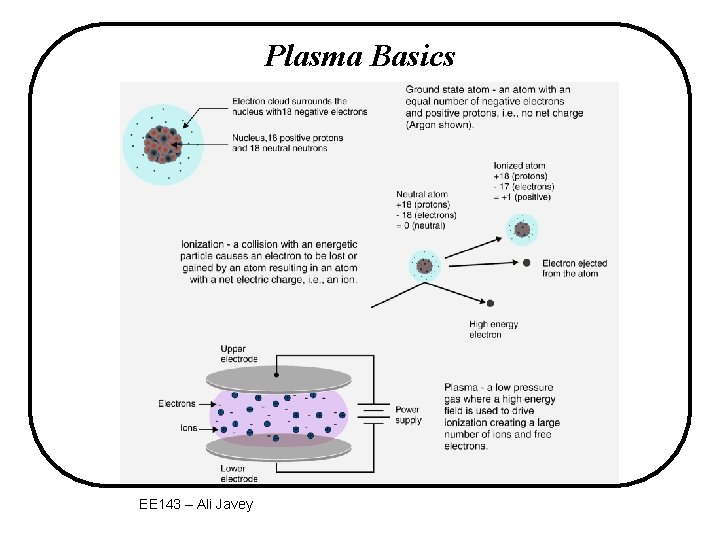
Plasma Basics EE 143 – Ali Javey
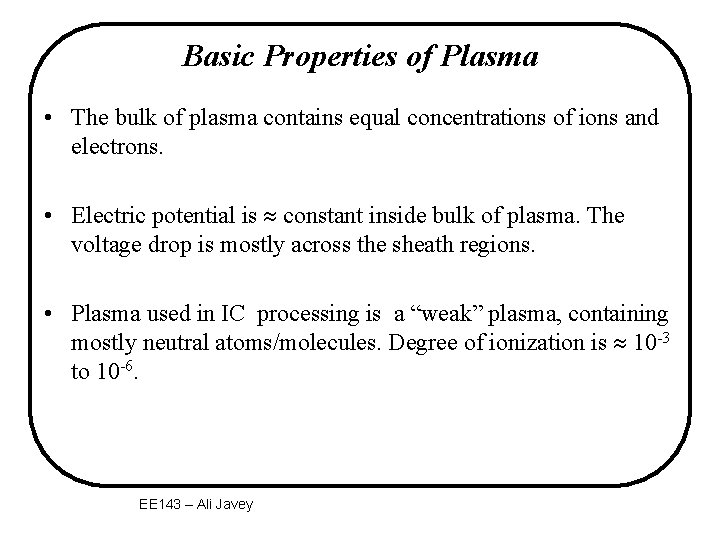
Basic Properties of Plasma • The bulk of plasma contains equal concentrations of ions and electrons. • Electric potential is constant inside bulk of plasma. The voltage drop is mostly across the sheath regions. • Plasma used in IC processing is a “weak” plasma, containing mostly neutral atoms/molecules. Degree of ionization is 10 -3 to 10 -6. EE 143 – Ali Javey
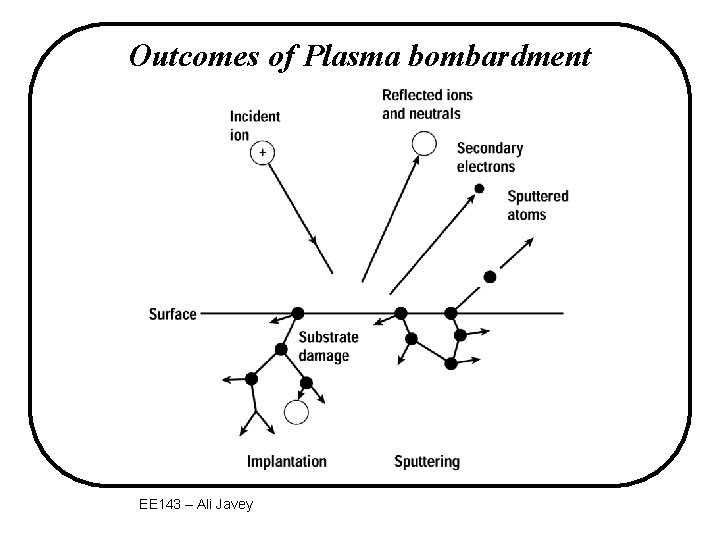
Outcomes of Plasma bombardment EE 143 – Ali Javey
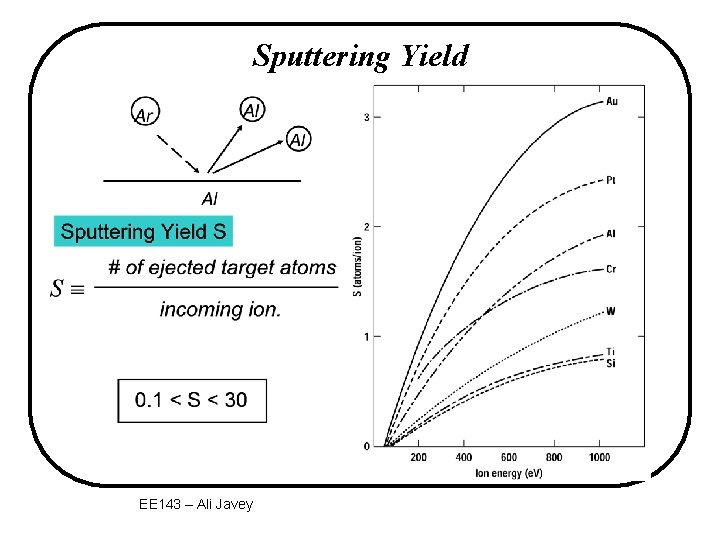
Sputtering Yield EE 143 – Ali Javey
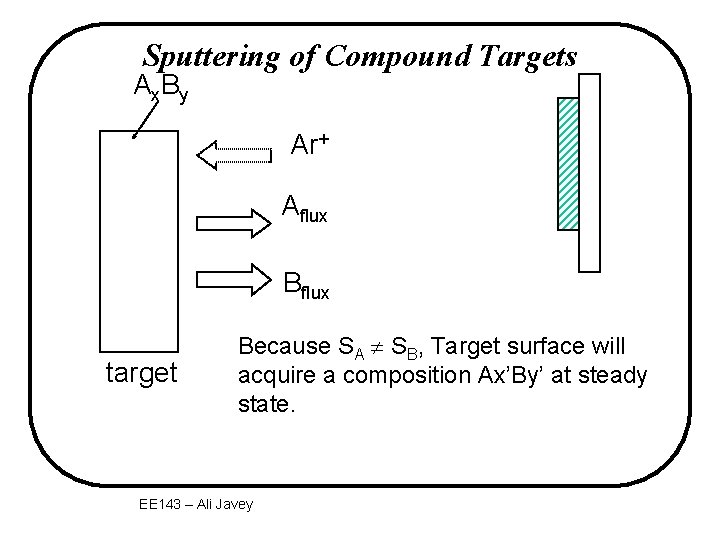
Sputtering of Compound Targets Ax. By Ar+ Aflux Bflux target Because SA SB, Target surface will acquire a composition Ax’By’ at steady state. EE 143 – Ali Javey
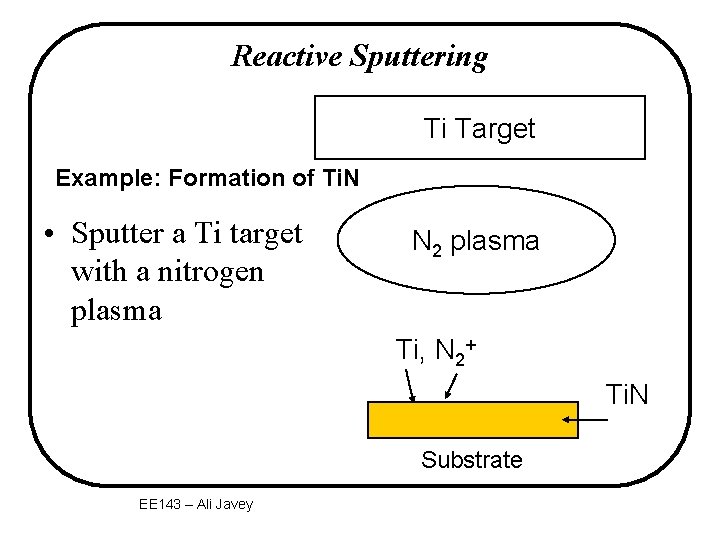
Reactive Sputtering Ti Target Example: Formation of Ti. N • Sputter a Ti target with a nitrogen plasma N 2 plasma Ti, N 2+ Ti. N Substrate EE 143 – Ali Javey
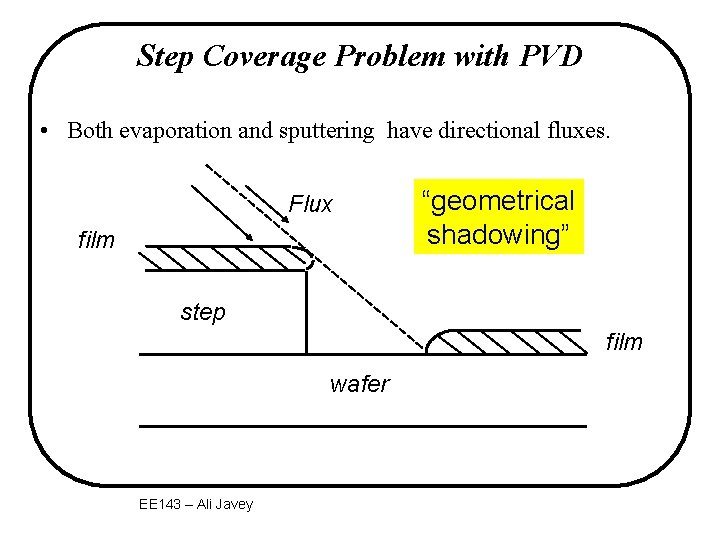
Step Coverage Problem with PVD • Both evaporation and sputtering have directional fluxes. Flux film “geometrical shadowing” step film wafer EE 143 – Ali Javey
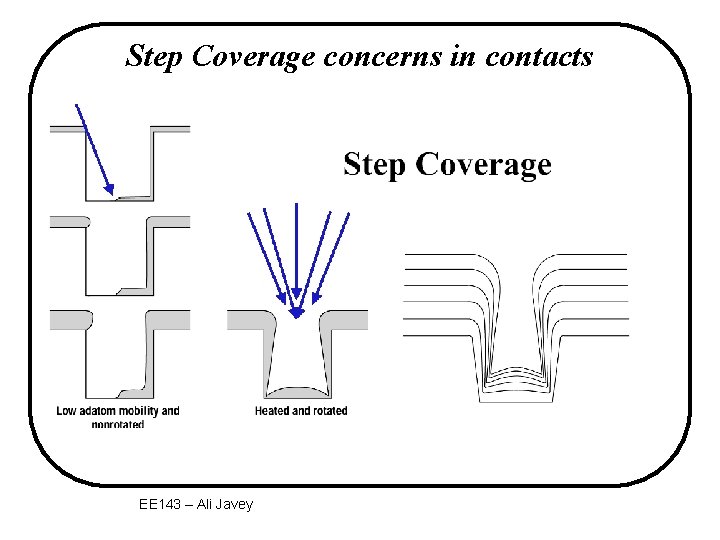
Step Coverage concerns in contacts EE 143 – Ali Javey
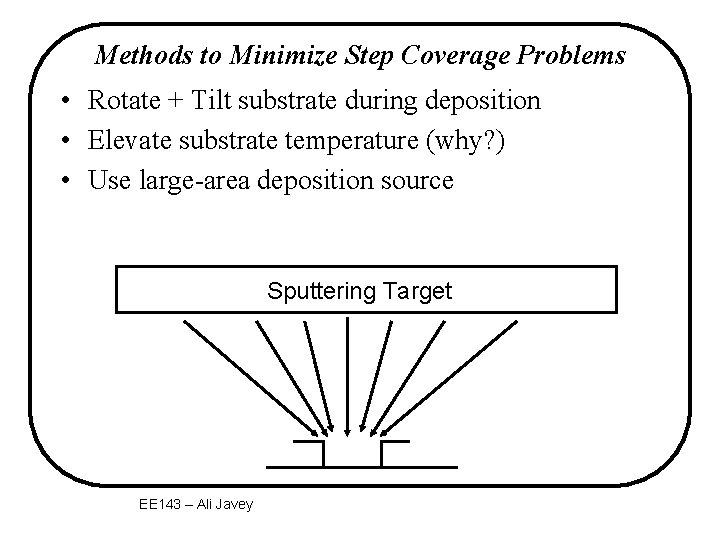
Methods to Minimize Step Coverage Problems • Rotate + Tilt substrate during deposition • Elevate substrate temperature (why? ) • Use large-area deposition source Sputtering Target EE 143 – Ali Javey
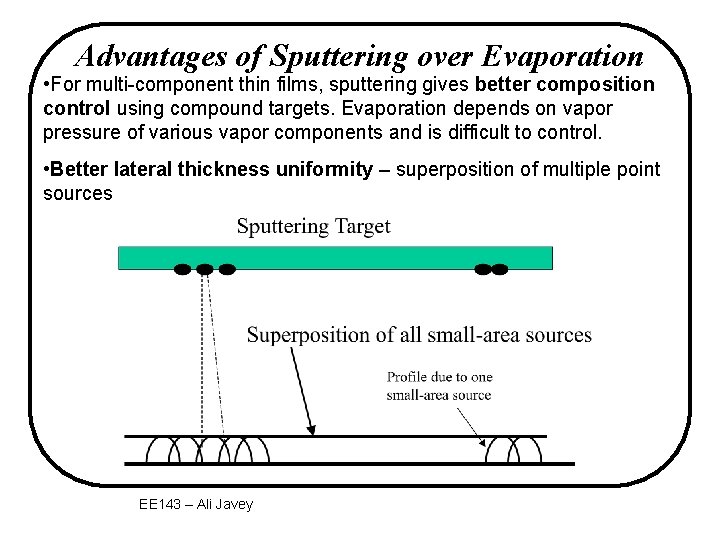
Advantages of Sputtering over Evaporation • For multi-component thin films, sputtering gives better composition control using compound targets. Evaporation depends on vapor pressure of various vapor components and is difficult to control. • Better lateral thickness uniformity – superposition of multiple point sources EE 143 – Ali Javey