
Section 5 4 The Irrational Numbers 1 2
Section 5. 4 The Irrational Numbers 1. 2. 3. 4. Objectives Define the irrational numbers. Simplify square roots. Perform operations with square roots. Rationalize the denominator. 12/13/2021 Section 5. 4 1
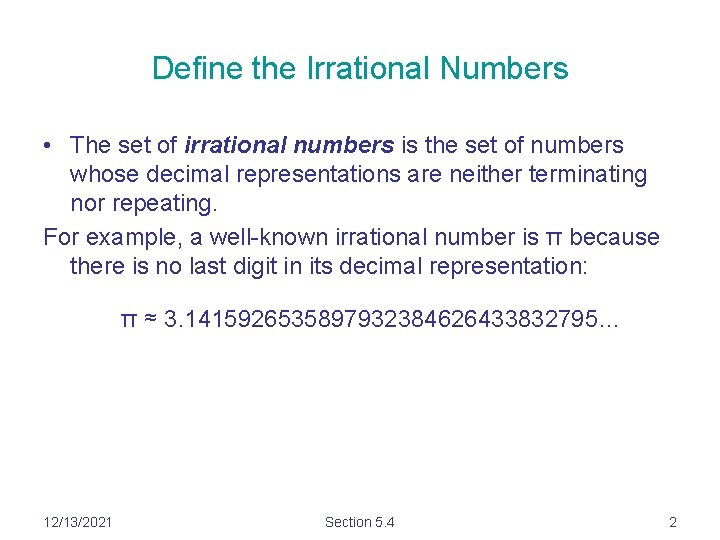
Define the Irrational Numbers • The set of irrational numbers is the set of numbers whose decimal representations are neither terminating nor repeating. For example, a well-known irrational number is π because there is no last digit in its decimal representation: π ≈ 3. 1415926535897932384626433832795… 12/13/2021 Section 5. 4 2
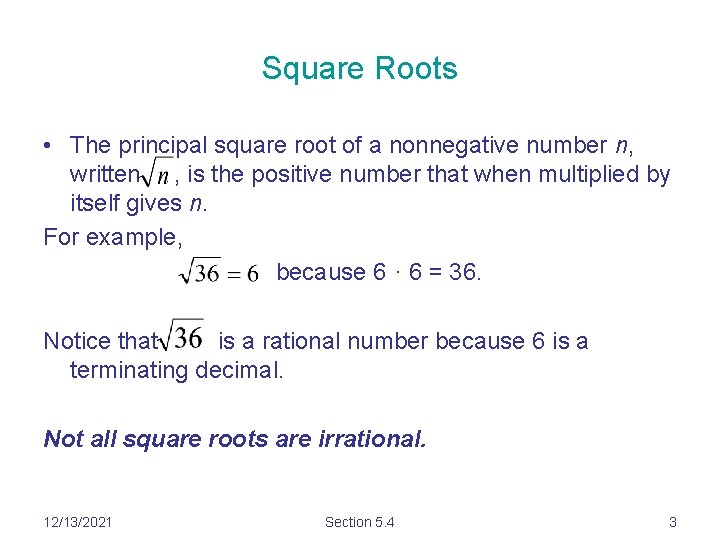
Square Roots • The principal square root of a nonnegative number n, written , is the positive number that when multiplied by itself gives n. For example, because 6 · 6 = 36. Notice that is a rational number because 6 is a terminating decimal. Not all square roots are irrational. 12/13/2021 Section 5. 4 3
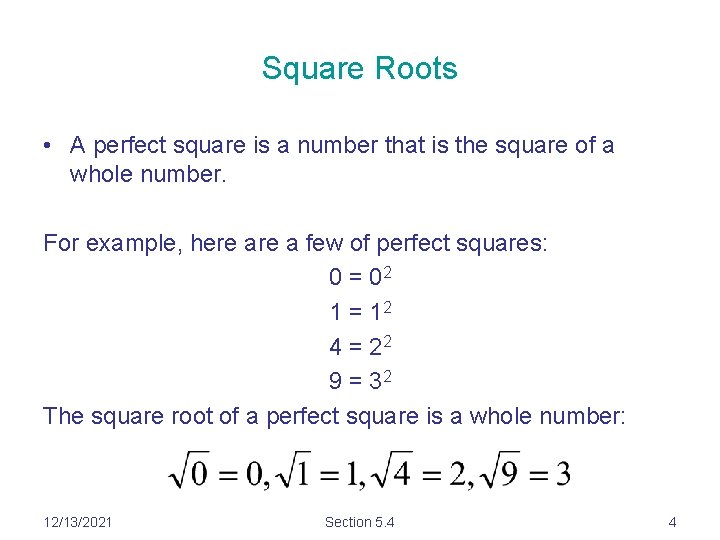
Square Roots • A perfect square is a number that is the square of a whole number. For example, here a few of perfect squares: 0 = 02 1 = 12 4 = 22 9 = 32 The square root of a perfect square is a whole number: 12/13/2021 Section 5. 4 4

Simplifying Square Roots Product Rule If a and b represent nonnegative numbers, then The square root of a product is the product of the square roots. Example: Simplify, if possible: a. √ 75 b. √ 500 c. √ 17 12/13/2021 Section 5. 4 5
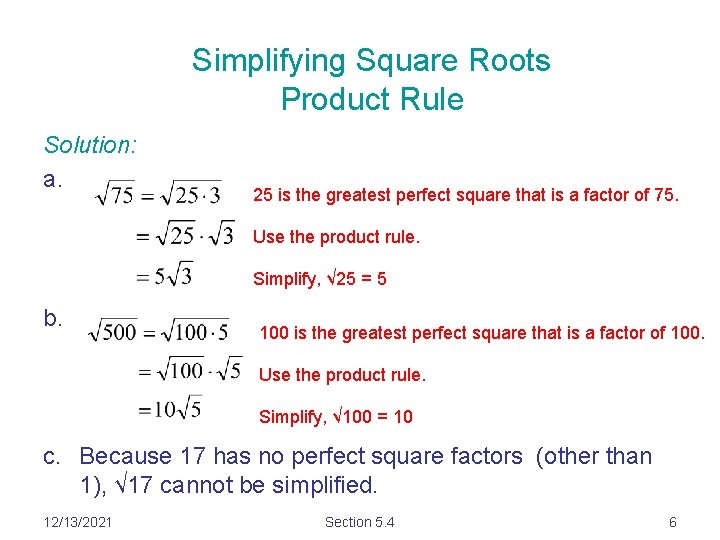
Simplifying Square Roots Product Rule Solution: a. 25 is the greatest perfect square that is a factor of 75. Use the product rule. Simplify, √ 25 = 5 b. 100 is the greatest perfect square that is a factor of 100. Use the product rule. Simplify, √ 100 = 10 c. Because 17 has no perfect square factors (other than 1), √ 17 cannot be simplified. 12/13/2021 Section 5. 4 6
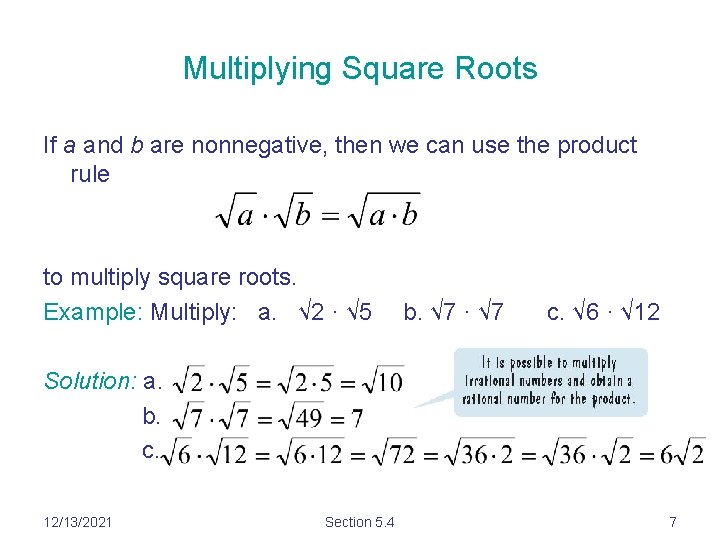
Multiplying Square Roots If a and b are nonnegative, then we can use the product rule to multiply square roots. Example: Multiply: a. √ 2 · √ 5 b. √ 7 · √ 7 c. √ 6 · √ 12 Solution: a. b. c. 12/13/2021 Section 5. 4 7
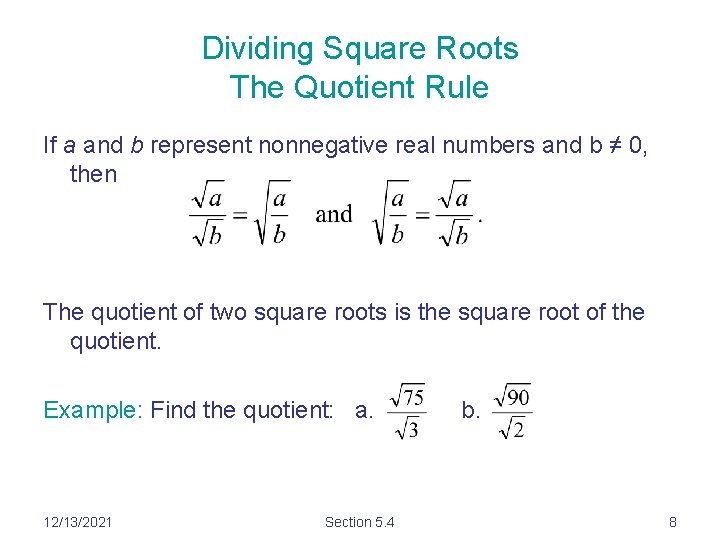
Dividing Square Roots The Quotient Rule If a and b represent nonnegative real numbers and b ≠ 0, then The quotient of two square roots is the square root of the quotient. Example: Find the quotient: a. 12/13/2021 Section 5. 4 b. 8
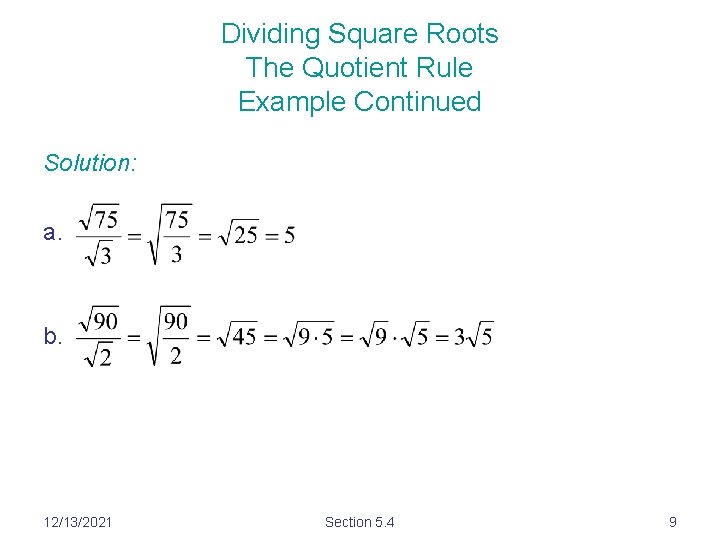
Dividing Square Roots The Quotient Rule Example Continued Solution: a. b. 12/13/2021 Section 5. 4 9
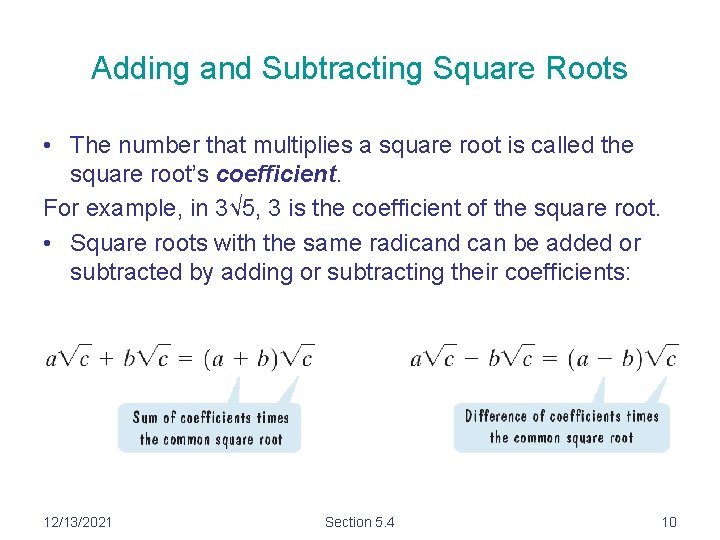
Adding and Subtracting Square Roots • The number that multiplies a square root is called the square root’s coefficient. For example, in 3√ 5, 3 is the coefficient of the square root. • Square roots with the same radicand can be added or subtracted by adding or subtracting their coefficients: 12/13/2021 Section 5. 4 10
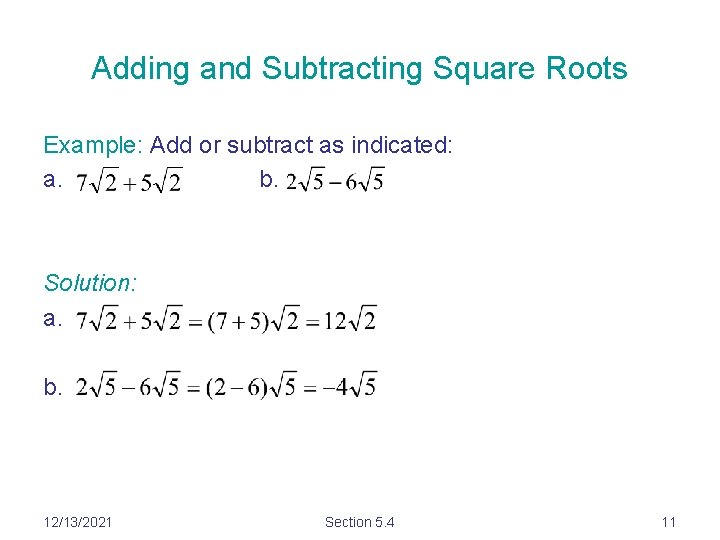
Adding and Subtracting Square Roots Example: Add or subtract as indicated: a. b. Solution: a. b. 12/13/2021 Section 5. 4 11
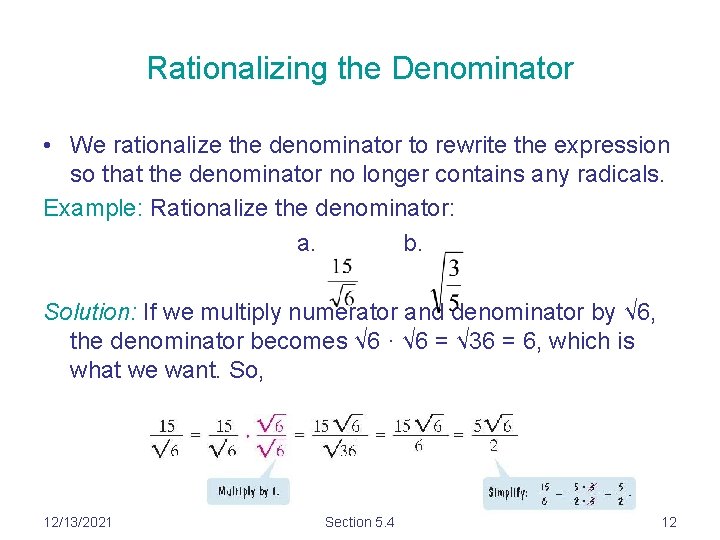
Rationalizing the Denominator • We rationalize the denominator to rewrite the expression so that the denominator no longer contains any radicals. Example: Rationalize the denominator: a. b. Solution: If we multiply numerator and denominator by √ 6, the denominator becomes √ 6 · √ 6 = √ 36 = 6, which is what we want. So, 12/13/2021 Section 5. 4 12
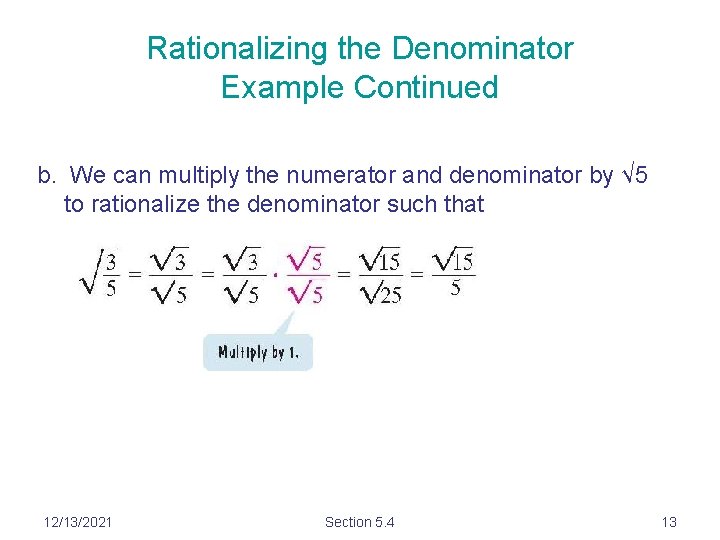
Rationalizing the Denominator Example Continued b. We can multiply the numerator and denominator by √ 5 to rationalize the denominator such that 12/13/2021 Section 5. 4 13
- Slides: 13